
 100% FREE ACCESS
11th Standard Syllabus & Materials
11th Standard
TN 11th Tamil இயற்கை வேளாண்மை,சுற்றுச்சூழல் -செய்யுள் - மனோன்மணீயம் Important Questions And Answers Study Material - QB365 Set A
NEW11th Standard
TN 11th Tamil என்னுயிர் என்பேன் -துணைப்பாடம் - இசைத்தமிழர் இருவர் Important Questions And Answers Study Material - QB365 Set A
NEW11th Standard
TN 11th Tamil மொழி கலை -செய்யுள் - ஒவ்வொரு புல்லையும் Important Questions And Answers Study Material - QB365 Set A
NEW11th Standard
TN 11th Tamil பீடு பெற நில் - இலக்கணம் - பகுபத உறுப்புகள் Important Questions And Answers Study Material - QB365 Set A
NEW11th Standard
TN 11th Tamil பீடு பெற நில் - துணைப்பாடம் - வாடிவாசல் Important Questions And Answers Study Material - QB365 Set A
NEW11th Standard
TN 11th Tamil பீடு பெற நில் - செய்யுள் - குறுந்தொகை Important Questions And Answers Study Material - QB365 Set A

Published on: 30/09/2018
Important 2mark -chapter 9,10
Download Tamil Nadu 11th Standard Chemistry question papers, model tests, one-mark questions, important questions, and public exam papers in PDF format. Free study materials and answer keys for TN State Board students.
Questions + Answers key
Take MCQ Chemistry Test
1.
Considering x- axis as molecular axis, which out of the following will form a sigma bond.
i) 1s and 2py
ii) 2Px and 2Px
iii) 2px and 2pz
iv) 1s and 2pz
2.
What is Polar Covalent bond ? explain with example.
3.
Hydrogen gas is diatomic where as inert gases are monoatomic – explain on the basis of MO theory.
4.
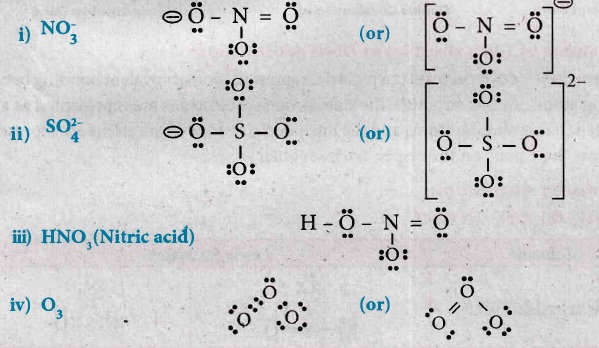
Draw the Lewis structures for the following species.
i) NO3–
ii) SO42–
iii) HNO3
iv) O3
5.
Linear form of carbondioxide molecule has two polar bonds. yet the molecule has Zero dipolement why ?
6.
What do you understand by Linear combination of atomic orbitals in MO theory.
7.
Draw MO diagram of CO and calculate its bond order.
8.
Calculate the molality of a solution containing 7.5 g of glycine (NH2 - CH2 - COOH) dissolved in 500 g of water.
9.
A 0.25 M glucose solution at 370.28 K has approximately the pressure as blood does what is the osmotic pressure of blood ?
10.
You are provided with a solid ‘A’ and three solutions of A dissolved in water - one saturated, one unsaturated, and one super saturated. How would you determine which solution is which ?
11.
What is molal depression constant ? Does it depend on nature of the solute ?
12.
State Raoult law and obtain expression for lowering of vapour pressure when nonvolatile solute is dissolved in solvent.
13.
What is a vapour pressure of liquid ?
What is relative lowering of vapour pressure ?
14.
Explain why the aquatic species are more comfortable in cold water during winter season rather than warm water during the summer.
15.
A litre of sea water weighing about 1.05 kg contains 5 mg of dissolved oxygen (O2). Express the concentration of dissolved oxygen in ppm.
16.
The antiseptic solution of iodopovidone for the use of external application contains 10 % w/v of iodopovidone. Calculate the amount of iodopovidone present in a typical dose of 1.5 mL.
17.
What is a pi bond ?
18.
Define the following
Bond order
19.
Define the term ‘isotonic solution’.
20.
What is osmosis ?
21.
Define molality
22.
At 400 K 1.5 g of an unknown substance is dissolved in solvent and the solution is made to 1.5 L. Its osmotic pressure is found to be 0.3 bar. Calculate the molar mass of the unknown substance.
23.
24.
Which one of the following has highest bond order ?
N2, N2+, or N2-
25.
What type of hybridisations are possible in the following geometeries ?
a) octahedral
b) tetrahedral
c) square planer
26.
Explain resonance with reference to carbonate ion ?
27.
Explain the bond formation in BeCl2 and MgCl2.
28.
Explain Sp2 hybridisation in BF3.
29.
Explain the effect of pressure on the solubility.
30.
State and explain Henry’s law.
1.
i) 1s and 2py - sigma bond is formed
ii) 2Px and 2Px - sigma bond is formed
iii) 2px and 2pz - No sigma bond is formed
iv) 1s and 2pz - sigma bond is formed.
2.
In the case of covalent bond formed between atoms having different electronegativities, the atom with higher electro negativity will have greater tendency to attract the shared pair of electrons more towards itself than the other atom. As a result the cloud of shared electron
pair gets distorted. Let us consider the covalent bond between hydrogen and fluorine in hydrogen fluoride. The electro negativities ofhydrogen and fluorine on Pauling's scale are 2.1 and 4 respectively. It means that fluorine attracts the shared pair of electrons approximately twice as much as the hydrogen which leads to partial negative charge on fluorine and partial positive charge on hydragen. Hence, the H-F bond is said to be polar covalent bond.
3.
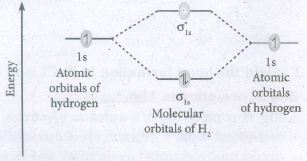
H2 molecule :
Electronic configuration of H atom 1s1
Electronic configuration of H2 molecule \(\sigma^{2}_{1s}\)
Bond order = \({N_b-N_a\over2}={2-0\over2}=1\)
Molecule has no unpaired electrons hence it is diamagnetic
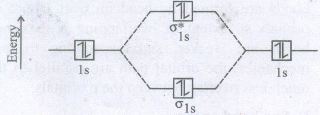
Helium molecule (i.e) He2 :
The electronic econfiguration of He atom is 1 s2
.'. Electronic configuration of He2 molecule is \((\sigma_{1s})^2(\sigma^*_{1s})^2\)
Bond order = \({N_b-N_a\over2}={2-2\over2}\)
= 0
He, cannot exist. Similarly all the inert gases, X2 cannot orist as their bond order = 0.
4.
5.
Molecules having polar bonds will not necessarily have a dipole moment. For example, the linear form of carbon dioxide has zero dipole moment, even though it has two polar bonds. In CO2, tlie dipole moments of two polar bonds (CO) are equal in magnitude but have opposite direction. Hence, the net dipole moment of the CO2 is,
\(\mu=\mu_{1}+\mu_{2}=\mu_{1}+(-\mu_{1})=0.\)
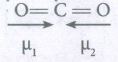
In this case \(\mu=\overrightarrow { { \mu }_{ 1 } } +\overrightarrow { { \mu }_{ 2 } } \quad \)
\(=\overrightarrow { { \mu }_{ 1 } } +\overrightarrow { ({ \mu }_{ 1 }) } =0\)
6.
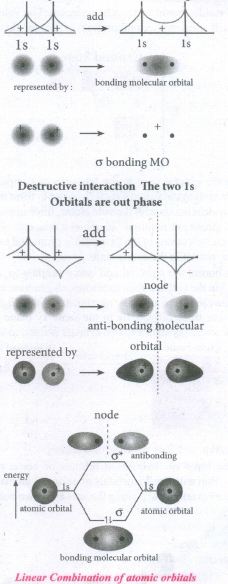
Linear combination of atomic orbitals:
1. The wave functions for the molecular orbitals can be obtained by solving Schrodinger wave equation for the molecule. Since solving the Schrodinger equation is too complex, approximation methods are used to obtain the wave function for molecular orbitals. The most common method is the linear combination of atomic orbitals (LCAO).
2. The atomic orbitals are represented by the wave function \(\Psi \). Let us consider two atomic orbitals represented by the wave function \(\Psi _A\) and \(\Psi _B\) with comparable energy, combines to form two molecular orbitals. One is bonding molecular orbital (\(\Psi \)bonding) and the other is antibonding molecular orbital (\(\Psi \)antibondin ). The wave functions for these" two" molecular orgitals can be obtained by the linear combination of the atomic orbitals \(\Psi _A\) and \(\Psi _B\) as beIow.
\(\Psi _{bonding}=\Psi _A+\Psi _B\\ \Psi _{antibonding}=\Psi _A-\Psi _B\)
3.The formation of bonding molecular orbital can be considered as the result of constructive interference of the atomic orbitals and the formation of antibonding molecular orbital can be the result of the destructive interference of the atomic orbitals. The formation of the two molecular orbitals from two 1s orbitals is shown below.
4.Constructive interaction : The two 1s orbitals are in phase and have the same sign.
7.
Bonding in some heteronuclear di-atomic molecules:
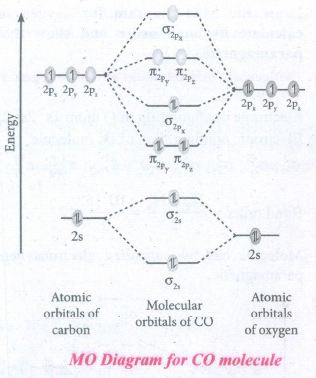
Molecular orbital diagram of Carbon monoxide molecule (CO)
Electronic configuration of C atom 1s22s22p2
Electronic configuration of O atom 1s22s22p4
Electronic conguration of CO molecule
\(\sigma^{2}_{1s},\sigma^{*2}_{1s},\sigma^{2}_{2s},\sigma^{*2}_{2s}\)\(\pi^{2}_{2py},\pi^{2}_{2pz},\sigma^2_{2px}\)
Bond order = \({N_b-N_a\over2}={10-4\over2}=3\)
Molecule has no unpaired electrons hence it is diamagnetic
8.
Molar mass of glycine = 1(N) + 5(H) + 2(C) + 2(O)
= 1(14) + 5(1) + 2(12) + 2(16)
= 14 + 5 + 24 + 32
= 75 g/mol
m = 7.5 g
Number of moles of glycine \(
=\frac{\mathrm{m}}{\mathrm{M}}
\)
\(=\frac{7.5}{75}=0.1 \mathrm{~mol}\)
Mass of solvent H2O = 500 g
= 0.5 kg
molality = \({no.\ of\ moles\ of\ solute\over mass\ of\ solvent\ (in\ Kg)}\)
no. of moles of glycine = \({mass\ of\ glycine\over molar\ mass\ of\ glycine}\)
\(=\frac{0.1}{0.5}=0.2 \mathrm{~m}\)
9.
Given : C = 0.25 M
T = 370.28 K
R = 0.0821 L atm mol-1 K-1
\(\pi\) = ?
\(\pi\) = CRT
= 0.25 x 0.0821 x 370.28
= 7.59 atm.
10.
Add the solute to all the solutions and structures.
a) If the solute dissolves, then that solution is an unsaturated one
b) If the solute settledown at the bottom then that solution is a saturated one
c) If precipitation (crystallisation) occurs then that solution is a super saturated one.
11.
i) Molal depression constant:
Molal freezing point depression constant or Cryoscopic constant is defined as the depression in freezing point for 1 molol solution.
ii) It doesn't depend on the nature of the solute but depends on the nature of the solvent.
Example : Kf for water = 1.86 K kg mol-1
Kf for benzene = 5.12 K kg mol-1
12.
Raoult law states that. "in the case of a solution of volatile liquids, the partial vapour pressure of each component (A & B) of the solution is directly proportional to its mole fraction.
According to Raoult's law,
PA \(\alpha\) XA
pA = K XA
When xA = 1, k = \({ p }_{ A }^{ 0 }\)
Where \({ p }_{ A }^{ 0 }\) is the vapour pressure of pure component 'A' at the same temperature
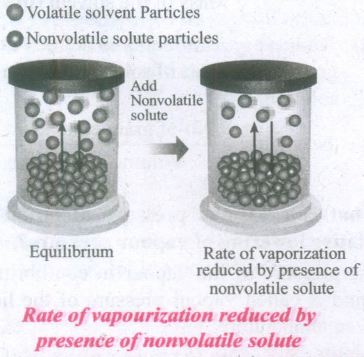
"The relative lowering of vapour pressure of an ideal solution containing the nonvolatile solute is equal to the mole fraction of the solute at a given temperature".
Derivation:
when sodium chloride is added to the water, the vapour pressure of the salt solution is lowered. The vapour Pressure of the solution is determined by the number of molecules of the solvent present in the surface at any time and is proportional to the mole fraction of the solvent.
Psolution \(\infty \) XA
Where XA is the mole fraction of the solvent
Psolution = K XA
When XA = 1, K = P0 solvent
\({ P }_{ solvent }^{ 0 }\) is the partial pressure of pure solvent
Psolution = \({ P }_{ solvent }^{ 0 }\) XA
\(\frac { { P }_{ solution } }{ { P }_{ solvent }^{ 0 } } ={ X }_{ A }\)
\(1-\frac { { P }_{ solution } }{ { P }_{ solvent }^{ 0 } } 1-{ X }_{ A }\)
\(\frac { { P }_{ solvent }^{ 0 }-{ P }_{ solution } }{ { P }_{ solvent }^{ 0 } } ={ x }_{ B }\)
Where XB the mole fraction of the solute
( \(\because\) XA + AB = 1, XB = 1 - XA)
The above expression gives the relative lowering of vapour pressure. Based on this expression, Raoult's law can also be stated as "the relative lowering of vapour pressure of an ideal solution containing, the nonvolatile solute is equal to the mole fraction of the solute at a given temperature".
13.
(i) The pressure of the vapour in equilibrium with its liquid is called vapour pressure of the liquid at the given temperature.
(ii) The ratio of the difference between the vapour pressure of pure solvent and the vapour pressure of a solution to the vapour pressure of pure solvent is called the relative lowering of vapour pressure.
Relative lowering of vapour pressure = \(\frac{\mathbf{P}^{0} \text { solvent }-\mathbf{P}_{\text {soultion }}}{\mathbf{P}_{\text {solvent }}^{0}}\).
14.
The amount of dissolved oxygen in water decreases with rise in water's temperature. Cold water has more dissolved oxygen per unit area than warm water. So they are more comfortable is cold water during winter. During summer the warm water contain less dissolved oxygen.
15.
ppm = \({mass\ of\ dissolved\ solid\over mass\ of\ water}\times 10^6\)
\({5\times 10^{-3}\ g\over 1.05\times 10^{3}\ g}\times 10^6=\) 4.76 ppm.
16.
\(10\%{W\over V}\) means that 10g of solute in 100 ml solution
\(\therefore\) amount of iodopovidone in 1.5 ml = \({10\ g\over 100\ ml}\times 1.5\ ml\)
= 0.15 g.
17.
When two atomic orbitals overlaps sideways, the resultant covalent bond is called a pi (\(\pi\)) bond.
18.
Bond order:
The number of bonds formed between the two bonded atoms in a molecule is called the bond order.
19.
Two solutions having same osmotic pressure at a given temperature are called isotonic solutions.
20.
Osmosis, which is a spontaneous process by which the solvent molecules pass through a semi permeable membrane from a solution of lower concentration to a solution of higher concentration.
21.
Molality : It is the number of moles of the solute present one kg of the solvent
Molality = \(\frac { No.of \ moles\ of \ solute }{ Mass\ of\ the\ solvent\ (in\ kg) } \)
22.
Molar mass = \({mass\ of\ unknown\ solute × RT\over osmotic\ pressure\ ×\ volume\ of\ solution}\)
\(= {1.5\times 8.314\times 10^{-2}\times 400\over 0.3\times 1.5}\)
= 110.85 gram mol-1.
23.
24.
Bond order of N2
Total no of electrons = 14
Electronic configuration = \(\sigma1s^{2}\sigma^{*}1s^2\sigma1s^{2}\sigma^{*}{2s^2}\)
\(\pi^82p_y^2\pi2p^2_z\sigma ^*2p_x^2\)
\(\therefore\)Bond order = \({10-4\over2}=3\)
Bond order of N2
Total number of electrons = 13
Electronic configuration = \(\sigma1s^{2}\sigma^{*}1s^2\sigma1s^{2}\sigma^{*}{2s^2}\)
\(\pi2p_y^2=\pi2p^2_z\sigma 2p_x^1\)
\(\therefore\)Bond order = \({9-4\over2}=2.5\)
Bond order of N2
Total number of electrons = 14
Electronic configuration = \(\sigma1s^{2}\sigma^{*}1s^2\sigma1s^{2}\sigma^{*}{2s^2}\)
\(\pi^82p_y^2=\pi2p^2_z\sigma 2p_x^2\sigma 2p_x^1\)
\(\therefore\)Bond order = \({10-5\over2}=2.5\)
So, N2 has the highest bond order of 3.
25.
a) octahedral - sp3d2
b) tetrahedral - sp3
c) square planer - dsp2
26.
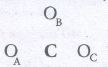
'When we write Lewis structures for a molecule, more than one valid Lewis structures are possible in certain cases. For exampte let us consider the Lewis structure of carbbnate ion [CO3]2- . The skeletal structure of carbonate ion (The oxygen atoms are denoted as OA, OB & Oc
2. Total number of valence electrons = [1 x 4(carbon)] + [3 x 6 (oxygen)] + [2 (charge)] = 24 electrons.
3. Distribution of these valence electrons gives us the following structure.
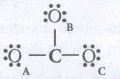
4. Complete the octet for carbon by moving a lone pair from one of the oxygens (OA) and write the charge of the ion (2-) on the upper right side.
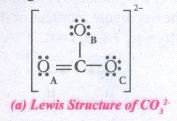
5. In this case, we can draw two additional Lewis structures by moving the lone pairs from the other two oxygens (OB & Oc) thus creating three similar structures as shown below in which the relative position of the atoms are same. They only differ in the position of bonding and lone pair of electrons. Such stnictures are called resonance structures (canonical structures) and this phenomenon is called resonance.
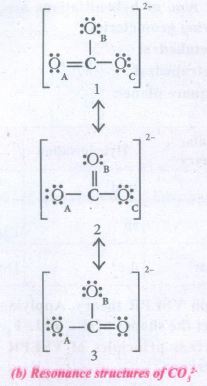
6. It is evident from the experimental results that all carbon-oxygen bonds in carbonate ion are equivalent. The actual structure of the molecules is said to be the resonance hybrid, an average of these three resonance forms. It is important to note that carbonate ion does not change from one structure to another and vice versa. It is not possible to picturise the resonance hybrid by drawing a single Lewis structure. However, the following structure gives a qualitative idea about the correct structure
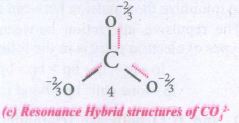
7. It is found that the energy of the resonance hybrid (structure 4) is lower than that of all possible canonical structures (Structure 1, 2 & 3). The difference in energy between structure 1 or 2 or 1 3, (most stable canonical structure) and structure 4 (resonance hybrid) is called resonance energy.
27.
i) BeCI2
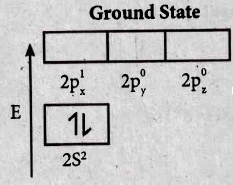
The valence shell electronic configuration of ber-yllium in the ground state is shown in the figure
In BeCI2 both the Be-CI bonds are equivalent and it was observed that the molecule is linear. VB theory explain this observed behaviour by sp hybridisation. one of the paired electrons in the 2s orbital gets excited to 2p orbital and the electronic configuration at'the encited state.
Now, the 2s and 2p orbitals hybridise and produce two equivalent sp hytridised orbitals which have 50 % s-character aird 50 % p-character. These sp hybridised orbitals are oriented in opposite direction.
.jpg)
overlap with orbital of chlorine Each of the sp hybridized orbitals linearly bverlap with pz orbital of the chlorine to form a covalent bont between Be and Cl as shown in the Figure.
.jpg)
ii) MgCl2.
Mg + Cl + Cl = MgCl2
Magnesium atom donates one electron each to, each of the chlorine atoms. In total, Mg atom donates 2 electrons. So Mg becomes Mg2+ cation attaining stable Neon configuration. The two Cl atoms gain are each and forms Cl- anion with stable configuration of Argon.
Mg2+ and 2 Cl- ions combine to form an ionic crystal in which they are held together by electrostatic attractive force.
28.
Sp2 hybridisation:
1. Consider boron trifluoride molecule. The valence shell electronic configuration of boron atom is [He] 2s2 2p1.
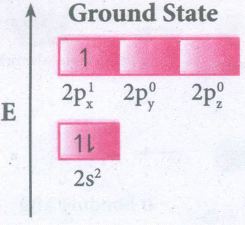
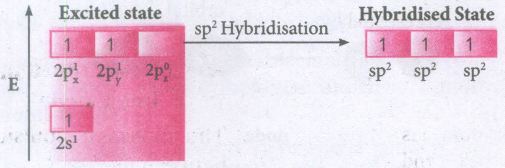
2. In the ground state boron has only one unpaired electron in the valence shell. In order-to form three covalent bonds with fluorine atoms, three unpaired electrons are required. To achieve this, one of the paired electrons in the 2s orbital is promoted to the 2py orbital in the excite state.
3. In boron, the s orbital and two p orbitals (Px and p ) in the valence shell hybridses, to generate three equivalent Sp2 orbitals as shown in the Figure. These three orbitals lie in the same xy plane and the angle between any two orbitals is equal to 120°
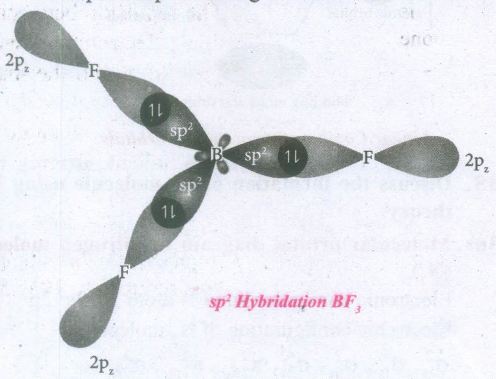
Overlap with 2pz orbitals of Dorine:
The three Sp2 hybridised orbitals of boron now overlap with the 2pz orbitals ofuorine (3 atoms). is overlap takes place along the axis as shown below
29.
Generally the change in pressure does not have any significant effect in the solubility of solids and liquids as they are not compressible. However, the solubility of gases generally increases with increase of pressure.
Consider a saturated solution of a gaseous solute dissolved in a liquid solvent in a closed container. In such a system, the following equilibrium exists.
Gas (in gaseous state) = Gas (in solution)
According to Le-Chatelier principle, the increase in pressure will shift the equilibrium in the direction which will reduce the p.ressure. Therefore, more number of gaseous molecules dissolves in the solvent and the solubility increases.
30.
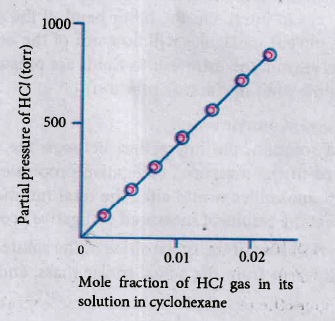
Henry's law states that, "the partial pressure of the gas in vapour phase is directly proportional to the mole fraction(x) of the gaseous solute in the solution at low concentrations".
Henry's law can be expressed as,
\(\rho \)solute \(\alpha\) X solute in solution
Psolute = KHx solute in solution
Explanation: Here, Psolute represents the partial pressure of the gas in vapour state which is commonly called as vapour pressure. x solute in solution represents the mole fraction of solute in the solution. KH is a empirical consiint with the dimensions of pressure. The value of 'KH' depends on the nature of the gaseous solute and solvent. The above equation is a straight-line in the form of y = mx. The plot partial pressure of the gas against its mole fraction in a solution will give a straight line as shown in fig The slope of the. straight line gives the value of KH.
Limitation of Henry's law:
i) Henry's law is applicable at moderate temperature and pressure only.
ii) Only the less soluble gases obeys Henry's law.
iii) The gases reacting with the solvent do not obey Henlry s law For example, ammonia or HCI reacts \Mith water and hence does not obey this law.
\(\mathrm{NH}_3+\mathrm{H}_2 \mathrm{O} \leftrightarrows \mathrm{NH}_4^{+}+\mathrm{OH}^{-}\)
(iv) The gases obeying Henry's law should not associate or dissociate while dissolving in the solvent.

11th Standard Syllabus & Materials
11th Standard
TN 11th Tamil பீடு பெற நில் - செய்யுள் - காவடிச்சிந்து Important Questions And Answers Study Material - QB365 Set A
NEW11th Standard
TN 11th Tamil பீடு பெற நில் - உரைநடை - மலை இடப்பெயர்கள் : ஓர் ஆய்வு Important Questions And Answers Study Material - QB365 Set A
NEW11th Standard
TN 11th Tamil மாமழை போற்றுதும் - துணைப்பாடம் - யானை டாக்டர் Important Questions And Answers Study Material - QB365 Set A
NEW11th Standard
TN 11th Tamil மாமழை போற்றுதும் - செய்யுள் - ஐங்குறுநூறு Important Questions And Answers Study Material - QB365 Set A



Tamilnadu Stateboard 11th Standard Subjects

Maths

Commerce

Economics

Biology

Business Maths and Statistics

Accountancy

Computer Science

Physics
Chemistry
Maths
Biology
Economics
Physics
Chemistry

History
Business Maths and Statistics

Computer Science
Accountancy

Computer Applications
History
Computer Technology
Commerce
Computer Applications
Computer Technology

Tamil

English

French
Tamilnadu Stateboard Standards
