
 100% FREE ACCESS
11th Standard Syllabus & Materials
11th Standard
TN 11th Tamil இயற்கை வேளாண்மை,சுற்றுச்சூழல் -செய்யுள் - மனோன்மணீயம் Important Questions And Answers Study Material - QB365 Set A
NEW11th Standard
TN 11th Tamil என்னுயிர் என்பேன் -துணைப்பாடம் - இசைத்தமிழர் இருவர் Important Questions And Answers Study Material - QB365 Set A
NEW11th Standard
TN 11th Tamil மொழி கலை -செய்யுள் - ஒவ்வொரு புல்லையும் Important Questions And Answers Study Material - QB365 Set A
NEW11th Standard
TN 11th Tamil பீடு பெற நில் - இலக்கணம் - பகுபத உறுப்புகள் Important Questions And Answers Study Material - QB365 Set A
NEW11th Standard
TN 11th Tamil பீடு பெற நில் - துணைப்பாடம் - வாடிவாசல் Important Questions And Answers Study Material - QB365 Set A
NEW11th Standard
TN 11th Tamil பீடு பெற நில் - செய்யுள் - குறுந்தொகை Important Questions And Answers Study Material - QB365 Set A

Published on: 30/09/2018
Important 3mark -chapter 5,6
Download Tamil Nadu 11th Standard Physics question papers, model tests, one-mark questions, important questions, and public exam papers in PDF format. Free study materials and answer keys for TN State Board students.
Questions + Answers key
Take MCQ Physics Test1.
Why is there no lunar eclipse and solar eclipse every month?
2.
Define weight.
3.
Why is the energy of a satellite (or any other planet) negative?
4.
Define gravitational potential.
5.
Is potential energy the property of a single object? Justify.
6.
Will the angular momentum of a planet be conserved? Justify your answer.
7.
State Newton’s Universal law of gravitation.
8.
A rolling wheel has velocity of its center of mass as 5 ms-1. If its radius is 1.5 m and angular velocity is 3 rad s-1 then check whether it is in pure rolling or not.
9.
Find the moment of inertia of a uniform rod about an axis which is perpendicular to the rod and touches anyone end of the rod.
10.
State conservation of angular momentum.
11.
What is radius of gyration?
12.
Define centre of gravity.
13.
Define couple.
14.
What is the difference between gravitational potential and gravitational potential energy?
15.
Define gravitational potential energy.
16.
17.
A child stands at the centre of turn table with his two arms out stretched.
(i) The turn table is set rotating with an angular speed of 40 rpm. How mueh is the angular speed of the child if he folds his hands back and thereby reduces his moment of inertia to 2/3 times the initial value? Assume that the turn table rotates without friction.
(ii) Show that the child's new kinetic energy of rotation is more than the initial kinetic energy of rotation. How do you account for this increase in kinetic energy ?
18.
Calculate the ratio of radius of gyration of a circular ring and a disc of the same radius with respect to the axis passing through their centres and perpendicular to their planes.
19.
Three masses 3 kg, 4 kg and 5 kg are located at the corners of an equilateral triangle of side 1 m. Locate the center of mass of the system.
20.
Give the physical significance of moment of inertia. Explain the need of fly wheel in Engine.
21.
A rope of negligible mass is wound round a hollow cylinder of mass 3 kg and radius 40 cm. What is angular acceleration of the cylinder if the rope is pulled with a force of 30N? What is the linear acceleration of the rope? Assume that there is no slipping.
22.
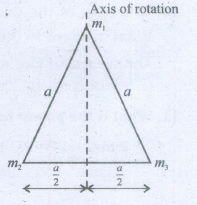
Three mass points m1 m2 and m3 are located at the vertices of an equilateral triangle of length a. what is the moment of inertia of the system about an axis along the altitude of the triangle passing through m1?
23.
The maximum and minimum distances of a come from the sun are 1.4\(\times\)1012m and 7\(\times\)1010m. If its velocity nearest to the sun is 6 \(\times\) 104 ms-1, what is the velocity in the farthest position? Assume that path of the comet in both the instantaneous positions is circular.
24.
Explain Right hand rule to find the direction of Torque.
25.
Write the equation for the CM of two point masses when,
(i) Masses are on positive x-axis
(ii) Origin coincides with anyone of the masses
(iii) origin coincides with CM itself.
26.
The diameter of a solid disc is 0.5m and its mass is 16kg. What torque will increase Its angular velocity from zero to 120 rotations/minute in 8 seconds?
27.
What is rolling motion?
28.
Mention any two physical significance of moment of inertia?
29.
State principle of moments
30.
Consider a thin uniform circular ring rolling down in an inclined plane without slipping. Compute the linear acceleration along the inclined plane if the angle of inclination is \(45 ^{0}\).
1.
If the orbits of the Moon and Earth lie on the same plane, during full Moon of every month, we can observe lunar eclipse. If this is so during new Moon we can observe solar eclipse. But Moon's orbit is tilted 5o with respect to Earth's orbit. Due to this 5o tilt, only during certain periods of the year, the Sun, Earth and Moon align in straight line leading to either lunar eclipse or solar eclipse depending on the alignment.
2.
The weight of an object is defined as the downward force whose magnitude W is equal to the upward force that must be applied to the object to hold it at rest or at constant velocity relative to the Earth.
3.
(i) Implies that the satellite is bound to the Earth and it cannot escape from the Earth
(ii) As h approaches ∝ the total energy tends to zero. Its physical meaning is that the satellite is completely free from the influence of Earth's gravity and is not bound to Earth at large distances.
4.
The gravitational potential at a distance r due to a mass is defined as the amount of work required to bring unit mass from infinity to the distance r and it is denoted as V(r).
\(\mathrm{V}(\mathrm{r})=-\frac{\mathrm{Gm}}{r}\)
5.
No, potential energy is not the property of a single object. But, it is the gravitational potential energy of the system consisting of two masses m1 and m2 separated by a distance r, is the gravitational potential energy difference of the system when the masses are separated by an infinite distance and by distance r.
\(\mathrm{U}(\mathrm{r}) =\mathrm{U}(\mathrm{r})-\mathrm{U}(\alpha)
\)
\(\therefore \mathrm{U}(\alpha) =0\)
6.
Yes, the angular momentum of a planet is conserved.
During the orbitary motion of the planets around the Sun, the line of action of gravitational force passes through the axis, the external torque is zero. Hence the angular momentum is conserved.
Torque, \( { \tau } =\frac { dL }{ dt }\)
If torque is zero then angular momentum (L) is constant i.e., it is conserved.
7.
Newton's law of gravitation states that a particle of mass M1 attracts any other particle of mass M2 in the universe with an attractive force. The strength of this force of attraction was found to be directly proportional to the product of their masses and is inversely proportional to the square of the distance between them.
\(\vec{F}=-\frac{G M_{1} M_{2}}{r^{2}} \hat{r}\)
8.
Translational velocity (VTRANS) or velocity of center of mass, VCM = 5 m s-1
The radius is, R = 1.5 m and the angular velocity is, \(\omega\) = 3 rad s-1
Rotational velocity, VROT = R\(\omega\)
VROT = 1.5 x 3
VROT = 4.5 ms-1
As vCM > R\(\omega\) (or) VTRANS> R\(\omega\), It is not in pure rolling but sliding.
9.
The concepts to form the integrand to find the moment of inertia could be borrowed from the earlier derivation. Now, the origin is fixed to the left end of the rod and the limits are to be taken from 0 to l.
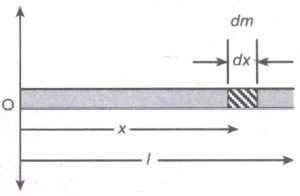
\(I=\frac{M}{l}\int ^{1}_{0}{x^{2}dx}=\frac{M}{l}[\frac{x^{3}}{3}]^{1}_{0}=\frac{M}{l}[\frac{l^{3}}{3}]\)
\(I=\frac{1}{3}Ml^{2}\)
10.
Law of conservation of angular momentum states that, when no external torque acts on the body, the net angular momentum of a rotating body remains constant.
11.
Radius of gyration of an object is the perpendicular distance from the axis of rotation to an equivalent point mass, which would have the same mass as well as the same moment of inertia of the object.
12.
The center of gravity of a body is the point at which the entire weight of the body acts irrespective of the position and orientation of the body.
13.
A pair of forces which are equal in magnitude but opposite in direction and separated by a perpendicular distance so that their lines of action do not coincide that causes a turning effect is called a couple.
14.
| S.No | Gravitational potential | Gravitational potential energy |
| 1. | It depends only on the source mass. | It depends upon two masses and the distance between them. |
| 2. | It is a scalar | It is a scalar |
| 3. | It's unit is J Kg-1. | Its unit is Joule. |
15.
The gravitational potential energy U(r) of a system of two masses m1 and m2 separated by a distance r as the amount of work done to bring the mass m2 from infinity to a distance r assuming m1 to be fixed in its position and is written as
\(\mathrm{U}(\mathrm{r})=-\frac{G m_{1} m_{2}}{r}\)
16.
17.
Here \(\omega_1=40\)rpm, \(I_2=\frac{2}{5}I_1\)
By the principle of conservation of angular momentum,
\(I_1 \omega_1=I_2 \omega_2 \)or \(I_1 \times 40 =\frac{2}{5}I_1\omega_2 or \omega_2=100 rpm.\)
(ii) Initial kinetic energy of rotation
\(\frac{2}{5}I_12\omega^{2}_{1}=\frac{2}{5}I_1(40)^{2}=800 I_1\)
New kinetic energy of rotation
\(\frac{2}{5}I_2 \omega^{2}_{2}=\frac{1}{2}\times \frac{2}{3} I_1 (100)^{2}=2000 I_1\)
\(\frac{New K.E.}{Initial K.E.}=\frac{2000 I_1}{800 I_1}=2.5\)
Thus the child's new kinetic energy of rotation is 2.5 times its initial kinetic energy of rotation. This increase in kinetic energy is due to the internal energy of the child which he uses in folding his hands back from the out stretched position.
18.
2: 1
19.
(x, y) = (0.54 m, 0.36 m)
20.
It plays the same role in rotatory motion as the mass does in translatory motion.
21.
Here M = 3 kg, R = 40 cm = 0.40 m, F = 30 N
Torque, \(\tau \)= F \(\times\) R = 30 \(\times\) 0.40 = 12 Nm
M.l. of the hollow cylinder about its own axis,
I = MR2 = 3 \(\times\) (0.40)2 = 0.48 kgm2
Angular acceleration, \(\alpha =\frac { \tau }{ I } \)= \(\frac {12}{0.48}\)= 25 rad s-2
Linear acceleration, \(\alpha\) = R\(\alpha\) = 0.40\(\times\)25= 10 ms-2
22.
As shown in figure, the axis of rotation passes through m1. The distances of mi, mi and m3 from the axis of rotation are \(O,{a\over 2}\) and \({a\over 2}\) respectively.
\(\therefore\) M.I of the system about the altitude through m1 is
\(I=m_1{r}_{1}^{2}+m_2{r}_{2}^{2}+m_3{r}_{3}^{2}\)
\(=m_1(0)^2+m_2\left( {a\over 2} \right)^2+m_2\left( {a\over 2} \right)^2\)
or \(I={a^2 \over 4}(m_2+m_1)\)
23.
At minimum distance r1 = 7 \(\times\) 1010m, velocity V1= 6 \(\times\) 104 ms-1
At maximum distance r2 = 1.4 \(\times\) 1012m ,velocity V2= ?
By conservation of angular momentum l1ω1 = I2ω2
or mr12x\(\frac { v_{ 1 } }{ r_{ 1 } } \) = mr22 x\(\frac { v_{ 2 } }{ r_{ 2 } } \)
or v1r1 = v2r2
or v2 = \(\frac { v_{ 1 }r_{ 1 } }{ r_{ 2 } } \) = \(\frac { 6\times 10^{ -4 }\times 7\times { 10 }^{ 10 } }{ 1.4\times { 10 }^{ 12 } } \)= 3000 ms-1
24.
If fingers of right hand are kept along the position vector with palm facing the direction of the force and when the fingers are curled the thumb points to the direction of the torque.
25.
(i) \({ X }_{ CM }=\frac { { m }_{ i }{ x }_{ i }+{ m }_{ 2 }{ x }_{ 2 } }{ { m }_{ 1 }+{ m }_{ 2 } } \)
(ii) \({ X }_{ CM }=\frac { { m }_{ 2 }{ x }_{ 2 } }{ { m }_{ 1 }+{ m }_{ 2 } } \)
(iii) \({ m }_{ 1 }{ x }_{ 1 }={ m }_{ 2 }{ x }_{ 2 }\)
26.
Given: diameter = 0.5m, Mass = 16 kg
Formula: Moment of inertia of solid disc
I = \(\frac { 1 }{ 2 } \)MR2 = \(\frac { 1 }{ 2 } \times 16\times \left[ \frac { { 0.5 } }{ 2 } \right] ^{ 2 }\)= \(\frac { 1 }{ 2 } \)
Angular velocity \(\omega \) = \(\frac { 120\times 2\pi }{ 60 } \) = \(4\pi \)
And change in angular momentum \(\Delta L=I\omega -0=I\omega \)
Angular impulse \(\tau \times t=\Delta L\Rightarrow \tau =\frac { \Delta L }{ t } =\frac { 1 }{ 8 } \times \frac { 1 }{ 2 } \times 4\pi =\frac { \pi }{ 4 } Nm\quad \)
27.
It is the combination of pure translational and pure rotational motion.
1. The rolling motion is the most commonly observed motion in daily life. The motion of wheel is an example of rolling motion.
2. Round objects like ring, disc, sphere etc. are most suitable for rolling. Let us study the rolling of a disc on a horizontal surface. Consider a point P on the edge of the disc.
3. While rolling, the point undergoes translational motion along with its center of mass and rotational motion with respect to its center of mass.
28.
1. Greater the mass concentrated away from the axis, greater the moment of inertia.
2. Moment of inertia of a body about an axis of rotation resists a change in it. In rotational motion, moment of inertia increases with increase in torque to change its rotation.
29.
Sum of the clockwise moments is equal to sum of the anticlockwise moments when a body is in rotational equilibrium or algebraic sum of moments at any point is zero.
30.
The linear acceleration along the inclined plane can be computed by
\(a=\frac{g sin\theta}{1+\frac{K^{2}}{R^{2}}}\)
For a thin uniform circular ring, axis passing through its center is I = MR2.
\(\therefore K^{2}=R^{2} \Rightarrow \frac{K^{2}}{R^{2}}=1\)
And the angle of inclination, \(\theta=45 ^{0}\)
\(\Rightarrow (sin 45^{0}=\frac{1}{\sqrt{2}})\)
Hence, \(a=\frac{g+\frac{1}{\sqrt{2}}}{1+1}\)
\(a=\frac{g}{2\sqrt{2}}\)ms-2.

11th Standard Syllabus & Materials
11th Standard
TN 11th Tamil பீடு பெற நில் - செய்யுள் - காவடிச்சிந்து Important Questions And Answers Study Material - QB365 Set A
NEW11th Standard
TN 11th Tamil பீடு பெற நில் - உரைநடை - மலை இடப்பெயர்கள் : ஓர் ஆய்வு Important Questions And Answers Study Material - QB365 Set A
NEW11th Standard
TN 11th Tamil மாமழை போற்றுதும் - துணைப்பாடம் - யானை டாக்டர் Important Questions And Answers Study Material - QB365 Set A
NEW11th Standard
TN 11th Tamil மாமழை போற்றுதும் - செய்யுள் - ஐங்குறுநூறு Important Questions And Answers Study Material - QB365 Set A



Tamilnadu Stateboard 11th Standard Subjects

Maths

Commerce

Economics

Biology

Business Maths and Statistics

Accountancy

Computer Science
Physics

Chemistry
Maths
Biology
Economics
Physics
Chemistry

History
Business Maths and Statistics

Computer Science
Accountancy

Computer Applications
History
Computer Technology
Commerce
Computer Applications
Computer Technology

Tamil

English

French
Tamilnadu Stateboard Standards

