
 100% FREE ACCESS
11th Standard Syllabus & Materials
11th Standard
TN 11th Tamil இயற்கை வேளாண்மை,சுற்றுச்சூழல் -செய்யுள் - மனோன்மணீயம் Important Questions And Answers Study Material - QB365 Set A
NEW11th Standard
TN 11th Tamil என்னுயிர் என்பேன் -துணைப்பாடம் - இசைத்தமிழர் இருவர் Important Questions And Answers Study Material - QB365 Set A
NEW11th Standard
TN 11th Tamil மொழி கலை -செய்யுள் - ஒவ்வொரு புல்லையும் Important Questions And Answers Study Material - QB365 Set A
NEW11th Standard
TN 11th Tamil பீடு பெற நில் - இலக்கணம் - பகுபத உறுப்புகள் Important Questions And Answers Study Material - QB365 Set A
NEW11th Standard
TN 11th Tamil பீடு பெற நில் - துணைப்பாடம் - வாடிவாசல் Important Questions And Answers Study Material - QB365 Set A
NEW11th Standard
TN 11th Tamil பீடு பெற நில் - செய்யுள் - குறுந்தொகை Important Questions And Answers Study Material - QB365 Set A

Published on: 30/09/2018
Important 5mark -chapter 5,6
Download Tamil Nadu 11th Standard Physics question papers, model tests, one-mark questions, important questions, and public exam papers in PDF format. Free study materials and answer keys for TN State Board students.
Questions + Answers key
Take MCQ Physics Test1.
Explain in detail the geostationary and polar satellites.
2.
3.
Derive the time period of satellite orbiting the Earth.
4.
Derive an expression for escape speed.
5.
Explain in detail the idea of weightlessness using lift as an example.
6.
Derive the expression for gravitational potential energy.
7.
Explain how Newton verified his law of gravitation.
8.
Discuss the important features of the law of gravitation.
9.
A massless right tangled triangle is suspended with its right angle corner. A mass of 100 kg is suspended from another corner B which subtends an angle \(53^{0}\). Find the mass m that should be suspended from other corner C so that BC (hypotenuse) remains horizontal.
10.
A solid cylinder when dropped from a height of 2 m acquires a velocity while reaching the ground. If the same cylinder is rolled down from the top of an inclined plane to reach the ground with same velocity, what must be the height of the inclined plane? Also compute the velocity.
11.
Three particles of masses m1= 1kg, m2 = 2kg and m3 = 3kg are placed at the comers of an equilateral triangle of side 1m as shown in Figure. Find the position of center of mass.
12.
A particle of mass (m) is moving with constant velocity (v). Show that its angular momentum about any point remains constant throughout the motion.
13.
Discuss how the rolling is the combination of translational and rotational and also be possibilities of velocity of different points in pure rolling.
14.
Derive an expression for center of mass for distributed point masses.
15.
Derive the relation between rotational KE and angular momentum.
16.
Explain the principle of moments of rotational equilibrium? Hence define mechanical advantage?
17.
A hoop of radius 2m weights 100 kg. It rolls along a horizontal floor so that its centre of mass has speed of 20 cm/s. How much work has to be done to stop it?
18.
A car of mass 1200 kg is travelling around a circular path of radius 300 m with a constant speed of 54 km/h. Calculate its angular momentum.
19.
A uniform disc of mass 100g has a diameter of 10 cm, Calculate the total energy of the disc when rolling along a horizontal table with a velocity of 20 cms-1. (take the surface of table as reference).
20.
A fly wheel rotates with a uniform angular acceleration. If its angular velocity increases from 20\(\pi\) rad/s to 40\(\pi\) rad/s in 10 seconds. Find the number of rotations in that period.
21.
The 747 Boeing plane is landing at a speed of 70 m S-1 Before touching the ground, the wheels are not rotating. How long a skid mark do the wing wheels leave (assume their mass is 100 kg which is distributed uniformly, radius is 0.7 m, and the coefficient of friction with the ground is 0.5)?
22.
Write an expression for the kinetic energy of a body in pure rolling.
23.
Define angular momentum and derive the expression of it.
24.
Derive an expression for the Center of Mass of Two Point Masses.
25.
State and prove parallel axis theorem.
26.
Derive the expression for moment of inertia of a rod about its center and perpendicular to the rod?
27.
Explain the types of equilibrium with suitable examples?
28.
A student was asked a question ‘why are there summer and winter for us? He replied as since Earth is orbiting in an elliptical orbit, when the Earth is very far away from the Sun(aphelion) there will be winter, when the Earth is nearer to the Sun(perihelion) there will be winter. Is this answer correct? If not, what is the correct explanation for the occurrence of summer and winter?
29.
Explain the variation of g with altitude.
30.
A solid sphere is undergoing pure rolling. What is the ratio of its translational kinetic energy to rotational kinetic energy?
1.
(i) The satellites orbiting the Earth have different time periods corresponding to different orbital radii. Orbital radius of a satellite if its time period is 24 hours is calculated below:
Kepler's third law is used to find the radius of the orbit.
T2 = \(\frac { 4\pi ^{ 2 } }{ { GM }_{ E } } \) (RE + h)3
(RE + h)3 = \(\frac { { GM }_{ E }{ T }^{ 2 } }{ 4\pi ^{ 2 } } \)
RE + h = \(\left( \frac { { GM }_{ E }{ T }^{ 2 } }{ 4\pi ^{ 2 } } \right) ^{ 1/3 }\)
(ii) Substituting for the time period (24 hrs = 86400 seconds), mass, and radius of the Earth, h turns out to be 36,000 km. Such Satellites are called "geo-stationary satellites", They appear to be stationary when seen from Earth.
India uses the INSAT group of satellites that are basically geo-stationary satellites for the purpose of telecommunication.
Another group of satellite which is placed at a distance of 500 to 800 km from the surface of the Earth orbits the Earth from north to south direction. This type of satellite that orbits Earth from North Pole to South Pole is called a polar satellite. The time period of a polar satellite is nearly 100 minutes and the satellite completes many revolutions in a day. A polar satetrlite covers a small strip of area from pole to pole during one revolution it covers a different strip of area since the Earth would have moved by a small angle. In this way polar satellites cover the entire surface area of the Earth.
2.
3.
The distance covered by the satellite during one rotation in its orbit is equal to 2\(\pi\)(RE + h) and time taken for it, is the time period, T. Then
\(\text{speed v} =\frac { Distance \ travelled }{ Time \ taken } =\frac { 2\pi ({ R }_{ E }+h) }{ T } \)
From equation
\(\sqrt { \frac { { GM }_{ E } }{ ({ R }_{ E }+h) } } =\frac { 2\pi ({ R }_{ E }+h) }{ T } \) ...(1)
T = \(\frac { 2\pi }{ \sqrt { G{ M }_{ E } } } \)(RE + h)3/2 ....(2)
Squaring both sides of the equation (2), we get
T2 = \(\frac { 4\pi ^{ 2 } }{ { GM }_{ E } } \) = (RE + h)3
\(\frac { 4\pi ^{ 2 } }{ { GM }_{ E } } \) = constant say c
T2 = T2 = c(RE + h)3 ...(3)
Equation (3) implies that a satellite orbiting the Earth has the same relation between time and distance as that of Kepler's law of planetary motion. For a satellite orbiting near the surface of the Earth, h is negligible compared to the radius of the Earth RE Then,
T2 = \(\frac { 4\pi ^{ 2 } }{ { GM }_{ E } } \) = RE2
T2 = \(\frac { 4\pi ^{ 2 } }{ { { GM }_{ E } }/{ { R }_{ E }^{ 2 } } } R_E\)
T2 = \(\frac { { 4\pi }^{ 2 } }{ g } \)RE
Since\(\frac { { GM }_{ E } }{ { R }_{ E }^{ 2 } } \) = g
T = \(2\pi \sqrt { \frac { { R }_{ E } }{ g } } \) ......(4)
By substituting the values of RE = 6.4 x 10⁶ m and g = 9.8 ms-2, the orbital time period is obtained as T ≅ 85 minutes.
4.
Consider an object of mass M on the surface of the Earth. When it is thrown up with an initial speed Vi' the initial total energy of the object is
Ei = \(\frac { 1 }{ 2 } { Mv }_{ i }^{ 2 }-\frac { GMM_{ E } }{ R_{ E } } \) ............(1)
where, ME is the mass of the Earth and RE- the radius of the Earth. The term \(\frac { GMM_{ E } }{ R_{ E } } \) is the potential energy of the mass M.
When the object reaches a height far away from Earth and hence treated as approaching infinity, the gravitational potential energy becomes zero [U(∝) = 0] and the kinetic energy becomes zero as well. Therefore the final total energy of the object becomes zero. This is for minimum energy and for minimum speed to escape. Otherwise Kinetic energy can be non-zero.
Ef = 0
According to the law of energy conservation,
Ei = Ef .............(2)
Substituting (1) in (2) we get,
\(\frac { 1 }{ 2 } { Mv }_{ i }^{ 2 }-\frac { GMM_{ E } }{ R_{ E } } \) =0
\(\frac { 1 }{ 2 } { Mv }_{ e }^{ 2 }-\frac { GMM_{ E } }{ R_{ E } } \) = 0 .............(3)
Consider the escape speed, the minimum speed required by an object to escape Earth's gravitational field, hence replace vi with ve. i.e.,
\(\frac { 1 }{ 2 } { Mv }_{ e }^{ 2 }-\frac { GMM_{ E } }{ R_{ E } } \)
\(v_{ e }^{ 2 }-\frac { GMM_{ E } }{ R_{ E } } .\frac { 2 }{ M } \)
\(v_{ e }^{ 2 }=\frac { 2G{ M }_{ E } }{ { R }_{ E } } \) ..............(4)
Using g = \(\frac { G{ M }_{ E } }{ { R }_{ e } } \) ..............(5)
\(v_{ e }^{ 2 }=2g{ R }_{ E }\)
\({ v }_{ e }=\sqrt { 2g{ R }_{ E } } \) .................(6)
5.
Let us consider a man inside an elevator in the following scenarios.
When a man is standing in the elevator, there are two forces acting on him.
(i) Gravitational force which acts downward. If we take the vertical direction as positive y direction, the gravitational force acting on the man is \( \vec{F}_{G}=-m g \hat{j}\)
(ii) The normal force exerted by floor on the man which acts vertically upward, \(\vec{N}=N \hat{j}\)
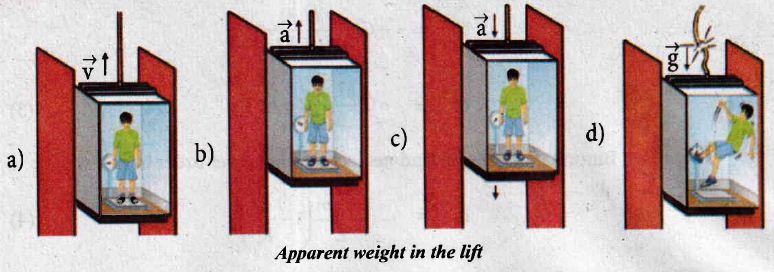
Case (i) When the elevator is at rest
The acceleration of the man is zero. Therefore the net force acting on the man is zero. With respect to inertial frame (ground), applying Newton's second law on the man,
\(\vec {F}_{G}+\vec{N}=0 \)
\(-m g \hat{j}+N \hat{j}=0\)
By comparing the components, we can write
\(\mathrm{N}-\mathrm{mg}=0 \text { (or) } \mathrm{N}=\mathrm{mg}\)
Since weight, W = N, the apparent weight of the man is equal to his actual weight.
Case (ii) When the elevator is moving uniformly in the upward or downward direction
In uniform motion (constant velocity), the net force acting on the man is still zero.
Hence, in this case also the apparent weight of the man is equal to his actual weight.
Case (iii) When the elevator is accelerating upwards
If an elevator is moving with upward acceleration \((\vec{a}=a \vec{j})\), with respect to inertial frame (ground), applying Newton's second law on the man,
\(\overrightarrow{F}_{G}+\vec{N}=m \vec{a}\)
Writing the above equation in terms of unit vector in the vertical direction,
\(-m g \hat{j}+N \hat{j}=m a \hat{j}\)
By comparing the components,
\(\mathrm{N}=\mathrm{m}(\mathrm{g}+\mathrm{a})\)
Therefore, apparent weight of the man is greater than his actual weight
Case (iv) When the elevator is accelerating downwards
If the elevator is moving with downward acceleration \((\vec{a}=-a \hat{j})\), by applying Newton's second law on the man, we can write
\(\overrightarrow{F}_{G}+\vec{N}=m \vec{a}\)
Writing the above equation in terms of unit vector in the vertical direction,
\(-m g \hat{j}+N \hat{j}=-m a \hat{j}\)
By comparing the components
\(\mathrm{N}=\mathrm{m}(\mathrm{g}-\mathrm{a})\)
Therefore, apparent weight W = N = m(g - a) of the man is lesser than his actual weight.
6.
Consider the Earth and mass system, with r, the distance between the mass m and the Earth's centre. Then the gravitational potential energy,
\(\mathrm{U}=-\frac{G M_{e} m}{r}\) ......(1)
Here r = Re + h, where Re is the radius of the Earth. h is the height above the Earth's surface.
\(\mathrm{U}_{\mathrm{c}}=-G \frac{M_{e} m}{\left(R_{e}+h\right)}\) .......(2)
If h << Re, equation can be modified as
\(\mathrm{U} =-G \frac{M_{e} m}{\mathrm{R}_{e}\left(1+h / R_{e}\right)}
\)
\(\mathrm{U} =-G \frac{M_{e} m}{\mathrm{R}_{e}}\left(1+h / R_{e}\right)^{-1}\) .......(3)
By using Binomial expansion and neglecting the higher order terms, we get
\(\mathrm{U}=-G \frac{M_{e} m}{\mathrm{R}_{e}}\left(1-\frac{h}{R_{e}}\right)\) ........(4)
We know that, for a mass m on the Earth's surface,
\(G \frac{M_{e} m}{\mathrm{R}_{e}}=m g \mathrm{R}_{e}\) ........(5)
Substituting equation (5) in (4) we get
\(\mathrm{U}=-\mathrm{mg} \mathrm{R}_{e}+\mathrm{mgh}\) .......(6)
It is clear that the first term in the above expression is independent of the height h. For example, if the object is taken from height h1 to h2 then the potential energy at h1 is
\(\mathrm{U}\left(\mathrm{h}_{1}\right)=-\mathrm{mg} \mathrm{} \mathrm{R}_{\mathrm{e}}+\mathrm{mgh}_{1}\) .......(7)
and the potential energy at h2 is
\(\mathrm{U}\left(\mathrm{h}_{2}\right)=-\mathrm{mg} \mathrm{} \mathrm{R}_{\mathrm{e}}+\mathrm{mgh}_{2}\) .....(8)
The potential energy difference between h1 and h2 is
\(U\left(h_{2}\right)-U\left(h_{1}\right)=m g\left(h_{1}-h_{2}\right)\) .......(9)
7.
(i) Newton verified his law of universal gravitation by comparing the acceleration of a terrestrial object to the acceleration of the moon.
(ii) He knew that the distance from the center of earth to the center of two spheres of known mass at either end of a light rod suspended by a then fiber from the center of the rod.
(iii) He had earlier found the small force that was needed to twist the fiber.
(iv) By bringing a third sphere close to one of the suspended spheres.
(v) He was able to measure the force of gravity between the spheres and hence gravitation.
8.
As the distance between two masses increases, the strength of the force tends to decrease because of inverse dependence on r2. Physically it implies that the planet Uranus experiences less gravitational force from the Sun than the Earth since Uranus is at larger distance from the Sun compared to the Earth.
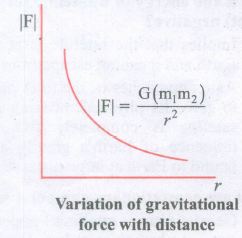
The gravitational forces between two particles always constitute an action reaction pair. It implies that the gravitational force exerted by the Sun on the Earth is always towards the Sun. The reaction-force is exerted by the Earth on the Sun. The direction of this reaction force is towards Earth.
The torque experienced by the Earth due to the gravitational force of the Sum is zero given by
\(\vec { \tau } =\vec { r } \times \vec { F } =\vec { r } \times \left( -\frac { { GM }_{ s }{ M }_{ E } }{ { r }^{ 2 } } \hat { r } \right) =0\)
Since \(\vec { r } =r\hat { r } ,(\hat { r } \times \hat { r } )=0\)
So, \(\hat { \tau } =\frac { d\vec { L } }{ dt } =0\)
It implies that angular momentum \(\vec{L}\) is a constant vector. The angular momentum of the Earth about the Sun is constant throughout the motion. It is true for all the planets. In fact, this constancy of angular momentum leads to the Kepler's second law.
The expression \(\vec{F}=-\frac{G M_{1} M_{2}}{r^{2}} \hat{r}\) has one inherent assumption that both M1 and M2 are treated as point masses. When it is said that Earth orbits around the Sun due to Sun's gravitational force, we assumed Earth and Sun to be point masses. This assumption is a good approximation because the distance between the two bodies is very much larger than their diameters. For some irregular and extended objects separated by a small distance, we cannot directly use the equation. Instead, we have to invoke separate mathematical treatment which will be brought forth in higher classes.
However, this assumption about point masses holds even for small distance for one special case. To calculate force of attraction between a hollow sphere of mass M with uniform density and point mass m kept outside the hollow sphere, we can replace the hollow sphere of mass M as equivalent to a point mass M located at the center of the hollow sphere. The force of attraction between the hollow sphere of mass M and point mass m can be calculated by treating the hollow sphere also as another point the center of the hollow sphere. It is shown in the Figure.
There is also another interesting result. Consider a hollow sphere of mass M. If we place another object of mass 'm' inside this hollow sphere as in Figure, the force experienced by this mass 'm' will be zero.
The triumph of the law of gravitation is that it concludes that the mango that is falling down and the Moon orbiting the Earth are due to the same gravitational force.
9.
From the principle of moments,
\(100 \times g \times x_{1}=m\times g \times x_{2}\)
\(100 \times cos 53^{0}=m\times cos 37^{0}\) .................(1)
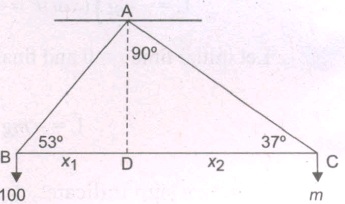
Where, x1 and x2 are the arm lengths.
The right angle triangle with angles \(37^{0}, 53 ^{0} \ and \ 90^{0}\) is a special triangle which has the respective sides in the ratio, 3:4:5 as shown in the diagram.
Substituting the values in equation (1),
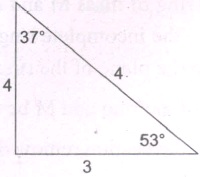
\(100 \times cos 53^{0}=3\times cos 37^{0}\)
\(100 \times \frac{3}{5}=m\times \frac{4}{5}\)
\(m=100\times \frac{3}{4}\)
m = 75 kg
10.
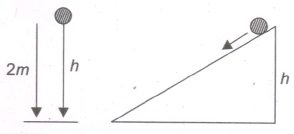
In the first case,
potential energy = kinetic energy
\(mgh=\frac{1}{2}mv^{2}\)
\(mg\times 2 =\frac{1}{2} mv^{2}\) ........... (1)
In second case,
potential energy = translational kinetic energy + rotational kinetic energy
\(mgh^{'}=\frac{1}{2}mv^{2}+\frac{1}{2} I\omega^{2}\)
\(mgh{'}=\frac{1}{2}mv^{2}+\frac{1}{2}(\frac{mr^{2}}{2})(\frac{v^{2}}{r^{2}})\)
\(\therefore mgh^{'}=\frac{3}{4} mv^{2}\) --- (2)
Dividing (2) by (1),
\(\frac{mgh^{'}}{mg\times 2}=\frac{\frac{3}{4}mv^{2}}{\frac{1}{2}mv^{2}}=\frac{3}{4}\times \frac{2}{1}=\frac{3}{2}\)
h'=3 m
From equation (1), 2 mg =\(\frac{1}{2}mv^{2}\)
\(v=\sqrt{4g}=2\sqrt{g}\)
\(v=2\times \sqrt{9.81}\)
\(v=6.3 ms^{-1}\)
11.
The center of mass of an equilateral triangle lies at its geometrical center G. The positions of the mass m1, m2 and m3 are at positions A, B and C as shown in the Figure.
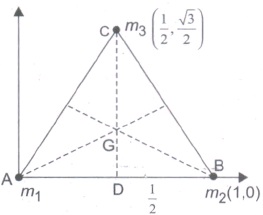
From the given position of the masses, the coordinates of the masses mi and m1 are easily marked as (0,0) and (1,0) respectively.
To find the position of ma the Pythagoras theorem is applied.
As the ΔDBC is a right angle triangle,
BC2 = CD2 + DB2
CD2 = BC2 - DB2
\(CD^{2}=1^{2}-(\frac{1}{2})^{2}=1-(\frac{1}{4})=\frac{3}{4}\)
\(CD=\frac{\sqrt{3}}{2}\)
The position of mass m3 is \((\frac{1}{2},\frac{\sqrt{3}}{2})\) or \((0.5,0.5 \sqrt{3})\)
X coordinate of center of mass
\(x_{CM}=\frac{m_1y_1+m_2y_2+m_3y_3}{m_1+m_2+m_3}\)
\(x_{CM}=\frac{\sqrt{3}}{4}\)m
∴ The coordinates of center of mass G (xCM,yCM) is \((\frac{7}{12},\frac{\sqrt{3}}{4})\).
12.
Let the particle of mass m move with constant velocity \(\overrightarrow {v}\).
As it is moving with constant velocity, its path is a straight line. Its momentum (\(\overrightarrow {p}=m\overrightarrow {v}\)) is also directed along the same path. Let us fix an origin (0) at a perpendicular distance (d) from the path. At a particular instant, we can connect the particle which is at position Q with a position vector \((\overrightarrow{r}=\overrightarrow{OQ})\)
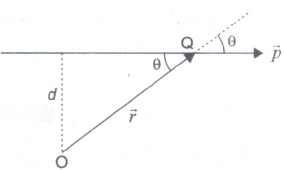
Take, the angle between the \(\overrightarrow{r}\) and \(\overrightarrow{q}\) as \(\theta\). The magnitude of angular momentum of that particle at that instant is,
L = OQ p sin θ = OQ mv sin θ = mv (OQ sin θ)
The term (OQ sin θ) is the perpendicular distance (d) between the origin and line along which the mass is moving. Hence, the angular momentum of the particle about the origin is,
L= mvd
The above expression for angular momentum L, does not have the angle 8. As the momentum (p = mv) and the perpendicular distance (d) are constants, the angular momentum of the particle is also constant Hence, the angular momentum is associated with bodies with linear motion also. If the straight path of the particle passes through the origin, then the angular momentum is zero, which is also a constant.
13.
The rolling motion is the most commonly observed motion in daily life. The motion of wheel is an example of rolling motion. Round objects like ring, disc, sphere etc. are most suitable for rolling. Let us study the rolling of a disc on a horizontal surface. Consider a point P on the edge of the disc. While rolling, the point undergoes translational motion along with its center of mass and rotational motion with respect to its center of mass.
Combination of Translation and Rotation: We will now see how these translational and rotational motions are related in rolling. If the radius of the rolling object is R, in one full rotation, the center of mass is displaced by 2\(\pi\)R (its circumference). One would agree that not only the center of mass, but all the points on the disc are displaced by the same 2\(\pi\)R after one full rotation. The only difference is that the center of mass takes a straight path; but, all the other points undergo a path which has a combination of the translational and rotational motion. Especially the point on the edge undergoes a path of a cycloid as shown in the figure.
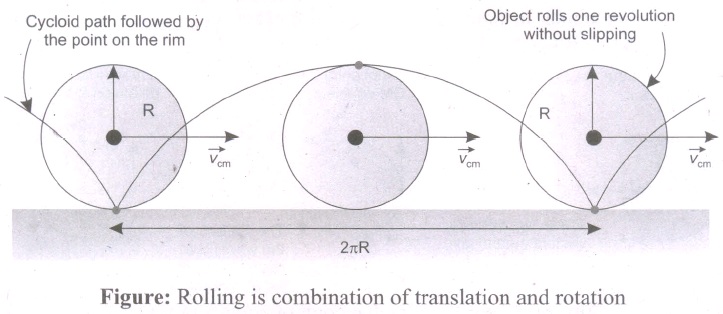
As the center of mass takes only a straight line path, its velocity vCM is only translational velocity vTRANS (vCM = vTRANS)· All the other points have two velocities. One is the translational velocity vTRANS, (which is also the velocity of center of mass) and the other is the rotational velocity vROT (vROT = r\(\omega\)). Here, r is the distance of the point from the center of mass and eo is the angular velocity. The rotational velocity vROT is perpendicular to the instantaneous position vector from the center of mass as shown in figure (a). The resultant of these two velocities is v. This resultant velocity v is perpendicular to the position vector from the point of contact of the rolling object with the surface on which it is rolling as shown in figure (b).
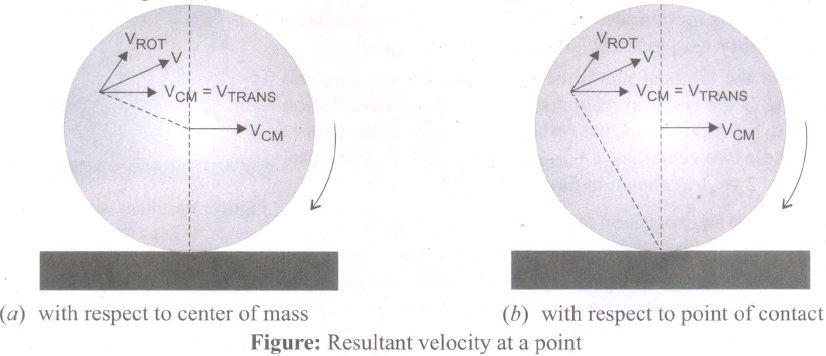
We shall now give importance to the point of contact. In pure rolling, the point of the rolling object which comes in contact with the surface is at momentary rest. This is the case with every point that is on the edge of the rolling object. As the rolling proceeds, all the points on the edge, one by one come in contact with the surface; remain at momentary rest at the time of contact and then take the path of the cycloid as already mentioned.
Hence, we can consider the pure rolling in two different ways. (i) The combination of translational motion and rotational motion about the center of mass. (or) (ii) The momentary rotational motion about the point of contact. As the point of contact is at momentary rest in pure rolling, its resultant velocity v is zero (v = 0). For example, in figure, at the point of contact, vTRANS is forward (to right) and vROT is backwards (to the left).
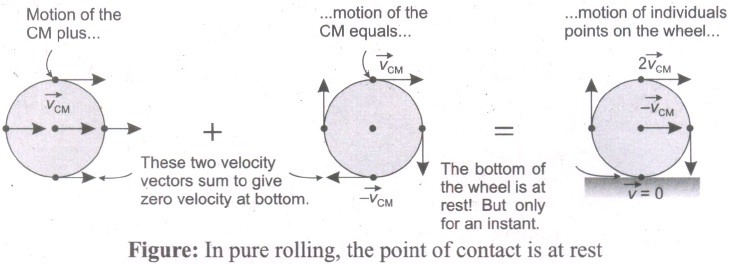
That implies that, vTRANS and vROT are equal in magnitude and opposite in direction (v = vTRANS -vROT = 0). Hence, we conclude that in pure rolling, for all the points on the edge, the magnitudes of vTRANS and vROT are equal (vTRANS = vROT)· As vTRANS = vCM and vROT = \(R_\omega\), in pure rolling we have,
\(V_{CM}=R_\omega\)
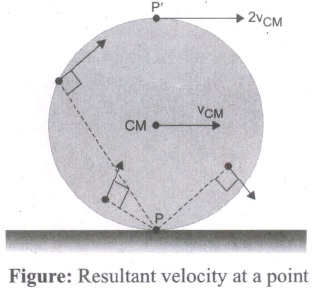
We should remember the special feature of the above equation. In rotational motion, as per the relation v = r\(\omega\), the center point will not have any velocity as r is zero. But in rolling motion, it suggests that the center point has a velocity vCM given by above equation VCM - R\(\omega\). For the topmost point, the two velocities vTRANS and vROT are equal in magnitude and in the same direction (to the right). Thus, the resultant velocity v is the sum of these two velocities, v = vTRANS + vROT· In other form,v= 2 vCM as shown in figure below.
14.
A point mass is a hypothetical point particle which has non-zero mass and no size or shape. To find the center of mass for a collection ofn point masses, say, m1, m2, m3 ... mn we have to first choose an origin and an appropriate co-ordinate system as shown in Figure. Let, x1, x2, x3 ... xn be the X-coordinates of the positions of these point masses in the X direction from the origin.
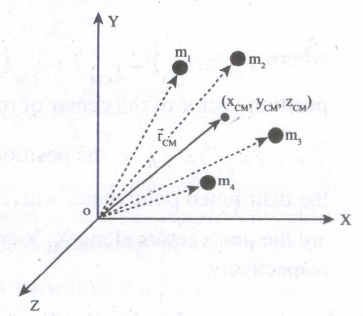
The equation for the X coordinate of the center of mass is,
\({ x }_{ cm }=\frac { \sum { { m }_{ i }{ x }_{ i } } }{ \sum { { m }_{ i } } } \)
where, \(\sum { { m }_{ i } } \) is the total mass M of all the particles, (\(\sum { { m }_{ i } } =M\)). Hence,
\({ x }_{ CM }=\frac { \sum { { m }_{ i }{ x }_{ i } } }{ M } \)
Similarly, we can also find y and z coordinates of the center of mass for these distributed point masses as indicated in Figure.
\({ y }_{ CM }=\frac { \sum { { m }_{ i }{ y }_{ i } } }{ M } \)
\({ z }_{ CM }=\frac { \sum { { m }_{ i }{ z }_{ i } } }{ M } \)
Hence, the position of center of mass of these point masses in a Cartesian coordinate system is (xCM, yCM zCM) In general, the position of center of mass can be written in a vector form as,
\(\overset { \rightarrow }{ r_{ CM } } =\frac { \sum { { m }_{ i } } \overset { \rightarrow }{ r } i }{ M } \)
where, \(\overset { \rightarrow }{ r_{ CM } } ={ x }_{ CM }\hat { i } +{ y }_{ CM }\hat { j } +{ z }_{ CM }\hat { k } \) is the position vector of the center of mass and \(\overset { \rightarrow }{ { r }_{ i } } ={ x }_{ i }\hat { i } +{ y }_{ i }\hat { j } +{ z }_{ i }\hat { k } \) is the position vector of the distributed point mass; where \(\hat { i } ,\hat { j } \) and \(\hat { k } \) are the unit vectors along X, Y and Z-axes respectively.
15.
Let a rigid body of moment of inertia I rotate with angular velocity ധ
The angular momentum of a rigid body is, L= Iധ
The rotational kinetic energy of the rigid body is, KE =\(\frac{1}{2}\)Iധ2
By multiplying the numerator and denominator of the above equation with I, we get a relation between L and KE as,
\(KE=\frac { 1 }{ 2 } \frac { { I }^{ 2 }{ \omega }^{ 2 } }{ I } =\frac { 1 }{ 2 } \frac { { \left( I\omega \right) }^{ 2 } }{ I } \)
\(KE=\frac { { L }^{ 2 } }{ 2I } \)
16.
Consider a light rod of negligible mass which is pivoted at a point along its length, Let two parallel forces F1 and F2 act at the two ends at distances d1 and d2 from the point of pivot and the normal reaction force N at the point of pivot as shown in the figure (Principle of moments).
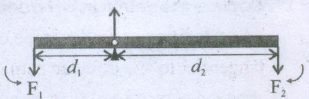
If the rod has to remain stationary in horizontal position, it should be in translational and rotational equilibrium. Then, both the net force and net torque must be zero.
For net force to be zero, -F1 + N - F2 = 0
For net torque to be zero, d1F1 - d2F2 = 0
d1F1 = d2F2 ...(1)
The above equation represents the principle of moments. This forms the principle for beam balance used for weighing goods with the condition d1 = d2; F1 = F2. We can rewrite the equation (1) as,
\(\frac { { F }_{ 1 } }{ { F }_{ 2 } } =\frac { { d }_{ 2 } }{ { d }_{ 1 } } \)
If F1 is the load and F2 is our effort, we get advantage when, d1 < d2. This implies that F1 > F2. Hence, we could lift a large load with small effort. The ratio \(\left( \frac { { d }_{ 2 } }{ { d }_{ 1 } } \right) \)is called mechanical advantage of the simple lever.
17.
Moment of inertia of hoop about its centre
I=MR2
and energy of loop = translational kinetic energy of CM and rotational kinetic energy about axis through CM.
=\(\frac { 1 }{ 2 } { mv }^{ 2 }_{ CM }+\frac { 1 }{ 2 } I{ \omega }^{ 2 }\) [\(I=mR^{ 2 }\) and \(\omega =\frac { v }{ R } \)]
=\(\frac { 1 }{ 2 } { mv }^{ 2 }_{ CM }+\frac { 1 }{ 2 } m{ R }^{ 2 }\times \frac { { v }^{ 2 }_{ CM } }{ { R }^{ 2 } } ={ mv }^{ 2 }_{ CM }\)
Work done is stopping the hoop
=total KE of hoop
=\({ mv }^{ 2 }_{ CM }\)=100 \(\times\)(0.2)2=4J
18.
mass, m=1200 kg
v=54 km/h=\(54\times \frac { 5 }{ 18 } \) m/sec=15 m/s
Angular momentum, L =r m v= 300 \(\times\) 1200 \(\times\)15
=54,00,000
=5.4 x 10⁶ kg m2/s
19.
Mass of the disc m = 100 g = 6.1 kg.
Diameter of the disc d = 10 cm.
Radius of the disc r = 5 cm = 0.05m
Rolling with a velocity v = 20 cms-1 = 0.20 ms-1
Total energy of the disc ETot = ?
ETot = Translational K energy + rotational K.E
M.I of the disc about its own axis,
\(I=\frac { 1 }{ 2 } { mr }^{ 2 }\)
\(v=r\omega \ \therefore { \omega }^{ 2 }=\frac { { v }^{ 2 } }{ { r }^{ 2 } } \)
Rotational K.E = \(I=\frac { 1 }{ 2 } I{ \omega }^{ 2 }=\frac { 1 }{ 2 } \times \left( \frac { 1 }{ 2 } { mr }^{ 2 } \right) \times \left( \frac { { v }^{ 2 } }{ { r }^{ 2 } } \right) \)
\(=\frac { 1 }{ 4 } { mv }^{ 2 }\)
T.E. \(=\frac { 1 }{ 2 } { mv }^{ 2 }+\frac { 1 }{ 4 } { mv }^{ 2 }=\frac { 3 }{ 4 } { mv }^{ 2 }\)
T.E. of the disc ETot = \(\frac{3}{4}\) \(\times\) 0.1 \(\times\) 0.20 \(\times\) 0.20
= 0.003 J
20.
Angular Velocity rad = 20\(\pi\) rad/s
Angular velocity rad = 10\(\pi\) rad/s
time taken, t = 10 s
No.of rotations / see = ?
\(\omega ={ \omega }_{ 0 }+\alpha t\)
\(\alpha =\frac { \omega -{ \omega }_{ 0 } }{ t } =\frac { 40\pi -20\pi }{ 10 } =\frac { 20\pi }{ 10 } =2\pi \)
\(\alpha\) = 2 rad/s
\(\theta ={ \omega }_{ 0 }t+\frac { 1 }{ 2 } \alpha { t }^{ 2 }\)
= 20\(\pi\) \(\times\) 10 + \(\frac{1}{2}\) \(\times\) 2\(\pi\) \(\times\) 10 \(\times\)10
= 200\(\pi\) + 100\(\pi\)
\(\theta\) = 300\(\pi\)
No.of rotations / sec = \(\frac{\theta}{2\pi}=\frac{300\pi}{2\pi}\)= 150 rotations.
21.
Note:
1. The tires will leave a skid mark if the speed of the tire in contact with the ground is less than that of the linear velocity of the plane. ie., the ground is moving relative to the tire.
2. The condition for this is WR < u
3. So, the tire will stop skidding [and start rolling]when it has attained an angular velocity of u /R.
4. The forces acting on the wheel after the plane touches down are
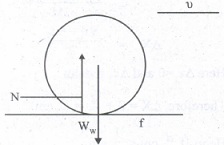
5. Since the wheel is not accelerating N=Ww [Ww = wing wheels support the weight.]
6. The torque about the center of the wheel \(\tau \) = fR = \(\mu\) WwR
Solution:
Therefore, angular acceleration is
\(\alpha =\frac { \tau }{ l } =\frac { \mu { W }_{ m }R }{ \frac { 1 }{ 2 } m{ R }^{ 2 } } \)
\(=2\mu \frac { { W }_{ W }mR }{ } \)
So, the time it takes for the wheel to stop skidding is
\(W={ W }_{ 0 }+\alpha t\)
\(=0+\alpha t=\frac { v }{ R } \)
\(t=\frac { v }{ R\alpha } =\frac { v }{ R } .\frac { mR }{ 2 } \mu { W }_{ W }\)
\(=\frac { mR }{ 2 } \mu { W }_{ W }\)
\(=\frac { 100kg\times 70{ ms }^{ -1 } }{ 2\times 0.5\times 232 } KN\)
= 0.03 s
The skid mark has a length of
l = vt = 70ms-1 \(\times\) 0.03s
= 2.1 m.
22.
(i) The total kinetic energy (KE) can be written as the sum of kinetic energy due to translational motion (KETRANS) and kinetic energy due to rotational motion (KEROT)
KE = KETRANS + KEROT
(ii) If the mass of the rolling object is M, the velocity of center of mass is vCM its moment of inertia about center of mass is ICM and angular velocity is ω, then
KE = \(\frac { 1 }{ 2 } Mv^{ 2 }_{ CM }+\frac { 1 }{ 2 } { I }_{ CM }\omega ^{ 2 }\)
(iii) With center of mass as reference:
The moment of inertia (lCM) of a rolling object about the center of mass is,
ICM= MK2 and vCM= Rω. Here, K is radius of gyration.
\(KE=\frac { 1 }{ 2 } Mv^{ 2 }_{ CM }+\frac { 1 }{ 2 } \left( MK^{ 2 } \right) \frac { v^{ 2 }_{ CM } }{ R^{ 2 } } \\ \\ \)
\(KE=\frac { 1 }{ 2 } Mv^{ 2 }_{ CM }+\frac { 1 }{ 2 } Mv^{ 2 }_{ CM }\left( \frac { { K }^{ 2 } }{ R^{ 2 } } \right) \)
\(KE=\frac { 1 }{ 2 } Mv^{ 2 }_{ CM }\left( 1+\frac { K^{ 2 } }{ R^{ 2 } } \right) \)
(iv) With point of contact as reference: We can also arrive at the same expression by taking the momentary rotation happening with respect to the point of contact (another approach to rolling). if we take the point of contact as 0, then,
\(KE=\frac { 1 }{ 2 } { I }_{ 0 }\omega ^{ 2 }\)
Here, Io is the moment of inertia of the object about the point of contact. By parallel axis theorem, Io = ICM+ MR2. Further we can write, Io = MK2 + MR2. With vCM= Rω or
\(\omega =\frac { { v }_{ CM } }{ R } \)
\(KE=\frac { 1 }{ 2 } \left( MK^{ 2 }+MR^{ 2 } \right) \frac { v^{ 2 }_{ CM } }{ { R }^{ 2 } } \)
\(KE=\frac { 1 }{ 2 } Mv^{ 2 }_{ CM }\left( 1+\frac { { K }^{ 2 } }{ R^{ 2 } } \right) \)
(vi) K.E. in pure rolling can be determined by anyone of the following two cases.
(a) The combination of translational motion and rotational motion about the center of mass. (or)
(b) The momentary rotational motion about the point of contact.
23.
(i) The angular momentum of a point mass is defined as the moment of its linear momentum. In other words, the angular momentum Lof a point mass having a linear momentum p at a position r with respect to a point or axis is mathematically written as,
\(\overset { \rightarrow }{ L } =\overset { \rightarrow }{ r } \overset { \rightarrow }{ p } \)
(ii) The magnitude of angular momentum could be written as, L= rp sin\(\theta\) where, ፀ is the angle between \(\overset { \rightarrow }{ r } \) and \(\overset { \rightarrow }{ p } .\overset { \rightarrow }{ L } \) is perpendicular to the plane containing \(\overset { \rightarrow }{ r } \) and \(\overset { \rightarrow }{ p } \)
(iii) As we have written in the case of torque, here also we can associate sinፀ with either \(\overset { \rightarrow }{ r } \) and \(\overset { \rightarrow }{ p } \)
L=r(p sin\(\theta\)) = r(p丄)
L=(r sin\(\theta\)) p = (r丄)p
where, p丄 is the component of linear momentum p perpendicular to r, and r丄 is the component of position r perpendicular to p.
(iv) The angular momentum is zero (L = 0), if the linear momentum is zero (p = 0) or if the particle is at the origin (\(\overset { \rightarrow }{ r } \)=0) or if \(\overset { \rightarrow }{ r } \) and \(\overset { \rightarrow }{ p } \) are parallel or antiparallel to each other\(\theta\) =00 or 1800)
24.
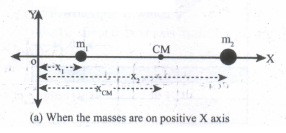
Let the center of mass of two point masses m1 and m2, which are at positions x1 and x2 respectively on the X-axis. For this case, we can express the position of center of mass in the following three ways based on the choice of the coordinate system.
(i) When the masses are on positive X-axis: The origin is taken arbitrarily so that the masses m1 and m2 are at positions x1 and x2 on the positive X-axis as shown in Figure. The center of mass will also be on the positive X-axis at xCM as given by the expression,
\({ x }_{ CM }=\frac { { m }_{ 1 }x_{ 1 }+{ m }_{ 2 }x_{ 2 } }{ { m }_{ 1 }+{ m }_{ 2 } } \)
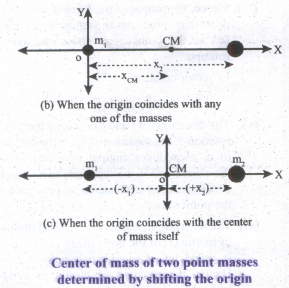
(ii) When the origin coincides with any one of the masses: The calculation could be minimised if the origin of the coordinate system is made to. coincide with any one of the masses as shown in Figure. When the origin coincides with the point mass m1 its position x1 is zero, (i.e. x1 = 0). Then,
\({ x }_{ CM }=\frac { { m }_{ 1 }\left( 0 \right) +{ m }_{ 2 }x_{ 2 } }{ { m }_{ 1 }+{ m }_{ 2 } } \)
The equation further simplifies as,
\({ x }_{ CM }=\frac { { m }_{ 2 }x_{ 2 } }{ { m }_{ 1 }+{ m }_{ 2 } } \)
(iii) When the origin coincides with the center of mass itself:
If the origin of the coordinate system is made to coincide with the center of mass, then, xCM =0 and the mass m1 is found to be on the negative X-axis as shown in Figure. Hence, its position x1 is negative, (i.e. -x1).
\(0=\frac { { m }_{ 1 }\left( -{ x }_{ 1 } \right) +{ m }_{ 2 }{ x }_{ 2 } }{ { m }_{ 1 }+{ m }_{ 2 } } \)
0 = m1(-x1) + m2x2
m1x1 = m2x2
The expression given above is known as principle of moments.
25.
(i) Parallel axis theorem states that the moment of inertia of a body about any axis is equal to the sum of its moment of inertia about a parallel axis through its center of mass and the product of the mass of the body and the square of the perpendicular distance between the two axes.
(ii) If IC is the moment of inertia of the body of mass M about an axis passing through the center of mass, then the moment of inertia I about a parallel axis at a distance d from it is given by the relation,
I = IC + Md2
(iii) Let us consider a rigid body as shown in Figure. Its moment of inertia about an axis AB passing through the center of mass is IC DE is another axis parallel to AB at a perpendicular distance d from AB. The moment of inertia of the body about DE is I. We attempt to get an expression for I in terms of IC For this, let us consider a point mass m on the body at position x from its center of mass.
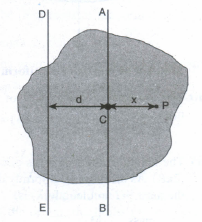
(iv) The moment of inertia of the point mass about the axis DE is, m(x + d)2. The moment of inertia I of the whole body about DE is the summation of the above expression.
\(I=\sum { m\left( x+d \right) ^{ 2 } } \)
This equation could further be written as,
\(I=\sum { m\left( { x }^{ 2 }+{ d }^{ 2 }+2xd \right) } \)
\(I=\sum { \left( { mx }^{ 2 }+m{ d }^{ 2 }+2dmx \right) } \)
\(I=\sum { { mx }^{ 2 }+\sum { m{ d }^{ 2 } } +2d\sum { mx } } \)
(v) Here, \(\sum { mx^{ 2 } } \) is the moment of inertia of the body about the center of mass. Hence,
IC = \(\sum { mx= } 0\) because, x can take positive and negative values with respect to the axis AB. The summation \(\left( \sum { mx } \right) \) will be zero.
Thus, I = Ic + \(\sum { md^{ 2 } } \) = IC + \(\left( \sum { m } \right) d^{ 2 }\)
(vi) Here, \(\sum { m } \) is the entire mass M of the object \(\left( \sum { m=M } \right) \)
I = IC + Md2
Hence the parallel axis theorem is proved.
26.
Let us consider a uniform rod of mass (M) and length (1) as shown in Figure. Let us find an expression for moment of inertia of this rod about an axis that passes through the center of mass and perpendicular to the rod. First an origin is to be fixed for the coordinate system so that it coincides with the center of mass, which is also the geometric center of the rod. The rod is now along the x axis. We take an infinitesimally small mass (dm) at a distance (x) from the origin. The moment of inertia (dI) of this mass (dm) about the axis is,
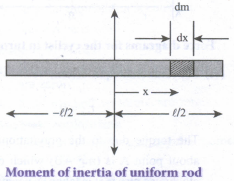
dI = (dm) x2
As the mass is uniformly distributed, the mass per unit length (λ) of the rod is, \(\lambda =\frac { M }{ l } \)
The (dm) mass of the infinitesimally small length as, dm = λ dx = \(\frac { M }{ l } dx\)
The moment of inertia (I) of the entire rod can be found by integrating dI,
\(I=\int { dI } =\int { \left( dm \right) { x }^{ 2 } } =\int { \left( \frac { M }{ l } dx \right) { x }^{ 2 } } \)
\(I=\frac { M }{ l } \int { { x }^{ 2 }dx } \)
As the mass is distributed on either side of the origin, the limits for integration are taken from -1/2 to 1/2.
\(I=\frac { M }{ l } \int _{ -t/2 }^{ t/2 }{ { x }^{ 2 }dx=\frac { M }{ l } } \left[ \frac { { x }^{ 3 } }{ 3 } \right] ^{ t/2 }_{ -t/2 }\)
\(I=\frac { M }{ l } \left[ \frac { { l }^{ 3 } }{ 24 } -\left( -\frac { { l }^{ 3 } }{ 24 } \right) \right] =\frac { M }{ l } \left[ \frac { { l }^{ 3 } }{ 24 } +\frac { { l }^{ 3 } }{ 24 } \right] \)
\(I=\frac { M }{ l } \left[ 2\left( \frac { { l }^{ 3 } }{ 24 } \right) \right] \)
I = \(\frac { 1 }{ 12 } \) ml2
27.
A body is said to be in equilibrium if both the linear momentum and angular momentum of the rigid body remain constant with time. Hence for a body in equilibrium, the linear acceleration of its centre of mass would be zero and also the angular acceleration of the rigid body about any axis would be zero.
The different types of equilibrium of a body are
1. Stable equilibrium
2. Unstable equilibrium
3. Neutral equilibrium
Equilibrium is thus stable, unstable neutral according, to whether potential energy is minimum, maximum or instant.

Let us consider the motion of a marble along a curved surface of a bowls.
If a marble M is placed on a curved surface of a bowl S it rolls down and settles in equilibrium at the lowest point A as shown in figure (a).
If the marble is disturbed and displaced at B, its energy increases. When it is released, the marble rolls back at A. Thus the marble at the portion A is said to be in stable equilibrium. In this case, the body possess minimum potential energy.
Suppose, now that bowl S is inverted and the marble is placed at its top point at A as shown in Fig (b).
If the marble is displaced slightly to the point C, its potential energy is lowered and tends to move further away from the equilibrium position to one of lowest energy. Thus the marble is said to be in unstable equilibrium.
Consider that the marble M is placed on the plane surface as shown in figure (c). If it is displaced slightly, its potential energy does not change. In this case, the marble is said to be in neutral equilibrium.
Translational equilibrium:
The resultant of all the external forces acting on the body must be zero.
\(\sum \vec{F}_{ext} =0 \ or \sum F_x=0\sum F_y=0\sum F_2=0\)
\(\sum \vec{F}_{ext} =M\vec{\alpha}_{CM}=M \frac{d\vec{v}_{CM}}{dt}=0\)
or \(\frac{d\vec{v}_{CM}}{dt}\)=0 or \(\vec{v}_{cm}\) = constant
This implies that a body in translational equilibrium, will be either at rest (v = 0) or in uniform motion. If the body is in uniform motion along a straight path, it is in dynamic equilibrium
Rotational equilibrium:
For rotational equilibrium \(\sum \vec{\tau}_{ext}=\sum \vec{r}.x\vec{F}_{ext}=0\)
If the total torque is zero about any point, then it will be zero about any other point when the body is in equilibrium
28.
The answer is wrong.
Actually, the seasons in the Earth arise due to the rotation of Earth around the sun with 23.5o tilt.
29.
Consider an object of mass m at a height h from the surface of the Earth. Acceleration experienced by the object due to Earth is
g' = \(\frac { GM }{ ({ R }_{ e }+h)^{ 2 } } \) ..........(1)
g'= \(\frac { GM }{ { R }_{ e }^{ 2 }\left( 1+\frac { h }{ { R }_{ e } } \right) ^{ 2 } } \)
g'=\(\frac { GM }{ { R }_{ e }^{ 2 } } \left( 1+\frac { h }{ { R }_{ e } } \right) ^{ 2 }\)
If h << Re
We can use Binomial expansion. Taking the terms up to first order
g'= \(\frac { GM }{ { R }_{ e }^{ 2 } } \left( 1-2\frac { h }{ { R }_{ e } } \right) \)
g' = \(g\left( 1-2\frac { h }{ { R }_{ e } } \right) \) .....(2)
We find that g'< g. This means that as altitude h increases, the acceleration due to gravity g decreases.
30.
The expression for total kinetic energy in pure rolling is,
KE = KETRANS + KEROT
For any object the total kinetic energy as per given equation
\(KE=\frac{1}{2}Mv^{2}_{CM}+\frac{1}{2}Mv^{2}_{CM}(\frac{K^{2}}{R^{2}})\)
\(KE=\frac{1}{2}Mv^{2}_{CM}(1+\frac{K^{2}}{R^{2}})\)
Then, \(\frac{1}{2}Mv^{2}_{CM}(1+\frac{K^{2}}{R^{2}})\)=\(\frac{1}{2}Mv^{2}_{CM}+\frac{1}{2}Mv^{2}_{CM}(\frac{K^{2}}{R^{2}})\)
The above equation suggests that in pure rolling the ratio of total kinetic energy, translational kinetic energy and rotational kinetic energy is given as,
KE:KETRANS KEROT::\((1+\frac{K^{2}}{R^{2}}):1:(\frac{K^{2}}{R^{2}})\)
Now, KETRANS: KEROT::1:\((\frac{K^{2}}{R^{2}})\)
For a solid sphere, \(\frac{K^{2}}{R^{2}}=\frac{2}{5}\)
Then, KETRANS: KEROT::1:\(\frac{2}{5}\) or KETRANS: KEROT:: 5:2

11th Standard Syllabus & Materials
11th Standard
TN 11th Tamil பீடு பெற நில் - செய்யுள் - காவடிச்சிந்து Important Questions And Answers Study Material - QB365 Set A
NEW11th Standard
TN 11th Tamil பீடு பெற நில் - உரைநடை - மலை இடப்பெயர்கள் : ஓர் ஆய்வு Important Questions And Answers Study Material - QB365 Set A
NEW11th Standard
TN 11th Tamil மாமழை போற்றுதும் - துணைப்பாடம் - யானை டாக்டர் Important Questions And Answers Study Material - QB365 Set A
NEW11th Standard
TN 11th Tamil மாமழை போற்றுதும் - செய்யுள் - ஐங்குறுநூறு Important Questions And Answers Study Material - QB365 Set A



Tamilnadu Stateboard 11th Standard Subjects

Maths

Commerce

Economics

Biology

Business Maths and Statistics

Accountancy

Computer Science
Physics

Chemistry
Maths
Biology
Economics
Physics
Chemistry

History
Business Maths and Statistics

Computer Science
Accountancy

Computer Applications
History
Computer Technology
Commerce
Computer Applications
Computer Technology

Tamil

English

French
Tamilnadu Stateboard Standards

