
 100% FREE ACCESS
11th Standard Syllabus & Materials
11th Standard
TN 11th Tamil இயற்கை வேளாண்மை,சுற்றுச்சூழல் -செய்யுள் - மனோன்மணீயம் Important Questions And Answers Study Material - QB365 Set A
NEW11th Standard
TN 11th Tamil என்னுயிர் என்பேன் -துணைப்பாடம் - இசைத்தமிழர் இருவர் Important Questions And Answers Study Material - QB365 Set A
NEW11th Standard
TN 11th Tamil மொழி கலை -செய்யுள் - ஒவ்வொரு புல்லையும் Important Questions And Answers Study Material - QB365 Set A
NEW11th Standard
TN 11th Tamil பீடு பெற நில் - இலக்கணம் - பகுபத உறுப்புகள் Important Questions And Answers Study Material - QB365 Set A
NEW11th Standard
TN 11th Tamil பீடு பெற நில் - துணைப்பாடம் - வாடிவாசல் Important Questions And Answers Study Material - QB365 Set A
NEW11th Standard
TN 11th Tamil பீடு பெற நில் - செய்யுள் - குறுந்தொகை Important Questions And Answers Study Material - QB365 Set A

Published on: 30/09/2018
Important question-chapter 1,2
Download Tamil Nadu 11th Standard Maths question papers, model tests, one-mark questions, important questions, and public exam papers in PDF format. Free study materials and answer keys for TN State Board students.
Questions + Answers key
Take MCQ Maths Test1.
If P(x) = x3 + 3x2 + 2x + 1, then the remainder on dividing p(x) by (x - 1) is ___________
7
0
6
1
2.
If \(\alpha\) and \(\beta\) are the roots of 2x2 - 3x - 4 = 0 find the value of \(\alpha^2+\beta^2\)
\(\frac{41}{4}\)
\(\frac{\sqrt{14}}{2}\)
0
none of these
3.
The value of loga b logb c logc a is
2
1
3
4
4.
The rule f(x) = x2 is a bijection if the domain and the co-domain are given by
R, R
R, (0, ∞)
(0, ∞), R
[0, ∞), [0,∞)
5.
Let X = {1, 2, 3, 4} and R = {(1, 1), (1, 2), (1, 3), (2, 2), (3, 3), (2, 1), (3, 1), (1, 4),(4, 1)}. Then R is
reflexive
symmetric
transitive
equivalence
6.
Let R be the universal relation on a set X with more than one element. Then R is
not reflexive
not symmetric
transitive
none of the above
7.
If f : R➝R is given by f(x) = 3x - 5, then f-1(x) is __________
\(\frac{1}{3x-5}\)
\(\frac{x+5}{3}\)
does not exist since f is not one-one
does not exist since f is not onto
8.
Let R be the set of all real numbers. Consider the following subsets of the plane R x R: S = {(x, y) : y =x + 1 and 0 < x < 2} and T = {(x,y) : x - y is an integer} Then which of the following is true?
T is an equivalence relation but S is not an equivalence relation
Neither S nor T is an equivalence relation
Both S and T are equivalence relation
S is an equivalence relation but T is not an equivalence relation.
9.
For real numbers x and y, define xRy if x - y + √2 is an irrational number. Then the relation R is __________
reflexive
symmetric
transitive
none of these
10.
Let f:R➝R be defined by f(x) = 1 - |x|. Then the range of f is
R
(1,∞)
(-1,∞)
(-∞,1]
11.
Determine the region in the Plane determined by the inequalities 3x+4y≤60,x+3y≤30,x≥0,y≥0
12.
Forensic Scientists use h = 61.4+2.3F to predict the height h in centimeters for a female whose thigh bone (femur) measures F cm. If the height of the female lies between 160 to 170 cm find the range of values for the length of the thigh bone?
13.
Solve the linear inequalities and exhibit the solution set graphically: x + y ≥ 3, 2x - y ≤ 5, -x + 2y ≤ 3.
14.
Resolve into partial fractions: \(\frac{x+1}{x^2(x-1)}\)
15.
Find the largest possible domain of the real valued function f(x) =\(\frac { \sqrt { 4-{ x }^{ 2 } } }{ \sqrt { { x }^{ 2 }-9 } } \)
16.
Resolve the following rational expressions into partial fractions.
\({{{(x-1)}^{2}}\over{x^3+x}}\)
17.
On the set of natural numbers let R be the relation defined by aRb if a + b \(\le\) 6. Write down the relation by listing all the pairs. Check whether it is transitive
18.
If the equations x2 - ax + b = 0 and x2 - ex + f = 0 have one root in common and if the second equation has equal roots, then prove that ae = 2 (b + f).
19.
Evaluate \(\sqrt [ 3 ]{ {{{(45.4)}^{2}}\over{{(3.2)}^{2}}\times{(6.5)}^{2}} } \)
20.
Let A = {a, b, c, d}, B = {a, c, e}, C = {a, e}.
Show that A ∩ (B ∩ C) = (A ∩ B) ∩ C
21.
Solve the equation \(8+9\sqrt{(3x-1)(x-2)}=3x^2-7x.\)
22.
From the curve y = sin x, draw y = sin |x|. (Hint: sin (-x) = -sin x)
23.
Solve \({2x-1\over x}>-1\)
24.
Find the domain and range of the function f(x) = \(\frac { 1 }{ \sqrt { x-5 } } \).
25.
Let f = {(1, 2), (3, 4), (2, 2)} and g = {(2, 1), (3, 1), (4, 2)}. Find g o f and f o g.
26.
Solve x = \(\sqrt{x+20}\) for x ∈ R
27.
Find a quadratic polynomial f(x) such that, f(0) = 1; f(-2) = 0 and f(1) = 0.
28.
Solve the following system of linear inequalities 3x - 9 ≥ 0, 4x -10 ≤ 6;
29.
Solve 3|x - 2| + 7 = 19 for x.
30.
Draw venn diagram of three sets A, B and C which illustrates the following:
A and B disjoint but both are subsets of C.
31.
Write a description of each shaded area. Use symbols U, A, B, C, U, ∩, ' and \ as necessary.
.png)
32.
Write a description of each shaded area. Use symbols U, A, B, C, U, ∩, ' and \ as necessary.
.png)
33.
If a2+ b2 = c2, show that a6 + b6 + 3a2b2c2 = c6.
34.
Prove \(log\frac { { a }^{ 2 } }{ bc } +log\frac { b^{ 2 } }{ ca } +log\frac { c^{ 2 } }{ ab } =0\)
35.
Resolve with partial fractions \(\frac{1}{(x^2-1)(x+2)}\)
36.
Solve \(\frac{6-x}{3}<\frac{x}{4}-1\)
37.
If a3+ b3= ab(8 - 3a - 3b), show that log \(\left( \frac { a+b }{ 2 } \right) =\frac { 1 }{ 3 } \) (log a + log b)
38.
Let A be the set of all 50 students of class XII. Let f : R➝N be a function defined by f(x)=Roll number of student x. Show that f is one-one but not onto.
39.
Show that the relation R on the set A = {1, 2, 3} given by R = {(1, 1) (2, 2) (3, 3) (1, 2) (2, 3)} is reflexive but neither symmetric nor transitive.
40.
Discuss the following relations for reflexivity, symmetricity and transitivity :
On the set of natural numbers, the relation R is defined by "xRy if x + 2y = 1".
1.
(a)
7
2.
(b)
\(\frac{\sqrt{14}}{2}\)
3.
\(\log _{a} b \log _{b} c \log _{c} a=\log _{a} c \log _{c} a=\log _{a} a=1\)
4.
\(\text { The domain is }[0, \infty)\)
\(\text { The codomain is also }[0, \infty)\)
5.
\(\text { If } 4 \in X \text { then }(4,4) \notin \mathrm{R}\)
R is not reflexive
symmetric can be easily checked
6.
Let X = (a, b, c)
Then R = Universal relation
= {(a, a), (a, b), (a, c), (b, a), (b, b), (b, c), (c, a), (c, b), (c, c)}.
It is transitive
7.
(b)
\(\frac{x+5}{3}\)
8.
\(\mathrm{T}: x-y \text { is an integer } \Rightarrow x \mathrm{R} y\)
\(\text { i) } x-x=0 \text { is an integer }\)
\(\therefore \text { T is reflexive. }\)
\(\text { ii) }(x-y) \text { is an integer } \Rightarrow y-x \text { is also an integer }\)
\(\therefore \mathrm{T} \text { is symmetry }\)
iii) If (x - y) is an integer and y- z is also an integer, by adding
x - z is also an integer.
\(\therefore \mathrm{T} \text { is transitive }\)
Thus, T is an equivalence relation.
\(\mathrm{S}: \mathrm{y}=x+1 \Rightarrow x \mathrm{~S} y\)
\(\text { i) } x=x+1 \Rightarrow x S x \text { is not true. }\)
\(\therefore S \text { is not reflexive. }\)
Hence T is an equivalence relation but S is not an equivalence relation
9.
(a)
reflexive
10.
\(\mathrm{f}: \mathbb{R} \rightarrow \mathbb{R} \text { is defined by }\)
\(\mathrm{f}(x)=1-|x|\)
\(\text { The range is }(-\infty, 1] \text { as } f(-\infty)=-\infty\)
\(f(0)=1\)
\(f(\infty) =-\infty\)
11.
The given inequality 3x+4y ≤ 60.
Draw the graph of the line 3x+3y =60
Table of values satisfying the equation
3x +4y= 60
| x | 8 | 12 |
| y | 9 | 6 |
Putting (0, 0) in the given inequation, we have 3\(\times\)0+4\(\times\)0≤60⇒ 0≤60
∴ Half plane of 3x+4y≤60 is towards origin.
Also the given inequality x+3y≤30.
Draw the graph of the line x + 3y = 30.
Table of values satisfying the equation
x+3y=30
| x | 0 | 9 |
| y | 10 | 7 |
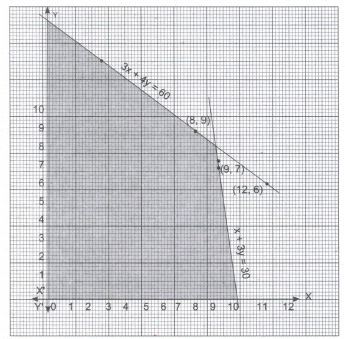
Putting (0, 0) in the given inequation, we have 0+3\(\times\)0≤30 ⇒0≤30 which is true.
∴ Half plane of x+3y≤30 is towards origin.
12.
Given h = 61.4 + 2.3 F
Given h = 160 ⇒160 = 61.4 + 2.3 F
⇒ 2.3 F = 160-61.4 = 98.6
F =\(\frac { 98.6 }{ 2.3 } \) = 42.87
Given h = 170,
170 = 61.4 + 2.3 F
⇒ 170 - 61.4 = 2.3 F
2.3 F = 108.6
⇒ F =\(\frac { 108.6 }{ 2.3 } \)= 47.23
So the ranges of values are
42.8 < x < 47.23
13.
Observe that a straight line can be drawn if we identify any two points on it. For example, (3, 0) and (0, 3) can be easily identified as two .points on the straight line x + y = 3.
Draw the three straight lines x + y = 3, 2x - y = 5 and -x + 2y = 3.
Now (0, 0) does not satisfy x +y ≥ 3. Thus, the half plane bounded by x + y = 3, not containing the origin, is the solution set of x + y ≥ 3.
Similarly, the half-plane bounded by 2x - y ≤ 5 containing the origin represents the solution set of the 2x - y ≤ 5
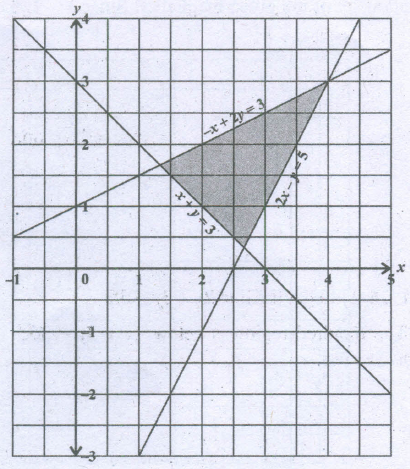
The region represented by -x + 2y ≤ 3 is the half space bounded by the straight line the line -x + 2y = 3 that contains the origin.
The region common to the above three half planes represents the solution set of the given linear inequalities.
14.
Let \(\frac{x+1}{x^2(x-1)}=\frac{A}{x}+\frac{B}{x^2}+\frac{C}{x-1}\)
Then, x + 1 = Ax(x - 1) + B(x - 1) + Cx2
When x = 0, we have B = -1 and when x = 1, we get C = 2
When x = -1 we have 2A - 2B + C = 0 which gives A = -2
Thus, \(\frac{x+1}{x^2(x-1)}=\frac{-2}{x}-\frac{1}{x^2}+\frac{2}{x-1}\)
15.
Given f(x) = \(\frac { \sqrt { 4-{ x }^{ 2 } } }{ \sqrt { { x }^{ 2 }-9 } } \)
When x = 2, f(x) = 0
When x = -2, f(x) = 0
For all the other values, we get negative value in the square root which is not possible.
\(\therefore\) Domain = {2, -2}
16.
\({{{(x-1)}^{2}}\over{x^3+x}}={{{(x-1)}^{2}}\over{x(x^2+1)}}={{A}\over{x}}+{{Bx+C}\over{x^2+1}}\)
\(\Rightarrow\) (x-1)2 = A(x2+ 1) + (Bx + C)(x)
Putting x = 0 in (1) we get,
\(\boxed{1=A}\)
Putting x = 1 in (1) we get.
0 = A(2) + (B + C)(1)
\(\Rightarrow\) 0 = 2A + B + C
Equating the Coefficient of x2 in (1) we get,
1 = A + B \(\Rightarrow\) 1 = 1 B \(\Rightarrow\) \(\boxed{B=0}\)
Substituting A = 1, B = 0 in (2) we get,
0 = 2 + 0 + C \(\Rightarrow\) \(\boxed{C=-2}\)
\(\therefore\) \({{{(x-1)}^{2}}\over{x^3+x}}={{1}\over{x}}+{{0x-2}\over{x^2+1}}\)
\(\Rightarrow\) \({{{(x-1)}^{2}}\over{x^3+x}}={{1}\over{x}}-{{2}\over{x^3+1}}\)
17.
The relation is defined by aRb if a + b \(\le\) 6 for all a, b \(\in \)N.
a+b \(\le\)6 \(\Rightarrow\) a \(\le\) 6 - b
| a | 5 | 4 | 3 | 2 | 1 |
| b | 1 | 2 | 3 | 4 | 5 |
\(\therefore\) The list of ordered pairs are (5,1) (4, 2) (3, 3) (2, 4) and (1, 5).
(4, 2) \(\in \) R and (2, 4) \(\in \) R \(\Rightarrow\) (4, 4) \(\notin \) R
\(\therefore\) R is not transitive.
18.
Given equations are x2 - ax + b = 0 .....(1)
and x2 - ex + f = 0 .....(2)
Let \(\alpha\) be the common root.
Let \(\alpha ,\beta \) be the roots of x2 - ax + b = 0
Then \(\alpha +\beta =a\) and \(\alpha \beta =b\) ....(3)
Let \(\alpha\), \(\alpha\) be the roots of x2 - ex +f = 0 [\(\because\) the roots are equal]
\(\therefore\) \(\alpha\)+\(\alpha\) = e, \(\alpha \times \alpha =f\)
\(\Rightarrow\) \(2\alpha =e\) and \({ \alpha }^{ 2 }=f\) .....(4)
Now LHS = \(ae=\left( \alpha +\beta \right) 2\alpha \)
LHS = \(ae=2{ \alpha }^{ 2 }+2\alpha \beta \)
= 2(f) + 2b [From (4)]
= 2 (b + f) = RHS. Hence proved.
19.
Let x = \(\sqrt[3]{(45.4)^2\over (3.2)^2\times(6.5)^3}\)
Taking logarithms of both sides, we get
log x = \(log\left[ (45.4)^2\over (3.2)^2\times(6.5)^3 \right]^{1/3}\)
\(={1\over 3}log\left(45.4)^2\over (3.2)^2\times(6.5)^2\right)\)
\(={1\over 3}[2log 45.4 - 2 log3.2 - 3 log 6.5]\)
\(={1\over 3}[2(1.6571) - 2(0.5052)- 3 (0.8129)]\)
\(={1\over 3}(-0.1349)= -0.0450\)
= -1 + 1 - 0.0450 = -1.9550
log x = -1.9550
⇒ x = antilog (-1.9550)
⇒ x = 0.9016
20.
Given A = {a, b, c, d}, B = {a, c, e}, C = {a, e}
B∩C = {a, c}
A∩(B∩C) = {a}
A ∩ B = {a, e}
(A ∩ B) ∩ C = {a}
From (1) and (2), it is clear that A ∩ (B ∩ C) = (A ∩ B) ∩ C.
21.
Given equation is
.png)
\(8+9\sqrt{(3x-1)(x-2)}=3x^2-7x\)
⇒ \(9\sqrt{(3x-1)(x-2)}=3x^2-7x-8\)
⇒ \(9\sqrt{3x^2-7x+2}=(3x^2-7x-2)-10\)
Let \(\sqrt{3x^2-7x+2}=y\)
⇒ 9y = y2 - 10 ⇒ y2 - 9y - 10 = 0
⇒ (y-10)(y + 1) = 0 [By factorisation]
⇒ \(y=0\ or \ -1⇒\sqrt{3x^2-7x+2}=10\ or\ -1\)
Case (i) :
When \(\sqrt{3x^2-7x+2}=10\)
3x2 - 7x + 2 = 100
3x2 - 7 x - 98 = 0
(x - 7) (3x + 14) = 0
x = 7 or x = \(-14\over 3\)
.png)
Case(ii) :
When \(\sqrt{3x^2-7x+2}=-1\)
This is impossible
The roots are 7, \({{-14}\over{3}}\)
22.
y = sin |x|
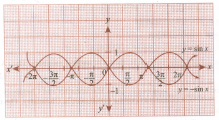
We know \(|x| =\begin{cases}x\ if\ x\ge0 \\-x\ if\ x<0 \end{cases}\)
∴ sin |x| = sin x if x > 0 and sin |x| = sin (-x) = -sin x if x < 0.
The graph of y = sin (-x) = - sin x is the reflection of the graph of sin x about Y-axis.
23.
\({2x-1\over x}>-1\)
⇒ \({2x-1\over x}+1>-1+1\)
(i.e) \({2x-1+x\over x}>0\)
\(\frac { (3x-1) }{ x } >0\)
⇒ \(\frac { (3x-1)(x) }{ x } >0\times x\)
(i.e) x(3x-1) > 0
x>0 and x\(<\frac { 1 }{ 3 } \)
So \((-∞,0) \cup \left( \frac { 1 }{ 3 } ,\infty \right) \)
24.
Given that : f(x) =\(\frac { 1 }{ \sqrt { x-5 } } \)
Here, it is clear that/ex) is real when x - 5 > 0 ⇒ x > 5
Hence, the domain = \((5,\infty)\)
Now to find the range put
\(f(x)=y=\frac { 1 }{ \sqrt { x-5 } } \)
\(⇒ \sqrt { x-5 } =\frac { 1 }{ y } \Rightarrow x-5=\frac { 1 }{ { y }^{ 2 } } \)
\(⇒ x=\frac { 1 }{ { y }^{ 2 } } +5\)
For x \(\in \) \((5,\infty),\) y \(\in \) R+.
Hence, the range of f = R+
25.
To check whether compositions can be defined, let us find the domain and range of these functions.
Domain of f = {1, 2, 3}, Range of f = {2, 4}, Domain of g = {2, 3, 4} and Range of g = {1, 2}. Since the range of f is contained in the domain of g we can define g o f, so as to find the image of 1 under g o f, we first find the image of 1 under f and then its image under g. The image of 1 under f is 2 and its image under g is 1. So (g o f) (1) = g(f(1)) = g(2) = 1.
Similarly we find that (g o f) (2) = 1 and (g o f) (3) = 2. So g o f = {(1, 1), (2, 1), (3, 2)}.
Similarly f o g = {(2, 2), (3, 2), (4, 2)}.
26.
Observe that \(\sqrt{x+20}\) is defined only if x + 20 ≥ 0
By definition, \(\sqrt{x+20}\ge0\). So, x is positive.
Now squaring we get x2= x + 20. x2- x - 20 = 0
(x - 5)(x + 4) = 0, which gives x = 5, x = -4
Since, x is positive, the required solution is x = 5
27.
Let f(x) = ax2 + bx + c be the polynomial satisfying the given conditions.
f(0) = a(0)2 + b(0) + c = 1, implies that c = 1. Now the other two conditions f(-2) = 0; f(1) = 0 give 4a - 2b + c = 0 and a + b + c = 0.
Using c = 1, we get 4a - 2b = -1 and a + b = -1. Solving these two equations we get a = b = \(-\frac{1}{2}\) and thus, we have f(x) =\(-\frac{1}{2}x^2-\frac{1}{2}x+1\)
28.
Note that 3x - 9 ≥ 0 implies 3x ≥ 9, by multiplying both sides by \(\frac{1}{3}\) we get x ≥ 3.
Similarly, 4x - 10 ≤ 6 implies 4x ≤ 16 and hence x ≤ 4
So the solution set of 3x - 9 ≥ 0, 4x -10 ≤ 6 is the intersection of [3, ∞) and (-∞, 4]. Clearly, the intersection of these intervals give [3, 4].
29.
3|x - 2| + 7 = 19, So that we have, |x - 2| = \(\frac { 19-7 }{ 3 } =4\). Thus, we have either, x - 2 = 4 (or) x - 2 = -4
Therefore the solutions are x = -2 (or) x = 6
30.
The venn diagram of A and B are disjoint sets but both are subsets of C is
.png)
31.
The shaded region is (A ∩ B)\C.
32.
The shaded region is (A ∩ B) U (A ∩ B)
33.
Given a2+ b = c2
Taking power 3 both sides, we get
\(\Rightarrow\) (a2+ b2) = (c2)3
\(\Rightarrow\) (a2)3+ 3(a2)2(b2) + 3a2(b2)2 + (b2)3 = c6 [ \(\because\) (a + b)3 = a3 + 3a2b 3ab2 + b3 ]
\(\Rightarrow\) a6+ 3a4b2+3a2b4+ b6= c6
\(\Rightarrow\) a6+ b6+ 3a2b2(a2+b2) = c6
\(\Rightarrow\) a6+ b6+ 3a2b2c2 = c6 \([\because a^2+b^2=c^2]\)
Hence proved.
34.
LHS = \(log\frac { { a }^{ 2 } }{ bc } +log\frac { b^{ 2 } }{ ca } +log\frac { c^{ 2 } }{ ab } \)
= \(log\left( \frac { { a }^{ 2 } }{ bc } .\frac { b^{ 2 } }{ ca } .\frac { c^{ 2 } }{ ab } \right) \)
= \(log\left( \frac { { a }^{ 2 }b^{ 2 }c^{ 2 } }{ { a }^{ 2 }b^{ 2 }c^{ 2 } } \right) \)
= log 1 = 0 =RHS
Hence proved
35.
\(\frac{1}{6(x-1)}-\frac{1}{2(x+1)}+\frac{1}{3(x+2)}\)
36.
x>\(\frac{36}{7}\)
37.
Given a3+b3 = ab (8-3a-3b)
⇒ a3+ b3 = 8ab - 3a2b - 3ab2
⇒ a3+b3+3a2b+3ab2=8ab
⇒ (a+b)3= 23 ab
⇒ \(\left( \frac { a+b }{ 2 } \right) ^{ 3 }\)= ab
⇒ log\(\left( \frac { a+b }{ 2 } \right) \) = log ab [Taking logarithm on both sides]
⇒ 3 log\(\left( \frac { a+b }{ 2 } \right) \) log a + log b [Using power rule and product rule]
⇒ log \(\left( \frac { a+b }{ 2 } \right) \) = \(\frac { 1 }{ 3 } \) [log a + log b]
38.
f associates each students to his/her roll number.
Since, no two different students of the class can have the same roll number, f is one-one.
Here, co-domain = N
Range = {1,2,3,...50}
Since Range ≠ co-domain, f is not onto.
39.
Since A = {1, 2, 3}
(1,1) (2, 2) (3, 3) ∈ R ⇒ is reflexive.
Also (1, 2) ∈ R but (2, 1) ∉ R ⇒ R is not symmetric.
And (1, 2) ∈ R, (2, 3) ∈ R but (1, 3) ∉ R ⇒ R is not transitive.
R is reflexive but neither symmetric nor transitive.
40.
The relation R is defined by xRy if x + 2y = 1 for x, y \(\in \) N.
Reflexivity : Let x, y \(\in \) N
xRx \(\Rightarrow\) x + 2x = 1 \(\Rightarrow\) 3x = 1 \(\Rightarrow\) x = \(\frac { 1 }{ 3 } \notin N\)
\(\therefore\) R is reflexive.
Symmetricity: xRy \(\Rightarrow\) yRx for x, y \(\in \) N
xRy \(\Rightarrow\) x + 2y = 1 which is not possible for any values of x, Y \(\in \) N
\(\therefore\) R is not symmetric
Transitivity: xRy and yRz \(\Rightarrow\) xRz.
xRy and yRz are not possible for any values of x, y, z \(\in \) N
\(\therefore\) R is not transitive.
\(\therefore\) R is neither reflexive, nor symmetric and not transitive.

11th Standard Syllabus & Materials
11th Standard
TN 11th Tamil பீடு பெற நில் - செய்யுள் - காவடிச்சிந்து Important Questions And Answers Study Material - QB365 Set A
NEW11th Standard
TN 11th Tamil பீடு பெற நில் - உரைநடை - மலை இடப்பெயர்கள் : ஓர் ஆய்வு Important Questions And Answers Study Material - QB365 Set A
NEW11th Standard
TN 11th Tamil மாமழை போற்றுதும் - துணைப்பாடம் - யானை டாக்டர் Important Questions And Answers Study Material - QB365 Set A
NEW11th Standard
TN 11th Tamil மாமழை போற்றுதும் - செய்யுள் - ஐங்குறுநூறு Important Questions And Answers Study Material - QB365 Set A



Tamilnadu Stateboard 11th Standard Subjects
Maths

Commerce

Economics

Biology

Business Maths and Statistics

Accountancy

Computer Science

Physics

Chemistry
Maths
Biology
Economics
Physics
Chemistry

History
Business Maths and Statistics

Computer Science
Accountancy

Computer Applications
History
Computer Technology
Commerce
Computer Applications
Computer Technology

Tamil

English

French
Tamilnadu Stateboard Standards

