
 100% FREE ACCESS
11th Standard Syllabus & Materials
11th Standard
TN 11th Tamil இயற்கை வேளாண்மை,சுற்றுச்சூழல் -செய்யுள் - மனோன்மணீயம் Important Questions And Answers Study Material - QB365 Set A
NEW11th Standard
TN 11th Tamil என்னுயிர் என்பேன் -துணைப்பாடம் - இசைத்தமிழர் இருவர் Important Questions And Answers Study Material - QB365 Set A
NEW11th Standard
TN 11th Tamil மொழி கலை -செய்யுள் - ஒவ்வொரு புல்லையும் Important Questions And Answers Study Material - QB365 Set A
NEW11th Standard
TN 11th Tamil பீடு பெற நில் - இலக்கணம் - பகுபத உறுப்புகள் Important Questions And Answers Study Material - QB365 Set A
NEW11th Standard
TN 11th Tamil பீடு பெற நில் - துணைப்பாடம் - வாடிவாசல் Important Questions And Answers Study Material - QB365 Set A
NEW11th Standard
TN 11th Tamil பீடு பெற நில் - செய்யுள் - குறுந்தொகை Important Questions And Answers Study Material - QB365 Set A

Published on: 01/08/2018
From the chapter Taxonomy and Systematic Botany., some of the important questions are covered in this question paper. The questions are covers from the book back and the previous year questions.
For Teachers, can examine their student’s knowledge. They can prepare plenty of question paper with answer key. For subscription, please Click Here
Download Tamil Nadu 11th Standard Biology question papers, model tests, one-mark questions, important questions, and public exam papers in PDF format. Free study materials and answer keys for TN State Board students.
Questions + Answers key
Take MCQ Biology Test1.
Duplicate specimen of the holotype collected from same population _____________.
Holotype
Isotype
Lectotype
Syntype
2.
Bambusetum is the major attraction in ............
BSI
Kew Herbarium
Jawaharlal Nehru Botanical Garden
New York Botanical Garden
3.
Botanical survey of India has its headquarters in
Kolkata
New Delhi
Dehradun
Shimla
4.
The largest botanical garden is in ............
Kew
Kolkata
Brazil
Sydney
5.
19th International Botanical Congress was held in .............
Australia
China
India
Egypt
6.
Choose the wrong statement with reference to 'species'.
Common ancestor
Closely resemble
Do not interbreed
Morphologically similar
7.
Flowers are zygomorphic in ______.
Ceropegia
Thevetia
Datura
Solanum
8.
Perianth is present in_______.
Clitoria ternatea
Datura metel
Allium cepa
Pongamia pinnata
9.
The taxonomy which involves the similarities & dissimilarities among the immune system of different taxa is termed as ______.
Chemotaxonomy
Molecular systematics
Serotaxonomy
Numerical taxonomy
10.
Phylogenetic classification is the most favoured classification because it reflects _______.
Comparative Anatomy
Number of flowers produced
Comparative cytology
Evolutionary relationships
11.
Specimen derived from non-original collection serves as the nomenclature type, when original specimen is missing. It is known as ________ .
Holotype
Neotype
Isotype
Paratype
12.
Write common name and scientific name of 10 different plants around your home.
13.
What is Biological Species / Isolation Species?
14.
How are cladistic groups classified?
15.
List the aims of biosystematics.
16.
How does molecular markers work to unlock the evolutionary history of organisms?
17.
Name binomial name of any two oil plants of Fabaceae.
18.
Describe about Sub-class Polypetalae.
19.
Vernacular names (Common names)
20.
Compare anamorph and telomorph.
21.
Discuss Morphological Species (Taxonomic species).
22.
Define the terms of division and kingdom.
23.
Define the terms of order and class.
24.
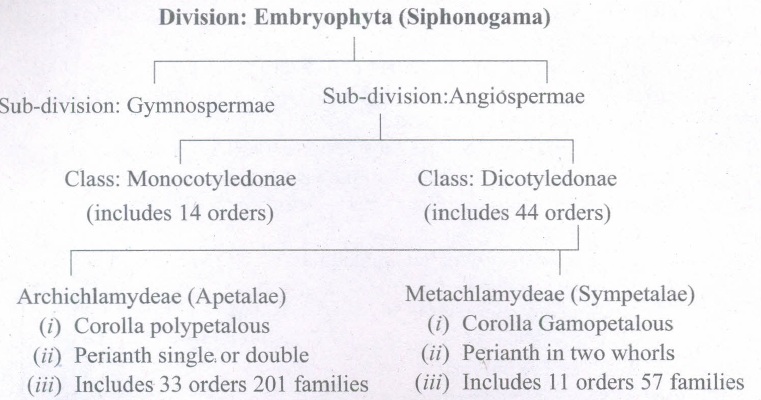
Draw an outline of Engler & Prantl Classification.
25.
Economic Importance of the Family: Liliaceae
1.
(b)
Isotype
2.
(c)
Jawaharlal Nehru Botanical Garden
3.
(a)
Kolkata
4.
(a)
Kew
5.
(b)
China
6.
(c)
Do not interbreed
7.
(a)
Ceropegia
8.
(c)
Allium cepa
9.
(c)
Serotaxonomy
10.
(d)
Evolutionary relationships
11.
(b)
Neotype
12.
| Common name of plants | Scientific name of plants | |
| 1 | Mango | Mangifera indica |
| 2 | Banana | Musa paradisiaca |
| 3 | Shoe flower | Hibiscus rosa-sinensis |
| 4 | Neem | Azadirachta indica |
| 5 | Coconut | Cocus nucifera |
| 6 | Rice | Oryza sativa |
| 7 | Onion | Allium cepa |
| 8 | Tomato | Solanum lycopersicum |
| 9 | Carrot | Dacus carota |
| 10 | Brinjal | Solanum melongena |
13.
According to Ernest Mayr 1963," these are groups of populations that interbreed and are reproductively isolated from other such groups in nature".
14.
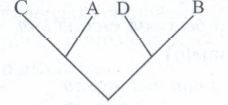
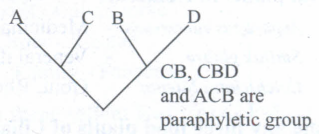
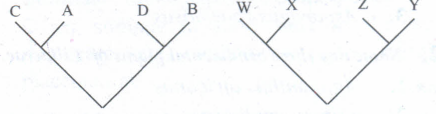
Represent diagrammatically
1. Monophyletic group: Taxa comprising all the descendants of a common ancestor.
2. Paraphyletic group: Taxon that includes an ancestor but not all of the descendants of that ancestor.
3. Polyphyletic group: Taxa that includes members from two different lineages
15.
The aims of biosystematics are as follows:
1. To delimit the naturally occurring biotic community of plant species.
2. To establish the evolution of a group of taxa by understanding the evolutionary and phylogenetic trends.
3. To involve any type of data gathering based on modern concepts and not only on morphology and anatomy.
16.
(i) It is a method to identify genetic markers using a randomly synthesized primer that will anneal (recombine (DNA) in the double stranded form) to complementary regions located in various locations of isolated DNA. If another complementary site is present on the opposing DNA strand at a distance that is not too great then the reaction will amplify this region of DNA.
(ii) RAPDs (Random Amplified Polymorphic DNA) like microsatellites may often be used for genetic studies within species but may also be successfully employed in phylogenetic studies to address relationships within a species or between closely related species.
17.
Arachis hypogea (Ground nut) and Pongamia pinnata (Pungam).
18.
1. Plants with free petals and dichlamydeous flowers come under polypetalae. It is further divided
2. into three series - Thalamiflorae, Disciflorae and Calyciflorae.
19.
1. Vernacular names are known as common names.
2. They are very often descriptive and poetic references to plants. Common name refer to more than one plant or many plants may have same common name.
3. These names are regional or local and are not universal. Example: Albizia amara. L belongs to Mimosaceae is called as Usilai in South Tamilnadu and Thurinji in North Tamilnadu.
20.
Anamorph - Asexual reproductive stage of fungus.
Telomorph - Sexual reproductive stage of fungus.
21.
1. When the individuals are similar to one another in one or more features and different
2. from other such groups, they are called morphological species .
3. These species are defined and categorized with no knowledge of phylogenetic history, gene flow or detailed reproductive mechanisms.
22.
1. Division is the next level of classification that consists of number of classes.
Example: Magnoliophyta.
2. Kingdom is the highest level or rank of the classification. Example: Plantae.
23.
1. Order includes group of families which show less similarities among them.
2. Class consists of group of orders which share few similarities.
24.
25.
| S.No. | Economical impartance | binomial | Usefull part | Uses |
| l. | Food plant | Allium cepa | Bulbs | Used as vegetable, stimulative, diuretic, expectorant with bactericidal properties. |
| Allium sativum | Bulbs | Used as condiment and also good for heart. | ||
| Asparagus officinalis | Fleshy shoots | Used as vegetables. | ||
| A. racemosus | Tuberous roots | Used as vegetables. | ||
| 2. | Medicinal plant | Aloe barbadense | Leaves | Leaves are the source of resinous drug, used as a purgative. |
| Aloe vera | Leaves | Gelatinous glycoside called aloin from succulent leaves are used in soothing lotions, piles and inflammations, hemorrhoidal salves and shampoos. | ||
| Asperagus racemosus | Roots | Medicinal oil is prepared from the root is used for nervous and rheumatic complaints and also in skin diseases. | ||
| Colchichum luteum | Roots | Used in the treatment of gout and rheumatism. | ||
| Gloriosa superba | Tubers | Tubers helpful in promoting labour pains in women. | ||
| Scilla hyacinthiana | Bulbs | Used as heart stimulant. | ||
| Similax glabra and S.ovalifolia | Roots | Used in the treatment of venereal diseases. | ||
| 3. | Fibre yielding plant | Phormium tenax | Fibre | Used for cordage, fishing net, mattings, twines |
| 4. | Raticides Insecticides | Urginea indica Veratrum album |
Bulbs Bulbs |
Used for killing rats Used as insecticide. |
| 5. | Polyploidy | Colchicum luteum is | Corm | Colchicine (alkaloid) used to induce polyploidy. |
| 6. | Ornamental plants | Agapanthus africanus (Africian Lilly) Hemerocallis fuvia (Orange Day Lilly) Gloriosa superba (Malabar glory lilly) Lilium candidum Lilium giganteum Ruscus aculewatus (Butchers Broom) Tulipa suaveolens Yucca alcifolia and Y.gloriosa | Plant | Some of the well known' garden ornamentals. |

11th Standard Syllabus & Materials
11th Standard
TN 11th Tamil பீடு பெற நில் - செய்யுள் - காவடிச்சிந்து Important Questions And Answers Study Material - QB365 Set A
NEW11th Standard
TN 11th Tamil பீடு பெற நில் - உரைநடை - மலை இடப்பெயர்கள் : ஓர் ஆய்வு Important Questions And Answers Study Material - QB365 Set A
NEW11th Standard
TN 11th Tamil மாமழை போற்றுதும் - துணைப்பாடம் - யானை டாக்டர் Important Questions And Answers Study Material - QB365 Set A
NEW11th Standard
TN 11th Tamil மாமழை போற்றுதும் - செய்யுள் - ஐங்குறுநூறு Important Questions And Answers Study Material - QB365 Set A



Tamilnadu Stateboard 11th Standard Subjects

Maths

Commerce

Economics
Biology

Business Maths and Statistics

Accountancy

Computer Science

Physics

Chemistry
Maths
Biology
Economics
Physics
Chemistry

History
Business Maths and Statistics

Computer Science
Accountancy

Computer Applications
History
Computer Technology
Commerce
Computer Applications
Computer Technology

Tamil

English

French
Tamilnadu Stateboard Standards

