
 100% FREE ACCESS
11th Standard Syllabus & Materials
11th Standard
TN 11th Tamil இயற்கை வேளாண்மை,சுற்றுச்சூழல் -செய்யுள் - மனோன்மணீயம் Important Questions And Answers Study Material - QB365 Set A
NEW11th Standard
TN 11th Tamil என்னுயிர் என்பேன் -துணைப்பாடம் - இசைத்தமிழர் இருவர் Important Questions And Answers Study Material - QB365 Set A
NEW11th Standard
TN 11th Tamil மொழி கலை -செய்யுள் - ஒவ்வொரு புல்லையும் Important Questions And Answers Study Material - QB365 Set A
NEW11th Standard
TN 11th Tamil பீடு பெற நில் - இலக்கணம் - பகுபத உறுப்புகள் Important Questions And Answers Study Material - QB365 Set A
NEW11th Standard
TN 11th Tamil பீடு பெற நில் - துணைப்பாடம் - வாடிவாசல் Important Questions And Answers Study Material - QB365 Set A
NEW11th Standard
TN 11th Tamil பீடு பெற நில் - செய்யுள் - குறுந்தொகை Important Questions And Answers Study Material - QB365 Set A

Published on: 30/09/2018
Important questions -chapter 1,2
Download Tamil Nadu 11th Standard Physics question papers, model tests, one-mark questions, important questions, and public exam papers in PDF format. Free study materials and answer keys for TN State Board students.
Questions + Answers key
Take MCQ Physics Test1.
While measuring acceleration due to gravity, by a simple pendulum, a student makes a positive error of 1% in the length of the pendulum and a negative error , of 3% in the value of time period. The percentage error in the measurement of 'g' is _______________.
2%
4%
10%
7%
2.
No force is required for ____________.
an object moving in circular motion.
an object moving in straight line with constant velocity.
an object moving with constant acceleration.
an object moving in elliptical pattern
3.
A body of mass 30 kg climbs on a rope. The boy climbs up with an acceleration of 5 ms-2 What is the tension of a rope?
250 N
540 N
312 N
444 N
4.
SI unit of the universal constant of gravitation (G) is ______________.
kg-2 m-2
kg ms-1
Nm2 kg-2
Nm-1
5.
The speed of an object v = 40 ms-1. The same quantity of speed in kmh-1 is _____________.
60
160
40
144
6.
How many \(\mu\)m present in one metre?
10-6 \(\mu\)m
106 \(\mu\)m
10-3 \(\mu\)m
10-2 \(\mu\)m
7.
Choose the motion in two dimension from the following.
Motion of a train along a straight railway track
An object falling freely under gravity close to the Earth.
A particle moving along a curved path in a plane.
Flying of a kite on a windy day.
8.
The horizontal range of a projectile fired at an angle of 15° is 50 m. If it is fired with the same speed at angle of 45°, its range will be
125 m
75 m
100 m
150 m
9.
The centrifugal force appears to exist
only in inertial frames
only in rotating frames
in any accelerated frame
both in inertial and non-inertial frames
10.
11.
A book is at rest on the table which exerts a normal force on the book. If this force is considered as reaction force, what is the action force according to Newton's third law?
Gravitational force exerted by Earth on the book
Gravitational force exerted by the book on Earth
Normal force exerted by the book on the table
None of the above
12.
13.
If one object is dropped vertically downward and another object is thrown horizontally from the same height, then the ratio of vertical distance covered by both objects at any instant t is
1
2
4
0.5
14.
If a particle has negative velocity and negative acceleration, its speed
increases
decreases
remains same
zero
15.
The velocity of a particle v at an instant t is given by v = at + br2. The dimensions of b is
[L]
[LT-1]
[LT-2]
[LT-3]
16.
In the cricket game, a batsman strikes the ball such that it moves with the speed 30 ms-1 at an angle 30° with the horizontal as shown in the figure. The boundary line of the cricket ground is located at a distance of 75 m from the batsman? Will the ball go for a six? (Neglect the air resistance and take acceleration due to gravity g = 10 m s-2).
.png)
17.
Consider a circular leveled road of radius 10m having coefficient of static friction 0.81. Three cars (A, B and C) are travelling with speed 7 ms-1, 8 m s-1 and 10 ms-1 respectively. Which car will skid when it moves in the circular level road? (g = 10 m s-2).
18.
A block of mass m slides down the plane inclined at an angle 60° with an acceleration \(\frac { g }{ 2 } \). Find the coefficient of kinetic friction.
19.
The velocity of three particles A, B, C are given below. Which particle travels at the greatest speed?
\(\vec {v_A}=3\hat i+5\hat j+2\hat k\)
\(\vec {V_B}=\hat i+2\hat j+3\hat k\)
\(\vec{V_C}=5\hat i+3\hat j+4\hat k\)
20.
The Moon subtends an angle of 10 55' at the base line equal to the diameter of the earth. What is the distance of the Moon from the Earth? (Radius of the Earth is 6.4\(\times\)106m)
21.
A 40 gm of bullet moving at 250 ms-1 stops after penetrating 20 cm of wood. Calculate the average force exerted by the bullet.
22.
A bomb of mass 30 kg, initially at rest explodes into three pieces of masses. m1 = m2 = 20 kg. If the kinetic energy of two pieces (m1 = m2) is 400 J. Calculate the kinetic energy of the third piece.
23.
How can the depth of well is measured and also estimate the % of real error.
24.
A boy throws ball of mass 100 g with a speed of 15 m/s, If the ball hits a wall and rebounds with the half the original speed, what is the change in momentum of the ball?
25.
Briefly explain on Aristotle vs. Newton's approach on sliding object.
26.
Write an expression for the two objects, moving with uniform velocities along the same straight tracks but opposite in direction.
27.
What does the slope of 'position-time' graph represent? Which physical quantity is obtained from it?
28.
In a physical units, how many units are there in 1 metre?
1 parallactic second (parsec) = 3.08\(\times\)1016 m
Given data:
1 AU = 1.496\(\times\)1011m
1 ly = 9.467\(\times\)1015m
1 mm = 10-6m
1 parsec = 3.08\(\times\)1016m
29.
A bob attached to the string oscillates back and forth. Resolve the forces acting on the bob into components. What is the acceleration experienced by the bob at an angle ፀ.
30.
Convert the vector \(\vec { r } =3\hat { i } +2\hat { j } \) into a unit vector.
31.
In a submarine equipped with sonar, the time delay between the generation of a pulse and its echo after reflection from an enemy submarine is observed to be 80 sec. If the speed of sound in water is 1460 ms-1. What is the distance of enemy submarine?
32.
Briefly explain the types of physical quantities.
33.
A gun is fired from a place which is at distance 1.2 km from a hill. The echo of the sound is heard back at the same place of firing after 8 second. Find the speed of sound.
34.
Calculate the centripetal acceleration of the Earth which orbits around the Sun. The Sun to Earth distance is approximately 150 million km. (Assume the orbit of Earth to be circular).
35.
Convert 76 cm of mercury pressure into Nm-2 using the method of dimensions.
36.
What are the forces acting on the vehicle when it moves in circulated road?
37.
What are the forces acting on the sliding object?
38.
Write second law of motion in the derivative of position vector form.
39.
Give examples for inertia frames
40.
In a submarine fitted with a SONAR, the time delay between generation of a signal and reception of its echo from an enemy ship is 110.3 seconds. If speed of sound in water is 1450 ms-1 then calculate the distance of the enemy ship from the submarine.
41.
When the planet Jupiter is at a distance of 824.7 million kilometers from the earth. its angular diameter is measured to be 35.72 of arc. Calculate the diameter of Jupiter.
42.
Using a screw gauge the thickness of a wire was measured as 5mm. Calculate
(i) the fractional error
(ii) the percentage error
Given data:
Thickness of the wire (t) = 5mm
Accuracy \(\triangle t\)= 0.01mm
43.
Define relative velocity.
44.
Explain the concept of a function.
45.
Distinguish between distance and displacement.
46.
What is meant by frame of reference?
47.
A spider of mass 50 g is hanging on a string of a cob web. What is the tension in the string?
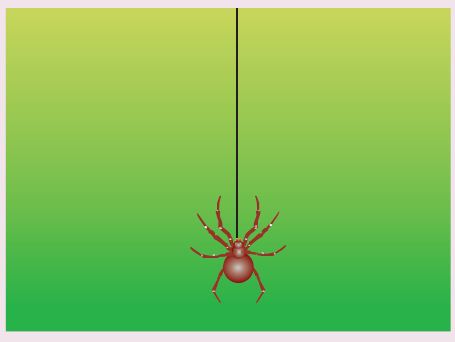
48.
The resultant of two vectors A and B is perpendicular to vector A and its magnitude is equal to half of the magnitude of vector B. Then the angle between A and B is
(a) 30°
(b) 45°
(c) 150°
(d) 120°
49.
An object at an angle such that the horizontal range is 4 times of the maximum height. What is the angle of projection of the object?
50.
What are the resultants of the vector product of two given vectors given by \(\overrightarrow { A } =4\hat { i } -2\hat { j } +\hat { k } \ and \ \overrightarrow { B } =5\hat { i } +3\hat { j } -4\hat { k } \)
51.
Show that a screw gauge of pitch 1mm and 100 divisions is more precise than a vernier caliper with 20 divisions on the sliding scale.
52.
The radius of the circle is 3.12 m. Calculate the area of the circle with regard to significant figures.
53.
How will you measure the diameter of the Moon using parallax method?
54.
The force F acting on a body moving in a circular path depends on mass of the body (m), velocity (v) and radius (r) of the circular path. Obtain the expression for the force by dimensional analysis method. (Take the value of k = 1)
55.
If the value of universal gravitational constant in SI is 6.610-11Nm-2kg-2, then find its value in CGS System?
56.
Explain triangular law of addition method.
57.
Find
(i) acceleration
(ii) speed of the sliding object using free body diagram.
58.
Calculate the centripetal acceleration of Moon towards the Earth.
1.
(d)
7%
2.
(b)
an object moving in straight line with constant velocity.
3.
(d)
444 N
4.
(c)
Nm2 kg-2
5.
(d)
144
6.
(b)
106 \(\mu\)m
7.
(c)
A particle moving along a curved path in a plane.
8.
(c)
100 m
9.
(b)
only in rotating frames
10.
(a)
11.
(c)
Normal force exerted by the book on the table
12.
(b)
13.
For a free falling body, initial vertical downward velocity = 0
For a body thrown horizontally with a velocity, initial vertical downward velocity = 0
Since both having same initial vertical downward velocity they cover equal vertical distance at any instant
14.
Velocity and acceleration are in the same direction: So speed increases.
15.
\(v=a t+b t^{2}\)
\(\text { Dimensional equation is } \mathrm{LT}^{-1}\)
\(=a T=b T^{2}\)
\(\therefore \text { The dimension of } b=\frac{\mathrm{LT}^{-1}}{\mathrm{~T}^{2}}=\mathrm{LT}^{-3}\)
16.
The motion of the cricket ball in air is essentially a projectile motion. As we have already seen, the range (horizontal distance) of the projectile motion is given by
\(R=\frac{u^2sin2\theta}{g}\)
The initial speed u = 30 ms-1
The projection angle θ = 30°
The horizontal distance travelled by the cricket ball \(R=\frac{(30)^2\times sin60^0}{10}=\frac{900\times\frac{\sqrt 3}{2}}{10}=77.94\ m\)
This distance is greater than the distance of the boundary line. Hence the ball will cross this line and go for a six.
17.
From the safe turn condition the speed of the vehicle (v) must be less than or equal to \(\sqrt { { \mu }_{ s }rg } \)
v ≤ \(\sqrt { { \mu }_{ s }rg } \)
\(\sqrt { { \mu }_{ s }rg } \)=\(\sqrt { 0.81\times 10\times 10 } \)=9 ms-1
For car C, \(\sqrt { { \mu }_{ s }rg } \) is less than v.
The speed of car A, B and Care 7 m s-1, 8 m s-1 and 10 m s-1 respectively. The cars A and B will have safe turns. But the car C has speed 10 m s-1 while it turns which exceeds the safe turning speed. Hence, the car C will skid.
18.
Kinetic friction comes to playas the block is moving on the surface.
The forces acting on the mass are the normal force perpendicular to surface, downward gravitational force and kinetic friction fk along the surface.
mg sinθ - fk = ma
But a = g/2
mg sin 600 - fk = mg/2
\(\frac { \sqrt { 3 } }{ 2 } \)mg - fk = mg/2
fk = mg\(\left( \frac { \sqrt { 3 } }{ 2 } -\frac { 1 }{ 2 } \right) \)
fk =\(\left( \frac { \sqrt { 3 } -1 }{ 2 } \right) mg\)
There is no motion along the y-direction as normal force is exactly balanced by the mg cos θ
mg cosθ = N = mg/2
fk = μkN = μk mg/2
μk = \(\frac { \left( \frac { \sqrt { 3 } -1 }{ 2 } \right) mg }{ \frac { mg }{ 2 } } \)
uk = \(\sqrt { 3 } \)-1
19.
We know that speed is the magnitude of the velocity vector. Hence,
Speed of A = \(|\vec{V_A}|=\sqrt{(3)^2+(-5)^2+(2)^2}=\sqrt{9+25+4}=\sqrt{48}ms^{-1}\)
Speed of B = \(\vec{V_B}=\sqrt{(1)^2+(2)^2+(3)^2}=\sqrt{1+4+9}=\sqrt{14}ms^{-1}\)
Spedd of C = \(\vec{V_C}=\sqrt{(5)^2+(3)^2+(4)^2}=\sqrt{25+9+16}=\sqrt{50}ms^{-1}\)
The particle C has the greatest speed.
\(\sqrt{50}>\sqrt{38}>\sqrt{14}\)
20.
Angle \(\theta\) = 1° 55'= 115' = (115\(\times\)60)"\(\times\) (4.85\(\times\) 10-6) rad = 3.34\(\times\)10-2 rad
Since 1" = 4.85\(\times\)10-6 rad
Radius of the Earth = 6.4\(\times\)106m
From the Figure AB is the diameter of the Earth (b) = 2\(\times\)6.4\(\times\)106m
Distance of the Moon from the Earth x = ?
\(x={b\over \theta}={2\times 6.4 \times 10^6\over 3.34\times 10^{-2}}\)
x = 3.83\(\times\)108m
21.
Mass of a bullet (m) = \(\frac { 40 }{ 1000 } kg\) = 0.04kg
Initial velocity (u) = 250 ms-1
Final velocity (v) = 0.
displacement (s) = 20cm = 20\(\times\)10-2m
Acceleration a bullet \(a=\frac { { v }^{ 2 }-{ u }^{ 2 } }{ 2s } \)
\(=\frac { { 0 }^{ 2 }-\left( 250 \right) ^{ 2 } }{ 2\times (20\times 10^{ -2 }m) } \)
= \(\frac { -250\times 250 }{ 2\times 20\times { 10 }^{ -2 }m } \)
= \(\frac { -62,50,000 }{ 40\times { 10 }^{ -2 } } \)
Acceleration 'a' = - 156.25 x10⁵ ms-2
Now, Average force F = ma
F = 0.04 \(\times\)(-156.25 x 10⁵)
= 6.25\(\times\)105N
22.
Total mass = 30 kg m1 = m2 = 20 kg
Mass of a third piece, m3 =Total mass - m1 and m2 = 30 kg - 20 kg
Kinetic energy of m1 and m2 = 400 J
Kinetic energy of m3 =?
\({ V }_{ 3 }=\sqrt { \frac { 2\left( { E }_{ 1 }+{ E }_{ 2 } \right) }{ \left( { m }_{ 1 }+{ m }_{ 2 } \right) } } \)
\({ V }_{ 3 }=\sqrt { \frac { 2\times 400 }{ 20 } } \)
\({ V }_{ 3 }=\sqrt { \frac { 800 }{ 20 } } \)\(=\sqrt { 40 } \)
V3 = 6.32 ms-2
Let V3 be the speed of the Kg mass
23.
(i) Consider a well without water, of some depth d. Take a small object (for example lemon) and a stopwatch. When you drop the lemon, start the stopwatch. As soon as the lemon touches the bottom of the well, stop the watch. Note the time taken by the lemon to reach the bottom and denote the time as t.
(ii) Since the initial velocity of lemon u=0 and the acceleration due to gravity g is constant over the well, by using use the equations of motion for constant acceleration.
\(s=ut+\frac { 1 }{ 2 } { a }t^{ 2 }\)
(iii) u = 0, s = d, a = g (Since we choose the y axis downwards), Then
\(d=\frac { 1 }{ 2 } { gt }^{ 2 }\)
(iv) Substituting g = 9.8 ms-2 the depth of the well is obtained.
(v) To estimate the error in calculation another method is used to measure the depth of the well.
(vi) Take a long rope and hang the rope inside the well till it touches the bottom. Measure the length of the rope which is the correct depth of the well (dcorrect). Then
error = dcorrect - d
relative error = \(\frac { { d }_{ correct }-d }{ { d }_{ correct } } \)
percentage of relative error
\(=\frac { { d }_{ correct }-d }{ { d }_{ correct } } \times 100\)
24.
Mass of the ball (m) = 100 g = 0.1 kg
Speed of the ball (v) = 15 ms-1
Velocity of the ball after rebounding,
\({ V }^{ 1 }=-\frac { V }{ 2 } =-\frac { 15 }{ 2 } m/s\)
\({ V }^{ 1 }=-7.5m/s^{ -1 }\)
Change in momentum =m(v1 - v)
= 0.1\(\times\)(-7.5 -15)
Change in momentum = -22.5 Ns
25.
(i) Newton's second law gives the correct explanation for the experiment on the inclined plane.
(ii) In normal cases, where friction is not negligible, once the object reaches the bottom of the inclined plane, it travels some distance and stops.
(iii) Note that it stops because there is a frictional force acting in the direction opposite to its velocity.
(iv) It is this frictional force that reduces the velocity of the object to zero and brings it to rest.
(v) As per Aristotle's idea, as soon as the body reaches the bottom of the plane, it can travel only a small distance and stops because there is no force acting on the object.
26.
(i) Consider two objects A and B moving with uniform velocities VA and VB along the same straight tracks but opposite in direction.
\(\overrightarrow { \xrightarrow { { v }_{ A } } } \overleftarrow { \xrightarrow { { v }_{ B } } } \)
(ii) The relative velocity of object A with respect to object B is
\(\overrightarrow { { V }_{ AB } } =\overrightarrow { { V }_{ A } } -(-\overrightarrow { { V }_{ B } } )=\overrightarrow { { V }_{ A } } +\overrightarrow { { V }_{ B } } \)
(iii) The relative velocity of object B with respect to object A is
\(\overrightarrow { { V }_{ BA } } =-\overrightarrow { { V }_{ B } } -\overrightarrow { { V }_{ A } } =-(\overrightarrow { { V }_{ A } } +\overrightarrow { { V }_{ B } } )\)
(iv) Thus, if two objects are moving in opposite directions, the magnitude of relative velocity of one object with respect to other is equal to the sum of magnitude of their velocities.
27.
(i) Graphically the slope of the position-time graph will give the velocity of the particle.
(ii) At the same time, if velocity-time graph is given, the distance and displacement are determined, by calculating the area under the curve.
Velocity is given by \(\frac { dx }{ dt } =v\)
(iii) Therefore, dx = vdt
By integrating both sides, \(\int _{ { x }_{ 1 } }^{ { x }_{ 2 } }{ dx=\int _{ { x }_{ 1 } }^{ { x }_{ 2 } }{ v\quad dt } } \)
Integration is equivalent to area under the given curve.
(iv) So the term \(\int _{ { t }_{ 1 } }^{ { t }_{ 2 } }{ vdt } \) represents the area under the curve v as a function of time.
(v) Since the left hand side of the integration represents the displacement travelled by the particle from time t1 to t2, the area under the velocity time graph will give the displacement of the particle.
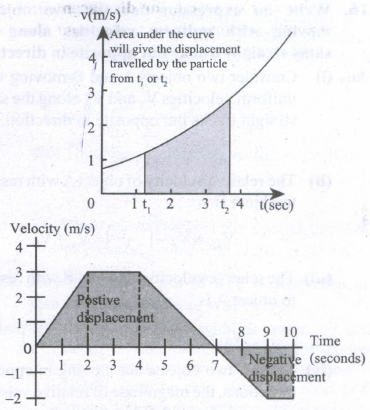
Displacement in the velocity - time graph
(vi) If the area is negative, it means that displacement is negative, so the particle has travelled in the negative direction.
28.
3.08 x 10¹⁶m equivalent to 1 parsec
1 metre is equivalent to \({{1}\over{3.08\times{10}^{16}}}\)
= 0.324\(\times\)10-16
= 3.24\(\times\)10-17 m
In one metre 3.24\(\times\)10-17 parsec are present.
29.
(i) Tangential acceleration = g sin ፀ
(ii) mg cos ፀ acts along OP (outwards)
(iii) tension (T) acts along PO (inwards)
Net force on the body at P acting along
PO = T- mg cos ፀ
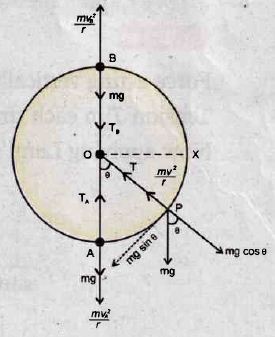
This must provide the necessary centripetal force. \(\frac{mv^2}{r}\)
\(\therefore T -mg \ cos \ \theta=\frac{mv^2}{r} \)
Centripetal acceleration (a⊥) = \(\frac { T-mg \ cos\theta }{ m } \)
30.
\(\overrightarrow { r } =3\hat { i } +2\hat { j } \)
\(\text { Unit vector } =\frac{\vec{r}}{|\vec{r}|} \)
\(|\vec{r}| =\sqrt{3^{2}+2^{2}}=\sqrt{13} \)
\(\therefore \text { Unit vector } =\frac{3 \hat{i}+2 \hat{j}}{\sqrt{13}}\)
31.
The speed of sound in water v = 1460 ms-1
Time taken t = 80 s
\(=\frac{2 d}{t} \)
2d = u x t
= 1460 x 80
2d =11680 m
\(\therefore \text { Distance of enemy submarine } d =\frac{11680}{2} \)
= 58.40 km
32.
(i) Physical quantities are classified into two types. There are fundamental and derived quantities.
(ii) Fundamental or base quantities are quantities which cannot be expressed in terms of any other physical quantities.
(iii) These are length, mass, time, electric current, temperature, luminous intensity and amount of substance.
(iv) Quantities that can be expressed in terms of fundamental quantities are called derived quantities.
(v) For example, area, volume, velocity, acceleration, force.
33.
The echo will be heard when the sound reaches back at the place of firing. So, the total distance travelled by sound is 2\(\times\)1.2 km = 2.4 km = 2400 m.
\(speed=\frac{2400m}{8s}=300\ ms^{-1}\)
34.
The centripetal acceleration ac=\(\frac { { v }^{ 2 } }{ r } \)
V.- velocity of Earth around the orbit
r - radius of orbit or distance of Earth to Sun
Velocity of Earth is written in terms of angular velocity (ω) as
v-ωr
By substituting in the centripetal acceleration formula, ac=\({ a }_{ c }=\frac { { \omega }^{ 2 }{ r }^{ 2 } }{ r } =\omega ^{ 2 }\)=ω2r
But ω=\(\frac { 2\pi }{ T } \) where T is time for the Earth to orbit around the sun, which is one year.
T = 365 days = 365\(\times\)24\(\times\)60\(\times\)60s
T = 31\(\times\)107 s
(ω)= 2.02\(\times\)10-7 rad per see
ac = (2.02\(\times\)10-7)2 \(\times\)(150\(\times\)108)
ac= 6.12\(\times\)10-4 ms-2
35.
In cgs system 76 cm of mercury pressure = 76\(\times\)13.6\(\times\)980 dyne cm-2
The dimensional formula of pressure P is [ML-1T-2]; so P1 [M1a L1b T1c ]= P2[M2a L2bT2c]
We have P2 = P1 \([{M_1\over M_2}]^a[{L_1\over 2}]^b[{T_1\over T_2} ]^c\)
M1 = 1g, M2 =1kg
L1 = 1 cm, L2 = 1m
T1 = 1 s, T2 = 1s
So, a = 1, b = -1, and c =-2
Then, P1 = 76\(\times\)13.6\(\times\)980
\([{1g\over 1kg}]^1[{1cm\over 1m}]^{-1}[{1s\over 1s}]^{-1}=76\times13.6\times980[{10^{-3}kg\over 1kg}]^1[{10^{-2}m\over1m}]^{-1}[{1s\over 1s}]^{-2}\)
= 76\(\times\)13.6\(\times\)980\(\times\)[10-3]\(\times\)102
P2 = 1.01\(\times\)105 Nm-2
36.
(i) Gravitational force (mg) acting downwards
(ii) Normal force (mg) acting upwards
(iii) Frictional force (Fs) acting horizontally Inwards along the road.
37.
Downward gravitational force (mg), Normal force perpendicular to inclined surface (N).
38.
Since the acceleration is the second derivative of position vector of the body
\(\left( \overset { \rightarrow }{ a } =\frac { { d }^{ 2 }\overset { \rightarrow }{ r } }{ { dt }^{ 2 } } \right) \) , the force on the body is
\(\overset { \rightarrow }{ F } =m\frac { { d }^{ 2 }\overset { \rightarrow }{ r } }{ { dt }^{ 2 } } \)
39.
(i) The car is moving with uniform velocity v with respect to a person standing (at rest) on the ground.
(ii) As the car is moving with constant velocity with respect to ground to the person is at rest on the ground, both frames (with respect to the car and to the ground) are inertial frames.
40.
Speed of a sound in water 1450 ms-1
Time delay T = 110.3s
Distance of the enemy ship, D \(={{\sqrt{T}}\over{2}}\)
\(={{1450\times110.3}\over{}2}\)
\(={{1159935}\over{2}}\)
= 79967 m
Distance of enemy ship = 79.86 km.
41.
Distance, D = 824.7\(\times\)106 km
\(\theta=35.72"={{35.72}\over{60\times 60}}\times{{\pi}\over{180}}\) rad
\(\theta \ \rightarrow\) is angular diameter
Diameter, d = ?
\(d=D\times\theta\)
\(=824.7\times{10}^{6}\times{{35.72}\over{60\times 60}}\times{{\pi}\over{180}}\) km
\(=824.7\times{10}^{6}\times{{35.72}\over{3600}}\times{{\pi}\over{180}}\) km
\(=824.7\times{10}^{6}\times{{35.72\times3.14}\over{3600\times180}}\)km
Diameter of Jupiter = 1.427\(\times\)105 km
42.
(i) Fractional error \(=\delta_t={{\triangle t}\over{t}}\)
\(={{0.01}\over{5}}=0.002.\)
(ii) Percentage error \(=\delta_t={{\triangle t}\over{ t}}\times100\%\)
= 0.002\(\times\)100%
= 0.02%
43.
When two objects A and B are moving with different velocities, then the velocity of one object A with respect to another object B is called relative velocity of object A with respect to B.
44.
(i) Any physical quantity is represented by a "function" in mathematics. For example:- temperature T. We know that the temperature varies with time.
(ii) Mathematically this variation can be represented by the notation 'T (t)' and it should be called "temperature as a function of time".
(iii) It implies that if the value of 't' is given, then the function "T (t)" will give the value of the temperature at that time 't'.
45.
(i) The Distance travelled by an object in motion in a given time is never negative or zero, it is always positive.
(ii) The displacement of an object, in a given time can be positive, zero or negative.
(iii) The displacement of an object can be equal or less than the distance travelled but never greater than distance travelled.
(iv) The distance covered by an object between two positions can have many values, but the displacement between them has only one value (in magnitude).
46.
A coordinate system and the position of an object is described relative to it, then such a coordinate system is called frame of reference.
47.
T = mg
T = 50g x 9.8m/s2
Tension (T) = 0.49 N
48.
According to triangle law of vectors.
\(R =\sqrt{A^{2}+B^{2}+2 A B \cos \theta} \text { and }
\)
\(\tan \alpha =\frac{B \sin \theta}{A+B \cos \theta}
\)
\(\alpha =90^{\circ}(\text { given })
\)
\(\therefore \frac{B \sin \theta}{A+B \cos \theta} =\alpha
\)
\(\therefore A+B \cos \theta =0
\)
\(\text { or } A =-B \cos \theta
\)
\(R =\sqrt{A^{2}+B^{2}+2 A B \cos \theta}\)
\(=\sqrt{B^{2} \cos ^{2}} \theta+B^{2}-2 B^{2} \cos ^{2} \theta\)
\(=\sqrt{B^{2}-B^{2} \cos ^{2} \theta}
\)
\(=\sqrt{B^{2}\left(1-\cos ^{2} \theta\right)}
\)
\(=\sqrt{B^{2} \sin ^{2} \theta}
\)
\(R =B \sin \theta
\)
\(But \ R=\frac{B}{2} (given)\)
\(\therefore \frac{B}{2}=B \sin \theta
\)
\(\sin \theta=\frac{1}{2} or \theta=30^{\circ}\)
\(\therefore\) angle between A and B= \(180^{\circ}-\theta=180^{\circ}-30^{\circ}=150^{\circ}\)
49.
Max.height = \(\frac { { u }^{ 2 }{ sin }^{ 2 }\theta }{ 2g } \)
\(Range \ R=\frac { { u }^{ 2 }{ sin 2 }\theta }{ 2g } \)
Here, R = 4 x Max.height
\(\therefore \frac { { u }^{ 2 }{ sin 2 }\theta }{ g } =\frac { {4\times u }^{ 2 }{ sin }^{ 2 }\theta }{ 2g } \)
\(sin2\theta =2{ sin }^{ 2 }\theta \)
\(2sin\theta cos\theta =2{ sin }^{ 2 }\theta \)
\(\therefore \ cos\theta = sin \theta\)
\(\therefore \theta =45°\)
50.
\(\overrightarrow { A } =4\hat { i } -2\hat { j } +\hat { k } \)
\(\overrightarrow { B } =5\hat { i } +3\hat { j } -4\hat { k } \)
Resultant vector = \(\overrightarrow { A } +\overrightarrow { B } \)
\(=\left| \begin{matrix} \hat { i } & \hat { j } & \hat { k } \\ 4 & -2 & 1 \\ 5 & 3 & -4 \end{matrix} \right| \)
\(=\hat{i}(8-3)+\hat{j}[5-(-16)]+\hat{k}(12+10)\)
Resultant vector = 5\(\hat { i } \) +21\(\hat { j } \) + 22\(\hat { k } \)
51.
Least count of screw gauge
\(={{Pitch}\over{No. of\ divisions}}\)
\(={{1}\over{100}}=0.01\ mm\) (or) 0.001 cm
Least count of vernier calipers
\(=1MSD-1-1VSD=(1-19/20)MSD\)
\(={{1}\over{20}}\) = 0.05 cm.
So screw gauge is more precise than vernier.
52.
Radius of the circle r = 3.12 m
Area of the circle A = \(\pi\) r2
= 3.14\(\times\)3.12\(\times\)3.12
= 30.566016 m2
According to the rule of significant
A = 30.6 m2
53.
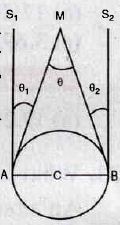
C is the centre of the Earth. A and B are two diametrically opposite places on the surface of the Earth. From A and B, the parallaxes θ1 and θ2 respectively of Moon M with respect to some distant star are determined with the help of an astronomical telescope. Thus, the total parallax of the Moon subtended on Earth.
\(\angle AMB=\theta_1+ \theta_2=\theta\)
If θ is measured in radians, then
\(\theta=\frac{A B}{A M} ; A M \approx M C \quad {\theta}=\frac{A B}{M C} \text { or } M C=\frac{A B}{\theta}\)
Knowing the values of AB and θ, we can calculate the distance MC of Moon from the Earth.
54.
F ∝ ma vb rc ;
F = k ma vb rc
where k is a dimensionless constant of proportionality. Rewriting above equation in terms of dimensions and taking k= 1, we have
[MLT-2] = [M]a [LT-1]b [L]c
= [MaLbT-bLc]
[MLT-2] = [MaLb+cT-b]
Comparing the powers of M, L and T on both sides
a = 1 ; b + c = 1; -b =-2
2 + c = 1 ; b = 2;
a = 1 b = 2 and c = -1
From the above equation we get
F = mavbrc
F =m1v2r-1
or F = \(\frac { m{ v }^{ 2 } }{ r } \)
55.
Let GSI be the gravitational constant in the SI system and Gcgs in the cgs system. Then
GSI = 6.6 10-11 Nm2 kg-2;
Gcgs = ?
n2 =\(n_1{ \left[ \frac { { M }_{ 1 } }{ { M }_{ 2 } } \right] }_{ }^{ a }{ \left[ \frac { L_{ 1 } }{ L_{ 2 } } \right] }_{ }^{ a }{ \left[ \frac { T_{ 1 } }{ T_{ 2 } } \right] }_{ }^{ c }\)
Gcgs = GSI \({ \left[ \frac { { M }_{ 1 } }{ { M }_{ 2 } } \right] }_{ }^{ a }{ \left[ \frac { L_{ 1 } }{ L_{ 2 } } \right] }_{ }^{ a }{ \left[ \frac { T_{ 1 } }{ T_{ 2 } } \right] }_{ }^{ c }\)
M1= 1 kg L1 = 1 m T1= 1s
M2= 1 kg L2 = 1 m T2= 1s
The dimensional formula for G is M-1L3 T-2
a = -1 b = 3 and c =-2
Gcgs = 6.6\(\times\)10-11 \(\left[ \frac { 1kg }{ 1g } \right] ^{ -1 }\left[ \frac { 1m }{ 1cm } \right] ^{ 3 }\left[ \frac { 1s }{ 1s } \right] ^{ -2 }\)
= 6.6\(\times\)10-11 \(\left[ \frac { 1kg }{ { 10 }^{ -3 }kg } \right] ^{ -1 }\left[ \frac { 1m }{ { 10 }^{ -2 }m } \right] ^{ 3 }\left[ \frac { 1s }{ 1s } \right] ^{ -2 }\)
= 6.6\(\times\)10-11\(\times\)10-3\(\times\)106\(\times\)1
Gcgs = 6.6\(\times\)10-8 dyne cm2 g-2
56.
Let us consider two vectors \(\overrightarrow{A}\) and \(\overrightarrow{B}\)
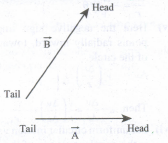
(i) Represent the vectors \(\overrightarrow{A}\) and \(\overrightarrow{B}\) by the two adjacent sides of a triangle taken in the same order.
(ii) Then the resultant is given by the third side of the triangle taken in the opposite order.
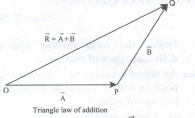
(iii) The head of the first vector \(\overrightarrow{A}\) is connected to the tail of the second vector \(\overrightarrow{B}.\)
(iv) Let 9 be the angle between \(\overrightarrow{A}\) and \(\overrightarrow{B}.\) Then R is the resultant vector connecting the tail of the first vector A to the head of the second vector \(\overrightarrow{B}.\)
(v) The magnitude of \(\overrightarrow{R}\) (resultant) is given geometrically by the length of \(\overrightarrow{R}\) (OQ) and the direction of the resultant vector is the angle between \(\overrightarrow{R}\) and \(\overrightarrow{A}\)
(vi) Thus we write \(\overrightarrow{R}=\overrightarrow{A}+\overrightarrow{B}\)
\(\because \overrightarrow{OQ}=\overrightarrow{OP}+\overrightarrow{PQ}\)
Magnitude of resultant vector
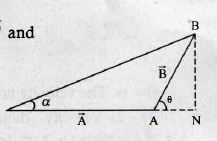
consider the triangle ABN, which is obtained by extending the side OA to ON. ABN is a right angled triangle.
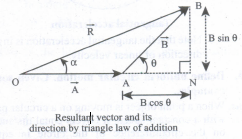
\(\cos\ \theta={{AN}\over{B}}\therefore AN=B\ \cos\theta\) and
\(\sin \ \theta={{BN}\over{B}}\) \(\therefore BN=B\sin\theta\)
For L10BN,we have OB2+ ON2+ BN2
\(\Rightarrow\) R2 = (A + B cos\(\theta\))2 + (B sin\(\theta\))2
\(\Rightarrow\) R2 = A2+ B2cos2\(\theta\) + 2AB cos\(\theta\) + B2sin2\(\theta\)
\(\Rightarrow\) R2 = A2+ B2 (cos2\(\theta\)+ sin2\(\theta\))+ 2AB cos\(\theta\)
\(\Rightarrow\ R=\sqrt{{A}^{2}+{B}^{2}+2AB\cos\ \theta}\)
which is the magnitude of the resultant of \(\overrightarrow{A}\) and \(\overrightarrow{B}.\)
Direction of resultant vectors: If \(\theta\) is the angle between \(\overrightarrow{A}\) and \(\overrightarrow{B}\), then
\(|\overrightarrow{A}+\overrightarrow{B}|=\sqrt{A^2+B^2+2AB\cos\theta}\)
If \(\overrightarrow{R}\) makes an angle \(\alpha\) with \(\overrightarrow{A},\) then in \(\triangle OBN,\)
\(\tan\ \alpha={{CN}\over{ON}}={{CN}\over{OA+AN}}\)
\(\tan\ \alpha={{BN}\over{ON}}={{BN}\over{OA+AN}}\)
\(\tan\ \alpha=\left({{B\sin\theta}\over{A+B\cos\theta}} \right)\)
\(\Rightarrow\alpha = {tan}^{-1}\left( {{B\sin\theta}\over{A+B\cos\theta}} \right)\)
57.
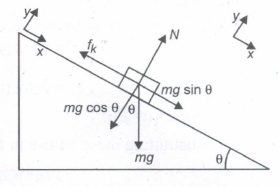
(i) To draw the free body diagram, the block is assumed to be a point mass. Since the motion is on the inclined surface, we have to choose the coordinate system parallel to the inclined surface as shown in Figure (b).
(ii) The gravitational force mg is resolved in to parallel component mg sin e along the inclined plane and perpendicular component mg cos e perpendicular to the inclined surface. (Figure (b)).
(iii) Note that the angle made by the gravitational force (mg) with the perpendicular to the surface is equal to the angle of inclination angle e as shown in Figure (c).
.png)
(a)Free body diagram
(b) mg resolved into parallel and perpendicular components
.png)
In the Triangle ABC Total Angle = 90 + \(\theta +{ \theta }_{ 1 }\) = 180 From the above equation
\({ \theta }_{ 1 }\) = 180 -90 - \(\theta\) = 90 - \(\theta\)
But from the figure \({ \theta }_{ 2 }\) =90 - \({ \theta }_{ 1 }\) = 90 -(90-\(\theta\))
It given \({ \theta }_{ 2 }\) = \(\theta\)
C) The angle \({ \theta }_{ 2 }\) is equal to \(\theta\)
There is no motion(acceleration) along they axis. Applying Newton's second law in the y-direction
-mg cos \(\theta\) \(\hat { j } +N\vec { j } \) = 0(No acceleration)
By comparing the components on both sides, N - mg cos \(\theta =0\)
N=mg cos \(\theta\)
The magnitude of normal force (N) exerted by the surface is equivalent to mg cos \(\theta\)
(v) The object slides (with an acceleration) along the x-direction. Applying Newton's second law in the x-direction
mg sin \(\quad \theta \hat { i } =ma\hat { i } \)
By comparing the components on both sides, we can equate. mg sin \(\theta\) = ma
The acceleration of the sliding object is a = g sin \(\theta\)
(vi) Note that the acceleration depends on the angle of inclination.\(\theta\) If the angle 9 is 90 degree, the block will move vertically with acceleration a = g
(vii) Newton's kinematic equation is used to find the speed of the object when it reaches the- bottom. The acceleration is constant throughout the motion
v2 = u2 + 2as along the x-direction .......(1)
The acceleration a is equal to mg sin \(\theta\) The initial speed (u) is equal to zero as it starts from rest. Here s is the length of the inclined surface.
The speed (v) when it reaches the bottom is (using equation (1))
\(v=\sqrt { 2sg\ sin\ \theta } \)
58.
(i) The centripetal acceleration is given by \(a=\frac { { v }^{ 2 } }{ r } \) This expression explicitly depends on Moon's speed which is non trivial. We can work with the formula
ω2Rm = am
(ii) am is centripetal acceleration of the Moon due to Earth's gravity.
ω is angular velocity
(iii) Rm the distance between Earth and the Moon, which is 60 times the radius of the Earth.
Rm = 60R = 60 \(\times\)6.4 \(\times\)106 = 384 \(\times\)106 m
(iv) As we know the angular velocity ω = \(\frac { 2\pi }{ T } \)and
T = 27.3 days = 27.3 \(\times\) 24 \(\times\) 60 \(\times\) 60 second
= 2.358 \(\times\) 106 sec
(v) By substituting these values in the formula for acceleration
am = \(\frac { (4\pi ^{ 2 })(384\times { 10 }^{ 6 }) }{ (2.358\times { 10 }^{ 6 }) } \) = 0.00272 ms-2
= 2.72 x 10⁻³ms-2
The centripetal acceleration of Moon towards the Earth is 0.00272 m s-2

11th Standard Syllabus & Materials
11th Standard
TN 11th Tamil பீடு பெற நில் - செய்யுள் - காவடிச்சிந்து Important Questions And Answers Study Material - QB365 Set A
NEW11th Standard
TN 11th Tamil பீடு பெற நில் - உரைநடை - மலை இடப்பெயர்கள் : ஓர் ஆய்வு Important Questions And Answers Study Material - QB365 Set A
NEW11th Standard
TN 11th Tamil மாமழை போற்றுதும் - துணைப்பாடம் - யானை டாக்டர் Important Questions And Answers Study Material - QB365 Set A
NEW11th Standard
TN 11th Tamil மாமழை போற்றுதும் - செய்யுள் - ஐங்குறுநூறு Important Questions And Answers Study Material - QB365 Set A



Tamilnadu Stateboard 11th Standard Subjects

Maths

Commerce

Economics

Biology

Business Maths and Statistics

Accountancy

Computer Science
Physics

Chemistry
Maths
Biology
Economics
Physics
Chemistry

History
Business Maths and Statistics

Computer Science
Accountancy

Computer Applications
History
Computer Technology
Commerce
Computer Applications
Computer Technology

Tamil

English

French
Tamilnadu Stateboard Standards

