
 100% FREE ACCESS
11th Standard Syllabus & Materials
11th Standard
TN 11th Tamil இயற்கை வேளாண்மை,சுற்றுச்சூழல் -செய்யுள் - மனோன்மணீயம் Important Questions And Answers Study Material - QB365 Set A
NEW11th Standard
TN 11th Tamil என்னுயிர் என்பேன் -துணைப்பாடம் - இசைத்தமிழர் இருவர் Important Questions And Answers Study Material - QB365 Set A
NEW11th Standard
TN 11th Tamil மொழி கலை -செய்யுள் - ஒவ்வொரு புல்லையும் Important Questions And Answers Study Material - QB365 Set A
NEW11th Standard
TN 11th Tamil பீடு பெற நில் - இலக்கணம் - பகுபத உறுப்புகள் Important Questions And Answers Study Material - QB365 Set A
NEW11th Standard
TN 11th Tamil பீடு பெற நில் - துணைப்பாடம் - வாடிவாசல் Important Questions And Answers Study Material - QB365 Set A
NEW11th Standard
TN 11th Tamil பீடு பெற நில் - செய்யுள் - குறுந்தொகை Important Questions And Answers Study Material - QB365 Set A

Published on: 06/12/2018
Mathematics is the easiest subject to increase the score if practiced well. Grab this model question paper for 11th state board Maths and practice to get the high score in exams. In this question paper, questions are prepared based on the state board syllabus with the book back and creative questions. This is the most important model question paper for plus one maths for the chapter Introduction To Probability.
Creative questions were added in this question paper in order to enhance the student's knowledge and get the idea that how to answer strategic questions asked in the board exams. Now you can use this model question paper for practice on your own to score more on your board exams. By practicing with this important model question paper student can gain more knowledge and confidence to crack the exams. Our aim is to bring out the best scores on board exams. This question paper is designed based on the academic syllabus. It will be more helpful for the Matriculation and state board students to prepare for their exams.
This question paper exclusively designed for the chapter Introduction To Probability from plus one Maths.HSC Board Exams are fast approaching and students are getting anxious about how to prepare for their HSC Board Exams. The latest sample papers have been designed as per the latest syllabus and examination trends. Students can make use of this question paper since all the questions are taken from the book back and creative question papers.
Download Tamil Nadu 11th Standard Maths question papers, model tests, one-mark questions, important questions, and public exam papers in PDF format. Free study materials and answer keys for TN State Board students.
Questions + Answers key
Take MCQ Maths Test1.
Given that the events A and B are such that P(A) = \(\frac { 1 }{ 2 } \), P(AUB) = \(\frac { 3 }{ 5 } \) and P(B) = p. find P if they are mutually exclusive events.
2.
The probability that student selected at random from a class will pass in Mathematics is \(\frac { 2 }{ 3 } \) and the probability that he passes in Mathematics and English is \(\frac { 1 }{ 3 } \). What is the probability that he will pass in English if it is known that he has passed in Mathematics?
3.
If \(P(A)=0.6, P(B)=0.5\) and \(P(A \cap B)=0.2\) Find \(P(A / \bar{B})\)
4.
If an experiment has exactly the three possible mutually exclusive outcomes A, B, and C, check in each case whether the assignment of probability is permissible.
\(P(A)=\frac { 1 }{ \sqrt { 3 } } ,\quad P(B)-1-\frac { 1 }{ \sqrt { 3 } } ,\quad P(C)-0\)
5.
If A and B are two independent events such that P(A\(\cup \)B) = 0.6, P(A) = 0.2, find P(B).
6.
Urn-I contains 8 red and 4 blue balls and urn-II contains 5 red and 10 blue balls. One urn is chosen at random and two balls are drawn from it. Find the probability that both balls are red.
7.
A firm manufactures PVC pipes in three plants viz, X, Y, and Z. The daily production volumes from the three firms X, Y and Z are respectively 2000 units, 3000 units, and 5000 units. It is known from the past experience that 3% of the output from plant X, 4% from plant Y and 2% from plant Z are defective. A pipe is selected at random from a day’s total production,
(i) find the probability that the selected pipe is a defective one.
(ii) if the selected pipe is a defective, then what is the probability that it was produced by plant Y?
8.
Two cards are drawn from a pack of 52 cards in succession. Find the probability that both are Jack when the first drawn card is (i) replaced (ii) not replaced.
9.
A problem in Mathematics is given to three students whose chances of solving \(\frac { 1 }{ 3 } ,\frac { 1 }{ 4 } \) and \(\frac { 1 }{ 5 } \) (i) What is the probability that the problem is solved? (ii) What is the probability that exactly one of them will solve it?
10.
A flash light has 8 batteries out of which 3 are dead. If 2 batteries are selected without replacement and tested, the probability that both are dead is
\(\frac { 3 }{ 28 } \)
\(\frac { 1 }{ 14 } \)
\(\frac { 9 }{ 64 } \)
\(\frac { 33 }{ 56 } \)
11.
If P(A) = 0.4, P(B) = 0.3 and P(AUB) = 0.5, then \(P(\bar { B } \cap A)\)
\(\frac { 2 }{ 3 } \)
\(\frac { 1 }{ 2 } \)
\(\frac { 3 }{ 10 } \)
\(\frac { 1 }{ 5 } \)
12.
If P(A)=\(\frac { 1 }{ 2 } \), P(B)=\(\frac { 1 }{ 3 } \) and P(A/B) = \(\frac { 1 }{ 4 } \), then \(P(\bar { A } \cap \bar { B } )\) =
\(\frac { 1 }{ 12 } \)
\(\frac { 3 }{ 4 } \)
\(\frac { 1 }{ 4 } \)
\(\frac { 3 }{ 16 } \)
13.
If A and B are two events such that P(A) = \(\frac { 4 }{ 5 } \) and \(P(A\cap B)=\frac { 7 }{ 10 } \) then P(B/A) =
\(\frac { 1 }{ 10 } \)
\(\frac { 1 }{ 8 } \)
\(\frac { 7 }{ 8 } \)
\(\frac { 17 }{ 20 } \)
14.
A box contains 10 good articles and 6 with defects. One item is drawn at random. The probability that it is either good or has a defect is
\(\frac { 64 }{ 64 } \)
\(\frac { 49 }{ 64 } \)
\(\frac { 40 }{ 64 } \)
\(\frac { 24 }{ 64 } \)
15.
A speaks truth in 75% cases and B speaks truth in 80% cases. Probability that they contradict each other in a statement is
\(\frac { 7 }{ 20 } \)
\(\frac { 13 }{ 20 } \)
\(\frac { 3 }{ 5 } \)
\(\frac { 2 }{ 5 } \)
16.
If m is a number such that m \(\le\) 5, then the probability that quadratic equation 2x2 + 2mx + m + 1 = 0 has real roots is
\({1\over 5}\)
\({2\over 5}\)
\({3\over 5}\)
\({4\over 5}\)
17.
If two events A and B are independent such that P(A) = 0.35 and \(P(A\cup B)=0.6\), then P(B) is
\({5\over 13}\)
\({1\over 13}\)
\({4\over 13}\)
\({7\over 13}\)
18.
A bag contains 5 white and 3 black balls. Five balls are drawn successively without replacement. The probability that they are alternately of different colours is
\({3\over 14}\)
\({5\over 14}\)
\({1\over 14}\)
\({9\over 14}\)
19.
A, B, and C try to hit a target simultaneously but independently. Their respective probabilities of hitting the target are\({3\over4},{1\over2},{5\over 8}\). The probability that the target is hit by A or B but not by C is
\({21\over64}\)
\({7\over32}\)
\({9\over64}\)
\({7\over8}\)
20.
A bag contains 10 white and 15 black balls. 2 balls are drawn in succession without replacement. What is the probability that first is white and second is black?
21.
One card is drawn from a well shuffled pack of 52 cards. If E is the event, "the card drawn is a king or queen" and F is the event "the card drawn is a queen or an ace", then find P(E/F).
22.
An experiment has the four possible mutually exclusive and exhaustive outcomes A, B, C, and D. Check whether the following assignments of probability are permissible.
P(A) = 0.22 , P(B) = 0.38 , P(C) = 0. 16, P (D) = 0.34
23.
1.
Since A and B are mutually exclusive, P(A\(\cap \)B) = 0
Now, P(AUB) = P(A) + P(B) - P(A\(\cap \)B)
\(\Rightarrow \frac { 3 }{ 5 } =\frac { 1 }{ 2 } +p-0\)
\(\Rightarrow p=\frac { 3 }{ 5 } -\frac { 1 }{ 2 } =\frac { 6-5 }{ 10 } =\frac { 1 }{ 10 } \)
\(\therefore\) \(p=\frac { 1 }{ 10 } \)
2.
Let m be the event the selected student passes in mathematics and E be the event that the selected student passes in English.
\(\therefore P(M)=\frac { 2 }{ 3 } \) and P(M\(\cap \)E)=\(\frac { 1 }{ 3 } \)
\(\therefore P(E/M)=\frac { P(M\cap E) }{ P(M) } =\frac { \frac { 1 }{ 3 } }{ \frac { 2 }{ 3 } } =\frac { 1 }{ 3 } \times \frac { 3 }{ 2 } =\frac { 1 }{ 2 } \)
3.
\(P(A / \bar{B}) =\frac{P(A \cap \bar{B})}{P(\bar{B})}\)
\(=\frac{P(A)-P(A \cap B)}{1-P(B)} \)
\(=\frac{0.6-0.2}{1-0.5}=\frac{0.4}{0.5}=\frac{4}{5}\)
4.
since the experiment has exactly the three possible mutually exclusive outcomes A, B and C, they must be exhaustive events.
\(\Rightarrow S=A\cup B\cup C\)
Therefore, by axioms of probability
\(P(A)\ge 0,P(B)\ge P(C)\ge 0\) and
\(P(A\cup B\cup C)=P(A)+P(B)+P(C)=P(S)=1\)
The assignment is permissible because
\(P(A)=\frac { 1 }{ \sqrt { 3 } } \ge 0,\quad P(B)-1-\frac { 1 }{ \sqrt { 3 } } \ge 0,\quad P(C)-0\ge 0\)
\(P(S)=P(A)+P(B)+P(C)=\frac { 1 }{ \sqrt { 3 } } +1-\frac { 1 }{ \sqrt { 3 } } +0-1\)

5.
Given A and B are independent
\(
\Rightarrow P(A \cap B) =P(A) P(B) \)
\(P(A \cup B) =0.6, P(A)=0.2\)
\(P(A \cup B) =P(A)+P(B)-P(A \cap B) \)
\(=P(A)+P(B)-P(A) \cdot P(B) \)
\(0 \cdot 6 =0 \cdot 2+P(B)(1-0 \cdot 2) \)
\(\frac{0 \cdot 4}{0 \cdot 8} =P(B) \)
\(\text { i.e., } P(B) =\frac{1}{2}=0.5\)
6.
Let A1 be the event of selecting urn-I and A2 be the event of selecting urn-II.
Let B be the event of selecting 2 red balls.
We have to find the total probability of event B. That is, P(B).
Clearly A1 and A2A1 are mutually exclusive and exhaustive events.
| Red balls | Blue balls | Total | |
| Urn-I | 8 | 4 | 12 |
| Urn-II | 5 | 10 | 15 |
| Total | 13 | 14 | 27 |
We have, \(P(A_1)={1\over2},P(B/A_1)={8c_2\over 12c_2}={14\over 33}\)
\(P(A_2)={1\over2},P(B/A_2)={5c_2\over 15c_2}={2\over21}\)


We know P(B) = P(A1).P(B/A1) + P(A2).P(B/A2)
P(B) =\({1\over2}.{14\over33}+{1\over2}.{2\over21}={20\over77}.\)
7.
Let A1, A2 and A3 be the event that the units of PVC pipes produced by plants X, Y, Z respectively.
Let B be the event of selected item is defective.
Then \(P\left(A_1\right)=\frac{2000}{10,000}=0.2, P\left(B / A_1\right)=0.03\)
\(P\left(A_2\right)=\frac{3000}{10,000}=0.3, P\left(B / A_2\right)=0.04\)
\(P\left(A_3\right)=\frac{5000}{10,000}=0.5, P\left(B / A_3\right)=0.02\)
(i) P (the selected pipe is defective) = P(B)
\(=P\left(A_1\right) \cdot P\left(B / A_1\right)+P\left(A_2\right) \cdot P\left(B / A_2\right)+P\left(A_3\right) \cdot P\left(B / A_3\right)\)
\(=0.2(0.03)+0.3(0.04)+0.5(0.02)\)
\(=0.006+0.012+0.010\)
\(=0.028=\frac{28}{1000}=\frac{7}{250}\)
(i) By Bayes theorem
\(P\left(A_2 / B\right)=\frac{P\left(A_2\right) \cdot P\left(B / A_2\right)}{P\left(A_1\right) P\left(B / A_1\right)+P\left(A_2\right) P\left(B / A_2\right)} +P\left(A_3\right) P\left(B / A_3\right)\)
\(=\frac{0.3(0.04)}{0.2(0.03)+0.3(0.04)+0.5(0.02)}\)
\(=\frac{0.012}{0.028}=\frac{12}{28}=\frac{3}{7}\)
8.
Let A be the event of drawing a Jack in the first draw,
B be the event of drawing a Jack in the second draw.
Case (i)
Card is replaced
n(A) = 4 (Jack)
n(B) = 4 (Jack)
and n(S) = 52 (Total)
Clearly the event A will not affect the probability of the occurrence of event B and therefore A and B are independent.
P(A\(\cap \) B) = P(A). P(B)
P(A) = \(\frac{4}{52}\) , P(B) = \(\frac{4}{52}\)
P(A\(\cap \) B) = P(A).P(B)
=\(\frac{4}{52}\).\(\frac{4}{52}\)
=\(\frac{1}{169}\) .
Case (ii)
Card is not replaced
In the first draw, there are 4 Jacks and 52 cards in total. Since the Jack, drawn at the first draw is not replaced, in the second draw there are only 3 Jacks and 51 cards in total. Therefore the first event A affects the probability of the occurrence of the second event B.
Thus A and B are not independent. That is, they are dependent events.
Therefore, P( A \(\cap \) B ) = P(A). P(B)
P(A) = \(\frac{4}{52}\)
P(B/A) = \(\frac{3}{51}\)
P( A \(\cap \) B ) = P(A).P(B/A)
=\(\frac { 4 }{ 52 } .\frac { 3 }{ 51 } \)
=\(\frac { 1 }{ 121 } \) .
9.
Let A, B, C be the events that the problems solved by 3 students. Then,
\(P(A)=\frac{1}{3}, P(B)=\frac{1}{4}, P(C)=\frac{1}{5}\)
(i) P (Problem is solved) \(=P(A \cup B \cup C)\)
\(=1-P(\overline{A \cup B \cup C})\)
\(=1-P(\bar{A} \cap \bar{B} \cap \bar{C})\)
\(=1-P(\bar{A}) P(\bar{B}) P(\bar{C})\)
\(=1-\frac{2}{3} \times \frac{3}{4} \times \frac{4}{5} \)
\(=1-\frac{2}{5}=\frac{3}{5}\)
(ii) P (exactly one of them will solve)
\(=P(A \bar{B} \bar{C} \cup \bar{A} B \bar{C} \cup \bar{A} \bar{B} C)\)
\(=P(A) \cdot P(\bar{B}) \cdot P(\bar{C})+P(\bar{A}) \cdot P(B) \cdot P(\bar{C})
+P(\bar{A}) \cdot P(\bar{B}) \cdot P(C)\)
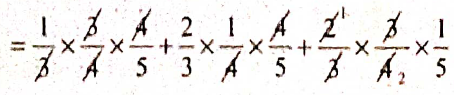
\(=\frac{1}{5}+\frac{2}{15}+\frac{1}{10}=\frac{1}{5}\left(1+\frac{2}{3}+\frac{1}{2}\right) \)
\(=\frac{6+4+3}{30}=\frac{13}{30}\)
10.
(a)
\(\frac { 3 }{ 28 } \)
11.
(d)
\(\frac { 1 }{ 5 } \)
12.
(c)
\(\frac { 1 }{ 4 } \)
13.
(c)
\(\frac { 7 }{ 8 } \)
14.
(a)
\(\frac { 64 }{ 64 } \)
15.
(a)
\(\frac { 7 }{ 20 } \)
16.
\(m \leq 5\)
\(2 x^{2}+2 m x+m+1>0\)
For real roots
\(4 m^{2}-8(m+1)>0 \)
\(4 m^{2} - 8 m-8>0 \)
\(m^{2}-2 m-2>0 \)
\(\text {Then } m \text { can be } 5,4,3\)
\(n(S)=5 ,n(A)=3 ,P(A)=\frac{3}{5} \)
17.
\(\mathrm{P}(\mathrm{A} \cup \mathrm{B}) =\mathrm{P}(\mathrm{A})+\mathrm{P}(\mathrm{B})-\mathrm{P}(\mathrm{A} \cap \mathrm{B}) \)
\(0.6 =0.35+\mathrm{P}(\mathrm{B})-\mathrm{P}(\mathrm{A}) \cdot \mathrm{P}(\mathrm{B}) \)
\(0.25 =\mathrm{P}(\mathrm{B})-0.35 \mathrm{P}(\mathrm{B}) \)
\(=\mathrm{P}(\mathrm{B})(1-0.35) \)
\(=\mathrm{P}(\mathrm{B})(0.65) \)
\(\mathrm{P}(\mathrm{B}) =\frac{0.25}{0.65}=\frac{5}{13} \)
18.
Required Probability ={P(WBWBW)+ P(BWBWB)}
\(=\left(\frac{5}{8} \times \frac{3}{7} \times \frac{4}{6} \times \frac{2}{5} \times \frac{3}{4}\right) +\left(\frac{3}{8} \times \frac{5}{7} \times \frac{2}{6} \times \frac{4}{5} \times \frac{1}{4}\right) \)
\(=\frac{3}{56}+\frac{1}{56}=\frac{4}{56}=\frac{1}{14} \)
19.
P(A or B but not C)
\(= P(A) P(B) P(\bar{C})+P(A) P(\bar{B}) P(\bar{C})+P(\bar{A}) P(B) P(\bar{C}) \)
\(= \frac{3}{4} \times \frac{1}{2} \times \frac{3}{8}+\frac{3}{4} \times \frac{1}{2} \times \frac{3}{8}+\frac{1}{4} \times \frac{1}{2} \times \frac{3}{8} \)
\(= \frac{9+9+3}{64}=\frac{21}{64} \)
20.
Consider the following events.
A: getting a white ball in I draw
B: getting a black ball in II draw
Required probability = P(getting white ball in I draw and getting a black ball in II draw)
= P(\(A\cap B\))
= P(A).P(B/A) \(\left[ \because P(B/A)=\frac { P(A\cap B) }{ P(A) } \right] \)


21.
n(S) = 52
There are 4 kings and 4 queens in a pack of cards
\(\therefore\) n(E) = 8
There are 4 queens and 4 aces in a pack of cards
\(\therefore\) n(F) = 8
\(\therefore P(E)=\frac { 8 }{ 52 } =\frac { 2 }{ 13 } \) and \(P(F)=\frac { 8 }{ 52 } =\frac { 2 }{ 13 } \) and \(P(E\cap F)=\frac { 4 }{ 52 } =\frac { 1 }{ 13 } \)
\(P(E/F)=\frac { P(E\cap F) }{ P(F) } =\frac { \frac { 1 }{ 13 } }{ \frac { 2 }{ 13 } } =\frac { 1 }{ 13 } \times \frac { 13 }{ 2 } =\frac { 1 }{ 2 } \)
22.
\(\mathrm{P}(\mathrm{A})>0 ; P(B)>0 ; P(C)>0 ; P(D)>0
\text { and } P(A)+P(B)+P(C)+\mathrm{P}(\mathrm{D}) \)
\(=0.22+0.38+0.16+0.34 \)
\(=1.1 \neq 1\)
\(\therefore\) The assignment of probability are not permissible.
23.

11th Standard Syllabus & Materials
11th Standard
TN 11th Tamil பீடு பெற நில் - செய்யுள் - காவடிச்சிந்து Important Questions And Answers Study Material - QB365 Set A
NEW11th Standard
TN 11th Tamil பீடு பெற நில் - உரைநடை - மலை இடப்பெயர்கள் : ஓர் ஆய்வு Important Questions And Answers Study Material - QB365 Set A
NEW11th Standard
TN 11th Tamil மாமழை போற்றுதும் - துணைப்பாடம் - யானை டாக்டர் Important Questions And Answers Study Material - QB365 Set A
NEW11th Standard
TN 11th Tamil மாமழை போற்றுதும் - செய்யுள் - ஐங்குறுநூறு Important Questions And Answers Study Material - QB365 Set A



Tamilnadu Stateboard 11th Standard Subjects
Maths

Commerce

Economics

Biology

Business Maths and Statistics

Accountancy

Computer Science

Physics

Chemistry
Maths
Biology
Economics
Physics
Chemistry

History
Business Maths and Statistics

Computer Science
Accountancy

Computer Applications
History
Computer Technology
Commerce
Computer Applications
Computer Technology

Tamil

English

French
Tamilnadu Stateboard Standards

