
 100% FREE ACCESS
11th Standard Syllabus & Materials
11th Standard
TN 11th Tamil இயற்கை வேளாண்மை,சுற்றுச்சூழல் -செய்யுள் - மனோன்மணீயம் Important Questions And Answers Study Material - QB365 Set A
NEW11th Standard
TN 11th Tamil என்னுயிர் என்பேன் -துணைப்பாடம் - இசைத்தமிழர் இருவர் Important Questions And Answers Study Material - QB365 Set A
NEW11th Standard
TN 11th Tamil மொழி கலை -செய்யுள் - ஒவ்வொரு புல்லையும் Important Questions And Answers Study Material - QB365 Set A
NEW11th Standard
TN 11th Tamil பீடு பெற நில் - இலக்கணம் - பகுபத உறுப்புகள் Important Questions And Answers Study Material - QB365 Set A
NEW11th Standard
TN 11th Tamil பீடு பெற நில் - துணைப்பாடம் - வாடிவாசல் Important Questions And Answers Study Material - QB365 Set A
NEW11th Standard
TN 11th Tamil பீடு பெற நில் - செய்யுள் - குறுந்தொகை Important Questions And Answers Study Material - QB365 Set A

Published on: 23/07/2018
UNIT TEST LES 2
Download Tamil Nadu 11th Standard Physics question papers, model tests, one-mark questions, important questions, and public exam papers in PDF format. Free study materials and answer keys for TN State Board students.
Questions + Answers key
Take MCQ Physics Test1.
The path of the projectile, projected horizontally is _____________.
hyperbola
parabola
straight line
circle
2.
The time of flight is __________ the time taken to attain the maximum height:
thrice
same
twice
four times
3.
During projectile motion the quantities that remain unchanged are _____________
force and vertical velocity
acceleration and horizontal velocity
kinetic energy and acceleration
acceleration and momentum
4.
If a particle executes uniform circular motion, choose the correct statement
The velocity and speed are constant
The acceleration and speed are constant.
The velocity and acceleration are constant.
The speed and magnitude of acceleration are constant.
5.
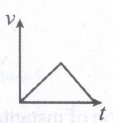
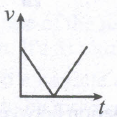
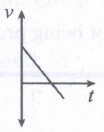
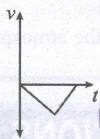
A ball is projected vertically upwards with a velocity v. It comes back to ground in time t. Which v-t graph shows the motion correctly?
6.
A particle is in circular motion with an acceleration α = 0.2 rad s-2.
(a) What is the angular displacement made by the particle after 5 s?
(b) What is the angular velocity at t = 5 s?. Assume the initial angular velocity is zero.
7.
Define non-uniform motion.
8.
What is degree? Express 1 radian in degree.
9.
An object is thrown with initial speed 5 ms-1 with an angle of projection 30\(\gamma \) . What is the height and range reached by the particle?
10.
Define a radian?
11.
Calculate the angle θ subtended by the two adjacent wooden spokes of a bullock cart wheel is shown in the figure. Express the angle in both radian and degree.
.png)
12.
In the cricket game, a batsman strikes the ball such that it moves with the speed 30 ms-1 at an angle 30° with the horizontal as shown in the figure. The boundary line of the cricket ground is located at a distance of 75 m from the batsman? Will the ball go for a six? (Neglect the air resistance and take acceleration due to gravity g = 10 m s-2).
.png)
13.
Derive an expression for the centripetal acceleration of a body moving in a circular path of radius 'r' with uniform speed.
14.
Define uniform circular motion. Given some examples.
15.
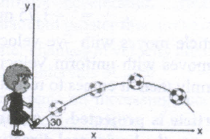
A foot-ball player hits the ball with speed 20 ms-1 with angle 30° with respect to horizontal direction as shown in the figure. The goal post is at distance of 40 m from him. Find out whether ball reaches the goal post.
16.
Write down the kinematic equations for angular motion.
17.
Define angular displacement and angular velocity.
18.
Derive the relation between Tangential acceleration and angular acceleration.
19.
Shows that the path of horizontal projectile is a parabola and derive an expression for
(i) Time of flight
(ii) Horizontal range
(iii) resultant relative and any instant
(iv) speed of the projectile when it hits the ground?
20.
Derive the relation between linear velocity and angular velocity.
1.
(b)
parabola
2.
(c)
twice
3.
(b)
acceleration and horizontal velocity
4.
It is a uniform circular motion. So the direction of velocity changes but not the magnitude. Therefore speed in considered constant. Again magnitude of acceleration does not change.
5.
Initially velocity has maximum value and at maximum height velocity becomes zero. After that the velocity becomes negative
6.
Since the initial angular velocity is zero \((\omega_0=0)\)
The angular displacement made by the particle is given by
\(\theta=\omega_0t+\frac{1}{2}\alpha t^2\)
\(\theta=\frac{1}{2}\times2\times10^{-1}\times25=2.5\ rad\)
In terms of degree \(\theta=2.5\times57.17^0\approx143^0\)
7.
If the velocity changes in both speed and direction during the circular motion, we get non uniform circular motion.
8.
Degree is the unit of measurement which is used to determine the size of an angle.
360°=2\(\pi\) radians or 1 radian = \(\frac { 180 }{ \pi } \) degrees
which means 1 rad = 57.295°
9.
Initial speed u = 5 ms-1
Angle of projection = 30°; g = 9.8 ms-2
Heightmax=?
Range R = ?
Height, \({ h }_{ max }=\frac { { u }^{ 2 }{ sin }^{ 2 }\theta }{ 2g } ;R=\frac { { u }^{ 2 }sin2\theta }{ g } \)
\({ h }_{ max }=\frac { { 5 }^{ 2 }{ sin }^{ 2 }30° }{ 2\times 9.8 } =\frac { 25\times \frac { 1 }{ 4 } }{ 19.6 } =\frac { 25 }{ 19.6 } \times \frac { 1 }{ 4 } \)
hmax = 0.318 m
Range, \(R=\frac { 25\quad sin60° }{ 9.8 } =\frac { 25\times \sqrt { 3 } }{ 19.6 } =\frac { 25\times 1.732 }{ 19.6 } \)
Range, R = 2.209 m.
10.
One radian is the angle subtended at the center of a circle by an arc that is equal in length to the radius of the circle.
1 rad = \(\frac{180}{\pi}\) degree = 57.295o
11.
The full wheel subtends \(2\pi\) radians at the center of the wheel. The wheel is divided into 12 parts (arcs).
So one part sub tends an angle \(\theta=\frac{2\pi}{12}=\frac{\pi}{6}\) radian at the center
Since, \(\pi\) rad=1800, \(\frac{\pi}{6}\) radian is equal to 30 degree.
\(\therefore\) The angle subtended by two adjacent wooden spokes is 30 degree at the center.
12.
The motion of the cricket ball in air is essentially a projectile motion. As we have already seen, the range (horizontal distance) of the projectile motion is given by
\(R=\frac{u^2sin2\theta}{g}\)
The initial speed u = 30 ms-1
The projection angle θ = 30°
The horizontal distance travelled by the cricket ball \(R=\frac{(30)^2\times sin60^0}{10}=\frac{900\times\frac{\sqrt 3}{2}}{10}=77.94\ m\)
This distance is greater than the distance of the boundary line. Hence the ball will cross this line and go for a six.
13.
The centripetal acceleration is derived from relationship between position and velocity vectors.
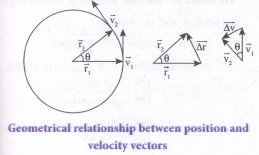
(ii) Let the directions of position and velocity vectors shift through the same angle \(\theta\) in a small interval of time \(\triangle t.\)
(iii) For uniform circular motion, r \(|{\overrightarrow{r}}_{1}|=|\overrightarrow{r}_2|\) and \(v=|\overrightarrow{v}_{1}|=|\overrightarrow{v}_{2}|,\) If the particle moves from position vector \(\overrightarrow{r}_1\) to \(\overrightarrow{r}_2\) the displacement is given by \(\triangle \overrightarrow{r}={\overrightarrow{r}}_{2}-{\overrightarrow{r}}_{1}\) and the change in velocity from \(\overrightarrow{v}_1\) to \(\overrightarrow{v}_2\) is given by \(\triangle\overrightarrow{v}={\overrightarrow{v}}_{2}-\overrightarrow{v}_{1}.\)
(iv) The magnitudes of the displacement \(\triangle r\) and of \(\triangle v\) satisfy the following relation.
\({{\triangle r}\over{r}}={{\triangle v}\over{v}}=\theta\)
(v) Here the negative sign implies that \(\triangle v\) points radially inward, towards the center of the circle
\(\triangle v=-v\left({{\triangle r}\over{r}} \right)\)
Then, \(a={{\triangle v}\over{\triangle t}}={{v}\over{r}}\left( {{\triangle v}\over{\triangle t}}\right)=-{{v^2}\over{}r}\)
(vi) For uniform circular motion \(\omega r\), where (0 is the angular velocity of the particle about the center. Then the centripetal acceleration can be written as
\(a=-\omega^2 r\)
14.
When a point object is moving on a circular path with a constant speed, it covers equal distances on the circumference of the circle in equal intervals of time. Then the object is said to be in uniform circular motion.
Examples:
(i) Motion of the tip of the second hand of a clock.
(ii) Motion of a point on the rim of a wheel rotating uniformly
15.
u = 20 ms-1.
\(\theta\) = 30°
Distance of goal Post = 40 m
Range = \(\frac { { u }^{ 2 }sin2\theta }{ g } \)
\(=\frac {400\times \sqrt{3}}{9.8 \times2}=35.35m\)
The ball will not reach the goal post.
16.
| 1. \(\omega ={ \omega }_{ 0 }+\alpha t\) | \(\omega \) = Final angular velocity |
| 2. \(\theta ={ \omega }_{ 0 }t+\frac { 1 }{ 2 } { \alpha t }^{ 2 }\) | \({ \omega }_{ 0 }\) = initial angular velocity |
| 3. \({ \omega }^{ 2 }={ \omega }_{ 0 }^{ 2 }+2\alpha \theta \) | \(\theta \) = Angular displacement |
| 4. \(\theta =\frac { \left( { \omega }_{ 0 }+\omega \right) t }{ 2 } \) | \(\alpha \) = angular acceleration t = time |
17.
Angular displacement: While a particle is revolving around a point in a circular path, the angle described by the particle about the axis of rotation (or at the centre of the circle) in a given time is called angular displacement. Its unit is radian.
Angular velocity: The rate of change of angular displacement is called angular velocity. Its unit is rad s-1
\(\omega =\frac { d\theta }{ dt } \)
18.
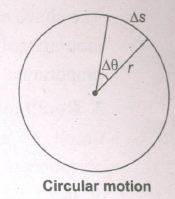
Consider an object moving along a circle of radius r. In a time ∆t, the object travels in an arc distance ∆s as shown in figure. The corresponding angle subtended is ∆\(\theta\)
The ∆s can be written in terms of ∆\(\theta\)
∆s = r∆\(\theta\) ...............(i)
In a time ∆t, we have
\(\frac { \Delta s }{ \Delta t } =t\frac { \Delta \theta }{ \Delta t } \) .......(ii)
In the limit Δt⟶0 the above equation becomes
\(\frac { ds }{ dt } =r\omega \) ........(iii)
Here\(\frac { ds }{ dt } \) is linear speed (v) which is tangential to the circle and \(\omega \) is angular speed. So equation (iii) becomes
vr = rω ........(iv)
which gives the relation between linear speed and angular speed
Eq (iv) is true only for circular motion. In general the relation between linear and angular velocity is given by
\(\vec { v } =\vec { \omega } \times \vec { r } \)...........(v)
For circular motion eq. (v) reduces to eq. (iv) since \(\vec { \omega } \) and \(\vec { r } \) are perpendicular to each other Differentiating the eq. (iv) with respect to time, we get (since r is constant)
\(\frac { dv }{ dt } =\frac { rd\omega }{ dt } =r\alpha \)
Here\(\frac { dv }{ dt } \) is the tangential acceleration and is denoted as at = \(\frac { d\omega }{ dt } \) is the angular acceleration Then eq.(v) becomes
at = r∝ ......(vii)
19.
Consider a projectile, say a ball, thrown horizontally with an initial velocity \(\vec{u}\) from the top of a tower of height h.
As the ball moves, it covers a horizontal distance due to its uniform horizontal velocity u, and a vertical downward distance because of constant acceleration due to gravity g. Thus, under the combined effect the ball moves along the path OPA. The motion is in a 2-dimensional plane. Let the ball take-time t to reach the ground at point A, Then the horizontal distance travelled by the ball is x(t) = x, and the vertical distance travelled is y(t) =y.
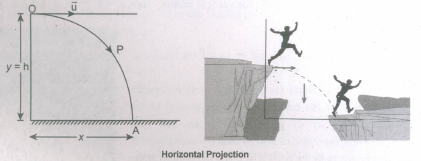
We can apply the kinematic equations along the x direction and y direction separately. Since this is two-dimensional motion, the velocity will have both horizontal component Ux and vertical component uy.
Motion along horizontal direction: The particle has zero acceleration along x direction. So, the initial velocity Ux remains constant throughout the motion.
The distance traveled by the projectile at a time t is given by the equation x = ux t+\(1\over 2\) at 2.
Since a = 0 along x direction, we have
x = uxt ................(i)
Motion along downward direction: Here u y = 0 (initial velocity has no downward component), a = g (we choose the +ve y-axis in downward direction), and distance y at time t.
\(\therefore\) y=\(u_xt+{1\over2}at^2,\) we get
\(y={1\over 2}at^2\) ..............(ii)
Substituting the value of t from equation (i) in equation (ii) we have
\(y={1\over 2}g{x^2\over u^2_x}=({g\over 2u^2_x})x^2\)
y = Kx2
where K = \(g\over 2u^2_x\) is constant.
Equation (iii) is the equation of a parabola. Thus, the path followed by the projectile is a parabola.
1. Time of Flight: The time taken for the projectile to complete its trajectory or time taken by the projectile to hit the ground is called time of flight. Consider the example of a tower and projectile. Let h be the height .of a tower. Let T be the time taken by the projectile to hit the ground, after being thrown horizontally from the tower.
We know that Sy = uyt +\(1\over2\) at2 for vertical motion. Here Sy = h, t = T, uy = 0 (i.e., no initial vertical velocity). Then
\(h={1\over2}gt^2 \ or \ T=\sqrt{2h\over g}\)
Thus, the time of flight for projectile motion depends on the height of the tower, but is independent of the horizontal. velocity of projection. If one ball falls vertically and another ball is projected horizontally with some velocity, both the balls will reach the bottom at the same time.
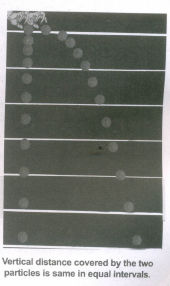
2. Horizontal range: The horizontal distance covered by the projectile from the foot of the tower to the point where the projectile hits the ground is called horizontal range.
For horizontal motion, we have
\(s_x=u_xt+{1\over2}at^2\)
Here, Sx = R (range), Ux = u, a = 0 (no horizontal acceleration) T is time of flight. Then horizontal range = uT.
Since the time of flight T =\(\sqrt{2h\over g}\) ,we substitute this and we get the horizontal range of the particle as R = u\(\sqrt{2h\over g}\)
The above equation implies that the range R is directly proportional to the initial velocity u and inversely proportional to acceleration due to gravity g.
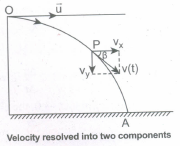
3. Resultant Velocity (Velocity of projectile at any time): At any instant t, the projectile has velocity components along both x-axis and y-axis. The resultant of these two components gives the velocity of the projectile at that instant t
The velocity component at any t along horizontal (x-axis) is vx= ux+axt.
Since, Ux = u, ax = 0 , we get
vx= u
The component of velocity along vertical direction (y-axis) isvy = uy + ay t
Since, uy = 0, ay = g, we get
vy = gt
Hence the velocity of the particle at any instant is
\(\vec{v}=u\hat{i}+gt\hat{j}\)
The speed of the particle at any instant t is given by
\(v=\sqrt{v^2_x+v^2_y}\)
\(\therefore v=\sqrt{u^2+g^2t^2}\)
4. Speed of the projectile when it hits the ground: When the projectile hits the ground after initially thrown horizontally from the top of tower of height h, the time of flight is
\(t=\sqrt{2h\over g}\)
The horizontal component velocity of the projectile remains the same i.e Vx = u.
The vertical component velocity of the projectile at time T is
\(v=gT=g\sqrt{2h\over g}=\sqrt{2gh}\)
The speed of the particle when it reaches the ground is
\(v=\sqrt{u^2+2gh}\)
20.
(i) Consider an object moving along a circle of radius r. In a time \(\Delta \) t, the object travels an arc distance \(\Delta\)s as shown in Figure. The corresponding angle subtended is \(\Delta\) \(\theta\) .
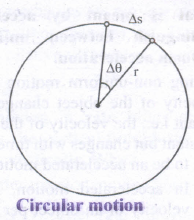
(ii) The \(\Delta\)s can be written in terms of \(\Delta\)\(\theta\) as,
\(\Delta\)s=r\(\Delta\)\(\theta\)
In a time \(\Delta\)t, we have
\(\frac { \Delta s }{ \Delta t } =r\frac { \Delta \theta }{ \Delta t } \)
(iii) In the limit \(\Delta\)t \(\rightarrow\) 0, the above equation becomes
\(\frac { ds }{ dt } =r\omega \) .............(i)
(iv) Here \(\frac { ds }{ dt } \) is linear speed (v) which is tangential to the circle and \(\omega \) is angular speed.
(v) So equation (i) becomes v = r\(\omega \)
(vi)This equation is true only for circular motion. In general, the relation between linear and angular velocity is given by \(\vec{v}=\vec{\omega} \times \vec{r}\)
(vii) The direction of linear velocity i is tangential to the circle, whereas the direction of angular velocity \(\vec{\omega}\) is along the axis of rotation following the right-hand rule. The radius is also represented as a vector \(\vec{r}\) directed radially from the centre of the circle.

11th Standard Syllabus & Materials
11th Standard
TN 11th Tamil பீடு பெற நில் - செய்யுள் - காவடிச்சிந்து Important Questions And Answers Study Material - QB365 Set A
NEW11th Standard
TN 11th Tamil பீடு பெற நில் - உரைநடை - மலை இடப்பெயர்கள் : ஓர் ஆய்வு Important Questions And Answers Study Material - QB365 Set A
NEW11th Standard
TN 11th Tamil மாமழை போற்றுதும் - துணைப்பாடம் - யானை டாக்டர் Important Questions And Answers Study Material - QB365 Set A
NEW11th Standard
TN 11th Tamil மாமழை போற்றுதும் - செய்யுள் - ஐங்குறுநூறு Important Questions And Answers Study Material - QB365 Set A



Tamilnadu Stateboard 11th Standard Subjects

Maths

Commerce

Economics

Biology

Business Maths and Statistics

Accountancy

Computer Science
Physics

Chemistry
Maths
Biology
Economics
Physics
Chemistry

History
Business Maths and Statistics

Computer Science
Accountancy

Computer Applications
History
Computer Technology
Commerce
Computer Applications
Computer Technology

Tamil

English

French
Tamilnadu Stateboard Standards

