
 100% FREE ACCESS
11th Standard Syllabus & Materials
11th Standard
TN 11th Tamil இயற்கை வேளாண்மை,சுற்றுச்சூழல் -செய்யுள் - மனோன்மணீயம் Important Questions And Answers Study Material - QB365 Set A
NEW11th Standard
TN 11th Tamil என்னுயிர் என்பேன் -துணைப்பாடம் - இசைத்தமிழர் இருவர் Important Questions And Answers Study Material - QB365 Set A
NEW11th Standard
TN 11th Tamil மொழி கலை -செய்யுள் - ஒவ்வொரு புல்லையும் Important Questions And Answers Study Material - QB365 Set A
NEW11th Standard
TN 11th Tamil பீடு பெற நில் - இலக்கணம் - பகுபத உறுப்புகள் Important Questions And Answers Study Material - QB365 Set A
NEW11th Standard
TN 11th Tamil பீடு பெற நில் - துணைப்பாடம் - வாடிவாசல் Important Questions And Answers Study Material - QB365 Set A
NEW11th Standard
TN 11th Tamil பீடு பெற நில் - செய்யுள் - குறுந்தொகை Important Questions And Answers Study Material - QB365 Set A

Published on: 28/07/2018
In this question paper, some of the important one mark, two and five marks questions from the chapter Laws of Motion are covered. The questions are prepared from the book back and creative question.
Download Tamil Nadu 11th Standard Physics question papers, model tests, one-mark questions, important questions, and public exam papers in PDF format. Free study materials and answer keys for TN State Board students.
Questions + Answers key
Take MCQ Physics Test1.
A truck weighing 1000 kg is moving with velocity of 50 km/h on smooth horizontal roads. A mass of 250 kg is dropped into it. The velocity with which it moves now is ____________.
12.5 km/h
20 km/h
40 km/h
50 km/h
2.
The centrifugal force appears to exist
only in inertial frames
only in rotating frames
in any accelerated frame
both in inertial and non-inertial frames
3.
When an object is at rest on the inclined rough surface ____________.
static and kinetic frictions acting on the object is zero
static friction is zero but kinetic friction is not zero
static friction is not zero and kinetic friction is zero
static and kinetic frictions are not zero
4.
Force acting on the particle moving with constant speed is
always zero
need not be zero
always non zero
cannot be concluded
5.
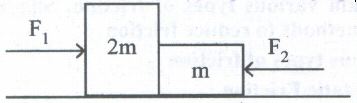
Two blocks of masses m and 2m are placed on a smooth horizontal surface as shown. In the first case only a force F1 is applied from the left. Later only a force F2 is applied from the right. If the force acting at the interface of the two blocks in the two cases is same, then F1 :F2 is
1:1
1:2
2:1
1:3
6.
A vehicle is moving along the positive x direction, if sudden brake is applied, then
frictional force acting on the vehicle is along negative x direction
frictional force acting on the vehicle is along positive x direction
no frictional force acts on the vehicle
frictional force acts in downward direction
7.
Explain the motion of blocks connected by a string in Horizontal motion.
8.
Prove the law of conservation of linear momentum. Use it to find the recoil velocity of a gun when a bullet is fired from it.
9.
What is the need of banking a circular road?
10.
Define coefficient of static friction.
11.
Give reason. fs = μs.N
12.
It is easier to roll a barrel than to pull it along the road. Why?
13.
Does the force of friction depends on the area of contact?
14.
Give reason "If the object is pressed hard on the surface where it is placed. As a result it is more difficult to move the object".
15.
The momentum of a system of particles is always conserved. True or false?
16.
Can we predict the direction of motion of a body from the direction of force on it?
17.
Can the coefficient of friction be more than one?
18.
When a person walks on a surface, the frictional force exerted by the surface on the person is opposite to the direction of motion. True or false?
19.
The Two masses m1=m2 =0.5kg are connected by a string which passes over a smooth frictionless pulley. What is the, acceleration of the masses
20.
What are the steps which have to be followed before applying Newton's laws?
1.
(c)
40 km/h
2.
(b)
only in rotating frames
3.
(c)
static friction is not zero and kinetic friction is zero
4.
(b)
need not be zero
5.
(c)
2:1
6.
(a)
frictional force acting on the vehicle is along negative x direction
7.
Horizontal motion:
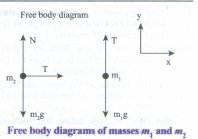
(i) In this case, mass m2 is kept on a horizontal table and mass m1 is hanging through a small pulley. Assume that there is no friction on the surface.
(ii) As both the blocks are connected to them unstretchable string, if m, moves with an acceleration a downward then m2 also moves with the same acceleration a horizontally.
The forces acting on mass m2 are
(i) Downward gravitational force (m2g)
(ii) Upward normal force (N) exerted by the surface
(iii) Horizontal tension (T) exerted by the string.
The forces acting on mass m1 are
(i) Downward gravitational force (m1g)
(ii) Tension (T) acting upwards
The free body diagrams for both the masses.
\(T\hat{j}-m_1g\hat{j}=m_1a\hat{j}\) ( along y direction)
(iii) By comparing the components on both sides of the above equation,
Applying Newton's second law for m2
\(T\hat{i}-m_2a\hat{i}\) (along x direction)
By comparing the components on both sides of above equation,
\(N\hat{j}-m_2g\hat{i}=0\)
By comparing the components on both sides
of the above equation
N - m2g = 0
N = m2g ........(3)
By substituting equation (2) in equation (1), we can find the tension T.
(iv) Comparing motion in both cases, it is clear that the tension in the string for horizontal motion is half of the tension for vertical motion for same set of masses and strings.
8.
Conservation of linear momentum is equivalent to Newton's third law of motion. If no external force acts on a system (called isolated) of constant mass, the total momentum of the system remains constant with time.
According to this law for a system of particles \(\vec{F}=\frac{d \vec{p}}{d t}\)
In the absence of external force F = 0 and \(\vec{p}\) = constant
i.e., \(p_{1}+\vec{p}_{2}+\vec{p}_{3}+\dots=\) constant
or \(m_{1} \vec{v}_{1}+m_{2} \vec{v}_{2}+m_{3} \vec{v}_{3}+\dots=\) constant
This equation shows that in absence of external force for a closed system the linear momentum of individual particles may change but their sum remains unchanged with time. For a system of two particles in absence of external force by law of conservation of linear momentum.
\(\vec{p}_{1}+\vec{p}_{2} =\text { constant } \)
\(m_{1} \vec{v}_{1}+m_{2} \vec{v}_{2} =\text { constant } \)
\(m_{1} \frac{d \vec{v}_{1}}{d t}+m_{2} \frac{d \vec{v}_{2}}{d t} =0 \Rightarrow m_{1} \vec{a}_{1}+m_{2} \vec{a}_{2}=0 \Rightarrow \vec{F}_{1}+\vec{F}_{2}=0 \)
\(\therefore \vec{F}_{2} =-\vec{F}_{1}\)
For every action there is equal and opposite reaction which is Newton's third law of motion.
Recoiling of a gun: For bullet and gun system, the force exerted by trigger will be internal so the momentum of the system remains unaffected.
Let mG= mass of gun, mB= mass of bullet, vG velocity of gun, vB= velocity of bullet Initial momentum of system =0
Final momentum of system \(=m_{G} \vec{v}_{G}+m_{B} \vec{v}_{B}\)
By the law of conservation linear momentum \(m_{G} \vec{v}_{G}+m_{B} \vec{v}_{B}=0\)
So recoil velocity \(v_{G}=-\frac{m_{B}}{m_{G}} \vec{v}_{B}\)
Here negative sign indicates that the velocity of recoil \(\vec{v}_{G}\) is opposite to the velocity of the bullet.
\(v_{G} \propto \frac{1}{m_{G}}\) i.e. higher the mass of gun, lesser the velocity of recoil of gun.
While firing the gun must be held tightly to the shoulder, this would save hurting the shoulder because in this condition the body of the shooter and the gun behave as one body. Total mass become large and recoil velocity becomes too small.
\(\vec{v}_{G} \propto \frac{1}{m_{G}+m_{\operatorname{man}}}\)
9.
Horizontal component of the normal reaction of the road provides the necessary centripetal force for the vehicle to move it along the curved path.
10.
The coefficient of static friction is equal to tangent of the angle of friction.
11.
It is not a vector equation. The relation fs = μs.N is not a vector relation. This is because the normal force N and fs are not in the same direction even though fs is equal to μs times the normal force. This is also true in the case of kinetic friction.
12.
Rolling friction < Sliding friction
13.
No
14.
If the object is pressed hard on the surface then the normal force acting on the object will increase. As a consequence it is more difficult to move the object.
15.
True
16.
If an object is thrown vertically upward, the direction of motion is upward, but gravitational force is downward.
17.
Yes, μ > 1, friction is stronger than normal force
18.
False
19.
The common acceleration of the masses is,
\(a=\frac { \left( { m }_{ 1 }-{ m }_{ 2 } \right) }{ \left( { m }_{ 1 }+{ m }_{ 2 } \right) } \times g\) [\(\therefore\) g \(\longrightarrow \) acceleration due to gravity]
= \(\frac { \left( 0.5-0.5 \right) }{ \left( 0.5+0.5 \right) } \times 9.8\)
= \(\frac { 0 }{ 1 } \times 9.8\)
The acceleration of the masses = 0
20.
(i) Choose a suitable inertial coordinate system to analyse the problem. For most of the cases we can take Earth as an inertial coordinate system.
(ii) Identify the system to which Newton's laws need to be applied. The system can be a single object or more than one object.
(iii) Draw the free body diagram
(iv) Once the forces acting on the system are identified, and the free body diagram is drawn, apply Newton's second law. In the left hand side of the equation, write the forces acting on the system in vector notation and equate it to the right hand side of equation which is the product of mass and acceleration. Here, acceleration should also be in vector notation.
(v) If acceleration is given, the force can be calculated. If the force is given, acceleration can be calculated.

11th Standard Syllabus & Materials
11th Standard
TN 11th Tamil பீடு பெற நில் - செய்யுள் - காவடிச்சிந்து Important Questions And Answers Study Material - QB365 Set A
NEW11th Standard
TN 11th Tamil பீடு பெற நில் - உரைநடை - மலை இடப்பெயர்கள் : ஓர் ஆய்வு Important Questions And Answers Study Material - QB365 Set A
NEW11th Standard
TN 11th Tamil மாமழை போற்றுதும் - துணைப்பாடம் - யானை டாக்டர் Important Questions And Answers Study Material - QB365 Set A
NEW11th Standard
TN 11th Tamil மாமழை போற்றுதும் - செய்யுள் - ஐங்குறுநூறு Important Questions And Answers Study Material - QB365 Set A



Tamilnadu Stateboard 11th Standard Subjects

Maths

Commerce

Economics

Biology

Business Maths and Statistics

Accountancy

Computer Science
Physics

Chemistry
Maths
Biology
Economics
Physics
Chemistry

History
Business Maths and Statistics

Computer Science
Accountancy

Computer Applications
History
Computer Technology
Commerce
Computer Applications
Computer Technology

Tamil

English

French
Tamilnadu Stateboard Standards

