
 100% FREE ACCESS
11th Standard Syllabus & Materials
11th Standard
TN 11th Tamil இயற்கை வேளாண்மை,சுற்றுச்சூழல் -செய்யுள் - மனோன்மணீயம் Important Questions And Answers Study Material - QB365 Set A
NEW11th Standard
TN 11th Tamil என்னுயிர் என்பேன் -துணைப்பாடம் - இசைத்தமிழர் இருவர் Important Questions And Answers Study Material - QB365 Set A
NEW11th Standard
TN 11th Tamil மொழி கலை -செய்யுள் - ஒவ்வொரு புல்லையும் Important Questions And Answers Study Material - QB365 Set A
NEW11th Standard
TN 11th Tamil பீடு பெற நில் - இலக்கணம் - பகுபத உறுப்புகள் Important Questions And Answers Study Material - QB365 Set A
NEW11th Standard
TN 11th Tamil பீடு பெற நில் - துணைப்பாடம் - வாடிவாசல் Important Questions And Answers Study Material - QB365 Set A
NEW11th Standard
TN 11th Tamil பீடு பெற நில் - செய்யுள் - குறுந்தொகை Important Questions And Answers Study Material - QB365 Set A

Published on: 30/09/2018
Important questions - Laws of Motion
Download Tamil Nadu 11th Standard Physics question papers, model tests, one-mark questions, important questions, and public exam papers in PDF format. Free study materials and answer keys for TN State Board students.
Questions + Answers key
Take MCQ Physics Test1.
How many degrees make a one newton?
102 dyne
202 dyne
105 dyne
205 dyne
2.
A machine gun has mass 15 kg. It fires 15 g bullet at the rate of 200 bullets per minutes with a speed of 150 m/s. Then the recoil velocity of the gun is ____________.
20 ms-1
15 ms-1
150 ms-1
0.2 ms-1
3.
Dimensions of impulse are same as that of ________________.
Force
Momentum
Energy
Acceleration
4.
A particle is acted upon by a force of constant magnitude which is always perpendicular to the velocity of the particle. The motion of the particle takes place in a plane. It follows that ______________.
Its acceleration is constant
Its velocity is constant
Its K.E. is constant
It moves in a straight line
5.
The centrifugal force appears to exist
only in inertial frames
only in rotating frames
in any accelerated frame
both in inertial and non-inertial frames
6.
When an object is at rest on the inclined rough surface ____________.
static and kinetic frictions acting on the object is zero
static friction is zero but kinetic friction is not zero
static friction is not zero and kinetic friction is zero
static and kinetic frictions are not zero
7.
8.
A vehicle is moving along the positive x direction, if sudden brake is applied, then
frictional force acting on the vehicle is along negative x direction
frictional force acting on the vehicle is along positive x direction
no frictional force acts on the vehicle
frictional force acts in downward direction
9.
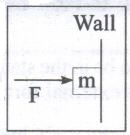
An object of mass m held against a vertical wall by applying horizontal force F as shown in the figure.The minimum value of the force F is
Less than mg
Equal to mg
Greater than mg
Cannot determine
10.
When a car takes a sudden left turn in the curved road, passengers are pushed towards the right due to
inertia of direction
inertia of motion
inertia of rest
absence of inertia
11.
Identify the internal and external forces acting on the following systems.
(a) Earth alone as a system
(b) Earth and Sun as a system
(c) Our body as a system while walking
(d) Our body + Earth as a system
12.
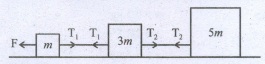
As shown in the diagram, three masses m, 3m and 5m connected together lie on a frictionless horizontal surface and pulled to the left by a force F. The tension T1 in the first string is 24N. Find
(i) acceleration of the system
(ii) tension in the second string and
(iii) force F
13.
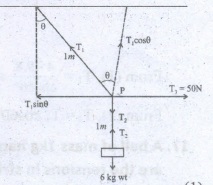
A mass of 6 kg is suspended by a rope of length 2m from a ceiling. A force of 50N in the horizontal direction is applied at the midpoint of the rope as shown in the figure. What is the angle the rope makes with the vertical is equilibrium? Take g = 10 ms-2. Neglect mass of the rope.
14.
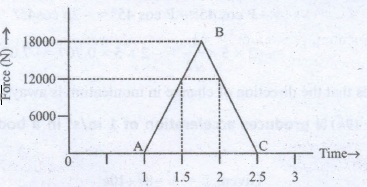
The diagram shows an estimated force-time graph for a baseball struck by a bat. Then find
(i) Impulse
(ii) Force
(iii) Maximum force
15.
Why do the blades of an electric fan continue to rotate for sometime after the current is switched off?
16.
Draw and explain the variations of force of friction vs applied force graphically.
17.
Explain with example how earth can be treated as both inertial and non-inertial frame of reference?
18.
"Jumping on a cemented floor receives more injuries than on the sand" - Given reason.
19.
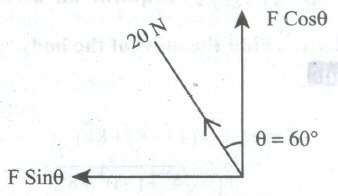
A force of 20 N is inclined to the vertical at an angle of 60°. Find the acceleration it produces in a body of mass 500 g which moves in the horizontal direction.
20.
The force that should be applied a body of mass 20 kg. It moves upward with an acceleration of 4 ms-2. Find the force in the vacuum.
21.
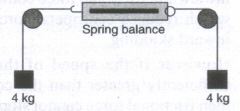
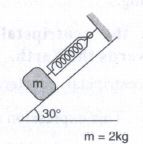
What is the reading shown in spring balance?
22.
23.
Explain briefly how will you apply Newton's second law to a mango (mass 400 g) hanging from a tree.
24.
Explain the concept of inertia. Write two examples each for inertia of motion, inertia of rest and inertia of direction.
25.
A body of mass 100 kg is moving with an acceleration of 50 cm s-2. Calculate the force experienced by it.
26.
Consider a circular road of radius 20 meter banked at an angle of 15 degree. With what speed a car has to move on the turn so that it will have safe turn?
27.
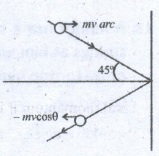
A ball of mass 0.20 kg hits a wall at an angle of 45° with a velocity of 25 m/s. If the ball rebounds at 90° to the direction of incidence, calculate the change in momentum of the ball.
Calculate the
(i) Impulse
(ii) Force
(iii) Maximum force.
28.
Will the momentum remain conserved if some external force acts on the system.
29.
What are non-inertial frame of reference? Explain with example.
30.
Explain cause and effect by Newton's second law.
31.
Find the acceleration when multiple forces act on the body?
32.
Give examples for inertia frames
33.
What is the meaning by 'pseudo force'?
34.
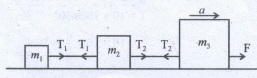
As shown In the diagram, three blocks connected together lie on a horizontal frictionless table and pulled to the right with a force F = 50N. If m1 = 5 kg, m2 = 10 kg and m3 = 15 kg. Find the tensions T1 and T2.
35.
Derive an expression for the acceleration of the body sliding down a frictionless surface.
36.
What happens to the object at rest if
(i) fs = 0
(ii) fs = Fext
(iii) fs = max.
37.
38.
Briefly explain 'centrifugal force' with suitable examples.
1.
(c)
105 dyne
2.
(d)
0.2 ms-1
3.
(b)
Momentum
4.
(c)
Its K.E. is constant
5.
(b)
only in rotating frames
6.
(c)
static friction is not zero and kinetic friction is zero
7.
(a)
8.
(a)
frictional force acting on the vehicle is along negative x direction
9.
(c)
Greater than mg
10.
(a)
inertia of direction
11.
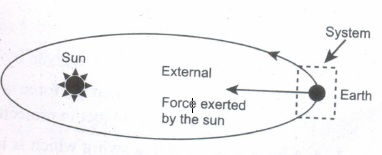
(a) Earth alone as a system: Earth orbits the Sun due to gravitational attraction of the Sun. If we consider Earth as a system, then Sun's gravitational force is an external force. If we take the Moon into account, it also exerts an external force on Earth.
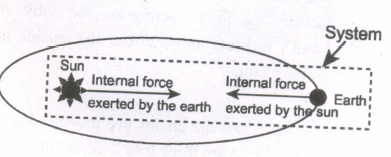
(b) (Earth + Sun) as a system: In this case, there are two internal forces which form an action and reaction pair-the gravitational force exerted by the Sun on Earth and gravitational force exerted by the Earth on the Sun.
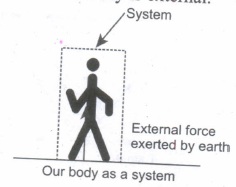
(c) Our body as a system: While walking, we exert a force on the Earth and Earth exerts an equal and opposite force on our body. If our body alone is considered as a system, then the force exerted by the earth on our body is external.
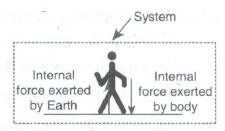
(d) (Our body + Earth) as a system: In this case, there are two internal forces present in the system. One is the force exerted by our body on the Earth and the other is the equal and opposite force exerted by the Earth on our body.
12.
(i) Tension T1 of 24N pulls the masses (3m + 5m) with acceleration a.
∴ 24 = (3m + 5m)a or a = \(\frac { 3 }{ m } \)
(ii) Tension T2 pulls mass 5m with acceleration \(\frac { 3 }{ m } \)
∴ T2 = 5m\(\times\) \(\frac { 3 }{ m } \) = 15N
(iii) F = (m + 3m + 5m)a = 9m\(\times\)\(\frac { 3 }{ m } \) = 27N
13.
Given: m = 6 kg
length = 2m
force = 50N
g = 10 ms-2
As shown in the diagram, there are three forces acting on the midpoint p of the rope. Suppose the rope makes an angle ፀ with the vertical in equilibrium, resolving the forces horizontally and vertically, we get
T1 sinፀ = T3 = 50N .....(1)
T1 cosፀ = T2 = 6kg wt = 60N .......(2)
Dividing (1) by (2) we get tanፀ = \(\frac { 5 }{ 6 } \) (or) \(\theta =tan^{ -1 }\left( \frac { 5 }{ 6 } \right) \) = 398
14.
Formula:
(i) Impulse = Area ABC
= \(\frac { 1 }{ 2 } \) \(\times\)18000\(\times\)(2.5 -1)
=1.35\(\times\)104 kg ms-1
(ii) Force = \(\frac { impulsw }{ time } =\frac { 1.35\times { 10 }^{ 4 } }{ (2.5-1) } \) = 9000 N
(iii) Maximum force = 18000 N
15.
This is due to inertia of motion that the blades of an electric fan continue to rotate for sometime even after the fan has been switched off.
16.
The variation of both static and kinetic frictional forces with external applied force is graphically shown in the figure.
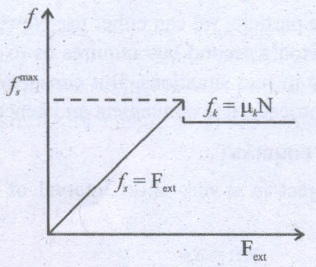
Variation of static and kinetic frictional forces with external applied force
The Figure shows that static friction increases linearly with external applied force till it reaches the maximum. If the object begins to move then the kinetic friction is slightly lesser than the maximum static friction. Note that the kinetic friction is constant and it is independent of applied force.
17.
Earth is not really an inertial frame since it has self-rotation and orbital motion. But these rotational effects of Earth can be ignored for the motion involved in our day-to-day life. Eg: when an object is thrown, or the time period of a simple pendulum is measured in the physics laboratory, the Earth's self rotation has very negligible effect on 'it. In this sense, Earth can be treated as an inertial frame. But at the same time, to analyse the motion of satellites and wind patterns around the Earth, we cannot treat Earth as an inertial frame since its self-rotation has a strong influence on wind patterns and satellite motion.
18.
Jumping on a concrete cemented floor is more dangerous than jumping on the sand. Sand brings the body to rest slowly than the concrete floor, so that the average force experienced by the body will be lesser.
19.
Mass (m) = 500 g = 0.5 kg
Angle (\(\theta\)) = 60°
Force (f) = 20 N
Horizontal component of force = F sin \(\theta\)
Acceleration of a body 'a = \(\frac { Fsin\theta }{ m } \)
\(\frac { 20sin{ 60 }^{ 0 } }{ 0.5 } \)
Acceleration of body "a'' = 17.32m.s2
20.
The force F has to act downward, because the body is to move up with an acceleration greater than 'g' acceleration due to gravity.
According to Newton's II law,
In a force acting an a downward} mg + F = ma
F = m(g+a)
= 20(9.8 + 4)
= 20(13.8)
= 276N
21.
1. Equal mass balancing each side so reading shows Zero.
2. Mass of string acting downward direction in the inclined plane.
mg sin θ = T
T = 2kg x 9.8m/s2 x sin(30o)
T = 9.8N
22.
23.
The forces acting on the mango are
(i) The gravitational force exerted by the Earth on the mango acting downward along the negative y-axis
(ii) Tension (in the cord attached to the mango) acts upward along positive y-axis. The free body diagram for the mango is shown in the figure
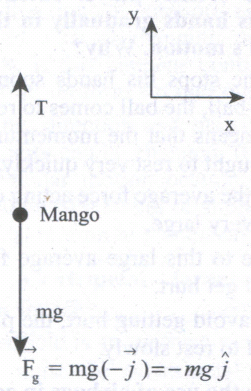
(iii) Here, mg is the magnitude of the gravitational force and -\(\hat { j } \) represents the unit vector in negative y-direction
\(\vec { T } -T\hat { j } \)
(iv) Here T is the magnitude of the tension force and \(\hat { j } \) represents the unit vector in positive y-direction
\(\vec { { F }_{ net } } -\vec { F } _{ g }+\vec { T } =-mg\hat { j } +\vec { T } \hat { j=(T-mg) } \hat { j } \)
(v) From Newton's second law \({ \vec { F } }_{ net }=m\vec { a } \) Since the mango is at rest with respect to us (inertial coordinate system) the acceleration
is Zero \((\vec { a } =0)So{ \vec { F } }_{ net }=m\vec { a } =0\)
\((T-mg\hat { j } )=0\)
(vi) By comparing the components on both sides of the above equation We get, T - mg = 0, So the tension Force acting on the mango is Given By T = mg
Mass of the mango m = 400 g and
g = 9.8 m S-2
Tension acting on the mango is
T= 0 .4\(\times\)9. 8 = 3.92
24.
Inherent property of all the bodies by virtue of which they cannot change their state of rest or uniform motion along a straight line by their own is called inertia.
Inertia of rest: It is the inability of a body to change by itself, its state of rest. This means a body at rest remains at rest and cannot start moving by its own.
(i) When a horse starts suddenly, the rider tends to fall backward on account of inertia of rest of upper part of the body as explained above.
(ii) Passengers experience a backward push due to inertia of rest.
Inertia of motion: It is the inability of a body to change itself its state of uniform motion i.e., a body in uniform motion can neither accelerate nor retard by its own.
(i) Passengers experience a forward push due to inertia of motion.
(ii) A person jumping out of a moving train may fall forward.
Inertia of direction: It is the inability of a body to change by itself direction of motion.
(i) A stone moves tangential to circle due to inertia of direction.
(ii) When a car goes round a curve suddenly, the person sitting inside is thrown outwards.
25.
Mass m = 100 kg
Acceleration a = 50 cm s-2 = 0.5 ms-2
Using Newton's second law,
F= ma
F=100 kg\(\times\)0.5 ms-2 = 50N
26.
v =\(\sqrt { (rg\quad tan\theta ) } =\sqrt { 20\times 9.8\times tan{ 15 }^{ 0 } } =\sqrt { 20\times 9.8\times 0.26 } \) = 7.1 ms-1
The safe speed for the car on this road is 7.1 ms-1
27.
Change in momentum = (-mv cos45°) - (mv cos45°)
dp = - 2mv cos45°
\(|\vec { dp } |=2\times 0.2\times 25\times \frac { 1 }{ \sqrt { 2 } } \Rightarrow dp=5\sqrt { 2 } \).
28.
No, the momentum remain conserved if some external force acts on the System.
29.
A frame of references in which if an object experience force, depending on the acceleration of the frame.
Eg: An object remains at rest on it smooth table kept inside the train, and if the train suddenly accelerates (whiche may not sense), the object appears to accelerate backwards even without any force acting on it.
30.
(i) Newton's second law is cause and effect relation. Force is the cause and acceleration is the effect.
(ii) Conventionally, the effect should be written on the left and cause on the right hand side of the equation. So the correct way of writing
Newton's second law is \(m\overset { \rightarrow }{ a } =\overset { \rightarrow }{ F } (or)\frac { d\overset { \rightarrow }{ p } }{ dt } =\overset { \rightarrow }{ F } \)
31.
(i) If multiple forces \(\overset { \rightarrow }{ { F } } _{ 1 },\overset { \rightarrow }{ { F } } _{ 2 },\overset { \rightarrow }{ { F } } _{ 3 }...\overset { \rightarrow }{ { F } } _{ n }\) act on the same body, then the total force \(\left( \overset { \rightarrow }{ { F }_{ net } } \right) \) is equivalent to the vectorial sum of the individual forces
(ii) Their net force provides the acceleration. \(\overset { \rightarrow }{ { F } } _{ net }=\overset { \rightarrow }{ { F } } _{ 1 },\overset { \rightarrow }{ { F } } _{ 2 },\overset { \rightarrow }{ { F } } _{ 3 }...\overset { \rightarrow }{ { F } } _{ n }\)
(iii) Newton's second law for this case is \(\overset { \rightarrow }{ { F } } _{ net }=m\overset { \rightarrow }{ a } \)
In this case the direction of acceleration is in the direction of net force.
32.
(i) The car is moving with uniform velocity v with respect to a person standing (at rest) on the ground.
(ii) As the car is moving with constant velocity with respect to ground to the person is at rest on the ground, both frames (with respect to the car and to the ground) are inertial frames.
33.
The centrifugal force appears to act on the particle, only when we analyses the motion from a rotating frame. With respect to an inertial frame there is only centripetal force which is given by the tension in the string. For this reason centrifugal force is called as a 'pseudo force'. A pseudo force has no origin, It arises due to the non-inertial nature of the frame considered.
34.
Given:
F = 50N
m1 = 5 kg
m2 = 10 kg
m3 = 15 kg
All the blocks move with common acceleration a under the force F = 50N
∴ F = (m1 + m2 + m3)a
or a = \(\frac { F }{ { m }_{ 1 }+{ m }_{ 2 }+{ m }_{ 3 } } =\frac { 50 }{ 5+10+15 } =\frac { 5 }{ 3 } \) ms-2
To determine T1 Refer to the free-body diagram for m1 shown in the diagram. Clearly, the tension T1 produces acceleration a in mass m1.
∴ T1 = m1a = \(5\times \frac { 5 }{ 3 } =\frac { 25 }{ 3 } \) = 8.33 N
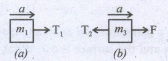
To determine T2 Refer to the free-body diagram for m3 shown in the diagram (b). Force F acts towards right and tension T2 acts towards left.
∴ F - T2 = m3 a (or) 50 - T2 = 15 x \(\frac { 5 }{ 3 } \) or T2 =25N
35.
When an object of mass m slides on a frictionless surface inclined at an angle e as shown in the figure, the forces acting on it decides the
(a) acceleration of the object
(b) speed of the object when it reaches the bottom.
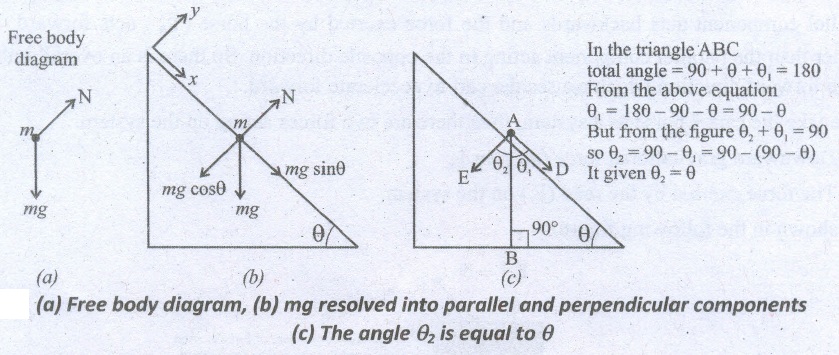
The force acting on the object is
(i) Downward gravitational force (mg)
(ii) Normal force perpendicular to inclined surface (N)
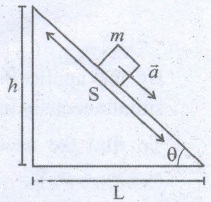
To draw the free body diagram, the block is assumed to be a point mass [in figure (a)]. Since the motion is on the inclined surface, we have to choose the coordinate system parallel to the inclined surface as shown
in the figure (b).
The gravitational force mg is resolved in to parallel component mg sine along the inclined plane and perpendicular component mg coss perpendicular to the inclined surface [figure (b)].
Note that the angle made by the gravitational force (mg) with the perpendicular to the surface is equal to the angle of inclination e' as shown in figure (c).
There is no motion (acceleration) along the y axis. Applying Newton's second law in the y direction
\(-mg\ cos\theta \hat { j } +N\hat { j } \) =0 (No acceleration)
By comparing the components on both sides, N-mg cos ፀ=0
N=mg cosፀ
The magnitude ~fnormal force (N) exerted by the surface is equivalent to mg cosፀ, Tlie object slides (with an acceleration) along the x direction. Applying Newton's second law in the x direction.
\(mg\ sin\theta\ \hat { i } =ma\hat { i } \)
By comparing the components on both sides, we can equate
mg sinፀ = ma
The acceleration of the sliding object is
a = g sinፀ
Note that the acceleration depends on the angle of inclination ፀ.
36.
(i) If the object is at rest and no external force is applied on the object, the static friction acting on the object is zero (fs = 0).
(ii) If the object is at rest, and there is an external force applied parallel to the surface, then the force of static friction acting on the object is exactly equal to the external force applied on the object (fs = Fext). But still the static friction Is is less than μsN.
(iii) When object begins to slide, the static friction (fs) acting on the object attains maximum.
37.
38.
(i) Consider the case of a whirling motion of a stone tied to a string. Assume that the stone has angular velocity ω in the inertial frame (at rest).
(ii) If the motion of the stone is observed from a frame which is also rotating along with the stone with same angular velocity ω then, the stone appears to be at rest.
(iii) This implies that in addition to the inward centripetal force - mω2r there must be an equal and opposite force that acts on the stone outward with value + mω2r.
(iv) So the total force acting on the stone in a rotating frame is equal to zero (-mω2r + mω2r=0).
(v) This outward force + mω2r is called the centrifugal force.

11th Standard Syllabus & Materials
11th Standard
TN 11th Tamil பீடு பெற நில் - செய்யுள் - காவடிச்சிந்து Important Questions And Answers Study Material - QB365 Set A
NEW11th Standard
TN 11th Tamil பீடு பெற நில் - உரைநடை - மலை இடப்பெயர்கள் : ஓர் ஆய்வு Important Questions And Answers Study Material - QB365 Set A
NEW11th Standard
TN 11th Tamil மாமழை போற்றுதும் - துணைப்பாடம் - யானை டாக்டர் Important Questions And Answers Study Material - QB365 Set A
NEW11th Standard
TN 11th Tamil மாமழை போற்றுதும் - செய்யுள் - ஐங்குறுநூறு Important Questions And Answers Study Material - QB365 Set A



Tamilnadu Stateboard 11th Standard Subjects

Maths

Commerce

Economics

Biology

Business Maths and Statistics

Accountancy

Computer Science
Physics

Chemistry
Maths
Biology
Economics
Physics
Chemistry

History
Business Maths and Statistics

Computer Science
Accountancy

Computer Applications
History
Computer Technology
Commerce
Computer Applications
Computer Technology

Tamil

English

French
Tamilnadu Stateboard Standards

