
 100% FREE ACCESS
11th Standard Syllabus & Materials
11th Standard
TN 11th Tamil இயற்கை வேளாண்மை,சுற்றுச்சூழல் -செய்யுள் - மனோன்மணீயம் Important Questions And Answers Study Material - QB365 Set A
NEW11th Standard
TN 11th Tamil என்னுயிர் என்பேன் -துணைப்பாடம் - இசைத்தமிழர் இருவர் Important Questions And Answers Study Material - QB365 Set A
NEW11th Standard
TN 11th Tamil மொழி கலை -செய்யுள் - ஒவ்வொரு புல்லையும் Important Questions And Answers Study Material - QB365 Set A
NEW11th Standard
TN 11th Tamil பீடு பெற நில் - இலக்கணம் - பகுபத உறுப்புகள் Important Questions And Answers Study Material - QB365 Set A
NEW11th Standard
TN 11th Tamil பீடு பெற நில் - துணைப்பாடம் - வாடிவாசல் Important Questions And Answers Study Material - QB365 Set A
NEW11th Standard
TN 11th Tamil பீடு பெற நில் - செய்யுள் - குறுந்தொகை Important Questions And Answers Study Material - QB365 Set A

Published on: 26/07/2018
Based on the Living World, some of the important questions are covered in this question paper. The questions are prepared from the book back and the creative questions.
For Teachers, please subscribes and gets the plenty of question paper based on chapter wise and also predefined blueprint. For subscription, please Click Here
Download Tamil Nadu 11th Standard Biology question papers, model tests, one-mark questions, important questions, and public exam papers in PDF format. Free study materials and answer keys for TN State Board students.
Questions + Answers key
Take MCQ Biology Test1.
The Earthy Odour is produced from the soil after rain due to presence of ________.
Basidiomycetes
Actinobacteria
Deutromycetes
Oomycetes
2.
In Bacterial sexual reproduction transformation is demonstrated by _________.
Griffith
Zinder
Tatum
Lederberg
3.
Fusion of two somative cells of the hypae is called:
Anisogamy
Somatogamy
Oogamy
Isogamy
4.
Match the following disease with their pathogen:
| Name of the disease | Name of the pathogen |
| (i) Bacterial blight | (a) Clavibactor michiganensis |
| (ii) Fire blight | (b) Xanthomonas citri |
| (iii) Citrus canker | (c) Xanthomonas oryzae |
| (iv) Ring rot | (d) Erwinia amylvora |
(i)-(d); (ii)-(c); (iii)-(b); (iv)-(a)
(i)-(c); (ii)-(a); (iii)-(b); (iv)-(d)
(i)-(a); (ii)-(d); (iii)-(b); (iv)-(c)
(i)-(c); (ii)-(d); (iii)-(b); (iv)-(a)
5.
Which among the bacteria breakdown hydrocarbons?
Pseudomonas putida
Lacto bacillus
Bifido bacterium
Nitrosomonas
6.
Identify the correctly matched pair.
Actinomycete - Late blight
Mycoplasma - Lumpy jaw
Bacteria - Crown gall
Fungi - Sandal spike
7.
8.
Identify the Archaebacterium.
Acetobacter
Erwinia
Treponema
Methanobacterium
9.
Identify the incorrect statement about the Gram positive bacteria.
Teichoic acid absent
High percentage of peptidoglycan is found in cell wall
Cell wall is single layered
Lipopolysaccharide is present in cell wall
10.
Which one of the following statement about virus is correct?
Possess their own metabolic system
They are facultative parasites
They contain DNA or RNA
Enzymes are present
11.
What are the plant diseases of viral disease.
12.
Mention Milestones in Virology.
13.
Point out response to stimuli.
14.
Differentiate between anabolism and catabolism.
15.
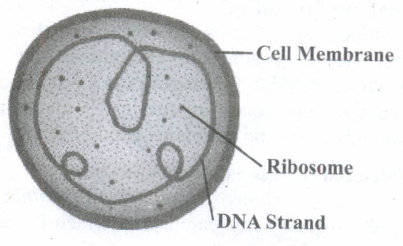
Draw a labelled diagram of Mycoplasma.
16.
Why do farmers plant leguminous crops in crop rotations/mixed cropping?
17.
Explain transformation in bacteria as experimented by Griffith.
18.
Give a general account on lichens.
19.
20.
Mention various types of fungal reproduction.
21.
Mention photosynthetic pigments of cyanobacteria.
22.
Why are shoots formed in potato but not formed in carrot?
23.
Why do we add little curd to milk for making curds?
24.
A complete virus particle is only capable of infection. Do you agree?
1.
(b)
Actinobacteria
2.
(a)
Griffith
3.
(b)
Somatogamy
4.
(d)
(i)-(c); (ii)-(d); (iii)-(b); (iv)-(a)
5.
(a)
Pseudomonas putida
6.
(c)
Bacteria - Crown gall
7.
(a)
8.
(d)
Methanobacterium
9.
(d)
Lipopolysaccharide is present in cell wall
10.
(c)
They contain DNA or RNA
11.
1. Tobacco mosaic
2. Cauliflower mosaic
3. Sugarcane mosaic
4. Potato leaf roll
5. Bunchy top of banana
6. Leaf curl of papaya
7. Vein clearing of Lady's finger
8. Rice tungro disease
9. Cucumber mosaic
10. Toinato mosaic disease.
12.
1. 1796 Edward Jenner used vaccination for small pox 1886 Adolf Mayer demonstrated the infectious nature of Tobacco mosaic virus using sap of mosaic leaves
2. 1892 Dimitry Ivanowsky proved that viruses are smaller than bacteria
3. 1898 M.W. Beijierink defined the infectious agent in tobacco leaves as 'Contagium vivum fluidum'
4. 1915 F.W.Twort identified Viral infection in Bacteria
5. 1917 d'Herelie coined the term 'Bacteriophage'
6. 1984 Luc Montagnier and Robert Gallo discovered HIV (Human Immuno Deficiency Virus).
13.
1. All organisms are capable of sensing their environment and respond to various physical, chemical and biological stimuli. Animals sense their surroundings by sense organs.
2. This is called Consciousness.
3. Plants also respond to the stimuli.
4. Bending of plants towards sunlight, the closure of leaves in touch-me-not plant to touch are some examples for response to stimuli in plants.
5. This type of response is called Irritability.
14.
| ANABOLISM | CATABOLISM | |
|---|---|---|
| 1. | Building up process | Breaking down process |
| 2. | Smaller molecules combine together to form larger molecule | Larger molecule break into smaller units |
| 3. | Chemical energy is formed and stored | The stored chemical energy is released and used |
| 4. | Eg: Synthesis of proteins from amino acids | Eg: Breaking down of glucose to CO2 and water |
15.
16.
During crop rotations and mixed cropping. Farmers plant leguminous crops to increase the soil fertility.
| S.No | Beneficial aspects | Bacteria | Role |
| 1. | Ammonification |
1. Bacillus ramosus 2. Bacillus mycoides |
Convert complex proteins in the dead bodies of plants and animals into ammonia which is later converted into ammonium salt |
| 2. | Nitrification |
1. Nitrobacter 2. Nitrosomonas |
Convert ammonium salts into nitrites and nitrates |
| 3. | Nitrogen fixation |
1. Azotobacter 2. Clostridium 3. Rhizobium |
(i) Converting atmospheric nitrogen into organic nitrogen |
| (ii) The nitrogenous compounds are also oxidized to nitrogen | |||
| (iii) All these activities of bacteria increase soil fertility |
17.
Transformation:
1. Transfer of DNA from one bacterium to another is called transformation.
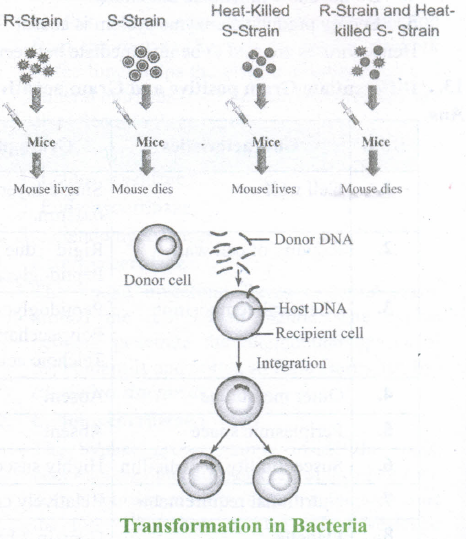
2. In 1928 the bacteriologist Frederick Griffith demonstrated transformation in mice using Diplococcus pneumoniae.
3. Two strains of this bacterium are present. One strain produces smooth colonies and is virulent in nature (S type). In addition another strain produced rough colonies and is avirulent (R type).
4. When S-type of cells were injected into the mouse, the mouse died. When R-type of cells were injected, the mouse survived.
5. When he injected heat-killed S-type cells into the mouse the mouse did not die.
6. When the mixture of heat-killed S-type cells and R-type cells were injected into the mouse. The mouse died.
7. The avirulent rough strain of Diplococcus had been transformed into S-type cells.
8. The hereditary material of heat-killed S-type cells had transformed R-type cells into virulent smooth strains.
9. Thus the phenomenon of changing the character of one strain by transferring the DNA of another strain into the former is called Transformation.
18.
(i) The symbiotic association between algae and fungi is called lichens.
(ii) The algal partner is called Phycobiont or Photobiont and the fungal partner is called Mycobiont.
(iii) Algae provide nutrition for fungal partner in turn fungi provide protection and also help to fix the thallus to the substratum through rhizines.
(iv) Asexual reproduction takes place through fragmentation, soredia and Isidia. Phycobionts reproduce by akinetes, hormogonia, aplanospore, etc., Mycobionts undergo sexual reproduction and produce ascocarps.
Classification:
(i) Based on the habitat lichens are classified into following types: Corticolous (on Bark) Lignicolous (on Wood) Saxicolous (on rocks) Terricolous (on ground) Marine (on siliceous rocks of sea) Fresh water (on siliceous rock of fresh water).
(ii) On the basis of morphology of the thallus they are divided into Leprose (a distinct fungal layer is absent) Crustose-crust like; Foliose-leaf like; Fruticose-branched pendulous shrub like.
(iii) The distribution of algal cells distinguishes lichens into two forms namely Homoiomerous (Algal cells evenly distributed in the thallus) and Heteromerous (a distinct layer of algae and fungi present)
(iv) If the fungal partner of lichen belongs to ascomycetes, it is called Ascolichen and if it is basidiomycetes it is called Basidiolichen.
19.
20.
1. Fungi reproduce both by asexual and sexual methods. The asexual phase is called Anamorph and the sexual phase is called Teleomorph.
2. Fungi having both phases are called Holomorph.
21.
The photosynthetic pigments include c-phyocyanin and c-phycoerythrin along with myxoxanthin and myxoxanthophyll.
22.
1. The 'eye' of potato tuber, is an axillary bud which sprouts and forms shoots.
Underground stem (tuber) is a means of vegetative propagation whereas carrot is a storage root and roots do not produce buds / shoots
23.
1. Lactococcus lactis, a bacterium present in curd acts on milk protein and helps to form curd.
2. The sourness is due to lactic acid production
24.
Yes, a complete virus particle refers to virus with capsid and nucleic acid. Viruses cannot infect a host if nucleic acid is not present.

11th Standard Syllabus & Materials
11th Standard
TN 11th Tamil பீடு பெற நில் - செய்யுள் - காவடிச்சிந்து Important Questions And Answers Study Material - QB365 Set A
NEW11th Standard
TN 11th Tamil பீடு பெற நில் - உரைநடை - மலை இடப்பெயர்கள் : ஓர் ஆய்வு Important Questions And Answers Study Material - QB365 Set A
NEW11th Standard
TN 11th Tamil மாமழை போற்றுதும் - துணைப்பாடம் - யானை டாக்டர் Important Questions And Answers Study Material - QB365 Set A
NEW11th Standard
TN 11th Tamil மாமழை போற்றுதும் - செய்யுள் - ஐங்குறுநூறு Important Questions And Answers Study Material - QB365 Set A



Tamilnadu Stateboard 11th Standard Subjects

Maths

Commerce

Economics
Biology

Business Maths and Statistics

Accountancy

Computer Science

Physics

Chemistry
Maths
Biology
Economics
Physics
Chemistry

History
Business Maths and Statistics

Computer Science
Accountancy

Computer Applications
History
Computer Technology
Commerce
Computer Applications
Computer Technology

Tamil

English

French
Tamilnadu Stateboard Standards

