
 100% FREE ACCESS
11th Standard Syllabus & Materials
11th Standard
TN 11th Tamil இயற்கை வேளாண்மை,சுற்றுச்சூழல் -செய்யுள் - மனோன்மணீயம் Important Questions And Answers Study Material - QB365 Set A
NEW11th Standard
TN 11th Tamil என்னுயிர் என்பேன் -துணைப்பாடம் - இசைத்தமிழர் இருவர் Important Questions And Answers Study Material - QB365 Set A
NEW11th Standard
TN 11th Tamil மொழி கலை -செய்யுள் - ஒவ்வொரு புல்லையும் Important Questions And Answers Study Material - QB365 Set A
NEW11th Standard
TN 11th Tamil பீடு பெற நில் - இலக்கணம் - பகுபத உறுப்புகள் Important Questions And Answers Study Material - QB365 Set A
NEW11th Standard
TN 11th Tamil பீடு பெற நில் - துணைப்பாடம் - வாடிவாசல் Important Questions And Answers Study Material - QB365 Set A
NEW11th Standard
TN 11th Tamil பீடு பெற நில் - செய்யுள் - குறுந்தொகை Important Questions And Answers Study Material - QB365 Set A

Published on: 01/08/2018
Based on the chapter Market Structure and Pricing, some of the important questions are covered in this question paper. The questions are prepared from the book back and the creative questions.
Download Tamil Nadu 11th Standard Economics question papers, model tests, one-mark questions, important questions, and public exam papers in PDF format. Free study materials and answer keys for TN State Board students.
Questions + Answers key
Take MCQ Economics Test
1.
In which market form, does absence of competition prevail?
Perfect competition
Monopoly
Duopoly
Oligopoly
2.
Under perfect competition, the shape of demand curve of a firm is ___________
Vertical
Horizontal
Negatively sloped
Positively sloped
3.
The average revenue curve under monopolistic competition will be ____________
Perfectly inelastic
Perfectly elastic
Relatively
Unitary elastic
4.
Price discrimination will always lead to _________
Increase in output
Increase in profit
Different prices
b and c
5.
Price leadership is the attribute of ________
Perfect competition
Monopoly
Oligopoly
Monopolistic competition
6.
Group equilibrium is analysed in ____________
Monopolistic competition
Monopoly
Duopoly
Pure competition
7.
Perfect competition assumes ____________
Luxury goods
Producer goods
Differentiated goods
Homogeneous goods
8.
In monopoly, MR curve lies below ____________
TR
MC
AR
AC
9.
In which type of market, AR and MR are equal _______
Duopoly
Perfect competition
Monopolistic competition
Oligopoly
10.
Another name of price is _________
Average Revenue
Marginal Revenue
Total Revenue
Average cost
11.
Explain the whole-sale and retail market.
12.
Define Firm.
13.
What is the meaning of monopoly?
14.
Write a note on 'Dumping'.
15.
What are the wastages of monopolistic competition?
16.
17.
Explain the comparison among the features of various markets.
18.
Explain the market on the basis of area.
19.
Bring out the features of Monopoly?
20.
What are the different types of price discrimination under monopoly?
21.
Explain how markets can be classified on the basis of area.
22.
Mention any three benefits of perfect competition.
23.
Classify the market based on competition.
24.
Distinguish between Price-Marker and Price-Taker?
1.
(b)
Monopoly
2.
(b)
Horizontal
3.
(c)
Relatively
4.
(d)
b and c
5.
(c)
Oligopoly
6.
(a)
Monopolistic competition
7.
(d)
Homogeneous goods
8.
(c)
AR
9.
(b)
Perfect competition
10.
(a)
Average Revenue
11.
(a) Whole-sale Market
It is for bulk selling and buying of goods (clothing, grocery, etc.). The price is likely to below compared to retail market.
(b) Retail Market
It is for selling (or) buying of commodities in small quantities (clothing, vegetables, etc.)."
12.
A single organization which employs factors of production to produce goods and sells.
13.
The word monopoly has been derived from the combination of two words i.e., 'Mono' and 'Poly'. Mono refers to a single and "Poly" to seller.
14.
(i) Dumping refers to the practice of the monopolist charging the higher price in the local market and, lower price in the foreign market.
(ii) Through dumping a country expands its command over other countries for its product. It is called as 'international price discrimination'.
15.
There are five kinds of wastages under monopolistic competition they are,
(i) Excess capacity
(ii) Unemployment
(iii) Advertisement
(iv) Too many varieties of goods.
(v) Inefficient firms.
16.
17.
| SI.No | Features | Perfect Competition | Monopoly | Monopolistic Competition |
| 1 | No of producers/sellers | Large | Only one | A few (or) some |
| 2 | Nature of the product | Homogeneous | Unique | Differentiated Product |
| 3 | Control over price | Price taker | Price maker | Price variation |
| 4 | Entry/Exit | Free | Entry prevented | The existence of entry possibility |
| 5 | Profit | No ultimate profit | Monopoly profit | Profit arising due to markets special feature |
| 6 | Market knowledge | Complete | Complete | partial |
| 7 | Cost Curves | Same | Same | Same |
| 8 | AR Curves | parallel to X-axis perfectly elastic | Fairly flat more elastic | Steep (highly inelastic) |
| 9 | Quantity | Very large | Substantially large | Very small |
| 10 | Price | Very low | Low | Very high |
| 11 | Market Power | Little | Less | More |
18.
Here the market is classified not only on its geographical spread but also nature of goods.
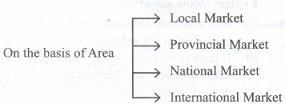
(i) Local Market:
1. The products exchanged are mostly perishable and semi-durable in nature.
2. For Example Halva in Tirunelveli.
(ii) Provincial Market:
1. Products are sold and bought in a restricted circle
2. For Example Provincial newspaper
(iii) National Market:
1. Products are sold and bought throughout a country is called national market.
2. For Example Tea, Coffee etc.
(iv) International Market:
1. Products are sold and bought at the world level are called international market.
2. For Example Petrol, Gold, etc.
19.
Features of Monopoly :
(1) There is a single producer / seller of a product;
(2) The product of a monopolist is unique and has no close substitute;
(3) There is strict barrier for entry of any new firm;
(4) The monopolist is a price-maker;
(5) The monopolist earns maximum profit/ abnormal profit.
(6) Firm and industry: Under monopoly, there is no difference between a firm and industry. As there is only one firm, that single firm constitutes the whole industry
20.
Types of Price Discrimination:
There are three types of price discrimination.
(i) Personal - Different prices· are charged for different individuals (for example, the railways give tickets at concessional rate to the 'senior citizens' for the same journey).
(ii) Geographical - Different prices are charged at different places for the same product (for example, a book sold within India at a price is sold in a foreign country at lower price). On their basis, China drops its goods in Indian market. As a result, watch and toys industries closed down their business.
(iii) On the basis of Use - Different prices are charged according to the use of a product (for example, lower rates are charged by Tamil Nadu Electricity Board for domestic uses of electricity and higher rates are charged for commercial and industrial uses.
21.
Markets on the basis of Area:
The market is classified not only on its geographical spread, but also on the nature of the goods exchanged.
(i) Local market arises when products or services are sold and bought in the place of their production. In such markets, the products exchanged are mostly perishable and semi-durable in nature: For example, vegetable, fruits, etc.
(ii) Provincial market arises when products or services are sold and bought in a restricted circle. For example, provincial newspaper.
(iii) National market arises when products and services are sold and bought throughout a country. For example, Nation-wide market for tea, coffee, cement, electrical goods, some printed books, etc.
(iv) International market arises when products and services are sold and bought at the world level. For example, petrol, gold, etc.
22.
i. There is consumer sovereignty in a perfect competitive market. The consumer has perfect knowledge about the market conditions.
ii. The price is equal to the minimum average cost which is beneficial to the consumer.
iii. The firms are price-takers and the products are homogeneous.
23.
The classification of market according to competition is as follows:
a. Perfect competition: Large number of sellers selling homogeneous products.
b. Imperfect competition :
i Monopoly : Single seller
ii Duopoly : Two sellers
iii Oligopoly : A few sellers selling homogeneous or differentiated products.
iv Monopolistic : Large number of sellers Competition selling differentiated products.
24.
Price-Marker : The power in the firm to get the price for good in the market
Price-Taker : The feature of a firm to accept the price fixed in the industry.

11th Standard Syllabus & Materials
11th Standard
TN 11th Tamil பீடு பெற நில் - செய்யுள் - காவடிச்சிந்து Important Questions And Answers Study Material - QB365 Set A
NEW11th Standard
TN 11th Tamil பீடு பெற நில் - உரைநடை - மலை இடப்பெயர்கள் : ஓர் ஆய்வு Important Questions And Answers Study Material - QB365 Set A
NEW11th Standard
TN 11th Tamil மாமழை போற்றுதும் - துணைப்பாடம் - யானை டாக்டர் Important Questions And Answers Study Material - QB365 Set A
NEW11th Standard
TN 11th Tamil மாமழை போற்றுதும் - செய்யுள் - ஐங்குறுநூறு Important Questions And Answers Study Material - QB365 Set A



Tamilnadu Stateboard 11th Standard Subjects

Maths

Commerce
Economics

Biology

Business Maths and Statistics

Accountancy

Computer Science

Physics

Chemistry
Maths
Biology
Economics
Physics
Chemistry

History
Business Maths and Statistics

Computer Science
Accountancy

Computer Applications
History
Computer Technology
Commerce
Computer Applications
Computer Technology

Tamil

English

French
Tamilnadu Stateboard Standards
