
 100% FREE ACCESS
11th Standard Syllabus & Materials
11th Standard
TN 11th Tamil இயற்கை வேளாண்மை,சுற்றுச்சூழல் -செய்யுள் - மனோன்மணீயம் Important Questions And Answers Study Material - QB365 Set A
NEW11th Standard
TN 11th Tamil என்னுயிர் என்பேன் -துணைப்பாடம் - இசைத்தமிழர் இருவர் Important Questions And Answers Study Material - QB365 Set A
NEW11th Standard
TN 11th Tamil மொழி கலை -செய்யுள் - ஒவ்வொரு புல்லையும் Important Questions And Answers Study Material - QB365 Set A
NEW11th Standard
TN 11th Tamil பீடு பெற நில் - இலக்கணம் - பகுபத உறுப்புகள் Important Questions And Answers Study Material - QB365 Set A
NEW11th Standard
TN 11th Tamil பீடு பெற நில் - துணைப்பாடம் - வாடிவாசல் Important Questions And Answers Study Material - QB365 Set A
NEW11th Standard
TN 11th Tamil பீடு பெற நில் - செய்யுள் - குறுந்தொகை Important Questions And Answers Study Material - QB365 Set A

Published on: 22/09/2018
Model Paper 2
Download Tamil Nadu 11th Standard Accountancy question papers, model tests, one-mark questions, important questions, and public exam papers in PDF format. Free study materials and answer keys for TN State Board students.
Questions + Answers key
Take MCQ Accountancy Test
1.
___________ requires that all accounting transactions recorded should be based on objective evidence.
Matching concept
Cost concept
Dual aspect concept
Objective evidence concept
2.
On 1st January, 2018, Kumar draws a bill on Ramar for 3 months, its due date is _________
4th April, 2018
1st April, 2018
31st March, 2018
1st March, 2018
3.
In accounting, computer is commonly used in the following areas:
Recording of business transactions
Payroll accounting
Stores accounting
All the above
4.
A depreciable asset may suffer obsolescence due to______.
Passage of time
Wear and tear
Technological changes
None of the above
5.
Amount received from IDBI as a medium term loan for augmenting working capital ______.
Capital expenditures
Revenue expenditures
Revenue receipts
Capital receipt
6.
The preparation of ___________ is the third step in the accounting process.
journal
ledger
trial balance
balance sheet
7.
The sub-division of work gives the advantage of specialisation leading to _____
business transactions
efficiency
decision making
none of these
8.
Trial balance is prepared ____________
At the end of the year
On a particular date
For a year
None of the above
9.
_____________must be properly maintained to increase their productivity.
Liabilities
Assets
Debtors
None of these
10.
The rule of stock valuation 'cost price or realisable value' whichever is lower is based on the accounting principle of :
Materiality
Money measurement
Conservatism
Accrual
11.
The root of financial accounting system is ______.
Social accounting
Stewardship accounting
Management accounting
Responsibility accounting
12.
Record the following transactions in the purchases book of Raja Furniture:
| 2017 | |
| May 4 | Purchased from Kasi Furnitures, Kanyakumari |
| 10 chairs @ Rs. 300 each | |
| 4 tables @ Rs. 800 each | |
| May 6 | Purchased for cash from Welcome Furniture, Vellore |
| 2 almirahs @ Rs. 2,000 each | |
| 4. chairs @ Rs. 200 each | |
| Less: Trade discount @ 5% | |
| May 10 | Bought furniture from Murugan Furniture Mart, Nagapattinam |
| 10 chairs @ Rs. 250 each | |
| 5 tables @ Rs. 750 each | |
| Delivery and packing charges Rs. 150 | |
| May 20 | Purchased 2 computers for office use from Anandan & Co., Adyar on credit for Rs. 5,550 each |
| May 25 | Purchased from Gowtham & Co., Chennai |
| 10 chairs @ Rs. 550 each | |
| 15 steek cabinets @ Rs. 2,000 each | |
| Delivery charges Rs. 200 | |
| Less: Trade discount @ 10% |
13.
Identify the following items into capital or revenue.
i) Audit fees paid Rs.10,000.
ii) Labour welfare expenses Rs.5,000.
iii) Rs.2,000 paid for servicing the company vehicle.
iv) Repair to furniture purchased second hand Rs.3,000.
v) Rent paid for the factory Rs.12,000
14.
Record the following transactions in the proper subsidiary books of Mis. Sunil & Co., and cost them to the Ledger.
| 2013 Apr 1 | Goods sold to Ramesh Rs. 1,000 |
| Apr 5 | Sold goods to Kumar Rs. 2,200 |
| Apr 8 | Sold goods to Shankar Rs. 300 |
| Apr 10 | Goods returned by Kumar Rs. 600 |
| Apr 15 | Credit Note sent to Shankar for Rs. 200 being the Invoice overcharged. |
15.
Balan who has a car driving school gives you the following ledger balances. Prepare trial balance as on 31st December 2016.
| Rs. | Rs. | ||
|---|---|---|---|
| Computer | 26,000 | Freehold land | 30,000 |
| Salaries to drivers | 4,000 | Bank loan | 15,000 |
| Taxes and insurance | 16,500 | Fees received | 18,150 |
| Fuel and Power | 2,000 | Capital | 53,850 |
| Rent and rates | 1,500 | Advertisement | 7,000 |
16.
Following is the trial balance of Sudhir Chaudhary as on 31.03.2017.
| Rs | Rs | ||
| Capital | 10,00,000 | Debtors | 9,64,000 |
| Plant and Machinery | 13,40,000 | Creditors | 5,30,000 |
| Furniture | 2,40,000 | Rent | 1,92,000 |
| Cash in hand | 60,000 | General expenses | 14,000 |
| Bank overdraft | 78,000 | Discount allowed | 2,000 |
| Purchases | 22,70,000 | Sales return | 6,000 |
| Sales | 34,80,000 |
17.
Explain briefly accounting conventions
18.
What are the bases of accounting? and briefly explain it.
19.
Discuss briefly the branches of accounting.
20.
Explain the various methods of preparing trial balance.
21.
Write short notes on accrual basis of accounting.
22.
Mention any three limitations of computerised accounting system.
23.
The following table is given to you. Find solution for the following questions.
| A | B | C | D | E | F | G | H | I | J | |
| 1 | 550 | 156 | 852 | 584 | TAX | 573 | GST | 1234 | ||
| 2 | 340 | 1285 | 468 | 584 | 268 | 222 | CASH | BRS | STOCK | DEBT |
A) How many cells contain numbers only?
B) Count the number of cells that contain any value.
C) Count the number of cells containing the value exceeding 1000.
24.
What are the objectives of book-keeping?
25.
"Business units last indefinitely". Mention and explain the concept on which the statement is based.
26.
Do you think that financial accounting system is suitable for all business?
27.
What are the conventions of accounting?
28.
Name any two accounting packages.
29.
A company has purchased a machinery for Rs.1,80,000 and spent Rs.10,000 for its installation. The estimated life of the machinery is 5 years with a residual value of Rs.15,000. Find out the amount of depreciation to be provided every year.
30.
What is annuity method?
31.
List out the various methods of depreciation.
32.
What is meant by deferred revenue expenditure?
33.
Classify the following expenditures and receipts as capital or revenue:
i) Rs.10,000 spent as travelling expenses of the directors on trips abroad for the purchase of fixed assets.
ii) Amount received from trade receivables during the year.
iii) Amount spent on demolition of building to construct a large building on the same site.
iv) Insurance claim received on account of a machinery damaged by fire.
34.
As per the Rough Book, following transactions of M/s. Jain Fashion Wears are given you are required to make out the Sales Book.
| 2015 Feb 1 | Sold to Mis. Om & Sons on Credit as per Invoice No. 182 |
| 72 Kurtas @ Rs. 175 each | |
| 45 Trousers @ Rs. 225 each | |
| Less: Trade Discount @ 5% | |
| Feb 5 | Sold to Deepti & Co. as per Invoice No.282 |
| 50 long shirts @ Rs. 185 each | |
| 65 Jeans @ Rs. 235 each | |
| Feb 18 | Sold to M/s. Gupta & Sons for cash as per Invoice No. 173 |
| 20 Ladies Suits @ Rs. 115 each | |
| 30 T-Shirts @ Rs. 405 each | |
| Less: Trade Discount 5% | |
| Feb 20 | Sold 5 Chairs @ Rs. 50 each to Mis. Kapil & Co. as per Invoice No. 381 |
35.
Is Trial balance an account or a statement?
36.
During the financial year, Rajan had cash sales of Rs. 4,50,000 and credit sales of Rs. 3,00, 000. Expenses incurred for the year were Rs. 3,50,000 out of which Rs. 1,50,000 are still to be paid. Find out Rajan's income following.
(i) Cash Basis of Accounting.
(ii) Accrual Basis of Accounting.
37.
Write notes on Parties involved in bill of exchange.
38.
What is financial accounting?
1.
(d)
Objective evidence concept
2.
(a)
4th April, 2018
3.
(d)
All the above
4.
(c)
Technological changes
5.
(d)
Capital receipt
6.
(c)
trial balance
7.
(b)
efficiency
8.
(b)
On a particular date
9.
(b)
Assets
10.
(c)
Conservatism
11.
(b)
Stewardship accounting
12.
| Date | Particulars | Invoice No. | L.F. | Amount Rs. | |
|---|---|---|---|---|---|
| Details | Total | ||||
| 2017 | Kasi Furnitures, Kanyakumari | ||||
| May 4 | 10 chairs @ Rs. 300 each | 3,000 | |||
| 4 tables @ Rs. 800 each | 3,200 | 6,200 | |||
| May 10 | Murugan Furniture Mart, | ||||
| Nagapattinam | |||||
| 10 chairs @ Rs. 250 each | 2,500 | ||||
| 5 tables @ Rs. 750 each | 3,750 | ||||
| 6,250 | |||||
| Add: Delivery and packing charges | 150 | 6,400 | |||
| May 25 | Gowtham & Co., Chennai | ||||
| 10 chairs @ Rs. 550 each | 5,500 | ||||
| 15 steel cabinets @ Rs. 2,000 each | 30,000 | ||||
| 35,500 | |||||
| Less: trade discount @ 10% | 3,550 | ||||
| 31,950 | |||||
| Add: Delivery charges | 200 | 32,150 | |||
| Purchase A/c Dr. | 44,750 | ||||
13.
| S.No. | Transactions | Classification |
|---|---|---|
| i) | Audit fees paid Rs.10,000. | Revenue expenditure |
| ii) | Labour welfare expenses Rs.5,000. | Revenue expenditure |
| iii) | Rs.2,000 paid for servicing the company vehicle | Revenue expenditure |
| iv) | Repair to furniture purchased second hand Rs.3,000. | Capital expenditure |
| v) | Rent paid for the factory | Revenue expenditure |
14.
| Date | Particulars | Outward Invoice No. | L.F. | Amount | |
|---|---|---|---|---|---|
| Details (Rs) | Total (Rs) | ||||
| 2013 Apr 1 | Ramesh | 1,000 | |||
| Apr 5 | Kumar | 2,200 | |||
| Apr 8 | Shankar | 300 | |||
| Sales A/c Cr. | 3,500 | ||||
| Date | Particulars | J.F | Amount Rs. | Date | Particulars | J.F. | Amount Rs. |
|---|---|---|---|---|---|---|---|
| 2013 Apr 30 | By sundries as per sales book | 3,500 |
| Date | Particulars | J.F | Amount Rs. | Date | Particulars | J.F. | Amount Rs. |
|---|---|---|---|---|---|---|---|
| 2013 Apr 1 | To Sales A/c | 1,000 |
| Date | Particulars | J.F | Amount Rs. | Date | Particulars | J.F. | Amount Rs. |
|---|---|---|---|---|---|---|---|
| 2013 Apr 5 | To Sales A/c | 2,200 |
| Date | Particulars | J.F | Amount Rs. | Date | Particulars | J.F. | Amount Rs. |
|---|---|---|---|---|---|---|---|
| 2013 Apr 8 | To Sales A/c | 300 |
| Date | Particulars | Credit Note No. | L.F. | Amount | Remarks | |
|---|---|---|---|---|---|---|
| Details (Rs) | Total (Rs) | |||||
| 2013 Apr 10 | Kumar | 600 | The Invoice over changed | |||
| Apr 15 | Shankar | 200 | ||||
| Sales return A/c Dr. | 800 | |||||
| Date | Particulars | J.F | Amount Rs. | Date | Particulars | J.F. | Amount Rs. |
|---|---|---|---|---|---|---|---|
| 2013 Apr 30 | To Sundries as per Sales return Book | 800 |
| Date | Particulars | J.F | Amount Rs. | Date | Particulars | J.F. | Amount Rs. |
|---|---|---|---|---|---|---|---|
| 2013 Apr 10 | By Sales Return A/c | 600 |
| Date | Particulars | J.F | Amount Rs. | Date | Particulars | J.F. | Amount Rs. |
|---|---|---|---|---|---|---|---|
| 2013 Apr 15 | By Sales Return A/c | 200 |
15.
| S.No | Name of account | L.F. | Debit balance Rs. |
Credit balance Rs. |
|---|---|---|---|---|
| 1. | Computer | 26,000 | ||
| 2. | Salaries to drivers | 4,000 | ||
| 3. | Taxes and insurance | 16,500 | ||
| 4. | Fuel and Power | 2,000 | ||
| 5. | Rent and rates | 1,500 | ||
| 6. | Freehold land | 30,000 | ||
| 7. | Bank loan | 15,000 | ||
| 8. | Fees received | 18,150 | ||
| 9. | Capital | 53,850 | ||
| 10. | Advertisement | 7,000 | 55,350 | |
| Total | 87,000 | 87,000 |
16.
| S.No | Name of account | L.F | Debit balance Rs |
Credit balance Rs |
| 1 | Capital | 10,00,000 | ||
| 2 | Plant and Machinery | 13,40,000 | ||
| 3 | Furniture | 2,40,000 | ||
| 4 | Cash in hand | 60,000 | ||
| 5 | Bank overdraft | 78,000 | ||
| 6 | Purchases | 22,70,000 | ||
| 7 | Sales | 34,80,000 | ||
| 8 | Debtors | 9,64,000 | ||
| 9 | Creditors | 5,30,000 | ||
| 10 | Rent | 1,92,000 | ||
| 11 | General expenses | 14,000 | ||
| 12 | Discount allowed | 2,000 | ||
| 13 | Sales return | 6,000 | ||
| Total | 50,88,000 | 50,88,000 |
17.
(i) Accounting Conventions:
1. The word convention refers to traditions or customs. The accounting convention describes the customs or traditions followed as a guide to the preparation of accounting statements.
2. Modern business world has accepted the utility of these Accounting conventions in making financial statements more realistic, reliable, and useful to all concerned parties. The following four conventions are generally adopted over a period of time.
(ii) Convention of consistency:
1. The consistency convention implies that the Accounting practice should remain the same from one year to another. The results of different years will be comparable only when same accounting methods are followed from year to year.
2. For Example: If a firm follows the original or fixed installment method of charging depreciation since its purchase/construction, the method should be followed without any change.
(iii) Convention of full disclosure:
1. The accounts must disclose all material information. The Accounting reports should disclose full and fair information to the related parties. The financial position and performance should be disclosed very honestly to all the users.
2. All the information should be relevant, reliable, comparable and understood by all the concerned authorities.
(iv) Convention of conservatism or prudence:
It is a policy of caution or playing safe. While recording the business transactions one has to anticipate no income but provide for all possible losses.
18.
There are three bases of accounting in common usage, namely
(i) Cash basis
(ii) Accrual or mercantile basis
(iii) Mixed or hybrid basis
(i) Accounting on cash basis:
1. Under cash basis of accounting, actual cash receipts and actual cash payments are recorded.
2. Credit transactions are not recorded till the cash is actually received or paid.
3. Under the basis,
a) Any income received
b) Any expenditure paid
c) Any asset purchased for which cash is paid.
d) Any liability paid during the accounting period. Whether related to the past, present or future is taken into account.
(ii) Accrual or mercantile basis :
1) Under accrual basis of accounting, the income whether received or not but has been earned or accrued during the period and expenses incurred whether paid or not are recorded.
2) Under this basis,
a) Any income earned whether received or not
b) Any expenditure incurred whether paid or not
c) Any asset purchased whether cash is paid or not
d) Any liability incurred whether paid or not during the accounting period is recorded.
(iii) Hybrid or mixed basis :
1. Under mixed basis of accounting both cash basis and accrual basis are followed.
2. Incomes are generally recorded on cash basis whereas expenses are generally taken on accrual basis.
19.
The various branches of accounting are
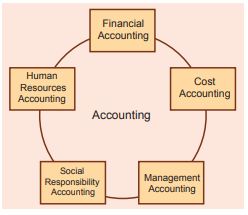
(i) Financial Accounting :
1. It involves recording of financial transactions and events.
2. It provides financial information to the users for taking decisions.
3. It ends up with the preparation of trading and profit and loss account and balance sheet,
(ii) Cost Accounting :
It involves the collection, recording, classification and appropriate allocation of expenditure for the determination of the costs of products or services and for the presentation of data for the purposes of cost control and managerial decision making.
(iii) Management Accounting :
It is concerned with the presentation of accounting information in such a way as to assist management in decision making and in the day - to - day operations of an enterprise.
(iv) Social Responsibility Accounting :
It is concerned with presentation of accounting information from the view point of the society by showing the social costs and social benefits.
(v) Human Resource Accounting :
It is concerned with identification, quantification, and reporting of investments made in human resources of an enterprise.
20.
A trial balance can be prepared in the following methods.
(i) Balance method: In this method, the balance of every ledger account either debit or credit, as the case may be, is recorded in the trial balance against the respective accounts. This method is widely used.
(ii) Total method: Under this method, the total amounts on the debit side of the ledger accounts and the total amounts on the credit side of the ledger accounts are ascertained and recorded in the trial balance. This is not commonly used.
(iii) Total and balance method: This method is a combination of both total method and balance method. Under this method, four columns are provided namely (a) total of debit side of the ledger accounts (b) total of credit side of the ledger accounts (c) debit balances of ledger accounts and (d) credit balances of ledger accounts. This method is not in practice.
21.
Under the accrual basis of accounting, the revenue whether received or not, but has been earned or accrued during the accounting period and expenses incurred whether paid or not are recorded. In other words, revenue is recognised, when it is earned or accrued and expenses are recognised when these are incurred. Under this basis,
a) Any income earned whether received or not
b) Any expenditure incurred whether paid or not
c) Any asset is purchased when cash is paid or not
d) Any liability incurred whether paid or not during the accounting period is recorded.
22.
(i) Heavy cost of installation:
Computer hardware needs replacement and software needs to be updated from time to time with the availability of newer versions.
(ii) Cost of training:
To ensure effective and efficient use of computerised system of accounting, newer versions of hardware and software are to be introduced.
(iii) Fear of unemployment:
On account of the introduction of computerised accounting system, the employees feel insecure that they may lose employment and show less interest in computer related work.
23.
Procedure
i) Open a new spread sheet in MS-Excel.
ii) Enter the data in cells from A1 to J2 as in the question
iii) To get the Number of cells containing numbers only, write the formula in B3
= COUNT(A1:J2)
iv) To get Number of cells that contain any value, write the formula in B4
= COUNTA(A1:J2)
v) To get the Number of cells which have values exceeding 1000, write the formula in B5
= COUNTIF(A1:J2,”>1000”)
Answer
A) 12 B) 18 C) 2 b) Text functions
24.
Following are the objectives of book-keeping :
(i) To have a complete and permanent record of all business transactions in chronological order and under appropriate headings.
(ii) To facilitate ascertainment of the profit or loss of the business during a specific period.
(iii) To facilitate ascertainment of financial position.
(iv) To know the progress of the business.
(v) To find out the tax liabilities.
(vi) To fulfill the legal requirements
25.
(i) "Business units last indefinitely". This statement is used in Going Concern Concept.
(ii) Going concern concept influences Accounting practices in relation to valuation of assets and liabilities, depreciation of the fixed assets, treatment of outstanding and prepaid expenses and Incomes.
(iii) The values involved in the going concern concept are
1. Growth: By following the going concern concept, business activities are to be carried out for future growth.
2. Preparing for future: By following the going concern assumption, business firm always intends to prepare for the future.
26.
This system is not suitable for all business because the actual profit or loss can not be found out by this system. If it is a small business only can follow this system.
27.
i) Convention of consistency
ii) Convention of full disclosure
iii) Convention of materiality
iv) Convention of conservatism or providence.
28.
(i) Readymade Software
(ii) Customised Software
29.
Amount of depreciation per year = \(Original\ cost\ of\ the\ asset − Estimated\ scrap\ value\over Estimated\ useful\ life\ of\ the\ asset\ in\ years\)
\(={1,90,000 – 15,000\over 10}={1,75,000\over 10}\) = Rs.35,000 per year
30.
(i) Under this method, the amount spent on the purchase of an asset is regarded as an investment. As such, the interest at a certain rate is calculated on the opening balance of the asset account each year and debited to the asset account.
(ii) The amount of depreciation written off is ascertained by- referring to the annuity table. Annual depreciation is uniform throughout the working life of the asset.
31.
The following are the different methods of providing depreciation:
(i) Straight line method or Fixed instalment method or Original cost method
(ii) Written down value method or Diminishing balance method
(iii) Sum of years of digits method
(iv) Machine hour rate method
(v) Depletion method
(vi) Annuity method
(vii) Revaluation method
(viii) Sinking fund method
(ix) Insurance policy method
32.
(i) An expenditure, which is revenue expenditure in nature, the benefit of which is to be derived over a subsequent period or periods is known as deferred revenue expenditure.
(ii) The benefit usually accrues for a period of two or more years.
(iii) It is for the time being, deferred from being charged against income.
33.
i) Capital expenditure
ii) Revenue receipt
iii) Capital expenditure
iv) Capital receipt.
34.
| Date | Particulars | Outward Invoice No. | L.F. | Amount | |
| Details (Rs) | Total (Rs) | ||||
| 2015 Feb 1 | M/s. Om & Sons | 182 | |||
| 72 Kurtas @ Rs. 175 each | 12,600 | ||||
| 45 Trousers @ Rs. 225 each | 10,125 | ||||
| 22,725 | |||||
| Less : Trade Discount @ 5% | 1,136 | 21,589 | |||
| Feb 5 | M/s. Deepti & Co. | 282 | |||
| 50 Long Shirts @ Rs. 185 each | 9,250 | ||||
| 65 Jeans @ Rs. 235 each | 15,273 | 24,525 | |||
| Sales A/c Cr. | 46,114 | ||||
35.
Trial balance is a Statement, showing the names and balances of all the accounts in the ledger and cash book.
36.
(i) Cash Basis of Accounting
= 4,50,000 - 2,00,000 (3,50,000 - 1,50,000)
= Rs. 2,50,000
(ii) Accrual Basis of Accounting
= 4,50,000 + 3,00,000 - 3,50,000
= Rs. 4,00,000
37.
There are three parties to a bill of exchange as under:
(i) Drawer: The person who prepares the bill is called the drawer i.e., a creditor
(ii) Drawee: The person who has to make the payment or who accepts to make the payment is called the drawee i.e., a debtor.
(iii) Payee: The person who receives the payment is payee. He may be a third party or the drawer himself.
38.
(i) Financial Accounting involves recording of transactions and events which are financial in nature.
(ii) It provides financial information to the users for taking decisions
(iii) It ends up with the preparation of trading and profit and loss account and balance sheet.

11th Standard Syllabus & Materials
11th Standard
TN 11th Tamil பீடு பெற நில் - செய்யுள் - காவடிச்சிந்து Important Questions And Answers Study Material - QB365 Set A
NEW11th Standard
TN 11th Tamil பீடு பெற நில் - உரைநடை - மலை இடப்பெயர்கள் : ஓர் ஆய்வு Important Questions And Answers Study Material - QB365 Set A
NEW11th Standard
TN 11th Tamil மாமழை போற்றுதும் - துணைப்பாடம் - யானை டாக்டர் Important Questions And Answers Study Material - QB365 Set A
NEW11th Standard
TN 11th Tamil மாமழை போற்றுதும் - செய்யுள் - ஐங்குறுநூறு Important Questions And Answers Study Material - QB365 Set A



Tamilnadu Stateboard 11th Standard Subjects

Maths

Commerce

Economics

Biology

Business Maths and Statistics
Accountancy

Computer Science

Physics

Chemistry
Maths
Biology
Economics
Physics
Chemistry

History
Business Maths and Statistics

Computer Science
Accountancy

Computer Applications
History
Computer Technology
Commerce
Computer Applications
Computer Technology

Tamil

English

French
Tamilnadu Stateboard Standards
