
 100% FREE ACCESS
11th Standard Syllabus & Materials
11th Standard
TN 11th Tamil இயற்கை வேளாண்மை,சுற்றுச்சூழல் -செய்யுள் - மனோன்மணீயம் Important Questions And Answers Study Material - QB365 Set A
NEW11th Standard
TN 11th Tamil என்னுயிர் என்பேன் -துணைப்பாடம் - இசைத்தமிழர் இருவர் Important Questions And Answers Study Material - QB365 Set A
NEW11th Standard
TN 11th Tamil மொழி கலை -செய்யுள் - ஒவ்வொரு புல்லையும் Important Questions And Answers Study Material - QB365 Set A
NEW11th Standard
TN 11th Tamil பீடு பெற நில் - இலக்கணம் - பகுபத உறுப்புகள் Important Questions And Answers Study Material - QB365 Set A
NEW11th Standard
TN 11th Tamil பீடு பெற நில் - துணைப்பாடம் - வாடிவாசல் Important Questions And Answers Study Material - QB365 Set A
NEW11th Standard
TN 11th Tamil பீடு பெற நில் - செய்யுள் - குறுந்தொகை Important Questions And Answers Study Material - QB365 Set A

Published on: 28/07/2018
Some of the important questions from the chapter Number Systems covered in this question paper. The questions are prepared from the book back and PTA question.
Teachers can prepared question paper with answer key within five minutes. Please Click Here for getting the question paper with answer key.
Download Tamil Nadu 11th Standard Computer Applications question papers, model tests, one-mark questions, important questions, and public exam papers in PDF format. Free study materials and answer keys for TN State Board students.
Questions + Answers key
Take MCQ Computer Applications Test
1.
NAND is called as ......Gate
Fundamental Gate
Derived Gate
Logical Gate
Electronic gate
2.
NOR is a combination of?
NOT(OR)
NOT(AND)
NOT(NOT)
NOT(NOR)
3.
A + A =?
A
O
I
A
4.
Which gate is called as the logical inverter?
AND
OR
NOT
XNOR
5.
Which is a basic electronic circuit which operates on one or more signals?
Boolean algebra
Gate
Fundamental gates
Derived gates
6.
Which amongst this is not an Octal number?
645
234
876
123
7.
What is the 1's complement of 00100110?
00100110
11011001
11010001
00101001
8.
For 11012 the equalent Hexadecimal equivalent is?
F
E
D
B
9.
How many bytes does 1 KiloByte contain?
1000
8
4
1024
10.
Which refers to the number of bits processed by a computer's CPU?
Byte
Nibble
Word length
Bit
11.
Write the radix of Decimal, Binary, Octal, Hexadecimal Number systems.
12.
Name the four types of Number system.
13.
We cannot find 1's complement for (28)10 State reason.
14.
Convert (46)10 into Binary number
15.
Write the 1's complement procedure.
16.
What is data?
17.
Write a note on Decimal Number system
18.
Complete the following Octal numbers 365, 366, 367,.......
19.
Perform the following expressions. (COFFEE)16 = (?)2
20.
Write short note on ISCII.
21.
Convert (150)10 into Binary, then convert that Binary number to Octal.
22.
Write note on binary number System.
23.
Convert the Following - (101.10)16 \(\rightarrow \) (?2) = (?)10
24.
Write the steps for converting Decimal to Binary numbers.
1.
(b)
Derived Gate
2.
(a)
NOT(OR)
3.
(a)
A
4.
(c)
NOT
5.
(a)
Boolean algebra
6.
(c)
876
7.
(b)
11011001
8.
(c)
D
9.
(d)
1024
10.
(c)
Word length
11.
The radix of Decimal is 10, Binary is 2, Octal is 8 and Hexadecimal is 16
12.
(i) Decimal Number system
(ii) Binary Number system
(iii) Octal Number system
(iv) Hexadecimal Number system
13.
(28)10 is a positive number. 1's complement represent signed numbers (Negative numbers) only. So, (28)10 cannot find 1's complement.
14.
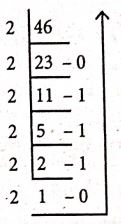
∴ 4610 - 1011102
15.
Step 1: Convert given Decimal number into Binary
Step 2: Check if the binary number contains 8 bits. if less add 0 at the left most bit, to make it as 8 bits.
Step 3: Invert all bits (i.e. Change 1 as 0 and 0 as 1).
16.
The term data comes from the word datum, which means a raw fact. The data is a fact about people. places or some objects
17.
(i) The term Decimal is derived from a Latin prefix decimal, which means ten.
(ii) The Decimal number system has ten digits ranging from 0-9.
(iii) Because this system has ten digits. It is also called as a base ten number system or denary number system.
(iv) A decimal number should always be written with a subscript 10
18.
(365)8 = 3 x 82 x 6 x 81 + 5 x 80
= 192 + 48 + 5 = (245)10
(366)8 = 3 x 82 + 6 x 81 + 6 x 80
= 192 + 42 + 6 = (246)10
(367)8 = 3 x 82 + 6 x 81 + 7 x 80
= 192 + 42 + 6 = (247)10
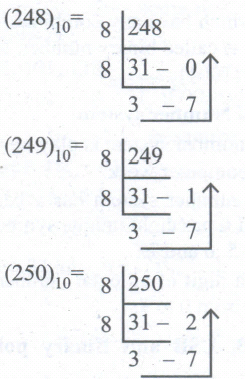
In decimal form, the given sequence will be 245, 246, 247, 248, 249, 250.
To complete the sequence of Octal number, we need to find the octal equal of 248, 249 and 250.
19.
(COFFEE)16
\(\overset { C }{ \underset { 1100 }{ \downarrow } } \)\(\overset { O }{ \underset { 0000 }{ \downarrow } } \)\(\overset { F }{ \underset { 1111 }{ \downarrow } } \)\(\overset { F }{ \underset { 1111 }{ \downarrow } } \)\(\overset { E }{ \underset { 1110 }{ \downarrow } } \)\(\overset { E }{ \underset { 1110 }{ \downarrow } } \)
(COFFEE)16 = (110000001111111111101110)2
20.
(i) ISCII is the system of handling the character of Indian local languages. This as a 8-bit coding system.
(ii) Therefore it can handle 256 (28) characters. This system is formulated by the department of Electronics in India in the year 1986-88 and recognized by Bureau of Indian Standards (BIS).
(iii) Now this coding system is integrated with Unicode.
21.
.png)
15010 = (10010110)2
100101102=?
.png)
100101102 = 2268
22.
(i) There are only two digits in the Binary system, namely, 0 and 1.
The numbers in the binary system are represented to the base 2 and the positional multipliers are the powers of 2.
(ii) The left most bit in the binary number is called as the Most Significant Bit (MSB) and it has the largest positional weight.
(iii) The right most bit is the Least Significant Bit (LSB) and has the smallest positional weight.
23.
(101.10)16 in binary From
= 1 0 1 1 0
0001 0000 0001 0001 0000
(101.10)2 = (000100000001.00010000)2
(101.10)16 in Decimal Form
(101.10)2 = 1 x 162 + x 161 + 1 x 160 + 1 x 16-1 + 0 x 16-2
= 256 + 0 + 1 + 0.0625 + 0 =(275.0625)10
24.
Steps for Decimal to Binary Conversion.
Step 1: Divide the decimal number which is to be converted by two which is the base of the binary number.
Step 2: The remainder which is obtained from step 1 is the least significant bit of the new binary number.
Step 3: Divide. the quotient which is obtained from step 2 and the remainder obtained from this is the second least significant bit of the binary number
Step 4: Repeat the process until the quotient becomes zero.
Step 5: The last remainder obtained from the division is the most significant bit of the binary number. Hence, arrange the number from the most significant bit to the least significant bit (i.e., from bottom to top).

11th Standard Syllabus & Materials
11th Standard
TN 11th Tamil பீடு பெற நில் - செய்யுள் - காவடிச்சிந்து Important Questions And Answers Study Material - QB365 Set A
NEW11th Standard
TN 11th Tamil பீடு பெற நில் - உரைநடை - மலை இடப்பெயர்கள் : ஓர் ஆய்வு Important Questions And Answers Study Material - QB365 Set A
NEW11th Standard
TN 11th Tamil மாமழை போற்றுதும் - துணைப்பாடம் - யானை டாக்டர் Important Questions And Answers Study Material - QB365 Set A
NEW11th Standard
TN 11th Tamil மாமழை போற்றுதும் - செய்யுள் - ஐங்குறுநூறு Important Questions And Answers Study Material - QB365 Set A



Tamilnadu Stateboard 11th Standard Subjects

Maths

Commerce

Economics

Biology

Business Maths and Statistics

Accountancy

Computer Science

Physics

Chemistry
Maths
Biology
Economics
Physics
Chemistry

History
Business Maths and Statistics

Computer Science
Accountancy
Computer Applications
History
Computer Technology
Commerce
Computer Applications
Computer Technology

Tamil

English

French
Tamilnadu Stateboard Standards
