
 100% FREE ACCESS
11th Standard Syllabus & Materials
11th Standard
TN 11th Tamil இயற்கை வேளாண்மை,சுற்றுச்சூழல் -செய்யுள் - மனோன்மணீயம் Important Questions And Answers Study Material - QB365 Set A
NEW11th Standard
TN 11th Tamil என்னுயிர் என்பேன் -துணைப்பாடம் - இசைத்தமிழர் இருவர் Important Questions And Answers Study Material - QB365 Set A
NEW11th Standard
TN 11th Tamil மொழி கலை -செய்யுள் - ஒவ்வொரு புல்லையும் Important Questions And Answers Study Material - QB365 Set A
NEW11th Standard
TN 11th Tamil பீடு பெற நில் - இலக்கணம் - பகுபத உறுப்புகள் Important Questions And Answers Study Material - QB365 Set A
NEW11th Standard
TN 11th Tamil பீடு பெற நில் - துணைப்பாடம் - வாடிவாசல் Important Questions And Answers Study Material - QB365 Set A
NEW11th Standard
TN 11th Tamil பீடு பெற நில் - செய்யுள் - குறுந்தொகை Important Questions And Answers Study Material - QB365 Set A

Published on: 30/09/2018
Important 3mark -chapter 3,4
Download Tamil Nadu 11th Standard Chemistry question papers, model tests, one-mark questions, important questions, and public exam papers in PDF format. Free study materials and answer keys for TN State Board students.
Questions + Answers key
Take MCQ Chemistry Test
1.
Predict which of the following hydrides is a gas on a solid
(a) HCI
(b) NaH
Give your reason.
2.
Explain about the importance of hydrogen bonding in proteins.
3.
What are intra molecular hydrogen bonding? Explain with an example
4.
Explain about the exchange reactions of deuterium oxide.
5.
What is covalent radius? How would you.determine the covalent radius of chlorine atom?
6.
Ionization energy of Mg is greater than that of AI. Why?
7.
Compare the properties of isotopes of hydrogen.
8.
A student reported the ionic radii of isoelectronic species X3+,Y2+ and Z- as 136 pm,64 pm and 49 pm respectively.Is that oreder correct?Comment
9.
The second electron affinity of O is positive, whereas first is negative. Give reason.
10.
(i) Can marine species live in distilled water?
(ii) Can distilled water be called as deionised water?
11.
To which block does the element with configuration 3d10 4s2 belong?
12.
What are metalloids? Give an example.
13.
Mention the uses of deuterium.
14.
What are isotopes? Write the names of isotopes of hydrogen.
15.
What is water-gas shift reaction?
16.
Complete the following chemical reactions and classify them into
(a) hydrolysis (b) redox (c) hydration reactions.
(1) KMnO4 + H2O2 ➝
(2) CrCl3 + H2O ➝
(3) CaO + H2O ➝
17.
Mention any two anomalous properties of second period elements.
18.
In what period and group will an element with Z = 118 will be present?
19.
The electronic configuration of atom is one of the important factor which affects the value of ionisation potential and electron gain enthalpy. Explain.
20.
Energy of an electron in the ground state of the hydrogen atom is -2.8 x 10⁻¹⁸ J. Calculate the ionisation enthalpy of atomic hydrogen in terms of kJ mol-1.
1.
(i) At room temperature, HCI is a colourless gas and the solution of HCI in water is called hydrochloric acid and it is in liquid state.
(ii) Sodium hydride NaH is an ionic compound and it is made of sodium cations (Na+) and hydride (H-) anions. It has the octahedral crystal structure. It is an alkali metal hydride.
2.
(i) Hydrogen bonds occur in complex biomolecules such as proteins and in biological systems.
(ii) For example, hydrogen bonds play an important role in the structure of deoxyribonucleic acid (DNA), since it holds together the two helical nucleic acid chains.
(iii) In these systems, hydrogen bonds are formed between specific pairs, for example, with a thymine unit in one chain bonding to an adenine unit in another; similarly, a cytosine unit in one chain bonds to a guanine unit in another.
(iv) Intramolecular hydrogen bonding also plays an important role in the structure of polymers, both synthetic and natural.
3.
(i) Intramolecular hydrogen bonds are those which occur within one single molecule. This occurs between two functional groups within a molecule.
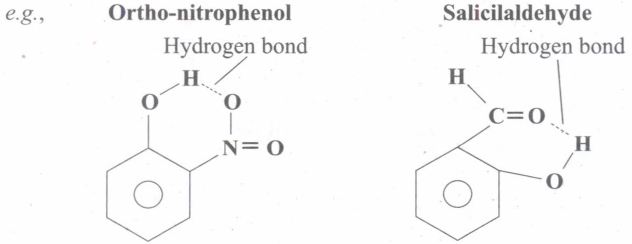
(ii) An intramolecular hydrogen bond (dashed lines) joins the OH group to the doubly bonded oxygen atom of the carboxyl group on the same molecule. e.g., Salicylic acid.
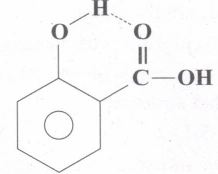
(iii) Salicylic acid act as an analgesic and antipyretic.
4.
When compounds containing hydrogen are treated with D2O, hydrogen undergoes an exchange for Deuterium.
2NaOH + D2O ⟶ 2NaOD + HOD
Sodium hydroxide Heavy water Sodium deutroxide
HCI + D2O ⟶ DCI + HOD
Hydrogen chloride Deuterium Chloride
NH4Cl + 4D2O ⟶ ND4Cl + 4HOD
Ammonium chloride Deutero Ammonium Chloride
5.
The distance between the nuclei of two covalently bonded atoms is known as covalent distance or inter-nuclear distance. The one-half of this inter-nuclear distance is called covalent radius.
The covalent distance (Cl-Cl) of Cl2 molecule is experimentally found as 198 pm (1.98 \(\mathring { A } \)). Its covalent radius is 99 pm (0.99 \(\mathring { A } \)).
Cl-Cl Inter Inter nuclear distance = 1.98 \(\mathring { A } \)
∴ rCl =1.98/2 = 0.99 \(\mathring { A } \)
6.
Mg (Z=12)1s2 2s2 2p6 3s2.
Al (Z=13) 1s2 2s2 2p6 3s2 3p1.
Although the nuclear charge of aluminium is greater than that of magnesium, I.E of Mg is greater than that of AI. It is because Mg atom has more stable configuration than Al atom.
\(\therefore\) I.E1 of Mg>LE1 of AI.
7.
| S.No. | Property | Protium | Deuterium | Tritium |
| 1 | Atomic nature | H | D | T |
| 2 | Atomic mass | 1.008 | 2.014 | 3.016 |
| 3 | Nuclear stability | Stable | Stable | Radioactive |
| 4 | Molecular hydrogen | H2 | D2 | T2 |
| 5 | Abundance (%) | 99.985 | 0.015 | ~10-16 |
| 6 | Molecular mass | 2.016 | 4.028 | 6.032 |
8.
X3+,Y2+, Z- are isoelectronic.
∴ Effective nuclear charge is in the order
(Zeff)Z-< (Zeff)y2+< (Zeff)X3+ and hence
ionic radius should be in the order rz- > ry2+ >rX3+
∴ The correct values are
| Species | Ionic raddi |
| Z- | 136 |
| Y2+ | 64 |
| X3+ | 49 |
9.
\({ O }_{ (g) }+{ e }^{ - }\longrightarrow { O }^{ - }_{ (g) };{ \Delta }_{ eg }H=-141\quad kj\quad { mol }^{ -1 }\)
\({ O }_{ (g) }+{ e }^{ - }\longrightarrow { O }^{ 2- }_{ (g) };{ \Delta }_{ eg }H=+780\quad kj\quad { mol }^{ -1 }\)
When an electron is added to oxygen atom to form ion, energy is released. Hence, first electron gain enthalpy of oxygen is negative.
But when another electron is added to O- ion to form O2- ion, it feels stronger electrostatic repulsion. Hence, addition of second electron takes place with absorption of energy. That's why the second electron gain enthalpy of oxygen is positive.
10.
(i) Marine species cannot live in distilled water because it does not contain dissolved oxygen.
(ii) Distilled water is also called as deionised water, because it does not contain any cations and anions.
11.
The element belongs to d- block, Zinc (Z=30).
12.
Elements that show properties that are characteristic of both metals and non-metals are called as Semi Metals or Metalloids. Example- germanium, silicon, arsenic, antimony and tellurium.
13.
1. Deuterium is used in heavy water moderated fission reactors, usually as liquid D2O to slow neutrons
2. To prepare D2O (heavy water)
3. To prepare deuterated halides
4. To prepare compounds like deutero methane, deutero ammonia etc..
5. To manufacture deuterium lamps with quartz or UV glass bulb.
14.
Elements having same atomic number but different mass numbers are called isotopes. These are variant, of an element which differ in neutron numbers, which contain equal number of protons. They differ in relative atomic mass but not in chemical properties.
The isotopes of hydrogen are:
1. Protium \(\left(\mathrm{H}^{1} \text { or } \mathrm{H}\right)\) [Predominant form]
2. Deuterium (or) Heavy hydrogen \(\left({ }_{1} \mathrm{H}^{2} \text { or }{ }_{1} \mathrm{D}^{2}\right)\)
3. Tritium \(\left({ }_{1} \mathrm{H}^{3} \text { or }{ }_{1} \mathrm{T}^{3}\right)\)
15.
The carbon monoxide of the water gas can be converted to carbon dioxide by mixing the gas mixture with more steam at 400oC and passed over a shift converter containing iron/copper catalyst. This reaction is called as water-gas shift reaction.
CO + H2O ➝ CO2 + H2
16.
(i) 2KMnO4 + 3H2O2 ➝ 2MnO2 + 2KOH + 2H2O + 3O2 (Redox reaction)
(ii) CrCl3 + 6H2O ➝ [Cr Cl2 (H2O)CI. 2H2O [Hydration reaction]
(iii) CaO + H2O ➝ Ca(OH)2 (Hydration reaction)
17.
(i) Lithium and beryllium form more covalent compounds, unlike the alkali and alkali earth metals which predominantly form ionic compounds.
(ii) The elements of the second period have only four orbitals (2s & 2p) in the valence shell and have a maximum co-valence of 4, whereas the other members of the subsequent periods have more orbitals in their valence shell and shows higher valences. For example, boron forms BF4- and aluminium forms AIF63-.
18.
Z = 118; [86Rn] 5f14 6d10 7s2 7p6
In the periodic table the element with Z = 118 is located in p-block,
Period no = 7 (as n = 7 for valence shell)
Group no. = 18 (group no = 10+ ns electrons + np electrons) (n - outer most shell)
19.
(i) Electronic configuration is the arrangement of electrons in an atom. The outermost electron shell is often referred to as the "valence shell"determines the chemical properties.
(ii) Ionization energy and electron affinity is the amount of energy released or required in pulling out or adding an electron to a neutral atom. So both depend on electronic configuration of the element.
20.
Ionisation energy is the amount of energy required to remove the electron from the ground state (EI) to excited state (E∞)
E1=-2.18 x 10⁻¹⁸ J; E∞=0
ΔE=E∞-E1
=0-(-2.18 x 10⁻¹⁸ J)=2.18 x 10⁻¹⁸ J
I.E per hydrogen atom = 2.18 x 10⁻¹⁸ J
I.E per mole of H-atom =2.18 x 10-18 J x 6.023 x 1023
=13.13 x 10⁵ J mol-1

11th Standard Syllabus & Materials
11th Standard
TN 11th Tamil பீடு பெற நில் - செய்யுள் - காவடிச்சிந்து Important Questions And Answers Study Material - QB365 Set A
NEW11th Standard
TN 11th Tamil பீடு பெற நில் - உரைநடை - மலை இடப்பெயர்கள் : ஓர் ஆய்வு Important Questions And Answers Study Material - QB365 Set A
NEW11th Standard
TN 11th Tamil மாமழை போற்றுதும் - துணைப்பாடம் - யானை டாக்டர் Important Questions And Answers Study Material - QB365 Set A
NEW11th Standard
TN 11th Tamil மாமழை போற்றுதும் - செய்யுள் - ஐங்குறுநூறு Important Questions And Answers Study Material - QB365 Set A



Tamilnadu Stateboard 11th Standard Subjects

Maths

Commerce

Economics

Biology

Business Maths and Statistics

Accountancy

Computer Science

Physics
Chemistry
Maths
Biology
Economics
Physics
Chemistry

History
Business Maths and Statistics

Computer Science
Accountancy

Computer Applications
History
Computer Technology
Commerce
Computer Applications
Computer Technology

Tamil

English

French
Tamilnadu Stateboard Standards
