
 100% FREE ACCESS
11th Standard Syllabus & Materials
11th Standard
TN 11th Tamil இயற்கை வேளாண்மை,சுற்றுச்சூழல் -செய்யுள் - மனோன்மணீயம் Important Questions And Answers Study Material - QB365 Set A
NEW11th Standard
TN 11th Tamil என்னுயிர் என்பேன் -துணைப்பாடம் - இசைத்தமிழர் இருவர் Important Questions And Answers Study Material - QB365 Set A
NEW11th Standard
TN 11th Tamil மொழி கலை -செய்யுள் - ஒவ்வொரு புல்லையும் Important Questions And Answers Study Material - QB365 Set A
NEW11th Standard
TN 11th Tamil பீடு பெற நில் - இலக்கணம் - பகுபத உறுப்புகள் Important Questions And Answers Study Material - QB365 Set A
NEW11th Standard
TN 11th Tamil பீடு பெற நில் - துணைப்பாடம் - வாடிவாசல் Important Questions And Answers Study Material - QB365 Set A
NEW11th Standard
TN 11th Tamil பீடு பெற நில் - செய்யுள் - குறுந்தொகை Important Questions And Answers Study Material - QB365 Set A

Published on: 24/07/2019
Quantum Mechanical Model of Atom
Download Tamil Nadu 11th Standard Chemistry question papers, model tests, one-mark questions, important questions, and public exam papers in PDF format. Free study materials and answer keys for TN State Board students.
Questions + Answers key
Take MCQ Chemistry Test
1.
An ion with mass number 37 possesses unit negative charge. If the ion contains 11.1% more neutrons than electrons, Find the symbol of the ion.
2.
Explain briefly the time independent schrodinger wave equation?
3.
Explain why the uncertainty principle is significant only for the motion of sub-atomic particles but is negligible for the macroscopic objects?
4.
An electron a proton which one will have a higher velocity to produce matter waves of the same wavelength? Explain it
5.
The total number of orbitals associated with the principal quantum number n = 3 is _________
9
8
5
7
6.
What is the maximum numbers of electrons that can be associated with the following set of quantum numbers? n = 3, I = 1 and m =-1
4
6
2
= 10
7.
As per Aufbau principle, arrange the orbitals in increasing order of energy __________
4p > 4d > 5s > 5p
4p < 4d < 5s < 5p
4d < 4p < 5s < 5p
4p < 5s < 4d < 5p
8.
How many nodes are possible for 2s orbital?
1
2
3
zero
9.
The number of nodes in s orbital of any energy level is equal to _________
n
2n2
n-1
n-2
10.
The electronic configuration of Eu (Atomic no. 63) Gd (Atomic no. 64) and Tb (Atomic no. 65) are ____________
[Xe] 4f6 5d1 6s2, [Xe] 4f7 Sd1 6s2 and [Xe] 4f8 5d1 6s2
[Xe] 4f7 , 6s2, [Xe] 4f7 5d1 6s2 and [Xe] 4f9 6s2
[Xe] 4f7 ,6s2, [Xe] 4f8 6s2 and [Xe] 4f8 5d1 6s2
[Xe] 4f6 5d1 6s2, [Xe] 4f7 5d1 6s2 and [Xe] 4f9 6s2
11.
Splitting of spectral lines in an electric field is called _____________
Zeeman effect
Shielding effect
Compton effect
Stark effect
12.
The energies E1and E2 of two radiations are 25 eV and 50 eV respectively. The relation between their wavelengths ie \(\lambda \)1 and\(\lambda \)2 will be ___________
\(\frac { { \lambda }_{ 1 } }{ { \lambda }_{ 2 } } =1\)
\({ \lambda }_{ 1 }=2{ \lambda }_{ 2 }\)
\({ \lambda }_{ 1 }=\sqrt { 25\times 50{ \lambda }_{ 2 } } \)
\(2{ \lambda }_{ 1 }={ \lambda }_{ 2 }\)
13.
The energy of light of wavelength 45 nm is _____________.
6.67 x 10¹⁵J
6.67 x 10¹¹J
4.42 x 10⁻¹⁸J
4.42 x 10⁻¹⁵J
14.
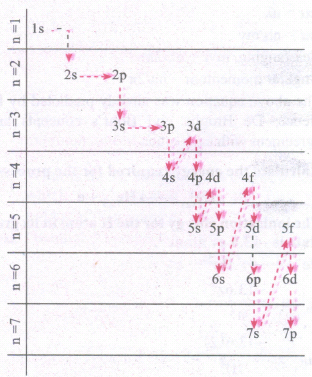
Describe the Aufbau principle
15.
State and explain pauli exclusion principle.
16.
By applying Bohr's postulates, arrive at the radius of nth orbit for hydrogen like atom
17.
Enlist the postulates of Bohr's atom model.
18.
What did Rutherford's alpha ray scattering experiment prove
19.
Write a note on Thomson's plum pudding model of an atom.
20.
Which quantum number reveal information about the shape, energy, orientation and size of orbitals?
21.
How many radial nodes for 2s, 4p, 5d and 4f orbitals exhibit? How many angular nodes
22.
How many orbitals are possible for n = 4?
1.
| Atom | Uni- negative ion | |
| number of electron | x-I | x |
| number of protons | x-1 | x-1 |
| number of neutrons | y | y |
Given that, y = x + 11.1% of x
\(=\left(x+\frac{11.1}{100} x\right)=x+0.111 x\)
Y = 1.111 x
mass number = 37
number of protons + number of neutrons = 37
(x -1) + 1.111x = 37
x+1.111x = 38
2.111x = 38
\(x=\frac{38}{2.11}\)
x = 18.009
x 18 (whole number)
ஃ Atomic number = x- 1 = 18 - 1 = 17
Mass number = 37
Symbol of the ion \({ _{ 17 }^{ 37 }{ Cl } }^{ - }\)
2.
Erwin Schrodinger expressed the wave nature of electron in terms of a differential equation. This equation determines the change of wave function in space depending on the field of force in which the electron moves. The time independent Schrodinger equation can be expressed as,
\(\overset { \wedge }{ H } \psi =E\psi \) .........(1)
Where \(\overset { \wedge }{ H } \) is called Hamiltonian operator, \(\psi \) is the wave function and is a function of position coordinates of the particle and is denoted as \(\psi \) (x, y, z) E is the energy of the system
\(\overset { \wedge }{ H } =\left[ \frac { { -h }^{ 2 } }{ 8{ \pi }^{ 2 } } \left( \frac { { \partial }^{ 2 }\psi }{ { \partial x }^{ 2 } } +\frac { { \partial }^{ 2 }\psi }{ { \partial y }^{ 2 } } +\frac { { \partial }^{ 2 }\psi }{ { \partial z }^{ 2 } } \right) +V \right] \)
can be written as
\(\left[ \frac { { -h }^{ 2 } }{ 8{ \pi }^{ 2 }m } \left( \frac { { \partial }^{ 2 }\psi }{ { \partial x }^{ 2 } } +\frac { { \partial }^{ 2 }\psi }{ { \partial y }^{ 2 } } +\frac { { \partial }^{ 2 }\psi }{ { \partial z }^{ 2 } } \right) +V\Psi \right] =E\Psi \)
Multiply by \(\frac { 8{ \pi }^{ 2 }m}{ { -h }^{ 2 } } \)and rearranging
\(\frac { { \partial }^{ 2 }\psi }{ { \partial x }^{ 2 } } +\frac { { \partial }^{ 2 }\psi }{ { \partial y }^{ 2 } } +\frac { { \partial }^{ 2 }\psi }{ { \partial z }^{ 2 } } +\frac { 8{ \pi }^{ 2 }m }{ { -h }^{ 2 } } (E-V)\Psi =0\) ........(2)
The above Schrodinger wave equation does not contain time as a variable and is referred to as time independent Schrodinger wave equation. This equation can be solved only for certain values of E, the total energy. i.e. the energy of the system is quantised. The permitted total energy values are called eigen values and corresponding wave functions represent the atomic orbitals.
3.
(i) The energy of photon is sufficient to disturb a sub-atomic particle so that there is uncertainty in the measurement of position and momentum of the sub-atomic particle.
(ii) However, the energy is insufficient to disturb a macroscopic object.
4.
From de Broglie equation, wavelength \(\lambda =\frac { h }{ mv } \)
For same wavelength with two different particles, (ie) electron and proton m1v1 = m2v2 (h is constant) Lesser the mass of the particle, greater will be the velocity.
Hence electron will have higher velocity
5.
(a)
9
6.
(c)
2
7.
(d)
4p < 5s < 4d < 5p
8.
(a)
1
9.
(c)
n-1
10.
(b)
[Xe] 4f7 , 6s2, [Xe] 4f7 5d1 6s2 and [Xe] 4f9 6s2
11.
(d)
Stark effect
12.
(b)
\({ \lambda }_{ 1 }=2{ \lambda }_{ 2 }\)
13.
(c)
4.42 x 10⁻¹⁸J
14.
The word Aufbau in German means 'building up'. In the ground state of the atoms, the orbitals are filled in the order of their increasing energies. That is the electrons first occupy the lowest energy orbital available to them.
Once the lower energy orbitals are completely filled, then the electrons enter the next higher energy orbitals. The order of filling of various orbitals as per the Aufbau principle which is in accordance with (n + l) rule.
15.
Statement : "No two electrons in an atom can have the same set of values of all four quantum numbers"
Explanation : It means that, each electron must have unique values for the four quantum numbers (n, l, m and s).
For the lone electron present in hydrogen atom, the four quantum numbers are: n = 1; l = 0; m = 0 and s = +1/2. For the two electrons present in helium, one electron has the quantum numbers same as the electron of hydrogen atom, n = 1.
l = 0, m = 0 and s = +1/2. For other electron, the fourth quantum number is different i.e., n = 1, l = 0, m = 0 and s = -1/2.
As we know that the spin quantum number can have only two values +1/2 and - 1/2, only two electrons can be accommodated in a given orbital in accordance with pauli exclusion principle.
| Atom | e- | n | l | m | s |
| Helium | First | 1 | 0 | 0 | +1/2 |
| Second | 1 | 0 | 0 | +1/2 |
16.
Applying Bohr's postulates to a hydrogen like atom (one electron species such as H, He+ and Li2+ etc...)the radius of the nth orbit and the energy of the electron revolving in the nth orbit were derived. The results are as follows:
rn = \(\frac { (0.529){ n }^{ 2 } }{ x } \mathring { A } \) ...(1)
En = \(\frac { -13.6({ z }^{ 2 }) }{ { n }^{ 2 } } ev\quad { atom }^{ -1 }\) or ... (2) or
En = \(\frac { (-1312.8){ z }^{ 2 } }{ { n }^{ 2 } } kJ\quad { mol }^{ -1 }\) .....(3)
17.
Bohr's atom is based on the following assumptions:
(a) The energies of electrons are quantised
(b) The electron is revolving around the nucleus in a certain fixed circular path called stationary orbit.
(c) Electron can revolve, only in those orbits in which the angular momentum (mvr) of the electron must be equal to an integral multiple of h/2π i.e mvr =nh/2π
where n = 1,2,3 ...etc...
As long as an electron revolves in the fixed stationary orbit, it doesn't lose its energy.
However, when an electron jumps from higher energy state (E2)to a lower energy state (E1)the excess energy is emitted as radiation. The frequency of the emitted radiation is
E2 = E1 = hv and
\(v=\frac { ({ E }_{ 2 }-{ E }_{ 1 }) }{ h } \)
Conversely, when suitable energy is supplied to an electron, it will jump from lower energy orbit to a higher energy orbit.
18.
(i) Atoms consist of huge positively charged centers called nuclei.
(ii) Most of the space inside the atom is empty.
19.
According to this theory, atom was assumed to consist of a sphere of uniform distribution of about 10-10 m positive charge with electrons embedded in it such that the number of electrons equal to the number of positive charges and the atom as a whole is electrically neutral.
20.
a) Principal quantum number defines energy and size of an orbital.
b) Azimuthal quantum number defines shape of an orbital
c) Magnetic quantum number defines spatial orientation (direction) of an orbital.
21.
| Orbital | n | 1 | Radial node n-1-1 | Angular node 1 |
| 2s | 2 | 0 | 1 | 0 |
| 4p | 4 | 1 | 2 | 1 |
| 5d | 5 | 2 | 2 | 2 |
| 4f | 4 | 3 | 0 | 3 |
22.
| n | l | m | orbitals | Total no of orbitals |
| 0 | 0 | 1 | (1- 4s +3 - 4P orbital +5 - 4d orbital +7 - 4f orbital) =16 |
|
| 4 | 1 | -1 0 +1 |
3 | |
| 2 |
-2 |
5 | ||
| 3 |
-3 |
7 |

11th Standard Syllabus & Materials
11th Standard
TN 11th Tamil பீடு பெற நில் - செய்யுள் - காவடிச்சிந்து Important Questions And Answers Study Material - QB365 Set A
NEW11th Standard
TN 11th Tamil பீடு பெற நில் - உரைநடை - மலை இடப்பெயர்கள் : ஓர் ஆய்வு Important Questions And Answers Study Material - QB365 Set A
NEW11th Standard
TN 11th Tamil மாமழை போற்றுதும் - துணைப்பாடம் - யானை டாக்டர் Important Questions And Answers Study Material - QB365 Set A
NEW11th Standard
TN 11th Tamil மாமழை போற்றுதும் - செய்யுள் - ஐங்குறுநூறு Important Questions And Answers Study Material - QB365 Set A



Tamilnadu Stateboard 11th Standard Subjects

Maths

Commerce

Economics

Biology

Business Maths and Statistics

Accountancy

Computer Science

Physics
Chemistry
Maths
Biology
Economics
Physics
Chemistry

History
Business Maths and Statistics

Computer Science
Accountancy

Computer Applications
History
Computer Technology
Commerce
Computer Applications
Computer Technology

Tamil

English

French
Tamilnadu Stateboard Standards
