
 100% FREE ACCESS
11th Standard Syllabus & Materials
11th Standard
TN 11th Tamil இயற்கை வேளாண்மை,சுற்றுச்சூழல் -செய்யுள் - மனோன்மணீயம் Important Questions And Answers Study Material - QB365 Set A
NEW11th Standard
TN 11th Tamil என்னுயிர் என்பேன் -துணைப்பாடம் - இசைத்தமிழர் இருவர் Important Questions And Answers Study Material - QB365 Set A
NEW11th Standard
TN 11th Tamil மொழி கலை -செய்யுள் - ஒவ்வொரு புல்லையும் Important Questions And Answers Study Material - QB365 Set A
NEW11th Standard
TN 11th Tamil பீடு பெற நில் - இலக்கணம் - பகுபத உறுப்புகள் Important Questions And Answers Study Material - QB365 Set A
NEW11th Standard
TN 11th Tamil பீடு பெற நில் - துணைப்பாடம் - வாடிவாசல் Important Questions And Answers Study Material - QB365 Set A
NEW11th Standard
TN 11th Tamil பீடு பெற நில் - செய்யுள் - குறுந்தொகை Important Questions And Answers Study Material - QB365 Set A

Published on: 15/09/2018
Model paper
Download Tamil Nadu 11th Standard Physics question papers, model tests, one-mark questions, important questions, and public exam papers in PDF format. Free study materials and answer keys for TN State Board students.
Questions + Answers key
Take MCQ Physics Test1.
The angle between A i +j and B = i - j is ______________.
45°
90°
-45°
180°
2.
Which one of the following statement is true?
A scalar quantity is conserved in a process
A scalar quantity does not vary from one point to another in apace
A scalar quantity can never take -ve values
A scalar quantity has only magnitude and no direction.
3.
A particle is moving with a constant velocity along a line parallel to positive X-axis. The magnitude of its angular momentum with respect to the origin is
zero
increasing with x
decreasing with x
remaining constant
4.
A couple produces,
pure rotation
pure translation
rotation and translation
no motion
5.
The center of mass of a system of particles does not depend upon,
position of particles
relative distance between particles
masses of particles
force acting on particle
6.
Two objects are projected at angles 30° and 60° respectively with respect to the horizontal direction. The range of two objects are denoted as R30° and R30°. Choose the correct relation from the following
R30° = R60°
R30° = 4R60°
R30° =\(\frac{R_{60°}}{2}\)
R30° = 2R60°
7.
If an object is thrown vertically up with the initial speed u from the ground, then the time taken by the object to return back to ground is
\(\frac{u^2}{2g}\)
\(\frac{u^2}{g}\)
\(\frac{u}{2g}\)
\(\frac{2u}{g}\)
8.
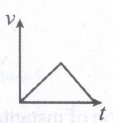
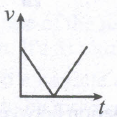
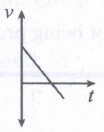
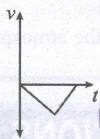
A ball is projected vertically upwards with a velocity v. It comes back to ground in time t. Which v-t graph shows the motion correctly?
9.
Identify the unit vector in the following?
\(\hat { i } +\hat { j } \)
\(\frac { \hat { i } }{ \sqrt { 2 } } \)
\(\hat { k } -\frac { \hat { j } }{ \sqrt { 2 } } \)
\(\frac { \hat { i } +\hat { j } }{ \sqrt { 2 } } \)
10.
Which one of the following Cartesian coordinate systems is not followed in physics?
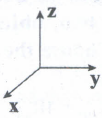
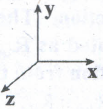
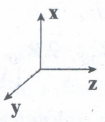
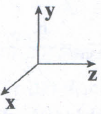
11.
Two vectors \(\vec A\) and \(\vec B\) of magnitude 5 units and 7 units respectively make an angle 60° with each other as shown below. Find the magnitude of the resultant vector and its direction with respect to 7 unit the vector \(\vec A\).
.png)
12.
Write an expression for the two objects, moving with uniform velocities along the same straight tracks but opposite in direction.
13.
Define the term relative velocity. How can it be obtained vectorially, when the two objects with uniform velocities move in same direction.
14.
What does the slope of 'position-time' graph represent? Which physical quantity is obtained from it?
15.
Write an expression for component of Instantaneous velocity or velocity and also define it.
16.
Define average velocity and represent it graphically.
17.
How is a function represented graphically and mathematically.
18.
Write an expression for displacement vector in Cartesian coordinate system and also show graphically.
19.
Obtain an expression for the area of triangle in terms of the cross product of two vectors representing the two sides of the triangle.
20.
The Moon is orbiting the Earth approximately once in 27 days, what is the angle traversed by the Moon per day?
21.
An object is executing uniform circular motion with an angular speed of \(\frac { \pi }{ 12 } \) radian per second. At t = 0 the object starts at an angle \(\theta\) = 0 What is the angular displacement of the particle after 4s?
22.
Write down the kinematic equations for angular motion.
23.
Define angular displacement and angular velocity.
24.
Define velocity and speed
25.
Define displacement and distance.
26.
How do you deduce that two vectors are perpendicular?
27.
A swimmer's speed in the direction of flow of a river is 12 km h-1. Against the direction of flow of the river the swimmer's speed is 6 km h-1. Calculate the swimmer's speed in still water and the velocity of the river flow.
28.
What are the two quantities which have maximum values when the maximum height attained by the projectile is to the largest.
29.
Find the magnitude of vector 3\(\hat { i } -2\hat { j } +\sqrt { 3 } \hat { k } \) ?
30.
Define a radian?
1.
(b)
90°
2.
(d)
A scalar quantity has only magnitude and no direction.
3.
(d)
remaining constant
4.
(a)
pure rotation
5.
(d)
force acting on particle
6.
Range is same for the angle if projection \(\theta \text { and } 90-\theta\)
7.
\(\text {Time of flight }=\frac{2 u}{g}\)
8.
Initially velocity has maximum value and at maximum height velocity becomes zero. After that the velocity becomes negative
9.
Unit vector specifies only direction
\(\hat{A}=\frac{\vec{A}}{|\vec{A}|} \)
\(\therefore \hat{i}+\hat{j}=\frac{\hat{l}+\hat{j}}{|\hat{l}+\hat{j}|}
\)
\(\hat{i} \text { and } \hat{j} \text { are orthogonal components of vectors. }\)
\(\therefore|\hat{i}+\hat{j}|=\sqrt{1^{2}+1^{2}}=\sqrt{1+1}=\sqrt{2}\)
10.
Answers (a), (b) and (c) are all anticlockwiseand answer (d) alone is in the clockwise direction
11.
By following the law of triangular addition, the resultant vector is given by \(\vec R\) = \(\vec A\) + \(\vec B\) as illustrated below.
The magnitude of the resultant vector \(\vec R\) is given by
\(R=|\vec R|=\sqrt{5^2+7^2+2\times 5\times 7\cos 60^o}\)
\(R=\sqrt{25+49+\frac{70\times 1}{2}}=\sqrt{109}\) units
i.png)
The angle \(\alpha\) between \(\vec R\) and \(\vec A\) is given by
\(\tan\alpha=\frac{B\sin\theta}{A+B\cos\theta}\)
\(\tan\alpha=\frac{7\times\sin60^o}{5+7\cos60^o}=\frac{7\sqrt{3}}{10+7}=\frac{7\sqrt{3}}{17}\) = 0.713
\(\therefore\alpha=35^o\)
ii.png)
12.
(i) Consider two objects A and B moving with uniform velocities VA and VB along the same straight tracks but opposite in direction.
\(\overrightarrow { \xrightarrow { { v }_{ A } } } \overleftarrow { \xrightarrow { { v }_{ B } } } \)
(ii) The relative velocity of object A with respect to object B is
\(\overrightarrow { { V }_{ AB } } =\overrightarrow { { V }_{ A } } -(-\overrightarrow { { V }_{ B } } )=\overrightarrow { { V }_{ A } } +\overrightarrow { { V }_{ B } } \)
(iii) The relative velocity of object B with respect to object A is
\(\overrightarrow { { V }_{ BA } } =-\overrightarrow { { V }_{ B } } -\overrightarrow { { V }_{ A } } =-(\overrightarrow { { V }_{ A } } +\overrightarrow { { V }_{ B } } )\)
(iv) Thus, if two objects are moving in opposite directions, the magnitude of relative velocity of one object with respect to other is equal to the sum of magnitude of their velocities.
13.
(i) When two objects A and B are moving with different velocities, then the velocity of one object A with respect to another object B is called relative velocity of object A with respect to B.
(ii) Consider two objects A and B moving with uniform velocities VA and VB, as shown, along straight tracks in the same direction \(\overrightarrow { { V }_{ A } } \),\(\overrightarrow { { V }_{ B } } \) , with respect to ground.
(iii) The relative velocity of object A with respect to object B is \(\overrightarrow { { V }_{ AB } } =\overrightarrow { { V }_{ A } } -\overrightarrow { { V }_{ B } } \)
(iv) The relative velocity of object B with respect to object A is \(\overrightarrow { { V }_{ AB } } =\overrightarrow { { V }_{ B } } -\overrightarrow { { V }_{ A } } \)
(v) Thus, if two objects are moving in the same direction, the magnitude of relative velocity of one object with respect to another is equal to the difference in magnitude of two velocities.
14.
(i) Graphically the slope of the position-time graph will give the velocity of the particle.
(ii) At the same time, if velocity-time graph is given, the distance and displacement are determined, by calculating the area under the curve.
Velocity is given by \(\frac { dx }{ dt } =v\)
(iii) Therefore, dx = vdt
By integrating both sides, \(\int _{ { x }_{ 1 } }^{ { x }_{ 2 } }{ dx=\int _{ { x }_{ 1 } }^{ { x }_{ 2 } }{ v\quad dt } } \)
Integration is equivalent to area under the given curve.
(iv) So the term \(\int _{ { t }_{ 1 } }^{ { t }_{ 2 } }{ vdt } \) represents the area under the curve v as a function of time.
(v) Since the left hand side of the integration represents the displacement travelled by the particle from time t1 to t2, the area under the velocity time graph will give the displacement of the particle.
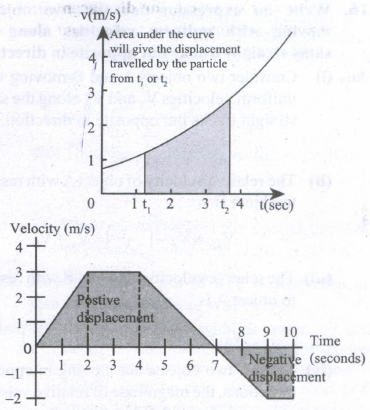
Displacement in the velocity - time graph
(vi) If the area is negative, it means that displacement is negative, so the particle has travelled in the negative direction.
15.
(i) The instantaneous velocity at an instant or simply 'velocity' at an instant t is defined as limiting value of the average velocity as \(\Delta \)t \(\rightarrow\)0, evaluated at time t.
(ii) In other words, velocity is equal to rate of change of position vector with respect to time. Velocity is a vector quantity.
\(\overrightarrow { v } =\lim _{ \Delta x\rightarrow 0 }{ \frac { \Delta \overrightarrow { r } }{ \Delta \overrightarrow { t } } =\frac { d\overrightarrow { r } }{ dt } } \)
(iii) In component form, this velocity is
\(\overrightarrow { v } =\frac { d\overrightarrow { r } }{ dt } =\frac { d }{ dt } (x\hat { i } +y\hat { j } +z\hat { k } )\)
\(=\frac { dx }{ dt } \hat { i } =\frac { dy }{ dt } \hat { j } +\frac { dz }{ dt } \hat { k } \)
Here \(\frac { dx }{ dt } ={ v }_{ x }=x-\) component of velocity.
\(\frac { dx }{ dt } ={ v }_{ y }=y-\) component of velocity.
\(\frac { dz }{ dt } ={ v }_{ z }=z\) - component of velocity.
(iv) The magnitude of velocity v is called speed and is given by
\(v=\sqrt { { v }_{ x }^{ 2 }+{ v }_{ y }^{ 2 }+{ v }_{ z }^{ 2 } } \)
Speed is always a positive scalar. The unit of speed is also meter per second.
16.
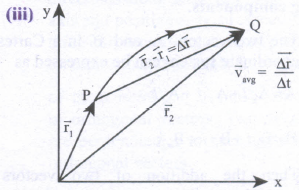
(i) The average velocity is defined as ratio of the displacement vector to the corresponding time interval
\(\overrightarrow { { v }_{ avg } } =\frac { \Delta \overrightarrow { r } }{ \Delta t } \)
(ii) It is a vector quantity. The direction of average velocity is in the direction of the displacement vector (\(\Delta \)\(\overrightarrow { r } \)).
17.
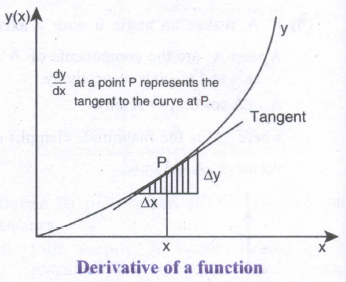
(i) If a function is represented by y = f (x), then dy/dx represents the derivative of y with respect to x.
(ii) Mathematically this represents the variation of y with respect to change in x, for various continuous values of x.
(iii) Mathematically the derivative dy/dx is defined as follows
\(\frac { dy }{ dx } =\underset { \Delta x\rightarrow 0 }{ lim } \frac { y(x+\Delta x)-y(x) }{ \Delta x } \)
\(=\lim _{ \Delta x\rightarrow 0 }{ \frac { \Delta y }{ \Delta x } } \)
\(\frac { dy }{ dx } \) represents the limit that the quantity \(\frac { \Delta y }{ \Delta x } \)
attains, as \(\Delta \)x tends to zero.
18.
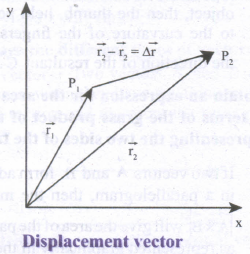
(i) In terms of position vector, the displacement vector is given as follows. Consider a particle moving from a point P1 having position vector \(\overrightarrow { { r }_{ 1 } } ={ x }_{ 1 }\hat { i } +{ y }_{ 1 }\hat { j } +{ z }_{ 1 }\hat { k } \) to a point P2 where its position vector is \(\overrightarrow { { r }_{ 2 } } ={ x }_{ 2 }\hat { i } +{ y }_{ 2 }\hat { j } +{ z }_{ 2 }\hat { k } \)
(ii) The displacement vector is given by \(\Delta \overrightarrow { r } =\overrightarrow { { r }_{ 2 } } -\overrightarrow { { r }_{ 1 } } \)
= (x2-x1)\(\hat { i } \) + (y2-y1)\(\hat { j } \)+(z2-z1)\(\hat {k } \)
(iii) This displacement is also shown in
19.
(i) If two vectors\(\overrightarrow { A } \) and \(\overrightarrow { B } \) form adjacent sides in a parallelogram, then the magnitude of |\(\overrightarrow { A } \) \(\times\)\(\overrightarrow { B } \)| will give the area of the parallelogram as represented graphically.
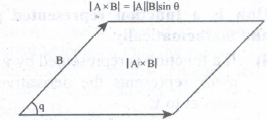
Area of Parallelogram
It divides a parallelogram into two equal triangles as shown. The area of a triangle with \(\overrightarrow { A } \) and \(\overrightarrow { B} \) as sides is \(\frac { 1 }{ 2 } |\overrightarrow { A } \times \overrightarrow { B } |\)
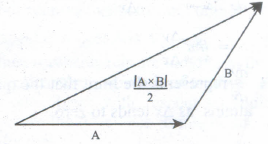
Area of triangle
20.
360o = 27 days
1 day = \(\frac{360^o}{27}=13^o.3'\)
21.
ω = \(\frac{\pi}{12}rads^{-1}\)
θ = ωt
\(=\frac{\pi}{12}\times 4=\frac{\pi}{3}\)
\(= \frac{18}{3}=60^o\)
22.
| 1. \(\omega ={ \omega }_{ 0 }+\alpha t\) | \(\omega \) = Final angular velocity |
| 2. \(\theta ={ \omega }_{ 0 }t+\frac { 1 }{ 2 } { \alpha t }^{ 2 }\) | \({ \omega }_{ 0 }\) = initial angular velocity |
| 3. \({ \omega }^{ 2 }={ \omega }_{ 0 }^{ 2 }+2\alpha \theta \) | \(\theta \) = Angular displacement |
| 4. \(\theta =\frac { \left( { \omega }_{ 0 }+\omega \right) t }{ 2 } \) | \(\alpha \) = angular acceleration t = time |
23.
Angular displacement: While a particle is revolving around a point in a circular path, the angle described by the particle about the axis of rotation (or at the centre of the circle) in a given time is called angular displacement. Its unit is radian.
Angular velocity: The rate of change of angular displacement is called angular velocity. Its unit is rad s-1
\(\omega =\frac { d\theta }{ dt } \)
24.
Velocity:
Velocity is equal to the rate of change of position vector with respect to time.
It is a vector quantity \(\overrightarrow{v}=\frac{d\overrightarrow{r}}{dt}\)
Speed:
The magnitude of velocity is called speed and is given by \(v= \sqrt{v^2_x+v^2_y+v^2_z}\). It is a positive scalar.
25.
(i) Displacement is the difference between the final and initial positions of the object in a given interval of time. It can also be defined as the shortest distance between these two positions of the object and its direction is from the initial to final position of the object, during the given interval of time. It is a vector quantity.
(ii) Distance is the actual path length travelled by an object in the given interval of time during the motion. It is a positive scalar quantity.
26.
The condition for the two vectors \(\vec{a}\ and \ \vec{b}\) to be perpendicular to each other is \(\vec{a} \cdot \vec{b}=|\vec{a}||\vec{b}| \cos \theta=0\).
Diagrammatically, when \(\vec{a}\ and \ \vec{b}\) are perpendicular to each other
\(|\vec{a}+\vec{b}| =|\vec{a}-\vec{b}|
\)
\(\text {Squaring }|\vec{a}+\vec{b}|^{2} =|\vec{a}-\vec{b}|^{2}
\)
\(a^{2}+b^{2}+2 a b \cos \theta =a^{2}+b^{2}-2 a b \cos \theta .
\)
\(4 a b \cos \theta =0
\)
\(\text { or } \cos \theta =0
\)
\(\theta =\frac{\pi}{2}\)
If \(|\vec{a}+\vec{b}|=|\vec{a}-\vec{b}|\) then \(\vec{a}\ and \ \vec{b}\) are perpendicular to each other.
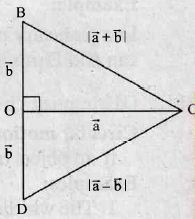
27.
Let vs and vr represent the velocities of the swimmer and river respectively with respect to ground
vs + vr = 12 ............(1)
and vs - vr = 6 ............ (2)
Adding the both equations (1) and (2) 2vs = 12 + 6 = 18 km h-1 or vs = 9 km h-1
From equation (1),
9+ vr = 12 or vr = 3 km h-1
When the river flow and swimmer move in the same direction, the net velocity of swimmer is 12 km h-1.
28.
(i) Vertical component of initial velocity.
(ii) Time of flight.
29.
\(|3\hat { i } -2\hat { j } +\sqrt { 3 } \hat { k } |=\sqrt { { 3 }^{ 2 }+{ 2 }^{ 2 }+{ \sqrt { 3 } }^{ 2 } } \)
\(\sqrt { 9+4+3 } =\sqrt { 16 } =4\)
30.
One radian is the angle subtended at the center of a circle by an arc that is equal in length to the radius of the circle.
1 rad = \(\frac{180}{\pi}\) degree = 57.295o

11th Standard Syllabus & Materials
11th Standard
TN 11th Tamil பீடு பெற நில் - செய்யுள் - காவடிச்சிந்து Important Questions And Answers Study Material - QB365 Set A
NEW11th Standard
TN 11th Tamil பீடு பெற நில் - உரைநடை - மலை இடப்பெயர்கள் : ஓர் ஆய்வு Important Questions And Answers Study Material - QB365 Set A
NEW11th Standard
TN 11th Tamil மாமழை போற்றுதும் - துணைப்பாடம் - யானை டாக்டர் Important Questions And Answers Study Material - QB365 Set A
NEW11th Standard
TN 11th Tamil மாமழை போற்றுதும் - செய்யுள் - ஐங்குறுநூறு Important Questions And Answers Study Material - QB365 Set A



Tamilnadu Stateboard 11th Standard Subjects

Maths

Commerce

Economics

Biology

Business Maths and Statistics

Accountancy

Computer Science
Physics

Chemistry
Maths
Biology
Economics
Physics
Chemistry

History
Business Maths and Statistics

Computer Science
Accountancy

Computer Applications
History
Computer Technology
Commerce
Computer Applications
Computer Technology

Tamil

English

French
Tamilnadu Stateboard Standards

