
 100% FREE ACCESS
11th Standard Syllabus & Materials
11th Standard
TN 11th Tamil இயற்கை வேளாண்மை,சுற்றுச்சூழல் -செய்யுள் - மனோன்மணீயம் Important Questions And Answers Study Material - QB365 Set A
NEW11th Standard
TN 11th Tamil என்னுயிர் என்பேன் -துணைப்பாடம் - இசைத்தமிழர் இருவர் Important Questions And Answers Study Material - QB365 Set A
NEW11th Standard
TN 11th Tamil மொழி கலை -செய்யுள் - ஒவ்வொரு புல்லையும் Important Questions And Answers Study Material - QB365 Set A
NEW11th Standard
TN 11th Tamil பீடு பெற நில் - இலக்கணம் - பகுபத உறுப்புகள் Important Questions And Answers Study Material - QB365 Set A
NEW11th Standard
TN 11th Tamil பீடு பெற நில் - துணைப்பாடம் - வாடிவாசல் Important Questions And Answers Study Material - QB365 Set A
NEW11th Standard
TN 11th Tamil பீடு பெற நில் - செய்யுள் - குறுந்தொகை Important Questions And Answers Study Material - QB365 Set A

Published on: 30/09/2018
MODEL QUESTION PAPER 5
Download Tamil Nadu 11th Standard Physics question papers, model tests, one-mark questions, important questions, and public exam papers in PDF format. Free study materials and answer keys for TN State Board students.
Questions + Answers key
Take MCQ Physics Test1.
The centre of mass of a solid cone along the line from the centre of the base to the vertex is at ___________.
one-fourth of the height
one-third of the height
one-fifth of the height
none of these
2.
A bullet is fired from a rifle. If the rifle recoils freely the K.E of the rifle as compared to that of bullet is ______________.
greater
equal
lesser
none of the above
3.
A body of mass 30 kg climbs on a rope. The boy climbs up with an acceleration of 5 ms-2 What is the tension of a rope?
250 N
540 N
312 N
444 N
4.
When a mass is rotating in a plane about a fixed point, its angular momentum is directed along
a line perpendicular to the plane of rotation
the line making an angle of 45o to the plane of rotation
the radius
tangent to the path
5.
The angle between A i +j and B = i - j is ______________.
45°
90°
-45°
180°
6.
What is the minimum velocity with which a body of mass m must enter a vertical loop of radius R so that it can complete the loop?
\(\sqrt{2gR}\)
\(\sqrt{3gR}\)
\(\sqrt{5gR}\)
\(\sqrt{gR}\)
7.
Identify the unit vector in the following?
\(\hat { i } +\hat { j } \)
\(\frac { \hat { i } }{ \sqrt { 2 } } \)
\(\hat { k } -\frac { \hat { j } }{ \sqrt { 2 } } \)
\(\frac { \hat { i } +\hat { j } }{ \sqrt { 2 } } \)
8.
Which of the following has the highest number of significant figures?
0.007 m2
2.64\(\times\)1024kg
0.0006032 m2
6.3200 J
9.
If the Earth’s pull on the Moon suddenly disappears, what will happen to the Moon?
10.
Write down the moment of inertia of a disc of radius R and mass m about an axis in its plane at a distance R/2 from its centre
11.
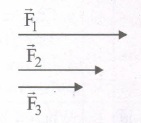
Which is the greatest force among the three force \(\vec { { F }_{ 1 } } ,\vec { { F }_{ 2 } } ,\vec { { F }_{ 3 } } \), shown below:
12.
Give examples where the centre of mass coincides with the geometrical centre of the body.
13.
When is the exchange of energy maximum during an elastic collision?
14.
A beam of metal has length, breadth and height as 4m, 3m and 5m respectively. Then what will be the volume of the metal beam? Express the result in SI unit system.
15.
What are the factors the horizontal range directly depends?
16.
How will you measure the diameter of the Moon using parallax method?
17.
How will you prove that Earth itself is spinning?
18.
A jester in a circus is standing with his arms extended on a turn table rotating with angular velocity \(\omega\). He brings his arms closer to his body so that his moment of inertia is reduced to one third of the original value. Find his new angular velocity. [Given: There is no external torque on the turn table in the given situation.]
19.
The velocity of three particles A, B, C are given below. Which particle travels at the greatest speed?
\(\vec {v_A}=3\hat i+5\hat j+2\hat k\)
\(\vec {V_B}=\hat i+2\hat j+3\hat k\)
\(\vec{V_C}=5\hat i+3\hat j+4\hat k\)
20.
A bomb of mass 30 kg, initially at rest explodes into three pieces of masses. m1 = m2 = 20 kg. If the kinetic energy of two pieces (m1 = m2) is 400 J. Calculate the kinetic energy of the third piece.
21.
Define the following
a) Coefficient of restitution
1.
(a)
one-fourth of the height
2.
(c)
lesser
3.
(d)
444 N
4.
(a)
a line perpendicular to the plane of rotation
5.
(b)
90°
6.
Radius =R
\(v_{1}^{2}-v_{2}^{2}=4 g R\)
\(\text { Tension } T_{2}=\frac{m v_{2}^{2}}{R_{2}}-m g\)
\(\text {To find minimum speed, let } T_{2}=0\)
\(0 =\frac{m v_{2}^{2}}{R}-m g \)
\(\frac{m v^{2}}{R} =m g \)
\(v_{2}^{2}=R g \ v_{2} =\sqrt{g R} \)
\(\text { sub (2) in the eqn (1) we get }\)
\(v_{1}^{2}-(\sqrt{g R})^{2} =4 g R \)
\(v_{1}^{2}-g R =4 g R \)
\(v_{1}^{2} =4 g R+g R \)
\(=5 g R \)
\(v_{1} =\sqrt{5 g R} \)
7.
Unit vector specifies only direction
\(\hat{A}=\frac{\vec{A}}{|\vec{A}|} \)
\(\therefore \hat{i}+\hat{j}=\frac{\hat{l}+\hat{j}}{|\hat{l}+\hat{j}|}
\)
\(\hat{i} \text { and } \hat{j} \text { are orthogonal components of vectors. }\)
\(\therefore|\hat{i}+\hat{j}|=\sqrt{1^{2}+1^{2}}=\sqrt{1+1}=\sqrt{2}\)
8.
The number of significant figures of 6.3200 J is 5
9.
Moon will start to move in spiral path towards the earth and it may hit on the surface of the Earth.
10.
\(\frac{1}{2}\)MR2
11.
Force is a vector and magnitude of the vector is represented by the length of the vector. Here \(\vec { { F }_{ 1 } } \) has greater length compared to other two. So \(\vec { { F }_{ 1 } } \) is largest of the three.
12.
For symmetrically shaped bodies of uniform composition (Eg: spheres, cylinders, rectangular solids), the centre of mass is located at the geometrical centre of the body.
13.
Energy exchange will be maximum if the two colliding bodies are of equal masses.
14.
Volume = length\(\times\)breadth\(\times\)height
SI unit of volume (v) = m\(\times\)m\(\times\)m = m3
SI unit of length (I) = 4m
SI unit of breadth (b)= 3m
SI unit of height (h) = 5m
Volume (v) = I\(\times\)b\(\times\)h
= 4\(\times\)3\(\times\)5 = 60m3
15.
(i) Initial speed (u)
(ii) The sine of angle of projection (\(\theta\)).
(iii) It inversely depends on acceleration due to gravity 'g'.
16.
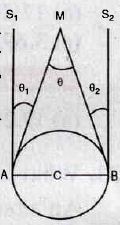
C is the centre of the Earth. A and B are two diametrically opposite places on the surface of the Earth. From A and B, the parallaxes θ1 and θ2 respectively of Moon M with respect to some distant star are determined with the help of an astronomical telescope. Thus, the total parallax of the Moon subtended on Earth.
\(\angle AMB=\theta_1+ \theta_2=\theta\)
If θ is measured in radians, then
\(\theta=\frac{A B}{A M} ; A M \approx M C \quad {\theta}=\frac{A B}{M C} \text { or } M C=\frac{A B}{\theta}\)
Knowing the values of AB and θ, we can calculate the distance MC of Moon from the Earth.
17.
Due to Earth's spinning motion, the stars in sky appear to move in circular motion about the pole star.
18.
Let the moment of inertia of the jester with his arms extended be I. As there is no external torque acting on the jester and the turn table, his total angular momentum is conserved. We can write the equation,
\(I_i \omega_i=I_f \omega_f\)
\(I \omega=\frac{1}{3} I\omega_f\) \(\because (I_f=\frac{1}{3}I)\)
\(\omega_f=3\omega\)
The above result tells that the final angular velocity is three times that of initial angular velocity.
19.
We know that speed is the magnitude of the velocity vector. Hence,
Speed of A = \(|\vec{V_A}|=\sqrt{(3)^2+(-5)^2+(2)^2}=\sqrt{9+25+4}=\sqrt{48}ms^{-1}\)
Speed of B = \(\vec{V_B}=\sqrt{(1)^2+(2)^2+(3)^2}=\sqrt{1+4+9}=\sqrt{14}ms^{-1}\)
Spedd of C = \(\vec{V_C}=\sqrt{(5)^2+(3)^2+(4)^2}=\sqrt{25+9+16}=\sqrt{50}ms^{-1}\)
The particle C has the greatest speed.
\(\sqrt{50}>\sqrt{38}>\sqrt{14}\)
20.
Total mass = 30 kg m1 = m2 = 20 kg
Mass of a third piece, m3 =Total mass - m1 and m2 = 30 kg - 20 kg
Kinetic energy of m1 and m2 = 400 J
Kinetic energy of m3 =?
\({ V }_{ 3 }=\sqrt { \frac { 2\left( { E }_{ 1 }+{ E }_{ 2 } \right) }{ \left( { m }_{ 1 }+{ m }_{ 2 } \right) } } \)
\({ V }_{ 3 }=\sqrt { \frac { 2\times 400 }{ 20 } } \)
\({ V }_{ 3 }=\sqrt { \frac { 800 }{ 20 } } \)\(=\sqrt { 40 } \)
V3 = 6.32 ms-2
Let V3 be the speed of the Kg mass
21.
(a) Coefficient of restitution
It is defined as the ratio of velocity of separation (relative velocity) after collision to the velocity of approach (relative velocity) before collision.
\(e=\frac{v_2-v_1}{u_1-u_2}\)

11th Standard Syllabus & Materials
11th Standard
TN 11th Tamil பீடு பெற நில் - செய்யுள் - காவடிச்சிந்து Important Questions And Answers Study Material - QB365 Set A
NEW11th Standard
TN 11th Tamil பீடு பெற நில் - உரைநடை - மலை இடப்பெயர்கள் : ஓர் ஆய்வு Important Questions And Answers Study Material - QB365 Set A
NEW11th Standard
TN 11th Tamil மாமழை போற்றுதும் - துணைப்பாடம் - யானை டாக்டர் Important Questions And Answers Study Material - QB365 Set A
NEW11th Standard
TN 11th Tamil மாமழை போற்றுதும் - செய்யுள் - ஐங்குறுநூறு Important Questions And Answers Study Material - QB365 Set A



Tamilnadu Stateboard 11th Standard Subjects

Maths

Commerce

Economics

Biology

Business Maths and Statistics

Accountancy

Computer Science
Physics

Chemistry
Maths
Biology
Economics
Physics
Chemistry

History
Business Maths and Statistics

Computer Science
Accountancy

Computer Applications
History
Computer Technology
Commerce
Computer Applications
Computer Technology

Tamil

English

French
Tamilnadu Stateboard Standards

