
 100% FREE ACCESS
11th Standard Syllabus & Materials
11th Standard
TN 11th Tamil இயற்கை வேளாண்மை,சுற்றுச்சூழல் -செய்யுள் - மனோன்மணீயம் Important Questions And Answers Study Material - QB365 Set A
NEW11th Standard
TN 11th Tamil என்னுயிர் என்பேன் -துணைப்பாடம் - இசைத்தமிழர் இருவர் Important Questions And Answers Study Material - QB365 Set A
NEW11th Standard
TN 11th Tamil மொழி கலை -செய்யுள் - ஒவ்வொரு புல்லையும் Important Questions And Answers Study Material - QB365 Set A
NEW11th Standard
TN 11th Tamil பீடு பெற நில் - இலக்கணம் - பகுபத உறுப்புகள் Important Questions And Answers Study Material - QB365 Set A
NEW11th Standard
TN 11th Tamil பீடு பெற நில் - துணைப்பாடம் - வாடிவாசல் Important Questions And Answers Study Material - QB365 Set A
NEW11th Standard
TN 11th Tamil பீடு பெற நில் - செய்யுள் - குறுந்தொகை Important Questions And Answers Study Material - QB365 Set A

Published on: 04/03/2019
+1 Public Exam March Model Question Paper 2019
Download Tamil Nadu 11th Standard Biology question papers, model tests, one-mark questions, important questions, and public exam papers in PDF format. Free study materials and answer keys for TN State Board students.
Questions + Answers key
Take MCQ Biology Test1.
How are meristerms classified based on function.
2.
How does ABA show Antagonistic effect?
3.
Compare the terms of andromonoecious and gynomonoecious.
4.
Plant A in a nutrient medium shows whiptail disease. Plant B in a nutrient medium shows a little leaf disease. Identify mineral deficiency of plant A and B?
5.
6.
How is rigor mortis happen?
7.
Which vessels drain filtered blood from the kidneys?
8.
Why are capillaries thin walled?
9.
Write the types of respiration seen in frog.
10.
11.
What is anadromous migration?
12.
What are nucleosomes?
13.
What is plectostele? Give example.
14.
The creation of proton gradient across the thylakoid membrane is a result of _________
Decrease in proton number in stroma
Accumulation of protons in the lumen
Decrease in pH in the lumen
All of the above
15.
Experiment with Balsam demonstrates
Translocation of solute
Plasmolysis
Transpiration pull
Ascent of Sap
16.
Calotes versicolor is a _________
House lizard
Rock lizard
Garden lizard
Flying lizard
17.
Imperfect flowers will have __________ essential whorl(s).
only 1
2
none
4
18.
The genome of viroid is ______ .
linear ssRNA
dumb-bell shaped ssRNA
circular ssRNA
linear dsRNA
19.
The term_____________________was introduced by Waldeyerin 1888.
Chromosome
Euchromatin
Heterochromatin
Nucleolus
20.
State whether the statement is true or false
To sustain themselves, earthworms must guide their way through the soil using their powerful muscles. They gather nutrients by ingesting organic matter and soil, absorbing what they need into their bodies.The two ends of the earthworm can equally ingest soil.
True
False
21.
________ is the powerful growth inhibitor
Ethanol
Cytokinins
ABA
Auxin
22.
When a leaf trace extends from a vascular bundle in a dicot stem, what would be the arrangement of vascular tissues in the veins of the leaf?
Xylem would be on top and the phloem on the bottom
Phloem would be on top and the xylem on the bottom
Xylem would encircle the phloem
Phloem would encircle the xylem
23.
Choose the correct match
Frontal lobe - Language, Reading
Parietal lobe - Visual Processing
Occipital lobe - Behaviour, Intelligence
Temporal lobe - Speech, Hearing
24.
25.
In ___________ the brood cells are of similar size and shape.
Apis dorsata
Apis adamsoni
Apis indica
Apis mellifera
26.
During inspiration, the diaphragm _____.
expands
unchanged
relaxes to become domed-shaped
contracts and flattens
27.
Identify the wrong match __________
Bowman's capsule - Glomerular filtration
DCT - Absorption of glucose
Henle's loop - Concentration of urine
PCT - Absorption of Na+ and K+ ions
28.
A living organism is differentiated from non-living structure based on _______.
Reproduction
Growth
Metabolism
All the above
29.
Curcuma amada, Curcuma domestica, Asparagus, Maranta are example of __________
Tuberous root
Beaded root
Moniliform root
Nodulose root
30.
Name the plant growth regulators?
31.
What is amber?
32.
Name anyone RNA animal virus and DNA plant virus.
33.
List the causes for conductive deafness
34.
What are the main duties of a worker bee?
35.
Identify the biological term
Excretion, glomerulus, urinary bladder, glomerular filtrate, ureters, urine, Bowman’s capsule, urinary system, reabsorption, micturition, osmosis, proteins.
a. A liquid which gathers in the bladder.
b. Produced when blood is filtered in a Bowman’s capsule.
c. Temporary storage of urine.
d. A ball of intertwined capillaries.
e. Removal of unwanted substances from the body.
f. Each contains a glomerulus.
g. Carry urine from the kidneys to the bladder.
h. Scientific term for urination.
i. Regulation of water and dissolved substances in blood and tissue fluid.
j. Consists of the kidneys, ureters and bladder.
k. Removal of useful substances from glomerular filtrate.
l. What solute the blood contains that are not present in the glomerular filtrate?
36.
How is the process of micturition altered by toilet training?
37.
Write a brief account on appendicitis.
38.
Differentiate between competitive and Allosteric
39.
Differentiate between aggregate fruit with multiple fruit.
40.
"Photosynthesis protects us from harmful ultraviolet radiation of sun" comment on the statement
41.
Define cardiac output. How can it be calculated.
42.
Describe the mechanism of photoperiodic induction of flowering.
43.
Briefly explain the structure of thyroid gland.
44.
How respiration takes place in cockroach?
45.
Explain clearly. A plant may have different names in different regions of the country or world. How do botanists solve this problem?
46.
Explain conjugation in bacteria.
1.
Protoderm, Procambium and ground meristerm
2.
1) The effect of two substances in such a way that they have opposite effects on the same process is called Antagonistic effect.
2) One accelerates and other inhibits. Example: ABA and gibberellins during seed or bud dormancy, ABA induces dormancy and gibberellins break it.
3.
1. Andromonoecious: A plant with both male flowers and bisexual flowers.
2. Gynomonoecious: A plant with both pistillate and bisexual flowers
4.
(i) Mineral deficiency of plant A is due to Molybdenum
(ii) Mineral deficiency of plant B is due to Zinc
5.
6.
The muscle contracts when the myosin shifts. The lack of ATP after death prevents it from relaxing and the muscle remains contracted. Such process occurs in all muscles and the body becomes rigid.
7.
Venules, veins of renal vein comes out of hilum of kidneys.
8.
The capillaries are thin-walled and consist of single layer of squamous epithelium. Tunica media and elastin fibres are absent.
9.
1. Cutaneous respiration: by skin
2. Lamellar or branchial respiration (young and developing tadpole):- by external and internal gills
3. Pulmonary respiration: by lungs
4. Buccopharyngeal respiration: by buccal cavity
10.
11.
1. Cyclostomes are marine but migrate to fresh waters for spawning. This is called anadromous migration.
2. After spawning they die within a few days. The larva after metamorphosis returns to the ocean.
12.
The chromatin is a gelatinous substance made of series of repeated units called nucleosomes each nucleosome has a core of 8 histone subunits.
13.
Xylem plates alternate with phloem plates. Eg: Lycopodium clavatum.
14.
(b)
Accumulation of protons in the lumen
15.
(d)
Ascent of Sap
16.
(c)
Garden lizard
17.
(a)
only 1
18.
(c)
circular ssRNA
19.
(a)
Chromosome
20.
(b)
False
21.
(c)
ABA
22.
(a)
Xylem would be on top and the phloem on the bottom
23.
(d)
Temporal lobe - Speech, Hearing
24.
(d)
25.
(a)
Apis dorsata
26.
(d)
contracts and flattens
27.
(d)
PCT - Absorption of Na+ and K+ ions
28.
(d)
All the above
29.
(d)
Nodulose root
30.
Five major groups of hormones viz., auxins, gibberellins, cytokinins, ethylene and abscisic acid are presently known to coordinate and regulate growth and development in plants.
31.
(i) Plants secrete resins for their protective benefits. Amber is a fossilized tree resin especially from the wood, which has been appreciated for its colour and natural beauty since Neolithic times.
(ii) Much valued from antiquity to the present as a gemstone, amber is made into a variety of decorative objects.
(iii) Amber is used in jewellery. It has also been used as a healing agent in folk medicine.
32.
RNA animal virus is HIV.
DNA plant virus is Cauliflower mosaic virus.
33.
Possible causes for conductive deafness may be due to
1. The blockage of ear canal with earwax.
2. Rupture of eardrum.
3. Middle ear infection with fluid accumulation.
4. Restriction of ossicular movement.
34.
(i) Worker bees are sterile females and smallest
(ii) They live in a chamber called "Worker Cell' and they perform different types of work in her life span.
(iii) During the first life span, she becomes a nurse bee attending indoor duties such as secretion of royal jelly, prepare bee bread to feed the larvae, take care of the queen and drones, secretes beeswax, builds combs, clean and fans the bee hives.
(iv) In the second life span she becomes soldier and guards the bee hive. She searches and gathers the pollen, nectar, propolis and water.
35.
(a) Urine
(b) Glomerular filtrate
(c) Urinary bladder
(d) afferent and efferent arterioles and venules of renal artery and renal vein.
(e) Excretion
(f) Bowman's capsule
(g) Ureters
(h) Micturition
(i) Balance of electrolytes minerals and organics
(j) excretory system
(k) micturition
(l) glucose, amino acid and liquids
36.
1. The process of release of urine from the urinary bladder is called micturition. It is more than a simple reflex. The control of micturition is learnt in infancy. It induces other sensory fibres in the bladder which conveys the information on fullness of bladder.
2. This information reaches the centres in thalamus and cerebral cortex of the brain via the spine.
3. The brain can sense the need to pass urine and urgency of the situation.
4. The brain centres can control the micturition, reflex by inhibiting the parasympathetic motor, fibres.
5. When convenient, the brain centre removes this control and permits micturition under conscious control.
6. Further the link between spine and cerebral cortex is developed only nearing 2 years of age. Hence toilet training is not possible in infants.
7. Therefore by training children at a young age, the micturition reflex can be brought under control.
37.
(i) Severe abdominal pain caused by the inflammation of the vermiform appendix.
(ii) Clinically appendix is removed by surgery.
(iii) If treatment is delayed the appendix may rupture and result in the infection of the abdomen called peritonitis.
38.
| S.No | Competitive Inhibitor | Allosteric inhibitor |
|---|---|---|
| 1 | Binds with active site | Binds with some other site except active site |
| 2 | Inhibitor shows very close resemblance to the substrate in structural organisation. | Inhibitor shows no resemblance to the substrate. |
| 3 | An inhibitor is not a product of metabolic pathway. | An inhibitor is a product or intermediate of metabolic pathway |
| 4 | Eg: Malonate is competitive Inhibitor for succinic dehydrogenase. | Eg: Glucose hexokinase glucose\(\rightarrow \) 6, phosphate hexokinase enzyme is inhibited by glucose 6 phosphate. |
39.
| S.No. | Aggregate fruit | Multiple fruit |
| 1 | Aggregate fruits develop from a single flower having an apocarpous pistil. Each of the free carpel develops into a simple fruitlet. A collection of simple fruitlets makes an Aggregate fruit. An individual ovary develops into a drupe, achene, follicle or berry | A Multiple or composite fruit develops from the whole inflorescence along with its peduncle on which they are borne |
| 2 | Eg: Polyalthia | Eg: Pineapple |
40.
1) Many plants use a group of chemicals called sinapate esters to defend against the sun. These aromatic compounds are found in the upper cell layers of the plant tissues and sinapoyl Malate provides bulk of the UV protection.
2) Thus when the green leaves of the plants are absorbing visible part of the spectrum for photosynthesis, the chemicals help to absorb the incident, UV radiation thus preventing the UV from affecting other living organisms. Thus photosynthesis protects us from harmful radiation of the sun.
41.
The amount of blood pumped out by each ventricle per minute is called cardiac output(CO). It is a product of heart rate (HR) and stroke volume (SV). Heart rate or pulse is the number of beats per minute.
Pulse pressure = systolic pressure - diastolic pressure.
Stroke volume (SV) is the volume of blood pumped out by one ventricle with each beat. SV depends on ventricular contraction.
CO = HR x SV
SV represents the difference between EDV (amount of blood that collects in a ventricle during diastole) and ESV (volume of blood remaining in the ventricle after contraction).
SV = EDV - ESV
42.
Photoperiodic induction
1) An appropriate photoperiod in 24 hours cycle constitutes one inductive cycle. Plants may require one or more inductive cycles for flowering.
2) The phenomenon of conversion of leaf primordia into flower primordia under the influence of suitable inductive cycles is called photoperiodic induction.
Example: Xanthium (SDP) - 1 inductive cycle and Plantago (LDP)- 25 inductive cycles.
Site of Photoinductive perception
1) Photoperiodic stimulus is perceived by the leaves.
2) Floral hormone is synthesised in leaves and translocated to the apical tip to promote flowering.
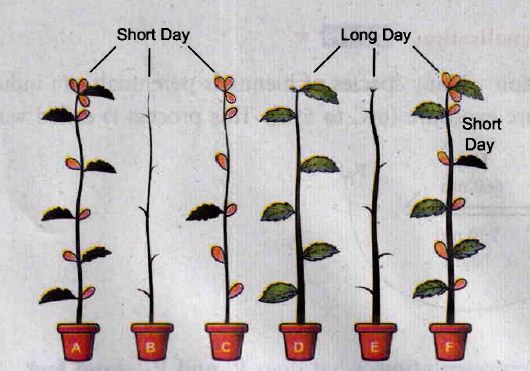
3) This can be explained by a simple experiment on Cocklebur (Xanthium pensylvanicum), a short day plant.
4) Usually Xanthium will flower under short day conditions. If the plant is defoliated and kept under short day conditions it will not flower.
5) Flowering will occur even when all the leaves are removed except one leaf.
6) If a cocklebur plant is defoliated and kept under long day conditions, it will not flower.
7) If one of its leaves is exposed to short day condition and rest are in long day condition, flowering will occur.
43.
Structure of thyroid gland:
Thyroid gland is the largest endocrine gland in the body.
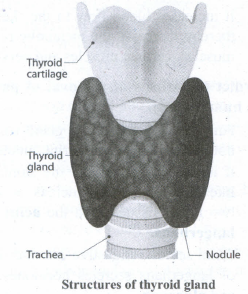
1. It is a butterfly shaped, bilobed gland located below the larynx on either side of upper trachea.
2. The two lateral lobes are connected by a median tissue mass called isthmus.
3. Each lobe is made up of many lobules. The lobules consist of follicles called acini.
4. Each acinus is lined with glandular, cuboidal or squamous epithelial cells. The lumen of acinus is filled with colloid, a thick glycoprotein mixture consisting of thyroglobulin molecules.
5. It secretes two hormones namely tri-iodothyronine [T3] and thyroxine or tetra- iodothyronine [T4].
6. The parafollicular cells or 'C' cells of thyroid gland secrete a hormone called thyrocalcitonin.
7. Iodine is essential for the normal synthesis of thyroid hormone.
8. Thyroid hormones shows a negative feedback effect on the hypothalamus and pituitary.
44.
1. The respiratory system of cockroach is well developed compared with other terrestrial insects.
2. Branched tubes known as trachea open through 10 pairs of small holes called spiracles or stigmata, present on the lateral side of the body.
3. Terminal branches of tracheal tubes are called tracheoles which carry oxygen to the entire body. The spiracles open and close by valves regulated by sphincter or spiracular muscles. Each tracheole is filled with a watery fluid through which exchange of gases takes place.
4. During high muscular activity, a part of the fluid is drawn into the tissues to enable more oxygen intake and rapid diffusion.
5. The passage of air in the tracheal system is:

45.
1. Botanists use binomial nomenclature to solve this problem.
2. A scientific name is given to the plant based on certain principles and criteria.
3. The scientific name of a particular plant is the same all over the world and is not given to any other plant.
46.
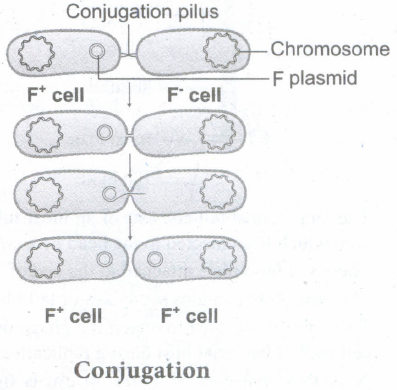
1. It is a method of sexual reproduction in bacteria. J. Lederberg and Edward L. Tatum demonstrated conjugation in E. coli in the year 1946.
2. In this method of gene transfer the donor cell gets attached to the recipient cell with the help of pili. The pilus grows in size and forms the conjugation tube.
3. The plasmid of donor cell which has the F+ (fertility factor) undergoes replication,
4. Only one strand of DNA is transferred to the recipient cell through conjugation tube.
5. The recipient completes the structure of double stranded DNA by synthesizing the strand that complements the strand acquired from the donor.

11th Standard Syllabus & Materials
11th Standard
TN 11th Tamil பீடு பெற நில் - செய்யுள் - காவடிச்சிந்து Important Questions And Answers Study Material - QB365 Set A
NEW11th Standard
TN 11th Tamil பீடு பெற நில் - உரைநடை - மலை இடப்பெயர்கள் : ஓர் ஆய்வு Important Questions And Answers Study Material - QB365 Set A
NEW11th Standard
TN 11th Tamil மாமழை போற்றுதும் - துணைப்பாடம் - யானை டாக்டர் Important Questions And Answers Study Material - QB365 Set A
NEW11th Standard
TN 11th Tamil மாமழை போற்றுதும் - செய்யுள் - ஐங்குறுநூறு Important Questions And Answers Study Material - QB365 Set A



Tamilnadu Stateboard 11th Standard Subjects

Maths

Commerce

Economics
Biology

Business Maths and Statistics

Accountancy

Computer Science

Physics

Chemistry
Maths
Biology
Economics
Physics
Chemistry

History
Business Maths and Statistics

Computer Science
Accountancy

Computer Applications
History
Computer Technology
Commerce
Computer Applications
Computer Technology

Tamil

English

French
Tamilnadu Stateboard Standards

