
 100% FREE ACCESS
11th Standard Syllabus & Materials
11th Standard
TN 11th Tamil இயற்கை வேளாண்மை,சுற்றுச்சூழல் -செய்யுள் - மனோன்மணீயம் Important Questions And Answers Study Material - QB365 Set A
NEW11th Standard
TN 11th Tamil என்னுயிர் என்பேன் -துணைப்பாடம் - இசைத்தமிழர் இருவர் Important Questions And Answers Study Material - QB365 Set A
NEW11th Standard
TN 11th Tamil மொழி கலை -செய்யுள் - ஒவ்வொரு புல்லையும் Important Questions And Answers Study Material - QB365 Set A
NEW11th Standard
TN 11th Tamil பீடு பெற நில் - இலக்கணம் - பகுபத உறுப்புகள் Important Questions And Answers Study Material - QB365 Set A
NEW11th Standard
TN 11th Tamil பீடு பெற நில் - துணைப்பாடம் - வாடிவாசல் Important Questions And Answers Study Material - QB365 Set A
NEW11th Standard
TN 11th Tamil பீடு பெற நில் - செய்யுள் - குறுந்தொகை Important Questions And Answers Study Material - QB365 Set A

Published on: 04/03/2019
Plus One Official Model Question 2019
Download Tamil Nadu 11th Standard Business Maths and Statistics question papers, model tests, one-mark questions, important questions, and public exam papers in PDF format. Free study materials and answer keys for TN State Board students.
Questions + Answers key
Take MCQ Business Maths and Statistics Test
1.
If y = A sin x + B cos x, then prove that, y2 + y = 0
2.
If nPr = 360, find n and r.
3.
A fruit grower can use two types of fertilizers in his garden, brand P and brand Q. The amounts (in Kg) of nitrogen, phosphoric acid, potash and chlorine in a bag of each brand are given in the table. Tests indicate that the garden needs atIeast 240 kgs of phosphoric acid, at least 270 kg of potash and atmost 310 kg of chlorine. If the grower wants to minimize the amount of nitrogen added to the garden, formulate the above as mathematical LPP.
4.
If f(x,y) = 3x2 + 4y3 + 6xy - x2y3 + 6. Find fyy(1,1)
5.
A limited company wants to create a fund to help their employees in critical circumstances. The estimated expenses per month is Rs. 18,000. Find the amount to be deposited by the company if the rate of compound interest is 15%.
6.
Evaluate : \(\cos\left[\frac{\pi}{3}-\cos^{-1}\left(\frac{1}{2}\right)\right]\)
7.
Find the inverse of each of the following matrices.\(\left[\begin{array}{rr} 1 & -1 \\ 2 & 3 \end{array}\right]\)
8.
Resolve into partial fractions for the following : \(\frac{4 x+1}{(x-2)(x+1)}\)
9.
The first quartile is also known as _________.
median
lower quartile
mode
third decile
10.
When an observation in the data is zero, then its geometric mean is
Negative
Positive
Zero
Cannot be calculated
11.
If X and Y are two variates, there can be atmost ________.
One regression line
two regression lines
three regression lines
more regression lines
12.
The present value of the perpetual annuity of Rs. 2000 paid monthly at 10 % compound interest is _______.
Rs. 2,40,000
Rs. 6,00,000
Rs. 20,40,000
Rs. 2,00,400
13.
What is the amount relalised on selling 8% stock 200 shares of face value Rs. 100 at Rs. 50.
Rs.16,000
Rs. 10,000
Rs. 7,000
Rs. 9,000
14.
If the values of two variables move in opposite direction then the correlation is said to be ______.
Negative
Positive
Perfect positive
No correlation
15.
Average cost is minimum when _______.
Marginal cost = Marginal revenue
Average cost = Marginal cost
Average cost = Marginal revenue
Average Revenue = Marginal cost
16.
For the cost function C =\(\frac { 1 }{ 25 } { e }^{ 5x }\), the marginal cost is _________.
\(\frac { 1 }{ 25 } \)
\(\frac { 1 }{ 5 } { e }^{ 5x }\)
\(\frac { 1 }{ 125 } { e }^{ 5x }\)
25e5x
17.
18.
Maximize: z = 3x1 + 4x2 subject to 2x1 + x2 ≤ 40, 2x1+ 5x2 ≤ 180, x1, x2 ≥ 0. In the LPP, which one of the following is feasible corner point?
x1 = 18, x2 = 24
x1 = 15, x2 = 30
x1 = 2.5, x2 = 35
x1 = 20.5, x2 = 19
19.
\(\lim _{ x\rightarrow \infty }{ \frac { \tan { \theta } }{ \theta } } =\)________.
1
\(\infty\)
\(-\infty\)
\(\theta\)
20.
If f(x) = x2 and g(x) = 2x + 1 then (fg)(0) is ________.
0
2
1
4
21.
\(\sin\left(\cos^{-1}\frac{3}{5}\right)\) is _____.
\(\frac{3}{5}\)
\(\frac{5}{3}\)
\(\frac{4}{5}\)
\(\frac{5}{4}\)
22.
The value of sec A sin(270o + A) is ______.
-1
cos2 A
sec2 A
1
23.
The distance between directrix and focus of a parabola y2 = 4ax is _______.
a
2a
4a
3a
24.
The eccentricity of the parabola is _______.
3
2
0
1
25.
26.
The value of n, when nP2 = 20 is _______.
3
6
5
4
27.
If any three rows or columns of a determinant are identical then the value of the determinant is ________.
0
2
1
3
28.
The value of x if \(\begin{vmatrix} 0 & 1 & 0 \\ x & 2 & x \\ 1 & 3 & x \end{vmatrix}=0\) is_________.
0, - 1
0, 1
- 1, 1
- 1, - 1
29.
If tanA =\(\frac{1}{7}\) and tanB =\(\frac{1}{3}\), show that cos2A = sin4B
30.
Show that the point (7, –5) lies on the circle x2 + y2 - 6x + 4y - 12 = 0 and find the coordinates of the other end of the diameter through this point.
31.
If the lines 3x - 5y - 11 = 0, 5x + 3y - 7 = 0 and x + ky = 0 are concurrent, find the value of k.
32.
Find adj A for \(A=\left[ \begin{matrix} 2 & 3 \\ 1 & 4 \end{matrix} \right] \)
33.
Solve the following LPP graphically. Maximize Z =−x1 + 2x2
Subject to the constraints −x1 + 3x2 ≤ 10, x1 + x2 ≤ 6,x1 − x2 ≤ 2 and x1,x2 ≥ 0
34.
A man wishes to pay back his depts of Rs.3783 due after 3 years by 3 equal yearly instalments. Find the amount of each instalments,money being worth 5% p.a. compounded annually
35.
Two phychologist ranked 12 candidates in the selection list as below:
| X | 1 | 2 | 3 | 4 | 5 | 6 | 7 | 8 | 9 | 10 | 11 | 12 |
| Y | 12 | 9 | 6 | 10 | 3 | 5 | 4 | 7 | 8 | 2 | 11 | 1 |
Find the rank correlation co-efficient.
36.
The following information is given
| Details | X(in Rs.) | Y(in Rs.) |
| Arithmetic Mean | 6 | 8 |
| Standard Deviation | 5 | \(\frac{40}{3}\) |
Coefficient of correlation between X and Y is \(\frac{8}{15}\) . Find (i) The regression Coefficient of Y on X (ii) The most likely value of Y when X = Rs.100.
37.
A man travelled by car for 3 days. He covered 480 km each day. On the first day he drove for 10 hours at 48 km an hour. On the second day, he drove for 12 hours at 40 km an hour and for the last day he drove for 15 hours at 32 km. What is his average speed?
38.
The total cost of x units of output of a firm is given by c = \(\frac { 2 }{ 3 } x+\frac { 35 }{ 2 } \) find the
(i) cost, when output is 4 units
(ii) average cost, when output is 10 units
(iii) marginal cost, when output is 3 units
39.
A dietician wishes to mix two types of food F1 and F2 in such a way that the vitamin contents of the mixture contains atleast 6 units of vitamin A and 9 units of vitamin B. Food F1 costs Rs.50 per kg and F2 costs Rs 70 per kg. Food F1 contains 4 units per kg of vitamin A and 6 units per kg of vitamin B while food F2 contains 5 units per kg of vitamin A and 3 units per kg of vitamin B. Formulate the above problem as a linear programming problem to minimize the cost of mixture.
40.
Find the separate equations of the pair of lines given by 3x2 + 7xy + 2y2 + 5x + 5y + 2 = 0.
41.
Differentiate the following with respect to x. \(\sqrt { 1+{ x }^{ 2 } } \)
42.
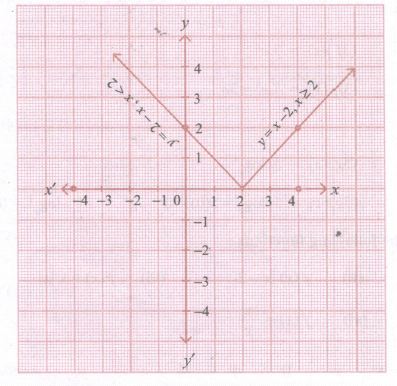
Draw the graph of the following function f(x) = |x - 2|
43.
An economy produces only coal and steel. These two commodities serve as intermediate inputs in each other’s production. 0.4 tonne of steel and 0.7 tonne of coal are needed to produce a tonne of steel. Similarly 0.1 tonne of steel and 0.6 tonne of coal are required to produce a tonne of coal. No capital inputs are needed. Do you think that the system is viable? 2 and 5 labour days are required to produce a tonnes of coal and steel respectively. If economy needs 100 tonnes of coal and 50 tonnes of steel, calculate the gross output of the two commodities and the total labour days required.
44.
The following table use the activities in a building project.
| Activity | 1-2 | 1-3 | 2-3 | 2-4 | 3-4 | 4-5 |
|---|---|---|---|---|---|---|
| Duration (days) | 21 | 26 | 11 | 13 | 5 | 11 |
Draw the network for the project, calculate the earliest start time, earliest finish time, latest start time and latest finish time of each activity and find the critical path. Compute the project duration.
45.
The demand for a quantity A is q = 16- 3PI - 2P22. Find the partial elasticities \({Eq\over EP_1}\) and \({Eq\over EP_2}\)
46.
Kamal sold Rs.9000 worth 7% stock at 80 and invested the proceeds in 15% stock at 120. Find the change in his income?
47.
Calculate the Mean deviation about median and its relative measure for the following data.
| X | 15 | 25 | 35 | 45 | 55 | 65 | 75 | 85 |
| frequency | 12 | 11 | 10 | 15 | 22 | 13 | 18 | 19 |
48.
Compute the mean deviation about mean from the following data:
| Class Interval | 0-5 | 5-10 | 10-15 | 15-20 | 20-25 |
|---|---|---|---|---|---|
| Frequency f | 3 | 5 | 12 | 6 | 4 |
49.
The demand for a commodity x is q = 5-2p1+ P2 -\({ p }_{ 1 }^{ 2 }{ p }_{ 2 }\). Find the partial elasticities \(\frac { Eq }{ { EP }_{ 1 } } \) and \(\frac { Eq }{ { EP }_{ 2 } } \) when p1= 3 and p2 = 7
50.
Calculate correlation coefficient for the following data.
| X | 25 | 18 | 21 | 24 | 27 | 30 | 36 | 39 | 42 | 48 |
| Y | 26 | 35 | 48 | 28 | 20 | 36 | 25 | 40 | 43 | 39 |
51.
Prove that cos 4x = 1 - 8 sin2x cos2x.
52.
If m parallel lines in a plane are intersected by a family of n parallel lines. Find the number of parallelogram formed?
53.
By the principle of mathematical induction, prove the following.
52n - 1 is divisible by 24, for all \(n\in N\) .
54.
If \(\sin { \theta \frac { 3 }{ 5 } } \), \(\tan { \phi } =\frac { 1 }{ 2 } \)and \(\frac { \pi }{ 2 } <\theta <\pi<\varphi <\frac { 3\pi }{ 2 } \) , then find the value of \(8\tan { \theta } -\sqrt { 5 } \sec {\varphi } \)
1.
y = A sin x + B cos x
y1 = A cos x – B sin x
y2 = –A sin x –B cos x
y2 = –y
y2 + y = 0
2.
nP r= 360 = 36 \(\times\) 10
= 3 \(\times\) 3 \(\times\) 4 \(\times\) 5 \(\times\) 2
= 6 \(\times\) 5 \(\times\) 4 \(\times\) 3 = 6P4
Therefore n = 6 and r = 4
3.
(i) Variables:
Let x1, x2 represent bags of brand P and brand Q.
(ii) Objective function:
Let Z be the amount of nitrogen. Since the amount of nitrogen is to be minimized, we have minimize Z = 3x + 3.5y
(iii) Constraints:
For Phosphoric acid,\({ x }_{ 1 }+2{ x }_{ 2 }\ge 240\)
For Potash, \({ 3x }_{ 1 }+{ 1.5x }_{ 2 }\ge 270\)
For Chlorine, \({ 1.5x }_{ 1 }+2{ x }_{ 2 }\ge 310\)
(iv) Non-negative restrictions:
Since the number of bags of brand P and Q, cannot be negative,\({ x }_{ 1 },{ x }_{ 2 }\ge 0\).
Here Mathematical form of the LPP is Minimize Z = 3x1 + 3.5x2
Subject to the constraints
\({ x }_{ 1 }+2{ x }_{ 2 }\ge 240\)
\({ 3x }_{ 1 }+{ 1.5x }_{ 2 }\ge 270\)
\( { 1.5x }_{ 1 }+2{ x }_{ 2 }\ge 310\)
and x1, x2 ≥ 0.
4.
Given f(x, y) =3x2+4y3+6xy-x2y3+6
Differentiating 'f' partially w.r.t. 'y' we get
fy(x,y) = 0+ 12y2+6x(1)-x2(3y2)+0
=12y2+ 6x - 3x2y2
Differentiating again partially w.r.t. 'y' we get,
fy(x, y) =24y + 0 - 3x2(2y) = 24y - 6x2y
\(\therefore\)fyy(1, 1)= 24(1) - 6(12)(1) = 24 - 6 = 18
5.
Here a = 18,000 ; i = 0.15 and k = 12.
P = \({\frac{a}{{i}/k}} = {\frac{18,000}{0.15/12}}\)
= \({\frac{18,000}{0.15}} \times {12}\)
\(=\frac{18,00,000\times 12}{15}=14,40,000\)
Therefore the amount to be deposited is Rs. 14,40,000.
6.
Let \(\cos^{-1}(\frac12)=\theta\)
\(\Rightarrow\frac12=\cos\theta\Rightarrow\cos=\frac{\pi}{3}\cos\theta\)
\(\Rightarrow\theta=\frac{\pi}{3}\)
\(\therefore\cos\left[\frac{\pi}{3}-\cos^{-1}(\frac{1}{2})\right]=\cos\left[\frac{\pi}{3}-\frac{\pi}{3}\right]=\cos(0)=1.\)
7.
Let \(A=\begin{bmatrix} 1&-1\\2&3 \end{bmatrix}\)
\(|A|=\begin{vmatrix} 1&-1\\2&3 \end{vmatrix}=3+2=5\) ≠ 0
\(\therefore A^{-1} \text { exists }\)
Now, \({A}^{-1}={{1}\over{|A|}}adj\ A={{1}\over{5}}\begin{bmatrix} 3 & 1 \\ -2 & 1\end{bmatrix}\)
8.
\(\frac { 4x+1 }{ (x-2)(x+1) } =\frac { A }{ x-2 } +\frac { B }{ x+1 } \)
⇒ \(\frac { 4x+1 }{ (x-2)(x+1) } =\frac { A(x+1)+B(x-2) }{ (x-2)(x+1) } \)
⇒ 4x + 1 = A(x + 1) + B(x - 2)
If x = 2
9 = A(2 + 1)
\(\Rightarrow A=\frac{9}{3}=3\)
If x = -1
-4 + 1 = B(-1 - 2)
⇒ -3 = -3B ⇒ \(\ B=1 \)
\(\frac { 4x+1 }{ (x-2)(x+1) } =\frac { 3 }{ x-2 } +\frac { 1 }{ x+1 } \)
9.
(b)
lower quartile
10.
(c)
Zero
11.
(b)
two regression lines
12.
\(P =\frac{\frac{a}{i}}{k} \)
\(=\frac{\frac{2000}{0.1}}{12}=2,40,000\)
13.
Amount = 200 x 50 = Rs. 10,000
14.
(a)
Negative
15.
(b)
Average cost = Marginal cost
16.
\(\frac{d C}{d x}=M C=\frac{5 e^{5 x}}{25}=\frac{1}{5} e^{5 x}\)
17.
(b)
18.
Since x1 = 2.5, x2 = 35 satisfies all the Constraints
19.
(a)
1
20.
(fg) (x) = 2x3 + x2 = fg (0) = 0
21.
\(\sin \left(\cos ^{-1} \frac{3}{5}\right)=\sin \left(\sin ^{-1} \frac{4}{5}\right)=4 / 5\)
22.
\(\sec A(-\cos A)=\frac{1}{\cos A}(-\cos A)=-1\)
23.
(b)
2a
24.
(d)
1
25.
(b)
26.
nP2 = 20
n(n - 1) = 5 x 4
n = 5
27.
(a)
0
28.
\(\left|\begin{array}{lll} 0 & 1 & 0 \\ x & 2 & x \\ 1 & 3 & x \end{array}\right|=0 \Rightarrow-1\left[x^2-x\right]=0\)
\(\Rightarrow x(x-1)=0 \Rightarrow x=0,1\)
29.
\(cos2A=\cfrac { 1-{ tan }^{ 2 }A }{ 1+{ tan }^{ 2 }A } =\cfrac { 1-\frac { 1 }{ 49 } }{ 1+\frac { 1 }{ 49 } } =\cfrac { 48 }{ 49 } \times \cfrac { 49 }{ 50 } \) = \(\cfrac { 24 }{ 25 } \) ..(1)
Now, sin4B = 2sin2B cos2B
\(\\ \\ \\ =2\cfrac { 2tanB }{ 1+{ tan }^{ 2 }B } \times \cfrac { 1-{ tan }^{ 2 }B }{ 1+{ tan }^{ 2 }B } \)
\( =\cfrac { 4\times \frac { 1 }{ 3 } }{ 1+\frac { 1 }{ 9 } } \times \cfrac { 1-\frac { 1 }{ 9 } }{ 1+\frac { 1 }{ 9 } } =\cfrac { 24 }{ 25 } \) ..(2)
From(1) and (2) we get, cos2A = sin4B.
30.
Let A(7, –5)
Equation of circle is
\({ x }^{ 2 }+{ y }^{ 2 }-6x+4y-12=0\)
Substitute (7, -5) for (x, y), we get
\({ x }^{ 2 }+{ y }^{ 2 }-6x+4y-12={ 7 }^{ 2 }+\left( -5 \right) ^{ 2 }-6(7)+4(-5)-12\)
= \(49+25-42-20-12=0\)
\(\therefore \left( 7,-5 \right) \) lies on the circle
Here g = –3 and f = 2
\(\therefore Centre=C\left( 3,-2 \right) \)
Let the other end of the diameter be B (x, y)
Midpoint of AB = \(\left(\frac{x+7}{2}, \frac{y-5}{2}\right)=C(3,-2)\)
\( \cfrac { x+7 }{ 2 } =3\)
\(x=-1\)
\(\cfrac { y-5 }{ 2 } =-2\)
\(y=1\)
Other end of the diameter is (–1 , 1).
31.
Given the lines are concurrent
Therefore \(\left| \begin{matrix} { a }_{ 1 } & { b }_{ 1 } & { c }_{ 1 } \\ { a }_{ 2 } & { b }_{ 2 } & { c }_{ 2 } \\ { a }_{ 3 } & { b }_{ 3 } & { c }_{ 3 } \end{matrix} \right| =0\)
\(\left| \begin{matrix} 3 & -5 & -11 \\ 5 & 3 & -7 \\ 1 & k & 0 \end{matrix} \right| =0\)
\(1(35+33)-k(-21+55)=0\)
\( \Rightarrow 34k=68\therefore k=2\)
32.
\(A=\left[ \begin{matrix} 2 & 3 \\ 1 & 4 \end{matrix} \right] \)
adj A = [Aij]T
\(=\left[ \begin{matrix} 4 & -3 \\ -1 & 2 \end{matrix} \right] \)
33.
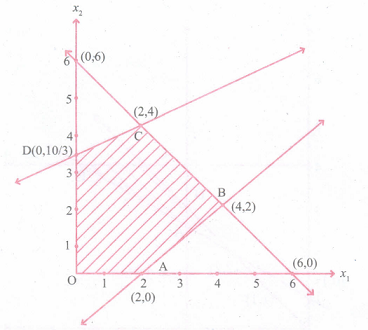
Since the decision variables x1 ,x2 are non-negative, the solution lies in the I quadrant of the plane.
Consider the equations
\(-{ x }_{ 1 }+3{ x }_{ 2 }=10\)
| \({ x }_{ 1 }\) | 0 | 2 |
|---|---|---|
| \({ x }_{ 2 }\) | 10/3 | 4 |
\({ x }_{ 1 }+{ x }_{ 2 }=6\)
| \({ x }_{ 1 }\) | 0 | 6 |
|---|---|---|
| \({ x }_{ 2 }\) | 6 | 6 |
\({ x }_{ 1 }{ -x }_{ 2 }=2\)
| \({ x }_{ 1 }\) | 4 | 2 |
|---|---|---|
| \({ x }_{ 2 }\) | 2 | 0 |
The feasible region is OABCD and its co-ordinates are O(0, 0)A(2, 0) B(4, 2) C(2, 4) and D(0, 10/3)
| Corner Points | \(Z=-{ x }_{ 1 }+2{ x }_{ 2 }\) |
|---|---|
| 0(0,0) | 0 |
| A(2, 0) | -2 |
| B (4, 2) | 0 |
| C(2,4) | 6 |
| D\(\left( 0,\frac { 10 }{ 3 } \right) \) | \(\frac { 20 }{ 3 } \) |
Maximum of Z occurs at\(D\left( 0,\frac { 10 }{ 3 } \right) \). Hence, the solution is \({ x }_{ 1 }=0,{ x }_{ 2 }=\frac { 10 }{ 3 } \quad and\quad { Z }_{ max }=\frac { 20 }{ 3 } \)
34.
Given A = Rs.3783,i = 0.05,n = 3
A = \(\cfrac { a }{ i } \left[ \left( 1+i \right) ^{ n }-1 \right] \)
3783 = \(\cfrac { a }{ i } \) [(1.05)3-1]
3783 x 0.05 = a[1.1576-1]
a = \(\cfrac { 189.15 }{ 0.1576 } \) = 1200.19
\(\therefore\) a =Rs.1200
(1.05)3 = 3 log (1.05)
= 3(0.212)
= 0.636
Antilog of 0.636 is 1.1576
35.
| RX | RY | d=RX-RY | d2 |
| 1 | 12 | -11 | 121 |
| 2 | 9 | -7 | 49 |
| 3 | 6 | -3 | 9 |
| 4 | 10 | -6 | 36 |
| 5 | 3 | 2 | 4 |
| 6 | 5 | 1 | 1 |
| 7 | 4 | 3 | 9 |
| 8 | 7 | 1 | 1 |
| 9 | 8 | 1 | 1 |
| 10 | 2 | 8 | 64 |
| 11 | 11 | 0 | 0 |
| 12 | 1 | 11 | 121 |
| \(\sum\)d2=416 |
n=12
Rank correlation co-efficient
\(\rho =1-\frac { 6\sum { { d }^{ 2 } } }{ N({ N }^{ 2 }-1) } \)
=1-\(\frac { 6\times 416 }{ 12({ 12 }^{ 2 }-1) } =1-\frac { 16 }{ 11 } =\frac { -5 }{ 11 } \)
\(\rho\)=-0.45
36.
\(\bar{X}\) = 6, \(\bar{Y}\) = 8, \(\sigma _x=5\)
\(\sigma_y=\frac{40}{3}, \quad r=\frac{8}{15} \)
\(b_{y x}=r \frac{\sigma_x}{\sigma_y}=\frac{8}{15}\left(\frac{40}{3 \times 5}\right)=\frac{64}{45}=1.422\)
Regression line of Y on X is
\(Y-\bar{Y}=b_{y x}(X-\bar{X}) \)
Y - 8 = 1.422(X - 6)
Y = 1.422 X - 8.532 + 8
Y = 1.422 X - 0.532 .
If X = Rs 100,
Y = 142.2 - 0.532 = Rs 141.67
37.
| x | f | f/x |
|---|---|---|
| 48 | 10 | 0.2083 |
| 40 | 12 | 0.3 |
| 32 | 15 | 0.4688 |
| N = 37 | \(\sum { \left( \frac { f }{ x } \right) }=\) 0.9771 |
HM = \(\frac { N }{ \sum { \left( \frac { f }{ x } \right) } } =\frac { 37 }{ 0.9771 } \) = 37.86 km/hr
38.
C = \(\frac { 2 }{ 3 } x+\frac { 35 }{ 2 } \)
(i) At x = 4 units,
\(c=\frac{8}{3}+\frac{35}{2}=\frac{16+105}{6} = Rs.\frac { 121 }{ 6 } \)
(ii) A.C. = Average cost \(=\frac{C}{x}=\frac{2}{3}+\frac{35}{2 x}\)
At x = 10
A.C \(=\frac{2}{3}+\frac{35}{20}=\frac{40+105}{60}=\frac{29}{12}\)
(iii) Marginal cost = M.C \(=\frac{d C}{d x}=\frac{2}{3}\)
At x = 3,
M.C \(= \frac{2}{3}\)
39.
(i) Variables: Let the mixture contains x1 kg of food F1 and x2 kg of food F2
(ii) Objective function: Cost of x1 kg of food F1 = 50 x1
Cost of x2 kg of food F2 = 70x2
The cost is to be minimized
Therefore minimize Z = 50 x1 + 70x2
(iii) Constraints:
We make the following table from the given data
| Resources | Food (in kg) | Requirement | |
| F1(x1) | F2(x2) | ||
| Vitamin A (units/kg) | 4 | 5 | 6 |
| Vitamin B (units/kg) | 6 | 3 | 9 |
| Cost (Rs/kg) | 50 | 70 | |
4x1 + 5x2 ≥ 6 (since the mixture contains ‘atleast 6’ units of vitamin A, we have the inequality of the type ≥ )
6x1 + 3x2 ≥ 9 (since the mixture contains ‘atleast 9’ units of vitamin B, we have the inequality of the type ≥ )
(iv) Non-negative restrictions:
Since the number of kgs of vitamin A and vitamin B are non-negative, we have x1, x2 ≥ 0
Thus, we have the following linear programming model
Minimize Z = 50x1 + 70x2 subject to 4x1+ 5x2 ≥ 6
6x1 + 3x2 ≥ 9 and x1, x2 ≥ 0
40.
Given equation is
3x2 + 7xy + 2y2 + 5x + 5y + 2 = 0
Factorising 3x2 + 7xy + 2y2 = (x + 2y) (3x + y)
\(\therefore \) 3x2 + 7xy + 2y2 + 5x + 5y + 2 = (x + 2y + l)(3x + y + m)
Equating the x and y Co-ordinates both sides,
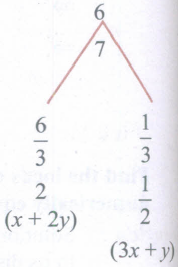
We get 5 = m + 3l ...(1)
5 = 2m + l ....(2)
| (1) \(\times\) (2) \(\rightarrow \) 10 | = 2m + 6l |
| (2) \(\rightarrow \) 5 | = 2m + 1l |
| 5 | = 0 + l \(\Rightarrow \) l = 1 |
Substituting l = 1 in (2) we get,
5 = 2m + 1 \(\Rightarrow \) 2m = 4 \(\Rightarrow \) m = 2.
Hence the separate equations are
x + 2y + 1 = 0 and 3x + y + 2 = 0.
41.
y = \(\sqrt { 1+{ x }^{ 2 } } =(1+{ x }^{ 2 })^{ \frac { 1 }{ 2 } }\)
\(\frac{d y}{d x}=\left(1+x^2\right)^{\frac{1}{2}}=\frac{1}{2}\left(1+x^2\right)^{\frac{1}{2}-1}\)
\(=\frac{1}{2 \sqrt{1+x^2}}(2 x)=\frac{x}{\sqrt{1+x^2}}\)
42.
f(x) = |x - 2|
y = x2 if x ≥ 0
= 2 - x if x ≥ 2
| x | -3 | -1 | 0 | 1 | 2 | 3 |
| y | 5 | 3 | 2 | 1 | 0 | 1 |
43.
Here the technology matrix is given under
| Steel | Coal | Final demand | |
| Steel | 0.4 | 0.1 | 50 |
| Coal | 0.7 | 0.6 | 100 |
| Labour days | 5 | 2 | - |
The technology matrix is B = \(\left[ \begin{matrix} 0.4 & 0.1 \\ 0.7 & 0.6 \end{matrix} \right] \)
I - B = \(\left[ \begin{matrix} 1 & 0 \\ 0 & 1 \end{matrix} \right] \)- \(\left[ \begin{matrix} 0.4 & 0.1 \\ 0.7 & 0.6 \end{matrix} \right] \) = \(\left[ \begin{matrix} 0.6 & -0.1 \\ -0.7 & 0.4 \end{matrix} \right] \)
|I - B| = \(\left| \begin{matrix} 0.6 & -0.1 \\ -0.7 & 0.4 \end{matrix} \right|\)
= (0.6)(0.4) – (–0.7)(–0.1)
= 0.24 – 0.07 = 0.17
Since the diagonal elements of I – B are positive and value of |I-B| is positive, the system is viable.
adj(I - B) = \(\left[ \begin{matrix} 0.4 & 0.1 \\ 0.7 & 0.6 \end{matrix} \right] \)
(I - B)-1 = \(\frac{1}{|I -B |} \)adj(I - B)
= \(\frac{1}{0.17} \) \(\left[ \begin{matrix} 0.4 & 0.1 \\ 0.7 & 0.6 \end{matrix} \right] \)
X = (I – B)–1D, where D =\(\left[ \begin{matrix} 50 \\ 100 \end{matrix} \right] \)
= \(\frac{1}{0.17} \)\(\left[ \begin{matrix} 0.4 & 0.1 \\ 0.7 & 0.6 \end{matrix} \right] \)\(\left[ \begin{matrix} 50 \\ 100 \end{matrix} \right] \)
= \(\frac{1}{0.17} \)\(\left[ \begin{matrix} 30 \\ 95 \end{matrix} \right] \)
= \(\left[ \begin{matrix} 176.5 \\ 558.8 \end{matrix} \right] \)
Steel output = 176.5 tonnes
Coal output = 558.8 tonnes
Total labour days required
= 5(steel output) + 2( coal output)
= 5(176.5) + 2(558.8)
= 882.5 + 1117.6 = 2000.1
\(\simeq\) 2000 labour days.
44.
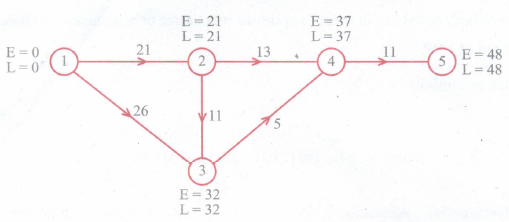
| E1= 0 | L5= 48 |
| E2= 0+21=21 | L4= 48 -11 = 37 |
| E3 =(21 + 11) or (0 + 26) Whichever is maximum =32 |
L3= 37 - 5 = 32 |
| E4= (32 + 5) or (21 + 13) =Whichever is maximum = 37 |
L2= (37 - 13) or (32 - 11) Whichever is minimum =21 |
| E5=37 + 11 = 48 | L1=(21 - 21) or (32 - 26) Whichever is minimum = 0 |
| Activity | Duration | EST | EFT = EST + tij | EFT = EST - tij | LFT |
|---|---|---|---|---|---|
| 1-2 | 21 | 0 | 21 | 21-21=0 | 21 |
| 1-3 | 26 | 0 | 26 | 32-26=6 | 32 |
| 2-3 | 11 | 21 | 32 | 32-11=21 | 32 |
| 2-4 | 13 | 21 | 34 | 37-13=24 | 37 |
| 3-4 | 5 | 32 | 37 | 37-5=32 | 37 |
| 4-5 | 11 | 37 | 48 | 48-11=37 | 48 |
EFT and LFT are same in the activities.
1 - 2, 2 - 3, 3 - 4 and 4 - 5
Hence, the critical path is 1 - 2 - 3 - 4 - 5 and the duration of project completion is 48 days .
45.
Given q = 16 -3P1 - 2P22
Differentiating partially w.r.t, 'P1' and 'P2' we get,
\({\partial q\over \partial p_1}=-3\ and\ {\partial q\over \partial p_2}=-4p_2\)
Partial elasticities
\({Eq\over Ep_1}={-p_1\over q}{\partial q\over \partial p_2}\)
\(={-p_1\over 16-3p_1-2p_2^2}(-3)\)
\(={3p_1\over 16-3p_1-2p_2^2}\)
and \({Eq\over Ep_2}=-{p_2\over q}{\partial q\over \partial p_2}={-p_2\over 16-3p_1-3p_2^2}(-4p_2)\)
\(={4p_2^2\over 16-{ 3p }_{ 1 }-2p_2^2}\)
46.
Stock = Rs.9000
FV =Rs.100
Dividend Rate = 7%
Income on 7% stock =\(\frac { \text {stock} }{ 100 } \)x FV x Rate percentage
=\(\frac { 9000 }{ 100 } \times 100\times \frac { 7 }{ 100 } \) = Rs.630 ...(1)
Cost of price of one share = 80
Sale proceeds = \(\frac { \text {stock} }{ 100 } \) x Cost Price
=\(\cfrac { 9000 }{ 100 } \)x 80 =7200
Investment = Rs.7200
Market Price = Rs.120
Dividend Rate =15%
Income =\(\frac {\text { Investment} }{ \text {Market Price } }\)x Dividend Rate
=\(\frac { 7200 }{ 120 } \)x15=Rs.900 .....(2)
Change in income = 930 - 630 = Rs.270
47.
Already the values are arranged in ascending order then Median is obtained by the following.
| X | f | cf |
| 15 | 12 | 12 |
| 25 | 11 | 23 |
| 35 | 10 | 33 |
| 45 | 15 | 48 |
| 55 | 22 | 70 |
| 65 | 13 | 83 |
| 75 | 18 | 101 |
| 85 | 19 | 120 |
| N = 120 |
Median = size of \(\left( \frac { (n+1) }{ 2 } \right) ^{ th }\)value
= size of \(\left( \frac { (120+1) }{ 2 } \right) ^{ th }\) value
= size of 60.5th item = 55
MD about Median = \(\frac { \Sigma f|X-Median| }{ N } =\frac { \Sigma f|D| }{ N } \)
Mean deviation about Median
| X | f | |D|=|X-55| | f|D| |
| 15 | 12 | 40 | 480 |
| 25 | 11 | 30 | 330 |
| 35 | 10 | 20 | 200 |
| 45 | 15 | 10 | 150 |
| 55 | 22 | 0 | 0 |
| 65 | 13 | 10 | 130 |
| 75 | 18 | 20 | 360 |
| 85 | 19 | 30 | 570 |
| N = 120 | Σf|D| = 2220 |
MD about Median = \(\frac { 2220 }{ 120 } \) = 18.5
Coefficient of mean deviation about median = \(\frac { MD \ about \ Median }{ Median } \)
= \(\frac { 18.5}{ 55 } \) = 0.34
48.
| C.I | x | f | fx | |D| = |X-13| | f|D| |
|---|---|---|---|---|---|
| 0-5 | 2.5 | 3 | 7.5 | 10.5 | 31.5 |
| 5-10 | 7.5 | 5 | 37.5 | 5.5 | 27.5 |
| 10-15 | 12.5 | 12 | 150 | 0.5 | 6 |
| 15-20 | 17.5 | 6 | 105 | 4.5 | 27 |
| 20-25 | 22.5 | 4 | 90 | 9.5 | 38 |
| \(\Sigma f= \) 30 | \(\Sigma fx= \) 390 | \(\Sigma f|D|= \) 130 |
\(\overline { X } =\frac { \sum { fx } }{ \sum f } =\frac { 390 }{ 30 } =13\)
Mean deviation about mean = \(\frac { \sum { f|D| } }{ \sum f } =\frac { 130 }{ 30 } =4.34\)
49.
\(\frac { \partial p }{ \partial { P }_{ 1 } } =2-{ p }_{ 1 }{ p }_{ 2 }\)
\(\frac { \partial p }{ \partial { P }_{ 2 } } =1-{ p }_{ 1 }^{ 2 }\)
(i) \(\frac { Eq }{ { EP }_{ 1 } } =\frac { { p }_{ 1 } }{ q } \frac { \partial p }{ \partial { P }_{ 1 } } =\frac { -p }{ 5-2{ p }_{ 1 }+{ p }_{ 2 }-{ p }_{ 1 }^{ 2 }{ p }_{ 2 } } (-2-{ p }_{ 1 }{ p }_{ 2 })\)
= \(\frac { { 2p }_{ 1 }+2{ p }_{ 1 }^{ 2 }{ p }_{ 2 } }{ 5-2{ p }_{ 1 }+{ p }_{ 2 }-{ p }_{ 1 }^{ 2 }{ p }_{ 2 } } \)
when p1 = 3 and p2 = 7
\(\frac { { E }q }{ { Ep_{ 1 } } } =\frac { 2(3)+2(9)(7) }{ 5-6+7-(9)(7) } =\frac { 132 }{ -57 } =\frac { -132 }{ 57 } \)
\(\frac { Eq }{ { EP }_{ 1 } } =\frac { { p }_{ 2 } }{ q } \frac { \partial p }{ \partial { P }_{ 2 } } =\frac { -p\left( 1-{ p }_{ 1 }^{ 2 } \right) }{ 5-2{ p }_{ 1 }+{ p }_{ 2 }-{ p }_{ 1 }^{ 2 }{ p }_{ 2 } } \)
\(\frac { { -p }_{ 2 }+{ p }_{ 2 }{ p }_{ 1 }^{ 2 } }{ 5-2{ p }_{ 1 }+{ p }_{ 2 }-{ p }_{ 1 }^{ 2 }{ p }_{ 2 } } \)
when p1 - 3 and p2 = 7
\(\frac { { E }q }{ { Ep_{ 2 } } } =\frac { -7+7(9) }{ 5-6+7-(9)(7) } =\frac { 56 }{ -57 } =\frac { -56 }{ 57 } \)
50.
| X | Y | x2 | y2 | xy |
| 25 | 26 | 625 | 676 | 650 |
| 18 | 35 | 324 | 1225 | 630 |
| 21 | 48 | 441 | 2304 | 1008 |
| 24 | 28 | 576 | 784 | 672 |
| 27 | 20 | 729 | 400 | 540 |
| 30 | 36 | 900 | 1296 | 1080 |
| 36 | 25 | 1296 | 625 | 900 |
| 39 | 40 | 1521 | 1600 | 1560 |
| 42 | 43 | 1764 | 1849 | 1806 |
| 48 | 39 | 2304 | 1521 | 1872 |
| \(\sum\)X = 310 | \(\sum\)Y = 340 | \(\sum\)X2 = 10480 | \(\sum\)Y2 = 12280 | \(\sum\)XY = 10718 |
\(r(x, y)=\frac{N \Sigma X Y-\left(\sum X\right)\left(\sum Y\right)}{\sqrt{N \Sigma X^2-(\Sigma Y)^2} \sqrt{N \Sigma Y^2-(\Sigma Y)^2}} \)
\(=\frac{10(10718)-(310)(340)}{\sqrt{10(10480)-(310)^2} \sqrt{10(12280)-(340)^2}} \)
\(=\frac{107180-105400}{\sqrt{104800-96100} \sqrt{122800-115600}} \)
\(=\frac{1780}{\sqrt{8700 \times 7200}}=\frac{1780}{7914.54}=0.2249\)
51.
LHS = cos 4x = cos 2(2x)
= 2 cos22x-1 [∴ cos 2A = 2cos2A - 1]
= 2 [2 cos2x - 1]2 - 1 = 2 [4 cos4x - 4cos2x + 1] - 1
= 8 cos4x - 8 cos2x + 2 - 1 = 1 - 8 cos2x + 8 cos4x
= 1 - 8 cos2x (1 - cos2x) = 1 - 8 cos2x . sin2x = RHS.
52.
A parallelogram is formed by choosing two straight lines from the set of m parallel lines and two straight lines from the set of n parallel lines. Two straight lines from the set of m parallel lines can be chosen in mC2 ways and Two straight lines from the set of n parallel lines can be chosen in nC2 ways
Hence, the number of parallelograms formed\(\Rightarrow\)mC2\(\times \)nC2\(=\frac { m(m-1) }{ 2\times 1 } \times \frac { n(n-1) }{ 2\times 1 } =\frac { mn(m-1)(n-1) }{ 4 } \)
53.
Let P(n) denote the statement 52n - 1 is divisible by 24.
Step-1: Put n = 1
52(1) - 1 = 25 - 1 = 24 is divisible by 24
∴ P(1) is true.
Step-2:
Let us assume that P(k) is true
∴ 52k - 1 is divisible by 24.
⇒ 52k - 1 = 24m
⇒ 52k = 24m + 1 ...(1)
To prove that P(k + 1) is true
P(k + 1) = 52(k+1) - 1
= 52k+2 - 1 = 52k.52 - 1
= (24m + 1)25 - 1
= 24m. 25 + 25 - 1
= 24m + 25 - 24
= 24(25m + 1)
Which is divisible by 24
∴ P (k + 1) is true whenever P(k) is true.
∴ P(n) is true for all \(n\in N\).
54.
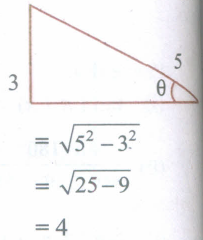
Given \(\sin { \theta = \frac { 3 }{ 5 } } \) and \(\frac { \pi }{ 2 } <\theta <\pi \)
\(\therefore\) \(\theta\) is in II quadrant, only sin and its reciprocal is positive
\(\cos { \theta } =\frac { adj }{ hyp } =-\frac { 4 }{ 5 } ,\tan { \theta } =\frac { -3 }{ 4 } \quad .....(1)\)
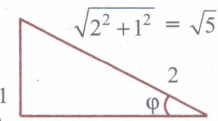
Also \(\tan { \varphi } =\frac { 1 }{ 2 } \) and \(\pi <\varphi <\frac { 3\pi }{ 2 } \)
\(\therefore\) \(\phi \) is in III quadrants, tan \(\varphi \) and its reciprocal alone are positive.
\(\therefore \quad \sec { \phi } =\frac { hyp }{ adj } =-\frac { \sqrt { 5 } }{ 2 } \)...(2)
\(8\tan { \theta } -\sqrt { 5 } \sec { \phi } \)
\(=8\left( \frac { -3 }{ 4 } \right) -\sqrt { 5 } \left( -\frac { \sqrt { 5 } }{ 2 } \right) \) [using (1) and (2)]
\(=+2(-3)+\frac { 5 }{ 2 } =-6+\frac { 5 }{ 2 } \)
\(=\frac { -12+5 }{ 2 } =\frac { -7 }{ 2 } \)
Hence Proved.

11th Standard Syllabus & Materials
11th Standard
TN 11th Tamil பீடு பெற நில் - செய்யுள் - காவடிச்சிந்து Important Questions And Answers Study Material - QB365 Set A
NEW11th Standard
TN 11th Tamil பீடு பெற நில் - உரைநடை - மலை இடப்பெயர்கள் : ஓர் ஆய்வு Important Questions And Answers Study Material - QB365 Set A
NEW11th Standard
TN 11th Tamil மாமழை போற்றுதும் - துணைப்பாடம் - யானை டாக்டர் Important Questions And Answers Study Material - QB365 Set A
NEW11th Standard
TN 11th Tamil மாமழை போற்றுதும் - செய்யுள் - ஐங்குறுநூறு Important Questions And Answers Study Material - QB365 Set A



Tamilnadu Stateboard 11th Standard Subjects

Maths

Commerce

Economics

Biology
Business Maths and Statistics

Accountancy

Computer Science

Physics

Chemistry
Maths
Biology
Economics
Physics
Chemistry

History
Business Maths and Statistics

Computer Science
Accountancy

Computer Applications
History
Computer Technology
Commerce
Computer Applications
Computer Technology

Tamil

English

French
Tamilnadu Stateboard Standards
