
 100% FREE ACCESS
11th Standard Syllabus & Materials
11th Standard
TN 11th Tamil இயற்கை வேளாண்மை,சுற்றுச்சூழல் -செய்யுள் - மனோன்மணீயம் Important Questions And Answers Study Material - QB365 Set A
NEW11th Standard
TN 11th Tamil என்னுயிர் என்பேன் -துணைப்பாடம் - இசைத்தமிழர் இருவர் Important Questions And Answers Study Material - QB365 Set A
NEW11th Standard
TN 11th Tamil மொழி கலை -செய்யுள் - ஒவ்வொரு புல்லையும் Important Questions And Answers Study Material - QB365 Set A
NEW11th Standard
TN 11th Tamil பீடு பெற நில் - இலக்கணம் - பகுபத உறுப்புகள் Important Questions And Answers Study Material - QB365 Set A
NEW11th Standard
TN 11th Tamil பீடு பெற நில் - துணைப்பாடம் - வாடிவாசல் Important Questions And Answers Study Material - QB365 Set A
NEW11th Standard
TN 11th Tamil பீடு பெற நில் - செய்யுள் - குறுந்தொகை Important Questions And Answers Study Material - QB365 Set A

Published on: 04/03/2019
Plus One Official Public Model Question 2019
Download Tamil Nadu 11th Standard Chemistry question papers, model tests, one-mark questions, important questions, and public exam papers in PDF format. Free study materials and answer keys for TN State Board students.
Questions + Answers key
Take MCQ Chemistry Test
1.
___________is used in fire extinguishers
CCl2 = CCl2
CHCl = CCl2
CH2 = CCl2
CCl4
2.
The molecule that has linear structure is ___________
CO2
NO2
SO2
SiO2
3.
Which of the following is the most reactive towards electrophilic substitution reaction?
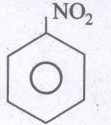
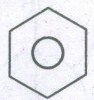
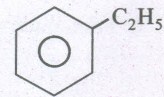
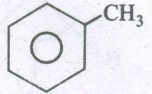
4.
Two moles of N2 and two moles of H2 are taken in a closed vessel of 5 litre capacity and suitable conditions are provided for the reaction. When the equilibrium is reached, it is found that a half mole of N2 is used up. The equilibrium concentration of NH3 is
0.2
0.4
0.3.
0.1
5.
Identify the wrong statement in the following __________.
The clean water would have a BOD value of more than 5 ppm
Greenhouse effect is also called as Global warming
Minute solid particles in air is known as particulate pollutants
Biosphere is the protective blanket of gases surrounding the earth
6.
-I effect is shown by ____________.
-Cl
-Br
both (a) and (b)
-CH3
7.
The general formula for alkadiene is ____________
CnH2n
CnH2n-1
CnH2n-2
CnHn-2
8.
Normality of 1.25M sulphuric acid is ___________
1.25 N
3.75 N
2.5 N
2.25 N
9.
Match the list I with list II and select the correct answer using the code given below the list.
| List I | List II | ||
| A | Ionisation energy | 1 | ionic compound |
| B | electro negativity | 2 | alloys |
| C | s-block elements | 3 | KJ mol-1 |
| D | d-block elements | 4 | No unit |
| A | B | C | D |
| 1 | 2 | 3 | 4 |
| A | B | C | D |
| 3 | 2 | 1 | 4 |
| A | B | C | D |
| 2 | 3 | 1 | 4 |
| A | B | C | D |
| 3 | 4 | 1 | 2 |
10.
Given that C(g)+ O2(g) ⟶ CO2(g)ΔHo =-akJ; 2CO(g)+O2(g) ⟶ 2CO2(g)ΔHo = -bkJ; Calculate the AHo for the reaction C(g)+ 1/2O2(g) ⟶ CO(g) ______________
\(\frac{b+2a}{2}\)
2a-b
\(\frac{2a-b}{2}\)
\(\frac{b-2a}{2}\)
11.
The change in the oxidation number of S in H2S and SO2,in the following industrial reaction:
2H2S(g) + SO2(g) \(\longrightarrow\) 3S(s) + H2O(g)
-2 to 0, +4 to 0
-2 to 0, +4 to -1
-2 to -1, +4 to 0
-2 to -1, +4 to -2
12.
25g of each of the following gases are taken at 27°C and 600 mm Hg pressure. Which of these will have the least volume?
HBr
HCI
HF
HI
13.
Time independent Schrodinger wave equation is ______________
\(\overset { \wedge }{ H } \psi =E\psi \)
\({ \triangledown }^{ 2 }\psi +\frac { 8{ \pi }^{ 2 }m }{ { h }^{ 2 } } (E+V)\psi =0\)
\(\frac { { \partial }^{ 2 }\psi }{ { \partial x }^{ 2 } } +\frac { { \partial }^{ 2 }\psi }{ { \partial y }^{ 2 } } +\frac { { \partial }^{ 2 }\psi }{ { \partial z }^{ 2 } } +\frac { { 2m } }{ { h }^{ 2 } } (E-V)\Psi =0\)
All of these
14.
A colourless solid substance (A) on heating evolved CO2 and also gave a white residue, soluble in water. Residue also gave CO2 when treated with dilute HCI ___________
Na2CO3
NaHCO3
CaCO3
Ca(HCO3)2
15.
The reaction H3PO2 + D2O ➝ H2DPO2 + HDO indicates that hypo-phosphorus acid is _____________
tribasic acid
dibasic acid
mono basic acid
none of these
16.
How would you estimate the percentage of carbon and hydrogen in an organic compound?
17.
How will you convert t-butyl bromide into t-butyl alcohol? Explain the process through the mechanism in stepwise manner.
18.
Calculate the percentage composition of the elements present in magnesium carbonate. How many Kg of CO2 can be obtained from 100 Kg of is 90% pure magnesium carbonate.
19.
In an experiment of verification of Charle's law, the following are the set of readings taken by a student.
| Experiment | Volume (L) | Temperature (0C) |
|---|---|---|
| 1 | 1.54 | 20 |
| 2 | 1.65 | 40 |
| 3 | 1.95 | 100 |
| 4 | 2.07 | 120 |
What is the average value of the constant of proportionality ?
20.
Explain how heat absorbed at constant volume is measured using bomb calorimeter with a neat diagram.
21.
Conc. H2SO4 cannot be used for drying hydrogen gas. Why?
22.
23.
What is the empirical formula of the following?
i) Fructose (C6 H12 O6) Found in honey
ii) Caffeine (C8 H10 N4 O2) a substance found in tea and Coffee
24.
Why the first ionisation enthalpy of sodium is lower than that of magnesium while its second ionisation enthalpy is higher than that of magnesium.
25.
Which among the following hybrid orbitals are highly electronegative? sp, sp2 , sp3 .
26.
Write a note on the following reactions.
(i) Dehydration of ethanol
(ii) Electrolysis of potassium succinate
(iii) Chlorination of ethene
27.
On the basis of chemical reactions involved, explain how do CFC’s cause depletion of ozone layer in stratosphere ?
28.
Deduce the Vant Hoff equation.
29.
1 mol of PCl5, kept in a closed container of volume 1 dm3 and was allowed to attain equilibrium at 423 K. Calculate the equilibrium composition of reaction mixture. (The Kc value for PCl5 dissociation at 423 K is 2)
30.
Which of the following pairs of elements would have more negative electron gain enthalpy?
(i) O or F
(ii) For Cl.
31.
Define the following terms.
32.
What is water-gas shift reaction?
33.
Consider the molecules NH2-, NH3, NH4+. Arrange them in the decreasing order of bond angles and give reason for your arrangement.
34.
Identify the electrophilic centre in the following compound & CH3 - CH = O, CH3CN, CH3I.
35.
How does classical smog differ from photochemical smog ?
36.
37.
What is meant by a functional group ? Identify the functional group in the following compounds.
Acetaldehyde
38.
0.2 m aqueous solution of KCl freezes at -0.68ºC calculate van’t Hoff factor. kf for water is 1.86 K kg mol-1.
39.
If 10 volumes of H2 gas react with 5 volumes of O2 gas, how many volumes of water vapour would be produced?
40.
Show by chemical reaction, with water, that Na2O is a basic oxide and Cl2O7 is an acidic oxide
41.
State Avogadro's hypothesis.
42.
Which quantum number reveal information about the shape, energy, orientation and size of orbitals?
1.
(d)
CCl4
2.
(a)
CO2
3.
(d)
4.
(a)
0.2
5.
(a)
The clean water would have a BOD value of more than 5 ppm
6.
(c)
both (a) and (b)
7.
(c)
CnH2n-2
8.
(c)
2.5 N
9.
(d)
| A | B | C | D |
| 3 | 4 | 1 | 2 |
10.
(d)
\(\frac{b-2a}{2}\)
11.
(a)
-2 to 0, +4 to 0
12.
(d)
HI
13.
(a)
\(\overset { \wedge }{ H } \psi =E\psi \)
14.
(b)
NaHCO3
15.
(c)
mono basic acid
16.
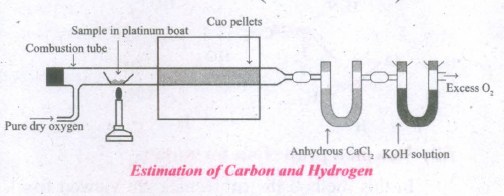
Both carbon and hydrogen are estimated by the same method. A known weight of the organic substance is burnt in excess of oxygen and the carbon and hydrogen present in it are oxidized to carbon dioxide and water, respectively.
The weight of carbon dioxide and water thus formed are determined and the amount of carbon and hydrogen in the organic substance is calculated. The apparatus employed for the purpose consists of three units
(1) oxygen supply
(2) combustion tube
(3) absorption apparatus.
(1) Oxygen supply: To remove the moisture from oxygen it is allowed to bubble through sulphuric acid and then passed through aV-tube containing soda lime to remove CO2. The oxygen gas free from moisture and carbondioxide enters the combustion tube.
(2) Combustion tube: A hard glass tube open at both ends is used for the combustion of the organic substance. It contains (i) an oxidized copper gauze to prevent the backward diffusion of the products of combustion (ii) a porcelain
boat containing a known weight of the organic substance (iii) coarse copper oxide on either side and (iv) an oxidized copper gauze placed towards the end of the combustion tube. The combustion tube is heated by a gas burner.
(3) Absorption Apparatus: The combustion products containing moisture and carbondioxide are then passed through the absorption apparatus which consists of (i) a weighed U'-tube packed with pumice soaked- in cone. H2SO4 to absorb water (ii) a set of bulbs containing a strong solution of KOH to absorb CO2 and finally (iii) a guard tube filled with anhydrous CaCI2 to prevent the entry of moisture from atmosphere. Procedure: The combustion tube is heated strongly to dry its content. It is then cooled slightly and connected to the absorption apparatus. The other end of the combustion tube is open for a while and the boat containing weighed organic substance is introduced. The tube is again heated strongly till the substance in the boat is burnt away. This takes about 2 hours. Finally, a strong current of oxygen is passed through the combustion tube to sweap away any traces of carbon dioxide or moisture which may be left in it. The If-tube and the potash bulbs are then detached and the increase in weight of each of them is determined.
Calculation:
Weight of the organic substance taken= w g
Increase in weight of H2O = xg
Increase in weight of CO2 =yg
18 g of H20 contain 2g of hydrogen
\(\therefore \) x g of H2O contain\(\left( \frac { 2 }{ 18 } \times \frac { x }{ w } \right) \) g of hydrogen
Percentage of hydrogen = \(\left( \frac { 2 }{ 18 } \times \frac { x }{ w } \times 100 \right) \)%
44g of CO2 contains 12g of carbon
\(\therefore \) y g of CO2 contain \(\left( \frac { 2 }{ 44 } \times \frac { y }{ w } \right) \) g of carbon
Percentage of carbon= \(\left( \frac { 2 }{ 44 } \times \frac { y }{ w } \times 100 \right) \)%
Note:
1. If the organic substance under investigation also contain N, it will produce oxides of nitrogen on combustion. A spiral of copper is introduced at the combustion tube, to reduce the oxides of nitrogen to nitrogen which escapes unabsorbed.
2. If the compound contains halogen a well, a spiral of silver is also introduced in the combustion tube. It converts halogen into dilver halide.
3. In case if the substance also contains sulphur, the copper oxide in the combustion tube is replaced by lead chromate. The SO2 formed during combustion is thus converted to lead sulphate and prevented from passing into the absorption unit.
17.
SN1stands for unimolecular nucleophilic substitution
(i) Hence rate ofthe reaction = k(alkyl halide. This SN1 reaction follows first order kinetics and occurs in two steps.
(ii) We understand ~l reaction-mechanism by taking a reaction between tertiary butyl bromide with aqueous KOH.
\({ CH }_{ 3 }-\overset { \underset { | }{ { CH }_{ 3 } } }{ \underset { \overset { | }{ { CH }_{ 3 } } }{ C } } -Br\overset { OH(aq) }{ \underset { -Br }{ \longrightarrow } } { CH }_{ 3 }-\overset { \underset { | }{ { CH }_{ 3 } } }{ \underset { \overset { | }{ { CH }_{ 3 } } }{ C } } -OH\)
Tert-Butyl bromide Tert-Butyl alcohol
This reaction takes place in two steps as shown below
Step - 1 Formation of carbocation :
(i) The polar C - Br bond breaks forming a carbocation and bromide ion. This step is slow and hence it is the rate determining step.
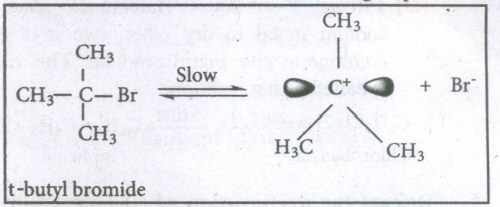
(ii) The carbocation has 2 equivalent lobes of the vacant 2p orbital, so it can react equally rapidly from either face.
Step - 2 :
(i) The nucleophile immediately reacts with the carbocation. This step is fast and hence does not affect the rate of the reactions.
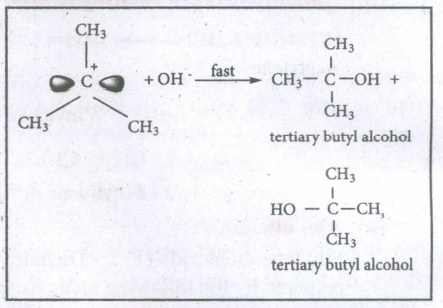
(ii) As shown above, the nucleophilic reagent OHcan attack carbocation from both the sides.
(iii) In the above example the substrate tert-butyl bromide is not optically active, hence the obtained product is optically inactive. If halo alkane substrate is optically active then, the product obtained will be optically inactive racemic mixture. As nucleophilic reagent OR- can attack carbocation from both the sides, to form equal proportion of dextro and levorotatory optically active isomers which results in optically inactive racemic mixture
18.
Molar mass of Mg CO3 = 84.32 g mol-1
Percentage of Mg =\({24\over 84.32}\times 100=28.46\%\)
Percentage of C=\({12\over 84.32}\times 100=14.23\%\)
Percentage of O3=\({48\over 84.32}\times 100=57.0\%\)
\(\underset{84.32\ g}{MgCO_3}\rightarrow MgO+\underset{44\ g}{CO_2 }\)
84.32 g of 100% pure MgCO3 gives 44g of CO2.
\(\therefore\) 100 x 103 g of 100 % pure MgCO3 gives =\({44\over 84.32}\times 100\times 10^3\)
= 52.182 x 10³g CO2
100% pure MgCO3 gives 52.182 x 10³ g CO2
\(\therefore\) 90% pure MgCO3 will give \({52.182\times 10^3\over 100}\times 90\) = 46963.8 g CO2
= 46.96 Kg CO2.
19.
| Experiment | \(\frac{v_1}{T_1}\)=constant |
|---|---|
| 1 | \(\frac{1.54}{293}\) = 0.0053 |
| 2 | \(\frac{1.65}{313}\) = 0.0053 |
| 3 | \(\frac{1.95}{373}\) = 0.0053 |
| 4 | \(\frac{2.07}{393}\) = 0.0053 |
The average value of the constant is 0.0053.
20.
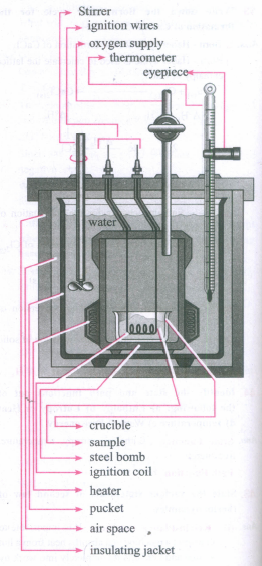
(i) Heat evolved at constant volume, is measured in a bomb calorimeter.
(ii) Apparatus setup: The inner vessel (the bomb) and its cover are made of strong steel. The cover is fitted tightly to the vessel by means of metal lid and screws.
(iii) Experiment: A weighed amount of the substance is taken in a platinum cup connected with electrical wires for striking an arc instantly to kindle combustion. The bomb is then tightly closed and pressurized with excess oxygen. The bomb is immersed in water, in the inner volume of the calorimeter. A stirrer is placed in the space between the wall of the calorimeter and the bomb, so that water can be stirred, uniformly. The reaction is started by striking the substance through electrical heating.
(iv) Calculation: A known amount of combustible substance is burnt in oxygen in the bomb. Heat evolved during the reaction is absorbed by the calorimeter as well as the water in which the bomb is immersed. The change in temperature is measured using a Beckman thermometer. Since the bomb is sealed its volume does not change and hence the heat measurements is equal to the heat of combustion at a constant volume (ΔU)c
The amount of heat produced in the reaction (ΔU)c is equal to the sum of the heat absorbed by the calorimeter and water.
Heat absorbed by the calorimeter q1 = k.ΔT
where k is a calorimeter constant equal to mc Cc (mc is mass of the calorimeter and Cc is heat capacity of calorimeter)
Heat absorbed by the water q2 = mw Cw ΔT
where mw is molar mass of water
Cw is molar heat capacity of water (4,184 kJ K-1mol-1)
Therefore ΔUc = q1 + q2
=k.ΔT + m w Cw ΔT
=(k+m w Cw) ΔT
Calorimeter constant can be determined by burning a know.n mass of standard sample (benzoic acid) for which the heat of combustion is known (-3227 kJmol-1)
The enthalpy of combustion at constant pressure of the substance is calculated from the equation (7.17)
\(\Delta { H }_{ C(pressure) }^{ 0 }=\Delta { U }_{ C(vol) }^{ o }+\Delta { n }_{ g }RT\)
21.
When conc. H2SO4 absorbs H2O from moist H2 it produces so much of heat since its highly exothermic and so it may catch fire.
22.
23.
| Compound | Molecular formula | Empirical Formula |
|---|---|---|
| Fructose | C6 H12O6 | C H2O |
| Caffeine | C8 H10 N4 O2 | C4 H5 N2O |
24.
The electronic configuration of Sodium (Z = 11) Is22s22p63s1.
Magnesium (Z = 12) 1s22s22p63s2
Magnesium atom has a smaller radius and higher nuclear charge than a sodium atom, thus more energy will be required to remove the electron from the same orbital (3s), making the first ionisation energy of magnesium higher than that of sodium.
However, the second ionization enthalpy of sodium is higher than that of magnesium. This is because after losing 1 electron, sodium attains the stable noble gas configuration of neon (1s22s22p6). On the other hand, magnesium, after losing 1 electron still has one electron in the 3s-orbital(1s22s22p63s1). In order to attain the stable noble gas configuration, Thus, the energy required to remove the second electron in case of sodium is much higher than that required in case of magnesium. Hence, the second ionization enthalpy of sodium is higher than that of magnesium.
25.
s-character & electronegativity,
\(\therefore\) sp hybrid orbitals are more electronegative among the three.
26.
(i) Preparation of alkene by dehydration of alcohol:
When an alcohol is heated at 430-440 K with excess of concentrated sulphuric acid, a molecule of water from alcohol is removed and an alkene is formed. is reaction is called elimination reaction.
\({ C }_{ 2 }{ H }_{ 5 }OH\overset { Conc.{ H }_{ 2 }{ SO }_{ 4 } }{ \underset { 430-440K }{ \longrightarrow } } { CH }_{ 2 }={ CH }_{ 2 }\)
Ethanol Ethene
Ethene can also be prepared in laboratory by catalytic dehydration of alcohol.
\({ C }_{ 2 }{ H }_{ 5 }OH\overset { { A1 }_{ 2 }{ O }_{ 3 } }{ \underset { 623K-723K }{ \longrightarrow } } { CH }_{ 2 }={ CH }_{ 2 }\)
Ethanol Ethene
(ii) Preparation of ethene by Kolbe's electrolytic method:
When an aqueous solution of potassium succinate is electrolyzed between two platinum electrodes, ethene is produced at the anode.
\(\overset { { CH }_{ 2 }-COOK }{ \underset { { CH }_{ 2 }-COOK }{ | } } \overset { Electrolysis }{ \longrightarrow } \overset { { CH }_{ 2 }-{ COO }^{ - } }{ \underset { { CH }_{ 2 }-{ COO }^{ - } }{ | } +2 } { K }^{ + }\)
Potassium Succinate
At anode
\(\overset { { CH }_{ 2 }CO{ O }^{ - } }{ \underset { { CH }_{ 2 }CO{ O }^{ - } }{ | } \rightarrow } \overset { { CH }_{ 2 } }{ \underset { { CH }_{ 2 } }{ || } } +{ CO }_{ 2(g) }+{ 2e }^{ - }\)
Ethene
(iii) When alkene is treated with halogens like chlorine or bromine, addition takes place rapidly and forms 1,2- dihalo alkane (or) vicinal dihalide.
\({ CH }_{ 2 }={ CH }_{ 2 }\overset { { \\ CI }_{ 2 } }{ \longrightarrow } \overset { { CH }_{ 2 }- }{ \underset { CI }{ | } } \overset { { CH }_{ 2 } }{ \underset { CI }{ | } } \)
1,2 dichloroethane
27.
The chloro fluoro derivatives of methane and ethane are referred by trade name Freons. These Chloro Fluoro Carbon compounds are stable, non-toxic, noncorrosive and noninflammable, easily liquefiable and are used in refrigerators, air- conditioners and ln the production of plastic foams. CFC's are the exhaust of supersonic air craft's and jumbo jets in the upper atmosphere. They slowly pass from troposphere to stratosphere. ,They stay for very longer period of 50 - 100 years. In the presence of uv radiation, CFC's break up into chlorine free radical
CF2Cl2 \(\xrightarrow{hv}\) CF2 CI +Cl.
CFCl3 \(\xrightarrow{hv}\)CFCI2+ Cl
Clo+O3 ⟶ C10+O2
Cloo+O ⟶ CI+O2
Chlorine radical is regenerated in the. course of reaction. Due to this continuous attack of Cl0 thinning of ozone layer takes place which leads to formation of ozone hole. It is estimated that for every reactive chlorine atom generated in the stratosphere 1,00,000 molecules of ozone are depleted.
28.
This equation gives the quantitative temperature dependence of equilibrium constant (K). The relation between standard free energy change (\(\triangle\)GO) and equilibrium constant is
\(\Delta { G }^{ 0 }=-RTln\ K\) ...(1)
We know that
\(\Delta { G }^{ 0 }=\Delta { H }^{ 0 }-T\Delta { S }^{ 0 }\)
Substituting (1) in equation (2)
\(-RTln\ K\ =\Delta { H }^{ 0 }-T\Delta { s }^{ 0 }\)
Rearranging
In \(K=\cfrac { -\Delta H^{ 0 } }{ RT } +\cfrac { { \Delta S }^{ 0 } }{ R } \) ...(3)
Differentiating equation (3) with respect to temperature
\(\cfrac { d\left( In\quad K \right) }{ dT } =\cfrac { \Delta { H }^{ 0 } }{ { RT }^{ 2 } } \) ...(4)
Equation 4 is known as differential form of Van't Hoff equation.
On integrating the equation 4, between T1 and T2 with their respective equilibrium constants K1 and K2.
\(\int _{ { k }_{ 1 } }^{ { K }_{ 2 } }{ d\left( In\ K \right) =\cfrac { \Delta { H }^{ 0 } }{ R } \int _{ { T }_{ 2 } }^{ { { T }_{ 2 } } }{ \cfrac { dT }{ { T }^{ 2 } } } } \)
\(\left[ In\quad K \right] _{ { K }_{ 1 } }^{ { K }_{ 2 } }=\cfrac { \Delta { H }^{ 0 } }{ R } \left[ -\cfrac { 1 }{ T } \right] ^{ { T }_{ 2 } }_{ { T }_{ 1 } }\)
\(In\quad { K }_{ 2 }-In\quad { K }_{ 1 }=\cfrac { \Delta { H }^{ 0 } }{ R } -\left[ \cfrac { 1 }{ { T }_{ 2 } } +\cfrac { 1 }{ { T }_{ 2 } } \right] \)
\(In\quad \cfrac { { K }_{ 2 } }{ { K }_{ 1 } } =\cfrac { \Delta { H }^{ 0 } }{ R } \left[ \cfrac { { T }_{ 2 }-{ T }_{ 1 } }{ { T }_{ 2 }{ T }_{ 1 } } \right] \)
\(log\quad \cfrac { { K }_{ 2 } }{ { K }_{ 1 } } =\cfrac { \Delta { H }^{ 0 } }{ 2.303R } \left[ \cfrac { { T }_{ 2 }-{ T }_{ 1 } }{ { T }_{ 2 }{ T }_{ 1 } } \right] \) ...(5)
Equation (5) is known as integrated form of Van't Hoff equation.
29.
PCl5 ⇌ PCl3 + Cl2
Given that [PCl5]initial = 1 mol; V = 1 dm3; KC = 2
| PCl5 | PCl3 | Cl2 | |
| Initial no.of moles | 1 | - | - |
| No.of moles | x | - | - |
| No.of moles at equilibrium | 1 - x | x | x |
| Equilibrium concentration | \({1-x\over 1}\) | \({x\over 1}\) | \({x\over 1}\) |
\(K_c={[PCl_3][Cl_2]\over [PCl_5]}\)
\(2={x\times x\over (1-x)}\)
2 - 2x = x2|
x2 + 2x - 2 = 0
Solution for a quadratic equation
\(a x^{2}+b x+c=0 \text { are }, x=\frac{-b-\sqrt{b^{2}-4 a c}}{2 a}\)
a- = 1 b = 2 c = -2
\(x=\frac{-2-\sqrt{4-4 \times 1 \times-2}}{2 \times 1} \)
\(x=\frac{-2-\sqrt{12}}{2}=\frac{-2-\sqrt{4 \times 3}}{2}\)
\( x =\frac{-2-2 \sqrt{3}}{2} \)
\(=\frac{-2+2 \sqrt{3}}{2}, \frac{-2-2 \sqrt{3}}{2} \)
\(x =-1+\sqrt{3} ;-1-\sqrt{3} \)
\(=-1-\sqrt{3} \text { not possible } \)
Since x is + ve,
x = -1 + 1.732
x = 0.732
Equilibrium concentration of
\( {\left[\mathrm{PCl}_{5}\right]_{\mathrm{eq}}=\frac{1-x}{1}=1-0.732=0.268 \mathrm{M}} \)
\({\left[\mathrm{PCl}_{3}\right]_{\mathrm{eq}}=\frac{x}{1}=\frac{0.732}{1}=0.732} \)
\({\left[\mathrm{Cl}_{2}\right]_{\mathrm{eq}}=\frac{x}{1}=\frac{0.732}{1}=0.732} \)
30.
(i) O or F. Both O and F lie in 2nd period. As we move from O to F the atomic size decreases. Due to smaller size of F nuclear charge increases.
Further, gain of one electron by
\(F\rightarrow F^-\)
ion has inert gas configuration, While tile gain of one electron by
\(O\rightarrow O^-\)
gives O- ion which does not have stable inert gas configuration. Consequently, the energy released is much higher in going from
\(F\rightarrow F^-\)
than going from\(O\rightarrow O^-\). In other words electron gain enthalpy of F is much more negative than that of oxygen.
(ii) The negative electron gain enthalpy of CI \((e.g.\triangle H=-349\ kJ\ mol^{-1})\) is more than that of \(F(e.g.\triangle H=-328\ kJ\ mol^{-1})\)
The reason for the deviation is due to the smaller size of F. Due to its small size, the electron repulsions in the relatively compact 2p-subshell are comparatively large and hence the attraction for incoming electron is less as in the case of Cl.
31.
(i) System: A system is defined as any portion of matter (or universe) under thermodynamic.consideration, which is separated from the rest of the universe by real or imaginary boundaries.
(ii) Surroundings: Everything in the universe that is not the part of system and can interact with system is called as surroundings.
(iii) Boundary: Anything which separates the system from its surroundings is called boundary.
32.
The carbon monoxide of the water gas can be converted to carbon dioxide by mixing the gas mixture with more steam at 400oC and passed over a shift converter containing iron/copper catalyst. This reaction is called as water-gas shift reaction.
CO + H2O ➝ CO2 + H2
33.
(i) The decreasing order of bond angles is: NH4+ > NH3>NH2-
(ii) The N-atoms in all the three molecules are sp3 hybridised
(iii) The number of lone-pair of electrons present on nitrogen of NH4+, NH3 and NH2- are 0, 1 and 2.
(iv) Greater the number of lone pairs, greater is the repulsion and lesser is the bond angle.
34.
CH3 - CH = O, CH3 -C = N and CH3-I, the underlined carbon atoms are electrophilic centres as they will have partial positive charge due to polarity of the C-O or C-N or C-I bond.
35.
| S.No | Classical somg (london smog) | Photochemical smog (Los Angels smog) |
|---|---|---|
| 1 | It was first observed in London in Dec. 1952 | It was first observed in Los Angels in 1950. |
| 2 | It occurs in cool, humid climate | It occurs in warm, dry and sunn climate |
| 3 | It consists of coal smoke and fog | It is formed by the combination of smoke dust and fog with air pollutants like N2 and hydrocarbons in presence of light. |
| 4 | It generally occurs in the morning and becomes worse when the sunshines | It forms when the sunshines and becomes worse in the afternoon. |
| 5 | This is mainly due to the induced oxidation of SO2 to SO3, which reacts with water yielding sulphuric acid aerosol. | This is mainly due to the induced oxidation of N2 to NO, NO2 and [O] + O2 to O3 NO and O3 are strong oxidising agents and can react with unburnt hydrocarbons in polluted air to form HCHO, Acrolein and PAN. |
| 6 | Chemically it is reducing in nature because of high concentration of SO2. | Chemically it is oxidising in nature because of high concentrations of oxidising agents like NO2 and O2 |
| 7 | It is called reducing smog | It is called oxidising smog |
| 8 | Responsible for acid rain, causes poor visibility, affects air and road transport and causes bronchial irritation. | Causes irritation to nose, throat, eyes, skin and lungs, increases asthma, causes chest pain, uncomfortable breathing, PAN attacks young leaves, causes corrosion of metals, stones painted surfaces, etc., |
36.
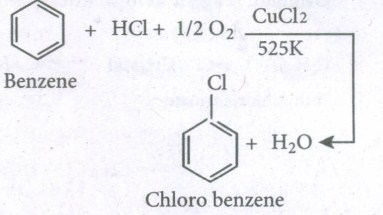
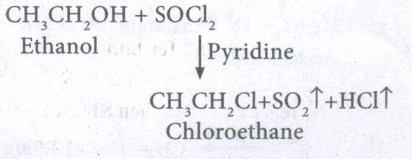
37.
Functional group :
A functional group is an'atom or a specific combination of bonded atoms that react in a characteristic way, irrespective of the organic molecule in which it is present.
Acetaldehyde - CHO.
38.
i = \({observed\ property\over Theoritical\ property\ (calculated)}\)
Given ΔTf = 0.680 K
m = 0.2 m
ΔTf (observed) = 0.680 K
ΔTf (calculated) = Kf m
= 1.86 K Kg mol–1 × 0.2 mol Kg–1
= 0.372 K
i = \({(\Delta T_f)\ observed\over (\Delta T_f)\ calculated}={0.680\ K\over 0.372\ K}=1.82\)
39.
\(\underset { 2\ volumes }{ { 2H }_{ { 2 }_{ (g) } } } +\underset { 1\ volumes }{ { O }_{ { 2 }_{ (g) } } } \rightarrow \underset { 2\ volumes }{ { 2H }_{ 2 }{ O }_{ (g) } } \)
Thus 2 volumes of H2 reacts with 1 volume of O2 to produce 2 volumes of H2O (g)
\(\therefore\) 10 volumes of H2 would react with 5 volumes of O2 to produce 10 volumes of H2O(g).
Thus 10 volumes of H2O will be produced.
40.
Na2O reacts with water and forms a base i.e, sodium hydroxide.
Na2O + H2O \(\rightarrow\)2NaOH
Cl2 O7 reacts with water and forms perchloric acid
Cl2O7 + H2O \(\rightarrow\) 2HClO4
41.
Equal volumes of all gases under the same conditions of temperature and pressure contain equal number of molecules. The mathematical form of Avogadro's hypothesis may be expressed as
V∝n, \(\frac { { V }_{ 1 } }{ { n }_{ 1 } } =\frac { { V }_{ 2 } }{ { n }_{ 2 } } =constant\)
Where V1and n1 are the volume and number of moles of a gas and V2 and n2 are a different set of values of volume and number of moles of the same gas at same temperature and pressure.
42.
a) Principal quantum number defines energy and size of an orbital.
b) Azimuthal quantum number defines shape of an orbital
c) Magnetic quantum number defines spatial orientation (direction) of an orbital.

11th Standard Syllabus & Materials
11th Standard
TN 11th Tamil பீடு பெற நில் - செய்யுள் - காவடிச்சிந்து Important Questions And Answers Study Material - QB365 Set A
NEW11th Standard
TN 11th Tamil பீடு பெற நில் - உரைநடை - மலை இடப்பெயர்கள் : ஓர் ஆய்வு Important Questions And Answers Study Material - QB365 Set A
NEW11th Standard
TN 11th Tamil மாமழை போற்றுதும் - துணைப்பாடம் - யானை டாக்டர் Important Questions And Answers Study Material - QB365 Set A
NEW11th Standard
TN 11th Tamil மாமழை போற்றுதும் - செய்யுள் - ஐங்குறுநூறு Important Questions And Answers Study Material - QB365 Set A



Tamilnadu Stateboard 11th Standard Subjects

Maths

Commerce

Economics

Biology

Business Maths and Statistics

Accountancy

Computer Science

Physics
Chemistry
Maths
Biology
Economics
Physics
Chemistry

History
Business Maths and Statistics

Computer Science
Accountancy

Computer Applications
History
Computer Technology
Commerce
Computer Applications
Computer Technology

Tamil

English

French
Tamilnadu Stateboard Standards
