
 100% FREE ACCESS
11th Standard Syllabus & Materials
11th Standard
TN 11th Tamil இயற்கை வேளாண்மை,சுற்றுச்சூழல் -செய்யுள் - மனோன்மணீயம் Important Questions And Answers Study Material - QB365 Set A
NEW11th Standard
TN 11th Tamil என்னுயிர் என்பேன் -துணைப்பாடம் - இசைத்தமிழர் இருவர் Important Questions And Answers Study Material - QB365 Set A
NEW11th Standard
TN 11th Tamil மொழி கலை -செய்யுள் - ஒவ்வொரு புல்லையும் Important Questions And Answers Study Material - QB365 Set A
NEW11th Standard
TN 11th Tamil பீடு பெற நில் - இலக்கணம் - பகுபத உறுப்புகள் Important Questions And Answers Study Material - QB365 Set A
NEW11th Standard
TN 11th Tamil பீடு பெற நில் - துணைப்பாடம் - வாடிவாசல் Important Questions And Answers Study Material - QB365 Set A
NEW11th Standard
TN 11th Tamil பீடு பெற நில் - செய்யுள் - குறுந்தொகை Important Questions And Answers Study Material - QB365 Set A

Published on: 04/03/2019
Plus One Public Exam March 2019 Model Question
Download Tamil Nadu 11th Standard Computer Science question papers, model tests, one-mark questions, important questions, and public exam papers in PDF format. Free study materials and answer keys for TN State Board students.
Questions + Answers key
Take MCQ Computer Science Test
1.
Which of the following statement is true or false?
(i) constructor invoked when class come into the scope
(ii) constructor associate with datatype
(iii) constructor defined only inside the class definition
(iv) constructor can also have the different name from class name
i-true, ii-false, iii-false, iv-false
i-false, ii-false, iii-false, iv-true
i-true, ii-true, iii-false, iv-false
i-true, ii-false, iii-false, iv-true
2.
Identify the odd one from the keywords of jump statements:
break
switch
goto
continue
3.
The data elements in the structure are also known as _________.
objects
members
data
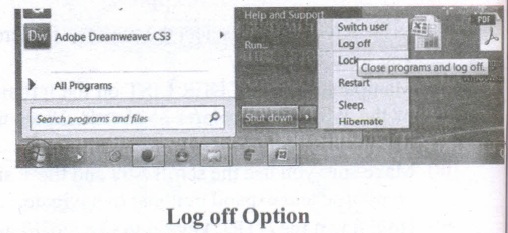
records
4.
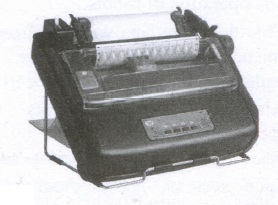
The ASCII encoding system is applicable only for handling the language_________.
English
Hindi
Tamil
All of these
5.
Which amongst the following is executed in the order of inheritance?
Destructor
Member function
Constructor
Object
6.
Which of the following statement is (are) false?
(i) complicated programs cannot be divided
(ii) It is easier the test, debug the functions
(iii) Programmers can not work on different-functions simultaneously
only (ii)
only (iii)
both (ii) and (iii)
both (i) and (iii)
7.
In which of the following functions in the same scope that share the same name but their parameters are different?
function overloading
operator overloading
data overloading
Data hiding
8.
Which of the following supports the transitive nature of data?
Inheritance
Encapsulation
Polymorphism
Abstraction
9.
The symbol used to denote preprocessor directive statement is ________.
#
//
@
{
10.
If m x a + n x b is an invariant for the assignment a, b: = a + 8, b + 7, the values of m and n are
m = 8, n = 7
m = 7, n = -8
m = 7, n = 8
m = 8, n = -7
11.
Match the following.
| (i) Tablet OS | (1) Linux |
| (ii) Desktop OS | (2) Android |
| (iii) Smart phone OS | (3) ios |
| (iv) OS used in super computer | (4) Windows 7 |
| i) | ii) | iii) | iv) |
| 1 | 4 | 3 | 2 |
| i) | ii) | iii) | iv) |
| 1 | 2 | 4 | 3 |
| i) | ii) | iii) | iv) |
| 4 | 3 | 1 | 2 |
| i) | ii) | iii) | iv) |
| 3 | 4 | 2 | 1 |
12.
4 bits =................
Bit
Byte
Nibble
Word
13.
Which of the following activities is algorithmic in nature?
Assemble a bicycle.
Describe a bicycle.
Label the parts of a bicycle.
Explain how a bicycle works.
14.
Which of the following is not a Function of Operating System?
Process Management
Memory Management
Security management
Compiler Environment
15.
How many memory locations are identified by a processor with 8 bits address bus at a time?
28
1024
256
8000
16.
Write a note on Asymmetric encryption?
17.
What is the function of getchar () and putchar() function?
18.
Differentiate structure and class though both are user defined data type.
19.
Assume n=10; what will be result of n++ and --n;?
20.
How do we refine a statement?
21.
Define factorial of a natural number recursively
22.
Expand CD, DVD, CD-ROM.
23.
What is multi-user Operating system?
24.
What is the function of an ALU?
25.
Why do you need for inheritance?
26.
What are the rules for function overloading?
27.
Write a note on the features of procedural programming.
28.
What is called anonymous structure. Give an example
29.
Write a C++ program to print multiplication table of a given number.
30.
Describe alternative statement.
31.
What does security management refers?
32.
Write the truth table of fundamental gates
33.
What is the format of the specification of an algorithm?
34.
Explain the scope resolution operator with an example.
35.
A railway reservation counter needs to computerise its reservation process. Using the following information write a C ++ program to do so:
class Train {
int number; //Train number
int seats _1; //Total seats in 1st class
int seats _2 ; //Total seats in 2nd class
int seats _3; //Total seats in 3rd class
public;
Train (int i, int j, int k, int l)
{
number = i; seats_1 =j ;
seats-2 =' k;,seats-3 = 1,.
}
int getnum(void)
{ return number; }
int getseats_1(void)
{ return seats_1 ; }
int getseats_2(void)
{ return seats _2 ;}
int getseats - 3 (void)
{return seats - 3:}
};
class Reservation : public Train
{ int bkd_1 ; //Seats reserved in 1st class
int bkd_2 ; ///Seats reserved in 2nd class
int bkd_3 ; ///Seats reserved in 3rd class
public:
int i, j, k, 1;
Reservation (int i, int j, int k, int 1) : Train (i ,j, k,l)
{bkd_1 = bkd_2 = bkd_3 = 0 ; }
void book(char type, int num);
void cancel (char type, int num) ;
void disp_status (void);
};
void Reservation: : book (char type, int num)
{ switch(type)
}
case '1': bkd_1+=num; //addnum to bkd_1
break;
case '2': bkd_2+=num; //addnum to bkd_2
break ;
case '3': bkd_3+=num; Iladdnum to bkd_3
break;
default: cout <<"Wrong class\n";
}
}
void Reservation: : cancel (char type. int num)
{ switch(type)
}
case '1': bkd_1-=num;
break;
case '2': bkd_2-=num;
break ;
case '3' : bkd_3-=num;
break ;
default: cout <<"Wrong class\n" ;
}
}
void Reservation : : disp_stauts (void)
{
cout <<"\t\t Train Numbe r: "<
Unreserved\n" ;
int val;
val = getseats_1 () ;
cout<< "I\t "< xval << "\t "<< bkd_1<< "
\t "<< val-bkd_1 << "\n";
val = getseats_2 () ;
cout << "2\t "<< val << "\t "< xbkd 2 << "
\t "<< val-bkd_2 << "\n";
val = getseats_3 ( ) ;
cout << "3\t "<< val << "\t "<< bkd 3 << "
\t "<< val-bkd_3 << "\n";
36.
What are the rules for operator overloading?
37.
Write the output of the following c++ program
#include <iostream>
#include <string>
using namespace std;
struct student
{
introll_no;
char name[10];
long phone_number;
};
int main(){
student p1 = {1,"Brown",123443},p2;
p2.roll_no = 2;
strcpy(p2.name ,"Sam");
p2.phone_number = 1234567822;
cout<< "First Student" <<endl;
cout<< "roll no : " << p1.roll_no <<endl<< "name : " << p1.name <<endl;
cout<< "phone no : " << p1.phone_number <<endl;
cout<< "Second Student" <<endl;
cout<< "roll no : " << p2.roll_no <<endl<< "name : " << p2.name <<endl;
cout<< "phone no : " << p2.phone_number <<endl;
return 0;
}
38.
What are the different forms of function return? Explain with example.
39.
Write a program to find sum of the series
S = 1 + x + x2 +..... + xn
40.
Explain the procedure of shutting down or logging of computer.
41.
Trace the step-by-step execution of the algorithm for factorial(4).
factorial(n)
--inputs: n is an integer, n > 0
-- outputs: f = n!
f, i := 1 ,1
while i < nf
, i := f × i, i+1
42.
Explain Impact Printers with an Example.
43.
Explain the types of ROM.
1.
(a)
i-true, ii-false, iii-false, iv-false
2.
(b)
switch
3.
(b)
members
4.
(a)
English
5.
(c)
Constructor
6.
(a)
only (ii)
7.
(a)
function overloading
8.
(a)
Inheritance
9.
(a)
#
10.
(b)
m = 7, n = -8
11.
(d)
| i) | ii) | iii) | iv) |
| 3 | 4 | 2 | 1 |
12.
(a)
Bit
13.
(a)
Assemble a bicycle.
14.
(b)
Memory Management
15.
(c)
256
16.
Public Key Encryption
(i) Public key encryption is also called Asymmetric encryption. It uses the concept of a key value pair, a different key is used for the encryption and decryption process. One of the keys is typically known as the private key and the other is known as the public key.
(ii) The private key is kept secret by the owner and the public key is either shared amongst authorized recipients or made available to the public at large.
(iii) The data encrypted with the recipient's public key can only be decrypted with the corresponding private key.
17.
The predefined function getchar() is used to get a single character from keyboard and putchar() functions is used to display it.
18.
The only difference between structure and class is the members of structure are by default public where as it is private in class.
19.
| Operator | Operation | Result |
| >> | n >> 2 | 00001010 n = 10 |
| 00001000 n >> 2 | ||
| 00000010 | ||
| n >> 2 = (00000010)2 = 210 | ||
20.
In refinement, each statement is repeatedly expanded into more detailed statements in the subsequent levels.
21.
\(\text { Fact }(\mathrm{n})=\left\{\begin{array}{l}
1 \text { if } \mathrm{n}=0 \\
\mathrm{n} * \text { fact }(\mathrm{n}-1) \text { otherwise }
\end{array}\right.\)
Recursive Algorithm:
Fact (n)
-- inputs: n
outputs: Fact=n!
if(n-0)- --base case
otherwise
1
else
n fact (n-1)--recursive step
22.
(i) CD - Compact Disc
(ii) DVD - Digital Versatile Disc or Digital Video Disc
(iii) CD-ROM - Compact Disc - Read Only Memory.
23.
A Multi-user Operating system is a computer operating system (OS) that allows multiple users on different computers or terminals to access a single system with one OS on it.
24.
The ALU is a part of CPU where various computing functions are performed on data. ALU performs arithmetic operations such as addition, subtraction, multiplication, division and logical operations.
25.
(i) Inheritance is an important feature of object oriented programming used for code reusability. It is a process of creating new classes called derived classes, from the existing or base classes.
(ii) Inheritance allows us to inherit all the code (except declared as private) of one class to another class. The class to be inherited is called base class or parent class and the class which inherits the other class is called derived class or child class.
(iii) The derived class is a power packed class, as it can add additional attributes and methods and thus enhan e its functionality.
26.
Rules for function overloading:
(i) The overloaded function must differ in the number of its arguments or data types.
(ii) The return type of overloaded functions are not considered for overloading same data type.
(iii) The default arguments of overloaded functions are not considered as part of the parameter list in function overloading
27.
1. Programs are organized in the form of subroutines or sub programs.
2. All data items are global.
3. Suitable for small sized software application.
4. Difficult to maintain and enhance the program code as any change in data type needs to be propagated to all subroutines that use the same data type. This is time consuming.
Example: FORTRAN and COBAL.
28.
A structure without a name/tag is called anonymous structure.
struct
{
long rollno;
int age;
float weight;
} student;
The student can be referred as reference name to the above structure and the elements can be accessed like student.rollno, student.age and student.weight .
29.
The syntax of if-else ladder:
#include <iostream>
using namespace std;
int main()
(
int num:
cout<<"Enter Number to find its multiplication table";
cin >> num;
for (int a = 1; a<= 10; a++)
{
cout << num << "*" << a << "=" << num*a << endl;
}
return 0;
}
30.
(i)Test whether C is true or false.
(ii) If C is true, then do S1; otherwise do S2.
31.
(i) OS security management refers to specified steps or measures used to protect the as from threats, viruses, worms, malware or remote hacker intrusions.
(ii) OS security encompasses all preventive-control techniques, which safeguard any computer assets capable of being stolen, edited or deleted if OS security is compromised.
32.
a) AND gate truth table
| A | B | C |
| 0 | 0 | 0 |
| 0 | 1 | 0 |
| 1 | 0 | 0 |
| 1 | 1 | 1 |
b) OR Gate Truth table
| A | B | C |
| 0 | 0 | 0 |
| 0 | 1 | 1 |
| 1 | 0 | 1 |
| 1 | 1 | 1 |
c) Not Gate Truth Table
| A | A |
| 0 | 1 |
| 1 | 0 |
33.
Let P be the required property of the inputs and Q the property of the desired outputs.
Format of specification of an algorithm:
(a) Algorithm name (Inputs)
(b) Inputs - P
(c) Outputs - Q
34.
If there are multiple variables with the same name defined in separate block as then: :(Scope resolution) operator will reveal the hidden file scope(global) variable.
Example:
#include < iostream >
using namespaces std;
int a=100;
class A
{
int a;
public:
void fun ( )
{
a=20;
a+=::a; //using global variable value
cout << a;
}
};
int main ( )
{
clrscr ( );
A a1;
a1.fun ( );
return 0;
}
Output:
120
In the program the class data member and the global variable have same name. To use the global variable :: used.
35.
#include< iostream.h >
#include< conio.h > //for clrscr ()
class Train {
//same as before
};
class Reservation: public Train
{
//same as before
};
//same as before
int main ( )
{ clrscr();
int num ;
cout << "Enter Train Number :\n" ; cin >> num ;
cout << "\nEnter total number of seats in 1st class\n";
int s1 ; cin >> s1 ;
cout<< "\nEnter totalnumberofseatsm2ndclass\n";
int s2 ; cin >> s2 ;
cout<< "\nEnter total number of seats in 3rd class\n";
int s3 ; cin >> s3 ;
Reservation Tr(num, sI,s2.s3) ;
char c1_type ;
int choice, seats ;
do
{
cout << "\nMain Menu\n" ;
cout << "1. Reservation \n" ;
cout << "2. Cancellation \n" ;
cout << "3. Display status \n" ;
cout << "4. Exit\n" ;
cout<< "Enter your choice:" ;
cin >> choice; cout << "\n" ;
switch(choice)
{case 1 : cout<< "Which class? (1\2\3): ";
cin > cltype ;
cout << "\nHow many seats?";
cin >> seats ;
cout << "\n";
Tr.book(cl_type, seats);
break;
case 2 : cout <<"Which class? (1\2\3) : ";
cin >> cl_type ;
cout << "\nHow many seats?";
cin>> seats ;
cout << "\n";
Tr.cancel(cl_type, seats) ;
break;
case 3 : Tr.disp_status ( ) ;
break;
case 4 : break ;
default: cout<< 'Wrong choice!!\n"
} ; \\end of switch
} while (choice >> 1 && choice < = 3);
return 0;
} \\end of main ( )
36.
Following are some rules to be followed while implementing operator overloading.
(i) Precedence and Associativity of an operator cannot be changed.
(ii) No new operators can be created, only existing operators can be overloaded.
(iii) Cannot redefine the meaning of an operator's procedure. You cannot change how integers are added. Only additional functions can be to an operator.
(iv) Overloaded operators cannot have default arguments.
(v) When binary operators are overloaded, the left hand object must be an object of the relevant class.
37.
Output:
First Student roll no: 1
name: Brown
phone no: 123443
Second Student roll no: 2
name: Sam
Phone no : 1234567822
Third Student roll no: 3
name :Addy
Phone no : 1234567844
38.
The return statement
Returning from the function is done by using the return statement. The return statement stops execution and returns to the calling function. When a return statement is executed, the function is terminated immediately at that point. The return statement is used to return from a function. It is categorized as a jump statement because it terminates the execution of the function and transfer the control to the called statement.
Syntax:
return expression/variable;
Example: return(a+b); return(a);
return; // to terminate the function
The Returning values:
The functions that return no value is declared a void. The data type of a function is treated as int, if no data type is explicitly mentioned. For example,
For Example:
int add (int, int);
add (int, int);
In both prototypes, the return value is int, because by default the return value of a function in C++ is of type int.
Returning Non-integer values
A string can also be returned to a calling statement.
#include <iostream>
#include<string.h>
using namespace std;
char*display()
{
return ("chennai");
}
int main()
{
char s[50];
strcpy(s,display());
cout<<"\n Example:Function with Non Integer Return"<<s;
return(0);}
Output:
Example: Function with Non Integer Return Chennai
The Returning by reference
#include<iostream>
using namespace std;
int main()
{
int nl-150;
int &nlrefn1;
cout<<"\nThe Value of NI =" <<n<< "and nl Reference="<<n/ref;
n1ref++;
cout<<"\n After nl increased the Value of N1 ="<<nl;
cout<<"and nl Reference="<<ntref;
return(0);
Output:
The Value of N1 - 150 and n1 Reference - 150
After n1 increased the Value of N1 =151 and n1 Reference = 151
39.
#include <iostream>
using namespace std;
#include <math.h>
int main()
{
int x, n;
float sum= 0;
cout<<"Enter the value for x:";
cin>>x;
cout<<"Enter the number of terms";
cin>>n;
for (int i=0; i<n; i++)
sum = sum + Pow(x,i);
cout<<"Sum="<< Sum<<endl;
cin.get();
return 0;
}
40.
Log Off:
To log off from our computer:
(i) Click on the start button.
(ii) Select log off.
(iii) If any open programs asked to be closed then Windows force them to shut down. Any unsaved information will be last.
Shut Down:
To shut down our computer:
(i) Click on the start button.
(ii) Select shut down.
(iii) Then see the shut down windows dialog box opens.
(iv) If any open programs asked to be closed then Windows, force them to shut down. Any unsaved information will be lost.
41.
(i) f=1 i=1 f = f * i i = i+1
f = 1 x 1 = 1 i = 2
(ii) f = 1 x 2 i = 3 = 2
(iii) f = 2 × 3 i = 4 = 6
(iv) f = 6 x 4 i = 5 (loop terminates) = 24
42.
Impact Printers:
(i) These printers print with striking of hammers or pins on ribbon. These printers can print on multi-part (using carbon papers) by using mechanical pressure.
(ii) For example, Dot Matrix printers and Line matrix printers are impact printers.
(iii) A Dot matrix printer that prints using a fixed number of pins or wires. Each dot is produced by a tiny metal rod, also called a "wire" or "pin", which works by the power of a tiny electromagnet or solenoid, either directly or through a set of small levers.
(iv) It generally prints one line of text at a time. The printing speed of these printers varies from 30 to 1550 CPS (Character Per Second).
(v) A Dot matrix printer that prints using a fixed number of pins or wires. Each dot is produced by a tiny metal rod, also called a "wire" or "pin", which works by the power of a tiny electromagnet or solenoid, either directly or through a set of small levers.
(vi) It generally prints one line of text at a time. The printing speed of these printers varies from 30 to 1550 CPS (Character Per Second).
43.
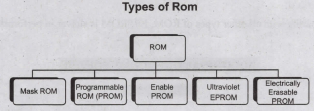
Read-only memory (ROM):
1. Read only memory refers to special memory in a computer with pre-recorded data at manufacturing time which cannot be modified.
2. The stored programs that start the computer and perform diagnostics are available in ROMs. ROM stores critical programs such as the program that boots the computer.
3. Once the data has been written onto a ROM chip, it cannot be modified or removed and can only be read.
4. ROM retains its contents even when the computer is. turned off. So, ROM is called as a non-volatile memory.
Programmable Read-Only Memory (PROM):
1. Programmable read-only memory is also a nonvolatile memory on which data can be written only once. Once a program has been written onto a PROM, it remains there forever.
2. Unlike the main memory, PROMs retain their contents even when the computer is turned off.
3. The PROM differs from ROM. PROM is manufactured as a blank memory, whereas a ROM is programmed during the manufacturing process itself.
4. PROM programmer or a PROM burner is used to write data to a PROM chip. The process of programming a PROM is called burning the PROM.
Erasable Programmable Read-Only Memory (EPROM):
1. Erasable Programmable Read Only Memory is a special type of memory which serves as a PROM, but the content can be erased using ultraviolet rays.
2. EPROM retains its contents until it is exposed to ultraviolet light. The ultraviolet light clears its contents, making it possible to reprogram the memory.
3. An EPROM differs from a PROM, PROM can be written only once and cannot be erased.
4. EPROMs are used widely in personal computers because they enable the manufacturer to change the contents of the PROM to replace with updated versions or erase the contents before the computer is delivered.
Electrically Erasable Programmable Read Only Memory (EEPROM)
1. Electrically Erasable Programmable Read Only Memory is a special type of PROM that can be erased by exposing it to an electrical charge.
2. Like other types of PROM, EEPROM retains its contents even when the power is turned off.
3. Comparing with all other types of ROM, EEPROM is slower in performance.

11th Standard Syllabus & Materials
11th Standard
TN 11th Tamil பீடு பெற நில் - செய்யுள் - காவடிச்சிந்து Important Questions And Answers Study Material - QB365 Set A
NEW11th Standard
TN 11th Tamil பீடு பெற நில் - உரைநடை - மலை இடப்பெயர்கள் : ஓர் ஆய்வு Important Questions And Answers Study Material - QB365 Set A
NEW11th Standard
TN 11th Tamil மாமழை போற்றுதும் - துணைப்பாடம் - யானை டாக்டர் Important Questions And Answers Study Material - QB365 Set A
NEW11th Standard
TN 11th Tamil மாமழை போற்றுதும் - செய்யுள் - ஐங்குறுநூறு Important Questions And Answers Study Material - QB365 Set A



Tamilnadu Stateboard 11th Standard Subjects

Maths

Commerce

Economics

Biology

Business Maths and Statistics

Accountancy
Computer Science

Physics

Chemistry
Maths
Biology
Economics
Physics
Chemistry

History
Business Maths and Statistics

Computer Science
Accountancy

Computer Applications
History
Computer Technology
Commerce
Computer Applications
Computer Technology

Tamil

English

French
Tamilnadu Stateboard Standards
