
 100% FREE ACCESS
11th Standard Syllabus & Materials
11th Standard
TN 11th Tamil இயற்கை வேளாண்மை,சுற்றுச்சூழல் -செய்யுள் - மனோன்மணீயம் Important Questions And Answers Study Material - QB365 Set A
NEW11th Standard
TN 11th Tamil என்னுயிர் என்பேன் -துணைப்பாடம் - இசைத்தமிழர் இருவர் Important Questions And Answers Study Material - QB365 Set A
NEW11th Standard
TN 11th Tamil மொழி கலை -செய்யுள் - ஒவ்வொரு புல்லையும் Important Questions And Answers Study Material - QB365 Set A
NEW11th Standard
TN 11th Tamil பீடு பெற நில் - இலக்கணம் - பகுபத உறுப்புகள் Important Questions And Answers Study Material - QB365 Set A
NEW11th Standard
TN 11th Tamil பீடு பெற நில் - துணைப்பாடம் - வாடிவாசல் Important Questions And Answers Study Material - QB365 Set A
NEW11th Standard
TN 11th Tamil பீடு பெற நில் - செய்யுள் - குறுந்தொகை Important Questions And Answers Study Material - QB365 Set A

Published on: 04/03/2019
+1 Public Official Model Question 2019
Download Tamil Nadu 11th Standard Economics question papers, model tests, one-mark questions, important questions, and public exam papers in PDF format. Free study materials and answer keys for TN State Board students.
Questions + Answers key
Take MCQ Economics Test
1.
In the pre-Iiberalisation period__________.
full support was given to private sector in all industries
industries were reserved exclusively for public sector
Both (a) and (b)
Neither (a) nor (b)
2.
Gross Profit - Implicit Cost.
Net Profit
Gross Profit
Normal Profit
Super Normal Profit
3.
Utility is a
Scientific concept
Ethical concept
Moral concept
Subjective and Psychological concept
4.
The East India Company had captured political power to secure maximum goods for __________
Maximum payment
Minimum payment
Normal payment
None of these
5.
_____ does Px denote.
Demand of a commodity
Quantity of the demand
Price of a commodity
All the above
6.
The man behind organizing the business called as ______________
Organizer
Entrepreneur
Both (a) and (b)
None of these
7.
Gossen's first law is known as
Law of Equi-Marginal Utility
Law of Diminishing Marginal Utility
Law of Demand
Law of Diminishing returns
8.
Thoothukudi is known as ________.
Gateway of Tamil Nadu
Gateway of India
Gateway of Kerala
Gateway of Andhra Pradesh
9.
Different prices are charged for different individuals in ______ price discrimination.
Personal
Geographical
On the basis of use
All of these
10.
In which year, Regional Rural Banks came into existence?
1965
1970
1975
1980
11.
The objective of the Industrial policy 1956 was ________.
Develop heavy Industries
Develop agricultural sector only
Develop private sector only
Develop cottage industries only
12.
The recommendation of Narasimham Committee Report was submitted in the year ________
1990
1991
1995
2000
13.
If x+y = 5 and x-y = 3 then, value of x
4
3
16
8
14.
Price discrimination will always lead to _________
Increase in output
Increase in profit
Different prices
b and c
15.
Loanable Funds Theory of Interest is called as
Classical Theory
Modern Theory
Traditional Theory
Neo-Classical Theory
16.
In health index, Tamil Nadu is ahead of
Kerala
Punjab
Gujarat
All the above
17.
Which factor is called the changing agent of the Society
Labourer
Land
Organizer
Capital
18.
Long-run average cost curve is also called as _____ curve.
demand
planning
production
sales
19.
The equilibrium price is the price at which
Everything is sold
Buyers spend their money
Quantity demanded equals quantity supplied
Excess demand is zero
20.
Who introduced the National Development Council in India?
Ambedkar
Jawaharlal Nehru
Radhakrishnan
V.K.R.V. Rao
21.
What is duopoly?
22.
If y = 4, then find \(\frac { dy }{ dx } \)
23.
What is Industrial delicensing?
24.
Thoothukudi is known as "Gateway of Tamil Nadu" - Why?
25.
Define - "Capital".
26.
What are Renewable Resources?
27.
Name the different types of land tenure that existed in India before Independence.
28.
What do you mean by Micro Finance?
29.
Give the meaning of deductive method.
30.
31.
Briefly explain the monopolistic competition.
32.
Differentiate the function \(Y={ 5x }^{ 4 }+{ 3x }^{ 3 }\) with respect to x.
33.
Discuss the arguments against LPG.
34.
Describe the features of human wants.
35.
Write short note on health care services in India?
36.
State the reasons for nationalisation of commercial banks.
37.
What are the functions of Entrepreneur?
38.
Describe briefly the Innovation Theory of Profit.
39.
What are the crucial decisions involved in 'what to produce'?
40.
Write a short note on Marginal Revenue.
41.
What are the weaknesses of Indian Economy?
42.
Elucidate the monetary and financial sector reforms.
43.
A producer has the total cost function TC(Q) = \(2Q^{ 3 }+{ 8Q }^{ 2 }+12Q+20\) where costs are given in rupees. Find the marginal cost (MC) and the average variable cost (AVC), when Q = 4.
44.
A manufacturer estimates that, when units of a commodity are produced each month the total costs will be TC(Q) = 128 + 60Q + 8Q2. Find the marginal cost, average cost, fixed cost, variable cost, average fixed cost and average variable cost.
45.
Explain the Agio theory of Interest.
46.
Describe the various types of industries in Tamil Nadu. The Government is promoting industrial parks like Rubber Park, Apparel Park, Floriculture Park, TICEL Park for Biotechnology, Siruseri IT Park and Agro Zones. Tamil Nadu has a network of about 110 industrial parks/estates that offer developed plots with supporting infrastructure.
47.
Explain the different types of utility.
48.
Explain the law of Equi-marginal utility
49.
If the total cost = 100 + Q3, find out AVC, AC, TFC, AFC and TVC when Q = 10.
50.
Explain the role of SSIs in economic development ?
51.
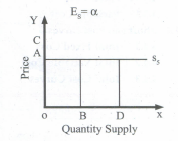
Explain the types of elasticity supply with the help of diagram.
52.
"The features of Rural Economy are peculiar"- Argue.
53.
54.
1.
(b)
industries were reserved exclusively for public sector
2.
(a)
Net Profit
3.
(d)
Subjective and Psychological concept
4.
(b)
Minimum payment
5.
(c)
Price of a commodity
6.
(c)
Both (a) and (b)
7.
(b)
Law of Diminishing Marginal Utility
8.
(a)
Gateway of Tamil Nadu
9.
(a)
Personal
10.
(c)
1975
11.
(a)
Develop heavy Industries
12.
(b)
1991
13.
(a)
4
14.
(d)
b and c
15.
(d)
Neo-Classical Theory
16.
(c)
Gujarat
17.
(c)
Organizer
18.
(b)
planning
19.
(c)
Quantity demanded equals quantity supplied
20.
(b)
Jawaharlal Nehru
21.
Duopoly is a special case of the theory if oligopoly in which there are only two sellers. Both the sellers are completely independent and no agreement exists between them.
22.
y = 4, here 4 is a constant. Differentiation of constant function is zero.
So, \(\frac { dy }{ dx } =\frac { d(4) }{ dx } =0\)
23.
Abolishing government control by removing the earlier restriction and licenses.
24.
Thoothukudi is the major chemical producer in the state. It produces the 70% of the total salt production in the State and 30% in the country.
25.
Marshall says "Capital consists of all kinds of wealth other than free gifts of nature, which yield income"
Bohm - Bawerk defines it as "a produced means of Production".
26.
Resources that can be regenerated in a given span of time. E.g. forests, wildlife, wind, biomass, tidal, hydro energies etc.
27.
(i) Zamindari system
(ii) Mahalwari system
(iii) Ryotwari system.
28.
Micro Finance is also called micro credit, it is a financial service that offers loans, savings and insurance to entrepreneurs and small business owners who do not have access to banks or investors.
29.
(i) In deductive method we move from general to particular.
(ii) It is also called as analytical (or) abstract method.
30.
31.
(i) There are large number of buyers and many sellers.
(ii) Firms under monopolistic competition are price makers. They set their own prices.
(iii) Firms produce differentiated products. It is the key element of monopolistic competition.
(iv) There is a free entry and exist of firms.
32.
\(Y={ 5x }^{ 4 }+{ 3x }^{ 3 }\)
Differentiating,
\(\frac { dx }{ dy } =5(4){ x }^{ 4-1 }+3(3){ x }^{ 3-1 }=20{ x }^{ 3 }+{ 9x }^{ 2 }\)
\(20{ x }^{ 3 }+{ 9x }^{ 2 }\)
33.
Arguments against LPG:
(a) Liberalization measures, when effectively enforced, favour an unrestricted entry of foreign companies in the domestic economy. Suchan entry prevents the growth of the local manufacturers
(b) Privatization measures favour the continuance of the monopoly power. Only the powerful people can sustain in business markets. Social justice cannot be easily established and maintained. As a result, the disparities tend to widen among people and among regions.
(c) (i) As globalization measures tend to integrate all economies of the world and bringing them all under one umbrella; they pave the way for redistribution of economic power at the world level.
(ii) Only the already well developed countries are favoured in this process and the welfare of the less developed countries will be neglected.
(iii) The economic crisis of the developed countries are easily spread to the developing economies through trade.
34.
Features (or) Characteristics of Human Wants:
(a) Wants are unlimited: Human wants are countless in number and various in kinds. When one want is satisfied another want crops up. Human wants multiply with the growth of civilization and development.
(b) Wants become habits: Wants become habits; for example, when a man starts reading newspaper in the morning, it becomes a habit. Same is the case with drinking tea or chewing pans.
(c) Wants are Satiable: Though we cannot satisfy all our wants, at the same time we can satisfy particular wants at a given time. When one feels hungry, he takes food and that want is satisfied.
(d) Wants are Alternative: There are alternative ways to: satisfy a particular want ego idly, dosa or chappathi.
(e) Wants are Competitive: All our wants are not equally important. So, there is competition among wants. Hence, we have to choose more urgent wants than less urgent wants.
(f) Wants are Complementary: Sometimes, satisfaction of a particular want requires the use of more than one commodity. Example: Car and Petrol, Ink and Pen.
(g) Wants are Recurring: Some wants occur again and again. For example, if we feel hungry, we take food and satisfy our want. But after sometime, we again feel hungry. and want food.
35.
(i) The health care services in India are mainly the responsibility of the ministry of health.
(ii) Health status is better in Kerala as compared to other states.
(iii) India's health status is worse than other developed countries.
36.
(i) After Independence, the government adopted planned economic development.
(ii) The main objective of planning was social welfare.
(iii) Before Independence commercial banks were in the private sector.
(iv) These banks did not help the government to achieve the social objectives of planning.
(v) So the government nationalised 14 major commercial banks on 19th July 1969 and 6 more banks in 1980.
37.
Initiation: He considers the situation and availability of resources and plans the process of production.
Innovation: He introduces new methods in the production process.
Co-ordination: He uses a particular combination of the factors of production.
Control, direction & supervision: He directs the factors to get better results and supervises for the efficient functioning of all factors.
Risk taking, uncertainty bearing: Risk is insured, uncertainties cannot be insured.
38.
(i) According to Schumpeter profit is the reward for innovation.
(ii) Innovation means invention put into commercial practice.
(iii) Innovation may consist of introduction of a new product or a new method of production or opening a new market or discovery of new raw materials or reorganisation of an industry.
(iv) The cost of production decreases and so profit increases.
(v) Innovation should be done continuously.
39.
(i) Whether to produce more of food, or clothing or housing or luxury goods.
(ii) Whether to produce more agricultural or industrial goods and services.
(iii) Whether to use more resources in education and health or military services.
(iv) Whether to have more consumption goods or investment goods.
(v) Whether to spend more on basic education or higher education.
40.
Marginal revenue is the addition to the total revenue by the sale of an additional unit of a commodity. It is got by dividing change in TR by the change in quantity sold.
\(M R=\frac{\Delta T R}{\Delta Q}\), where MR = Marginal revenue.
\(M R=T R_{n}-T R_{n-1} \quad \Delta T R=\text { change in total revenue. } \)
\(M R=T R_{n+1}-T R_{n} \quad \Delta Q=\text { change in total quantity. } \)
\(T R_{n}=\text { total revenue of } n^{\text {th }} \text { item } \)
\(T R_{n-1}=\text { total revenue of } n-1^{\text {th }} item\)
\(T R_{n+1}=\text { total revenue of } n+1^{\text {th }}item\)
41.
(i) Large Population: India stands second in terms of size of population next to China and our country is likely to overtake china in near future. Population growth rate of India is very high and this is always a hurdle to growth rate. The population growth rate in India is as high as 1.7 per 1000. The annual addition of population equals the total population of Australia.
(ii) Inequality and poverty: There exists a huge economic disparity in the Indian economy. The proportion of income and assets owned by top 10% of Indians goes on increasing. This has led to an increase in the poverty level in the society and still a higher percentage of individuals are living Below Poverty Line (BPL). As a result of unequal distribution of the rich becomes richer and poor becomes poorer.
(iii) Increasing Prices of Essential Goods: Even though there has been a constant growth in the GDP and growth opportunities in the Indian economy, there have been steady increase in the prices of essential goods. The continuous rise in prices erodes the purchasing power and adversely affects the poor people, whose income is not protected.
(iv) Weak Infrastructure: Even though there has been a gradual improvement in the infrastructural development in the past few decades, there is still a scarcity of the basic infrastructure like power, transport, storage etc.
(v) Inadequate Employment generation: With growing youth population, there is a huge need of the employment opportunities.' The growth in production is not accompanied by creation of job the Indian economy is characterized by 'jobless growth'.
(vi) Outdated technology: The level of technology in agriculture and small scale industries is still outdated and obsolete.
42.
Monetary reforms aimed at doing away with interest rate distortions and rationalising the structure of lending rates. The new policy tried in many ways to make the banking system more efficient. Some of the measures undertaken were:
(i) Reserve Requirements: Reduction in Statutory Liquidity Ratio (SLR) and the Cash Reserve Ratio (CRR) were recommended by the Narasimham Committee Report, 1991. It was proposed to cut down the SLR from 38.5 percent to 25 percent within a time span of three years. Similarly, it was proposed that the CRR be brought down to 3 to 5% over a period of four years.
(ii) Interest Rate Liberalisation: Earlier, -RBI controlled
(a) the interest rates payable on deposits,
(b) the interest rates which could be charged for bank loans.
(iii) Greater competition among public sector, private sector and foreign banks and elimination of administrative constraints.
(iv) Liberalisation of bank branch licensing policy in order to rationalize the existing branch network.
(v) Banks were given freedom to relocate branches and open specialized branches
(vi) Guidelines for opening new private sector banks.
(vii) New accounting norms regarding classification of assets and provisions of bad debt were introduced in tune with the Narasimham Committee Report.
43.
Given \(TC(Q)=2Q^{ 3 }+{ 8Q }^{ 2 }+12Q+20\)
To find MC differentiate the function with respect to Q.
\(MC(Q)=\frac { d(TC) }{ d(Q) } =2(3){ Q }^{ 3-1 }+8(2){ \quad Q }^{ 2-1 }+12(1)\quad { Q }^{ 1-1 }+0\)
\(={ 6Q }^{ 2 }+16Q^{ 1 }+12\)
\(When\quad Q=4\)
\(MC(Q)=6{ (4) }^{ 2 }+16(4)+12\)
\(=96+64+12\)
\(MC(Q)=172\)
To find AVC
\(AVC(Q)=TVC(Q)/Q\)
\(AVC(Q)=TC(Q)-TFC(Q)\)
In TC(Q)-Constant Value is TFC(Q) [\(\therefore \) Value of constant =20]
\(\therefore TFC(Q)={ 2 }Q^{ 3 }+{ 8Q }^{ 2 }+12Q\)
\(AVC(Q)=\frac { TVC(Q) }{ Q } =\frac { { 2Q }^{ 3 }+{ 8Q }^{ 2 }+12Q }{ Q } \)
\(={ 2Q }^{ 2 }+8Q+12\)
\(when \ Q=4\)
\(AVC(Q)=2({ 4) }^{ 2 }+8(4)+12\)
\(=2(16)+8(4)+12=32+32+12\)
\(AVC(Q)=76\)
\(marginal\ cost=172;AV\quad cost=76\)
44.
Given that TC(Q) = 128 + 60Q + 8Q2
We know TC = Fixed cost + variable cost
MC (Q) =\(\frac { d(TC) }{ dQ } \)
= 0 + 60(1)Q1-1 + 8(2)Q2-1
= 0 + 60Q0 + 16Q1(Since, Q0= 1)
MC = 60 + 16Q
Average Cost =\(\frac { TC }{ dQ } \)
=\(\frac { 128+60Q+8Q^{ 2 } }{ Q } \)
AC = \(\frac { 128 }{ Q } \) + 60 + 8Q
Constant value is known as fixed cost
Fixed cost = 128
FC = 128
Average Fixed cost = \(\frac { 128 }{ Q } \)
AFC = \(\frac { 128 }{ Q } \)
Average Variable cost = 60 + 8Q (total variable cost divided by Q)
∴ AVC = 60 + 8Q
45.
Agio Theory of Interest/The Psychological Theory of Interest/Time Preference Theory:
(i) This theory was propounded by John Rae in 1834. But credit goes to Bohm Bawerk an Austrian School economist who has given final shape to the theory.
(ii) The American economist Irving Fisher modified and gave a new theory viz Time Preference theory.
(iii) According to this theory, people prefer present goods rather than future goods. Because the present goods are more certain than future goods, just "as a bird in the hand is worth two in the bush".
(iv) There are many countries where no one knows what will happen next day.
(v) ASEAN crisis of 1996 and American crisis of 2007-08 were not predicted even for economists, including Nobel Laureates.
(vi) So, when people save they have to postpone their present enjoyment or satisfaction.
(vii) If one postpones one's present satisfaction, one has to be paid an "Agio" or "Premium".
(viii) This premium is "interest". People prefer present consumption than future consumption due to the risk increasing and uncertainties of the present world.
46.
The Government is promoting industrial parks like Rubber Park, Apparel Park, Floriculture Park, TICEL Park for Biotechnology, Siruseri IT Park and Agro Zones. Tamil Nadu has a network of about 110 industrial parks/estates that offer developed plots with supporting infrastructure.
Types of Industries:
i) Textiles:
Tamil Nadu is the largest textile hub of India and also "Yarn Bowl" of the country accounting for 41% of India's cotton yarn production. The western part of Tamil Nadu comprising Coimbatore, Tiruppur, Erode, Dindigul and Karur has the majority of spinning mills manufacturing cotton/polyster blended yarn and silk yarn used by garment units in Tamil Nadu. Tiruppur known as "knitting city" is the exporter of garments worth USD 3 million. Erode is the main cloth market both retail and Wholesale market.
ii) Leather:
Tamil Nadu occupies for 30% of leather exports and about 70% of leather production in the country. Hundreds of leather and tannery industries are located around Vel/ore, Dindigul and Erode. Every year the state hosts the India International Leather Fair in Chennai.
iii) Electronics:
Chennai has emerged at EMS Hub of India. Many Multi-national companies have chosen Chennai as their South Asian manufacturing hub.
iv) Automobiles:
Chennai nicknamed as "The Detroit of Asia" is home to large number of auto component industries. Tamil Nadu has 28% share each in automotive and auto component industries, 19% in the trucks segment and 18% each in ' passenger cars and two wheelers.
v) Cement:
Tamil Nadu ranks third in Cement production in India. Among 10 largest cement companies in India as on 2018, Ramco cement and India Cement find prominent place. And also Tamil Nadu stands second in number of cement plants with 21 units against 35 units in Andra Pradesh.
vi) Fireworks:
The town of Sivakasi is a leader in the areas of printing, fireworks and safety matches. It was fondly called as "Little Japan" by Jawaharlal Nehru. It contributes to 80% of India's fireworks production. Sivakasi provides over 60% of India's total offset printing solutions.
vii) Other Industries:
One of the global electrical equipment public sector companies BHEL has manufacturing plants in Tiruchirappalli and Ranipet. TNPL and the State Government, the world's biggest bagasse-based paper mill in Karut The region around Salem is rich in mineral ores. The country's largest steel plant public sector undertaking SAIL has a steel plant in Salem.
47.
Utility means "usefulness". In Economics utility is the want satisfying, power of a commodity or a service utility is a subjective or Psychological concept.
Types of Utility:
The following are the types of utility.
1. Form Utility: An individual consumer obtains utility from a good or service only where and when it is available in a particular form. (Ex) Cotton as a raw material may not possess utility for a consumer, but as it gets a new form as a cloth it yields the consumer utility.
2. Time Utility: A sick man derives time utility from blood not at the time of its donation, but only at the operation time, when it is used.
3. Place Utility: A student derives place utility from a book not at the place of its publication (Production centre) but only at the place of his education (consumption centre).
4. Service Utility: A consumer derives service utility from a service made available at the time when he most needs it. (Ex) Clients obtain service utility from their lawyers.
5. Possession Utility: When a student buy a book or dictionary from a book seller, then only it gives utility.
6. Knowledge Utility: It is the utility derived by having knowledge of a particular thing. Advertisement serves as a source of information on an object.
48.
Introduction:
(i) The law of diminishing marginal utility was extended and is called Law of Equi-marginal utility
(ii) Law of substitution or Law of consumer's Equilibrium or Gossen's II law or law of maximum satisfaction.
Definition:
Marshall, "If a person has a thing which he can put to several uses, he will distribute it among these uses in such a way that it has the same marginal utility in all. For, if it had a greater marginal utility in one use than another, he would gain by taking away some of it from the second use and applying it to first.
Assumption
(i) Consumer is rational and wants maximum satisfaction.
(ii) Utility is measurable in cardinal numbers.
(iii) Marginal utility of money is constant.
(iv) Income of the consumer is given.
(v) There is perfect competition.
(vi) Price is given.
(vii) Law of diminishing marginal utility operates
Explanation:
(i) The consumer has Rs. 11.
(ii) He wants to spend it on apple ( Rs 1 each) and orange (Rs. 1 each)
(iii) He will be in equilibrium only when he gets maximum satisfaction ie.
\(\mathrm{K}=\frac{\text { Marginal utility of apple }}{\text { Price of apple }}=\frac{\text { Marginal utility of orange }}{\text { Price of orange }}\)
If is \(\frac{\mathrm{MU_A}}{\mathrm{P_A}}\) less than \(\frac{\mathrm{MU_O}}{\mathrm{P_O}}\) he would transfer money from apple to orange till it is equal.
He should buy 6 units of apple & 5 units of oranges. He gets (92 + 58) = 150 units satisfaction.
\(\frac{\mathrm{MU_A}}{\mathrm{P_A}}=\frac{\mathrm{MU_O}}{\mathrm{P_O}}=\frac{4}{1}=\frac{4}{1}\)
| Apple | orange | |||
| Units of Commodities | Total Utility | marginal Utility | Total Utility | marginal Utility |
| 1 | 25 | 25 | 30 | 30 |
| 2 | 45 | 20 | 41 | 11 |
| 3 | 63 | 18 | 49 | 8 |
| 4 | 78 | 15 | 54 | 5 |
| 5 | 88 | 10 | 58 | 4 |
| 6 | 92 | 4 | 61 | 3 |
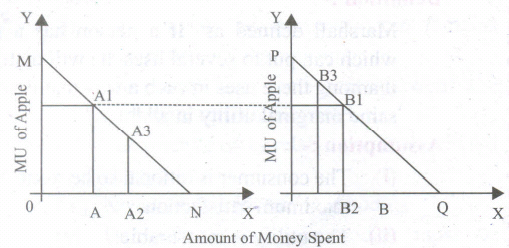
Explanation:
(i) X axis shows amount of money spent
(ii) Y axis shows marginal utility of apple and orange.
(iii) If consumer spends Rs.6 on apple and Rs.5 on orange MU will be equal.
(iv) ie. AA1 = BB1 = 4 = 4. So he gets maximum utility.
Criticisms:
(i) Utility cannot be measured.
(ii) No consumer compares the utility and disutility from each unit of the commodity while buying it.
(iii) This law cannot be applied to durable goods.
Conclusion:
(i) The law of Equi-marginal utility is an improvement over the law of diminishing marginal utility because it can be used for many commodities consumed at the same time.
49.
TC = TFC + TVC
\(AVC=\frac{TVC}{Q}\)
\(AFC=\frac{TFC}{Q}\)
\(AC=\frac{TC}{Q}\)
(i) TC = 100 + Q3. Total cost has two components TFC and TVC.
(ii) TFC = is the total fixed cost which does not change with the level of output.
(iii) It is determined by putting the value of Q.
(iv) Given the total cost function T = 100+Q3
Q = units of output where Q = 10
Here TFC = 100 (TFC will not change with output changes)
TC 100 + (10)3
= 100 + 1000
TC = 1100
\(\therefore\)1100 = 100 + TVC
1100 - 100 = TVC
\(\therefore\)TVC = 1000
TVC = 1000, TC = 1100 \(\therefore\) TFC =?
TC = TFC + TVC
1100 = TFC + 1000
1100 - 1000 = TFC
\(\therefore\)TFC = 100
\(AFC=\frac{TFC}{Q}\)
TFC = 100, Q = 10
\(\therefore\) AFC = 10
\(AFC=\frac{TFC}{Q}\)
TVC = 1000, Q = 10
\(\therefore\) AVC = 100
\(AC=\frac{TC}{Q}\)
TC = 1100, Q = 10
\(\therefore\) AC = 110
or
AC = AFC + AVC
AFC = 10, AVC = 100
AC = 10 + 100
\(\therefore\) AC = 110
50.
Introduction :
(i) Small scale industries play an important role for the development of Indian economy.
(ii) 60 - 70% of total innovations in India comes from SSIs.
Provides employment:
(i) SSIs use labour intensive techniques.
(ii) They provide employment to artisans, technically qualified persons and professionals, people engaged in traditional arts, people in villages and unorganized sector.
(iii) The employment-capital ratio is high.
Brings balanced regional development:
(i) SSIs are set up in backward and rural areas.
(ii) This promotes decentralised development of industries.
(iii) They reduce congestion, slums, sanitation and pollution in cities since they are found outside city limits.
(iv) They improve the standard of living of people in suburban and rural areas
(v) The entrepreneurial talent is tapped from different regions.
Helps in mobilization of local resources:
(i) SSIs mobilize and use local resources like small savings, entrepreneurial talent etc of the entrepreneurs which might have remained idle.
(ii) It promotes traditional family skills and handicrafts.
Paves for optimisation of capital:
(i) SSIs needs less capital. They give quick profit due to shorter gestation period.
(ii) SSIs functions as a stabilizing force by providing high output-capital ratio and high employment capital ratio.
(iii) They encourage people living in rural areas to save and channelize them into industrial activities.
Promotes export:
(i) Since they do not need sophisticated machinery, import of machinery from abroad is not needed.
(ii) There is great demand for goods produced by SSIs.
(iii) They reduce the pressure on balance of payment as they earn foreign exchange
Complements large scale industries:
(i) They provide components, parts, accessories to large scale industries.
(ii) They serve as ancillaries to large scale units.
Meets consumer demand:
(i) SSIs produce a wide range of consumer products.
(ii) They serve as an anti-inflationary force by providing goods of daily use.
Develops entrepreneurship:
(i) SSIs help to develop entrepreneurs.
(ii) They help the job seekers to become job givers.
(iii) They promote self-employment and a spirit of self-reliance.
(iv) It increases the per capita income of India.
(v) There is development of backward areas and weaker sections.
(vi) It helps in equitable distribution of income.
51.
There are five types of elasticity supply. There are,
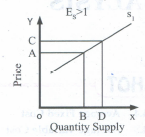
(1) Relative Elastic Supply: (ES> 1)
(i) The co-efficient of elastic supply is greater than 1 (ES> 1)
(ii) A unit change in the price causes more than one percent change in quantity supply of the commodity.
(2) Unitary Elastic Supply: (ES = 1)
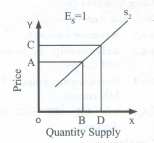
(i) The co-efficient of elastic supply is equal to one (ES = 1)
(ii) A unit change in the price causes an equal change in quantity supply is called elastic supply.
(3) Relatively Inelastic Supply: (ES < 1)
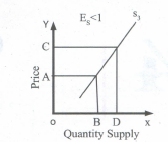
(i) The co-efficient of elasticity is less than one (ES < 1)
(ii) A unit change in the price causes and less than one percent change in the quantity supply.
(4) Perfectly Inelastic Supply: (ES = 0) .
(i) The co-efficient of elasticity is equal to zero (ES = 0)
(ii) A unit change in the price causes no change in the quantity supply.
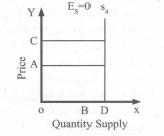
(5) Perfectly elastic supply: (ES = ∞)
(i) The co-efficient of elasticity of supply is infinity (ES = DC)
(ii) A unit change in the price causes an infinite change in the quantity supply.
52.
Introduction:
Rural economy refers to villages and rural community refers to people living in villages.
Features of rural economy:
Village is an institution:
(i) Village is a primary institution and it satisfies almost all the needs of the rural community.
(ii) The rural people have a feeling of belongingness and a sense of unity towards each other.
Dependence on agriculture:
The rural economy depends on nature and agricultural activities.
Life of rural people:
(i) Lifestyle in village is very simple. Education, housing, health and sanitation, transport and communication, banking, roads and markets are limited and unavailable.
(ii) Rural people rely on faith, superstitions and traditional cultural practices.
(iii) The methods of production, social organization, political mobilization, rural sector is extremely weak and backward.
(iv) The incidence of alcohol drinking has gone up.
Population density:
Population density is very low. Houses are scattered in the entire village.
Employment:
There is unemployment, seasonal unemployment and underemployment.
Poverty:
(i) Basic needs of the people like food, clothing and shelter are not met
(ii) About 22 crores of people in rural areas are poor and live below poverty line.
Indebtedness:
(i) People in rural areas are highly indebted owing to poverty, underemployment, lack of farm and non-farm employment opportunities, low wage employment, seasonality in production, poor marketing network.
(ii) Since formal loan facilities are not available to the villagers, they depend on local money lenders who squeeze the villagers.
Rural income
Large proportion of labourers are underemployed and the scope for increasing their income is limited.
Dependency:
Rural households are largely dependent on social grants and remittances from family members working in urban areas.
Dualism:
The co-existence of features of organised and unorganised, traditional and modern, regulated and unregulated, poor and rich, skilled and unskilled is very common in rural areas.
Inequality:
There is inequality in distribution of income, wealth and assets. Land, livestock are owned by a few people. Landlords dominate the rural activities.
Migration:
Rural people migrate from villages to urban areas for gainful employment. Lack of basic amenities in rural areas also push the people to urban areas.
53.
54.

11th Standard Syllabus & Materials
11th Standard
TN 11th Tamil பீடு பெற நில் - செய்யுள் - காவடிச்சிந்து Important Questions And Answers Study Material - QB365 Set A
NEW11th Standard
TN 11th Tamil பீடு பெற நில் - உரைநடை - மலை இடப்பெயர்கள் : ஓர் ஆய்வு Important Questions And Answers Study Material - QB365 Set A
NEW11th Standard
TN 11th Tamil மாமழை போற்றுதும் - துணைப்பாடம் - யானை டாக்டர் Important Questions And Answers Study Material - QB365 Set A
NEW11th Standard
TN 11th Tamil மாமழை போற்றுதும் - செய்யுள் - ஐங்குறுநூறு Important Questions And Answers Study Material - QB365 Set A



Tamilnadu Stateboard 11th Standard Subjects

Maths

Commerce
Economics

Biology

Business Maths and Statistics

Accountancy

Computer Science

Physics

Chemistry
Maths
Biology
Economics
Physics
Chemistry

History
Business Maths and Statistics

Computer Science
Accountancy

Computer Applications
History
Computer Technology
Commerce
Computer Applications
Computer Technology

Tamil

English

French
Tamilnadu Stateboard Standards
