
 100% FREE ACCESS
11th Standard Syllabus & Materials
11th Standard
TN 11th Tamil இயற்கை வேளாண்மை,சுற்றுச்சூழல் -செய்யுள் - மனோன்மணீயம் Important Questions And Answers Study Material - QB365 Set A
NEW11th Standard
TN 11th Tamil என்னுயிர் என்பேன் -துணைப்பாடம் - இசைத்தமிழர் இருவர் Important Questions And Answers Study Material - QB365 Set A
NEW11th Standard
TN 11th Tamil மொழி கலை -செய்யுள் - ஒவ்வொரு புல்லையும் Important Questions And Answers Study Material - QB365 Set A
NEW11th Standard
TN 11th Tamil பீடு பெற நில் - இலக்கணம் - பகுபத உறுப்புகள் Important Questions And Answers Study Material - QB365 Set A
NEW11th Standard
TN 11th Tamil பீடு பெற நில் - துணைப்பாடம் - வாடிவாசல் Important Questions And Answers Study Material - QB365 Set A
NEW11th Standard
TN 11th Tamil பீடு பெற நில் - செய்யுள் - குறுந்தொகை Important Questions And Answers Study Material - QB365 Set A

Published on: 05/12/2018
One mark questions are quick and easy to score. Here are the most important one mark questions from the Samacheer syllabus for 11th Maths. Students can practice with this question paper to score more. In this question paper, one marks are questions are taken based on the book back, creative questions and repeatedly asked questions.
The question paper is created based on the state board syllabus. It is a very useful question paper for Matriculation and state board students for their exam preparation. Usually, one mark questions are very simple but asked in a tricky way. By practicing repeatedly you will get the idea of answering the questions and this improves the speed of answering. This will save the time and you can complete all the questions without any last our tension.
Our aim is to bring out the best scores on board exams. By practicing with this important model question paper student can gain more knowledge and confidence to crack the exams. With this model objective questions, you can get good scores by practicing.
Download Tamil Nadu 11th Standard Maths question papers, model tests, one-mark questions, important questions, and public exam papers in PDF format. Free study materials and answer keys for TN State Board students.
Questions + Answers key
Take MCQ Maths Test1.
\(\int { \frac { x }{ 4+{ x }^{ 4 } } } \) dx is equal to________+c.
\(\frac { 1 }{ 4 } \) tan-1 (x2)
\(\frac { 1 }{ 4 } \) tan-1 \(\left( \frac { { x }^{ 2 } }{ 2 } \right) \)
\(\frac { 1 }{ 2 } \) tan-1 \(\left( \frac { { x }^{ 2 } }{ 2 } \right) \)
none of these
2.
\(\int { { tan }^{ 3 } } 2sec2x\) dx = ___________+c.
\(\frac { 1 }{ 6 } \) sec3 2x
\(\frac { 1 }{ 6 } \) sec32x - \(\frac { 1 }{ 2 } \) sec 2x
\(\frac { 1 }{ 2 } \) sec 2x
\(\frac { 1 }{ 6 } \) sec3 2x + \(\frac { 1 }{ 2 } \) sec 2x
3.
A flash light has 8 batteries out of which 3 are dead. If 2 batteries are selected without replacement and tested, the probability that both are dead is
\(\frac { 3 }{ 28 } \)
\(\frac { 1 }{ 14 } \)
\(\frac { 9 }{ 64 } \)
\(\frac { 33 }{ 56 } \)
4.
A bag contains 5 black balls, 4 white balls and 3 red balls. If a ball is selected at random, the probability that it is black or red ball is
\(\frac { 1 }{ 3 } \)
\(\frac { 1 }{ 4 } \)
\(\frac { 5 }{ 12 } \)
\(\frac { 2 }{ 3 } \)
5.
The slop of the curve \(y={ x }^{ 3 }-7{ x }^{ 2 }+5x+10\) at x=1 is
6
-6
5
15
6.
\(\lim _{ x\rightarrow \frac { \pi }{ 2 } }{ \frac { \sin { x } }{ x } } =\)
\(\pi \)
\(\frac { \pi }{ 2 } \)
\(\frac { 2 }{ \pi } \)
1
7.
Choose the correct or the most suitable answer from the given four alternatives.
If, \(y=a+b{ x }^{ 2 }\) where a, b are arbitrary constants, then ____
\(\frac { d^{ 2 }y }{ d{ x }^{ 2 } } =2xy\)
\(x\frac { d^{ 2 }y }{ d{ x }^{ 2 } } ={ y }_{ 1 }\)
\(x\frac { d^{ 2 }y }{ d{ x }^{ 2 } } -\frac { dy }{ dx } +y=0\)
\(x\frac { d^{ 2 }y }{ d{ x }^{ 2 } } =2xy\)
8.
Choose the correct or the most suitable answer from the given four alternatives.
If \(y=\log _{ a }{ x } \) then \(\frac { dy }{ dx } \) is ______
\(\frac { 1 }{ x } \)
\(\frac { 1 }{ x\log _{ e }{ a } } \)
\(\log { _{ e }^{ a } } \)
\(\frac { 1 }{ \log _{ a }{ x } } \)
9.
The value of \(\left| \begin{matrix} x+1 & x+2 & x+a \\ x+2 & x+3 & x+b \\ x+3 & x+4 & x+c \end{matrix} \right| \) =_____________ 0, where a, b, c are in AP is
(x+1)(x+2)(x+3)
I
0
(x+a)(x+b)(x+c)
10.
A matrix which is not a square matrix is called a_________matrix.
singular
non-singular
non-square
rectangular
11.
If m is a number such that m \(\le\) 5, then the probability that quadratic equation 2x2 + 2mx + m + 1 = 0 has real roots is
\({1\over 5}\)
\({2\over 5}\)
\({3\over 5}\)
\({4\over 5}\)
12.
If A and B are two events such that A ⊂ B and P(B)\(\neq o\), then which of the following is correct?
\(P(A/B)={P(A)\over P(B)}\)
P(A/B)
P(A/B)\(\ge\)P(A)
P(A/B)>P(B)
13.
A man has 3 fifty rupee notes, 4 hundred rupees notes, and 6 five hundred rupees notes in his pocket. If 2 notes are taken at random, what are the odds in favour of both notes being of hundred rupee denomination?
1:12
12:1
13:1
1:13
14.
\(\int \sin \sqrt{x} d x\) is
\(2(-\sqrt{x}cos\sqrt{x}+sin\sqrt{x})+c\)
\(2(-\sqrt{x}cos\sqrt{x}-sin\sqrt{x})+c\)
\(2(-\sqrt{x}sin\sqrt{x}-cos\sqrt{x})+c\)
\(2(-\sqrt{x}sin\sqrt{x}+cos\sqrt{x})+c\)
15.
\(\int \frac{e^{6 \log x}-e^{5 \log x}}{e^{4 \log x}-e^{3 \log x}} d x\) is
x+c
\({x^3\over 3}+c\)
\({3\over x^3}+c\)
\({1\over x^2}+c\)
16.
The number of points in R in which the function \(f(x)=|x-1|+|x-3|+sin \ x\) is not differentiable, is
3
2
1
4
17.
If y = cos (sin x2), then \({dy\over dx}\) at x = \(\sqrt{\pi\over 2}\) is
-2
2
\(-2\sqrt{\pi\over 2}\)
0
18.
\(lim_{\alpha \rightarrow {\pi/4}}{sin \alpha -cos \alpha \over \alpha -{\pi\over 4}}\) is
\(\sqrt{2}\)
\(1\over \sqrt{2}\)
1
2
19.
The vectors \(\overrightarrow{a}-\overrightarrow{b},\overrightarrow{b}-\overrightarrow{c},\overrightarrow{c}-\overrightarrow{a}\) are
parallel to each other
unit vectors
mutually perpendicular vectors
coplanar vectors.
20.
If \(\triangle\) = \(\begin{vmatrix} a&b &c \\ x & y & z \\ p &q &r \end{vmatrix}\), then \(\begin{vmatrix} ka&kb &kc \\ kx & ky & kz \\k p &kq &kr \end{vmatrix}\) is
\(\triangle\)
k\(\triangle\)
3k\(\triangle\)
k3\(\triangle\)
21.
The locus of a point which is collinear with the points (a, 0) and (0, b) is ______________
x + y = 1
\(\frac{x}{a}+\frac{y}{b}=1\)
x + y = ab
\(\frac{x}{a}-\frac{y}{b}=1\)
22.
The angle between the lines 2x - y + 5 = 0 and 3x + y + 4 = 0 is ______________
450
300
600
900
23.
Area of triangle ABC is _______________
\(\frac{1}{2}\)ab cos C
\(\frac{1}{2}\)ab sin C
\(\frac{1}{2}\)ab cos B
\(\frac{1}{2}\)bc sin B
24.
If sin θ = sin \(\alpha\), then the angles θ and \(\alpha\) are related by _______________
\(\theta=n\pi\pm\alpha\)
\(\theta=2n\pi+(-1)^n\alpha\)
\(\alpha=n\pi\pm(-1)^n\theta\)
\(\theta=(2n+1)\pi+\alpha\)
25.
Which one of the following is false?
A⋂(BΔ\C) = (A ⋂ B)Δ(A ∩ C)
A∩(B - C) = (A ∩B) \ (A∩C)
(A U B), = A' ∩ B'
(A \ B) U B = A ⋂ B
26.
Which one of the following statements is false? The graph of the function \(f(x)={1\over x}\)
exist is the first and third quadrant only
is a reciprocal function
is defined at x = 0
it is symmetric about y = x and y = - x.
27.
The length of perpendicular from the origin to a line is 12 and the line makes an angle of 120° with the positive direction of y-axis. then the equation of line is ______________
\(x+y\sqrt 3=24\)
\(x+y=12\sqrt 2\)
x + y = 24
\(x+y=12\sqrt 3\)
28.
If nC10 = nC6, then nC2 = _________
16
4
120
240
29.
A candidate is required to answer 7 question out of 12 questions, which are divided into two groups each containing 6 questions. He is not permitted to attempt more than 5 questions from either group. Find the number of different ways of doing questions.
779
781
780
782
30.
If an A.P the sum of terms equidistant from the beginning and end is equal to ______________
first term
second term
sum of first and last term
last term
31.
Let \(\alpha\) and \(\beta\) are the roots of a quadratic equation px2 + qx + r = 0 then ___________
\(\alpha +\beta=-{p\over r}\)
\(\alpha\beta={p\over r}\)
\(\alpha +\beta={-q\over p}\)
\(\alpha \beta =r\)
32.
Find the point of intersection of the lines 2x2+ xy -y2- 5x + 3y + 2 = 0 ______________
(-1, -1)
(1, 1)
(1, 0)
(0, 1)
33.
Expansion of \(log(\sqrt \frac{1+x}{1-x})\) is ______________
\(x+\frac{x^3}{3}+\frac{x^5}{5}+...\)
\(1.\frac{x^2}{2}+\frac{x^4}{4}+...\)
\(1-x+\frac{x^2}{2}+\frac{x^3}{5}+...\)
\(x-\frac{x^2}{3}+\frac{x^3}{3}+...\)
34.
The quadratic equation whose roots are tan 75° and cot 75° is _______________
x2+4x+ 1 = 0
4x2-x+ 1 = 0
4x2+ 4x - 1 = 0
x2 - 4x + 1 = 0
35.
 is _________
\(\lfloor{n}(n+2)\)


none of these
36.
If \(f:[-2,2]\rightarrow A\) is given by f(x) = 33 then f is onto, if A is ___________
[3, 3]
(3, 3)
[-24,24]
(-24, 24)
37.
The series for log \(\left( \frac { 1+x }{ 1-x } \right) is\) ______________
\(x+\frac { { x }^{ 3 } }{ 3 } +\frac { { x }^{ 5 } }{ 5 } +...+\infty \)
\(2\left[ x+\frac { { x }^{ 3 } }{ 3 } +\frac { { x }^{ 5 } }{ 5 } +...+\infty \right] \)
\(\frac { { x }^{ 2 } }{ 2 } +\frac { { x }^{ 4 } }{ 4 } +\frac { { x }^{ 6 } }{ 6 } +...+\infty \)
\(2\left[ \frac { { x }^{ 2 } }{ 2 } +\frac { { x }^{ 4 } }{ 4 } +\frac { { x }^{ 6 } }{ 6 } +...+\infty \right] \)
38.
If the two straight lines x + (2k -7)y + 3 = 0 and 3kx + 9y - 5 = 0 are perpendicular then the value of k is
k = 3
\(k=\frac13\)
\(k=\frac23\)
\(k=\frac32\)
39.
The first and last term of an A.P. are 1 and 11. If the sum of its terms is 36, then the number of terms will be ______________
5
6
7
8
40.
The number of ways to arrange the letters of the word CHEESE are _________
120
240
720
6
41.
Which of the following equation is the locus of (at2, 2at)
\(\frac{x^2}{a^2}-\frac{y^2}{b^2}=1\)
\(\frac{x^2}{a^2}+\frac{y^2}{b^2}=1\)
x2 + y2 = a2
y2 = 4ax
42.
The value of the series\(\frac { 1 }{ 2 } +\frac { 7 }{ 4 } +\frac { 13 }{ 8 } +\frac { 19 }{ 16 } +\).....is
14
7
4
6
43.
The number of five digit telephone numbers having at least one of their digits repeated is
90000
10000
30240
69760
44.
\(\sqrt [ 4 ]{ 11 } \) is equal to ___________
\(\sqrt [ 8 ]{ 11^{ 2 } } \)
\(\sqrt [ 8 ]{ 11^{ 4 } } \)
\(\sqrt [ 8 ]{ 11^{ 8 } } \)
\(\sqrt [ 8 ]{ 11^{ 6 } } \)
45.
If cosec x + cot x = \(\frac { 11 }{ 2 } \) then tan x = ___________
\(\frac { 21 }{ 22 } \)
\(\frac { 15 }{ 16 } \)
\(\frac { 44 }{ 117 } \)
\(\frac { 117 }{ 44 } \)
46.
The number of roots of (x + 3)4+ (x + 5)4 = 16 is
4
2
3
0
47.
48.
\(\left( 1+cos\frac { \pi }{ 8 } \right) \left( 1+cos\frac { 3\pi }{ 8 } \right) \left( 1+cos\frac { 5\pi }{ 8 } \right) \left( 1+cos\frac { 7\pi }{ 8 } \right) \) =
\(\frac { 1 }{ 8 } \)
\(\frac { 1 }{ 2 } \)
\(\frac { 1 }{ \sqrt { 3 } } \)
\(\frac { 1 }{ \sqrt { 2 } } \)
49.
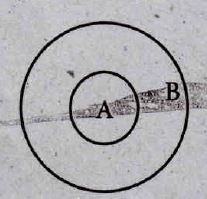
The shaded region in the adjoining diagram represents.

A\B
B\A
AΔB
A'
50.
The inverse of f(x) = \(\begin{cases} x\quad if\quad x<1 \\ { x }^{ 2 }\quad if\quad 1\le x\le 4 \\ 8\sqrt { x } \quad if\quad x>4 \end{cases}\) is
\({ f }^{ -1 }(x)=\begin{cases} x\quad if\quad x<1 \\ \sqrt { x } \quad if\quad 1\le x\le 16 \\ \frac { { x }^{ 2 } }{ 64 } \quad if\quad x>16 \end{cases}\)
\({ f }^{ -1 }(x)=\begin{cases} -x\quad if\quad x<1 \\ \sqrt { x } \quad if\quad 1\le x\le 16 \\ \frac { { x }^{ 2 } }{ 64 } \quad if\quad x>16 \end{cases}\)
\({ f }^{ -1 }(x)=\begin{cases} { x }^{ 2 }\quad if\quad x<1 \\ \sqrt { x } \quad if\quad 1\le x\le 16 \\ \frac { { x }^{ 2 } }{ 64 } \quad if\quad x>16 \end{cases}\)
\({ f }^{ -1 }(x)=\begin{cases} { 2x }\quad if\quad x<1 \\ \sqrt { x } \quad if\quad 1\le x\le 16 \\ \frac { { x }^{ 2 } }{ 8 } \quad if\quad x>16 \end{cases}\)
1.
(b)
\(\frac { 1 }{ 4 } \) tan-1 \(\left( \frac { { x }^{ 2 } }{ 2 } \right) \)
2.
(b)
\(\frac { 1 }{ 6 } \) sec32x - \(\frac { 1 }{ 2 } \) sec 2x
3.
(a)
\(\frac { 3 }{ 28 } \)
4.
(d)
\(\frac { 2 }{ 3 } \)
5.
(b)
-6
6.
(c)
\(\frac { 2 }{ \pi } \)
7.
(b)
\(x\frac { d^{ 2 }y }{ d{ x }^{ 2 } } ={ y }_{ 1 }\)
8.
(b)
\(\frac { 1 }{ x\log _{ e }{ a } } \)
9.
(c)
0
10.
(d)
rectangular
11.
\(m \leq 5\)
\(2 x^{2}+2 m x+m+1>0\)
For real roots
\(4 m^{2}-8(m+1)>0 \)
\(4 m^{2} - 8 m-8>0 \)
\(m^{2}-2 m-2>0 \)
\(\text {Then } m \text { can be } 5,4,3\)
\(n(S)=5 ,n(A)=3 ,P(A)=\frac{3}{5} \)
12.
\(P(A / B)=\frac{P(A \cap B)}{P(B)}=\frac{P(A)}{P(B)}[\because A \subset B \Rightarrow A \cap B=A]\)
13.
Fifty rupee note = 3
Hundred rupee note = 4
500 rupee note = 6
Totsl = 13
\(\mathrm{n}(\mathrm{S})=13 \mathrm{C}_{2}=78\)
\(\text {No. of ways the event to occur }=4\)
\(n(A)=4 C_{2}=6\)
\(\text {No. of ways the event not to occur }=72\)
The odds of event are a:b
\(6: 72 \Rightarrow 1: 12\)
14.
\(\text { Let } \sqrt{x}=t\)
\(\text { Then } x=t^{2}\)
\(\therefore \frac{d x}{d t}=2 t\)
\(\therefore d x=2 t d t\)
\(\therefore \int \sin \sqrt{x} d x=\int \sin t \times 2 t d t\)
\(=2 \int t \sin t d t\)
\(\text { Applying Bernoulli's formula }\)
\(=2[t(-\cos t)-1(-\sin t)]+c\)
\(\text { Putting } t=\sqrt{x}\)
\(=2[-\sqrt{x} \cos \sqrt{x}+\sin \sqrt{x}]+c\)
15.
\(\int \frac{e^{6 \log x}-e^{5 \log x}}{e^{4 \log x}-e^{3 \log x}} d x =\int \frac{x^{6}-x^{5}}{x^{4}-x^{3}} d x \)
\(=\int \frac{x^{2}\left(x^{4}-x^{3}\right)}{x^{4}-x^{3}} d x \)
\(=\int x^{2} d x=\frac{x^{3}}{3}+c \)
16.
\(f(x)=|x-1|+|x-3|+\sin x\)
\(\text { Since } \sin x \text { is differentiable everywhere }\)
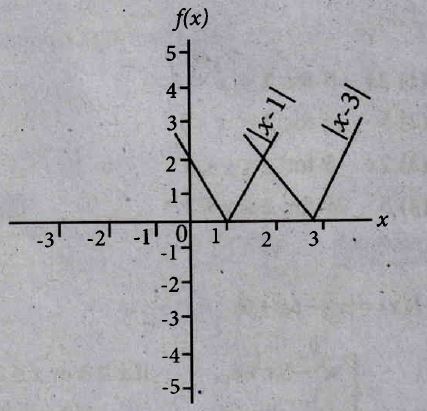
At x = 1 and x = 3. The graph admit cups.
\(\therefore\) The derivative is not exist.
\(\therefore\) The number of points in R is 2.
17.
\(y =\cos \left(\sin x^{2}\right) \)
\(\frac{d y}{d x} =-\sin \left(\sin x^{2}\right) \cos \left(x^{2}\right)(2 x) \)
\(\text { At } x =\sqrt{\pi / 2}, \frac{d y}{d x}=-\sin \sin \left(\frac{\pi}{z}\right) \cos (\pi / 2) 2(\sqrt{\pi / 2}) \)
\(=(\sin 1)(0) 2\left(\frac{\sqrt{\pi}}{2}\right)=0 \quad[\because \cos \pi / 2=0] \)
18.
We know that,
\(\sin \alpha-\cos \alpha =\sqrt{2}\left[\frac{1}{\sqrt{2}} \sin \alpha-\frac{1}{\sqrt{2}} \cos \alpha\right] \)
\(=\sqrt{2}\left[\cos \frac{\pi}{4} \sin \alpha-\sin \frac{\pi}{4} \cos \alpha\right] \)
\(=\sqrt{2} \sin \left(\alpha-\frac{\pi}{4}\right) \)
\(\therefore \lim _{\alpha \rightarrow \frac{\pi}{4}} \frac{\sin \alpha-\cos \alpha}{\alpha-\frac{\pi}{4}} =\lim _{\alpha-\frac{\pi}{4} \rightarrow 0} \frac{\sqrt{2} \sin \left(\alpha-\frac{\pi}{4}\right)}{\left(\alpha-\frac{\pi}{4}\right)}=\sqrt{2}
\)
19.
(d)
coplanar vectors.
20.
\(\left|\begin{array}{lll} k a & k b & k c \\ k x & k y & k z \\ k p & k q & k r \end{array}\right|=k^{3}\left|\begin{array}{lll} a & b & c \\ x & y & z \\ p & q & r \end{array}\right|=k^{3} \Delta\)
\(\text { Take } k \text { from } R_{1}, R_{2}, R_{3}\)
21.
(b)
\(\frac{x}{a}+\frac{y}{b}=1\)
22.
(a)
450
23.
(b)
\(\frac{1}{2}\)ab sin C
24.
(c)
\(\alpha=n\pi\pm(-1)^n\theta\)
25.
(d)
(A \ B) U B = A ⋂ B
26.
(c)
is defined at x = 0
27.
(a)
\(x+y\sqrt 3=24\)
28.
(c)
120
29.
(c)
780
30.
(c)
sum of first and last term
31.
(c)
\(\alpha +\beta={-q\over p}\)
32.
(b)
(1, 1)
33.
(a)
\(x+\frac{x^3}{3}+\frac{x^5}{5}+...\)
34.
(d)
x2 - 4x + 1 = 0
35.
(a)
\(\lfloor{n}(n+2)\)
36.
(c)
[-24,24]
37.
(b)
\(2\left[ x+\frac { { x }^{ 3 } }{ 3 } +\frac { { x }^{ 5 } }{ 5 } +...+\infty \right] \)
38.
\(\text { Slope of first line }=\frac{-1}{(2 k-7)}\)
\(\text { Slope of second line }=\frac{-3 k}{9}\)
\(\text { They are perpendicular } \mathrm{m}_{1} \mathrm{~m}_{2}=-1\)
\(\frac{3 k}{9(2 k-7)} =-1 \)
\(k =-3(2 k-7) \)
\(k =-6 k+21 \)
\(7 k =21 \)
\(k=3 \)
39.
(b)
6
40.
(a)
120
41.
\(\left(a t^{2}, 2 a t\right) \Rightarrow x=a t^{2}, \quad y=2 a t\)
\(y^{2} =4 a^{2} t^{2} \)
\(=4 a^{2}\left(\frac{x}{a}\right) \)
\(y^{2} =4 a x \)
42.
\(\mathrm{a} =1, \quad \mathrm{~d}=6, \quad \mathrm{r}=\frac{1}{2} \)
\(\mathrm{~S}_{\infty} =\frac{a}{1-\mathrm{r}}+\frac{\mathrm{dr}}{(1+\mathrm{r})^{2}} \)
\(=\frac{1}{1-\frac{1}{2}}+\frac{6 \times \frac{1}{2}}{\left(\frac{1}{2}\right)^{2}} \)
\(=2+(3 \times 4)=14 \)
43.
The number of five digit telephone numbers which can be formed using the digits 0,1,2.... 9 is 105.
The number of 5 digit numbers which has none of their digit repeated is 10P5, = 30240
The required number of telephone number is 105 =- 30240 = 69,760
44.
(a)
\(\sqrt [ 8 ]{ 11^{ 2 } } \)
45.
(c)
\(\frac { 44 }{ 117 } \)
46.
(a)
4
47.
(b)
48.
\(\left(2 \cos ^{2} \frac{\pi}{16}\right)\left(2 \cos ^{2} \frac{3 \pi}{16}\right)\left(2 \cos ^{2} \frac{5 \pi}{16}\right)\left(2 \cos ^{2} \frac{7 \pi}{16}\right) \)
\(=2^{4}\left[\cos \frac{\pi}{16} \cos \frac{3 \pi}{16} \cos \frac{5 \pi}{16} \cos \frac{7 \pi}{16}\right]^{2} \)
\(=\left(\cos \frac{8 \pi}{16}+\cos \frac{6 \pi}{16}\right)^{2}\left(\cos \frac{8 \pi}{16}+\cos \frac{2 \pi}{16}\right)^{2} \)
\(=\left(\cos \frac{6 \pi}{16}\right)^{2}\left(\cos \frac{2 \pi}{16}\right)^{2} \)
\(=\left\{\frac{1}{2}\left[\cos \frac{8 \pi}{16}+\cos \frac{4 \pi}{16}\right]\right\}^{2} \)
\(=\frac{1}{4} \cdot \frac{1}{2}=\frac{1}{8} \)
49.
(c)
AΔB
50.
\(\text { i) Let } y=x \text { then } x=y \Rightarrow f^{-1}(x)=x\)
\(\text { ii) Let } y=x^{2} \text { then } y=\sqrt{x} \Rightarrow f^{-1}(x)=\sqrt{x}\)
\(\text { iii) Let } y=8 \sqrt{x} \text { then } \frac{y^{2}}{64}=x \Rightarrow \mathrm{f}^{-1}(x)=\frac{x^{2}}{64}\)
\(\therefore \mathrm{f}^{-1}(x)= \begin{cases}x & x<1 \\ \sqrt{x} & 1 \leq x \leq 16 \\ \frac{x^{2}}{64} & x>16\end{cases}\)

11th Standard Syllabus & Materials
11th Standard
TN 11th Tamil பீடு பெற நில் - செய்யுள் - காவடிச்சிந்து Important Questions And Answers Study Material - QB365 Set A
NEW11th Standard
TN 11th Tamil பீடு பெற நில் - உரைநடை - மலை இடப்பெயர்கள் : ஓர் ஆய்வு Important Questions And Answers Study Material - QB365 Set A
NEW11th Standard
TN 11th Tamil மாமழை போற்றுதும் - துணைப்பாடம் - யானை டாக்டர் Important Questions And Answers Study Material - QB365 Set A
NEW11th Standard
TN 11th Tamil மாமழை போற்றுதும் - செய்யுள் - ஐங்குறுநூறு Important Questions And Answers Study Material - QB365 Set A



Tamilnadu Stateboard 11th Standard Subjects
Maths

Commerce

Economics

Biology

Business Maths and Statistics

Accountancy

Computer Science

Physics

Chemistry
Maths
Biology
Economics
Physics
Chemistry

History
Business Maths and Statistics

Computer Science
Accountancy

Computer Applications
History
Computer Technology
Commerce
Computer Applications
Computer Technology

Tamil

English

French
Tamilnadu Stateboard Standards

