
 100% FREE ACCESS
11th Standard Syllabus & Materials
11th Standard
TN 11th Tamil இயற்கை வேளாண்மை,சுற்றுச்சூழல் -செய்யுள் - மனோன்மணீயம் Important Questions And Answers Study Material - QB365 Set A
NEW11th Standard
TN 11th Tamil என்னுயிர் என்பேன் -துணைப்பாடம் - இசைத்தமிழர் இருவர் Important Questions And Answers Study Material - QB365 Set A
NEW11th Standard
TN 11th Tamil மொழி கலை -செய்யுள் - ஒவ்வொரு புல்லையும் Important Questions And Answers Study Material - QB365 Set A
NEW11th Standard
TN 11th Tamil பீடு பெற நில் - இலக்கணம் - பகுபத உறுப்புகள் Important Questions And Answers Study Material - QB365 Set A
NEW11th Standard
TN 11th Tamil பீடு பெற நில் - துணைப்பாடம் - வாடிவாசல் Important Questions And Answers Study Material - QB365 Set A
NEW11th Standard
TN 11th Tamil பீடு பெற நில் - செய்யுள் - குறுந்தொகை Important Questions And Answers Study Material - QB365 Set A

Published on: 12/03/2019
Plus One Public Exam March 2019 Important One Mark Questions
Download Tamil Nadu 11th Standard Physics question papers, model tests, one-mark questions, important questions, and public exam papers in PDF format. Free study materials and answer keys for TN State Board students.
Questions + Answers key
Take MCQ Physics Test1.
Moment of inertia of a thin uniform rod about an axis passing through the center of mass and perpendicular to the length is _____________.
\(\frac{1}{3}Ml^{2}\)
\(\frac{1}{12}Ml^{2}\)
\(\frac{1}{2}m(l^{2}+b^{2})\)
ml2
2.
The torque in rotational motion is analogous to __________ in translational motion
linear momentum
mass
couple
force
3.
A solid cylinder of mass 3 kg and radius 10 cm is rotating about its axis with a frequency of 20/\(\pi \). The rotational kinetic energy of the cylinder _____________.
10\(\pi \)J
12 J
\(\frac { 6\times { 10 }^{ 2 } }{ \pi } \)J
3 J
4.
A gun fires two bullets with same velocity at 60° and 30° with horizontal. The bullets strike at the same horizontal distance. The ratio of maximum height for the two bullets is in the ratio of _____________.
1: 2
3: 1
2: 1
1: 3
5.
In pure rolling, rotational velocity of points at its edges is equal to ____________.
Rω
velocity of centre of mass
translational velocity
all the above
6.
While rolling, the path of center of mass of an object is _______________.
straight line
parabola
hyperbola
circle
7.
Rotational Kinetic energy of a body is ____________.
\(\frac { 1 }{ 2 } \)mr2
\(\frac { 1 }{ 2 } \)Iω2
\(\frac { 1 }{ 2 } \)Iv2
\(\frac { 1 }{ 2 } \)mω2
8.
In non-uniform circular motion, the resultant acceleration makes an angle with the radius vector is ___________.
\(\tan^{-1}(\frac{ra_t}{V^2})\)
\(\tan_{-1}(\frac{a_t}{(\frac{r}{v^2})})\)
\(\tan^{-1}(\frac{rv^2}{at})\)
\(\tan^{-1}(\frac{r+at^2}{v^2})\)
9.
The slope of velocity-time graph gives _____________.
velocity
acceleration
force
displacement
10.
The first derivative of position vector with respect to time is _____________.
velocity
acceleration
force
displacement
11.
The dimension of point mass is _____________.
0
1
2
kg
12.
Centrifugal force is a _____________.
pseudo force
real force
forced acting towards centre
none of the above
13.
Which of the following pairs of materials has minimum amount of coefficient of static friction is ___________.
Glass and glass
wood and wood
ice and ice
steel and steel
14.
If the lines of forces act in the same plane, they can be ___________.
concurrent forces
coplanar forces
either concurrent force or coplanar forces
Lami's force
15.
The kinetic energy is not conserved in ______________.
Elastic collision
Inelastic collision
both (a) and (b)
none
16.
A bullet is fired normally on an immovable wooden plank of thickness 2 m. It loses 20% of its kinetic energy in penetrating a thickness 0.2 m of the plank. The distance penetrated by the bullet inside the wooden plank is ____________.
0.2 m
0.8 m
1 m
1.5 m
17.
The unit of power is _______________.
J
W
Js-1
both (b) and (c)
18.
Number of significant digits in 2030______________.
1
2
3
4
19.
Number of significant digits in 32005_______________.
1
2
5
2
20.
The triple point temperature of water is_______
-273.16 K
0 K
273.16 K
100 K
21.
If a car and a scooter have the same momentum, then which one is having greater speed?
scooter
car
both have same velocity
data insufficient
22.
If the brake is applied in the moving bus suddenly, passengers move forward is an example for _______________.
Inertia of motion
Inertia of direction
Inertia of rest
back pull
23.
When a bus starts to move from rest, the passengers experience a sudden backward push is an example for ____________.
Inertia of motion
Inertia of direction
Inertia of rest
back pull
24.
Inertia means ______________.
inability
resistance to change its state
movement
inertial frame
25.
A force acts on a 3 g particle, in such a way that the position of the particle as a function of time is given by x = 3t - 4t2 + t3, where x is in metres and t is in seconds. The work done during the first 4 second is _____________.
490 mJ
450 mJ
576 mJ
530 mJ
26.
Which of the following potential energy curve describes the elastic collision of two billiard balls?(R=radius of each ball)
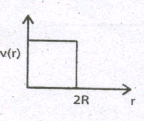
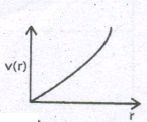
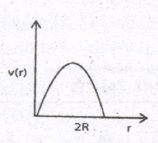
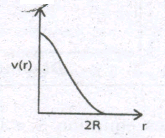
27.
A car is moving along a straight road with a uniform acceleration. It passes through two points P and Q separated by a distance with velocity 30 km/h and 40 km/h respectively. The velocity of the car midway between P and Q is ______________.
33.3km/h
20\(\sqrt{2}\) km/h
25\(\sqrt{2}\)km/h
35km/h
28.
Dimensional formula of self inductance is _______________.
[MLT-2A-2]
[ML2T-1A-2]
[ML2T-2A-2]
[ML-2T-2A-1]
29.
The dimensional formula of permeability of free space m0 is ______________.
[MLT-2A-2]
[M0L1T]
[M0L2T-1A2]
none of these
30.
The position x of a particle with respect to time t along x-axis is given by x = 9t2 + t3 where x is in metres and t in seconds. What will be the position of this particle when it achieves maximum speed along the +x direction?
54m
81m
24m
32m
31.
A block of mass m is placed on a smooth wedge of inclination θ. The whole system is accelerated horizontally so that the block does not slip on the wedge: The force exerted by the wedge on the block will be ____________ (g is acceleration due to gravity)
mg cosθ
mg sinθ
mg
mg/cosθ
32.
Identify the pair of physical quantities having the same dimensions.
Light year and period of a pendulum
Angular momentum and torque
Energy and Modulus of elasticity
Torque and work
33.
Which is a vector quantity?
Angular momentum
Work
Potential energy
Electric energy
34.
A solid sphere is rotating in free space. If the radius of the sphere is increased keeping mass same, which one of the following will not be affected?
Moment of inertia
Angular momentum
Angular velocity
Rotational kinetic energy
35.
A point in the system at which whole mass of the body is supposed to be concentrated is called _____________.
centre of gravity
centre of mass
centre of energy
centre of buoyancy
36.
Principle of conservation of linear momentum ______________.
is applicable when time of impact between 2 colliding particles is extremely small
when time of impact is moderately small
when time of impact is large
is independent of time of impact
37.
Which of the following curves does not represent motion in one dimension?
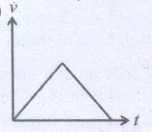
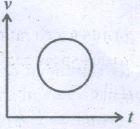
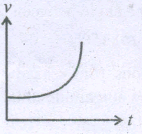
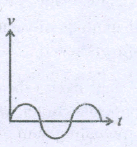
38.
If the force and the displacement are at an angle of 180°, then work done is ___________.
F.S
-F.S
0
F-S
39.
Length can't be measured by _____________.
fermi
micron
debye
light year
40.
The prefix of 10-18 is ______________.
femto
nano
giga
atto
41.
An engine pumps water continuously through a hose. Water leaves the hose with a velocity v and m is the mass per unit length of the water of the jet. What is the rate at which kinetic energy is imparted to water?
\({{1}\over{2}}{m}{v}^{2}\)
mv3
\({{1}\over{2}}{m}{v}^{3}\)
\({{1}\over{2}}{m}{v}^{2}\)
42.
M.I. of a ring of mass M and radius R about an axis passing through the centre & perpendicular to the plane is I. What is M.I. about its diameter?
I
I/2
\(I/\sqrt{2}\)
I + MR2
43.
Two rings of radius R & nR made from the same wire have the ratio of moments of inertia about an axis passing through their centre equal to 1 : 8. The value of n is
2
2\(\sqrt{2}\)
4
1/2
44.
A spacecraft of mass M moving with velocity v in free space explodes and breaks into two pieces. After the explosion a mass m of the spacecraft is left stationary. The velocity of other part is _______________.
\(\frac { mv }{ M-n } \)
\(\frac { M+n }{ Mv } \)
\(\frac { Mv }{ M-m } \)
\(\frac { Mv }{ m } \)
45.
When a body falls freely towards the earth, then its T.E. ______________.
increases
decreases
remains constant
first increases and then decreases
46.
A body is falling from a height h. After it has fallen a height \(\frac{h}{2}\) it will possess _______________
only Potential Energy
only Kinetic Energy
half potential and half kinetic energy
more kinetic and less potential energy
47.
A force\(\overrightarrow { F } =3\hat { i } +c\hat { j } +2\hat { k } \) acting on a particle causes a displacement \(\overrightarrow { S } =(2\hat { i } -3\hat { j } +4\hat { k } )\) in its own direction. If the work done is 8J, then the value of c is ______________.
0
6
2
1
48.
A ball moves on a frictionless inclined table without slipping. The work done by the table surface on the ball is ____________.
positive
negative
zero
none
49.
Action and reaction ___________
act on two different objects
have opposite direction
have equal magnitude
all of these
50.
A particle moves along x-axis from x = 0 to x = 7m under the influence of a force given by f(x) = 12-2x+3x2 then the work done is__________________
205 J
390 J
378 J
291 J
51.
A round object of mass M and radius R rolls down without slipping along an inclined plane. The frictional force,
dissipates kinetic energy as heat
decreases the rotational motion
decreases the rotational and transnational motion
converts transnational energy into rotational energy
52.
Two discs of same moment of inertia rotating about their regular axes passing through center and perpendicular to the plane of the disc with angular velocities ω1 and ω1. They are brought in to contact face to face coinciding with the axis of rotation. The expression for loss of energy during this process is
\(\frac{1}{4}\)\(I(\omega _{1}-\omega _{2})^2\)
\(I(\omega _{ 1 }-\omega _{ 2 })^{ 2 }\)
\(\frac{1}{8}\)\(I(\omega _{1}-\omega _{2})^2\)
\(\frac{1}{2}I\)\((\omega _{1}-\omega _{2})^2\)
53.
The speed of the center of a wheel rolling on a horizontal surface is vo. A point on the rim in level with the center will be moving at a speed of,
zero
vo
\(\sqrt{2}\)vo
2vo
54.
The speed of a solid sphere after rolling down from rest without sliding on an inclined plane of vertical height h is,
\( \sqrt \frac{4}{3}gh\)
\( \sqrt \frac{10}{7}gh\)
\(\sqrt{2gh}\)
\( \sqrt \frac{1}{2}gh\)
55.
The ratio of the acceleration for a solid sphere (mass m and radius R) rolling down an incline of angle \(\theta\) without slipping and slipping down the incline without rolling is,
5: 7
2: 3
2: 5
7: 5
56.
From a disc of radius R a mass M, a circular hole of diameter R, whose rim passes through the center is cut. What is the moment of inertia of the remaining part of the disc about a perpendicular axis passing through it
15MR2/32
13MR2/32
11MR2/32
9MR2/32
57.
A disc of the moment of inertia Ia is rotating in a horizontal plane about its symmetry axis with a constant angular speed \(\omega\). Another disc initially at rest of moment of inertia Ib is dropped coaxially on to the rotating disc. Then, both the discs rotate with the same constant angular speed. The loss of kinetic energy due to friction in this process is,
\(\frac { 1 }{ 2 } \frac { { I }_{ b }^{ 2 } }{ 2({ I }_{ a }+{ I }_{ b }) } { \omega }^{ 2 }\)
\(\frac { { I }_{ b }^{ 2 } }{ ({ I }_{ a }+{ I }_{ b }) } { \omega }^{ 2 }\)
\(\frac { { ({ I }_{ b }-{ I }_{ a }) }^{ 2 } }{ ({ I }_{ a }+{ I }_{ b }) } { \omega }^{ 2 }\)
\(\frac { 1 }{ 2 } \frac { { { I }_{ b }{ I }_{ b } } }{ ({ I }_{ a }+{ I }_{ b }) } { \omega }^{ 2 }\)
58.
A spring of force constant k is cut into two pieces such that one piece is double the length of the other. Then, the long piece will have a force constant of
\(\frac{2}{3}\)k
\(\frac{3}{2}\)k
3k
6k
59.
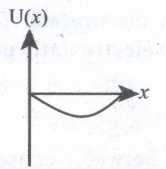
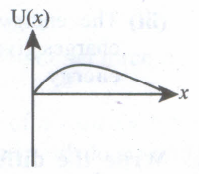
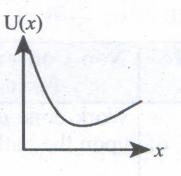
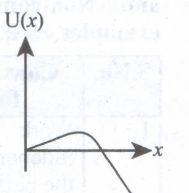
A particle which is constrained to move along x-axis, is subjected to a force in the same direction which varies with the distance x of the particle from the origin as F(x) = kx + ax3. Here, k and a are positive constants. For x ≥ 0, the functional form of the potential, energy U(x) of the particles
60.
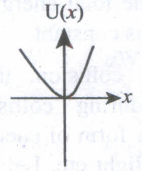
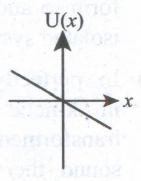
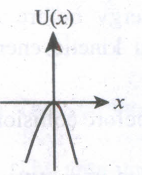
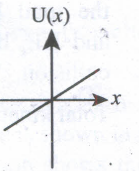
A particle is placed at the origin and a force F = kx is acting on it (where k is a positive constant). If U (0) = 0, the graph of U(x) versus x will be (where U, is the potential , energy function)
61.
What is the minimum velocity with which a body of mass m must enter a vertical loop of radius R so that it can complete the loop?
\(\sqrt{2gR}\)
\(\sqrt{3gR}\)
\(\sqrt{5gR}\)
\(\sqrt{gR}\)
62.
63.
A rigid body rotates with an angular momentum L. If its kinetic energy is halved, the angular momentum becomes,
L
L/2
2L
L/\(\sqrt{2}\)
64.
A closed cylindrical container is partially filled with water. As the container rotates in a horizontal plane about a perpendicular bisector, its moment of inertia
increases
decreases
remains constant
depends on direction of rotation
65.
A rope is wound around a hollow cylinder of mass 3 kg and radius 40 cm. What is the angular acceleration of the cylinder if the rope is pulled with a force 30 N?
0.25 rad s-2
25 rad s-2
5 ms-2
25 ms-2
66.
A particle is moving with a constant velocity along a line parallel to positive X-axis. The magnitude of its angular momentum with respect to the origin is
zero
increasing with x
decreasing with x
remaining constant
67.
A body of mass 1 kg is thrown upwards with a velocity 20 ms-1. It momentarily comes to rest after attaining a height of 18 m. How much energy is lost due to air friction?(Take g = 10 ms-2)
20 J
30 J
40 J
10 J
68.
A ball of mass 1 kg and another of mass 2 kg are dropped from a tall building whose height is 80 m. After, a fall of 40 m each towards Earth, their respective kinetic energies will be in the ratio of
\(\sqrt2:1\)
\(1:\sqrt2\)
2:1
1:2
69.
A uniform force of (2\(\hat { i }\)+\(\hat { j }\)) N acts on a particle of mass 1 kg. The particle displaces from position (3\(\hat { j }\)+\(\hat { k }\)) m to (5\(\hat { i }\)+3\(\hat { j }\)) m. The work done by the force on the particle is
9 J
6 J
10 J
12 J
70.
A couple produces,
pure rotation
pure translation
rotation and translation
no motion
71.
The center of mass of a system of particles does not depend upon,
position of particles
relative distance between particles
masses of particles
force acting on particle
72.
The displacement of a particle moving along x-axis with respect to times is given by x = at + bt2-ct3. The dimensions of b are ______________.
LoT-3
LoT-3
LT-2
LT-3
73.
The number of significant figures in 2.64\(\times\)104 kg is ______________.
2
4
5
3
74.
If a person moving from pole to equator, the centrifugal force acting on him
increases
decreases
remains the same
increases and then decreases
75.
The centrifugal force appears to exist
only in inertial frames
only in rotating frames
in any accelerated frame
both in inertial and non-inertial frames
76.
When an object is at rest on the inclined rough surface ____________.
static and kinetic frictions acting on the object is zero
static friction is zero but kinetic friction is not zero
static friction is not zero and kinetic friction is zero
static and kinetic frictions are not zero
77.
78.
An object of mass m begins to move on the plane inclined at an angle θ. The coefficient of static friction of inclined surface is μs. The maximum static friction experienced by the mass is
mg
μs mg
μs mg sin ፀ
μs mg cos ፀ
79.
Force acting on the particle moving with constant speed is
always zero
need not be zero
always non zero
cannot be concluded
80.
A particle of mass m sliding on the smooth double inclined plane (shown in figure) will experience
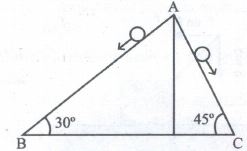
greater acceleration along the path AB
greater acceleration along the path AC
same acceleration in both the paths
no acceleration in both the paths
81.
A book is at rest on the table which exerts a normal force on the book. If this force is considered as reaction force, what is the action force according to Newton's third law?
Gravitational force exerted by Earth on the book
Gravitational force exerted by the book on Earth
Normal force exerted by the book on the table
None of the above
82.
A vehicle is moving along the positive x direction, if sudden brake is applied, then
frictional force acting on the vehicle is along negative x direction
frictional force acting on the vehicle is along positive x direction
no frictional force acts on the vehicle
frictional force acts in downward direction
83.
When a car takes a sudden left turn in the curved road, passengers are pushed towards the right due to
inertia of direction
inertia of motion
inertia of rest
absence of inertia
84.
85.
Two objects are projected at angles 30° and 60° respectively with respect to the horizontal direction. The range of two objects are denoted as R30° and R30°. Choose the correct relation from the following
R30° = R60°
R30° = 4R60°
R30° =\(\frac{R_{60°}}{2}\)
R30° = 2R60°
86.
If an object is thrown vertically up with the initial speed u from the ground, then the time taken by the object to return back to ground is
\(\frac{u^2}{2g}\)
\(\frac{u^2}{g}\)
\(\frac{u}{2g}\)
\(\frac{2u}{g}\)
87.
If a particle executes uniform circular motion in the xy plane in clockwise direction, then the angular velocity is in
+y direction
+z direction
-z direction
-x direction
88.
A ball is dropped from some height towards the ground. Which one of the following represents the correct motion of the ball?
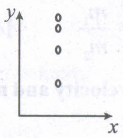
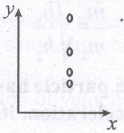
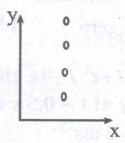
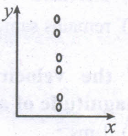
89.
A ball is projected vertically upwards with a velocity v. It comes back to ground in time t. Which v-t graph shows the motion correctly?
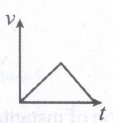
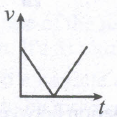
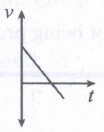
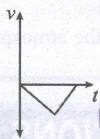
90.
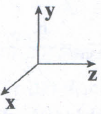
Which one of the following Cartesian coordinate systems is not followed in physics?
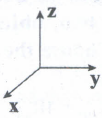
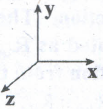
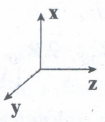
91.
The dimension of \({\left( {\mu}_{0}{\epsilon}_{0} \right)}^{{{1}\over{2}}}\) is
length
time
velocity
force
92.
If the force is proportional to square of velocity, then the dimension of proportionality constant is
[MLT0]
[MLT-1]
[MLT-2T]
[MLT-1T0]
93.
The dimensional formula for gravitational constant G is
[ML3T-2]
[M-1L3T-2]
[M-1L-3T-2]
[ML-3T2]
94.
The velocity of a particle v at an instant t is given by v = at + br2. The dimensions of b is
[L]
[LT-1]
[LT-2]
[LT-3]
95.
The dimensional formula of Planck's constant h is
[ML2T-1]
[ML2T3]
[MLT-1]
[ML3T-3]
96.
Which of the following pairs of physical quantities have same dimension?
force and power
torque and energy
torque and power
force and torque
97.
If \(\pi=3.14,\) then the value of \({\pi}^{2}\) is
9.8596
9.860
9.86
9.9
98.
Which of the following has the highest number of significant figures?
0.007 m2
2.64\(\times\)1024kg
0.0006032 m2
6.3200 J
99.
If the length and time period of an oscillating pendulum have errors of 1% and 3% respectively then the error in measurement of acceleration due to gravity is
4%
5%
6%
7%
100.
One of the combinations from the fundamental physical constants is \({{hc}\over{G}},\) The unit of this expression is
Kg2
m3
S-1
m
1.
(b)
\(\frac{1}{12}Ml^{2}\)
2.
(d)
force
3.
(b)
12 J
4.
(b)
3: 1
5.
(a)
Rω
6.
(a)
straight line
7.
(b)
\(\frac { 1 }{ 2 } \)Iω2
8.
(a)
\(\tan^{-1}(\frac{ra_t}{V^2})\)
9.
(b)
acceleration
10.
(a)
velocity
11.
(a)
0
12.
(a)
pseudo force
13.
(c)
ice and ice
14.
(a)
concurrent forces
15.
(b)
Inelastic collision
16.
(c)
1 m
17.
(d)
both (b) and (c)
18.
(d)
4
19.
(c)
5
20.
(d)
100 K
21.
(a)
scooter
22.
(a)
Inertia of motion
23.
(c)
Inertia of rest
24.
(b)
resistance to change its state
25.
(c)
576 mJ
26.
(d)
27.
(c)
25\(\sqrt{2}\)km/h
28.
(c)
[ML2T-2A-2]
29.
(a)
[MLT-2A-2]
30.
(a)
54m
31.
(d)
mg/cosθ
32.
(d)
Torque and work
33.
(a)
Angular momentum
34.
(b)
Angular momentum
35.
(b)
centre of mass
36.
(a)
is applicable when time of impact between 2 colliding particles is extremely small
37.
(b)
38.
(b)
-F.S
39.
(c)
debye
40.
(d)
atto
41.
Mass per unit length = m
Velocity = v
(mass of water pumped in one second)
M = mv
\(\text { Kinetic energy }=\frac{1}{2} M v^{2}\)
\(=\frac{1}{2} m v^{3}\)
42.
(a)
I
43.
The moment of inertia (I) of circular ring whose axis of rotation is passing through its center, \(\mathrm{I}_{1}=\mathrm{m}_{2} \mathrm{R}^{2} . \text { Also } \mathrm{I}_{2}=\mathrm{m}_{2}(\mathrm{n} \mathrm{R})^{2}\)
\(\frac{I}{I_{2}}=\frac{M R^{2}}{n M(n R)^{2}}=\frac{1}{n^{3}}=\frac{1}{8} \)
\(\therefore n^{3}=8 \)
\(\therefore n=\sqrt[3]{8}=2 \)
44.
(c)
\(\frac { Mv }{ M-m } \)
45.
(c)
remains constant
46.
(c)
half potential and half kinetic energy
47.
(c)
2
48.
(c)
zero
49.
(d)
all of these
50.
(b)
390 J
51.
(d)
converts transnational energy into rotational energy
52.
Moment of inertia of a disc passing through
\(\text { centre } I=\frac{1}{2} M R^{2}\)
\(\text { Energy of the first disc }=\frac{1}{4} I \omega_{1}^{2}\)
\(\text { Energy of the second disc }=\frac{1}{4} I \omega_{2}^{2}\)
\(\text { Loss of energy }=\frac{1}{4} I\left(\omega_{1}-\omega_{2}\right)^{2}\)
53.
\(v_{0}=r \omega ; \quad \therefore v_{0} \alpha r\)
For a wheel (uniform ring) the distance of a point on the rim in level with the center
\(\text { [i.e., radius] is } \sqrt{2} r\)
\(\therefore \text { The speed of the center is } \sqrt{2} v_{0}\)
54.
Potential energy = Translational kinetic energy + Rotational kinetic energy
\(m g h=\frac{1}{2} m v^{2}+\frac{1}{2} I \omega^{2} \)
\(=\frac{1}{2} m v^{2}+\frac{1}{2} \times \frac{2}{5} M R^{2} \times \frac{v^{2}}{R^{2}}\left[\omega=\frac{v}{R}\right] \)
\(=\frac{1}{2} m v^{2}+\frac{1}{5} m v^{2} \)
\(=\frac{5 m v^{2}+2 m v^{2}}{10}=\frac{7 m v^{2}}{10} \)
\(m g h=\frac{7 m v^{2}}{10} \)
\(g h=\frac{7 v^{2}}{10} \)
\(\therefore v^{2}=\frac{10 g h}{7} \)
\(\therefore v=\frac{\sqrt{10 g h}}{7} \)
55.
Acceleration of the solid sphere while rolling down without slipping
\(a_{1}=\frac{g \sin \theta}{1+\frac{k^{2}}{r^{2}}}\)
Acceleration developed while slipping down \(a_{2}=g \sin \theta\)
\(\text { Required ratio } \frac{a_{1}}{a_{2}}=\frac{g \sin \theta}{1+\frac{k^{2}}{r^{2}}} / g \sin \theta\)
\(\frac{a_{1}}{a_{2}}=\frac{1}{1+\frac{k^{2}}{r^{2}}}\)
\(\text { For a solid sphere } \frac{k^{2}}{r^{2}}=\frac{2}{5}\)
\(\therefore \text { Ratio of accelerations } \frac{a_{1}}{a_{2}}=\frac{1}{1+\frac{2}{5}}\)
\(=\frac{1}{5+\frac{2}{5}}=\frac{1}{\frac{7}{5}}=\frac{5}{7}\)
\(\therefore a_{1}: a_{2}=5: 7 \)
56.
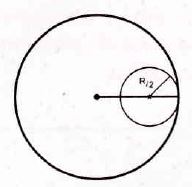
Moment of inertia of a disc
\(\mathrm{I}_{1}=\frac{M R^{2}}{2}\)
\(\text { Mass of small disc }=\frac{M}{\pi R^{2}} \times \pi \times\left(\frac{R}{2}\right)^{2}\)
\(=\frac{M}{\pi R^{2}} \times \frac{\pi R^{2}}{4}=\frac{M}{4}\)
By the theorem of parallel axis, the moment of inertia of the small disc. About an axis passing through 0 is
\(I_{2} =\frac{1}{2} \times \frac{M}{4}\left(\frac{R}{2}\right)^{2}+\frac{M}{4}\left(\frac{R}{2}\right)^{2} \)
\(=\frac{M}{8} \times \frac{R^{2}}{4}+\frac{M}{4} \times \frac{R^{2}}{4} \)
\(=\frac{M R^{2}}{32}+\frac{M R^{2}}{16}=\frac{M R^{2}+2 M R^{2}}{32} \)
\(I_{2} =\frac{3 M R^{2}}{32} \)
Moment of inertia of the remaining part is I= I1 - I2
\(=\frac{M R^{2}}{2}-\frac{3 M R^{2}}{32} \)
\(=\frac{16 M R^{2}-3 M R^{2}}{32}=\frac{13 M R^{2}}{32}\)
\(I =\frac{13 M R^{2}}{32} \)
57.
The moments of inertia of two discs are Ia and Ib respectively The angular velocity of the disc A is \(\omega\).
The sum of kinetic energies of two discs before coming in contact is \(k_{1}=\frac{1}{2} I_{a} \omega_{1}^{2}+\frac{1}{2} I_{b} \omega_{2}^{2}\)
\(\text { But angular velocity of the disc be is } \omega_{2}=0 \ \text {(rest)}\)
\(\therefore k_{1}=\frac{1}{2} I_{a} \omega_{1}^{2}\)
The final kinetic energy of the two discs system \(k_{2}=\frac{1}{2} \frac{I_{a}^{2} \omega_{1}^{2}}{I_{a}+I_{b}}\)
The loss of kinetic energy is
\(k_{1}-k_{2} =\frac{1}{2} I_{a} \omega^{2}-\frac{1}{2}\left[\frac{I a^{2} \omega_{1}^{2}}{I_{a}+I_{2 b}}\right] \)
\(=\frac{1}{2} \frac{\left[I_{1}\left(I_{a}+I_{b}\right) \omega^{2}-I_{a}^{2} \omega^{2}\right]}{I_{a}+I_{b}} \)
\(k_{1}-k_{2} =\frac{1}{2} \frac{I_{a} b}{\left(I_{a}+I_{b}\right)} \omega^{2} \)
58.
For any spring kl = constant
Length of the longer piece
\(=\frac{2 l}{3} \)
\(\therefore k^{1} \times \frac{2 l}{3} =k l \)
\(\therefore k^{1}=\frac{k l \times 3}{2 l}=\frac{3}{2} k \)
\(\therefore k^{1}=\frac{3}{2} k \)
59.
\(F=-\frac{d u}{d x} \quad F(x) =k x+a x^{3} \)
\(d u =-F d x \)
\(u(x) =-\int_{0}^{x}\left(-k x+a x^{3}\right) d x \)
\(=\int_{0}^{x} k x d x-a \int_{0}^{x} x^{3} d x \)
\(=\frac{k x^{2}}{2}-\frac{a x^{4}}{2} \)
\(U(x) =\frac{x^{2}}{2}\left(k-\frac{a x^{2}}{2}\right) \)
\(u(x)=0 \text { at } x=0 \text { and }\)
\(U(x) =0 ; k-\frac{a x^{2}}{2}=0 \)
\(=\frac{a}{2} x^{2}=-k \)
\(x^{2} =\frac{2 k}{a} \)
\(\therefore x =\sqrt{\frac{2 k}{a}} \)
\(\text { Clearly } u(x)=0 \text { at } x=0 \text { and }\)
\(x=\sqrt{\frac{2 k}{a}}\)
\(\text { For } x>\sqrt{\frac{2 k}{a}} U(x) \text { will be negative. } \)
\(\text { At } x=0 ; F=\frac{-d u}{d x}=0\)
(i.e.,) Slope of V - x graph is zero at x = 0
Hence the most appropriate answer is d.
60.
For a conservative force
\(F=-\frac{d v}{d t} \)
\(\int_{0}^{u(x)} d v=-\int_{0}^{x} F d x=-\int_{0}^{x} k x d x \)
\(\text { As } v(0)=0\)
\(U(x)=-\frac{k x^{2}}{2}\)
Thus, the graph of U(x) versus (x) will be a parabola, symmetric about U - ax is bying below x - ax is with its vertex at the origin. Hence the correct answer is C
61.
Radius =R
\(v_{1}^{2}-v_{2}^{2}=4 g R\)
\(\text { Tension } T_{2}=\frac{m v_{2}^{2}}{R_{2}}-m g\)
\(\text {To find minimum speed, let } T_{2}=0\)
\(0 =\frac{m v_{2}^{2}}{R}-m g \)
\(\frac{m v^{2}}{R} =m g \)
\(v_{2}^{2}=R g \ v_{2} =\sqrt{g R} \)
\(\text { sub (2) in the eqn (1) we get }\)
\(v_{1}^{2}-(\sqrt{g R})^{2} =4 g R \)
\(v_{1}^{2}-g R =4 g R \)
\(v_{1}^{2} =4 g R+g R \)
\(=5 g R \)
\(v_{1} =\sqrt{5 g R} \)
62.
(a)
63.
\(K \cdot E=\frac{1}{2} I \omega^{2} ; \quad L=I \omega ; \quad K \cdot E=\frac{2^{2}}{2^{2}} \)
\(\therefore K \cdot E \alpha L^{2} \quad E_{1} \alpha L_{1}^{2} \quad E_{2} \alpha L_{2}^{2}\)
\(\frac{E_{1}}{E_{2}}=\left(\frac{L_{1}}{L_{2}}\right)^{2} \)
\(\text { Here } E_{1}=E \quad E_{2}=\frac{E}{2} \)
\(L_{1}=L \quad \quad L_{2}=? \)
\(\frac{E}{\frac{E}{2}}=\left(\frac{L}{L_{2}}\right)^{2} \)
\(\frac{2 E}{E}=\left(\frac{L}{L_{2}}\right)^{2}\left(\frac{L_{1}}{L_{2}}\right)^{2}=2 \)
\(\therefore \frac{L}{L_{2}}=\sqrt{2} \)
\(L_{2}=\frac{L}{\sqrt{2}} \)
64.
(a)
increases
65.
\(m=3 \mathrm{~kg} \quad r=40 \times 10^{-2} \mathrm{~m}=0.4 \mathrm{~m}\)
\(\text { Force }=30 N\)
Moment of inertia of a hollow-cylinder I= MR2
\(=3 \times\left(40 \times 10^{-2}\right)^{2} \)
\(=3 \times 0.4 \times 0.4=0.48 \mathrm{kgm}^{2} \)
\( F R =I \alpha \)
\(30 \times 40 \times 10^{-2}=0.48 d \)
\(d=\frac{12}{0.48}=\frac{1200}{48}=25 \mathrm{rad} \mathrm{s}^{-2} \)
\(\alpha=25 \mathrm{rad} \mathrm{s}^{-2} \)
66.
(d)
remaining constant
67.
Mass = 1kg
Velocity v = 20m/s
Height h = 18 m
\(g=10 \mathrm{~m} / \mathrm{s}^{2}\)
\(\text { Potential energy } P . E=m g h\)
\(=1 \times 10 \times 18 =180 \mathrm{~J} \)
\(\text { Kinetic energy } K . E=\frac{1}{2} m v^{2}\)
\(K . E=\frac{1}{2} \times 1(20)^{2}\)
\(=\frac{1}{2} \times 20 \times 20=200 J\)
\(\text { Loss of energy due to air friction }= K.E - P.E\)
\(=200-180=20 \mathrm{~J}\)
68.
\(m_{1} =1, \quad m_{2}=2 \)
\(K . E . =m g(h-x) \)
\(\text { For both balls }(h-x)\)
\(=40 \text { i.e.) Same }\)
\(g=\text { constant }\)
\(\therefore K \cdot E_{1}=m_{1} g(h-x)=m_{1} g \times 40 \)
\(K \cdot E_{2}=m_{2} g(h-x)=m_{2} g \times 40 \)
\(\therefore \frac{K \cdot E_{1}}{K \cdot E_{2}}=\frac{m_{1} g \times 40}{m_{2} g \times 40}=\frac{m_{1}}{m_{2}} \)
\( \therefore K \cdot E_{1}: K \cdot E_{2}=1: 2 \)
69.
\(\text { Force } \overrightarrow{\mathbf{F}}=(2 i+\vec{j}) N\)
\(\text { Displacement } d=(5 \vec{i}+3 \vec{j})-(3 \vec{j}+\vec{k})\)
\(=(5 i-k) m\)
\(\text { Work done } W=F . d\)
\(=(2 \vec{i}+\vec{j})(5 i-k)\)
\(=10-0-0=10 J \)
70.
(a)
pure rotation
71.
(d)
force acting on particle
72.
(c)
LT-2
73.
(d)
3
74.
(a)
increases
75.
(b)
only in rotating frames
76.
(c)
static friction is not zero and kinetic friction is zero
77.
(a)
78.
(d)
μs mg cos ፀ
79.
(b)
need not be zero
80.
(b)
greater acceleration along the path AC
81.
(c)
Normal force exerted by the book on the table
82.
(a)
frictional force acting on the vehicle is along negative x direction
83.
(a)
inertia of direction
84.
(b)
85.
Range is same for the angle if projection \(\theta \text { and } 90-\theta\)
86.
\(\text {Time of flight }=\frac{2 u}{g}\)
87.
Use thumb rule
88.
Distance travelled \(s=\frac{1}{2} g t^{2} ; s \alpha t^{2}\). The ratio of distances travelled by a freely falling body will be with ratio 1:4:9:...
89.
Initially velocity has maximum value and at maximum height velocity becomes zero. After that the velocity becomes negative
90.
Answers (a), (b) and (c) are all anticlockwiseand answer (d) alone is in the clockwise direction
91.
\(\text { Velocity of light } c=\frac{1}{\sqrt{\mu_{0} \varepsilon_{0}}}\)
\(c=\left(\mu_{0} \varepsilon_{0}\right)^{-\frac{1}{2}}\)
\(\text { Hence dimension }\left(\mu_{0} \varepsilon_{0}\right)^{-\frac{1}{2}} \text { is that of velocity. }\)
92.
F = kv2
Dimensional of k
\(=\frac{\text { Dimension of } \mathrm{F}}{\text { Dimension of }(v)^{2}}\)
\(=\frac{\mathrm{MLT}^{-2}}{\left(\mathrm{LT}^{-1}\right)^{2}}=\frac{\mathrm{MLT}^{-2}}{\mathrm{~L}^{2} \mathrm{~T}^{-2}} \)
\(=\left[\mathrm{ML}^{-1-2} \mathrm{~T}^{-2+2}\right] \)
Dimension of proportionality constant \(=\left[\mathrm{ML}^{-1} \mathrm{~T}^{0}\right]\)
93.
\(\text { Gravitational constant } G=\frac{F r^{2}}{m_{l} m_{2}}\)
\(\text { Dimensional formula of } \mathrm{G}=\frac{\left[\mathrm{MLT}^{-2}\right]\left[\mathrm{L}^{2}\right]}{[\mathrm{M}][\mathrm{M}]}\)
\(=\frac{\mathrm{ML}^{3} \mathrm{~T}^{-2}}{\mathrm{M}^{2}}=\mathrm{M}^{-1} \mathrm{~L}^{3} \mathrm{~T}^{-2}\)
94.
\(v=a t+b t^{2}\)
\(\text { Dimensional equation is } \mathrm{LT}^{-1}\)
\(=a T=b T^{2}\)
\(\therefore \text { The dimension of } b=\frac{\mathrm{LT}^{-1}}{\mathrm{~T}^{2}}=\mathrm{LT}^{-3}\)
95.
Dimensional formula of Planck's
\(\text { constant }=\frac{\text { Energy }}{\text { Frequency }}=\frac{\mathrm{ML}^{2} \mathrm{~T}^{-2}}{\mathrm{~T}^{-1}}\)
\(=M L^{2} T^{-2+1}=M L^{2} T^{-1}\)
96.
\(\text { Torque }=\text { Force } \times \mathrm{r}\)
\(\text { Dimension of torque }\)
\(=\left[\mathrm{MLT}^{-2}\right][\mathrm{L}]=\left[\mathrm{ML}^{2} \mathrm{~T}^{-2}\right]\)
\(\text { Energy }=\text { Force } \times \text { displacement }\)
\(\text { Dimension of Energy }\)
\(=\left[\mathrm{MLT}^{-2}\right][\mathrm{L}]=\left[\mathrm{ML}^{2} \mathrm{~T}^{-2}\right]\)
97.
\(\pi=3.14 \)
\(\pi^{2} =3.14 \times 3.14 \)
\(=9.8596=9.86 \)
98.
The number of significant figures of 6.3200 J is 5
99.
\(T =2 \pi \sqrt{\frac{l}{g}} \)
\(g =4 \pi^{2} l / T^{2} \)
\(\frac{d g}{g} =\frac{d l}{l}-\frac{2 d T}{T} \)
\(\frac{d g}{g} \% =\left(\frac{d l}{l}\right) \%-2\left(\frac{d T}{T}\right) \% \)
\(=1 \%-2 \times(-3 \%) \)
\(=1+6=7 \% \)
100.
Unit of a (Planck's constant) - Js
Unit of c (Velocity of light) - ms-1
Unit of G (Gravitational Constant) - \(\frac{\mathrm{Nm}^{2}}{\mathrm{Kg}^{2}}\)
\(\therefore \text { Unit of } \frac{h c}{G} \text { is }=\frac{J s \times m s^{-1}}{N m^{2} / k g^{2}} \)
\(=\frac{N m s \times m s^{-1} \times k g^{2}}{N m^{2}}[J=N m] =\mathrm{kg}^{2}\)

11th Standard Syllabus & Materials
11th Standard
TN 11th Tamil பீடு பெற நில் - செய்யுள் - காவடிச்சிந்து Important Questions And Answers Study Material - QB365 Set A
NEW11th Standard
TN 11th Tamil பீடு பெற நில் - உரைநடை - மலை இடப்பெயர்கள் : ஓர் ஆய்வு Important Questions And Answers Study Material - QB365 Set A
NEW11th Standard
TN 11th Tamil மாமழை போற்றுதும் - துணைப்பாடம் - யானை டாக்டர் Important Questions And Answers Study Material - QB365 Set A
NEW11th Standard
TN 11th Tamil மாமழை போற்றுதும் - செய்யுள் - ஐங்குறுநூறு Important Questions And Answers Study Material - QB365 Set A



Tamilnadu Stateboard 11th Standard Subjects

Maths

Commerce

Economics

Biology

Business Maths and Statistics

Accountancy

Computer Science
Physics

Chemistry
Maths
Biology
Economics
Physics
Chemistry

History
Business Maths and Statistics

Computer Science
Accountancy

Computer Applications
History
Computer Technology
Commerce
Computer Applications
Computer Technology

Tamil

English

French
Tamilnadu Stateboard Standards

