
 100% FREE ACCESS
11th Standard Syllabus & Materials
11th Standard
TN 11th Tamil இயற்கை வேளாண்மை,சுற்றுச்சூழல் -செய்யுள் - மனோன்மணீயம் Important Questions And Answers Study Material - QB365 Set A
NEW11th Standard
TN 11th Tamil என்னுயிர் என்பேன் -துணைப்பாடம் - இசைத்தமிழர் இருவர் Important Questions And Answers Study Material - QB365 Set A
NEW11th Standard
TN 11th Tamil மொழி கலை -செய்யுள் - ஒவ்வொரு புல்லையும் Important Questions And Answers Study Material - QB365 Set A
NEW11th Standard
TN 11th Tamil பீடு பெற நில் - இலக்கணம் - பகுபத உறுப்புகள் Important Questions And Answers Study Material - QB365 Set A
NEW11th Standard
TN 11th Tamil பீடு பெற நில் - துணைப்பாடம் - வாடிவாசல் Important Questions And Answers Study Material - QB365 Set A
NEW11th Standard
TN 11th Tamil பீடு பெற நில் - செய்யுள் - குறுந்தொகை Important Questions And Answers Study Material - QB365 Set A

Published on: 04/03/2019
+1 Public Official Model Question March 2019
Download Tamil Nadu 11th Standard Physics question papers, model tests, one-mark questions, important questions, and public exam papers in PDF format. Free study materials and answer keys for TN State Board students.
Questions + Answers key
Take MCQ Physics Test1.
Two simple pendulums of time periods 2.0 s & 2.1 s are made to vibrate simultaneously. They are in phase initially, after how may vibrations are there in the same phase?
21
25
30
35
2.
Two drops of equal radius coalesce to form a bigger drop. What is ratio of surface energy of bigger drop to smaller one?
21/2:1
1:1
22/3:1
none of these
3.
Let y = \(\frac{1}{1+x^2}\) at t = 0 s be the amplitude of the wave propagating in the positive x-direction. At t = 2 s, the amplitude of the wave propagating becomes \(y=\frac{1}{1+(x-2)^{2}}. \) Assume that the shape of the wave does not change during propagation. The velocity of the wave is
0.5m s-1
1.0m s-1
1.5m s-1
2.0m s-1
4.
A simple pendulum is suspended from the roof of a school bus which moves in a horizontal direction with an acceleration a, then the time period is
\(T\propto \frac { 1 }{ { g }^{ 2 }+{ a }^{ 2 } } \)
\(T\propto \frac { 1 }{ \sqrt { { g }^{ 2 }+{ a }^{ 2 } } } \)
\(T\propto \sqrt { { g }^{ 2 }+{ a }^{ 2 } } \)
\(T\propto \left( { g }^{ 2 }+{ a }^{ 2 } \right) \)
5.
A sample of gas consists of \(\mu\)1 moles of monoatomic molecules, \(\mu\)2 moles of diatomic molecules and \(\mu\)3 moles of linear triatomic molecules. The gas is kept at high temperature. What is the total number of degrees of freedom?
[3\(\mu\)1 + 7( \(\mu\)2 + \(\mu\)3)] NA
[3\(\mu\)1 + 7\(\mu\)2 + 6\(\mu\)3] NA
[7\(\mu\)1 + 3( \(\mu\)2 + \(\mu\)3)] NA
[3\(\mu\)1 + 6( \(\mu\)2 + \(\mu\)3)] NA
6.
In an isochoric process, we have
W = 0
Q = 0
ΔU = 0
ΔT = 0
7.
Which of the following is not a scalar?
viscosity
surface tension
pressure
stress
8.
9.
The sum of moments of masses of all the particles in a system about the center of mass is _____________.
minimum
maximum
zero
infinity
10.
Two equal masses m1 and m2 moving along the same straight line with velocities +3 m/s and -5 m/s respectively collide elastically. Their velocities after the collision will be respectively _______________.
- 4 m/s and +4 m/s
+4 m/s for both
- 3 m/s and +5 m/s
- 5 m/s and + 3 m/s
11.
A man throws balls with the same speed vertically upwards one after the other at an interval of 2 seconds. What should be the speed of the throw so that more than two bails are in the sky at any time? (Given g = 9.8m/s2)
more than 19.6 m/s
at least 9.8 m/s
any speed less than 19.6m/s
only with speed 19.6 m/s
12.
From a disc of radius R a mass M, a circular hole of diameter R, whose rim passes through the center is cut. What is the moment of inertia of the remaining part of the disc about a perpendicular axis passing through it
15MR2/32
13MR2/32
11MR2/32
9MR2/32
13.
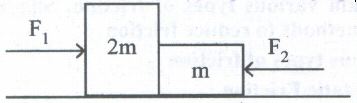
Two blocks of masses m and 2m are placed on a smooth horizontal surface as shown. In the first case only a force F1 is applied from the left. Later only a force F2 is applied from the right. If the force acting at the interface of the two blocks in the two cases is same, then F1 :F2 is
1:1
1:2
2:1
1:3
14.
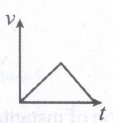
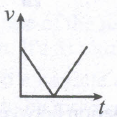
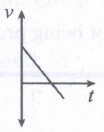
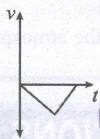
A ball is projected vertically upwards with a velocity v. It comes back to ground in time t. Which v-t graph shows the motion correctly?
15.
Planck's constant (h), speed of light in vacuum (c) and Newton's gravitational constant (G) are taken as three fundamental constants. Which of the following combinations of these has the dimension of length?
\({{\sqrt{hG}}\over{{c}^{{{3}\over{2}}}}}\)
\({{\sqrt{hG}}\over{{c}^{{{5}\over{2}}}}}\)
\(\sqrt{{{hc}\over{G}}}\)
\(\sqrt{{{Gc}\over{{h}^{{{3}\over{2}}}}}}\)
16.
From a certain apparatus, the diffusion rate of hydrogen has an average value of 28.7 cm3/s, The diffusion of another gas under the same condition is measured to have an average rate of 7.2 cm3/s. Identify the gas.
17.
Draw the PV diagram for
a. Isothermal process
b. Adiabatic process
c. isobaric process
d. Isochoric process
18.
State and prove Bernoulli’s theorem for a flow of incompressible, non-viscous, and streamlined flow of fluid.
19.
Explain how Newton arrived at his law of gravitation from Kepler’s third law.
20.
A projectile is fired horizontally with a velocity u. Obtain the expression for resultant velocity of the projectile at any instant.
21.
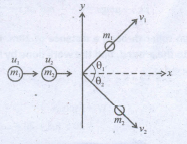
If a particle elastically collides obliquely with a particle of same mass at rest then show that they move perpendicular to each other after collision.
22.
A car of mass 1200 kg is travelling around a circular path of radius 300 m with a constant speed of 54 km/h. Calculate its angular momentum.
23.
Calculate the centripetal acceleration of Moon towards the Earth.
24.
(i) Explain the use of screw gauge and vernier caliper in measuring smaller distances.
(ii) Write a note on triangulation method and radar method to measure larger distances
25.
How does the frequency of a tunning fork change, when the temperature is increased?
26.
Consider two organ pipes of same length in which one organ pipe is closed and another organ pipe is open. If the fundamental frequency of closed pipe is 250 Hz. Calculate the fundamental frequency of the open pipe.
27.
A Carnot engine whose efficiency is 45% takes heat from a source maintained at a temperature of 327°C. To have an engine of efficiency 60% what must be the intake temperature for the same exhaust (sink) temperature?
28.
State Hooke’s law of elasticity.
29.
A small particle of mass m is projected with an initial velocity v at an angle \(\theta\) with x-axis in X-Y plane as shown in Figure.
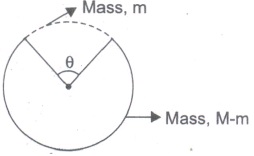
Find the angular momentum of the particle.
30.
An object is thrown vertically downward. What is the acceleration experienced by the object?
31.
KE. of a body is increased by 300 %. Find the % increase in its momentum.
32.
The position of the particle is represented by y = ut - \(\frac { 1 }{ 2 } \) gt2
(a) What is the force acting on the particle?
(b) What is the momentum of the particle?
33.
State the number of significant figures in 2.64\(\times\)1024 kg
34.
Two vectors \(\vec A\) and \(\vec B\) of magnitude 5 units and 7 units make an angle 60° with each other. Find the magnitude of the difference vector \(\vec A\) - \(\vec B\) and its direction with respect to the vector \(\vec A\).
35.
What are inertial frames?
36.
The time period of the satellite of the earth is Sh. If the separation between the earth and the satellite is increased to 4 times the previous value, then what will be the new time period of the satellite acceleration to Kepler's law of periods.
37.
Define cyclic processes
38.
Give the kinetic interpretation of temperature.
39.
What is meant by periodic and nonperiodic motion? Give any two examples, for each motion.
40.
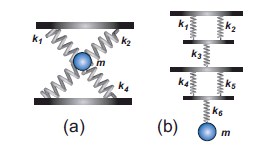
Calculate the equivalent spring constant for the following systems and also compute if all the spring constants are equal:
41.
Why the speed of whirl wind in a Tornado is alarmingly high?
42.
After perfectly inelastic collision between two identical particles moving with same speed in different directions, the speed of the particles become half the initial speed. Find the angle between the two before collision.
43.
The radius of gold nucleus is 41.3 fermi. Express its volume in m3.
1.
(a)
21
2.
(d)
none of these
3.
Factual information
\(\text { At } \mathrm{t}=0 \text { amplitude } \mathrm{y}=\frac{1}{1+x^{2}}\)
\(\text { At } \mathrm{t}=2 \text { amplitude } \mathrm{y}=\frac{1}{1+(x-2)^{2}}\)
\(\therefore v=\frac{\Delta y}{\Delta t} =\frac{2}{2} =1.0 \mathrm{~ms}^{-1} \)
4.
\(T=2 \pi \sqrt{\frac{\ell}{g}}\)
\(\text { when a bus is moving } g^{\prime} \sqrt{g^{2}+a^{2}}\)
\(\therefore T \propto \frac{1}{\sqrt{g^{2}+a^{2}}}\)
5.
For mono atomic molecule No of degrees of freedom = 3
For diatomic molecule of degrees of freedom = 5
For triatomic molecule No of degree of freedom = 7
\(\text { Total }=\left[3 x_{1}+7\left(\mu_{2}+\mu_{3}\right)\right] N_{A}\)
6.
Work done in an isochoric process is zero.
7.
(d)
stress
8.
(b)
9.
(c)
zero
10.
(d)
- 5 m/s and + 3 m/s
11.
(a)
more than 19.6 m/s
12.
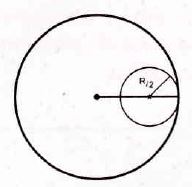
Moment of inertia of a disc
\(\mathrm{I}_{1}=\frac{M R^{2}}{2}\)
\(\text { Mass of small disc }=\frac{M}{\pi R^{2}} \times \pi \times\left(\frac{R}{2}\right)^{2}\)
\(=\frac{M}{\pi R^{2}} \times \frac{\pi R^{2}}{4}=\frac{M}{4}\)
By the theorem of parallel axis, the moment of inertia of the small disc. About an axis passing through 0 is
\(I_{2} =\frac{1}{2} \times \frac{M}{4}\left(\frac{R}{2}\right)^{2}+\frac{M}{4}\left(\frac{R}{2}\right)^{2} \)
\(=\frac{M}{8} \times \frac{R^{2}}{4}+\frac{M}{4} \times \frac{R^{2}}{4} \)
\(=\frac{M R^{2}}{32}+\frac{M R^{2}}{16}=\frac{M R^{2}+2 M R^{2}}{32} \)
\(I_{2} =\frac{3 M R^{2}}{32} \)
Moment of inertia of the remaining part is I= I1 - I2
\(=\frac{M R^{2}}{2}-\frac{3 M R^{2}}{32} \)
\(=\frac{16 M R^{2}-3 M R^{2}}{32}=\frac{13 M R^{2}}{32}\)
\(I =\frac{13 M R^{2}}{32} \)
13.
(c)
2:1
14.
Initially velocity has maximum value and at maximum height velocity becomes zero. After that the velocity becomes negative
15.
Dimension of Planck's constant is \(\left[\mathrm{ML}^{2} \mathrm{~T}^{-1}\right]\)
Dimension of Gravitational constant is \(\left[\mathrm{M}^{-1} \mathrm{~L}^{+3} \mathrm{~T}^{-1}\right]\)
Dimension of Velocity constant is LT-1
Dimension of Length is L
\(\therefore \text { Dimension of } \frac{\sqrt{h G}}{C^{\frac{3}{2}}}\)
\(=\frac{\sqrt{\left(\mathrm{ML}^{2} \mathrm{~T}^{-1}\right)\left(\mathrm{M}^{-1} \mathrm{~L}^{3} \mathrm{~T}^{-2}\right)}}{\left(\mathrm{LT}^{-1}\right)^{3 / 2}} \)
\(=\frac{\sqrt{\mathrm{L}^{5} \mathrm{~T}^{-3}}}{\mathrm{~L}^{3 / 2} \mathrm{~T}^{-3 / 2}} \)
\(=\frac{\mathrm{L}^{5 / 2} \mathrm{~T}^{-3 / 2}}{\mathrm{~L}^{3 / 2} \mathrm{~T}^{-3 / 2}} \)
\(=\mathrm{L}^{5 / 2-3 / 2} \mathrm{~T}^{3 / 2+3 / 2}=\mathrm{L}^{1} \mathrm{~T}^{0}=\mathrm{L}\)
Dimension of length = L
16.
Using Graham's law of diffusion
\(\frac { { R }_{ 1 } }{ { R }_{ 2 } } =\sqrt { \frac { { M }_{ 2 } }{ { M }_{ 1 } } } \)
Squaring both side, we get.
\({ \left( \frac { { R }_{ 1 } }{ { R }_{ 2 } } \right) }^{ 2 }={ \left( \sqrt { \frac { { M }_{ 2 } }{ { M }_{ 1 } } } \right) }^{ 2 }\)
\({ \left( \frac { { R }_{ 1 } }{ { R }_{ 2 } } \right) }^{ 2 }=\frac { { M }_{ 2 } }{ { M }_{ 1 } } \)
\({ M }_{ 2 }={ M }_{ 1 }{ \left( \frac { { R }_{ 1 } }{ { R }_{ 2 } } \right) }^{ 2 }\)
\(={ \left( \frac { { 28.7 } }{ { 7.2 } } \right) }^{ 2 }\)
\(=\frac { 823.69 }{ 51.84 } =15.88\)
=16
The gas is identified as oxygen.
17.
| Volume | Equation of state | Work done (ideal Gas) | Indicator diagram (Pv diagram) |
|---|---|---|---|
| Increases | PV = Constant | W = uRT ln \(\left( \frac { { V }_{ f } }{ { V }_{ i } } \right) >0\) | .PNG) |
| Decreases | W = uRT ln \(\left( \frac { { V }_{ f } }{ { V }_{ i } } \right) <0\) | .PNG) |
|
| Increases | \(\frac { V }{ T } \) = constant | W = P [Vf - Vi] = P \(\triangle\) V > 0 | .PNG) |
| Decreases | W = P [Vf - Vi] = P \(\triangle\) V < 0 | .PNG) |
|
| Constant | \(\frac { p }{ T } \) = constant | Zero | .PNG) |
.PNG) |
|||
| Increases | PVt = constant | \(W=\frac { \mu R }{ \gamma -1 } ({ T }_{ 1 }-{ T }_{ f })>0\) | .PNG) |
| Decreases | \(W=\frac { \mu R }{ \gamma -1 } ({ T }_{ 1 }-{ T }_{ f })<0\) | .PNG) |
18.
According to Bernoulli's theorem, the sum of pressure energy, kinetic energy, and potentialenergy per unit mass of an incompressible, nonviscous fluid in a streamlined flow remains a constant. Mathematically,
\(\frac{P}{\rho}+\frac{1}{2}v^{2}+gh\) = constant
This is known as Bernoulli's equation.
Proof:
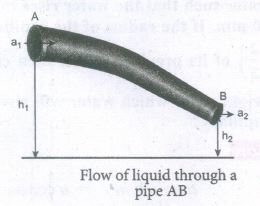
Let us consider a flow of liquid through a pipe AB as shown in Figure. Let V be the volume of the liquid when it enters A in a time t which is equal to the volume of the liquid leaving B in the same time. Let aA, vA and PA be the area of cross section of the tube, velocity of the liquid and pressure exerted by the liquid at A respectively.
Let the force exerted by the liquid at A is
FA= PAaA
Distance travelled by the liquid in time t is
d = vAt
Therefore, the work done is
W = FAd = PAaAvA t
But aAvAt = aAd = V, volume of the liquid entering at A.
Thus, the work done is the pressure energy (at A), W = FAd = PAV
Pressure energy per unit volume at
A = \(\frac{Pressure \ energy}{volume}=\frac{P_{A} V}{V}=P_{A}\)
Pressure energy per unit mass at
A = \(\frac{Pressure \ energy}{volume}=\frac{P_{A} V}{m}=\frac{P_{A}}{\frac{m}{V}}=\frac{P_{A}}{\rho}\)
Since m is the mass of the liquid entering at A in a given time, therefore, pressure energy of the liquid at A is
\(E_{PA}=P_{A}V=P_{A}V\times (\frac{m}{m})=m \frac{P_{A}}{\rho}\)
Potential energy of the liquid at A, PEA = mg hA,
Due to the flow of liquid, the kinetic energy of the liquid at A,
\(KE_{A}=\frac{1}{2}m V_{A}^{2}\)
Therefore, the total energy due to the flow of liquid at A, EA= EPA+ KEA + PEA
\(E_{A}=m \frac{P_{A}}{\rho}+\frac{1}{2}m V^{2}_{A}+mg \ h_{A}\)
Similarly, let aB, vB, and PB be the area of cross section of the tube, velocity of the liquid, and pressure exerted by the liquid at B. Calculating the total energy at EB, we get
\(EB=m \frac{P_{B}}{\rho}+\frac{1}{2}mv^{2}_{B}+mg h_{B}\)
From the law of conservation of energy,
EA = EB
\(m \frac{P_{A}}{\rho}+\frac{1}{2} mv^{2}_{A}+mgh_{A}=m\frac{P_{B}}{\rho}+\frac{1}{2}mv^{2}_{B}+mgh_{B}\)
\(\frac{P_{A}}{\rho}+\frac{1}{2}V^{2}_{A}+gh_{A}=\frac{P_{B}}{\rho}+\frac{1}{2}V^{2}_{B}+gh_{B}\) = constant
Thus, the above equation can be written as
\(\frac{P}{\rho g}+\frac{1}{2}\frac{v^{2}}{g}+h\) = constant
The above equation is the consequence of the conservation of energy which is true until there is no loss of energy due to friction. But in practice, some energy is lost due to friction. This arises due to the fact that in a fluid flow, the layers flowing with different velocities exert frictional forces on each other. This loss of energy is generally converted into heat energy. Therefore, Bernoulli's relation is strictly valid for fluids with zero viscosity or non-viscous liquids. Notice that when the liquid flows through a horizontal pipe, then \(\mathrm{h}=0 \Rightarrow \frac{P}{\rho g}+\frac{1}{2} \frac{v^{2}}{g}=\) constant.
19.
Newton's inverse square Law:
Newton considered the orbits of the planets as circular. For circular orbit of radius r,' the centripetal acceleration towards the center is
\(a=\frac { { V }^{ 2 } }{ r } \) ...(1)
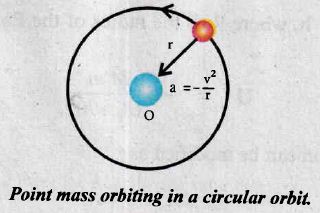
Here v is the velocity and r, the distance of the planet from the center of the orbit.
The velocity in terms of known quantities r and T, is
v = \(\frac { 2\pi r }{ T } \) ...(2)
Here T is the time period of revolution of the planet. Substituting this value of v in equation we get,
a = \(\frac { \left( \frac { 2\pi }{ T } \right) ^{ 2 } }{ r } =-\frac { 4\pi ^{ 2 }t }{ { T }^{ 2 } } \) ...(3)
Substituting the value of 'a' from (3) in Newton's second law, F = ma, where 'm' is the mass of the planet
F = \(\frac { 4\pi mr }{ { T }^{ 2 } } \) ...(4)
From Kepler's third law
\(\frac { r^{ 3 } }{ { T }^{ 2 } } \) = k(constant) ...(5)
\(\frac { r }{ { T }^{ 2 } } =\frac { k }{ { r }^{ 2 } } \) ....(6)
By substituting equation (6) in the force expression, we can arrive at the law of gravitation
\(F=\frac { 4\pi ^{ 2 }mk }{ { r }^{ 2 } } \) ...(7)
Here negative sign implies that the force is attractive arid it acts towards the center. In equation (7), mass of the planet 'm'. comes explicitly. But Newton strongly felt that according to his third law, if Earth is attracted by the Sun, then the Sun must also be attracted by the Earth with the same magnitude of force. So he felt that the Sun's mass (M) should also occur explicitly in the expression for force. From this insight, he equated the constant 4π2k to GM which turned out to be the law of gravitation
F = \(-\frac { GMm }{ { r }^{ 2 } } \)
Again the negative sign in the above equation implies that the gravitational force is attractive.
20.
At any instant t, the projectile has velocity components along both x-axis arid j-axis. The resultant of these two components gives the velocity of the projectile at that instant t, as shown in the figure
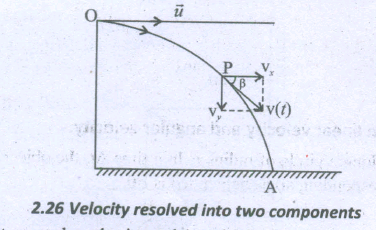
The velocity component at any t along horizontal (x-axis) is vx = ux+axt
Since, ux = u, ax = 0, we get
vx= u
The component of velocity along vertical direction (y-axis) is vy = uy + ayt
Since, uy = 0, ay = g, we get
vy = gt
Hence the velocity of the particle at any instant is
\(\vec { v } =u\hat { i } +gt\hat { j } \)
The speed of the particle at any instant t is given by
\(\therefore v=\sqrt { { v }_{ x }^{ 2 }+{ v }_{ y }^{ 2 } } \)
\(v=\sqrt { { u }^{ 2 }+{ g }^{ 2 }{ t }^{ 2 } } \)
21.
From law of conservation of momentum, along x-axis,
\(mu_1+0=mv_1\cos\theta_1+mv_2\cos\theta_2\)
\(u_1=v_1\cos\theta_1+v_2\cos\theta_2\) ....(1)
along y-axis, \(0=v_1\sin\theta_1-v_2\sin\theta_2\) ....(2)
From energy of conservation,
\({1\over2}{mu}_{1}^{2}={1\over2}{mv}_{1}^{2}+{1\over 2}{mv}_{2}^{2}\)
\({u}_{1}^{2}={v}_{1}^{2}+{v}_{2}^{2}\) ...(3)
By using equation (1) and (2) in equation (3) we get,
\(2v_1 v_2\cos(\theta_1+\theta_2)=0\)
\(\cos(\theta_1+\theta_2)=\cos{\pi \over 2}\)
\(\theta_1+\theta_2={\pi \over 2}\)
\(\therefore\) This shows that the particle move perpendicular to each other after collision.
22.
mass, m=1200 kg
v=54 km/h=\(54\times \frac { 5 }{ 18 } \) m/sec=15 m/s
Angular momentum, L =r m v= 300 \(\times\) 1200 \(\times\)15
=54,00,000
=5.4 x 10⁶ kg m2/s
23.
(i) The centripetal acceleration is given by \(a=\frac { { v }^{ 2 } }{ r } \) This expression explicitly depends on Moon's speed which is non trivial. We can work with the formula
ω2Rm = am
(ii) am is centripetal acceleration of the Moon due to Earth's gravity.
ω is angular velocity
(iii) Rm the distance between Earth and the Moon, which is 60 times the radius of the Earth.
Rm = 60R = 60 \(\times\)6.4 \(\times\)106 = 384 \(\times\)106 m
(iv) As we know the angular velocity ω = \(\frac { 2\pi }{ T } \)and
T = 27.3 days = 27.3 \(\times\) 24 \(\times\) 60 \(\times\) 60 second
= 2.358 \(\times\) 106 sec
(v) By substituting these values in the formula for acceleration
am = \(\frac { (4\pi ^{ 2 })(384\times { 10 }^{ 6 }) }{ (2.358\times { 10 }^{ 6 }) } \) = 0.00272 ms-2
= 2.72 x 10⁻³ms-2
The centripetal acceleration of Moon towards the Earth is 0.00272 m s-2
24.
Use of screw gauge in measuring radius of a thin wire in the range of 10-5 m
The wire whose diameter is to be determined should be clamped between the jaws of the screw gauge. The reading on pitch scale (P.S.R) is noted. Then the reading of the reading of the head scale coinciding with the pitch scale is noted (A.S.C.) The zero correction is applied to head scale incidence. (C.H.S.S.).
The total reading is given by
T.R = P.S.R + (C.H.S.C. X L.C)
The procedure is repeated for at least six different positions of the wire. The mean of the reading taken gives the diameter of the wire. Half of this gives radius of the wire 'r' in the range of 10-5 m.
Use of vernier caliper in measuring smaller distances in the range of 10-4 m
The sphere is kept between the two jaws. The main scale reading (MSR) is noted (i.e), the main scale division immediately before the zero of the vernier scale. Then the vernier scale division which coincides with some main scale division (VSD) is noted. Zero correction made with this VSD gives VSR. Multiply this VSR by least count and add with MSR. This will give the diameter of the sphere. Observations for different positions of the sphere is hence forth recorded. The mean of the readings taken gives the diameter of the sphere. Half of this gives the diameter of the sphere. Half of this gives radius in the range of 10-4 am
(ii) Write a note on triangulation method and radar method to measure larger distances.
Triangulation method for the height of an accessible object
Let AB = h be the height of the tree or tower to be measured. Let C be the point of observation at distance x from B. Place a range finder at C and measure the angle of elevation, ∠ACB = θ as shown in Figure
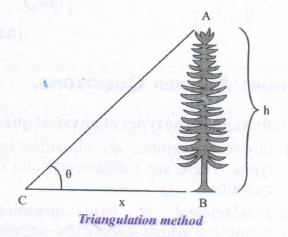
From right angled triangle ABC,
\(\tan \theta=\frac{A B}{B C}=\frac{h}{x}\)
(or) height h = x tan θ
Knowing the distance x, the height h can be determined.
Radar Method: In Radar method radio waves are sent from transmitters which, after reflection from the planet, are detected by the receiver. By measuring, the time interval (r) between the instants the radio waves are sent and received, the distance of the planet can be determined as to get the actual distance of the object. This method can also be used to determine the height, at which an aeroplane flies from the ground.
\(Speed =\frac{\text { Distance travelled }}{\text { Time taken }} \) (Speed is explained in unit 2 )
Distance (d)= Speed of radio waves x Time taken
\(d=\frac{v \times t}{2}\)
where v is the speed of the radio wave. As the time taken (r) is for the distance covered during the forward and backward path of the radio waves, it is divided by 2 to get the actual distance of the object. This method can also be used to determine the height, at which an aeroplane flies from the ground.
25.
As the temperature increases, the length of the prong of the tuning fork increases. This increases the wavelength of the stationary waves set up in the tunning fork, As frequency, \(v\ \alpha\ {1\over \lambda}\)so frequency of the tunning fork decreases.
26.
For a closed organ Pipe
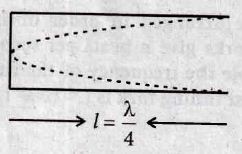
\(\ell=\frac{\lambda}{4}
\)
\(\therefore \lambda=4 \ell\)
For a open organ pipe \(L=\frac{\lambda}{2} \quad \therefore \lambda=2 L\)
Fundamental frequency of a closed pipe
\(f_{c} =250 \mathrm{~Hz}
\)
\(f_{0} =\frac{V}{\lambda}
\)
\(=\frac{V}{2 L}\)
Fundamental frequency of open organ pipe
\(f_{o} =2\left(\frac{V}{4 L}\right)
\)
\(=2 \times f_{c}
\)
\(=2 \times 250=500 \mathrm{~Hz}\)
∴ Frequency of open organ pipe =500 Hz.
27.
\(\eta =1-\frac{T_{2}}{T_{1}}
\)
\(\eta =\frac{45}{100}=0.45
\)
\(T_{1} =327^{\circ} \mathrm{C}
\)
\(=327+273=600 \mathrm{~K}
\)
\(\therefore 0.45 =1-\frac{T_{2}}{600}
\)
\(\therefore \frac{T_{2}}{600} =1-0.45=0.55
\)
\(\therefore T_{2} =600 \times 0.55=330 \mathrm{~K}
\)
\(\eta =60 \%
\)
\(= \frac{60}{100}=0.6\)
\(0.6 =1-\frac{T_{2}}{T_{1}}
\)
\(0.6 =1-\frac{330}{T_{1}}
\)
\(\frac{330}{T_1} =1-0.6=0.4\)
\({T_{1}} =\frac{330}{0.4}=\frac{3300}{4}=825 \mathrm{~K}
\)
= 825 - 273 = 552 oC
Intake temperature = 552 oC
28.
Hooke's law of elasticity states that within the elastic limit, the strain produced in a body is directly proportional to the stress applied.
strain ∝ stress
29.
Let the particle of mass m cross a horizontal distance x in time t.
Angular momentum \(\overrightarrow{L}=\int{\overrightarrow{\tau}}{dt}\)
But \(\overrightarrow{\tau}=\overrightarrow{r}\times \overrightarrow{F}\)
\(\overrightarrow{r}=x\hat { i } +y\hat { j} \) and \(\hat { F }=-mg \hat { j } \)
\(\therefore \overrightarrow { \tau }=(x\hat { i }+y\hat { j } ) \times (-mg \hat { j } )\)
\(\overrightarrow { \tau } =-mgx(\hat { i } \times \hat { j } )=-mgx\hat { k } \)
\(\overrightarrow { L } = -mg \int{(xdt)}\hat {k} =-gv\ cos\theta (\int t dt)\hat { k } \)
Let initial time t = 0 and final time t = tf
\(\overrightarrow {L}=-mg \cos \theta \left( ^{ t }\int _{ 0 }^{ f }{ tdt } \right) \hat k = -\frac{1}{2}mgv\ cos \theta\ t^{2}_{f} \hat{k}\)
Negative sign indicates, \(\overrightarrow {L}\) point inwards.
30.
.png)
We know that when the object falls towards the Earth, it experiences acceleration due to gravity g = 9.8 m s-2 downward. We can choose the coordinate system as shown in the figure. The acceleration is along the negative y direction.
\(\vec { a } =g(-\hat { j } )-g\hat { j } \)
31.
K.E. = \(\frac { { p }^{ 2 } }{ 2m } \) so p=\(\sqrt { 2mk } \)
Increase in K.E. = 300% of k = 3k
Final K.E., k' = k+ 3k= 4k
Final momentum, p' = \(\sqrt { 2m{ k }^{ \prime } } =\sqrt { 2m\times 4k } =2\sqrt { 2mk } \)=2p
% Increase in momentum = \(\frac { { p }^{ \prime }-p }{ p } \times 100\)=100%
32.
To find the force, we need to find the acceleration experienced by the particle.
Th e acceleration is given by a=\(\frac { { d }^{ 2 }y }{ { dt }^{ 2 } } \) or a=\(\frac { dv }{ dt } \)
Here v = velocity of the particle in y direction
v = \(\frac { dy }{ dt } \) = u - gt
The momentum of the particle = mv = m(u - gt)
a = \(\frac { dv }{ dt } \) = -g
The force acting on the object is given by F = ma = -mg
The negative sign implies that the force is acting on the negative y direction. This is exactly the force that acts on the object in projectile motion.
33.
3
34.
Using the equation,
\(|\vec A-\vec B|=\sqrt{5^2+7^2-2\times 5\times 7\cos60^o}=\sqrt{25+49-35}=\sqrt{39}\) units
The angle that \(\vec A-\vec B\) makes with the vector \(\vec A\) is given by
\(\tan\alpha_2=\frac{7\sin60^o}{5-7\cos60^o}=\frac{7\sqrt{3}}{10-7}=\frac{7}{\sqrt{3}}\)= 4.041
\(\alpha_2=tan^{-1}(4.041)=76^o\)
35.
(a) A frame of reference which is at rest or which is moving with a uniform velocity along a straight line is called an inertial frame of reference.
(b) In the inertial frame of reference Newton's laws of motion holds good.
Example: The lift at rest, lift moving (up or down) with constant velocity, car moving with constant velocity on a straight road.
36.
\({ \left( \frac { { T }_{ 2 } }{ { T }_{ 1 } } \right) }^{ 2 }={ \left( \frac { { R }_{ 2 } }{ { R }_{ 1 } } \right) }^{ 3 }(or)\ { \left( \frac { { T }_{ 1 } }{ 5 } \right) }^{ 2 }={ \left( \frac { { 4 }R_{ 1 } }{ { R }_{ 1 } } \right) }^{ 3 }\)
\({ T }_{ 2 }=\sqrt { 64\times 25 } \)
= 40h
37.
(i) This is a thermodynamic process in which the thermodynamic system returns to its initial state after undergoing a series of changes.
(ii) Since the system comes back to the initial state, the change in the internal energy is zero.
(iii) In cyclic process, heat can flow in to system and heat flow out of the system.
38.
Consider one mole of a gas.
p - pressure; v - volume; T - temperature;
M - molecular mass of the gas; density p.
Accumulate to kinetic theory, the pressure excited by the gas is
v = \(\frac{1}{3}\)pc2 = p =\(\frac{1}{3}\)\(\frac{m}{3}\).c2 (or) pv = \(\frac{1}{3}\)Mc2....(1)
pv = \(\frac{2}{3}\).\(\frac{1}{3}\)Mc2
\(\frac{1}{2}\)Mc2. is the ave. K.E.E of one mole of the gas.
\(\therefore\) pv =\(\frac{2}{3}\) .E
The ideal gas eqn for one mole of a gas is
pv = RT \(\therefore\) RT = \(\frac{2}{3}\) E (or) E=\(\frac{3}{2}\).RT
The above equation gives the mean K.E of one mole of gas.
\(\therefore\)The mean K. E per molecule is proportional to the absolute temperature of the gas.
39.
Periodic motion is any motion which repeats itself in a fixed time internal.
Example:
Hands in pendulum clock, swing of a cradle, the revolution of the Earth around the Sun, waxing and waning of Moon, etc.
Non periodic motion is any motion which does not repeat itself after a regular interval of time.
Example: Occurrence of Earth quake, eruption of volcano, etc.
40.
a. Since k1 and k2 are parallel, ku = k1 + k2 Similarly, k3 and k4 are parallel, therefore, kd = k3 + k4 But ku and kd are in series,
therefore, \({ k }_{ eq }=\frac { { k }_{ u }{ k }_{ d } }{ { k }_{ u }+{ k }_{ d } } \)
If all the spring constants are equal then, k1 = k2 = k3 = k4 = k
Which means, ku = 2k and kd = 2k
Hence, \({ k }_{ eq }=\frac { { 4k }^{ 2 } }{ 4k } =k\)
b. Since k1 and k2 are parallel, kA = k1 + k2 Similarly, k4 and k5 are parallel,
therefore, kB = k4 + k5
But kA, k3, kB, and k6 are in series,
therefore, \(\frac { 1 }{ { k }_{ eq } } =\frac { 1 }{ { K }_{ A } } +\frac { 1 }{ { K }_{ 3 } } +\frac { 1 }{ { K }_{ B } } +\frac { 1 }{ { K }_{ 6 } } \)
If all the spring constants are equal
then, k1 = k2 = k3 = k4 = k5 = k6 = k
which means, kA = 2k and kB = 2k
\(\frac { 1 }{ { k }_{ eq } } =\frac { 1 }{ { 2K } } +\frac { 1 }{ { K } } +\frac { 1 }{ { 2K } } +\frac { 1 }{ { K } } =\frac { 3 }{ { K } } \)
\({ k }_{ eq }=\frac { k }{ 3 } \)
41.
In this, air from nearly regions get concentrated in a small space, so I decreases considerably. Since I.\(\omega\) = constant so co increases so high.
42.
Linear momentum remains conserved.
Resultant initial momentum \(p=\sqrt{{p}_{1}^{2}+{p}_{2}^{2}+2{p}_{1}{p}_{2}\cos \ \theta}\)
\({\{ 2m\left( {v \over 2} \right) \}}^{2}=\{mv\}^2+2\{ mv\}\{ mv \}\ \cos\theta\)
\(1 = 1 + 1 +2 \times 1 \times 1 \cos\theta\)
\(\cos \theta=-{1\over2}\)
\(\theta=120°\)
43.
Radius of gold nucleus = 41.3\(\times\)10-15 m.
Volume (v) \(= {{4}\over{3}}\pi r^3\)
\(={{4}\over{3}}\times3.14\times(41.3\times{10}^{-15})^3\)
v = 2.95\(\times\)10-40 m.

11th Standard Syllabus & Materials
11th Standard
TN 11th Tamil பீடு பெற நில் - செய்யுள் - காவடிச்சிந்து Important Questions And Answers Study Material - QB365 Set A
NEW11th Standard
TN 11th Tamil பீடு பெற நில் - உரைநடை - மலை இடப்பெயர்கள் : ஓர் ஆய்வு Important Questions And Answers Study Material - QB365 Set A
NEW11th Standard
TN 11th Tamil மாமழை போற்றுதும் - துணைப்பாடம் - யானை டாக்டர் Important Questions And Answers Study Material - QB365 Set A
NEW11th Standard
TN 11th Tamil மாமழை போற்றுதும் - செய்யுள் - ஐங்குறுநூறு Important Questions And Answers Study Material - QB365 Set A



Tamilnadu Stateboard 11th Standard Subjects

Maths

Commerce

Economics

Biology

Business Maths and Statistics

Accountancy

Computer Science
Physics

Chemistry
Maths
Biology
Economics
Physics
Chemistry

History
Business Maths and Statistics

Computer Science
Accountancy

Computer Applications
History
Computer Technology
Commerce
Computer Applications
Computer Technology

Tamil

English

French
Tamilnadu Stateboard Standards

