
 100% FREE ACCESS
11th Standard Syllabus & Materials
11th Standard
TN 11th Tamil இயற்கை வேளாண்மை,சுற்றுச்சூழல் -செய்யுள் - மனோன்மணீயம் Important Questions And Answers Study Material - QB365 Set A
NEW11th Standard
TN 11th Tamil என்னுயிர் என்பேன் -துணைப்பாடம் - இசைத்தமிழர் இருவர் Important Questions And Answers Study Material - QB365 Set A
NEW11th Standard
TN 11th Tamil மொழி கலை -செய்யுள் - ஒவ்வொரு புல்லையும் Important Questions And Answers Study Material - QB365 Set A
NEW11th Standard
TN 11th Tamil பீடு பெற நில் - இலக்கணம் - பகுபத உறுப்புகள் Important Questions And Answers Study Material - QB365 Set A
NEW11th Standard
TN 11th Tamil பீடு பெற நில் - துணைப்பாடம் - வாடிவாசல் Important Questions And Answers Study Material - QB365 Set A
NEW11th Standard
TN 11th Tamil பீடு பெற நில் - செய்யுள் - குறுந்தொகை Important Questions And Answers Study Material - QB365 Set A

Published on: 28/07/2018
In this question paper, some of the important one mark, two and five marks questions from the chapter Production Analysis are covered. The questions are prepared from the book back and previous year questions.
For parents, Please subscribe and get the plenty of question with answer for your children practice. For Subscription please, click here.
Download Tamil Nadu 11th Standard Economics question papers, model tests, one-mark questions, important questions, and public exam papers in PDF format. Free study materials and answer keys for TN State Board students.
Questions + Answers key
Take MCQ Economics Test
1.
Education and training given to labour is _____________
money capital
human capital
physical capital
none of the these
2.
__________ represent Human capital.
Money
Efficiency
Hard work
All the above
3.
_________ faces both risks and uncertainties.
Entrepreneur
Labour
Land
None of these
4.
Modern economists have propounded the law of
Increasing returns
Decreasing returns
Constant returns
Variable proportions
5.
Product obtained from additional factors of production is termed as
Marginal product
Total product
Average product
Annual product
6.
Which of the following is not a characteristic of land?
Its limited supply
It is mobile
Heterogeneous
Gift of Nature
7.
An Iso - quant curve is also known as
Inelastic Supply Curve
Inelastic Demand Curve
Equi-Marginal Utility
Equal Product Curve
8.
The long-run production function is explained by
Law of Demand
Law of Supply
Returns to Scale
Law of Variable Proportions
9.
The short-run production is studied through
The Law of Returns to scale
The Law of Variable Proportions
Iso - quants
Law of Demand
10.
In a firm 5 units of factors produce 24 units of the product. When the number of factor increases by one, the production increases to 30 units. Calculate the Average Product.
30
6
5
24
11.
What is production?
12.
What is factors of production?
13.
What are the assumptions of Iso-quant curve?
14.
State the production function.
15.
16.
17.
Explain the Internal and External diseconomies of scale.
18.
Explain the characteristics of Capital?
19.
Explain the Various Forms of Capital?
20.
Explain the classification of factors of production.
21.
Distinguish between Total Product (TP) and Average Product (AP).
22.
What are the characteristics of capital?
23.
Explain the types of elasticity supply with the help of diagram.
24.
1.
(b)
human capital
2.
(a)
Money
3.
(a)
Entrepreneur
4.
(a)
Increasing returns
5.
(a)
Marginal product
6.
(b)
It is mobile
7.
(d)
Equal Product Curve
8.
(c)
Returns to Scale
9.
(b)
The Law of Variable Proportions
10.
(c)
5
11.
(i) Production refers to the creation or addition of value.
(ii) Production is a process of value adding.
(iii) In other words, production is also defined as the transformation of input into output.
12.
(i) The inputs that a firm uses in the production process are called factors of production.
(ii) It includes factor inputs and non-factor inputs
13.
(i) It is assumed that only two factors are used to produce a commodity.
(ii) Factors of production can be divided into small parts
(iii) Technique of production is constant.
(iv) Under the given techniques, factors of production can be used with maximum efficiency.
14.
(i) Production function refers to the relationship among units of the factors of production (inputs) and the resultant quantity of a good produced (output).
(ii) Q = f(N, L, K, T);
Q = Quantity of output, N = Land, L = Labour, K = Capital, T = Technology
15.
16.
17.
Diseconomies of scale: The diseconomies of the scale are a disadvantage to a firm or an industry or an organisation. This necessarily increases the cost of production of a commodity or service.
These diseconomies are of two types:
a) Internal Diseconomies of Scale and
b) External Diseconomies of Scale
a) Internal Diseconomies of Scale: When the scale of production increases beyond optimum limit, its efficiency may come down.
b) External ·Diseconomies of Scale: The term "External diseconomies of scale" refers to the threat or disturbance to a firm or an industry from factor lying outside it. For example a bus strike prevents the easy and correct entry of the workers into a firm. Similarly the rent of a firm increases very much if new economic units are established in the locality.
18.
Bohm - Bawerk defines it as "a Produced means of Production". All capital is wealth but all wealth is not capital.
Characteristics of Capital
i) is a man-made factor.
ii) Capital is mobile between places and persons.
iii) Capital is a passive factor of production.
iv) Capital's supply is elastic.
v) Capital's demand is a derived demand.
vi) Capital is durable.
19.
The various Forms of Capital are:
a. Physical Capital or Material Resources
b. Maney Capital or Monetary Resources, and
c. Human Capital or Human Resources
a. Physical Capital: All man-made physical assets like plant and machinery, tools, buildings, roads, dams and communication, etc., are the various forms of physical capital.
Characteristics of Physical capital
i. It is an asset which has a specific life period.
ii. Physical capital asset can be used in production again and again. As a result, it undergoes wear and tear or depreciation.
iii. When used in production, it gives a series of annual income flows called annuities, during its life period.
Accumulation of more and more physical capital is called physical capital formation.
b. Money Capital: The investment that is made in the form of money or monetary instruments is called money capital. A household saves its income in the form of bank deposits, shares and securities or other monetary instruments. These are the sources of money capital.
c. Human Capital: Human capital refers to the quality of labour resources, which can be improved through investments in education, training, and health. Higher the investments in human capital, higher will be the productivity.
20.
Factors of production are broadly classified into primary factors and derived factors. Man (Labour) acts upon Nature (Land) to produce goods and services and wealth. These two factors (Land and Labour) are naturally given and without them no goods can be produced. These are called primary factors. Capital and organisation are derived from the primary factors of production, and are called derived factors of production. These derived factors of production, when combined with the primary factors of production, raise total production.
According to the traditional classification, there are four factors of production. They are Land, Labour, Capital and Organisation.
21.
Total Product:
(i) It refers to the total amount of commodity produced by combination of all inputs in a given period of time.
(ii) It can be calculated in two ways
TP = AP x N (or) AP = TP / N
Average Product:
(i) It refers to the output per unit of the input (or)
\(AP=\frac { TP }{ Q } (or)N\)
(ii) It is the result of the total product divided by the total output.
22.
(i) Capital is man-made.
(ii) Capital is mobile between places and persons.
(iii) Capital is a positive factor of production.
(iv) Capital's supply is elastic.
(v) Capital's demand is derived demand.
(vi) Capital is durable.
23.
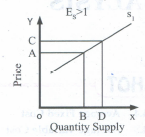
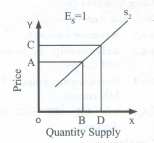
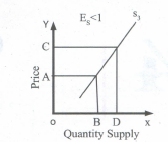
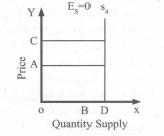
There are five types of elasticity supply. There are,
(1) Relative Elastic Supply: (ES> 1)
(i) The co-efficient of elastic supply is greater than 1 (ES> 1)
(ii) A unit change in the price causes more than one percent change in quantity supply of the commodity.
(2) Unitary Elastic Supply: (ES = 1)
(i) The co-efficient of elastic supply is equal to one (ES = 1)
(ii) A unit change in the price causes an equal change in quantity supply is called elastic supply.
(3) Relatively Inelastic Supply: (ES < 1)
(i) The co-efficient of elasticity is less than one (ES < 1)
(ii) A unit change in the price causes and less than one percent change in the quantity supply.
(4) Perfectly Inelastic Supply: (ES = 0) .
(i) The co-efficient of elasticity is equal to zero (ES = 0)
(ii) A unit change in the price causes no change in the quantity supply.
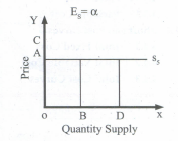
(5) Perfectly elastic supply: (ES= =)
(i) The co-efficient of elasticity of supply is infinity (ES = DC)
(ii) A unit change in the price causes an infinite change in the quantity supply.
24.

11th Standard Syllabus & Materials
11th Standard
TN 11th Tamil பீடு பெற நில் - செய்யுள் - காவடிச்சிந்து Important Questions And Answers Study Material - QB365 Set A
NEW11th Standard
TN 11th Tamil பீடு பெற நில் - உரைநடை - மலை இடப்பெயர்கள் : ஓர் ஆய்வு Important Questions And Answers Study Material - QB365 Set A
NEW11th Standard
TN 11th Tamil மாமழை போற்றுதும் - துணைப்பாடம் - யானை டாக்டர் Important Questions And Answers Study Material - QB365 Set A
NEW11th Standard
TN 11th Tamil மாமழை போற்றுதும் - செய்யுள் - ஐங்குறுநூறு Important Questions And Answers Study Material - QB365 Set A



Tamilnadu Stateboard 11th Standard Subjects

Maths

Commerce
Economics

Biology

Business Maths and Statistics

Accountancy

Computer Science

Physics

Chemistry
Maths
Biology
Economics
Physics
Chemistry

History
Business Maths and Statistics

Computer Science
Accountancy

Computer Applications
History
Computer Technology
Commerce
Computer Applications
Computer Technology

Tamil

English

French
Tamilnadu Stateboard Standards
