
 100% FREE ACCESS
11th Standard Syllabus & Materials
11th Standard
TN 11th Tamil இயற்கை வேளாண்மை,சுற்றுச்சூழல் -செய்யுள் - மனோன்மணீயம் Important Questions And Answers Study Material - QB365 Set A
NEW11th Standard
TN 11th Tamil என்னுயிர் என்பேன் -துணைப்பாடம் - இசைத்தமிழர் இருவர் Important Questions And Answers Study Material - QB365 Set A
NEW11th Standard
TN 11th Tamil மொழி கலை -செய்யுள் - ஒவ்வொரு புல்லையும் Important Questions And Answers Study Material - QB365 Set A
NEW11th Standard
TN 11th Tamil பீடு பெற நில் - இலக்கணம் - பகுபத உறுப்புகள் Important Questions And Answers Study Material - QB365 Set A
NEW11th Standard
TN 11th Tamil பீடு பெற நில் - துணைப்பாடம் - வாடிவாசல் Important Questions And Answers Study Material - QB365 Set A
NEW11th Standard
TN 11th Tamil பீடு பெற நில் - செய்யுள் - குறுந்தொகை Important Questions And Answers Study Material - QB365 Set A

Published on: 27/04/2019
Public exam five mark questions in Basic Concepts of Chemistry and Chemical Calculations
Download Tamil Nadu 11th Standard Chemistry question papers, model tests, one-mark questions, important questions, and public exam papers in PDF format. Free study materials and answer keys for TN State Board students.
Questions + Answers key
Take MCQ Chemistry Test
1.
Balance the following equation by ion electron method.
Zn + NO3- ⟶ Zn + NH4+2
2.
Balance the following equation by ion electron method.
Cr2O72- + C2H4O ⟶ Cr+3 + C2H4O2
3.
Balance the following equation by ion electron method.
Cr2O72- + Fe2+ ⟶ Cr3+ + Fe2+ in acidic medium.
4.
An inorganic compound an analysis gave the following composition. Na = 14.31%, S = 9.97%, H = 6.22%, O = 69.5%. Assume all the hydrogen atoms are present in combination with oxygen as water of crystallization. The molar mass of the compound is 322 g mol-1. Find its molecular formula.
5.
Balance the following equations by oxidation number method.
KMnO4 + KOH + H2O2 ⟶ K2MnO4 + O2 + H2O
6.
Balance the following equations by oxidation number method.
KBr + MnO2 + H2SO4 ⟶ KHSO4 + MnSO4 + H2O + Br2
7.
Balance the following equations by oxidation number method.
K2Cr2O7 + FeSO4 + H2SO4 ⟶ K2SO4 + Cr2(SO4)3 + Fe2(SO4)3 + H2O
8.
Balance the following equations by oxidation number method.
Ag + HNO3 ⟶ AgNO3 + H2O + NO
9.
Balance the following equations by oxidation number method.
Zn + HNO3 ⟶ Zn(NO3)2 + N2O + H2O
10.
Balance the following equations by oxidation number method.
K2Cr2O7 + HI ⟶ KI + Crl3 + H2O + I2
11.
Balance the following equations by oxidation number method.
NH3 + F2 ⟶ HF + N2
12.
Balance the following equations by oxidation number method.
C4H10 + O2 ⟶ CO2 + H2O
13.
Balance the following equations by oxidation number method.
C6H12O6 + H2SO4 ⟶ CO2 + SO2 + H2O
14.
Balance the following equations by oxidation number method.
KIO3 + SO2 + H2O ⟶ KHSO4 + H2SO4 + I2
15.
Balance the following equations by oxidation number method.
P + HNO3 ⟶ HPO3 + NO + H2O
16.
Balance the following equations by oxidation number method.
CuO + NH3 ⟶ Cu +N2 + H2O
17.
Explain the term competitive electron transfer reaction with an example.
18.
In a reaction, A + B2 \(\longrightarrow \) AB2, identify the limiting reagent if any in the following reaction mixtures
(i) 300 atoms of A + 200 molecules of B
(ii) 2 moles of A + 3 moles of B
(iii) 100 atoms of A + 100 molecules of B
(iv) 5 moles of A + 2.5 moles of B
(v) 2.5 moles of A + 5 moles of B
19.
Distinguish between the following.
(i) Atomic and molecular mass
(ii) Atomic mass and atomic weight
(iii) Empirical and molecular formula
(iv) Moles and molecules.
20.
Arrange the elements silver, Zinc and copper in the order of their decreasing electron releasing tendency and justify your arrangement with an appropriate experiment.
21.
Explain displacement reaction ? Explain its two types with an example for each.
22.
Write note on decomposition reaction
23.
Write note on combination reaction.
24.
What are disproportionation reaction (or) auto redox reactions ? Give examples.
25.
Calculate the number of molecules of oxygen gas that occupies a volume of 224 ml at 273 K and 3 atm pressure.
1.
Zn + NO3- ⟶ Zn + NH4+2 in basic medium
Zn ⟶ Zn+2 + 2e (oxidation) NO3- ⟶ NH4+ (Reduction)
Step-1: Balance all atoms other than hydrogen and oxygen.
Zn ⟶ Zn+2 NO3- ⟶ NH4+
Step-2: For balancing oxygen atom in alkaline medium, add H20 molecules on the side deficient of oxygen atom.
Then balance hydrogen atom, add H20 molecule to the side deficient in hydrogen and equal number of OH- on the other side.
Zn ⟶ Zn+2 NO3- ⟶ NH4-+3H2O
NO3- + 10H2O ⟶ NH4+ + 3H2O
NO3- + 10H2O ⟶ NH4+ + 3H2O + 10OH-
Step-3: Add electrons to balance charge
Zn ⟶ Zn+2 +2e
NO3- + 7H2O + 8e ⟶ NH4+ +10OH-
Zn ⟶ Zn+2 + 2e x 8
NO3- + 7H2O + 8e ⟶ NH4+ + 10OH-
___________________________________
8Zn + NO3- + 7H2O ⟶ 8Zn+2 + NH4+ + 10OH-
This is the balanced equation.
2.
Cr2O72- + C2H4O ⟶ Cr+3 + C2H4O2 In acidic medium.
\(\overset { +6-2 }{ { Cr }_{ 2 }{ O }_{ 7 } } +\overset { +1+1-2 }{ { C }_{ 2 }{ H }_{ 4 }O } \rightarrow \overset { +3+3 }{ Cr } +\overset { 0+1-2 }{ { C }_{ 2 }{ H }_{ 4 }{ O }_{ 2 } } \)
Cr2O7-2 ⟶ Cr+3 (Reduction) C2H4O ⟶ C2H4O2 (Oxidation)
Step - 1 : Balance all atoms other than oxygen
Cr2O7-2 ⟶ 2Cr+3 C2H4O ⟶ C2H4O2
Step - 2 : Balance oxygen atom by adding water molecules on the side deficient of oxygen atom.
Cr2O7-2 ⟶ 2Cr+3 + 7H2O C2H4O + H2O ⟶ C2H4O2
Step - 3 : To balance hydrogen atoms in acidic medium, add equal number of H" ions on the side deficient of hydrogen atom.
Cr2O7-2 + 14H-1 ⟶ 2Cr+3 + 7H2O C2H4O + H2O ⟶ C2HO2 + 2H-1
Step - 4 : Balance the charges by adding sufficient number of electrons
Cr2O7-2 ⟶ 14H+ + 6e ⟶ 2Cr+3 + 7H2O ..(1)
C2H4O + H2O ⟶ C2H4O2 + 2H+ + Ze ...(2)
Multiply equation (2) by 3 and add with equation (1)
Cr2O7-2 + 14H+ + 6e ⟶ 2Cr+3 + 7H2O
C2H4O + H2O ⟶ C2H4O2 + 2H+ +2e x 3
Cr2O7-2 + C2H4O + 8H+ ⟶ 2Cr+3 + 4H2O + 3C2H4O2
3.
Cr2O72- + Fe2+ ⟶ Cr3+ + Fe2+ (acidic solution)
Cr2O72- ⟶ Cr+3 (reduction) (The O.N ofCr decreases from +6 to +3)
Fe+2 ⟶ Fe+3 (oxidation) (The O.N of Fe increases from +2 to +3)
Balancing oxidation and reduction half reactions separately.
Cr2O7-2 ⟶ Cr+3 Fe+2 ⟶ Fe+3
Step - 1 : Balance' all atoms, other than hydrogen and oxygen.
Cr2O7-2 ⟶ Cr+3 Fe+2 ⟶ Fe3+
Step - 2 : Balance oxygen atom by adding equal number of H20 molecules on the side deficient of oxygen.
Cr2O7-2 ⟶ 2Cr+3 + 7H2O Fe+2 ⟶ Fe+3
Step - 3 : To balance, hydrogen atom in acidic medium, add equal number H+ ions on the side deficient of hydrogen atom.
14H+ + Cr2O7-2 ⟶ 2Cr+3 + 7H2O Fe+2 ⟶ Fe+3
Step - 4 : Balance the charges in such a way the charges on either side be the same
6e + Cr2O7-2 + 14H+ ⟶ 2Cr+3 + 7H2O Fe+2 ⟶ Fe+3
Add both equations in such a way the number of electrons taken up by the oxidising agent and the number of electron given by the reducing agent be the same,
Cr2O7-2 + 14H+ + be ⟶ 2Cr+3 + 7H2O
Fe+2 ⟶ Fe+3 + e x 6
_____________________________________
Cr2O7-2+14H++6Fe+2 ⟶ 2Cr+3+6Fe+3+7H2O
______________________________________
4.
| Element | % of composition | Atomic mass | Relative No. of moles | Simple ratio | Simplest whole number ratio |
| Na | 14.31 | 23 | \(\frac{14.31}{23}=0.622\) | \(\frac{0.622}{0.31}=2\) | 2 |
| S | 9.91 | 32 | \(\frac{9.91}{32}=0.31\) | \(\frac{0.31}{0.31}=1\) | 1 |
| H | 6.22 | 1 | \(\frac{6.22}{1}=6.22\) | \(\frac{6.22}{0.31}=20\) | 20 |
| O | 69.5 | 16 | \(\frac{69.5}{16}=4.34\) | \(\frac{4.34}{0.31}=14\) | 14 |
The Empirical formula is Na2SH20O14
Since all hydrogen are present as water of hydration, the number of mole of water present in the compound is 10H2O.
Hence, the empirical formula Na2SO4. 1OH 2O.
Empirical formula mass of the compound = 2 x 23 + 1 x 32 + 4 x 16 + 10 x 18 = 322.
Molar mass of the compound = 322 g mol-1.
n = \(\frac{Molar\ mass}{Empirical\ formula\ mass}=\frac{322}{322}=1\)
Hence the molecular formula is Na2SO4 1OH2O.
5.
Step - 1 : To find out atoms undergoing change in O.N.
\(\overset { +1+7-2 }{ KMnO_{ 4 } } +\overset { +1-2+1 }{ KOH } +\overset { +1-1 }{ { H }_{ 2 }{ O }_{ 2 } } \rightarrow +\overset { +1+6-2 }{ K_{ 2 }MnO_{ 4 } } +\overset { 0 }{ { O }_{ 2 } } +\overset { +1-2 }{ { H }_{ 2 }O } \)
Step - 2 : To find out total increase and decrease in O.N .
\(\overset { +7 }{ KMnO_{ 4 } } \rightarrow \overset { +6 }{ K_{ 2 }MnO_{ 4 } } \) (decrease of 1 unit per atom)
\(\overset { -1 }{ { H }_{ 2 }{ O }_{ 2 } } \rightarrow \overset { 0 }{ { O }_{ 2 } } \) (increase of 1 unit per atom or 2 units per atom)
Total increase = 2
Total decrease = 2
Step - 3 : To balance the total increase and decrease in O.N, multiply KMnO4 by 2.
2KMnO4 + KOH + H2O2 ⟶ K2MnO4 + O2 + H2O
Step - 4 : To balance all atoms other than 'H' and 'O'
2KMnO4 + 2KOH + H2O2 ⟶ 2K2MnO4 + O2 + H2O
number of oxygen atoms on LHS = 12
number of oxygen atoms on RHS = 11
Hence, multiply H2O in RHS by 2. The equation becomes,
2KMnO4 + 2KOH + H2O2 ⟶ 2K2MnO4 + O2 + H2O
Hydrogen atoms balance by themselves. The balanced equation is
2KMnO4 + 2KOH + H2O2 ⟶ 2K2MnO4 + O2 + 2H2O
6.
Step - 1 : To find atoms undergoing change in O.N.
\(\overset { +1-1 }{ KBr } +\overset { +4-2 }{ MnO_{ 2 } } +\overset { +1+6-2 }{ { H }_{ 2 }SO_{ 4 } } \rightarrow +\overset { +1+1+6-2 }{ KHSO_{ 4 } } +\overset { +2+6-2 }{ MnSO_{ 4 } } +\overset { -1-2 }{ { H }_{ 2 }O } +\overset { 0 }{ { Br }_{ 3 } } \)
Step - 2 : To find the total increase and decrease
\(\overset { +4 }{ MnO_{ 4 } } \rightarrow \overset { +2 }{ MnSO_{ 4 } } \) (Decrease in O.N. of 2 units per atom)
KBr-1Br2 (increase in O.N. of I unit per atom)
Total decrease = 2 x 1 = 2
Total increase = 1 x 2 = 2
Step - 3 : To balance the total increase and decrease in O.N, multiply KBr by 2.
2KBr + MnO2 + H2SO4 ⟶ KHSO4 + MnSO4 + H2O + Br2
Step - 4 : To balance all atoms other than hydrogen and oxygen atoms
2KBr + MnO2 + H2SO4 ⟶ 2KHSO4 + MnSO4+ H2O + Br2
Since SO4-2 (sulphate) radical does not undergo any change in O.N.
balance them RHS = 3 (SO42) radical; RHS = I (SO4-2)
Hence multiply H2SO4 in LHS by 3. The equation now becomes
2KBr + MnO2 + 3H2SO4 ⟶ 2KHSO4 + MnSO4 + H2O + Br2
To balance 'O' atoms, multiply H2O in RHS by 2.
2KBr + MnO2 + 3H2SO4 ⟶ 2KHSO4 + MnSO4 + 2H20 + Br2
This is the balanced equation.
7.
Step-1: To find out atoms undergoing change in O.N.
\(\overset { +1+6-2 }{ { K }_{ 2 }{ Cr }_{ 2 }{ O }_{ 7 } } +\overset { +1+6-2 }{ { H }_{ 2 }SO_{ 4 } } +\overset { +2+6-2 }{ Fe{ SO }_{ 4 } } \rightarrow \overset { +1+6-2 }{ { K }_{ 2 }{ SO }_{ 4 } } +\overset { +3\quad \quad +6-2 }{ { Cr }_{ 2 }(SO_{ 4 })_{ 3 } } +\overset { +3\quad \quad +6-2 }{ { Fe }_{ 3 }({ SO }_{ 4 })_{ 3 } } +\overset { +1-2 }{ { H }_{ 2 }O } \)
Step-2: To find out totel increase and decrease in O.N.
\(\overset { +6 }{ { K }_{ 2 }{ Cr }_{ 2 }{ O }_{ 7 } } \rightarrow \overset { +3 }{ { Cr }_{ 2 }({ SO }_{ 4 }) } _{ 3 }\) (Decrease of 3 unit / atom; 6 unit / 2 atoms)
Total decrease = 6 units
\(\overset { +2 }{ Fe_{ 2 }{ SO }_{ 4 } } \rightarrow \overset { +3 }{ { Fe }_{ 2 }({ SO }_{ 4 })_{ 3 } } \) (increase of 1 unit / atom
Total increase 1 x 6 = 6
Step-3: To balance the total increase and total decrease, multiply FeSO4 by 6.
K2Cr2O7 + 6FeSO4 +H2SO4 ⟶ K2SO4 + Fe2(SO4)3 + Cr2(SO4)3 + H2O
Step-4: Balance all atoms other than 'H' and 'O'.
Since Fe is oxidised (LHS) to Fe+3 (RHS) balance Fe2(SO4)3 by multiplying by 3.
Now the equation becomes,
K2Cr2O7 + 6FeSO4 + H2SO4 ⟶ K2SO4 + Cr2(SO4)3 + 3Fe2(SO4)3 + H2O
The sulphur atoms in SO4-2 radical does not undergo any change in O.N.
There are 7, SO4-2 radicals in LHS and 13, SO4-2 radicals in RHS.
To balance them, multiply H2SO4 in LHS by 7. The equation now becomes.
K2Cr2O7 + 6FeSO4 + 7H2SO4 ⟶ K2SO4 + Cr2(SO4)3 + 3Fe2(SO4)3 +H2O.
8.
Step - 1 : To balance atoms undergoing change in O.N.
\(\overset { 0 }{ Ag } +\overset { +1+5-2 }{ HNO_{ 3 } } \rightarrow +\overset { +1+5-2 }{ AgNO } +\overset { +1-2 }{ { H }_{ 2 }O+ } \overset { +2-2 }{ NO } \)
Step - 2 : To find out total increase and decrease in O.N.
\(\overset { 0 }{ Ag } \rightarrow \overset { +1 }{ Ag(NO_{ 3 })_{ 2 } } \) (increase of 1 unit / atom)
\(\overset { +5 }{ AgNO3 } \rightarrow +\overset { +2 }{ NO } \) (decrease of 3 units / atom)
Total increase = 1 x 3 = 3
Total decrease = 3 x 1 = 3
Step - 3 : To balance the total increase and decrease in O.N, multiply Ag by 3.
3Ag + HNO ⟶ AgNO3 + H2O +NO
Step - 4 : To balance all atoms other than hydrogen and oxygen.
3Ag + 4HNO3 ⟶ 3AgNO3 + H2O + NO
Step - 5 : To balance oxygen atoms
3Ag + 4HNO3 ⟶ 3AgNO3 + 2H2O + NO
Hydrogen atoms balanced by themselves.
The balanced equation is 3Ag + 4HNO3 ⟶ 3AgNO3 + 2H2O + NO
9.
Step - 1 : To find out atoms undergoing change in O.N.
\(\overset { 0 }{ Zn } +\overset { +1+5-2 }{ HNO_{ 3 } } \rightarrow +\overset { +2+6-2 }{ Zn(NO_{ 3 })_{ 2 } } +\overset { +1-2 }{ { N }_{ 2 }O } +\overset { +1-2 }{ { H }_{ 2 }O } \)
Step - 2 : To find out the total increase and decrease in O.N.
\(\overset { 0 }{ Zn } \rightarrow \overset { +2 }{ Zn } \) (NO3)2 (increase of 2 units per atom)
\(\overset { +5 }{ HNO_{ 3 }\rightarrow } \overset { +1 }{ { N }_{ 2 }O } \) (decrease of 4 units per atom)
Total increase 2 x 4 = 6
Total decrease 4 x 2 = 6
Step - 3 : To balance the total increase and decrease in O.N.
4Zn + 2HNO3 ⟶ Zn(NO3)2 + N2O + 5H2O
Step - 4 : Balance the equation
4Zn + 2HNO3 ⟶ 4Zn(NO3)2 + N2O + 5H2O
'8' nitrogen atoms, 12 oxygen atoms '8' hydrogen atoms in RHS to be balanced.
For this add 8 HNO3 to LHS.
4Zn + 10HNO3 ⟶ 4Zn(NO3)2 + N2O + 5H2O
The equation is now balanced.
10.
Step - 1 : To find atoms undergoing change in O.N.
K2Cr2O7 + HI ⟶ KI + Crl3 + H2O + I2
Step - 2 : To find the total increase and decrease in O.N.
K2Cr2O7 + CrI3 (decrease of 3 unit / atom = Total decrease = 6 units / 2 atom)
HI ⟶ I2 (increase of 1 unit / atom = total increase 1 x 6 = 6)
Step - 3 : To balance the total increase and decrease in O.N, multiply HI by 6.,
K2Cr2O7 + 6 HI ⟶ KI + Crl3 + H2O + I2
Step - 4 : To balance all atoms other than '0' and 'H'
K2Cr2O7 + 6 HI ⟶ 2KI + 2Crl3 + H2O + 3I2
This makes 14 iodine atoms on RHS. (These iodide ions do not undergo any change in O.N). Hence to balance the iodine atoms add 8HI to LHS.
i.e., K2Cr2O7 + 14 HI ⟶ 2KI + 2CrI3 + H2O + 3I2
These, the oxygen atoms are balanced by making 7H2O as RHS.
K2Cr2O7 + 14 HI ⟶ 2KI + 2CrI3 + 7H2O + 3I2
The hydrogen atoms are balanced by themselves.
Hence the balanced equation is
K2Cr2O7 + 14HI ⟶ 2KI + 2Crl3 + 7H2O + 3I2
11.
Step - 1 : To find atoms undergoing change in O.N.
\(\overset { +3 }{ { NH }_{ 3 } } +\overset { 0 }{ { F }_{ 2 } } \rightarrow \overset { -1 }{ HF } +\overset { 0 }{ { N }_{ 2 } } \).
Step - 2 : To find the total increase and decrease in O.N.
NH3 ⟶ N2 (decrease of 3 units per atom)
F2 ⟶ HF (increase in 1 unit per atom)
Total decrease = 6 units (3 x 2)
Total increase =6 units (2 x 3)
Step-3: To balance the increase and decrease in O.N, multiply NH3 by 2 and F2 by 3.
2NH3 + 3F2 ⟶ HF + N2
Step-4: To balance all atoms other than oxygen
2NH3 + 3F2 ⟶ 6HF + N2
Hydrogen atom balanced by themselves.
Hence, the balanced equation is 2N3 + 3F2 ⟶ 6HF + N2.
12.
Step - 1 : To find atoms undergoing change in O.N.
\(\overset { -2.5 }{ { C }_{ 4 }{ H }_{ 10 } } +\overset { 0 }{ { O }_{ 2 } } \rightarrow \overset { +4 }{ { CO }_{ 2 } } +\overset { -2 }{ { H }_{ 2 }O } \).
Step - 2 : To find the total increase and decrease in O.N.
C4H10 ⟶ CO2 (decrease by 6.5 units per atom)
-O2 ⟶ H2O (increases by 2 units per atom)
Total decrease = 4 x 6.5 = 26 units
Total increase = 2 x 13 = 26
Step - 3 : To balance the total increase and decrease in O.N, multiply C4H10 by 2 and O2 by 13.
2C4H10 + 13O2 ⟶ CO2 + H2O
Step - 4 : To balance all atoms other 'H' and 'O'.
2C4H10 + 13O2 ⟶ 8CO2 + H2O
Step - 5 : To balance 'O' and 'H' atoms
2C4H10 + 13O2 ⟶ 8CO2 + 10H2O
hydrogen atoms balanced by themselves.
Hence balanced equations is 2C4H10 + 13O2 ⟶ 8CO2 + 10H2O.
13.
Step-1: To find atoms undergoing change in O.N.
\(\overset { 0\quad +1\quad -2 }{ { C }_{ 6 }{ H }_{ 12 }{ O }_{ 6 } } +\overset { +1\quad +6\quad -2 }{ H_{ 2 }{ SO }_{ 4 } } \rightarrow \overset { +1-2 }{ { CO }_{ 2 } } +\overset { +4-2 }{ SO_{ 2 } } +\overset { +1-2 }{ { H }_{ 2 }O } \)
Step-2: To find the total increase and decrease in O.N.
C6H12O6 ⟶ CO2 (increase of 4 units per atom)
Total increase = 24 units
H2SO4 ⟶ SO2 (decrease of 2 units per atom)
Total decrease = 2 x 12 = 24
Step-3: To balance the total increase and decrease in O.N, multiply H2SO4 by 12.
C6H12O6 + 12H2SO4 ⟶ CO2 + SO2 + H2O
Step-4: Balance all atoms other than 'R' and 'O'
C6H12O6 + 12H2SO4 ⟶ 6CO2 + 12SO2 + H2O
Step-5: Balance 'O' atoms.
C6H12O6+ 12H2SO4 ⟶ 6CO2 + 12SO2 + 18H2O
Hydrogen atoms balance by themselves.
Hence the balanced equation is
C6H12O6 + 12H2SO4 ⟶ 6CO2 + 12SO2+ 18H2O.
14.
Step - 1 : To find atoms undergoing change in O.N.
\(\overset { +1+5-2 }{ KIO_{ 3 } } +\overset { +4-2 }{ SO_{ 2 } } +\overset { +1-2 }{ H_{ 2 }O } \rightarrow \overset { +1+1+6-2 }{ KHSO_{ 4 } } +\overset { +1+6-2 }{ H_{ 2 }SO_{ 4 } } +\overset { 0 }{ { I }_{ 2 } } \)
Step - 2 : To find the total decrease and increase in O.N.
KIO3 ⟶ I2 (decrease of 5 units per atom)
SO2 ⟶ H2SO4 (increase of 2 units per atom)
Total decrease = 5 x 2 = 10
Total increase = 2 x 5 = 10
Step - 3 : To balance the total decrease and in O.N. increase, multiply KIO3 by 2 and SO2 by 5.
2 KIO3 + 5SO2 + H2O ⟶ KHSO4 + H2SO4 + I2
Step - 4 : To balance all atoms other than 'O' and 'H'
2KIO3 + 5SO2 + H2O ⟶ 2KHSO4 + 3H2SO4 + I2
Step - 5 : To balance 'O' atoms
2 KIO3 + 5SO2 + 4H2O ⟶ 2KHSO4 + 3H2SO4 + I2
Hydrogen atoms balance by themselves.
Hence, the balanced equations is
2KIO3 + 5SO2 + 4H2O ⟶ 2KHSO4 + 3H2SO4 + I2
15.
Step-1: To find atoms undergoing change in O.N
\(\overset { 0 }{ P } +\overset { +1\quad +5 }{ HNO_{ 3 } } \rightarrow \overset { +1+5-2 }{ HPO_{ 3 } } +\overset { +1-2 }{ NO } +\overset { +1-2 }{ { H }_{ 2 }O } \)
Step-2: To find total decrease and increase in O.N.
P ⟶ HPO3 (increase in O.N. of 5 units per atom)
HNO3 ⟶ NO (decrease in O.N. of3 units per atom)
Total decrease 5 x 3 = 15
Total increase 3 x 5 = 15
Step-3: To balance the total increase and decrease in the equation, by multiplying P by 3 and HNO3 by 5.
3P + 5HNO3 ⟶ HPO3 + NO + H2O
Step-4: To balance all atoms other than 'O' and 'H'
3P + 5HNO3 ⟶ 3HPO3 + 5NO + H2O
Step-5: To balance by oxygen atoms
Oxygen and hydrogen atoms balance by themselves.
Hence the balanced equation is 3P + 5HNO3 ⟶ 3HPO3 + 5 NO + H2O
16.
Step-1: To find atoms undergoing change in O.N.
\(\overset { +2-2 }{ CuO } +\overset { -3+1 }{ { NH }_{ 3 } } \rightarrow \overset { 0 }{ Cu } +\overset { 0 }{ { N }_{ 2 } } +\overset { +1-2 }{ { H }_{ 2 }O } \)
Step-2: To find total increase and decrease in O.N.
CuO ➝ Cu (decrease of 2 unit per atom)
NH3 ➝ N2 (increase of3 unit per atom)
Total decrease = 2 x 3 = 6
Total increase = 3 x 2 = 6
Step-3: To balance the total decrease and increase in O.N, multiply two by 3 and NH3 by 2.
3CuO + 2NH3 ⟶ Cu + N2 + H2O
Step-4: To balance all atoms other than 'H' and 'O'
3CuO + 2NH3 ⟶ 3Cu + N2 + H2O
Step-5: To balance 'O' atoms
3CuO + 2NH3 ⟶ 3Cu + N2 + 3H2O
hydrogen atoms balance by themselves.
Hence the final equation is
3CuO + 2NH3 ⟶ 3Cu + N2 + 3H2O
17.
When a strip of metallic copper in sliver nitrate solution ~aken in a beaker and after some time, the solution slowly turns blue. This is due to the formation of Cu2+ ions, i.e. copper replaces silver from silver nitrate. The reaction is,
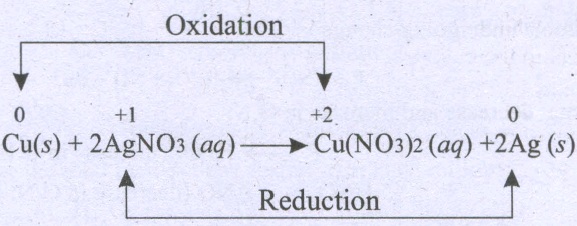
It indicates that between copper and silver, copper has the tendency to release electrons and silver to accept electrons. This type of metal displacement reactions are known as competitive electron transfer reactions.
18.
The given equation shows that 1 mole of A reacts with 1 mole of B2 and I atom of A reacts with 1 molecule of B2
(i) B is the limiting reagent because 200 molecules of B2 will react with 200 atoms of A and 100 atoms of A will be left in excess.
(ii) A is limiting reagent because 2 moles of A will react with 2 moles of B and 1 mole of B will be left in excess.
(iii) Both will react completely because it is a stoichiometric mixture. No limiting reagent.
(iv) 2.5 moles of B will react with 2.5 moles of A. Hence B is the limiting reagent.
(v) 2.5 moles of A will react with 2.5 moles of B. Hence A is the. limiting reagent.
19.
| (i) | Atomic Mass | Molecular Mass |
|---|---|---|
| Atomic mass is the mass of a single atom, which is its collective mass of neutron proton and electrons |
Molecular weight is the mass of one molecule Molecular mass can be calculated from the sum of atomic masses of all atoms present in a compound. |
|
| (ii) | Atomic Mass | Atomic Mass |
| Atomic mass is the mass of a single atom, which is its collective mass of neutron, proton and electrons |
Atomic weight is the average weight of an elements with respect to all its isotopes and their relative abundance. |
|
| (iii) | Empricial Formula | Molecular Formula |
| It represents the simplest whole number ratio of various atoms present in one molecule of the compound. Empirical formula of Benzene is CH |
The molecular formula shows the exact number of different types of atoms present in a molecule of a compound. Molecular formula of Benzene is C6H6. |
|
| (iv) | Moles | Molecules |
| The amount of the substance that contains specified particles as the number of atoms in 12 g carbon - 12 isotope |
Two or more atoms joint together by chemical bonds. |
20.
(i) In metal displacement reactions, we learnt that zinc replaces copper from copper sulphate solution. Let us examine whether .the reverse reaction takes place or not. As discussed earlier, place a metallic copper strip in zinc sulphate solution. If copper replaces zinc from zinc sulphate solution, Cu2+ ions would be released into the solution and the colour of the solution would change to blue. But no such change is observed. Therefore, we conclude that among zinc and copper, zinc has more tendency to release electrons and copper to accept the electrons.
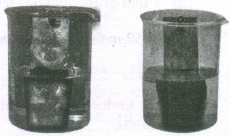
(ii) Let us extend the reaction to copper metal and silver nitrate solution. Place a strip of metallic copper in silver nitrate solution taken in a beaker. After some time, the solution slowly turns blue. This is due to the formation of' Cu2+ ions, i.e. copper replaces silver from silver nitrate. The reaction is
(iii) It indicates that between copper and silver, copper has the tendency to release electrons and silver to accept electrons.
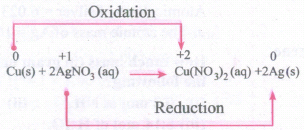
(iv) From the above experimental observations, we can conclude that among the three metals, namely, zinc, copper and silver, the electron releasing tendency is in the following order
Zinc> Copper> Silver.
21.
Displacement reaction: Redox reactions in which an ion (or an atom) in a compound is replaced by an ion (or atom) of another element are called displacement reactions. They are further classified into
(i) metal displacement reactions
(ii) non-metal displacement reactions.
(i) Metal displacement reactions :
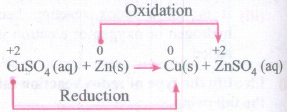
Place a zinc metal strip in an aqueous copper sulphate solution taken in a beaker. Observe the solution, the intensity of the blue colour of the solution slowly reduced and finally disappeared.
The zinc metal strip became coated with brownish metallic copper. This is due to the following metal displacement reaction.
(ii) Non-metal displacement:
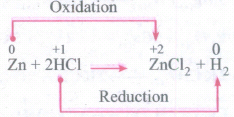
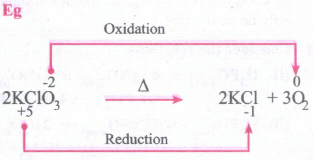
22.
Decomposition reaction: Redox reactions in which a compound breaks down into two or more components are called decomposition reactions. These reactions are opposite to combination reactions. In these reactions, the oxidation number of the different elements in the same substance is changed.
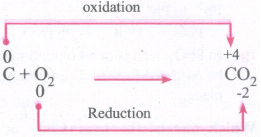
23.
Combination reaction: Redox reactions in which two substances combine to form a single compound are called combination reaction.
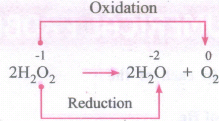
24.
Disproportionation reaction : In some redox reactions, the same compound can undergo both oxidation and reduction. In such reactions, the oxidation state of one and the same element is both increased and decreased. These reactions are called disproportionation reactions.
25.
At 273 K and l atm pressure 1 mole of a gas occupies a volume of 22.4L
Therefore, number of moles of oxygen, that occupies a volume of 224 ml at 273 k and 3 atm.
\(=\frac{1 \text { mole }}{273 \mathrm{~K} \times 1 \mathrm{~atm} \times 22.4 \mathrm{~L}} \times 0.224 \mathrm{~L} \times 273 \mathrm{~K} \times 3 \mathrm{~atm}\)
= 0.03 mole
1 mole of oxygen contain 6.022 x 10²³ molecures
0.03 mole of oxygen contains = 6.022 x 1023 x 0.03
= 1.8 x 10²² molecules of oxygen.

11th Standard Syllabus & Materials
11th Standard
TN 11th Tamil பீடு பெற நில் - செய்யுள் - காவடிச்சிந்து Important Questions And Answers Study Material - QB365 Set A
NEW11th Standard
TN 11th Tamil பீடு பெற நில் - உரைநடை - மலை இடப்பெயர்கள் : ஓர் ஆய்வு Important Questions And Answers Study Material - QB365 Set A
NEW11th Standard
TN 11th Tamil மாமழை போற்றுதும் - துணைப்பாடம் - யானை டாக்டர் Important Questions And Answers Study Material - QB365 Set A
NEW11th Standard
TN 11th Tamil மாமழை போற்றுதும் - செய்யுள் - ஐங்குறுநூறு Important Questions And Answers Study Material - QB365 Set A



Tamilnadu Stateboard 11th Standard Subjects

Maths

Commerce

Economics

Biology

Business Maths and Statistics

Accountancy

Computer Science

Physics
Chemistry
Maths
Biology
Economics
Physics
Chemistry

History
Business Maths and Statistics

Computer Science
Accountancy

Computer Applications
History
Computer Technology
Commerce
Computer Applications
Computer Technology

Tamil

English

French
Tamilnadu Stateboard Standards
