100% FREE ACCESS
9th Standard CBSE Syllabus & Materials
9th Standard CBSE
CBSE 9th Science Is matter around us pure? - New Model Questions Papers Study Material - QB365 Set A
NEW9th Standard CBSE
CBSE 9th Science Matter in our surroundings - New Model Questions Papers Study Material - QB365 Set A
NEW9th Standard CBSE
CBSE 9th Mathematics Heron's Formula Sample Question Papers Study Material - QB365 Set A
NEW9th Standard CBSE
CBSE 9th Mathematics Circles Sample Question Papers Study Material - QB365 Set A
NEW9th Standard CBSE
CBSE 9th Mathematics Quadrilaterals Sample Question Papers Study Material - QB365 Set A
NEW9th Standard CBSE
CBSE 9th Mathematics Triangles Sample Question Papers Study Material - QB365 Set A

Published on: 31/07/2018
In this question paper prepared from the chapter Quadrilaterals. The important questions are covers from the Higher Order Thinking Questions and Value Based Questions.
Teachers can prepared question paper with answer key within five minutes. Please Click Here for subscribe.
Download CBSE Class 9th Standard CBSE Mathematics question papers, sample papers, important questions, and previous year solved papers in PDF format. Get free study materials, NCERT solutions, and exam preparation resources for Class 9th Standard CBSE Mathematics
Questions + Answers key
Take MCQ Mathematics Test
1.
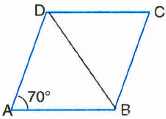
In the given figure, ABCD is a rhombus. Find \(\angle CDB\)
2.
Show that the line segments joining the mid-points of the opposite sides of a quadrilateral bisect each other.
3.
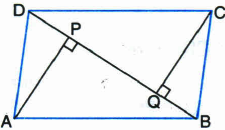
ABCD is a parallelogram and APand CQ are perpendiculars from vertices A and C on diagonal BD respectively. Show that:
\((i)\Delta APB\cong \Delta CQD\)
\(\\ (ii)AP=CQ\)
4.
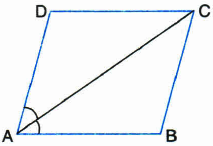
Diagonal AC of a parallelogram ABCD bisects \(\angle A\) (see figure). Show that:
(i) it bisects \(\angle C\) also
5.
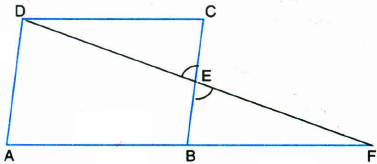
In the figure ABCD is a parallelogram and E is the midpoint of side BC DE and AB on producing meet at F. Prove that AF = 2AB.
6.
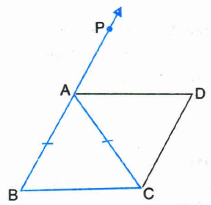
ABC is an isosceles triangle in which AB = AC AD bisects \(\angle \) PAC and CD II AB. Show that
(i) \(\angle \) DAC =\(\angle \) BCA
(ii) ABCD is a parallelogram
7.
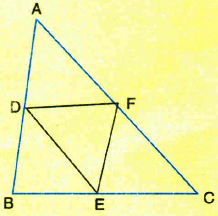
In \(\Delta \) ABC, D, E and F are midpoints of sides AB, BC and CA. If AB = 6 cm,BC = 7.2 cm and AC = 7.8 crn find the perimeter of \(\Delta \)DEF.
8.
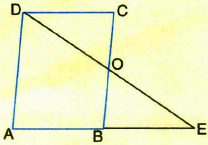
In the figure, ABCD is a parallelogram in which AB is produced to E so that AB = BE
(a) Prove that ED bisects BC
(b) If AD = 10 cm, find OB.
9.
If an angle of a parallelogram in two-third of its adjacent angle then find the measure of all the angles,
10.
In a parallelogram PQRS, if \(\angle \)QRS=2x, \(\angle \)PQS=4x, and \(\angle \)PSQ=4x, find the angles of the parallelogram.
11.
The angles A, B, C and D of a quadrilateral have measures in the ratio 2 : 4 : 5 : 7. Find the measures of these angles. What type of quadrilateral is it? Give reasons.
12.
The quadrilateral formed by joining the mid-point of the sides of a rectangle taken in order is a
rectangle
square
rhombus
kite
13.
The triangle formed by joining the mid-points of the sides of a angled triangle is a
scalene
isosceles
equilateral
right
14.
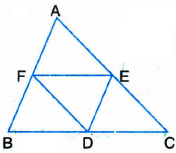
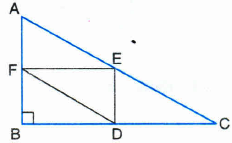
Find the perimeter of quadrilateral BDEF.
8 cm
11 cm
7 cm
3.5 cm
15.
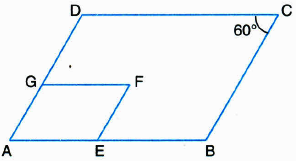
In the following figure, ABCD and AEFG are two parallelograms. If \(\angle \)c=\(60°\), then \(\angle \)GFE is
60°
120°
30°
45°
16.
A quadrilateral, whose all the four sides are equal yet all the four angles are not equal, is called
square
rhombus
rectangle
parallelogram.
17.
A rhombus is
a rectangle
a square
a kite
not a square.
18.
Which of the following is false?
A square is a rectangle
A square is a rhombus
A parallelogram is a trapezium
A kite is a parallelogram.
19.
Each angle of a square is
300
600
900
450
20.
The sum of all the angles of a quadrilateral is
3600
1800
5400
7200
21.
What is the number of vertices of a quadrilateral?
1
2
4
3
1.
55°
2.
Given: ABCD is a quadrilateral. P, Q, R, and S are the mid-points of the sides DC, CB, BA, and AD respectively.
To Prove: PR and QS bisect each other.
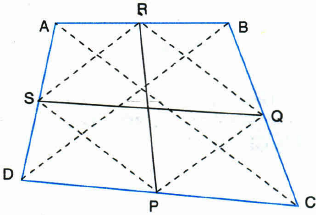
Construction: Join PQ, QR, RS, SP, AC and BD
Proof: In \(\Delta\)ABC,
\(\because\) R and Q are the mid-points of AB and BC respectively.
\(\therefore\) RQ II AC and RQ = \(1\over2\)AC.
Similarly, we can show that
PS II AC and PS = \(1\over2\) AC
\(\therefore\) RQ II PS and RQ = PS.
Thus a pair of opposite sides of a quadrilateral PQRS are parallel and equal.
\(\therefore\) PQRS is a parallelogram.
Since the diagonals of a parallelogram bisect each other.
\(\therefore\) PR and QS bisect each other.
3.
Given: ABCD is a parallelogram and AP and CQ are perpendiculars from vertices A and C on diagonal BD respectively.
To Prove:
\((i)\Delta APB\cong \Delta CQD\)
\(\\ (ii)AP=CQ\)
Proof: (i) In \(\Delta APB\ \) and \( \Delta CQD\)
AB = CD I Opp. sides of || gm ABCD
\(\angle ABP=\angle CDQ\) |Each=\(90°\)
(ii) \(\Delta APB\cong \Delta CQD\) I Proved above in (i)
\(\therefore \) AP = CQ. I C.P.C.T.
4.
Given: Diagonal AC of a parallelogram ABCD bisects \(\angle A\)
(i) It bisects \(\angle C\) also
Proof: (i) In \(\Delta\)ADC and \(\Delta\)CBA,
AD = CB I Opp. sides of IIgm ABCD
CA = AC I Common
DC = BA I Opp. sides of II gm ABCD
\(\therefore \) \(\Delta\)ADC \(\cong \) \(\Delta\)CBA I SSS Congruence Rule
\(\angle ACD=\angle CAB\) |C.P.C.T
\(\angle DAC=\angle BCA\) |C.P.C.T
but \(\angle CAB=\angle DAC\) |Given
\(\therefore \ \angle ACD=\angle BCA\)
\(\therefore \) AC bisects \(\angle C\) also
(ii) From above,
AD = CD I Sides opposite to equal angles of a triangle are equal
\(\therefore \) AB = BC = CD = DA I \(\therefore \) ABCD is a II gm
\(\therefore \) ABCD is a rhombus.
5.
Given: ABCD is a parallelogram and E is the mid-point of side BC. DE and AB on producing meet at F.
To Prove: AF = 2AB
Proof: In \(\Delta \)FAD,
\(\therefore\) E is the mid-point of BC I Given
and EB II DA | Opposite sides of a parallelogram are parallel
\(\therefore\) B is the mid-point of AF I By converse of mid-point theorem
AB = BF = \(1\over2\) AF ⇒ AF = 2AB
6.
Given: ABC is an isosceles triangle in which AB = AC. AD bisects L PAC and CD IIAB.
To Prove:
(i) \(\angle \)DAC =\(\angle \)BCA
Proof:
(i) In \(\Delta \) ABC,
\(\because\) AB = AC
\(\therefore\) \(\angle \)B =\(\angle \)C .......(1) I Angles opposite to equal sides of a triangle are equal
Also, Ext. \(\angle \)PAC =\(\angle \)B +\(\angle \)C
⇒
⇒ 2\(\angle \)CAD = 2\(\angle \)C
⇒ \(\angle \)CAD =\(\angle \)C
\(\therefore\) AD II BC
Also, CD II AB I Given
\(\therefore\) ABCD is a parallelogram IA quadrilateral is a parallelogram if its both the pairs of opposite sides are parallel.
7.
10.5 cm
8.
5 cm
9.
72°, 108°, 72°, 108°
10.
\(36°\),\(144°\),\(36°\), \(144°\)
11.
40°, 80°, 100°, 140°; Trapezium
12.
(c)
rhombus
13.
FE IIBC, ED II AB
\(\therefore\)BDEF is a parallelogram
14.
Perimeter of quadrilateral BDEF
= BD + DE+EF+FD
= 2 (BD + DE)
= 2 (\(1\over2\)BC + \(1\over2\)AB)
= BC + AB = 4 + 3 = 7 cm.
15.
\(\angle \)GAE = \(\angle \)DCB =\(60°\)
\(\therefore \) \(\angle \)GFE = \(\angle \)GAE =\(60°\)
16.
See a rhombus
17.
no of angle of a rhombus is 900
18.
opposite sides are not equal in a kite
19.
(a)
300
20.
(a)
3600
21.
(c)
4

9th Standard CBSE Syllabus & Materials
9th Standard CBSE
CBSE 9th Mathematics Lines and Angles Sample Question Papers Study Material - QB365 Set A
NEW9th Standard CBSE
CBSE 9th Mathematics Introduction to Euclid's Geometry Sample Question Papers Study Material - QB365 Set A
NEW9th Standard CBSE
CBSE 9th Mathematics Linear Equations in Two Variables Sample Question Papers Study Material - QB365 Set A
NEW9th Standard CBSE
CBSE 9th Mathematics Coordinate Geometry Sample Question Papers Study Material - QB365 Set A



CBSE 9th Standard CBSE Subjects
CBSE Standards