
 100% FREE ACCESS
11th Standard Syllabus & Materials
11th Standard
TN 11th Tamil இயற்கை வேளாண்மை,சுற்றுச்சூழல் -செய்யுள் - மனோன்மணீயம் Important Questions And Answers Study Material - QB365 Set A
NEW11th Standard
TN 11th Tamil என்னுயிர் என்பேன் -துணைப்பாடம் - இசைத்தமிழர் இருவர் Important Questions And Answers Study Material - QB365 Set A
NEW11th Standard
TN 11th Tamil மொழி கலை -செய்யுள் - ஒவ்வொரு புல்லையும் Important Questions And Answers Study Material - QB365 Set A
NEW11th Standard
TN 11th Tamil பீடு பெற நில் - இலக்கணம் - பகுபத உறுப்புகள் Important Questions And Answers Study Material - QB365 Set A
NEW11th Standard
TN 11th Tamil பீடு பெற நில் - துணைப்பாடம் - வாடிவாசல் Important Questions And Answers Study Material - QB365 Set A
NEW11th Standard
TN 11th Tamil பீடு பெற நில் - செய்யுள் - குறுந்தொகை Important Questions And Answers Study Material - QB365 Set A

Published on: 25/08/2018
chapter 2
Download Tamil Nadu 11th Standard Chemistry question papers, model tests, one-mark questions, important questions, and public exam papers in PDF format. Free study materials and answer keys for TN State Board students.
Questions + Answers key
Take MCQ Chemistry Test
1.
State Hund's rule of maximum multiplicity
2.
What are degenerate orbitals?
3.
Write the equation to calculate the energy of nth orbit.
4.
Explain about the significance of de Broglie equation.
5.
Explain Thomson's atom model.
6.
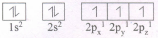
What is meant by electronic configuration? Write the electronic configuration of N (Z = 7).
7.
How many unpaired electrons are present in the ground state of
(i) Cr3+ (Z = 24)
(ii) Ne (Z = 10)
8.
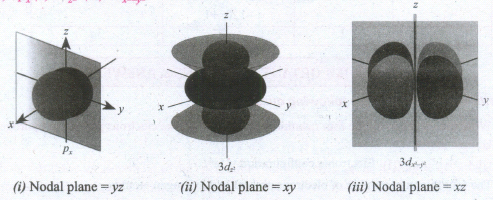
Draw the shapes (boundary surfaces) for the following orbitals.
(i) 2px
(ii) 3dz2
(iii) 3dx2y2
9.
How many neutrons and protons are there in the Following nuclei?
\(_{ 6 }^{ 13 }{ C }\),\(_{ 2 }^{ 18 }{ O }\).\(_{ 12}^{ 24}{ Mg }\),\(_{26 }^{ 56}{ Fe }\),\(_{ 88}^{ 38}{ Sr }\)
10.
What is the charge and mass of an electron?
11.
What are the defects of Rutherford's model?
12.
Which quantum number reveal information about the shape, energy, orientation and size of orbitals?
13.
How many radial nodes for 2s, 4p, 5d and 4f orbitals exhibit? How many angular nodes
14.
How many orbitals are possible for n = 4?
15.
What are quantum numbers?
16.
From the following sets of quantum numbers, state which are possible. Explain why the others are not possible.
\(n=1,l=1,m_l=0,m_s=+\frac{1}{2}\)
17.
Using Aufbau principle, write the ground state electronic configuration of following atoms.
(i) Boron (Z = 5)
(ii) Neon (Z = 10)
(iii) Aluminium (Z = 13)
(iv) Chlorine (Z = 17)
(v) Calcium (Z = 20)
(vi) Rubidium (Z = 37)
18.
Write a note about principal quantum number.
19.
What are the limitations of Bohr's atom model?
20.
What are the conclusions of Rutherford's α-rays scattering experiment?
21.
Bring out the main points of difference between orbit and orbital.
22.
What are the significance of \(\Psi \) and \(\Psi ^{ 2 }\)
23.
State Heisenberg's uncertainty principle and give its mathematical expression
24.
Write the Schrodinger wave equation
25.
Which of the following are isoelectronic species? Na+, K+, Mg2+, Ca2+, S2-, Ar.
26.
What is Stark effect?
27.
What is Zeeman effect?
28.
If the K.E of electron is 2.5 \(\times\)10-24 J, then calculate its de-Broglie wavelength.
29.
What are the atomic numbers of elements whose outermost electrons are represented by
(a) 3s2
(b) 2p3
(c) 3p5
30.
State Hund's rule of maximum multiplicity.
31.
Write the electronic configurations of the following ions:
(a) H-
(b) Na+
(c) O2-
(d) F-
32.
(i) State (n + 1) rule.
(ii) Arrange the orbitals in the increasing order of energies based on (a) principal quantum number and (b) (n + 1) rule.
33.
Explain briefly the time independent schrodinger wave equation?
34.
Which one among the following salts is more stable? Ferrous and ferric salts
35.
Using s, p, d notations, describe the orbital with the following quantum numbers.
(i) n =1 ,l = 0
(ii) n = 3, l= 1
(iii) n = 4, l= 2
(iv) n =4 , l = 3
36.
Describe the Aufbau principle
37.
State and explain pauli exclusion principle.
1.
It states that electron pairing in the degenerate orbitals does not take place until all the available orbitals contain one electron each.
2.
As we know there are three different orientations in space that are possible for a p orbital. All the three p orbitals, namely, px, py and pz have same energies and are called degenerate orbitals. However, in the presence of magnetic or electric field the degeneracy is lost.
3.
\(E_n={(-1312.8)Z^2\over n^2}KJ\ mol^{-1}\)
Where Z = atomic number, n = principal quantum number.
4.
(i) \(\lambda =\frac{h}{mv}\). This equation implies that a moving particle can be considered as a wave and a wave can exhibit the properties of a particle.
(ii) For a particle with high linear momentum (mv) the wavelength will be so small and cannot be observed.
(iii) For a microscopic particle such as an electron, the mass is of the order of 10-31 kg, hence the wavelength is much larger than the size of atom and it becomes significant.
(iv) For the electron, the de Broglie wavelength is significant and measurable while for the iron ball it is too small to measure, hence it becomes insignificant.
5.
J. J. Thomson's cathode ray experiment revealed that atoms consist of negatively charged particles called electrons. He proposed that atom is a positively,charged sphere in which the electrons are embedded like the seeds in the watermelon.
6.
The distribution of electrons into various orbitals of an atom is called its electronic configuration.
N (Z = 7)
7.
(i) Cr (Z = 24) Is2 2s2 2p6 3s2 3p6 3d5 4s1
Cr3+ - Is2 2s2 2p6 3s2 3p6 3d4.
It contains 4 unpaired electrons.
(ii) Ne (Z = 10) 1s22s2 2p6. No unpaired electrons in it.
8.
9.
| Nucleus | Atomic Number (Z) | Mass Number (A) | Number of protons =Z | Number of Neutrons =A-Z |
| \(_{ 6 }^{ 13 }{ C }\) | 6 | 13 | 6 | 13 - 6 = 7 |
| \(_{ 2 }^{ 18 }{ O }\) | 8 | 16 | 8 | 16 - 8- = 8 |
| \(_{ 12}^{ 24}{ Mg }\) | 12 | 24 | 12 | 24 - 12 = 12 |
| \(_{26 }^{ 56}{ Fe }\) | 26 | 56 | 26 | 56 - 26 = 30 |
| \(_{ 88}^{ 38}{ Sr }\) | 38 | 88 | 38 | 88 - 38 = 50 |
10.
The charge of an electron is 1.602 x 10⁻¹⁹ coulomb
The mass of an electron is 9.11 x 10⁻³¹ kg
11.
According to J. C. Maxwell, whenever an electron is subjected to acceleration, it emits radiation and loses energy. As a result of this, its orbit should become smaller and smaller and finally it should drop into the nucleus by following a spiral path. This means that atom would collapse and thus Rutherford's model failed to explain stability of atoms. Another drawback of the Rutherford's model is that it gives no information about the electronic structure of an atom.
12.
a) Principal quantum number defines energy and size of an orbital.
b) Azimuthal quantum number defines shape of an orbital
c) Magnetic quantum number defines spatial orientation (direction) of an orbital.
13.
| Orbital | n | 1 | Radial node n-1-1 | Angular node 1 |
| 2s | 2 | 0 | 1 | 0 |
| 4p | 4 | 1 | 2 | 1 |
| 5d | 5 | 2 | 2 | 2 |
| 4f | 4 | 3 | 0 | 3 |
14.
| n | l | m | orbitals | Total no of orbitals |
| 0 | 0 | 1 | (1- 4s +3 - 4P orbital +5 - 4d orbital +7 - 4f orbital) =16 |
|
| 4 | 1 | -1 0 +1 |
3 | |
| 2 |
-2 |
5 | ||
| 3 |
-3 |
7 |
15.
Quantum numbers are a set of four numbers which are used to specify the position, energy, shape, size, angular momentum, magnetic properties spin and orientation of an electron in an atom.
16.
The set of quantum numbers is not possible because, for n = 1,1 cannot be equal to 1. It can have 0 value.
17.
(i) Boron (Z = 5) ; 1s2 2s2 2p1
(ii) Neon (Z = 10) ; 1s2 2S22p6
(iii) Aluminium (Z = 13) ;1s2 2S22p6 3s2 3p1
(iv) Chlorine(Z = 17) ; 1s2 2s2 2p6 3s2 3p5
(v) Calcium (Z = 20) ;1s2 2S22p6 3s2 3p6 4s2
(vi) Rubidium (Z = 37) ; 1s2 2s2 2p6 3s2 3p6 3d10 4s2 4p6 5s1
18.
(i) The principal quantum number represents the energy level in which electron revolves around the nucleus and is denoted by the symbol 'n'.
(ii) The 'n' can have the values 1,2,3, ... n = 1 represents K shell; n = 2 represents L shell and n = 3, 4, 5 represent the M, N, O shells, respectively.
(iii) The maximum number of electrons that can be accommodated in a given shell is 2n2.
(iv) 'n' gives the energy of the electron,
\(E_n=\frac{(-1312.8)Z^2}{n^2}\ kJ\ mol^{-1}\) and the distance of the electron from the nucleus is given by \(r_n=\frac{(0.529)n^2}{Z}A\)
19.
(i) The Bohr's atom model is applicable only to species having one electron such as hydrogen, Li2+ etc and not applicable to multi-electron atoms.
(ii) It was unable to explain the splitting of spectral lines in the presence of magnetic field (Zeeman effect) or an electric-field (Stark effect).
(iii) Bohr's theory was unable to explain why the electron is restricted to revolve around the nucleus in a fixed orbit in which the angular momentum of the electron is equal to \(\frac{nh}{2\pi}\)
20.
(i) Rutherford bombarded a thin gold foil with a stream of fast moving a-particles.
(ii) It was observed that most of the \(\alpha\)-particles passed through the foil.
(iii) Some of them were deflected through a small angle.
(iv) Very few α-particles were reflected back by 180°.
(v) Based on these observations, he proposed that in an atom, there is a tiny positively charged nucleus and the electrons are moving around the nucleus with high speed.
21.
| ORBIT | ORBITALS | |
| 1. | It is a well defined circular path around the nucleus in which the electrons revolve/td> | Its the three dimensional space around the nucleus within which the probability of finding an electron is maximum |
| 2. | The concept of an orbit does not consider the wave character of electrons and uncertainty principle. |
The concept of an orbital is in accordance with the wave character of electrons and uncertainty principle. |
| 3. | They do not have any directional characteristics. | Except s-orbitals, all orbitals have directional characteristics. |
| 4. | The maximum number of electrons that an orbit can have is given by 2n2 where n is the number of the orbit |
The maximum number of electrons that can be occupied by an orbital is always two |
22.
In an atom the wave function \(\Psi \) for an electron has no physical significance as such. However, its square i.e.\(\Psi ^{ 2 }\) at any point gives the intensity of the electron wave at that point.
In view of Heisenberg's uncertainty principle, it shows the probability of finding the electron at that point and therefore, termed as probability density
23.
It is impossible to accurately determine both the position as well as the momentum of a microscopic particle simultaneously.
\(\Delta x.\Delta p\ge h/4\pi \)
where, Δx and Δp are uncertainties in determining the position and momentum, respectively
24.
Schrodinger Wave Equation:
\(\frac { \partial ^{ 2 }\Psi }{ \partial x^{ 2 } } +\frac { \partial ^{ 2 }\Psi }{ \partial y^{ 2 } } +\frac { \partial ^{ 2 }\Psi }{ \partial z^{ 2 } } +\frac { 8\pi ^{ 2 }m }{ { h }^{ 2 } } (E-V)\Psi =0\)
\(\Psi \) = amplitude of wave; E = total energy of electron
V = potential energy; m = mass of electron
25.
Isoelectronic - Species having same number of electrons
11Na+ = 11 - 1 = 10e-; 19K+ = 19 - 1 = 18e-
12Mg2+= 12 - 2 = 10e-; .20Ca2+ = 20 - 2 = 18e-
16S2- 16 + 2 = 18e-; I8Ar = 18e-
Hence the isoelectronic species are
(i) Na+ and Mg2+
(ii) K+, Ca2+, S2- and Ar
26.
If a substance which gives a line emission spectrum is placed in an external electric field, its lines get split into a number of closely spaced lines. This phenomenon is known as Stark effect.
27.
If a substance which gives a line emission spectrum, is placed in a magnetic field, the lines of the spectrum get split up into a number of closely spaced lines. This phenomenon is known as Zeeman effect.
28.
K.E = 2.5 \(\times\)10-24 J
Kinetic energy = \(\frac { 1 }{ 2 } \)mv2 = 2.5 \(\times\)10-24
m = 9.1\(\times\) 10-31 kg
v = \(\left( \frac { 2K.E }{ m } \right) ^{ \frac { 1 }{ 2 } }=\left[ \frac { 2\times 2.5\times { 10 }^{ -24 } }{ 9.1\times { 10 }^{ -31 } } \right] ^{ \frac { 1 }{ 2 } }\)
= 2.34 \(\times\)103 ms-1
\(\boxed{v = 2.34 103\ {ms}^{-1}}\)
Wavelength , \(\lambda =\frac { h }{ mv } \)
= \(\frac { 6.626\times { 10 }^{ -34 } }{ 9.1\times { 10 }^{ -31 }\times 2.34\times { 10 }^{ 3 } } =311.1\times { 10 }^{ -9 }m\)
\(\boxed{\lambda =311.1\times 10^{ -9 }m(or)311.1\ nm}\)
29.
To obtain atomic number of an element fill the orbitals in order of their increasing energies up to the given outer orbital configuration
(a) Is22s2, 2p6, 3s2 (Z = 12)
(b) Is2 2S2, 2p3 (Z = 7)
(c) Is22s2, 2p6, 3s2, 3p5 (Z = 17)
30.
It states that electron pairing in the degenerate orbitals does not take place until all the available orbitals contains one electron each.
31.
(a) 1H = 1s1, H- = 1s2
(b) 11Na = 1s2 2s2,2p6,3s1,Na+ = 1s22s22p6
(c) 8O = 1s2 2s2,2p4,O2- = 1s22s22p6
(d) 9F = 1s2 2s2,2p5,F- =1s22s22p6
32.
(i) It states that, the lower the value of (n + 1) for an orbital, the lower is its energy. If two orbitals have the same value of (n + 1), the orbital with lower value of n will have the lower energy.
(ii) (a) Principal quantum number : 1s < 2s = 2p < 3s = 3p = 3d <4s = 4p = 4d = 4f < 5s = 5p = 5d = 5f < 6s = 6p = 6d = 6f < 7s
(b) Based on the (n+1) rule: 1s < 2s < 2p < 3s < 3p < 4s <3d <4p <5s <4d < 5p <6s <4f < 5d < 6p < 7s < 5f < 6d.
33.
Erwin Schrodinger expressed the wave nature of electron in terms of a differential equation. This equation determines the change of wave function in space depending on the field of force in which the electron moves. The time independent Schrodinger equation can be expressed as,
\(\overset { \wedge }{ H } \psi =E\psi \) .........(1)
Where \(\overset { \wedge }{ H } \) is called Hamiltonian operator, \(\psi \) is the wave function and is a function of position coordinates of the particle and is denoted as \(\psi \) (x, y, z) E is the energy of the system
\(\overset { \wedge }{ H } =\left[ \frac { { -h }^{ 2 } }{ 8{ \pi }^{ 2 } } \left( \frac { { \partial }^{ 2 }\psi }{ { \partial x }^{ 2 } } +\frac { { \partial }^{ 2 }\psi }{ { \partial y }^{ 2 } } +\frac { { \partial }^{ 2 }\psi }{ { \partial z }^{ 2 } } \right) +V \right] \)
can be written as
\(\left[ \frac { { -h }^{ 2 } }{ 8{ \pi }^{ 2 }m } \left( \frac { { \partial }^{ 2 }\psi }{ { \partial x }^{ 2 } } +\frac { { \partial }^{ 2 }\psi }{ { \partial y }^{ 2 } } +\frac { { \partial }^{ 2 }\psi }{ { \partial z }^{ 2 } } \right) +V\Psi \right] =E\Psi \)
Multiply by \(\frac { 8{ \pi }^{ 2 }m}{ { -h }^{ 2 } } \)and rearranging
\(\frac { { \partial }^{ 2 }\psi }{ { \partial x }^{ 2 } } +\frac { { \partial }^{ 2 }\psi }{ { \partial y }^{ 2 } } +\frac { { \partial }^{ 2 }\psi }{ { \partial z }^{ 2 } } +\frac { 8{ \pi }^{ 2 }m }{ { -h }^{ 2 } } (E-V)\Psi =0\) ........(2)
The above Schrodinger wave equation does not contain time as a variable and is referred to as time independent Schrodinger wave equation. This equation can be solved only for certain values of E, the total energy. i.e. the energy of the system is quantised. The permitted total energy values are called eigen values and corresponding wave functions represent the atomic orbitals.
34.
Ferrous and ferric salts: In ferrous salts Fe2+, the configuration is 1s22s2,2p6,3s2, 3p6, 3d6.In ferric salts Fe3+ ,the configuration is 1s22s2,2p6,3s2, 3p6, 3d5.
As half-filled 3d5 configuration is more stable therefore ferric salts are more stable than ferrous salts.
35.
| S.No | n | l | Subshell notation |
| (i) | 1 | 0 | 1s |
| (ii) | 3 | 1 | 3p |
| (iii) | 4 | 2 | 4d |
| (iv) | 4 | 3 | 4f |
36.
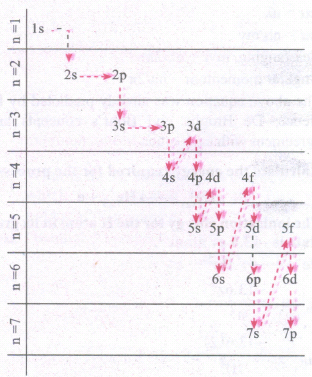
The word Aufbau in German means 'building up'. In the ground state of the atoms, the orbitals are filled in the order of their increasing energies. That is the electrons first occupy the lowest energy orbital available to them.
Once the lower energy orbitals are completely filled, then the electrons enter the next higher energy orbitals. The order of filling of various orbitals as per the Aufbau principle which is in accordance with (n + l) rule.
37.
Statement : "No two electrons in an atom can have the same set of values of all four quantum numbers"
Explanation : It means that, each electron must have unique values for the four quantum numbers (n, l, m and s).
For the lone electron present in hydrogen atom, the four quantum numbers are: n = 1; l = 0; m = 0 and s = +1/2. For the two electrons present in helium, one electron has the quantum numbers same as the electron of hydrogen atom, n = 1.
l = 0, m = 0 and s = +1/2. For other electron, the fourth quantum number is different i.e., n = 1, l = 0, m = 0 and s = -1/2.
As we know that the spin quantum number can have only two values +1/2 and - 1/2, only two electrons can be accommodated in a given orbital in accordance with pauli exclusion principle.
| Atom | e- | n | l | m | s |
| Helium | First | 1 | 0 | 0 | +1/2 |
| Second | 1 | 0 | 0 | +1/2 |

11th Standard Syllabus & Materials
11th Standard
TN 11th Tamil பீடு பெற நில் - செய்யுள் - காவடிச்சிந்து Important Questions And Answers Study Material - QB365 Set A
NEW11th Standard
TN 11th Tamil பீடு பெற நில் - உரைநடை - மலை இடப்பெயர்கள் : ஓர் ஆய்வு Important Questions And Answers Study Material - QB365 Set A
NEW11th Standard
TN 11th Tamil மாமழை போற்றுதும் - துணைப்பாடம் - யானை டாக்டர் Important Questions And Answers Study Material - QB365 Set A
NEW11th Standard
TN 11th Tamil மாமழை போற்றுதும் - செய்யுள் - ஐங்குறுநூறு Important Questions And Answers Study Material - QB365 Set A



Tamilnadu Stateboard 11th Standard Subjects

Maths

Commerce

Economics

Biology

Business Maths and Statistics

Accountancy

Computer Science

Physics
Chemistry
Maths
Biology
Economics
Physics
Chemistry

History
Business Maths and Statistics

Computer Science
Accountancy

Computer Applications
History
Computer Technology
Commerce
Computer Applications
Computer Technology

Tamil

English

French
Tamilnadu Stateboard Standards
