
 100% FREE ACCESS
11th Standard Syllabus & Materials
11th Standard
TN 11th Tamil இயற்கை வேளாண்மை,சுற்றுச்சூழல் -செய்யுள் - மனோன்மணீயம் Important Questions And Answers Study Material - QB365 Set A
NEW11th Standard
TN 11th Tamil என்னுயிர் என்பேன் -துணைப்பாடம் - இசைத்தமிழர் இருவர் Important Questions And Answers Study Material - QB365 Set A
NEW11th Standard
TN 11th Tamil மொழி கலை -செய்யுள் - ஒவ்வொரு புல்லையும் Important Questions And Answers Study Material - QB365 Set A
NEW11th Standard
TN 11th Tamil பீடு பெற நில் - இலக்கணம் - பகுபத உறுப்புகள் Important Questions And Answers Study Material - QB365 Set A
NEW11th Standard
TN 11th Tamil பீடு பெற நில் - துணைப்பாடம் - வாடிவாசல் Important Questions And Answers Study Material - QB365 Set A
NEW11th Standard
TN 11th Tamil பீடு பெற நில் - செய்யுள் - குறுந்தொகை Important Questions And Answers Study Material - QB365 Set A

Published on: 11/03/2019
Download Tamil Nadu 11th Standard Chemistry question papers, model tests, one-mark questions, important questions, and public exam papers in PDF format. Free study materials and answer keys for TN State Board students.
Questions + Answers key
Take MCQ Chemistry Test1.
The IUPAC name for CH3-C - CH - CH3 CH3 CI CH3
2-Bromo-3-chloro-2,4-dimethyl pentane
3-Bromo':'2-chloro-2,4-dimethyl pentane
2-Bromo-3-chloro-2,4-dimethyl propane
None of the above
2.
Geometrical isomers differ in ___________
Position.of functional group
Position of atoms
patial arrangement of atoms
Length of carbon chain
3.
When NaCI is added to aqueous solution of glucose __________
Freezing point is lowered
Freezing point is raised
Freezing point does not change
Variation is freezing point can't be predicted
4.
The most stable carbanion is _____________
CH3-CH2
CH2 = CH
CH2 ≡ C
(CH3)2 - CH
5.
Living in the atmosphere of CO is dangerous because it __________.
Combines with O2 present inside to form CO2
Reduces organic matter of tissues
Combines with haemoglobin and makes it incapable to absorb oxygen
Dries up the blood
6.
In an organic compound, phosphorus is estimated as ____________
Mg2P2O7
Mg3(PO4)2
H3PO4
P2O5
7.
In ClF3, NF3 and BF3 molecules the chlorine, nitrogen and boron atoms are ______
sp3 hybridised
sp3 ,sp3 and sp2 respectively
sp2 hybridised
sp3d, sp3 and sp hybridised respectively
8.
In a chemical equilibrium, the rate constant for the forward reaction is 2.5 \(\times\)102 and the equilibrium constant is 50. The rate constant for the reverse reaction is ____________
11.5
5
2 x 10²
2 x 10⁻³
9.
On moving from left to right across a period in the periodic table, the metallic character__________.
increases
decreases
remains constant
first increases and then decreases
10.
First law of thermodynamics does not give any information regarding _________
spontaneity
feasibility
both (a) & (b)
neither (a) nor (b)
11.
Which among the following is the strongest reducing agent?
Na
K
Ac
Mg
12.
Assertion: Critical temperature of CO2 is 304K, it can be liquefied above 304K.
Reason : For a given mass of gas, volume is to directly proportional to pressure at constant temperature
both assertion and reason are true and reason is the correct explanation of assertion
both assertion and reason are true but reason is not the correct explanation of assertion
assertion is true but reason is false
both assertion and reason are false
13.
Time independent Schrodinger wave equation is ______________
\(\overset { \wedge }{ H } \psi =E\psi \)
\({ \triangledown }^{ 2 }\psi +\frac { 8{ \pi }^{ 2 }m }{ { h }^{ 2 } } (E+V)\psi =0\)
\(\frac { { \partial }^{ 2 }\psi }{ { \partial x }^{ 2 } } +\frac { { \partial }^{ 2 }\psi }{ { \partial y }^{ 2 } } +\frac { { \partial }^{ 2 }\psi }{ { \partial z }^{ 2 } } +\frac { { 2m } }{ { h }^{ 2 } } (E-V)\Psi =0\)
All of these
14.
If a body of a fish contains 1.2 g hydrogen in its total body mass, if all the hydrogen is replaced with deuterium then the increase in body weight of the fish will be ______________
1.2 g
2.4 g
3.6 g
\(\sqrt{4.8}\)g
15.
Carbon forms two oxides, namely carbon monoxide and carbon dioxide. The equivalent mass of which element remains constant ?
Carbon
Oxygen
Both carbon and oxygen
Neither carbon nor oxygen
16.
(i) x, Y and Z elements have 4, 5 and 7 valence electrons. Draw the structure of XH4, YH5,YH3 and H-Z.
Which of these compounds possess highest dipole moment ?
17.
The following concentration were obtained for the formation of NH3 from N2 and H2 at equilibrium for the reaction \({ N }_{ 2g }+3{ H }_{ 2\left( g \right) }\rightleftharpoons { { 2NH }_{ 3\left( g \right) } }\)
[N2] = 1.5 x 10⁻²M; [H2]= 3.0 x 10⁻²M;
[NH3] = 1.2 x 10⁻²M
Calculate the equilibrium constant.
18.
Define solution
19.
Peroxide effect is observed only in HBr and not in HCl or HI. Justify.
20.
State Markovnlkoff's rule.
21.
Starting from CH3MgI, How will you prepare the following?
i) Acetic acid
ii) Acetone
iii) Ethyl acetate
iv) Iso propyl alcohol
v) Methyl cyanide.
22.
(i) Define critical temperature.
(ii) What is the critical temperature of CO2 gas?
23.
How alkali metals react with water? Give an equation?
24.
The bond dissociation energies of gaseous chlorine, hydrogen, and hydrogen chloride are 104, 58, and 103 k.cal mol-1 respectively. Calculate the enthalpy of formation of HCI(g). Predict in which of the following, entropy increases / decreases . - H2(g) \(\rightarrow\) 2H(g)
25.
For each of the following pair of hydrogen orbitals indicate which is higher in energy?
(i) 1s, 2s
(ii) 2p, 3p
(iii) 3dxy 3dyz
(iv) 3s, 3d
(v) 4f, 5s.
26.
Define enthalpy of neutralization
27.
Define equivalent mass.
28.
What is effective nuclear charge?
29.
Figure out the variation of bond order in the following conversions
1.\(NO\rightarrow(NO)^+e^-\)
2.\(C_2+e^-\rightarrow C^-_2\)
30.
Mention the applications of equilibrium constant
31.
State Huckel's rule of aromaticity and explain it interms of cyclopentadiene, cycloxtateraene and cyclopropenylcation.
32.
(i) Give the test to predict the .presence of Cl, Br and I in an organic compound.
(ii) How will you eliminate in Nand S present in an organic halogen compund?
33.
Discuss the reason behind the classification of inductive effect into +I and -I effect.
34.
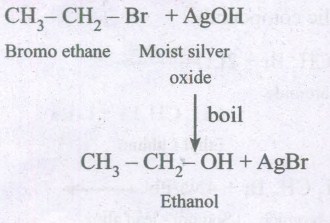
How does bromo ethane react with the following?
(i) Silver Oxide(moist)
(ii) Sodium hydrogen sulphide
(iii) Potassium cyanide
35.
Write short note on freezing point, depression in freezing point and cryoscopic constant.
36.
What would happen, if the greenhouse gases were totally missing in the earth’s atmosphere ?
37.
An organic compound (A) with molecular formula C2H5Cl reacts with KOH gives compounds (B) and with alcoholic KOH gives compound (C). Identify (A),(B), and (C)
38.
Show the heterolysis of covalent bond by using curved arrow notation and complete the following equations.
Identify the nucleophile is each case.
CH3 - Br + KOH →
39.
Describe optical isomerism with suitable example.
40.
Considering x- axis as molecular axis, which out of the following will form a sigma bond.
i) 1s and 2py
ii) 2Px and 2Px
iii) 2px and 2pz
iv) 1s and 2pz
41.
Calculate the amount of water produced by the combustion of 32 g of methane.
42.
A small bubble rises from the bottom of a lake where the temperature and pressure are 8° C and 6.4 atm. to the water surface, where the temperature is 25°C and pressure is 1 atm. Calculate the final volume in (mL) of the bubble, if its initial volume is 2.1 mL.
43.
Write the simplest formula for the following. - C6H12O6
44.
H2O2 is stored in plastic bottles and not in glass containers. Explain.
45.
In a constant volume calorimeter:3.5g of a gas with molecular weight 28 was burnt in excess oxygen at 298 K. The temperature of the calorimeter was found to increase from 298 K to 298.45 K due to the combustion process. Given that the calorimeter constant is 2.5 kJ K-1. Calculate the enthalpy of combustion of the gas in kJ mol-1
46.
What are representative elements?
47.
An alkali metal (x) forms a hydrated sulphate, X2SO4 • 10 H2O. Is the metal more likely to be sodium (or) potassium.
48.
Show that the circumference of the Bohr orbit for the hydrogen atom is an integral multiple of the de Broglie wave length associated with the electron revolving around the nucleus.
49.
Write balanced chemical equation for each of the following chemical reactions.
Lithium metal with nitrogen gas.
50.
Discuss the similarities and differences between 1s and 2s-orbitals.
51.
52.
Write the Van der Waals equation for a real gas. Explain the correction term for pressure and volume.
53.
Define orbital ? what are the n and 1 values for 3px and 4dx2-y2 electron ?
1.
(a)
2-Bromo-3-chloro-2,4-dimethyl pentane
2.
(c)
patial arrangement of atoms
3.
(a)
Freezing point is lowered
4.
(c)
CH2 ≡ C
5.
(d)
Dries up the blood
6.
(a)
Mg2P2O7
7.
(d)
sp3d, sp3 and sp hybridised respectively
8.
(b)
5
9.
(b)
decreases
10.
(c)
both (a) & (b)
11.
(b)
K
12.
(d)
both assertion and reason are false
13.
(a)
\(\overset { \wedge }{ H } \psi =E\psi \)
14.
(a)
1.2 g
15.
(b)
Oxygen
16.
1.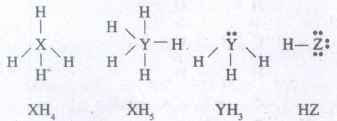
2. The compound with more number of electrons on the valence shell, \(\therefore\) is considered to be the most electronegative element.
\(\therefore\) HZ is the most electronegative element which has highest dipole moment.
17.
\({ K }_{ c }=\cfrac { \left[ { NH }_{ 3 } \right] ^{ 2 } }{ \left[ { N }_{ 2 } \right] \left[ { H }_{ 2 } \right] ^{ 3 } } =\cfrac { 1.2\times { 10 }^{ -2 } }{ 1.5\times { 10 }^{ -2 }\times \left( 3\times { 10 }^{ -2 } \right) ^{ 3 } } \)
18.
Solution is a homogeneous mixture of two or more substances. If the water is the solvent in the solution, then it is an aqueous solution.
19.
\({ CH }_{ 3 }-CH={ CH }_{ 2 }+HBr\overset { Peroxide }{ \underset { ({ C }_{ 6 }{ H }_{ 5 }CO)_{ 2 }{ O }_{ 2 } }{ \longrightarrow } } { CH }_{ 3 }-{ CH }_{ 2 }-{ CH }_{ 2 }-Br\)
The H-CI bond is stronger (430.5 kJmol-1 ) than H-Br bond (363.7 kJmol-1), thus H-CI is not cleaved by the free radical. The H-I bond is weaker (296.8 kJmol-1), than H-CI bond. us H-I bond breaks easily but iodine free radicals combine to form iodine molecules instead of adding to the double bond and hence peroxide effect is not observed in HCI& HI.
20.
"When an unsymmetrical alkene reacts with hydrogen halide, the hydrogen adds to the carbon that has more number of hydrogen and halogen add to the carbon having fewer hydrogen". this rule can also be stated as in the addition reaction of alkene/alkyne, the most electro negative part of the reagent adds on to the least hydrogen attached doubly bonded carbon.
21.
i) Acetic acid: Solid carbon dioxide reacts with Grignard reagent to form addition product which on hydrolysis yields carboxylic acids.
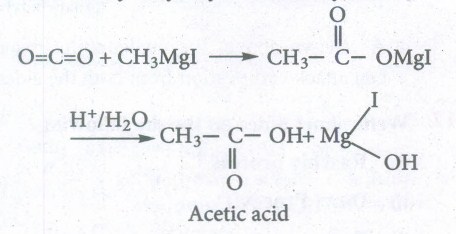
ii) Acetone :
\(\underset { Iodomethane }{ { CH }_{ 3 }-I+Mg } \overset { dryether }{ \longrightarrow } \underset { Methyl \ magnesium \ iodide }{ { CH }_{ 3 }MgI } \)
iii) Ethyl acetate: Ethy1chloroformate reacts with Grignard reagent to form esters.
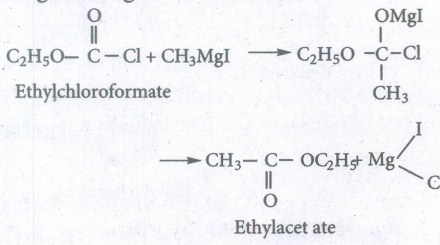
iv) Iso propyl alcohol : Aldehydes other than formaldehyde, react with Grignard reagent to give addition product which on hydrolysis yields secondary alcohol.
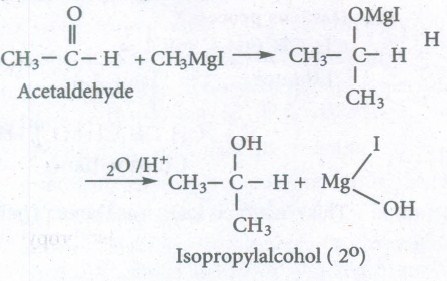
v) Methyl cyanide : Grignard reagent reacts with cyanogen chloride to from alkyl cyanide

22.
(i) The temperature below which a gas can be liquefied by application of pressure is known as critical temperature.
(ii) The critical temperature of CO2 gas is 303.98 K.
23.
The most reactive alkali metals decompose water in the cold with the evolution of hydrogen and leaving an alkali solution
2Na(s) + 2H2O(1) ⟶ 2NaOH(aq) + H2(g)
24.
H2(g) \(\rightarrow\) 2H(g). In this reaction, the number of gaseous particles increase, and hence entropy will also increase.
25.
(i) 2s > 1s
(ii) 3p > 2p
(iii) 3dxy > 3dyz
(iv) 3s = 3d
(v) 5s > 4f.
26.
The heat of neutralisation is defined as "The change in enthalpy when one gram equivalent of an acid is completely neutralised by one gram equivalent of a base or vice versa in dilute solution"
27.
Gram equivalent mass of an element, compound or ion is the mass that combines or displaces 1.008 g hydrogen or 8 g oxygen or 35.5 g chlorine.
28.
The net nuclear charge experienced by valence electrons in the outermost shell is called the effective nuclear charge.
Zeff=Z-S
Where Z is the atomic number and 'S' is the screening constant.
29.
1.\(NO\rightarrow(NO)^+e^-\)
| Molecule | No.of electrons | Electonic configuration | Bond order |
| NO | 15 | \((\sigma_{1s})^2(\sigma^*_{1s})^2(\sigma_{2s})^2(\sigma^*_{2s})^2(\sigma_2p_z)^2(p_2p_x)^2(p_2p_y)^2(p^*_2p_x)^1\) | \({1\over2}({10-5})=2.5\) |
| NO+ | 14 | \((\sigma_{1s})^2(\sigma^*_{1s})^2(\sigma_{2s})^2(\sigma^*_{2s})^2(\sigma_2p_z)^2(p_2p_x)^2(p_2p_y)^2\) | \({1\over2}({10-4})=3\) |
\(NO\rightarrow(NO)^+e^-\)
Bond order increases
2.\(C_2+e^-\rightarrow C^-_2\)
| Molecule | No.of electrons | Electonic configuration | Bond order |
| C2 | 12 | \((\sigma_{1s})^2(\sigma^*_{1s})^2(\sigma_{2s})^2(\sigma^*_{2s})^2(p_2p_x)^2(p_2p_y)^2\) | \({1\over2}({8-4})=2\) |
| \(C^-_2\) | 13 | \((\sigma_{1s})^2(\sigma^*_{1s})^2(\sigma_{2s})^2(\sigma^*_{2s})^2(p_2p_x)^2(p_2p_y)^21(\sigma_2p_z)^1\) | \({1\over2}({9-4})=2.5\) |
\(C_2+e^-\rightarrow C^-_2\)
Bond order increases
30.
The knowledge of equilibrium constant helps us to
1. Predict the direction in which the net reaction will take place
2. Predict the extent of the reaction and
3. Calculate the equilibrium concentrations of the reactants and products.
It is to be noted that these constants do not provide any information regarding the rates of the forward or reverse reactions.
31.
Huckel proposed that aromaticity is a function of electronic structure. A compound may be aromatic, if it obeys the following rules
(i) The molecule must be co-planar
(ii) Complete delocalization of \(\pi\) electron in the ring
(iii) Presence of (4n+2) \(\pi\) electrons in the ring where n is an integer (n=0,1,2 .... ) is known as Huckle's rule.
| 1. | 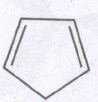 Cyclo penta diene |
(i) It has a planar Structure (ii) It has four \(\pi\) electron but the elecron are not delocalised and hence it is not an aromatic compound. |
| 2. | 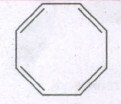 Cyclooctatetraene |
Molecule is non-planar and hence it is not an aromatic compound. |
| 3. | 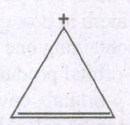 Cyclopropenylcation |
(i) Cyclopropenyl cation has planar structure. (ii) It has 2 delocalised \(\pi\) electron. (iii) 4n + 2 = 2 4n = 0 n = 0 (an interger) and hence it is aromatic compount. |
32.
(i) Test for halogens:To a portion of the Lassaigne's filtrate add dil HNO3 warm gently and add AgNO3 solution.
a) Appearance of curdy white precipitate soluble in ammonia solution indicates the presence of chlorine.
b) Appearance of pale yellow precipitate sparingly soluble in ammonia solution indicates the presence of bromine.
c) Appearance of a yellow precipitate insoluble in ammonia solution indicates I the presence of iodine.
\(Na+\underset { from\quad organic\\ compound }{ X } \overset { heat }{ \rightarrow } \quad \quad Na{ X }_{ (Where\quad X=Cl,\quad Br,I) }\)
Nax + AgNO3 AgX + NaNO3
(ii) If N or S is present in the compound along with the halogen, we might obtain NaCN and Na2S in the solution, which interfere with the detection of the halogen in the AgNO3 test Therefore we boil the Lassaignes extract with HNO3 which decomposes NaCN and Na2S as
\(NaCN+{ HNO }_{ 3 }\overset { \Delta }{ \rightarrow } { NaNO }_{ 3 }+HCN\uparrow \)
\({ Na }_{ 2 }S+{ 2HNO }_{ 3 }\overset { \Delta }{ \rightarrow } { aNaNO }_{ 3 }+{ H }_{ 2 }S\uparrow \)
\(NaCN+{ AgNO }_{ 3 }\overset { further }{ \rightarrow } \underset { white\quad ppt\quad confusing\quad with\quad AgCl }{ AgCN } +{ NaNO }_{ 3 }\)
\(\\ { Na }_{ 2 }S+{ AgNO }_{ 3 }\rightarrow \underset { black\quad ppt }{ { Ag }_{ 2 }S } \downarrow { NaNO }_{ 3 }\)
33.
The inductive effect represents the ability of a particular atom or a group to either withdraw or donate electron density to the attached carbon. Based on this ability the substituents are classied as +I groups and -I groups. Their ability to release or withdraw the electron through sigma covalent bond is called +I effect and -I effect respectively.
Higher the electronegativity of the substitutent, greater is the -I effect. The order of the -I effect of some groups are given below.
NH3+ > NO2 > CN > SO3H > CHO
Highly electropositive atoms and atoms are groups which carry a negative charge are electron donating or +I groups.
Example: Alkali metals, alkyl groups such as methyl, ethyl, negatively charged groups such as CH3O-, C2H5O-, COO- etc
Lesser the electronegativity of the elements, greater is the +I effect. The relative order of +I effect of some alkyl groups is given below
-C(CH3)3> - CH(CH3)2 > - CH2CH3 > - CH3
34.
(i) Silver Oxide(moist):
(ii) Sodium hydrogen sulphide:
\(\underset { Bromo \ ethane }{ { CH }_{ 3 }{ CH }_{ 2 }Br+NaSH } \overset { alcohol/{ H }_{ 2 }O }{ \underset { \triangle }{ \longrightarrow } } \underset { Ethan \ ethiol }{ { CH }_{ 3 }{ CH }_{ 2 }SH+NaBr } \)
(iii) Potassium cyanide :
\(\underset { Bromo \ ethane }{ { CH }_{ 3 }{ CH }_{ 2 }-Br+KCN } \longrightarrow \underset { Ethyl \ cryanide }{ { CH }_{ 3 }{ CH }_{ 2 }-CN+KBr } \)
35.
(i) Freezing point is defined as "the temperature at which the solid and the liquid states of the substance have the same vapour pressure".
(ii) The freezing point of water is O°C. At this temperature the ice and the water are in equilibrium. When a nonvolatile solute is added to water at its freezing point, the freezing point of the solution is lowered from O°C. The lowering of the freezing point of the solvent when a solute is added is called depression in freezing point (\(\triangle\)Tf).
36.
Without the heating caused by the greenhouse effect, earth's average surface temperature would be only about -18 oC (0 oF). Although the greenhouse effect is a naturally occurring phenomenon, it is intensified by the continuous emission of greenhouse gases into the atmosphere.
During the past 100 years, the amount of carbon dioxide in the atmosphere increased by roughly 30 percent and the amount of methane more than doubled.If these trends continue, the average global temperature will increase which can lead to melting of polar ice caps and flooding of low areas. This will increase incidence of infectious diseases like dengu., malaria, etc.
37.
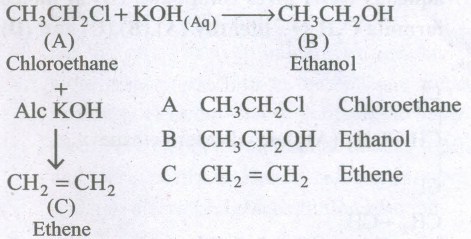
38.
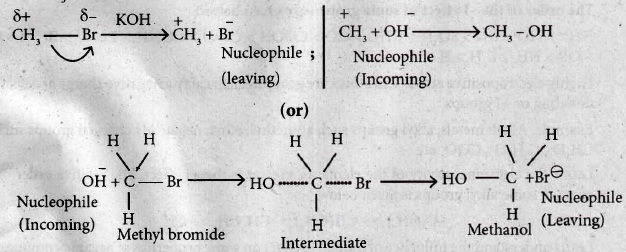
39.
Optical isomerism:
Compounds having same physical and chemical property but differ only in the rotation of plane of the polarized light are known as optical isomers and the phenomenon is known as optical isomerism.
Some organic compounds such as glucose have the ability to rotate the plane of the plane polarized light and they are said to be optically active compounds and this property of a compound is called optical activity. The optical isomer, which rotates the plane of
the plane polarised light to the right or in cloclauisl direction is said to be dextrorotary (dexter means right) denoted by the sign (+), whereas the compound which rotates to the left or anticloclanrise is said to be leavo rotatory (leanues mean left) denoted by sign(-).
Dextrorotatory compounds are represented as 'd' or by sign (+) and lavorotatory compounds are ( - ) represented as 'l' or by sign (-).
Enantiomerism and optical activity: An optically active substance may exist in two or more isomeric forms which have same physical and chemical properties but differ in terms of direction of rotation of plane polarized light, such optical isomers which rotate the plane of polarized light with equal angle but in opposite direction are known as enantiomers and the phenomenon is knovrrn as enantiomerism. Isomers which are non-super impossible mirror images of each other are called enantiomers.
conditions for enantiomerism or optical isomerism:
A carbon atom whose tetra vaiency is satisfied by four different substituents (atoms or groups) is called a symmetric carbon or chiral carbon. It is indicated by an asterisk as C*. A molecule Possessing chiral carbon atom and non-super impossible to its own mirror image is said to be a chiral molecule or asymmetric, and the pioperty is called chirality or dissymmetry.
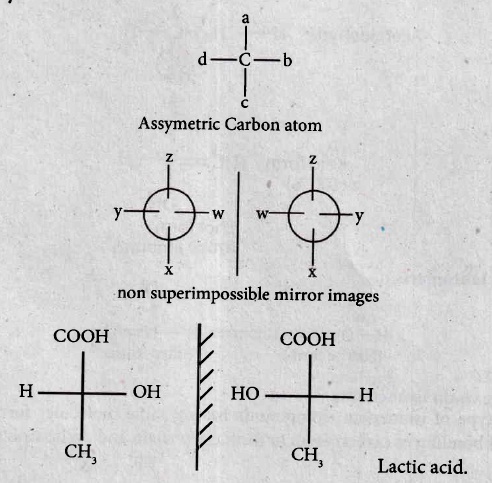
40.
i) 1s and 2py - sigma bond is formed
ii) 2Px and 2Px - sigma bond is formed
iii) 2px and 2pz - No sigma bond is formed
iv) 1s and 2pz - sigma bond is formed.
41.
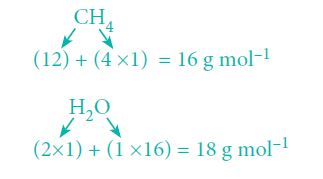
CH4(g) + 2O2 \(\rightarrow\) CO2 + 2H2O
16g (2x18)g
As per stoichiometric equation,
16 g of methane produces 36 g of H2O
\(\therefore\) 32 g of methane will produce = \(\frac { 36 }{ 16 } \times 32=72\) g of water.
42.
T1 = 8°C + 273 = 281 K
P1 = 6.4 atm V1 = 2.1 ml
T2 = 25°C + 273 = 298 K
P2 = 1 atm V2 = ?
\(\frac{\mathrm{P}_{1} \mathrm{~V}_{1}}{\mathrm{~T}_{1}}=\frac{\mathrm{P}_{2} \mathrm{~V}_{2}}{\mathrm{~T}_{2}} \Rightarrow \mathrm{V}_{2}=\left(\frac{\mathrm{P}_{1} \mathrm{~V}_{1}}{\mathrm{~T}_{1}}\right) \times \frac{\mathrm{T}_{2}}{\mathrm{P}_{2}}\)
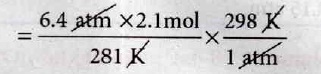
= 14.25 ml
43.
CH2O
44.
H2O2 decomposes slowly on exposure to light.
2H2O2(l) ➝ 2H2O(l) + O2(g)
In the presence of metal surfaces or traces of alkali (present in glass containers), the above reaction is catalysed and is therefore, stored in wax-lined glass or plastic vessels in dark.
45.
Ti = 298 K
Tf = 298.45 K
k = 2.5 kJK-1
m =3.5g
Mm = 28
heat evolved= kΔT
=k (Tf - Ti)
=2.5 KJ K-1 (298.45 - 298)K
=1.125kJ
ΔHc=\(\frac{1.125}{3.5}\times\)28KJmol-1
ΔHc = 9 kJ mol-1
46.
s-block and p-block (Groups 13-18) elements are collectively called representative elements or Main Group Elements.
47.
In Na2 SO4.10 H2O. So the metal will be Na (sodium). The salt is washing soda.
48.
Circumference of the orbit - 2\(\pi\)r .... ...(1)
Circumference of the orbit of H - atom (n = 1) - n\(\lambda\), .........(2)
(1) = (2) \(2 \pi r=\lambda \text { (or) } 2 \pi r=\frac{\mathrm{h}}{\mathrm{mv}}\)
49.
6Li + N2 ⟶ 2Li3 N
50.
The similarities in 1s and 2s-orbitals are as follows :
(i) Both have the spherical shape
(ii) Both have the same angular momentum.
The difference in between them are as follows :
(i) Size of 2s-orbital is larger than that of 1s-orbital.
(ii) Energy of 2s-orbital is greater than that of 1s-orbital.
(iii) 2s-orbital has one node while 1s-orbital has no node.
51.
52.
The van der equation for a real gas is
\(\left( P+{{{am}^{2}}\over{{V}^{2}}} \right)(V-nb)=nRT\)
Pressure, Correction:
The pressure of a gas is directly proportional to the force created by the bombardment of molecules on the walls of the container. The speed of a molecule moving towards the wall of the container is reduced by the attractive forces exerted by its neighbours. Hence, the measured gas pressure is lower than the ideal pressure of the gas. Hence, van der Waals introduced a correction term to this effect.
Van der Waals found out the forces of attraction experienced by a molecule near the wall are directly proportional to the square of the density of the gas.
\(P^{\prime} \propto \rho^{2} ; \quad \rho=\frac{n}{v}\)
where n is the number of moles of gas and
V is the volume of the container
\( \Rightarrow p^{\prime} \alpha \frac{n^{2}}{V^{2}} \)
\(\Rightarrow p^{\prime}=a \frac{n^{2}}{V^{2}}\)
where a is proportionality constant and depends on the nature of gas
Therefore \(P_{\text {ideal }}=P+\frac{\operatorname{an}^{2}}{V^{2}}\)
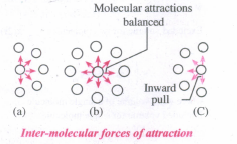
Volume Correction
As every individual molecule of a gas occupies a certain volume, the actual volume is less than the volume of the container,
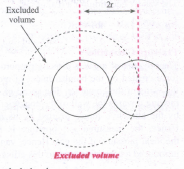
V. Van der Waals introduced a correction factor V' to this effect. Let us calculate the correction term by considering gas molecules as spheres.
V = excluded volume
Excluded volume for two molecules
\(=\frac{4}{3} \pi(2 r)^{3}=8\left(\frac{4}{3} \pi r^{3}\right)=8 V_{m}\)
Where Vm it a volume of a single molecule
Excluded volume for single molecule = \(\frac{8 \mathrm{~V}_{\mathrm{m}}}{2}=4 \mathrm{~V}_{\mathrm{m}}\)
Excluded volume for n molecule = n(4Vm) = nb
Where b is van der waals constant which is equal to 4Vm
\( \Rightarrow V^{\prime}=n b \)
\(V_{\text {ideal }}=V-n b\)
Replacing the corrected pressure and volume in the ideal gas equation PV = nRT we get the Van der Waals equation of state for real gases as below,
\(\left(p+\frac{a^{2}}{V^{2}}\right)(V-n b)=n R T\)
The constants a and b are van der Waals constants and their values vary with the nature of the gas. It is an approximate formula for the non-ideal gas.
53.
The solution to Schrodinger equation gives the permitted total energy values called eigen values and the corresponding wave function represent atomic orbitals.
| Orbital | n | l |
| 3px | 3 | 1 |
| 4dx2-y2 | 4 | 2 |

11th Standard Syllabus & Materials
11th Standard
TN 11th Tamil பீடு பெற நில் - செய்யுள் - காவடிச்சிந்து Important Questions And Answers Study Material - QB365 Set A
NEW11th Standard
TN 11th Tamil பீடு பெற நில் - உரைநடை - மலை இடப்பெயர்கள் : ஓர் ஆய்வு Important Questions And Answers Study Material - QB365 Set A
NEW11th Standard
TN 11th Tamil மாமழை போற்றுதும் - துணைப்பாடம் - யானை டாக்டர் Important Questions And Answers Study Material - QB365 Set A
NEW11th Standard
TN 11th Tamil மாமழை போற்றுதும் - செய்யுள் - ஐங்குறுநூறு Important Questions And Answers Study Material - QB365 Set A



Tamilnadu Stateboard 11th Standard Subjects

Maths

Commerce

Economics

Biology

Business Maths and Statistics

Accountancy

Computer Science

Physics
Chemistry
Maths
Biology
Economics
Physics
Chemistry

History
Business Maths and Statistics

Computer Science
Accountancy

Computer Applications
History
Computer Technology
Commerce
Computer Applications
Computer Technology

Tamil

English

French
Tamilnadu Stateboard Standards

