
 100% FREE ACCESS
9th Standard Syllabus & Materials
9th Standard
TN 9th Tamil உள்ளத்தின் சீர் -கற்கண்டு (இலக்கணம்) - தொடர் இலக்கணம், ஆகுபெயர் Important Questions And Answers Study Material - QB365 Set A
NEW9th Standard
TN 9th Tamil உள்ளத்தின் சீர் -விரிவானம் (துணைப்பாடம்) - தாய்மைக்கு வறட்சி இல்லை! Important Questions And Answers Study Material - QB365 Set A
NEW9th Standard
TN 9th Tamil உள்ளத்தின் சீர் -கவிதை பேழை (செய்யுள்) - மார்கழி பெருவிழா Important Questions And Answers Study Material - QB365 Set A
NEW9th Standard
TN 9th Tamil உயிருக்கு வேர்-இலக்கணம் - பகுபத உறுப்பிலக்கணம் Important Questions And Answers Study Material - QB365 Set A
NEW9th Standard
TN 9th Tamil அமுதென்று பேர் - இலக்கணம்-எழுத்து -அளபெடை Important Questions And Answers Study Material - QB365 Set A
NEW9th Standard
TN 9th Tamil அமுதென்று பேர்-துணைப்பாடம் - ஆறாம்திணை Important Questions And Answers Study Material - QB365 Set A

Published on: 29/12/2018
SECOND SUMMATIVE EXAM 2018
Download Tamil Nadu 9th Standard Science question papers, model tests, one-mark questions, important questions, and public exam papers in PDF format. Free study materials and answer keys for TN State Board students.
Questions + Answers key
Take MCQ Science Test1.
Name the parts of a computer
2.
Give the sequence of the events occurring during prophase of mitosis.
3.
Find the odd one out: Lemon juice, Tomato juice, Household ammonia, Coffee
4.
Identify the following reactions as oxidation or reduction
a. Na \(\rightarrow\)Na+ + e-.
b. Fe3+ + 2e-\(\rightarrow\) Fe+
5.
What are the limitations of Mendeleev's periodic table?
6.
Two coils A and B of insulated wire are kept close to each other. Coil A is connected to a galvanometer. While coil B is connected to a battery through a key. What would happen if
(i) a current is passed through coil B by plugging the key?
(ii) the current is stopped by removing the plug from the key?
7.
State an important advantage of ac over dc.
8.
Ice is kept in a double-walled container. Why?
9.
Statement: Elements in a group generally possess similar properties but elements along a period have different properties.
Reason: The difference in electronic configuration makes the element differ in their chemical properties along a period.
a) Statement is true and reason explains the statement.
b) Statement is false but the reason is correct.
10.
Mark the correct choice as:
(a) If both assertion and reason are true and reason is the correct explanation of assertion.
(b) If both assertion and reason are true but reason is not the correct explanation of assertion.
(c) If assertion is true but reason is false.
(d) If assertion is false but reason is true.
Assertion: Food can be cooked faster in vessels with copper bottom.
Reason: Copper is the best conductor of heat.
11.
Describe the alimentary canal of man.
12.
Identify the following relationship
Cuboidal : Epithelial
Cardiac :_____________
Granulocytes : _______________
Osteocytes :_______________
13.
Why does distilled water not conduct electricity whereas rain water does?
14.
State any five features of modern periodic table.
15.
Explain two types of transformer.
16.
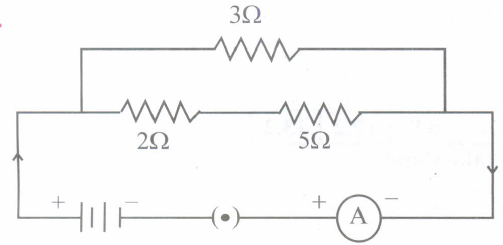
Draw a circuit with a 2\(\Omega\) and 5\(\Omega\) resistors in series. Connect another 3\(\Omega\) resistor parallel to the above connection.
17.
What are the changes of state in water? Explain.
18.
Complete the following table referring the modern periodic table:
| Period number | Total no of elements | Elements | Total no of elements in | ||||
| From | To | s-block | p-block | d-block | f-block | ||
| 1 | |||||||
| 2 | |||||||
| 3 | |||||||
| 4 | |||||||
| 5 | |||||||
| 6 | |||||||
| 7 | |||||||
19.
Complete the missing terms in the following table:
| Process | Phase I | Phase II |
| Sublimation | Vapour | |
| Solidification | Solid | |
| Solid | Liquid | |
| Freezing | Liquid | |
| Condensation | Liquid |
20.
Name the components of xylem and phloem.
21.
State modern periodic law.
22.
Differentiate step up and step down transformer.
23.
List the main parts of an electric motor.
24.
What is the effective resistance across the terminals a and b of the arrangement of resistors?

25.
How much heat energy is required to change 2 kg of ice at 0ºC into water at 20ºC? (Specific latent heat of fusion of water = 3,34,000 J/kg, Specific heat capacity of water = 4200JKg-1K-1).
26.
Find the oxidation number of the elements in the following compounds.
a. C in CO2
b. Mn in MnSO4
c. N in HNO3
27.
Calculate the amount of charge that would flow in 2 hours through an element of an electric bulb drawing a current of 2.5A.
28.
Identify the following parts:
1. It conducts food from pharynx to stomach by peristalsis-
2. Finger-like projections which enhances the absorbing capacity of small intestine-
3. The bunch of capillaries inside the Bowman’s capsule-
4. Thin muscular tubes which carry urine from kidney to urinary bladder-
5. Small sac-like muscular structures that encloses testes-
29.
Match the parts of the given figure with the correct option.
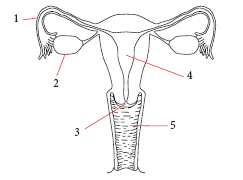
| 1 | 2 | 3 | 4 | 5 |
| a.Fallopian tube | Oviduct | Uterus | Cervix | Vagina |
| b.Oviduct | Cervix | Vagina | Ovary | Vas deferens |
| c.Ovary | Oviduct | Uterus | Vagina | Cervix |
| d.Fallopian tube | Ovary | Cervix | Uterus | Vagina |
30.
Electroplating is an example for
heating effect
chemical effect
flowing effect
magnetic effect
31.
The tissue composed of living thin walled polyhedral cell is
Parenchyma
Collenchyma
Sclerenchyma
None of above
32.
Since metal carbonate and metal bicarbonate are basic they react with acids to give salt and water with the liberation of__________
NO2
SO2
CO2
SO4
33.
Bond formed between a metal and non-metal atom is usually____________
ionic bond
covalent bond
co-ordinate bond
metallic bond
34.
SI unit of temperature is
fahrenheit
joule
celsius
kelvin
35.
The direction opposite to the movement of electron is called _______ current.
36.
__________ tissues provide mechanical support to organs.
37.
No force acts in a current carrying conductor when it is __________ the magnetic field.
38.
Vessels are found in collenchyma.
39.
A generator converts mechanical energy into electrical energy
1.
Three parts of the computer are:
(i) Input Unit
(ii) Central Processing Unit (CPU)
(iii) Output Unit.
2.
(i) During this stage chromosomes become short and thick and are clearly visible inside the nucleus.
(ii) Centrosome splits into two daughter centrioles, they move apart and occupy opposite poles of the cell.
(iii) Each centriole is surrounded by radiating rays, termed as aster rays. Spindle fibres appear between the two centrioles.
(iv) Nuclear membrane and nucleolus disappear gradually
3.
Household ammonia - since its pH value is greater than 7. It is basic in nature. Whereas other three are acidic in nature as their pH values are lesser than 7.
Note pH
Lemon juice -2.2 - 2.4
Tomato juice - 4.0 - 4.4
Coffee - 4.4 - 5.5
Household ammonia - 12.0
4.
(a) oxidation
(b) reduction
5.
(i) Elements with large difference in properties were included in the same group.
Eg: Hard metals like copper (Cu) and silver (Ag) were included along with soft metals like sodium (Na) and potassium (K).
(ii) No proper position could be given to the element hydrogen. Non-metallic hydrogen was placed along with metals like lithium (Li), sodium (Na) and potassium (K).
(iii) The increasing order of atomic mass was not strictly followed throughout.
Eg: Co & Ni, Te & I.
(iv) No place for isotopes in the periodic table.
6.
(i) If a current is passed through coil B by plugging the key, the needle of the galvanometer instantly jumps to one side and just as quickly returns to zero, indicating a momentary current in coil - A (As the current in the coil B changes, the magnetic field associated with it also changes).
(ii) If the current is stopped by removing the plug from the key: The needle of the galvanometer in coil - A momentarily moves, but to the opposite side. It means that now the current flows in the opposite direction in coil - A.
7.
(i) The cost of generation of AC is less than the cost of generation of DC.
(ii) AC can be easily converted into D.C.
(iii) Only alternating voltage can be stepped up or stepped down by using a transformer.
(iv) AC can be transmitted to distant places without much loss of electric power than DC.
8.
To avoid the loss of heat due to conduction, convection and radiation, ice is kept in a double walled container.
9.
a) Statement is true and reason explains the statement.
10.
a. If both assertion and reason are true and reason is the correct explanation of assertion.
11.
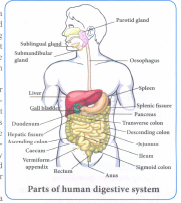
Alimentary canal of man:
Alimentary canal is a muscular coiled, tubular structure. It consists of mouth, buccal cavity, pharynx, oesophagus, stomach, small intestine (consisting of duodenum, jejunum and ileum), large intestine (consisting of caecum, colon and rectum) and anus.
Mouth: The mouth leads into the buccal cavity. The buccal cavity is a large space bound above by the palate (which separates the windpipe and food tube), below by the throat and on the sides by the jaws. The jaws bear teeth.
Teeth: Teeth are hard structures meant for holding, cutting, grinding and crushing the food. In human beings two sets of teeth (Diphyodont) are developed in their lifetime.
Each tooth has a root fitted in the gum (Thecodont). Permanent teeth are of four types (Heterodont), according to their structure and function namely incisors, canines, premolars and molars.
Dental formula represents the number of different type of teeth present in each half of a jaw (upper and lower jaw).
For Permanent teeth in each half of upper and lower jaw:
\(\cfrac { 2,1,2,3 }{ 2,1,2,3 } =16\times 2=32\)
Salivary glands: Three pairs of salivary glands are present in the mouth cavity. They are: parotid glands, sublingual glands and submaxillary or submandibular glands
i. Parotid glands are the largest salivary glands, which lie in the cheeks
ii. Sublingual glands are the smallest glands and lie beneath the tongue.
iii. Submaxillary or Submandibular glands lie at the angles of the lower Jaw.
Tongue: The tongue is a muscular, sensory organ which helps in mixing the food with the saliva.
Pharynx: The pharynx is a membrane lined cavity behind the nose and mouth, connecting them to the oesophagus. It serves as a pathway for the movement of food from mouth to oesophagus.
Oesophagus: Oesophagus or the food pipe is a muscular-membranous canal about 22 cm length. It conducts food from pharynx to the stomach by peristalsis (wave-like movement) produced by the rhythmic contraction and relaxation of the muscular walls of alimentary canal.
Stomach: The stomach is a wide J-shaped muscular organ located between oesophagus and the small intestine
Small intestine: The small intestine is the longest part of the alimentary canal, which is a long coiled tube measuring about 5 - 7 m. It comprises three parts duodenum, jejunum and ileum.
1. Duodenum is C-shaped and receives the bile duct (from liver) and pancreatic duct (from pancreas).
2. Jejunum is the middle part of the small intestine. It is a short region of the small intestine.
3. Ileum forms the lower part of the small intestine and opens into the large intestine. Ileum is the longest part of the small intestine. It contains minute finger like projections called villi (one millimeter in length) where absorption of food takes place. Internally, each villus contains fine blood capillaries and lacteal tubes. The small intestine serves both for digestion and absorption. It receives (i) the bile from liver and (ii) the pancreatic juice from pancreas in the duodenum.
Liver: It is the largest digestive gland of the body which is reddish brown in colour. Bile salts help in the digestion of fats by bringing about their emulsification (conversion of large fat droplets into small ones).
Pancreas: It is a lobed, leaf shaped gland situated between the stomach and duodenum. Pancreas acts both as an exocrine gland and as an endocrine gland.
Large intestine: The unabsorbed and undigested food is passed into the large intestine. It extends from the ileum to the anus. It is about 1.5 meters in length. It has three parts- caecum, colon and rectum .
The caecum is a small blind pouch like structure situated at the junction of the small and large intestine. From its blind end a finger-like structure called vermiform appendix arises. It is a vestigial (functionless) organ in human beings
The colon is much broader than ileum. It passes up the abdomen on the right (ascending colon), crosses to the left just below the stomach (transverse colon) and down on the left side (descending colon).
The rectum is the last part which opens into the anus. It is kept closed by a ring of muscles called anal sphincter which opens when passing stools.
12.
Cardiac : Muscular
Granulocytes : Blood cells
Osteocytes : Bone cells
13.
Distilled water can not conduct electricity. Because it does not contain ions whereas rain water conducts electricity as it contains ions due to presence of dissolved salt in it.
14.
Features of modern periodic table:
(i) All the elements are arranged in the increasing order of their atomic number.
(ii) The horizontal rows are called periods. There are seven periods in the periodic table.
(iii) The elements are placed in periods based on the number of shells in their atoms.
(iv) Vertical columns in the periodic table starting from top to bottom are called groups. There are 18 groups in the periodic table.
(v) Based on the physical and chemical properties of elements, they are grouped into various families.
15.
Depending upon the number of turns in the primary and secondary coils, we can step-up or step-down the voltage in the secondary coil.
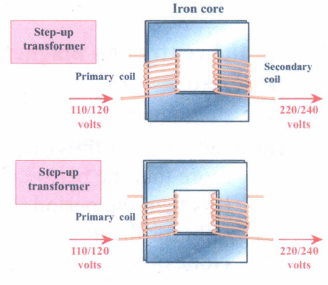
Step up transformer: The transformer used to change a low alternative voltage to a high alternating voltage is called a step up transformer. ie (Vs>Vp ). In a step up transformer, the number of turns in the secondary coil is more than the number of turns in the primary coil (Ns > Np).
Step down transformer: The transformer used to change a high alternating voltage to a low alternating voltage is called a step down transformer (Vs < Vp). In a step down transformer, the number of turns in the secondary coils are less than the number of turns in the primary coil (Ns N
16.
17.
The process of changing of a substance from one physical state to another at a definite temperature is defined as change of state.
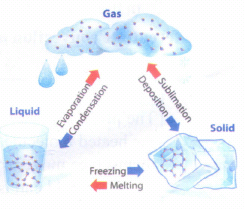
For example, water molecules are in liquid state at normal temperature. When water is heated to 100oC, it becomes steam which is a gaseous state of matter. On reducing the temperature of the steam it becomes water again. If we reduce the temperature further to 0oC, it becomes ice which is a solid state of water. Ice on heating, becomes water again. Thus, water changes its state when there is a change in temperature. There are different such processes in the change of state in matter. The figure shows various processes of change state.
18.
| Period number | Total no of elements | Elements | Total no of elements in | ||||
| From | To | s-block | p-block | d-block | f-block | ||
| 1 | 2 | H | He | 2 | - | - | - |
| 2 | 8 | Li | Ne | 2 | 6 | - | - |
| 3 | 8 | Na | Ar | 2 | 6 | - | - |
| 4 | 18 | K | Kr | 2 | 6 | 10 | - |
| 5 | 18 | Rb | Xe | 2 | 6 | 10 | - |
| 6 | 32 | Cs | Rn | 2 | 6 | 9 | 15 |
| 7 | 32 | Fr | Og | 2 | 6 | 9 | 15 |
19.
| Process | Phase I | Phase II |
| Sublimation | SOLID | Vapour |
| Solidification | GAS | Solid |
| MELTING | Solid | Liquid |
| Freezing | Liquid | SOLID |
| Condensation | GAS | Liquid |
20.
Xylem is composed of
(a) Xylem tracheids
(b) Xylem fibres
(c) Xylem vessels
(d) Xylem parenchyma
Phloem is composed of
(a) Sieve elements
(b) Companion cells.
(c) Phloem fibres
(d) Phloem parenchyma
21.
Modern periodic law states that "The Chemical and Physical properties of elements are the periodic functions of their atomic number".
22.
| S.No. | Step up transformer | Step down transformer |
| 1. | It is used to change low alternative voltage to high alternating voltage. |
It is used to change high alternative voltage to low alternating voltage. |
| 2. | The number of turns in the secondary coil is more than the number of turns in the primary coil. |
The number of turns in the secondary coils are less than the number of turns in the primary coil. |
23.
NS - permanent magnet
ABCD - coil wire
B1 B2 - carbon brushes
S1 S2 - split ring
24.
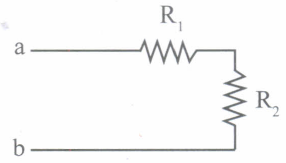
Effective resistance of the
series combination of R1 & R2
Effective resistance of the parallel combination of
R1 = R1 + R2 = R + R = R\(\Omega \)
Effective resistance of the entire circuit,
R3 & R4
\(\cfrac { 1 }{ { R }^{ 11 } } =\cfrac { 1 }{ { R }_{ 3 } } +\cfrac { 1 }{ { R }_{ 4 } } \)
\(\cfrac { 1 }{ { R }^{ 11 } } =\cfrac { 1 }{ R } +\cfrac { 1 }{ R } =\cfrac { 2 }{ R } \)
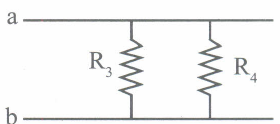
Effective resistance of the entire circuit,
\(\cfrac { 1 }{ { R }_{ P } } =\cfrac { 1 }{ { R }^{ 1 } } +\cfrac { 1 }{ { { R }^{ 11 } } } \)
\(=\cfrac { 1 }{ 2R } +\cfrac { 2 }{ R } =\cfrac { 1+4 }{ 2R } =\cfrac { 5 }{ 2R } \)
\({ R }_{ P }=\cfrac { 2 }{ 5 } R\Omega \)
25.
Mass (m) = 2 kg
Specific heat capacity (c) = 4200 Jkg-1 K-1
Temperature variation (\(\triangle \)t) = 20oC -0oC = 20oC
Specific latent heat (L) = 3,34,000 J/kg
Heat energy required = mc\(\triangle \)t + ml
= (2 x 4200 x 20) + (2 x 3, 34,000)
= 168000 + 668000
= 836000 J
26.
a) C in CO2
Let C be x and we know O = -2
So,
(x) + 2 x (-2) = 0
x + (-4) = 0
x = +4
So oxidation number of carbon is +4.
b) Mn in MnSO4
Let Mn be x and we know S is +6, O is -2
So,
(x) + (1 x +6) + (4 x -2) = 0
x + 6 + (-8) = 0
x - 2 = 0
x = +2
Oxidation number of Mn is +2.
c) N in HNO3
Let N be x and we know H is +1 and O is -2
So,
(+1) + (x) + 3 x (-2) = 0
+1 + (x) - 6 = 0
x - 5 = 0
x = +5
Oxidation number of N is +5.
27.
Time(t) = 2 hours
= 2 x 60 x 60 = 7200 sec
Current flowing (I) = 2.5 A
Amount of charge (Q) = ?
I = Q / t
Q = It
= 2.5A x 7200 sec = 18000 C
28.
1.Oesophagus
2.Villi
3.Glomerulus
4.Ureter
5.Scrotal sacs
29.
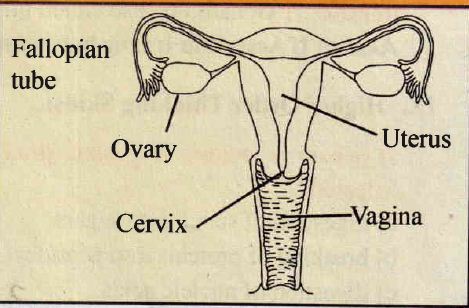
| d.Fallopian tube | Ovary | Cervix | Uterus | Vagina |
30.
(b)
chemical effect
31.
(a)
Parenchyma
32.
(c)
CO2
33.
(a)
ionic bond
34.
(d)
kelvin
35.
()
alternating
36.
()
Collenchyma
37.
()
parallel
38.
(b)
39.
(a)

9th Standard Syllabus & Materials
9th Standard
TN 9th Tamil உள்ளத்தின் சீர் - திருக்குறள் Important Questions And Answers Study Material - QB365 Set A
NEW9th Standard
TN 9th Tamil உள்ளத்தின் சீர் - மணிமேகலை Important Questions And Answers Study Material - QB365 Set A
NEW9th Standard
TN 9th Tamil உள்ளத்தின் சீர் - ஏறு தழுவுதல் Important Questions And Answers Study Material - QB365 Set A
NEW9th Standard
TN 9th Tamil உயிருக்கு வேர் - தண்ணீர் Important Questions And Answers Study Material - QB365 Set A



Tamilnadu Stateboard 9th Standard Subjects
Tamilnadu Stateboard Standards





