
 100% FREE ACCESS
9th Standard Syllabus & Materials
9th Standard
TN 9th Tamil உள்ளத்தின் சீர் -கற்கண்டு (இலக்கணம்) - தொடர் இலக்கணம், ஆகுபெயர் Important Questions And Answers Study Material - QB365 Set A
NEW9th Standard
TN 9th Tamil உள்ளத்தின் சீர் -விரிவானம் (துணைப்பாடம்) - தாய்மைக்கு வறட்சி இல்லை! Important Questions And Answers Study Material - QB365 Set A
NEW9th Standard
TN 9th Tamil உள்ளத்தின் சீர் -கவிதை பேழை (செய்யுள்) - மார்கழி பெருவிழா Important Questions And Answers Study Material - QB365 Set A
NEW9th Standard
TN 9th Tamil உயிருக்கு வேர்-இலக்கணம் - பகுபத உறுப்பிலக்கணம் Important Questions And Answers Study Material - QB365 Set A
NEW9th Standard
TN 9th Tamil அமுதென்று பேர் - இலக்கணம்-எழுத்து -அளபெடை Important Questions And Answers Study Material - QB365 Set A
NEW9th Standard
TN 9th Tamil அமுதென்று பேர்-துணைப்பாடம் - ஆறாம்திணை Important Questions And Answers Study Material - QB365 Set A

Published on: 15/09/2018
First Term - Full Portion Test
Download Tamil Nadu 9th Standard Maths question papers, model tests, one-mark questions, important questions, and public exam papers in PDF format. Free study materials and answer keys for TN State Board students.
Questions + Answers key
Take MCQ Maths Test1.
Express the following in the form \({p\over q},\) where p and q are integers and q \(\ne\) 0.
\(0.5\overline {7}\)
2.
Let U= {x : -3 : < x < 4} A = {-1,2,3} B = {0,1,2,3} C = {-3;-2,-1,0,1,2}. Find (i) A' UB' (ii) (A ∩ B)' (iii) (A ⋂ C)'
3.
Procedure: Cut off a quadrilateral ABCD in a paper with prescribed dimensions. Mark the mid points P, Q, R and S of the sides AB, BC, CD and DA respectively. By folding the sides appropriately cut off the quadrilateral PQRS. Fold the quadrilateral (i) Does PQ lie on SR? similarly fold the other way and verify QR lies on PS.
Observation
(i) What do you conclude?
(ii) Name the resulting figure?
Draw the following quadrilaterals and join the mid points of all its sides. Find the resultant shape and complete the table.
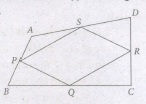
| Name of the quadrilateral | Shape obtained by joining the midpoints |
| Parallelogram | |
| Rectangle | |
| Square | |
| Kite | |
| Trapezium | |
| Rhombus |
4.
Which ones are not quadrilaterals?

5.
If A = {1, 2, 6} and B = {2, 3, 4} , find A∪B.
6.
Insert the appropriate symbol \(\subseteq \) or \(\nsubseteq \) in each blank to make a true statement.
{p, q, r} _____ {w, x, y, z}
7.
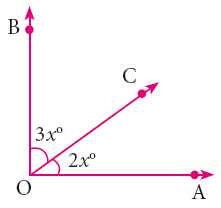
Find the value of x
8.
In which quadrant does the following points lie?(–1,–3)
9.
Plot the points A( 1, 0), B ( -7, 2), C (-3, 7) on a graph sheet and join them to form a triangle.
Plot the point G ( -3, 3).
Join AG and extend it to intersect BC at D.
Join BG and extend it to intersect AC at E.
What do you infer when you measure the distance between BD and DC and the distance between CE and EA?
Using distance formula find the lengths of CG and GF, where F in on AB.
Write your inference about AG: GD, BG: GE and CG: GF.
10.
Consider the ten real numbers
\(\sqrt { 2 } ,\frac { 7 }{ 9 } \),-1.32,\(\frac { 6 }{ 9 } ,-\sqrt { 3 } \) , 2.151155 .....,\(\frac { 23 }{ 6 } ,\frac { 48 }{ 5 } \), -3.010010001... and 12.353553555.
(i) Arrange the ten real numbers in the given boxes in ascending order.

(ii) Arrange the same numbers in the boxes given below in descending order
11.
Without actual division , prove that f(x) = 2x4- 6x3 + 3x2 + 3x - 2 is exactly divisible by x2 – 3x + 2
12.
Classify the following polynomials based on their degree.
13.
Identify monomials, binomials and trinomial from the following expression.
(i) -8 abc
(ii) 3a2bc+8-9a2
(iii) -9
(iv) a2+b2+c2-k2
(v) a+b
(vi) 7ab3
(vii) -z+\(\sqrt{3}\)z3
14.
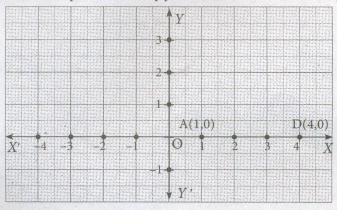
Plot the following points on a graph sheet by taking the scale as 1cm = 1 unit.
Find how far the points are from each other?
A (1,0) and D (4, 0). Find AD and also DA.
Is AD = DA?
You plot another set of points and verify your Result.
15.
Take three different colour sheets; place on over the other and draw a triangle on the top sheet. Cut the sheets to get triangles of different colour which are identical. Mark the vertices and the angles as shown. Place the interior angles ㄥ1, ㄥ2 and ㄥ3 on a straight line, adjacent to each other, without leaving any gap. What can you say about the total measure of the three angles ㄥ1, ㄥ2 and ㄥ3?
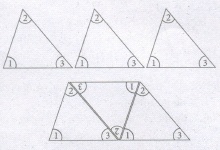
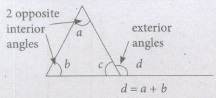
Can you use the same figure to explain the "Exterior angle property" of a triangle?
If a side of a triangle is stretched, the exterior angle so formed is equal to the sum of the two remote interior angles.
16.
Your friend draws a figure such as this on a piece of paper.
You don't know what it is, and stand at the board. She has to describe the figure to you so that you draw exactly the same figure on the board.
You both know rectangles, so it is easy to describe and draw a rectangle. The rest are not easy.
Can we describe any such shape we can ever think of, in a way that another person
hearing it can reproduce it exactly?
Yes, yes, yes! Now, isn't that exciting? The answer is so simple that it is breathtaking.
We describe different shapes by their properties.
17.
Show that the following points taken in order form an isosceles triangle A (6, –4), B (–2, –4), C (2,10)
18.
Determine whether the given set of points in each case are collinear or not (–2, –8), (2, –3) (6, 2)
19.
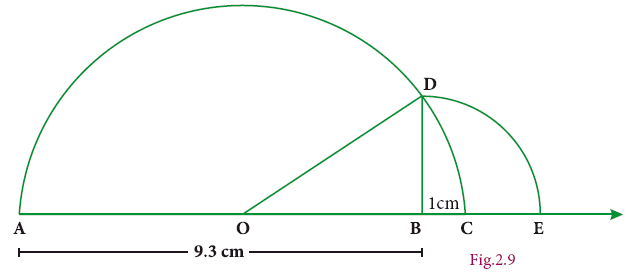
Represent \(\sqrt { 9.3 } \) on a number line
20.
Find the odd one out of the following.
\(\sqrt { 32 } \times \sqrt { 2 } \)
\(\frac { \sqrt { 27 } }{ \sqrt { 3 } } \)
\(\sqrt { 72 } \times \sqrt { 8 } \)
\(\frac { \sqrt { 54 } }{ \sqrt { 18 } } \)
21.
if \(\frac { 1 }{ 7 } \) = \(0.\overline { 142857 } \) then the value of \(\frac { 5 }{ 7 } \) ________.
\(0.\overline { 142857 } \)
\(0.\overline { 714285 } \)
\(0.\overline { 571428 } \)
0.714285
22.
Point (0, –7) lies ________
on the x-axis
in the II quadrant
on the y-axis
in the IV quadrant
23.
Point (–3, 5) lie in the ________ quadrant
I
II
III
IV
24.
It is not possible to construct a triangle when its sides are ____________
8.2 cm, 3.5 cm, 6.5 cm
6.3 cm, 3.1 cm, 3.2 cm
7 cm, 8 cm, 10 cm
4 cm, 6 cm, 6 cm
25.
7x - 5y + 3 has __________ terms
26.
A square has sides of equal length and angles of equal measures, so it is not a ______ polygon.
27.
A rhombus is a quadrilateral with _____ of equal length
1.
Let x = 0.57777 ......... \(\rightarrow\) (1)
10x = 5.77777 ............ \(\rightarrow\) (2)
100x = 57.7777 ........... \(\rightarrow\) (3)
| (3) - (2) \(\Rightarrow\) 100x - 10x | = 57.7777 .......... |
| = 57.7777 ........ | |
| 99x | = 52.0000 ....... |
\(x={52\over 90}={26\over 45}\)
\(\therefore 0.5\overline{7}={26\over 45}\)
2.
(i) {-3,-2,-1,0,1,4} (ii) {-3,-2,-1,0,1,4} (iii) {-3,-2,0,1,3,4}
3.
4.
It is not a quadrilateral
5.
Given A = {1, 2, 6}, B = {2, 3, 4}
A∪B = {1,2,3, 4,6}.
6.
{p, q, r} _____ {w, x, y, z}
Since the element p belongs to {p, q, r} but does not belong to {w, x, y, z}, shows that {p, q, r} \(\nsubseteq \) {w, x, y, z}.
7.
\(\angle AOB =90^0\)
\(\angle BOC +\angle COA=90^0\)
3x0+2x0 = 900
5x0= 900
\(x^0=\frac{90}{5}=18^0\)
The value of x = 18°
8.
The x-coordinate is negative and y – coordinate is negative. So, Point(–1,–3) lies in the III quadrant
9.
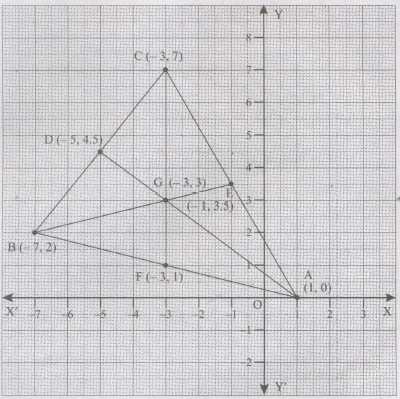
Measure BD and DC.
BD = 3.3 cm and DC = 3.3 cm
\(\therefore\) BD=DC=3.3 cm
Measure CE and EA.
CE =4 cm andEA= 4 cm
\(\therefore\) CE=EA=4cm
Distance =\(\sqrt{(x_2+x_1)^2+(y_2-y_1)^2}\)
CG =\(\sqrt{(-3+3)^2+(3-7)^2}\)
\(=\sqrt{0+(-4)^2}=\sqrt{16}=4 \ uints\)
GF =\(\sqrt{(-3+3)^2+(3-1)^2}\) (The point F is (-3,1) )
\(=\sqrt{0+2^2}=\sqrt{4}=2 \ uints\)
AG =\(\sqrt{(-3-1)^2+(3-0)^2}\)
\(=\sqrt{(-4)^2+(3)^2}=\sqrt{16+9}=\sqrt{25}=5 \ units\)
GD =\(\sqrt{(-3+5)^2+(3-4.5)^2}\)
\(=\sqrt{2^2+(-1.5)^2}=\sqrt{4+2.25}=\sqrt{6.25}=2.5 \ uints\)
BG =\(\sqrt{(-7+3)^2+(2-3)^2}\)
\(=\sqrt{(-4)^2+(-1)^2}=\sqrt{16+1}\)
\(=\sqrt{17}=4.12 \ units\) (Approximately BG = 4)
GE =\(\sqrt{(-3+1)^2+(3-3.5)^2}\)
\(=\sqrt{2^2+(0.5)^2}=\sqrt{4+0.25}\)
\(=\sqrt{4.25}=2.06 \ units\) (Approximately GE = 2)
AG : GD = 5 : 2.5
= 1 : 0.5
=2: 1
BG: GE =4: 2
= 2: 1
CG: GF =4: 2
= 2: 1
AG : GD = BG : GE = CG = GF = 2 : 1
10.
\(\sqrt { 2 } \) =1.414213...
\(\sqrt { 3} \) =1.73205....
\(\frac { 7 }{ 9 } \) =0..7777
\(\frac { 6 }{ 7 } \) =0.857142
\(\frac { 23 }{ 6 } \) =3.8333...
\(\frac { 48 }{ 5 } \) =9.6
(i) Arrange the ten real numbers in the given boxes in ascending order.

(ii) Arrange the same numbers in the boxes given below in descending order.

11.
Let f(x) = 2x4- 6x3+3x2+3x-2
g(x) = x2 –3x + 2
= x2-2x-x+2
= x(x-2)-1(x-2)
= (x-2)(x-1)
we show that f(x) is exactly divisible by (x–1) and (x–2) using remainder theorem
f(1) = 2(1)4-6(1)3+3(1)2+3(1)-2
= 2 – 6 + 3 + 3 – 2 = 0
f(2) = 2(2)4-6(2)3+3(2)2+3(2)-2
= 32 – 48 + 12 + 6 – 2 = 0
f(x) is exactly divisible by (x – 1) (x – 2)
i.e., f(x) is exactly divisible by x2 –3x + 2
If p(x) is divided by (x -a) with the remainder p(a) = 0 , then (x -a) is a factor of p(x). Remainder Theorem leads to Factor Theorem.
12.
| S.No. | Polynomial | Degree | Type |
| (i) | \(\sqrt [ 3 ]{ 4 } z+7\) | Degree one | Linear polynomial |
| (ii) | \({ z }^{ 3 }-{ z }^{ 2 }+3\) | Degree three | Cubic polynomial |
| (iii) | \(\sqrt { 7 } \) | Degree zero | Constant polynomial |
| (iv) | \({ y }^{ 2 }-\sqrt { 8 } \) | Degree two | Quadratic polynomial |
13.
In the given expressin (i), (iii) and (vi) contain only one term.
\(\therefore\) (i), (iii) and (vi) are monomials.
The expression (v) contains two terms. So it is a binomial.
The expression (ii) contains three terms. So it is a trinomial.
The expression (iv) contains four terms. So it is none of the given type. It is a polynomial
14.
AD = 3 units
DA = 3 units (From graph)
Yes, Distance AD = Distance DA
The students are asked to do the activity with different points and verify the result.
15.
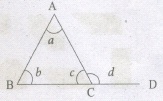
If a side is produced in a triangle, the angle formed is called an exterior angle.
Here BC, a side of ΔABC is produced, which lead to the formation of exterior angle ㄥACD.
Also BCD is a straight line ⇒ ㄥBCD is a straight angle.
ㄥBCD = 1800
ㄥc + ㄥd = 1800 ......(1)
Also in ΔABC ㄥa + ㄥb + ㄥc
From (1) and (2) we get,
ㄥa + ㄥb + ㄥc = ㄥc + ㄥd
∴ ㄥa + ㄥb =ㄥd
Hence, we conclude that the measure of exterior angle formed is equal to the sum of the measure of two opposite interior angles.
16.
To draw the different types of quadrilateral by giving the instructions using their properties.
Example:
(i) It is four sides closed diagram.
(ii) Opposite sides are parallel.
(iii) Four sides are equal in size.
(iv) Diagonals bisect each other at 90°.
(v) Diagonals are not equal.
The diagram represents as a rhombus
Like this for hexagon, parallelogram, Trapezium etc.
Any one must give the clues to draw the diagram.
At last they have to find what it represent.
17.
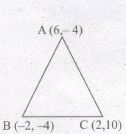
Distance = \(\sqrt { ({ x }_{ 2 }-{ x }_{ 1 })^{ 2 }+({ y }_{ 2 }-y_{ 1 })^{ 2 } } \)
AB= \(\sqrt { (-2-6)^{ 2 }+(-4+4)^{ 2 } } \)
= \(\sqrt { (-8)^{ 2 }+0 } =\sqrt { 64 } =8\)
BC = \(\sqrt { (2+2)^{ 2 }+(10+4)^{ 2 } } \)
= \(\sqrt { (4)^{ 2 }+(14)^{ 2 } } =\sqrt { 16+196 } =\sqrt { 212 } \)
AC = \(\sqrt { (2-6)^{ 2 }+(10+4)^{ 2 } } \)
= \(\sqrt { (-4)^{ 2 }+(14)^{ 2 } } =\sqrt { 1+-196 } =\sqrt { 212 } \)
BC = AC =\(\sqrt { 212 } \) (Two sides are equal)
∴ ABC is an isosceles triangle.
18.

Distance AB =\(\sqrt { (2+2)^{ 2 }+(-3+8)^{ 2 } } \)
= \(\sqrt { (4)^{ 2 }+(5)^{ 2 } } =\sqrt { 16+25 } =\sqrt { 41 } \)
BC =\(\sqrt { (6-2)^{ 2 }+(2+3)^{ 2 } } \)
= \(\sqrt { (4)^{ 2 }+(5)^{ 2 } } =\sqrt { 16+25 } =\sqrt { 41 } \)
AC = \(\sqrt { (6+2)^{ 2 }+(2+8)^{ 2 } } \)
= \(\sqrt { (8)^{ 2 }+(10)^{ 2 } } =\sqrt { 64+100 } =\sqrt { 164 } \)
= \(\sqrt { 4\times 41 } =2\sqrt { 41 } \)
AB + BC = AC ⇒ \(\sqrt { 41 } +\sqrt { 41 } =2\sqrt { 41 } \)
∴ The given three points are collinear.
19.
i) Draw a line and mark a point A on it.
ii) Mark a point B such that AB = 9.3 cm.
iii) Mark a point C on this line such that BC = 1 unit
iv) Find the midpoint of AC by drawing perpendicular bisector of AC and let it be O
v) With O as center and OC = OA as radius, draw a semicircle
vi) Draw a line BD, which is perpendicular to AB at B.
vii) Now BD = \(\sqrt { 9.3 } \) which can be marked in the number line as the value of BE = BD =\(\sqrt { 9.3 } \)
20.
(d)
\(\frac { \sqrt { 54 } }{ \sqrt { 18 } } \)
21.
(b)
\(0.\overline { 714285 } \)
22.
(c)
on the y-axis
23.
(b)
II
24.
(b)
6.3 cm, 3.1 cm, 3.2 cm
25.
()
3
26.
()
regular
27.
()
sides

9th Standard Syllabus & Materials
9th Standard
TN 9th Tamil உள்ளத்தின் சீர் - திருக்குறள் Important Questions And Answers Study Material - QB365 Set A
NEW9th Standard
TN 9th Tamil உள்ளத்தின் சீர் - மணிமேகலை Important Questions And Answers Study Material - QB365 Set A
NEW9th Standard
TN 9th Tamil உள்ளத்தின் சீர் - ஏறு தழுவுதல் Important Questions And Answers Study Material - QB365 Set A
NEW9th Standard
TN 9th Tamil உயிருக்கு வேர் - தண்ணீர் Important Questions And Answers Study Material - QB365 Set A



Tamilnadu Stateboard 9th Standard Subjects
Tamilnadu Stateboard Standards





