
 100% FREE ACCESS
9th Standard Syllabus & Materials
9th Standard
TN 9th Tamil உள்ளத்தின் சீர் -கற்கண்டு (இலக்கணம்) - தொடர் இலக்கணம், ஆகுபெயர் Important Questions And Answers Study Material - QB365 Set A
NEW9th Standard
TN 9th Tamil உள்ளத்தின் சீர் -விரிவானம் (துணைப்பாடம்) - தாய்மைக்கு வறட்சி இல்லை! Important Questions And Answers Study Material - QB365 Set A
NEW9th Standard
TN 9th Tamil உள்ளத்தின் சீர் -கவிதை பேழை (செய்யுள்) - மார்கழி பெருவிழா Important Questions And Answers Study Material - QB365 Set A
NEW9th Standard
TN 9th Tamil உயிருக்கு வேர்-இலக்கணம் - பகுபத உறுப்பிலக்கணம் Important Questions And Answers Study Material - QB365 Set A
NEW9th Standard
TN 9th Tamil அமுதென்று பேர் - இலக்கணம்-எழுத்து -அளபெடை Important Questions And Answers Study Material - QB365 Set A
NEW9th Standard
TN 9th Tamil அமுதென்று பேர்-துணைப்பாடம் - ஆறாம்திணை Important Questions And Answers Study Material - QB365 Set A

Published on: 22/09/2018
First Term Half Test
Download Tamil Nadu 9th Standard Maths question papers, model tests, one-mark questions, important questions, and public exam papers in PDF format. Free study materials and answer keys for TN State Board students.
Questions + Answers key
Take MCQ Maths Test1.
The sum of 7x2 - 4x + 5 and 9x - 10 is __________
2.
The value of \(3\sqrt { 3 } +\sqrt { 3 } \) is ______________.
3.
Sets having at least one element in common are called ___________
4.
Consider the following sets A = {0, 3, 5, 8}, B = {2, 4, 6, 10} and C = {12, 14,18, 20}.
18 _______ B.
5.
Consider the set A = {Ashwin, Muralivijay, Vijay Shankar, Badrinath }.
Fill in the blanks with the appropriate symbol \(\in \) or \(\notin \).
Muralivijay ____ A.
6.
If U = {a, b, c, d, e, f, g, h}, A = {b, d, f, h} and B = {a, d, e, h}, find the following sets. (A′)′
7.
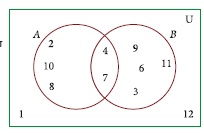
Using the given Venn diagram, write the elements of A'
8.
Using the given Venn diagram, write the elements of B
9.
Identify the following sets as null set or singleton set.
D = The set of all triangles having four sides.
10.
Represent the following sets in descriptive form.
R = {x : x \(\in \) N, x < 5}
11.
Which of the following are sets?
The Collection of good Hockey players.
12.
In a class, all students take part in either music or drama or both. 25 students take part in music, 30 students take part in drama and 8 students take part in both music and drama. Find
(i) The number of students who take part in only music.
(ii) The number of students who take part in only drama.
(iii) The total number of students in the class.
13.
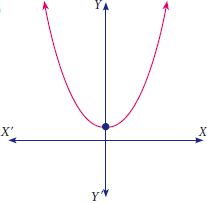
Find the number of zeros of the following polynomials represented by their graphs.
14.
Find the value of the polynomial f (y) = 6y - 3y2 + 3 at y = 0
15.
Draw Venn diagram and shade the region representing the following sets
(A – B)′
16.
If A = {1, 2, 6} and B = {2, 3, 4} , find A∪B.
17.
Write all the subsets of A = {a, b}.
18.
Construct an isosceles triangle PQR where PQ = PR and ㄥQ = 500, QR = 7cm. Also draw its circumcircle.
19.
Discuss with your friends and give examples of subsets of sets from your daily life situation.
20.
Find the type of triangle formed by (-1, -1), (1, 1) and (\(-\sqrt{13},\sqrt{13}\))
21.
If two polynomials 2x3 + ax2 + 4x – 12 and x3 + x2 –2x+ a leave the same remainder when divided by (x – 3), find the value of a and also find the remainder.
22.
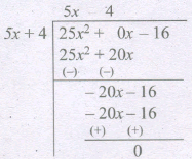
The base of a parallelogram is (5x+4). Find its height, if the area is 25x2–16.
23.
If a triangle and a parallelogram lie on the same base and between the same parallels, then prove that the area of the triangle is equal to half of the area of parallelogram.
24.
The side of a rhombus is 13 cm and the length of one of the diagonal is 24 cm. Find the length of the other diagonal?
25.
Which type of quadrilateral satisfies the following properties?
(i) Both pairs of opposite angles are equal in size.
(ii) Both pairs of opposite sides are equal in length.
(iii) Each diagonal is an angle bisector.
(iv) The diagonals bisect each other.
(v) Each pair of consecutive angles is supplementary.
(vi) The diagonals are equal.
(vii) Can be divided into two congruent triangles.
26.
The length of a rectangle is (3x+2) units and it’s breadth is (3x–2) units. Find its area in terms of x. What will be the area if x = 20 units.
27.
Show that the points A(7,10), B(-2, 5), C(3, -4) are the vertices of a right angled triangle.
28.
The area of a rectangle with length \(2l^{ 2 }m\) and breadth \(3l^{ 2 }m\) is_______________________
\(6l^{ 3 }m^{ 3 }\)
\(l^{ 3 }m^{ 3 }\)
\(2l^{ 3 }m\)
\(4l^{ 3 }m^{ 3 }\)
29.
One angle of a parallelogram is a right angle. The name of the quadrilateral is ______
square
rectangle
rhombus
kite
30.
Sets having the same number of elements are called ___________
overlapping sets
disjoint sets
equivalent sets
equal sets
31.
Which one of the following has terminating decimal expansion?
\(\frac { 7 }{ 9 } \)
\(\frac { 8 }{ 15 } \)
\(\frac { 1 }{ 2 } \)
\(\frac { 5 }{ 32 } \)
32.
On which quadrant does the point (-4, 3) lie?
I
II
III
IV
33.
Let the polynomials be
(A) –13q5 + 4q2 + 12q
(B) (x2 +4 )(x2 + 9)
(C) 4q8 – q6 + 2
(D) -\(\frac {5}{7}\)y12+y3+y5
Then ascending order of their degree is _______.
A,B,D,C
A,B,C,D
B,C,D,A
B,A,C,D
34.
The point M lies in the IV quadrant. The coordinates of M is _______
(a,b)
(–a, b)
(a, –b)
(–a, –b)
35.
If X = {x : x = 4(n – 1), n ∈ N} and Y = {y : y = 3n – 2n – 1, n ∈ N}, then X∪Y is ______________
W
X
Y
N
36.
If A∪B = A∩B, then ________.
A ≠ B
A = B
A ⊂ B
B ⊂ A
37.
The correct statement out of the following is ________.
ΔABC ≅ ΔDEF
ΔABC ≅ ΔDEF
ΔABC ≅ ΔFDE
ΔABC ≅ ΔFED
1.
()
7x2 + 5x - 5
2.
()
\(4\sqrt { 3 } \)
3.
()
overlapping sets
4.
()
\(\notin \)
5.
()
Muralivijay \(\in \) A.
6.
A' = {a, c, e, g}
(A')' = U - A'
= {a, b, c, d, e, f, g, h} - {a, c, e, g}
= {b, d, f, h}
7.
{1, 3, 6, 9, 11, 12}
8.
{3, 4, 6, 7, 9, 11}
9.
D is a null set
10.
R = The set of natural numbers less than 5
11.
not a set
12.
Let M be the set of all students take part in music.
Let D be the set of all students take part in drama.
n( M) = 25, n(D) = 30 and n(M\(\cap \)D) = 8
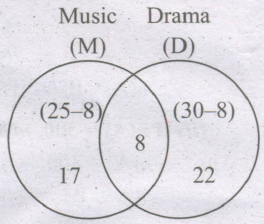
By using venn diagram
From the venn diagram we get.
(i) Number of students take part in only music = 17
(ii) Number of students take part in only drama = 22
(iii) Total number of students in the class = 17 + 8 + 22 = 47
Alter :
(i) The number of students who take part in only music
= n(M) - n(M\(\cap \)D)
= 25 - 8 = 17
(ii) The number of students who take part in only drama
= n(D) - n(M\(\cap \)D)
= 30 - 8 = 22
(iii) The total number of students
n(M∪D) = n(M) + n(D) - n(M\(\cap \)D)
= 25 + 30 - 8 = 47
13.
Number of zeros = 0 (The curve is not intersecting the x-axis)
14.
When y = 0
f(y) = 6y-3y2 + 3
f(0) = 6(0) - 3(0)2+ 3
= 0 - 0+ 3 = 3
15.
(A – B)′
.jpg)
16.
Given A = {1, 2, 6}, B = {2, 3, 4}
A∪B = {1,2,3, 4,6}.
17.
A= {a,b}
Subsets of A are \(\phi \),{a}, {b} and {a, b}.
18.
Given PQ = PR
∴ ㄥR = 50° (opposite angles are equal)
Steps for construction:
Step 1: Draw the ΔABC with the given measures.
Step 2: Construct the perpendicular bisector of any two sides (QR and PR) and let them meet at S. S is the circumcenter of Δ PQR.
Step 3: With S as centre SP = SQ = SR as radius. Draw the circumcircle.
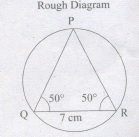
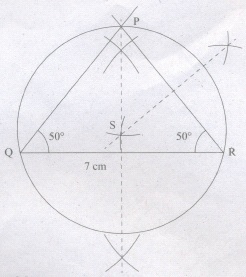
Circum radius = 3.5 cm.
Construction of Orthocentre of a Triangle:
Orthocentre: The orthocentre is the point of concurrency of the altitudes of a triangle. Usually it is denoted by H.
19.
(i) A = The set of shapes which have four sides. ,
B = {square, rectangle, rhombus}
B ⊆ A ( B is the subset of A)
(ii) A - Set of natural numbers; B = {set of all even numbers}
B ⊆ A
(iii) M = A set of family members; N = {Daughter, Son}.
N ⊆ M
20.
Let the point A (-1, -1), (1, 1) and (\(-\sqrt{13},\sqrt{13}\))
Distance = \(\sqrt{(x_2-x_1)^2+(y_2-y_1)^2}\)
AB =\(\sqrt{(1+1)^2+(1+1)^2}\)
\(\sqrt{2^2+2^2}=\sqrt{4+4}=\sqrt{8}\)
BC =\(\sqrt{(-\sqrt{3}+1)^2+(\sqrt{3}-1)^2}\)
\(\sqrt{(\sqrt{3}+1)^2+(\sqrt{3}-1)^2}\)
\(\sqrt{3+1+2\sqrt{3}+3+1-2\sqrt{3}}\)
\(\sqrt{3+1+3+1}=\sqrt{8}\)
AC =\(\sqrt{(-\sqrt{3}+1)^2+(\sqrt{3}+1)^2}\)
\(=\sqrt{3+1-2\sqrt{3}+3+1+2\sqrt{3}}\)
\(=\sqrt{4+4}=\sqrt{8}\)
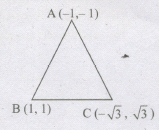
AB= BC=AC= \(\sqrt{8}\)
\(\therefore\)ABC is an equilateral triangle.
21.
p(x1) = 2x3 + ax2 + 4x - 12
When it is divided by x - 3,
p(3) = 2(3)3 + a(3)2 + 4(3) - 12
= 54 + 9a + 12 - 12
= 54 + 9a .....(R1)
p(x2) = x3 + x2 - 2x + a
When it is divided by x - 3,
p(3) = 33 + 32 - 2(3) + a
= 27 + 9 -6 +a
= 30 + a ......(R2)
The given remainders are same (R1 = R2)
\(\therefore\) 54 + 9a = 30 + a
9a - a = 30 - 54
8a = -24
\(\therefore\) a = - 24/8 = - 3
Consider R2,
Remainder = 30 - 3
= 27
22.
Let the height of the parallelogram be " h "
Base of the parallelogram = 5x + 4
Area of a parallelogram = 25x2 - 16
Base \(\times\) Height = 25x2 - 16
(5x + 4) \(\times\) h = 25x2-16
h = \(\frac { { 25 }x^{ 2 }-16 }{ 5x+4 } \) (or)
h = \(\frac { \left( { 5x }^{ 2 } \right) -{ 4 }^{ 2 } }{ 5x+4 } =\frac { \left( 5x+4 \right) \left( 5x-4 \right) }{ 5x+4 } \)
Height of the parallelogram = 5x - 4
23.
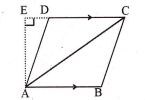
Let \(\triangle APB\) and parallelogram ABCD lie on base AB and between parallels AB and DC.
Draw perpendicular line from A to CD, It meets at E.
\(\therefore\) AE \(\perp\) DE.
Area of parallelogram ABCD = Base \(\times\) height
AB \(\times\) AE
Let ABC be the triangle. Base AB vertical height A.E
Area of \(\Delta\)ABC = \(\frac{1}{2}\times\)base\(\times\)height
= \(\frac{1}{2}\times\) AB \(\times\) AE
Hence proved
24.
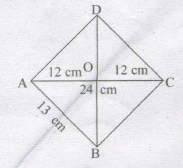
In the given rhombus, the diagonal AC and BD bisect and intersect at right angles at O.
In right \(\triangle AOB\)
OB2 = AB2- AO2 (By pythagoras theorem)
= 132-122
= 169 - 144
OB2 = 25
\(OB=\sqrt {25}=5\)
\(\therefore\) Diagonal BD = 5 \(\times\) 2 = 10 cm.
25.
(i) Both pairs of opposite angles are equal in size are square and rectangle.
(ii) Both pairs of opposite sides are equal in length are square and rhombus.
(iii) Each diagonal is an angle bisector of square and rectangle.
(iv) The diagonals of the following quadrilateral bisect each other: Parallelogram, rectangle, square, and rhombus.
(v) Each pair of consecutive angles is supplementary are square, rectangle, rhombus, parallelogram.
(vi) The diagonals are equal in case of square and rectangle.
(vii) Square, rectangle, rhombus, and parallelogram can be divided into two congruent triangles.
26.
Length of the rectangle = 3x + 2 units
Breadth of the rectangle = 3x - 2 units
Area of the rectangle = (3x + 2 ) (3x - 2)
= 9x2 - 6x + 6x - 4
= 9x2- 4
When x = 20
Area of the rectangle = 9(20)2 - 4
= 9(400) - 4
= 3600 - 4 = 3596 sq.units.
27.
Here A = (7, 10), B = (-2, 5), C = (3,-4)
\(AB=\sqrt { \left( { x }_{ 2 }-{ x }_{ 1 } \right) ^{ 2 }+\left( y_{ 2 }-y_{ 1 } \right) ^{ 2 } } \)
\(=\sqrt { \left( -2-7 \right) ^{ 2 }+\left( 5-10 \right) ^{ 2 } } \)
\(=\sqrt { \left( -9 \right) ^{ 2 }+\left( -5 \right) ^{ 2 } } \)
\(=\sqrt { \left( 81+25 \right) } \)
\(=\sqrt { 106 } \)
\(A{ B }^{ 2 }=106\)............1
\(BC=\sqrt { \left( { x }_{ 2 }-{ x }_{ 1 } \right) ^{ 2 }+\left( y_{ 2 }-y_{ 1 } \right) ^{ 2 } } \)
\(=\sqrt { \left( 3-\left( -2 \right) \right) ^{ 2 }+\left( -4-5 \right) ^{ 2 } } \)
\(=\sqrt { \left( 5 \right) ^{ 2 }+\left( -9 \right) ^{ 2 } } \)
\(=\sqrt { \left( 81+25 \right) } \)
\(=\sqrt { 106 } \)
\({ BC }^{ 2 }=106\)...............2
\(AC=\sqrt { \left( { x }_{ 2 }-{ x }_{ 1 } \right) ^{ 2 }+\left( y_{ 2 }-y_{ 1 } \right) ^{ 2 } } \)
\(=\sqrt { \left( 3-7 \right) ^{ 2 }+\left( -4-10 \right) ^{ 2 } } \)
\(=\sqrt { \left( -4 \right) ^{ 2 }+\left( -14 \right) ^{ 2 } } \)
\(=\sqrt { \left( 16+196 \right) } \)
\(=\sqrt { 212 } \)
\({ AC }^{ 2 }=212\)..........3
From (1), (2) & (3) we get
AB2+BC2 = 106 +106 = 212 = AC2
AB2 + BC2 = AC2
ΔABC is a right angled triangle, right angled at B.
28.
(a)
\(6l^{ 3 }m^{ 3 }\)
29.
(b)
rectangle
30.
(c)
equivalent sets
31.
(d)
\(\frac { 5 }{ 32 } \)
32.
(b)
II
33.
(d)
B,A,C,D
34.
(c)
(a, –b)
35.
(b)
X
36.
(b)
A = B
37.
(d)
ΔABC ≅ ΔFED

9th Standard Syllabus & Materials
9th Standard
TN 9th Tamil உள்ளத்தின் சீர் - திருக்குறள் Important Questions And Answers Study Material - QB365 Set A
NEW9th Standard
TN 9th Tamil உள்ளத்தின் சீர் - மணிமேகலை Important Questions And Answers Study Material - QB365 Set A
NEW9th Standard
TN 9th Tamil உள்ளத்தின் சீர் - ஏறு தழுவுதல் Important Questions And Answers Study Material - QB365 Set A
NEW9th Standard
TN 9th Tamil உயிருக்கு வேர் - தண்ணீர் Important Questions And Answers Study Material - QB365 Set A



Tamilnadu Stateboard 9th Standard Subjects
Tamilnadu Stateboard Standards





