
 100% FREE ACCESS
9th Standard Syllabus & Materials
9th Standard
TN 9th Tamil உள்ளத்தின் சீர் -கற்கண்டு (இலக்கணம்) - தொடர் இலக்கணம், ஆகுபெயர் Important Questions And Answers Study Material - QB365 Set A
NEW9th Standard
TN 9th Tamil உள்ளத்தின் சீர் -விரிவானம் (துணைப்பாடம்) - தாய்மைக்கு வறட்சி இல்லை! Important Questions And Answers Study Material - QB365 Set A
NEW9th Standard
TN 9th Tamil உள்ளத்தின் சீர் -கவிதை பேழை (செய்யுள்) - மார்கழி பெருவிழா Important Questions And Answers Study Material - QB365 Set A
NEW9th Standard
TN 9th Tamil உயிருக்கு வேர்-இலக்கணம் - பகுபத உறுப்பிலக்கணம் Important Questions And Answers Study Material - QB365 Set A
NEW9th Standard
TN 9th Tamil அமுதென்று பேர் - இலக்கணம்-எழுத்து -அளபெடை Important Questions And Answers Study Material - QB365 Set A
NEW9th Standard
TN 9th Tamil அமுதென்று பேர்-துணைப்பாடம் - ஆறாம்திணை Important Questions And Answers Study Material - QB365 Set A

Published on: 26/07/2018
Based on the Term I syllabus, Geography Important question paper is prepared. In this question paper, it covers the important one mark, two, three, five marks and ten marks question.
Download Tamil Nadu 9th Standard Social Science question papers, model tests, one-mark questions, important questions, and public exam papers in PDF format. Free study materials and answer keys for TN State Board students.
Questions + Answers key
Take MCQ Social Science Test
1.
The process of dissolution of rock substances in water is________
oxidation
solution
gradation
hydration
2.
This is the earth's magnetic belt________
Thermosphere
Stratosphere
Mesosphere
Magnetosphere
3.
The wind blowing from the east is________
Planetary winds
Easterly winds
Variable winds
Local winds
4.
Humidity of the atmosphere is measured by the wet and dry bulb thermometer called _________
Anemometer
Thermometer
Hygrometer
Barometer
5.
Composite volcanoes are commonly found in the______________ocean.
Pacific
Southern
Indian
Atlantic
6.
This is a dead volcano.
Mt. St. Helens
Mt. Kilimanjaro
Mt. Fuji
Paricutin
7.
This is the solid outer part of the Earth
Lithosphere
Atmosphere
Hydrosphere
Biosphere
8.
The Monsoons are _________
Prevailing winds
Periodic winds
local winds
none of the above
9.
The average global surface temperature is ______
120°C
130°C
140°C
150°C
10.
______ is the most important gas for the survival of living organisms.
Helium
carbon-di-oxide
oxygen
oxygen
11.
Deposits of fine silt blown by wind is called as
Loess
Barchans
Hamada
Ripples
12.
Karst topography is formed due to the action of
Glacier
Wind
Sea waves
Ground water.
13.
The point of origin of an Earthquake is called the ________.
epicentre
focus
seismic wave
magnitude
14.
In the ancient period, Gondwana land moved towards _________ direction.
north
south
east
west
15.
Diastrophism is connected to______
volcanism
earthquakes
tectonics
fold/fault
16.
Why do the Pedestal rock look like mushroom?
17.
The sub-tropical high pressure are called "horse latitudes". Why?
18.
Convectional rainfall is also called 4'0 clock rain.
19.
Cyclones cause huge loss of life and property.
20.
Wind can possibly erode the rocks from all sides.
21.
Igneous rocks are also called Primary Rocks or Mother rocks.
22.
Alluvial Plain and Flood Plain
23.
Isobar and Isotherm.
24.
Atmosphere and Biosphere.
25.
Stalactite and stalagmite
26.
Primary waves and Secondary waves.
27.
Describe the Erosional landforms of Sea
28.
How is the Orographic rainfall caused?
29.
Write a note on the internal and external processes of Earth
30.
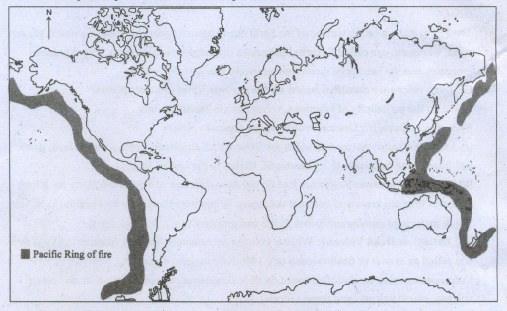
On the given outline map of the world, mark the following:
a. Pacific Ring of fire
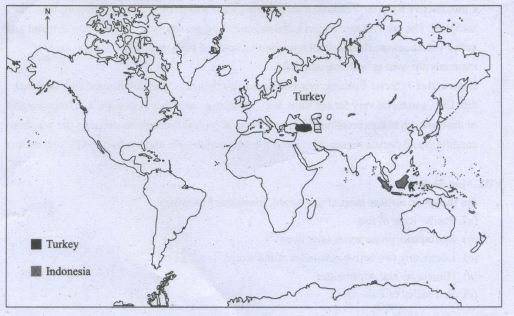
b. Earthquake prone zones (any two)
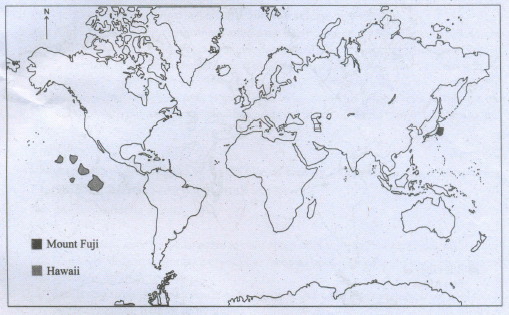
c. Locate any two active volcanoes of the world.
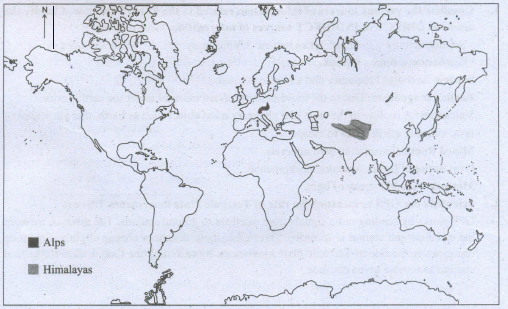
d. Himalayas and Alps ranges
e. Rift valley of East Africa.
31.
State the other erosional features of Karst regions in other parts of the world
32.
What are "Pot Holes"?
33.
Cuddalore and Nagapattinam are always affected by cyclones. Why?
34.
Glaciers do not form deep narrow valleys. Why?
35.
Snowline of Alps is 2700 metre where as the snowline of Greenland is just 600 mts. Find out the reason.
36.
Is weathering a pre-requisite in the formation of soil
37.
What happens to atmospheric pressure with altitude?
38.
What do the internal processes generate?
39.
What are fossils?
40.
What is insolation?
41.
What are the units used to measure the temperature?
42.
What do you mean by a hanging valley?
43.
What do you mean by biological weathering?
44.
Composite Volcano
45.
Mantle.
46.
Carbonation
47.
Granular disintegration
48.
Ferrel's law
49.
Nitrogen
50.
Oxygen
51.
Cliff
52.
Stalactites
53.
Eskers
54.
Basalt
55.
Diamond
56.
Granite
57.
Wind Vane
58.
Anemometer
1.
(b)
solution
2.
(d)
Magnetosphere
3.
(b)
Easterly winds
4.
(c)
Hygrometer
5.
(a)
Pacific
6.
(b)
Mt. Kilimanjaro
7.
(a)
Lithosphere
8.
(b)
Periodic winds
9.
(a)
120°C
10.
(c)
oxygen
11.
(a)
Loess
12.
(d)
Ground water.
13.
(b)
focus
14.
(a)
north
15.
(c)
tectonics
16.
By the constant wearing down action of wind, the bottom gets eroded away to form a mushroom like structure. So the Pedestal rock looks like mushroom.
17.
(i) With little water and food left for humans, sailors used to throw the horses into the sea in order to make the vessels lighter.
(ii) Henceforth these belts (or) latitudes are called as "horse latitudes".
18.
It occurs regularly ln the equatorial region in the evenings.
19.
(i) Because they are formed due to the differential heating of land and sea.
(ii) Due to heavy rain, strong wind & large storm.
(iii) The destruction depends mainly on its intensity, its size and its location.
(iv) After the cyclone the devastation continues.
20.
Because of the earth rotation, wind changes their directions.
21.
All other rocks are directly or indirectly formed from them.
22.
| S.No. | Alluvial Plain | FloodPlain |
|---|---|---|
| (i) | A fan shaped deposition made by the river at the foothills is called an alluvial plain. | Fine sediments are deposited on river banks when a river floods and is called flood plain |
| (ii) | These deposits are rich and fertile useful for cultivation. | These sediments make the region rich and fertile |
23.
| Isobar | Isotherm |
| An Isobar is an imaginary line drawn through places having equal atmospheric pressure reduced to sea level. | An imaginary line on a map connecting points having the same temperature. |
24.
| Atmosphere | Biosphere |
|---|---|
| The atmosphere is a thin layer of gases that surround the Earth. | The Biosphere is the layer of Earth where life exists. |
25.
| Stalactite | Stalagmite |
| When the water containing dissolved calcite gradually drips from the ceiling of the caves, water evaporates and the remaining calcite hangs from the ceiling and thus Stalactites are formed | When the calcite deposits rises upward like a pillar Stalagmites are formed |
26.
| S.No | Primary Waves | Secondary Waves |
| (i) | These waves are the fastest of all the Earthquake waves and the first to reach the epicentre. | Secondary waves travel less faster than the primary waves. |
| (ii) | These waves pass through solids, liquids and gases. | These waves travel only through solids. |
| (iii) | The average velocity of these waves is 5.3 k.m/sec to 10.6 k.m/second. | The average velocity of these waves is 1 k.m/sec to 8 k.m/second. |
27.
Some of the erosional landforms of sea waves are sea cliff, sea cave, arch, stack, beach, bar and spit and wave cut platform.
Sea Cave: Prolonged wave attack on the base of a cliff erodes rock materials, which result in the formation of caves.
Sea Arch: When two caves approach one another from either side of a headland and unite, they form an arch. e.g., Neil Island, Andaman and Nicobar.
Sea Stack: Further erosion by waves ultimately leads to the total collapse of the arch. The seaward portion of the headland will remain as a pillar of rock known as stack. Eg the Old man of Hoy in Scotland.
Sea Cliffs: Sea cliffs are steep rock faces formed when sea waves dash against them. The rocks get eroded to form steep vertical walls.
Wave Cut Platforms: Flat surface found at the foot of sea cliffs are called as wave-cut platforms. Wave cut platform is also referred as beach, shelf, terrace and plain.
28.
Orographic rainfall, 'also called relief rainfall" is caused when air is forced to rise against a high mountain. The mountain barriers lying across the direction of air flow, force the moisture laden air rise along the mountain slope. This results in the cooling of the air, which leads to the formation of clouds and rain. This rainfall is called Orographic rainfall. The side of the mountain facing the wind is called the windward side and receives heavy rainfall. It is called the rainfed region. The other side of the mountain that does not face the wind is called the leeward side and receives less rainfall becomes rain shadow region.
29.
The formation and deformation of landforms on the surface of the Earth is a continuous activity of two broad processes i.e. internal and external. These processes cause stress and deformation on Earth materials and finally bring changes on the surface of the Earth. These are referred as Geomorphic Processes.
The forces that act from the Earth's interior towards the Earth's surface are called Internal processes or Endogenetic processes. These forces build the landscape and create topographic relief.
The forces that act on the surface of the Earth due to natural agents like running water, glacier, wind, waves etc. are called External processes or Exogenetic processes. These external processes tear the landscape down into relatively low elevated plains.
30.
a) Pacific Ring of fire: It is a major area and an arc in the_basin of the Pacific ocean where many earthquakes and volcanic eruptions occur.
(b) Earthquake-prone zones (any two): Turkey, Indonesia
(c) Locate any two active volcanoes of the world: Hawaii-, Mount Fuji
(d) Himalayas and Alps ranges
31.
Swallow Holes, Uvalas, Dolines, Poljis are the other erosional features
32.
Due to the river action, cylindrical holes are drilled vertically in the river bed with varying depth and diametre.
33.
(i) Coastal zone is exposed to natural forces including cyclones and Tsunamis.
(ii) Cuddalore and Nagapattinam are situated on the Sea-Shore.
(iii) Cuddalore and Nagapattinam are vulnerable to storms.
(iv) During Summer Bay of Bengal subject to intense heat cause to raise the humid and unstable air masses that produce cyclone.
34.
(i) A valley is made deeper by a stream of water (or) a river as it flows from the high land.
(ii) The valleys are either 'U' shaped or 'V' shaped.
(iii) The glacier debris get deposited in the low lying areas. So glaciers do not form deep narrow valleys.
35.
On tropical mountains, the snowline may be as high as 500 mts, but when traced poleward it descends to 2700 mts in the European Alps to 600 meters in Greenland and just to sea level near the poles.
36.
(i) Yes, weathering a pre-requisite in the formation of soil.
(ii) The rock materials in due course of time are weathered further to form soil.
(iii) Soil is a mixture of disintegrated rock material.
37.
(i) Air pressure decreases with altitude.
(ii) The air molecules became scattered and more widely spaced at higher altitudes.
(iii) The air pressure develops by 34 millibars per 300 metres increase in height.
38.
(i) The internal processes generate heat and eject materials from deep below the Earth's crust.
(ii) Internal radio activity in the principal source of power for this process.
39.
The bodies of plants and animals that fall on the sedimentary rock deposits get embedded in the layers and form fossils.
40.
The amount of heat received from the sun in the form of short waves is called insulation (or) incoming Solar Radiation
41.
Temperature is a measure of the warmth of an object expressed in terms of celsius (or) farenheit, measured with thermometer
42.
These are valleys eroded by tributary glacier and that hangs over the main valley
43.
Biological weathering occurs due to the penetration and expansion of plant roofs, earth worms, burrowing animals (rabbits, rats) and same human activities.
44.
Pacific Ocean
45.
SIMA
46.
Mixing of water with CO2
47.
Due to the action temperature
48.
William Ferrel
49.
78%
50.
21%
51.
action of sea wave
52.
karst topography
53.
glacial action
54.
Laying roads
55.
jewellery making
56.
Construction work
57.
direction of wind
58.
wind speed

9th Standard Syllabus & Materials
9th Standard
TN 9th Tamil உள்ளத்தின் சீர் - திருக்குறள் Important Questions And Answers Study Material - QB365 Set A
NEW9th Standard
TN 9th Tamil உள்ளத்தின் சீர் - மணிமேகலை Important Questions And Answers Study Material - QB365 Set A
NEW9th Standard
TN 9th Tamil உள்ளத்தின் சீர் - ஏறு தழுவுதல் Important Questions And Answers Study Material - QB365 Set A
NEW9th Standard
TN 9th Tamil உயிருக்கு வேர் - தண்ணீர் Important Questions And Answers Study Material - QB365 Set A



Tamilnadu Stateboard 9th Standard Subjects
Tamilnadu Stateboard Standards




