
 100% FREE ACCESS
11th Standard Syllabus & Materials
11th Standard
TN 11th Tamil இயற்கை வேளாண்மை,சுற்றுச்சூழல் -செய்யுள் - மனோன்மணீயம் Important Questions And Answers Study Material - QB365 Set A
NEW11th Standard
TN 11th Tamil என்னுயிர் என்பேன் -துணைப்பாடம் - இசைத்தமிழர் இருவர் Important Questions And Answers Study Material - QB365 Set A
NEW11th Standard
TN 11th Tamil மொழி கலை -செய்யுள் - ஒவ்வொரு புல்லையும் Important Questions And Answers Study Material - QB365 Set A
NEW11th Standard
TN 11th Tamil பீடு பெற நில் - இலக்கணம் - பகுபத உறுப்புகள் Important Questions And Answers Study Material - QB365 Set A
NEW11th Standard
TN 11th Tamil பீடு பெற நில் - துணைப்பாடம் - வாடிவாசல் Important Questions And Answers Study Material - QB365 Set A
NEW11th Standard
TN 11th Tamil பீடு பெற நில் - செய்யுள் - குறுந்தொகை Important Questions And Answers Study Material - QB365 Set A

Published on: 24/08/2026
Download Tamil Nadu 11th Standard Chemistry question papers, model tests, one-mark questions, important questions, and public exam papers in PDF format. Free study materials and answer keys for TN State Board students.
Questions + Answers key
Take MCQ Chemistry Test
1.
Give the structure for the following compound.
i)3- ethyl - 2 methyl -1-pentene ii)3 - Chlorobutanal iii)3 - methylbutan - 2 - ol iv) v) 1,3,5- Trimethyl cyclohex - 1 -ene vi)4-methylpent-3-en-2-one vii) 3-phenyl prop -2-enoicacid viii) 4-methylpentan -1- olix) methanoicacid x)2,2,5-trimethylheptane
2.
(i) Why do you classify mesomeric effect (M-effect) into +M and -M effect ?
(ii) Why type of mesomeric effect is observed in phenol? Explain.
3.
Explain inductive effect with suitable example.
4.
Derive de-Broglie wave length.
5.
An atom of an element contains 35 electrons and 45 neutrons. Deduce
(i) the number of protons
(ii) the electronic configuration for the element
(iii) All the four quantum numbers for the last electron
6.
State and explain pauli exclusion principle.
7.
Write a note on limitations of Bohr's atom model.
8.
Which of the following species does not acts as a nucleophile ?
ROH
ROR
PCl3
BF3
9.
Which of the following represent a set of nuclephiles ?
BF3, H2O, NH2-
AlCl3, BF3, NH3
CN-, RCH2-, ROH
H+, RNH3+, :CCl2
10.
Heterolytic fission of C-C bond results in the formation of _____________.
free radical
Carbanion
Carbocation
Carbanion and Carbocation
11.
Which of the following carbocation will be most stable ?
Ph3C-+
\({ C }{ H }_{ 3 }-\overset { + }{ C } { H }_{ 2 }\)
\(\left( { CH }_{ 3 } \right) _{ 2 }-\overset { + }{ C } { H }\)
\(CH_{ 2 }=CH-\overset { + }{ C } { { H }_{ 2 } }\)
12.
Which of the following species does not exert a resonance effect ?
C6H5OH
C6H5Cl
C6H5NH2
\({ C }_{ 6 }{ H }_{ 5 }\overset { + }{ N } { H }_{ 3 }\)
13.
Which of the group has highest +I effect ?
CH3-
CH3 - CH2 -
(CH3)2 - CH-
(CH3)3 - C-
14.
Hyper Conjugation is also known as ___________.
no bond resonance
Baker - nathan effect
both (a)and (b)
none of these
15.
Decreasing order of nucleophilicity is ____________.
OH- > NH2- > -OCH3 > RNH2
NH2- > OH- > -OCH3 > RNH2
NH2- > CH3O- > OH- > RNH2
CH3O- > NH2- > OH- > RNH2
16.
Which of the following does not represent the mathematical expression for the Heisenberg uncertainty principle?
\(\triangle x.\triangle p\ge \frac { h }{ 4\pi } \)
\(\triangle x.\triangle v\ge \frac { h }{ 4\pi m } \)
\(\triangle E.\triangle t\ge \frac { h }{ 4\pi } \)
\(\triangle E.\triangle x\ge \frac { h }{ 4\pi } \)
17.
The ratio of de Broglie wavelengths of a deuterium atom to that of an \(\alpha\) - particle, when the velocity of the former is five times greater than that of later, is ____________
4
0.2
2.5
0.4
18.
A macroscopic particle of mass 100 g and moving at a velocity of 100 cm S-1 will have a de Broglie wavelength of ___________
6.6 x 10⁻²⁹ cm
6.6 x 10⁻³⁰ cm
6.6 x 10⁻³¹ cm
6.6 x 10⁻³² cm
19.
If uncertainty in position and momentum are equal, then minimum uncertainty in velocity is _________
\(\frac { 1 }{ m } \sqrt { \frac { h }{ \pi } } \)
\( \sqrt { \frac { h }{ \pi } } \)
\(\frac { 1 }{ 2m } \sqrt { \frac { h }{ \pi } } \)
\( { \frac { h }{4\pi } } \)
20.
For d-electron, the orbital angular momentum is ___________
\(\frac { \sqrt { 2 } h }{ 2\pi } \)
\(\\ \frac { \sqrt { 2h } }{ 2\pi } \)
\(\frac { \sqrt { 2\times 4 } h }{ 2\pi } \)
\(\frac { \sqrt { 6 } h }{ 2\pi } \)
21.
Two electrons occupying the same orbital are distinguished by ___________
azimuthal quantum number
spin quantum number
magnetic quantum number
orbital quantum number
22.
The electronic configuration of Eu (Atomic no. 63) Gd (Atomic no. 64) and Tb (Atomic no. 65) are ____________
[Xe] 4f6 5d1 6s2, [Xe] 4f7 Sd1 6s2 and [Xe] 4f8 5d1 6s2
[Xe] 4f7 , 6s2, [Xe] 4f7 5d1 6s2 and [Xe] 4f9 6s2
[Xe] 4f7 ,6s2, [Xe] 4f8 6s2 and [Xe] 4f8 5d1 6s2
[Xe] 4f6 5d1 6s2, [Xe] 4f7 5d1 6s2 and [Xe] 4f9 6s2
23.
Show the heterolysis of covalent bond by using curved arrow notation and complete the following equations.
Identify the nucleophile is each case.
CH3 - OCH3 + HI →
24.
Explain Hund's rule with an example.
25.
Give examples for the following types of organic reactions
β - elimination.
26.
What are electrophiles and nucleophiles ? Give suitable examples for each.
27.
Determine the values of all the four quantum numbers of the 8th electron in O- atom and 15th electron in Cl atom.
28.
Explain briefly the time independent schrodinger wave equation?
29.
Write short notes on Hyperconjucation.
30.
What are addition reactions ? Give an example.
31.
Write short notes on Resonance.
32.
Which ion has the stable electronic configuration? Ni2+ or Fe3+.
33.
How many orbitals are possible in the 4th energy level? (n = 4)
34.
How many radial nodes for 2s, 4p, 5d and 4f orbitals exhibit? How many angular nodes
1.
2.
(i) Similar to the other electron displacement effect, mesomeric effect is also classied into positive mesomeric effect (+M or +R) and negative mesomeric effect (-M of -R) based on the nature of the functional group present adjacent to the multiple bond.
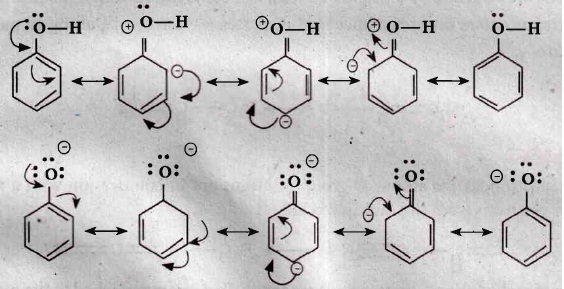
(ii) Resonance is useful in explaining certain properties such as acidity of phenol. The phenoxide ion is more stabilised than phenol by resonance effect (+M effect) and hence resonance favours ionisation of phenol to form. H+ and shows acidity
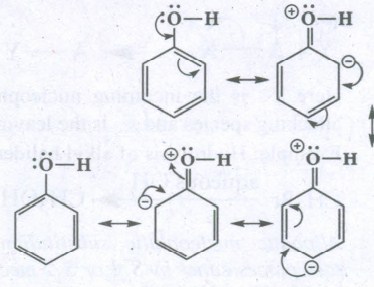
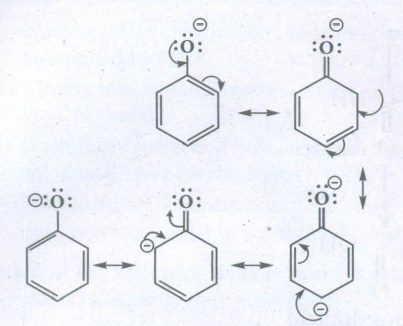
The above structures shows that there is a charge separation in the resonance structure of phenol which needs energy, where as there is no such hybrid structures in the case of phenoxide ion. This increased stability accounts for the acidic character of phenol
3.
Inductive effect (I):
(i) Inductive effect is defined as the change in the polarisation of a covalent bond due to the presence of adjacent bonds, atoms or groups in the molecule. This is a permanent phenomenon.
(ii) Let us explain the inductive effect by considering ethylchloride as example. The C-C bond in ethyl chloride is polar.
We know that chlorine is more electronegative than carbon, and hence it attracts the shared pair of electron between C-Cl in ethyl chloride towards itself. is develops a slight negative charge on Chlorine and a slight positive charge on carbon to which chlorine is attached.
To compensate it, the C1 draws the shared pair of electron between itself and. C2 . This polarisation effect is called inductive effect.
(iii) The magnitude of the charge separation decreases rapidly, as we move away from C1 and is observed maximum for 2 carbons and almost insignicant after 4 bonds from the active group.
\(\overset { \delta }{ C } \overset { \delta + }{ { H }_{ 3 } } \longrightarrow \underset { 1 }{ C\overset { \delta + }{ { H }_{ 2 } } } \twoheadrightarrow \overset { \delta - }{ C } { l }_{ 2 }\)
It is important to note that the inductive effect does not transfer electrons from one atom to another but the displacement effect is permanent. The inductive effect represents the ability of a particular atom or a group to either withdraw or donate electron density to the attached carbon. Based on this ability the substituents are classified as +I groups and -I groups. Their ability to release or withdraw the electron through sigma covalent bond is called +I effect and -I effect respectively.
Highly electronegative atoms and atoms of groups which are carry a positive charge are electron withdrawing or -I group
Example : -F, -CI, -COOH, -NO2, NH2,
Higher the electronegativity of the substitutent, greater is the -I effect.
The order of the -I effect of some groups are given below :
NH3+ > NO2 > CN > SO3H > CHO > CO > COOH > COCI > CONH2 > F > Cl > Br > I > OH > OR, NH2 > C6H5 > H
Highly electropositive atoms and atoms are groups which carry a negative charge are electron donating or +I groups.
Example. Alkali metals, alkyl groups such as methyl, ethyl, negatively charged groups such as CH3O-, C2H5O-, COO- etc.
Lesser the electronegativity of the elements, greater is the +I effect. The relative order of +I effect of some alkyl groups is given below
\(-\mathrm{C}\left(\mathrm{CH}_3\right)_3>-\mathrm{CH}\left(\mathrm{CH}_3\right)_2>-\mathrm{CH}_2 \mathrm{CH}_3>-\mathrm{CH}_3\)
Let us understand the influence of inductive effect on some properties of organic compounds.
Reactivity :
When a highly electronegative atom such as halogen is attached to a carbon then it makes the C-X bond polar. In such cases the -I effect of halogen facilitates the attack of an incoming nucleophile at the polarised carbon, and hence increases the reactivity.
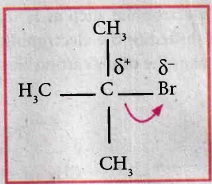
If a - I group is attached nearer to a carbonyl carbon, it decreases the availability of electron density-on the carbonyl carbon, and hence increases the rate of the nucelophilic addition reaction.
Aciditv of carborvlic acids :
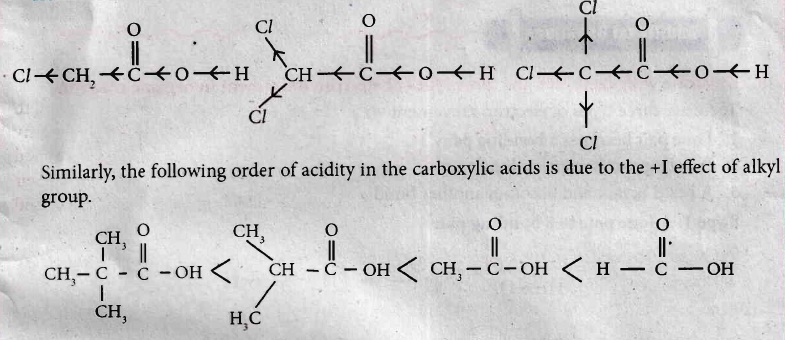
When a halogen atom is attached to the carbon which is nearer to the carboxylic acid group, its -I effect withdraws the bonded electrons towards itself and makes the ionisation of H+ easy. The acidity of various chloro acetic acid is in the following order. The strength of the acid increases with increase in the -I effect of the group attached to the carboxyl group.
Tiichloro acetic acid > Dichloro acetic acid > Chloro acetic acid > acetic acid
4.
Louis de Broglie proposed that all forms of matter showed dual character. To quantify this relation, he Jerived an equation for the wavelength of a matter wave. He combined the following two equations of energy of which one represents wave character (hu) and the other represents the particle nature (mc2).
Planck's quantum hypothesis:
E = hv ....(1)
Einsteins mass-energy relationship:
E = mc2 .... (2)
From (1) and (2)
hv = mc2
hc/\(\lambda\) = mc2
\(\therefore \lambda ={h\over mc}\) ...(3)
The equation (3) represents the wavelength of photons whose momentum is given by mc. (Photons have zero rest mass).
For a particle of matter with mass m and moving with a velocity v, the equation (3) can be written as
\(\lambda ={h\over mv}\) ....(4)
This is valid only when the particle travels at speed much less than the speed of Light.
5.
(i) no. of electrons: 35 (given)
no. of protons : 35
(ii) Electronic configuration
1s2 2S2 2p6 3s2 3p6 4s2 3d10 4p5
(iii) Last electron:
| \(\downharpoonleft\upharpoonright\) | \(\upharpoonleft\downharpoonright\) | \(\upharpoonleft\) |
4Px 4Py 4pz
last electron present in 4Py orbital y
n = 4, l = 1 m1 = either + 1 or -1 and s = -1/2
6.
Statement : "No two electrons in an atom can have the same set of values of all four quantum numbers"
Explanation : It means that, each electron must have unique values for the four quantum numbers (n, l, m and s).
For the lone electron present in hydrogen atom, the four quantum numbers are: n = 1; l = 0; m = 0 and s = +1/2. For the two electrons present in helium, one electron has the quantum numbers same as the electron of hydrogen atom, n = 1.
l = 0, m = 0 and s = +1/2. For other electron, the fourth quantum number is different i.e., n = 1, l = 0, m = 0 and s = -1/2.
As we know that the spin quantum number can have only two values +1/2 and - 1/2, only two electrons can be accommodated in a given orbital in accordance with pauli exclusion principle.
| Atom | e- | n | l | m | s |
| Helium | First | 1 | 0 | 0 | +1/2 |
| Second | 1 | 0 | 0 | +1/2 |
7.
Limitation of Bohr's atom model:
(a) The Bohr's atom model is applicable only to species having one electron such as hydrogen, Li2+ etc ... and not applicable to multi electron atoms.
(b) It was unable to explain the splitting of spectral lines in the presence of magnetic field (Zeeman effect) or an electric field (Stark effect).
(c) Bohr's theory was unable to explain why the electron is restricted to revolve around the nucleus in a fixed orbit in which the angular momentum of the electron is equal to nh/2π
8.
(d)
BF3
9.
(c)
CN-, RCH2-, ROH
10.
(d)
Carbanion and Carbocation
11.
(a)
Ph3C-+
12.
(d)
\({ C }_{ 6 }{ H }_{ 5 }\overset { + }{ N } { H }_{ 3 }\)
13.
(d)
(CH3)3 - C-
14.
(c)
both (a)and (b)
15.
(b)
NH2- > OH- > -OCH3 > RNH2
16.
(d)
\(\triangle E.\triangle x\ge \frac { h }{ 4\pi } \)
17.
(d)
0.4
18.
(c)
6.6 x 10⁻³¹ cm
19.
(c)
\(\frac { 1 }{ 2m } \sqrt { \frac { h }{ \pi } } \)
20.
(d)
\(\frac { \sqrt { 6 } h }{ 2\pi } \)
21.
(b)
spin quantum number
22.
(b)
[Xe] 4f7 , 6s2, [Xe] 4f7 5d1 6s2 and [Xe] 4f9 6s2
23.

24.
It states that electron pairing in the degenerate orbitals does not take place until all the available orbitals contains one electron each. We know that there are three p orbitals, five d orbitals and seven f orbitals.
According to this rule, pairing of electrons in these orbitals starts only when the 4th, 6th and 8th electron enters the p, d and f orbitals respectively. For example, consider the carbon atom which has six electrons. According to Aufbau principle, the electronic configuration is 1s2, 2s2, 2p2. It can be represented as below,
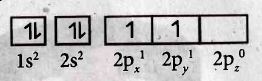
In this case, in order to minimise the electron-electron repulsion, the sixth electron enters the unoccupied 2py orbital as per Hund's rule. i.e. it does not get paired with the fifth electron already present in the 2Px orbital.
25.
In this reaction two substituents are eliminated from the molecule, and a new C - C double bond is formed between the carbon atoms to which the eliminated atoms/groups are previbusly attached. Elimination reaction is always accompanied with chanle in hybridisation.
Example: n- Propyl bromide on reaction with alcoholic KOH gives Propene. In this reaction hydrogen and Br are eliminated.

26.
a) Electrophiles:
Electrophiles are reagents that are attracted towards negative charge or electron rich center. They are either positively charged ions or electron deficient neutral molecules. All Lewis acids act as electrophiles.
Neutral molecules like SnCl4 can also act as an electrophile, as it has vacant d-orbitals which can accommodate the electrons from others.
| Types | Examples | Electron deficiententity |
| Neutral electrophiles | Carbon dioxide (CO2), dichlorocarbene (CCl2) |
C |
| Aluminium chloride (AlCl3), boron trifluoride (BF3) and ferric chloride (FeCI3) | Metal (M) | |
| Positively charged electrophiles | Carbocations(R+) | C+ |
| Proton (H+) | H+ | |
| Alkyl halides (RX) | X+ | |
| Oxonium ion (H3O+) and nitrosonium ion (NO+) | O+ | |
| Nitronium ion (+NO2) | N+ |
b) Nucleophiles:
Nucleophiles are reagents that has high affinity for electro positive centers. They possess an atom has an unshared pair of electrons, and hence it is in search for an electro positive centre where it can have an opportunity to share its elections to form a covalent bond, and gets stabilised.
They are usually negatively charged ions or electron rich neutral molecules (contains one or more lone pair of electrons). AII Lewis bases act as nucleophiles.
| Types | Examples | Electron rich site |
| Neutral molecules having unshared pair of electron | Ammonia (NH3) and amines (RNH2) | N: |
| Water (H2O), alcohols(ROH) and ethers (R - O- R) |
:O: | |
| Hydrogen sulphide (H2S) and thiols (RSH) |
:S: | |
| Negatively, charged nucleophiles | Chlorides (Cl-), bromides (Br-) and iodides (I-) |
X- |
| Hydroxide ( HO-), alkoxide (RO-) and Carboxlate ions (RCOO-) |
O- | |
| Cyanide (CN-) | N- |
27.
Electronic configuration of oxygen
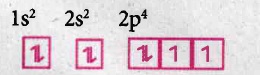
ஃ 8th electron present in 2px orbital and the quantum numbers are
n = 2,l = 1,m1 = either + 1 or -1 and s = -1/2
Electronic configuration of chlorine
.png)
15th electron present in 3Pz orbital and the quantum numbers are n = 3, l = 1, m1 = either +1 or -1 and ms = +1/2
28.
Erwin Schrodinger expressed the wave nature of electron in terms of a differential equation. This equation determines the change of wave function in space depending on the field of force in which the electron moves. The time independent Schrodinger equation can be expressed as,
\(\overset { \wedge }{ H } \psi =E\psi \) .........(1)
Where \(\overset { \wedge }{ H } \) is called Hamiltonian operator, \(\psi \) is the wave function and is a function of position coordinates of the particle and is denoted as \(\psi \) (x, y, z) E is the energy of the system
\(\overset { \wedge }{ H } =\left[ \frac { { -h }^{ 2 } }{ 8{ \pi }^{ 2 } } \left( \frac { { \partial }^{ 2 }\psi }{ { \partial x }^{ 2 } } +\frac { { \partial }^{ 2 }\psi }{ { \partial y }^{ 2 } } +\frac { { \partial }^{ 2 }\psi }{ { \partial z }^{ 2 } } \right) +V \right] \)
can be written as
\(\left[ \frac { { -h }^{ 2 } }{ 8{ \pi }^{ 2 }m } \left( \frac { { \partial }^{ 2 }\psi }{ { \partial x }^{ 2 } } +\frac { { \partial }^{ 2 }\psi }{ { \partial y }^{ 2 } } +\frac { { \partial }^{ 2 }\psi }{ { \partial z }^{ 2 } } \right) +V\Psi \right] =E\Psi \)
Multiply by \(\frac { 8{ \pi }^{ 2 }m}{ { -h }^{ 2 } } \)and rearranging
\(\frac { { \partial }^{ 2 }\psi }{ { \partial x }^{ 2 } } +\frac { { \partial }^{ 2 }\psi }{ { \partial y }^{ 2 } } +\frac { { \partial }^{ 2 }\psi }{ { \partial z }^{ 2 } } +\frac { 8{ \pi }^{ 2 }m }{ { -h }^{ 2 } } (E-V)\Psi =0\) ........(2)
The above Schrodinger wave equation does not contain time as a variable and is referred to as time independent Schrodinger wave equation. This equation can be solved only for certain values of E, the total energy. i.e. the energy of the system is quantised. The permitted total energy values are called eigen values and corresponding wave functions represent the atomic orbitals.
29.
The delocalisation of electrons of σ bond is called as hyper conjugation. It is a special stabilising effect that results due to the interaction of electrons of a σ-bond (usually C-H or C-C) with the adjacent, empty non-bonding p-orbital or an anti- bonding σ* or π* orbitals resulting in an extended molecular orbital. Unlike electrometric eect, hyper conjugation is a permanent effect.
It requires an σ-CH group or a lone pair on atom like N, O adjacent to a π bond (sp2 hybrid carbon). It occurs by the overlapping of the o-bonding orbital or the orbital containing a lone pair with the adjacent π-orbital or p-orbital.
Example 1 :
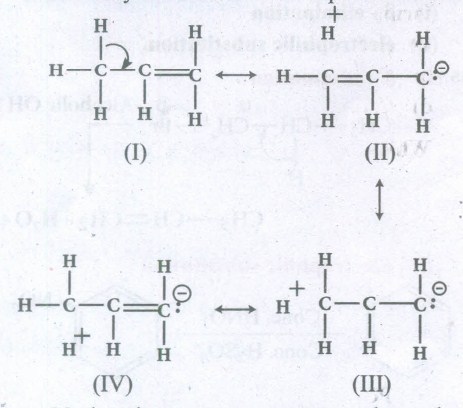
No bond resonance structures shown by propene are due to hyperconjugation
In propene, the σ-electrons of C-H bond of methyl group can be delocalised into the n-orbital of doubly bonded carbon as represented below.
In the above structure the sigma bond is involved in resonance and breaks in order to supply electrons for delocalisation giving rise to 3 new canonical forms. In the contributing canonical structures : (II), (III) & (IV) of propene, there is no bond between an carbon and one of the hydrogen atoms. Hence the hyperconjugation is also known as "no bond resonance" or "Baker-Nathan effect''. The structures (II), (III) & (IV) are polar in nature.
Example 2:
Hyper conjugation effect is also observed when atoms / groups having lone pair of electrons are attached by a single bond, and in conjugation with a π bond. The lone pair of electrons enters into resonance and displaces π electrons resulting in more than one structure.

Example 3 :
When electronegative atoms or group of atoms are in conjugation with a π - bond, they pull π - electrons from the multiple bond.

In case of carboc ations, greater the number of alkyl groups attached to the carbon bearing positive charge, greater is number of the hlper conjugate structure. thus the stability of various carbocations decreases in the order
30 Carbocation > 20 Carbocation > 10 Carbocation.
30.
All organic compounds having double or triple bond adopt addition reactions in which two substances unite to form a single compound. During the addition reaction the hybridization of the substrate changes as only one bond breaks and two new bonds are formed.
Example :
\(\underset { (Acetylene) }{ CH\equiv CH+{ CH }_{ 2 } } \longrightarrow \underset { (Bromethene) }{ { CH }_{ 2 }=CH\ominus Br } \)
31.
The resonance is a chemical phenomenon which is observed in certain organic compounds possessing double bonds at a suitable position. Certain organic compounds can be represented by more than one structure and they differ only in the position of
bonding and lone pair of electrons. Such structures are called resonance structures (canonical structures) and this phenomenon is called resonance. This phenomenon is also called mesomerism or mesomeric effect.
For example, the structure of aromatic compounds such as benzene and conjugated systems tike 1,3 - butadiene cannot be represented by a single structure, and their observed properties can be explained on the basis of a resonance hybrid.
In 1, 3 buta diene, it is expected that the bond between C1 - C2 and C3 - C4 should be shorter than that of C2 - C3, but the observed bond lengths are of same. This property cannot be explained by a simple structure in which two \(\pi\) bonds localised between C1 - C2 and C3 - C4 . Actually the \(\pi\) electrons are delocalised

These resonating structures are called canonical forms and the actual structure lies between these three resonating strucfures, and is called a resonance hybrid. The resonance hybrid is represented
Similar to the other electron displacement effect, mesomeric effect is also classified into positive mesomeric effect (+M or +R) and negative mesomeric effect (-M of -R) based on the nature of the functional group present adjacent to the multiple bond.
Positive Mesomeric Effect :
Positive resonance effect occurs, when the electrons move away from substituent attached to the conjugated system. It occurs, if the electron releasing substituents are attached to the conjugated system. In such cases, the attached group has a tendency to release electrons through resonance. These electron releasing groups are usually denoted as +R or +M groups.
Examples : -OH, -SH, -OR, -SR, -NH2, -O- etc...
Negative Mesomeric Effect :
Negative resonance effect occurs, when the electrons move towards the substituent attached to the conjugated system. It occurs if the electron withdrawing substituents are attached to the conjugated system.
In such cases, the attached group has a tendency to withdraw electrons through resonance. These electron withdrawing groups are usually denoted as -R or -M groups.
Examples : NO2, > C = O, -COOH, -C = N etc......
Resonance is useful in explaining certain properties such as acidity oi phenol. The phenoxide ion is more stabilised than phenol by resonance effect (+M effect) and hencp resonance tavours ionisation of phenol to form H+ and shows acidity.
The structures shows that there is a charge separation in the resonance structure of phenol which needs energy, where as there is no such hybrid structures in the case of phenoxide ion. This increased stability accounts for the acidic character of phenol.
32.
Electronic configuration of Fe3+ : 1s2 2s2 2p6 3s2 3p6 4s0 3d5
Electronic configuration of Ni2+ : 1s2 2s2 2p6 3s2 3p6 4s0 3d8
Fe3+ has stable 3d5 half filled configuration.
33.
n = 4 l = 0,1,2,3
4 sub shells s, p, d & f.
I = 0 m1 = 0 + one 4s orbital.
I = 1 m1 = -1, 0, + 1 \(\Rightarrow\) three 4p orbitals.
I = 2 m1 = -2,:1, 0, +1, +2 \(\Rightarrow\) five 4d orbitals.
I = 3 m1 = -3, -2, -1,0, +1, +2, +3 \(\Rightarrow\) seven 4f orbitals.
Over all 16 orbitals are possible.
34.
| Orbital | n | 1 | Radial node n-1-1 | Angular node 1 |
| 2s | 2 | 0 | 1 | 0 |
| 4p | 4 | 1 | 2 | 1 |
| 5d | 5 | 2 | 2 | 2 |
| 4f | 4 | 3 | 0 | 3 |

11th Standard Syllabus & Materials
11th Standard
TN 11th Tamil பீடு பெற நில் - செய்யுள் - காவடிச்சிந்து Important Questions And Answers Study Material - QB365 Set A
NEW11th Standard
TN 11th Tamil பீடு பெற நில் - உரைநடை - மலை இடப்பெயர்கள் : ஓர் ஆய்வு Important Questions And Answers Study Material - QB365 Set A
NEW11th Standard
TN 11th Tamil மாமழை போற்றுதும் - துணைப்பாடம் - யானை டாக்டர் Important Questions And Answers Study Material - QB365 Set A
NEW11th Standard
TN 11th Tamil மாமழை போற்றுதும் - செய்யுள் - ஐங்குறுநூறு Important Questions And Answers Study Material - QB365 Set A



Tamilnadu Stateboard 11th Standard Subjects

Maths

Commerce

Economics

Biology

Business Maths and Statistics

Accountancy

Computer Science

Physics
Chemistry
Maths
Biology
Economics
Physics
Chemistry

History
Business Maths and Statistics

Computer Science
Accountancy

Computer Applications
History
Computer Technology
Commerce
Computer Applications
Computer Technology

Tamil

English

French
Tamilnadu Stateboard Standards


