
 100% FREE ACCESS
11th Standard Syllabus & Materials
11th Standard
TN 11th Tamil இயற்கை வேளாண்மை,சுற்றுச்சூழல் -செய்யுள் - மனோன்மணீயம் Important Questions And Answers Study Material - QB365 Set A
NEW11th Standard
TN 11th Tamil என்னுயிர் என்பேன் -துணைப்பாடம் - இசைத்தமிழர் இருவர் Important Questions And Answers Study Material - QB365 Set A
NEW11th Standard
TN 11th Tamil மொழி கலை -செய்யுள் - ஒவ்வொரு புல்லையும் Important Questions And Answers Study Material - QB365 Set A
NEW11th Standard
TN 11th Tamil பீடு பெற நில் - இலக்கணம் - பகுபத உறுப்புகள் Important Questions And Answers Study Material - QB365 Set A
NEW11th Standard
TN 11th Tamil பீடு பெற நில் - துணைப்பாடம் - வாடிவாசல் Important Questions And Answers Study Material - QB365 Set A
NEW11th Standard
TN 11th Tamil பீடு பெற நில் - செய்யுள் - குறுந்தொகை Important Questions And Answers Study Material - QB365 Set A

Published on: 24/08/2026
Download Tamil Nadu 11th Standard Chemistry question papers, model tests, one-mark questions, important questions, and public exam papers in PDF format. Free study materials and answer keys for TN State Board students.
Questions + Answers key
Take MCQ Chemistry Test
1.
The correct order of decreasing electronegativity values among the elements X, Y, Z and A with atomic numbers 4, 8, 7 and 12 respectively __________
Y > Z > X > A
Z > A > Y > X
X > Y > Z > A
X > Y > A > Z
2.
Lassaigne’s test for the detection of nitrogen fails in ______________
H2N – CO– NH.NH2.HCl
NH2 – NH2. HCl
C6H5 – NH – NH2. HCl
C6H5 CONH2
3.
Which of these represents the correct order of their increasing bond order _________
C2 < C2 2- < O2 2- < O2
C 2 2- < C2 + < O2 < O2 2-
O2 2- < O2 < C2 2- < C 2+
O2 2- < C2 + < O2 < C2 2-
4.
In ClF3, NF3 and BF3 molecules the chlorine, nitrogen and boron atoms are ______
sp3 hybridised
sp3 ,sp3 and sp2 respectively
sp2 hybridised
sp3d, sp3 and sp hybridised respectively
5.
In which of the following equilibrium, KP and KC are not equal ?
2 NO(g) ⇌ N2(g) + O2(g)
SO2 (g) + NO2 ⇌ SO3(g) + NO(g)
H2(g) + I2(g) ⇌ 2HI(g)
PCl5 (g) ⇌ PCl3(g) + Cl2(g)
6.
Solubility of carbon dioxide gas in cold water can be increased by ____________
increase in pressure
decrease in pressure
increase in volume
none of these
7.
Assertion: Permanent hardness of water is removed by treatment with washing soda.
Reason: Washing soda reacts with soluble calcium and magnesium chlorides and sulphates in hard water to form insoluble carbonates
Both assertion and reason are true and reason is the correct explanation of assertion.
Both assertion and reason are true but reason is not the correct explanation of assertion.
Assertion is true but reason is false
Both assertion and reason are false
8.
Match the list-I and list-II using the correct code given below the list.
| List-I | List-II | ||
| A. | Alkali metal | 1. | ns2 np1-6 |
| B. | Alkaline earth metals | 2. | ns1 |
| C. | d-block elements | 3. | ns2 |
| D. | p-block elements | 4. | (n-1)d1-10 ns0-2 |
| A | B | C | D |
| 2 | 3 | 4 | 1 |
| A | B | C | D |
| 3 | 4 | 2 | 1 |
| A | B | C | D |
| 4 | 2 | 3 | 1 |
| A | B | C | D |
| 1 | 4 | 2 | 3 |
9.
Consider the following statements
1. \(\lambda\) = h / mv is valid only when the particle travels at speed much less than the speed of light.
2. Einstein's mass-energy relationship is E = mc2
3. The angular momentum (mvr) ofthe electron must be equal to an integral multiple of h/4\(\pi\) . Which of the following statements) given above is/ are correct?
1&3
Only 1
1 & 2
1, 2 & 3
10.
The suspension of slaked lime in water is known as ___________
lime water
quick lime
milk of lime
aqueous solution of slaked lime
11.
For alkali metals, which one of the following trends is incorrect ?
Hydration energy: Li > Na > K > Rb
Ionisation energy: Li > Na > K > Rb
Density: Li < Na < K < Rb
Atomic size: Li < Na < K < Rb
12.
Use of hot air balloon in sports at meteorological observation is an application of __________________
Boyle's law
Newton's law
Kelvin's law
Brown's law
13.
Which of the following pairs of d-orbitals will have electron density along the axes ?
dz2, dxz
dxz, dyZ
dz2, dx2-y2
dxy ,dx2-y2
14.
Non-stoichiometric hydrides are formed by _____________
palladium, vanadium
carbon, nickel
manganese, lithium
nitrogen, chlorine
15.
Carbon forms two oxides, namely carbon monoxide and carbon dioxide. The equivalent mass of which element remains constant ?
Carbon
Oxygen
Both carbon and oxygen
Neither carbon nor oxygen
16.
What is meant by a functional group ? Identify the functional group in the following compounds.
oxalic acid.
17.
What are the IUPAC names of the following compounds?
(i)\({ CH }_{ 3 }-{ CH }_{ 2 }-\underset { \overset { | }{ COOH } }{ CH } -CH={ CH }_{ 2 }\)
(ii) \(HOOC-\overset { \underset { | }{ { CH }_{ 3 } } }{ \underset { \overset { | }{ { CH }_{ 3 } } }{ C } } -{ CH }_{ 2 }-{ CH }_{ 2 }-{ CH }_{ 2 }-{ CH }_{ 3 }\)
18.
Distinguish between homogeneous and heterogeneous equilibrium reaction.
19.
Define the following
σ- bond
20.
(i) Define critical temperature.
(ii) What is the critical temperature of CO2 gas?
21.
Mention the shape of s, p, d orbitals.
22.
State Graham's law of diffusion.
23.
How is tritium prepared?
24.
Magnesium loses electrons successively to form Mg+, Mg2+ and Mg3+ ions. Which step will have the highest ionisation energy and why?
25.
Write the possible isomers for the formula C5H12 with their names and structures.
26.
Mention the applications of equilibrium constant
27.
Discuss the conditions for optical isomerism.
28.
What is dipole moment ?
29.
Arrange Na+, Mg2+ and Al3+in the increasing order of ionic radius. Give reason.
30.
How is bleaching powder prepared ?
31.
A sample of gas has a volume of 8.5 dm3 at an unknown temperature. When the sample is submerged in ice water at 0 °C, its volume gets reduced to 6.37 dm3. What is its initial temperature ?
32.
Explain briefly the time independent schrodinger wave equation?
33.
Distinguish between oxidation and reduction.
34.
Derive the Kp and Kc for the following equilibrium reaction.
\({ H }_{ 2\left( g \right) }+{ I }_{ 2\left( g \right) }\rightleftharpoons { 2HI }_{ \left( g \right) }\)
35.
List down the characteristics possessed by the organic compounds.
36.
Write a note on homologous series.
37.
Discuss the formation of N2 molecule using MO Theory
38.
Using Slater's rule calculate the effective nuclear charge on a 3p electron in aluminium and chlorine. Explain how these results relate to the atomic radius of the two atoms.
39.
Balance the following equations by oxidation number method
i) \({ K }_{ 2 }{ Cr }_{ 2 }{ O }_{ 7 }+KI+{ H }_{ 2 }SO_{ 4 }\longrightarrow { K }_{ 2 }{ SO }_{ 4 }+{ Cr }_{ 2 }({ SO }_{ 4 })+{ I }_{ 2 }+{ H }_{ 2 }O\)
ii) \({ K }Mno_{ 4 }+{ Na }_{ 2 }{ So }_{ 3 }\longrightarrow { MnO }_{ 2 }+{ Na }_{ 2 }{ So }_{ 4 }+KOH\)
iii) \(Cu+{ HNO }_{ 3 }\longrightarrow Cu\left( { No }_{ 3 } \right) _{ 2 }+{ No }_{ 2 }+{ H }_{ 2 }O\)
iv) \({ KMn }O_{ 4 }+{ H }_{ 2 }{ C }_{ 2 }{ O }_{ 4 }+{ H }_{ 2 }{ SO }_{ 4 }\longrightarrow { K }_{ 2 }{ SO }_{ 4 }+{ MnSO }_{ 4 }+{ CO }_{ 2 }+{ H }_{ 2 }O\)
40.
Explain the exchange reactions of heavy water
41.
Discuss briefly the similarities between beryllium and aluminium.
42.
Write the Van der Waals equation for a real gas. Explain the correction term for pressure and volume.
43.
State and explain pauli exclusion principle.
1.
(a)
Y > Z > X > A
2.
(c)
C6H5 – NH – NH2. HCl
3.
(d)
O2 2- < C2 + < O2 < C2 2-
4.
(d)
sp3d, sp3 and sp hybridised respectively
5.
(d)
PCl5 (g) ⇌ PCl3(g) + Cl2(g)
6.
(a)
increase in pressure
7.
(a)
Both assertion and reason are true and reason is the correct explanation of assertion.
8.
(a)
| A | B | C | D |
| 2 | 3 | 4 | 1 |
9.
(c)
1 & 2
10.
(c)
milk of lime
11.
(c)
Density: Li < Na < K < Rb
12.
(a)
Boyle's law
13.
(c)
dz2, dx2-y2
14.
(a)
palladium, vanadium
15.
(b)
Oxygen
16.
Functional group :
A functional group is an'atom or a specific combination of bonded atoms that react in a characteristic way, irrespective of the organic molecule in which it is present.
oxalic acid - COOH
17.
(i) 2-ethyl-but-4-ene-oic acid
(ii) 2, 2-dimethyl-hexanoic acid
18.
| S.No | Homegoneous equilibrium | Heterogeneous equiliburium |
| (i) | In a homogeneous equilibrium, all the reactants and products are in the same phase. | If the reactants and products of a reaction in equilibrium are in different phases, then it is called as heterogeneous equilibrium. |
| (ii) | \({ H }_{ 2 }\left( g \right) +{ I }_{ 2 }\left( g \right) \rightleftharpoons 2HI\left( g \right) \) | \(CaCO_{ 3 }\left( s \right) \rightleftharpoons CaO\left( s \right) +{ CO }_{ 2 }\left( g \right) \) |
19.
σ- bon:
When two atomic orbitals overlap linearly along the axis, the resultant bond is called a sigma (σ) bond.
20.
(i) The temperature below which a gas can be liquefied by application of pressure is known as critical temperature.
(ii) The critical temperature of CO2 gas is 303.98 K.
21.
Shape of s-orbital - sphere
Shape of p-orbital- dumb bell
Shape of d-orbital- clover leaf
22.
The rate of effusion or diffusion of a gas is inversely proportional to the square root of molar mass at constant temperature and pressure.
23.
(i) By bombarding lithium with slow neutrons
(ii) 3Li6+0n1 ➝ 1T3+2He4
24.
Mg + I.E1 ⟶ Mg+ +1e- .....(i)
Mg+ + I.E2 ⟶ Mg2+ + 1e- ....(ii)
Mg2+ + I.E3 ⟶ Mg3+ + 1e- ....(iii)
(i) The step (iii) which involves the formation of Mg3+ requires higher ionisation energy.
(ii) Mg2+ consist of 10 electrons (2, 8) attaining the stable noble gas configuration of argon (Z = 10).
(iii) Since the valence orbital is completely filled, more energy will be required to remove electrons.
25.
(i) \(\underset { n-pentane }{ { CH }_{ 3 }-{ CH }_{ 2 }-{ CH }_{ 2 }-{ CH }_{ 2 }-{ CH }_{ 3 } } \)
(ii) \(\underset { Isopentane }{ { CH }_{ 3 }-\underset { \overset { | }{ { CH }_{ 3 } } }{ CH } -{ CH }_{ 2 }-{ CH }_{ 3 } } \)
(iii) \(\underset { Neopentane }{ { CH }_{ 3 }-\overset { \underset { | }{ { CH }_{ 3 } } }{ \underset { \overset { | }{ { CH }_{ 3 } } }{ C } } -{ CH }_{ 3 } } \)
(i), (ii) and (iii) are chain isomers.
26.
The knowledge of equilibrium constant helps us to
1. Predict the direction in which the net reaction will take place
2. Predict the extent of the reaction and
3. Calculate the equilibrium concentrations of the reactants and products.
It is to be noted that these constants do not provide any information regarding the rates of the forward or reverse reactions.
27.
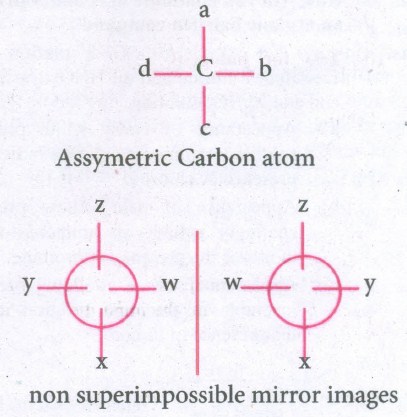
A carbon atom whose tetra valency is satisfied by four different substituents (atoms or groups) is called asymmetric carbon or chiral carbon. It is indicated by an asterisk as C*. A molecule possessing chiral carbon atom and non-super impossible to its own mirror image is said to be a chiral molecule or asymmetric, and the property is called chirality or dissymmetry.
28.
Dipole moment :
The polarity of a covalent bond can be measured in terms of dipole moment which is defined as \(\mu=q \times 2d\)
Where \(\mu\) is the dipole moment, q is the charge and 2d is the distance between the two charges.
Where p is the dipole moment, q is the charge and 2d is the distance between the two charges. The dipole moment is a vector and the direction of the dipole moment vector points from the negative charge to positive charge.
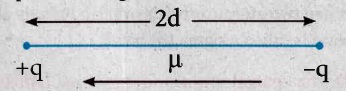
The unit for dipole moment is columb meter (C m). It is usually expressed in Debye unit (D). The conversion factor is 1 Debye = 3.336 x 10⁻³⁰ C m.
29.
Na+, Mg2+ and Al3+ are isoelectronic cations.
| Ions | Na+ | Mg2+ | Al3+ |
| Number of electrons | 10 | 10 | 10 |
| Number of Nuclear charge | 11 | 12 | 13 |
The cation with the greater positive charge will have a smaller radius because of the greater attraction of the electrons to the nucleus. Hence the increasing order of ionic radius is, rNa+ > rMg2+ > rAl3+
30.
Milk of lime reacts with chlorine to form hypochlorite, a constituent of bleaching powder.
2Ca (OH)2 + 2Cl2 ⟶ CaCl2 + Ca(OCI)2 + 2H2O
31.
V1 = 8.5 dm3 V2 = 6.37 dm3
T1 = ? T2 = 0o C = 273 K
\(\frac { { V }_{ 1 } }{ { T }_{ 1 } } =\frac { { V }_{ 2 } }{ { T }_{ 2 } } \)
\({ V }_{ 1 }\times \left( \frac { { T }_{ 2 } }{ { V }_{ 2 } } \right) ={ T }_{ 1 }\)
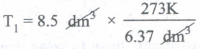
T1 = 364.28 K
32.
Erwin Schrodinger expressed the wave nature of electron in terms of a differential equation. This equation determines the change of wave function in space depending on the field of force in which the electron moves. The time independent Schrodinger equation can be expressed as,
\(\overset { \wedge }{ H } \psi =E\psi \) .........(1)
Where \(\overset { \wedge }{ H } \) is called Hamiltonian operator, \(\psi \) is the wave function and is a function of position coordinates of the particle and is denoted as \(\psi \) (x, y, z) E is the energy of the system
\(\overset { \wedge }{ H } =\left[ \frac { { -h }^{ 2 } }{ 8{ \pi }^{ 2 } } \left( \frac { { \partial }^{ 2 }\psi }{ { \partial x }^{ 2 } } +\frac { { \partial }^{ 2 }\psi }{ { \partial y }^{ 2 } } +\frac { { \partial }^{ 2 }\psi }{ { \partial z }^{ 2 } } \right) +V \right] \)
can be written as
\(\left[ \frac { { -h }^{ 2 } }{ 8{ \pi }^{ 2 }m } \left( \frac { { \partial }^{ 2 }\psi }{ { \partial x }^{ 2 } } +\frac { { \partial }^{ 2 }\psi }{ { \partial y }^{ 2 } } +\frac { { \partial }^{ 2 }\psi }{ { \partial z }^{ 2 } } \right) +V\Psi \right] =E\Psi \)
Multiply by \(\frac { 8{ \pi }^{ 2 }m}{ { -h }^{ 2 } } \)and rearranging
\(\frac { { \partial }^{ 2 }\psi }{ { \partial x }^{ 2 } } +\frac { { \partial }^{ 2 }\psi }{ { \partial y }^{ 2 } } +\frac { { \partial }^{ 2 }\psi }{ { \partial z }^{ 2 } } +\frac { 8{ \pi }^{ 2 }m }{ { -h }^{ 2 } } (E-V)\Psi =0\) ........(2)
The above Schrodinger wave equation does not contain time as a variable and is referred to as time independent Schrodinger wave equation. This equation can be solved only for certain values of E, the total energy. i.e. the energy of the system is quantised. The permitted total energy values are called eigen values and corresponding wave functions represent the atomic orbitals.
33.
| Oxidation | Reduction | |
| 1. | Addition of oxygen | Addition of Hydrogen |
| 2. | Removal of Hydrogen | Removal of oxygen |
| 3. | Addition of an electronegative element. | Addition of an electro positive element |
| 4. | Removal of an electro positive element | Removal of an electro negative element |
| 5. | Loss of electron | Gain of electron |
| 6. | Increase in oxidation state / number | Decrease in oxidation state/ number. |
34.
Let us consider the formation of HI in which, 'a' moles of hydrogen and 'b' moles of iodine gas are allowed to react in a container of volume V. Let 'x' moles of each of H2 and I2react together to form 2x moles of HI.
\({ H }_{ 2\left( g \right) }+{ I }_{ 2\left( g \right) }\rightleftharpoons { 2HI }_{ \left( g \right) }\)
| H2 | I2 | HI | |
| Initial number of moles | a | b | 0 |
| Number of moles reached | x | x | 0 |
| Number of moles at equilibrium | a-x | b-x | 2x |
| Active mass or molar concentration at equilibrium | \(\cfrac { a-x }{ V } \) | \(\cfrac { b-x }{ V } \) | \(\cfrac { 2x }{ V } \) |
Applying law of mass action,
\({ K }_{ C }=\cfrac { { \left[ HI \right] }^{ 2 } }{ { \left[ H \right] }_{ 2 }\left[ { I }_{ 2 } \right] } \)
= \(\cfrac { \left( \cfrac { 2x }{ V } \right) ^{ 2 } }{ \left( \cfrac { a-x }{ V } \right) \left( \cfrac { b-x }{ v } \right) } =\cfrac { { 4x }^{ 2 } }{ \left( a-x \right) \left( b-x \right) } \)
The equilibrium constant Kp can also be calcu•lated as follows:
We know }he \rer~tionship between the Kc and Kp
Here the \(\Delta n_{ g }\)=np -nr = 2 - 2 =0
Hence K = Kc ;\({ K }_{ p }=\cfrac { { 4x }^{ 2 } }{ \left( a-x \right) \left( b-x \right) } \)
35.
(i) They are covalent compounds of carbon and generally insoluble in water and readily soluble in organic solvent such as benzene, toluene, ether, chloroform, etc ...
(ii) Many of the organic compounds are inflammable (except CCI4).They possess low boiling and melting points due to their covalent nature.
(iii) Organic compounds are characterised by functional groups. A functional group is an atom or a specific combination of bonded atoms that react in a characteristic way, irrespective of the organic molecule in which it is present. In
almost all the cases, the reaction of an organic compound takes place at the functional group. They exhibit isomerism which is a unique phenomenon.
(iv) Homologous series: A series of organic compounds each containing a characteristic functional group and the successive members differ from each other in molecular formula by a CH2 group is called homologous series.
Alkanes: Methane (CH4) Ethane (C2H6) Propane (C3H8) etc.
36.
Homologous series: A series of organic compounds each containing a characteric functional group and the successive' members differ from each other in molecular formula by a CH2 group is called homologous series. Eg.
Alkanes : Methane (CH4), Ethane (C2H6), Propane (C3Hg) etc .
Alcohols: Methanol (CH3OH), Ethanol (C2H5OH) Propanol (C3H7OH) etc ..)
Compounds of the homologous series are represented by a general formula Alkanes CnH2n+2' Alkenes CnH2n, Alkynes CnH2n-2 and can be prepared by general methods. They show regular gradation in physical properties but have almost similar chemical property.
37.
Molecular orbital diagram of nitrogen molecule (N2) :
Electronic configuration of N atom 1s2 2s2 2p3
Electronic configuration of N, molecule
\(\sigma^{2}_{1s},\sigma^{*2}_{1s},\sigma^{2}_{2s},\sigma^{*2}_{2s}\)\(\pi^{2}_{2py},\pi^{2}_{2pz},\sigma^2_{2px}\)
Bond order = \({N_b-N_a\over2}={10-4\over2}=3\)
Molecule has no unpaired electrons hence it is diamagnetic.

38.
Electronic Configuration of Aluminium
\(\underbrace { { Al }^{ 13 }{ 1s }^{ 2 } }_{ (n-2) } \underbrace { 2s^{ 2 }{ 2p }^{ 2 } }_{ (n-1) } \underbrace { { 3s }^{ 2 }{ 3p }^{ 1 } }_{ n } \)
| Group | no.of electrons |
Contribution of each electron to'S' value |
Contribution of a particular group |
| n (n-1) (n-2) |
2 8 2 |
0.35 0.85 1 |
0.70 6.80 2.00 |
| 9.50 |
∴ Effective nuclear charge = Z - S = 13 - 9.5
(Zeff)Al =3.5
Electronic Configuration of chlorine
\(\underbrace { { 1s }^{ 2 } }_{ (n-2) } \underbrace { 2s^{ 2 }{ 2p }^{ 2 } }_{ (n-1) } \underbrace { { 3s }^{ 2 }{ 3p }^{ 5 } }_{ n } \)
| Group | no.of electrons |
Contribution of each electron to'S' value |
Contribution of a particular group |
| n (n-1) (n-2) |
6 8 2 |
0.35 0.85 1 |
2.1 6.8 2 |
| S= | 10.9 |
∴ Effective nuclear charge = Z - S = 17 - 10.9
(Zeff)cl = 6.1
(Zeff)cl > (Zeff)Al and hence rcl
39.
(i) \({ K }_{ 2 }\overset { +6 }{ \underset { \underset { 2\times { 3e }^{ - } }{ \uparrow } }{ Cr_{ 2 } } } { O }_{ 7 }+K\overset { -1 }{ \underset { { 1e }^{ - } }{ \underset { \downarrow }{ I } } } +{ H }_{ 2 }{ SO }_{ 4 }\longrightarrow { K }_{ 2 }{ SO }_{ 4 }+{ \overset { +3 }{ Cr } }_{ 2 }({ SO }_{ 4 })_{ 3 }+\overset { 0 }{ I } _{ 2 }+{ H }_{ 2 }O\)
K2Cr2O7 + 6KI + H2SO4 \(\longrightarrow \) K2SO4 + Cr2(SO4)3 + I2 + H2O
K2Cr2O7 + 6KI + H2SO4 \(\longrightarrow \) K2SO4 + Cr2(SO4)3 + 3I2 + H2O
K2Cr2O7 + 6KI + 7H2SO4 \(\longrightarrow \) 4k2SO4 + Cr2(SO4)3 + 3I2 + 7H2
ii) \({ K }Mno_{ 4 }+{ Na }_{ 2 }{ So }_{ 3 }\longrightarrow { MnO }_{ 2 }+{ Na }_{ 2 }{ So }_{ 4 }+KOH\)
\({ K }\overset { +7 }{ \underset { \underset { 3e^{ - } }{ \uparrow } }{ M } } n{ O }_{ 4 }+{ Na }_{ 2 }\overset { +4 }{ \underset { { 2e }^{ - } }{ \underset { \downarrow }{ S } } } { O }_{ 3 }\longrightarrow \overset { +4 }{ M } { nO }_{ 2 }+{ Na }_{ 2 }\overset { +6 }{ s } { O }_{ 4 }+KOH\)
\(\Rightarrow\) 2KMnO4 + 3Na2SO3 \(\longrightarrow \) MnO2 + Na2 SO4 + KOH
\(\Rightarrow\) 2KMnO4 + 3Na2SO3 \(\longrightarrow \) 2MnO2 + 3Na2SO4 + KOH
\(\Rightarrow\) 2KMNO4 + 3NaSO3 + H2O \(\longrightarrow \) 2MnO2 + 3Na2 SO4 + 2KOH
iii) \(Cu+{ HNO }_{ 3 }\longrightarrow Cu\left( { No }_{ 3 } \right) _{ 2 }+{ No }_{ 2 }+{ H }_{ 2 }O\)
\(\overset { 0 }{ \underset { \underset { 2e^{ - } }{ \downarrow } }{ Cu } } { O }_{ 7 }+H\overset { +5 }{ \underset { { 1e }^{ - } }{ \underset { \uparrow }{ N } } } { O }_{ 3 }\longrightarrow \overset { +2 }{ Cu } \left( { No }_{ 3 } \right) _{ 2 }+\overset { +4 }{ N } { O }_{ 2 }+{ H }_{ 2 }O\)
Cu +2HNO3 \(\longrightarrow \) Cu(NO3)2 + NO2 + H2O
Cu + 2HNO3 + 2HNO3 \(\longrightarrow \) Cu(NO3)2 + 2NO2 + 2H2O
Cu + 4HNO3 \(\longrightarrow \) Cu (NO3)2 + 2No2 + 2H2O
iv) \({ KMn }O_{ 4 }+{ H }_{ 2 }{ C }_{ 2 }{ O }_{ 4 }+{ H }_{ 2 }{ SO }_{ 4 }\longrightarrow { K }_{ 2 }{ SO }_{ 4 }+{ MnSO }_{ 4 }+{ CO }_{ 2 }+{ H }_{ 2 }O\)
\({ K }\overset { +7 }{ \underset { \underset { 2\times { 3e }^{ - } }{ \downarrow } }{ M } } n{ O }_{ 4 }+{ H }_{ 2 }\overset { -1 }{ \underset { { 1e }^{ - } }{ \underset { \uparrow }{ C_{ 2 } } } } { O }_{ 4 }+{ H }_{ 2 }{ SO }_{ 4 }\longrightarrow { K }_{ 2 }{ SO }_{ 4 }+\overset { +2 }{ M } n{ SO }_{ 4 }+\overset { +4 }{ C } { O }_{ 2 }+{ H }_{ 2 }O\)
2KMnO4 + 5 H2C2O4 + H2S04 \(\longrightarrow \) Mn02 + Na2S04 + KOH
2KMnO4+ 5 H2C2O4 + H2S04 \(\longrightarrow \) K2SO4 + 2MnSO4 + 10CO2 + H2O
2KMnO4 + 5 H2C2O4 + 3H2S04 \(\longrightarrow \) K2S04 + 2MnS04 + 10C02 + 8 H20
40.
When compounds containing hydrogen are treated with D2O, hydrogen undergoes an exchange with deuterium
2NaOH + D2O ➝ 2NaOD + HOD
HCl + D2O ➝ DCl + HOD
NH4Cl + 4D2O ➝ ND4Cl + 4HOD
These exchange reactions are useful in determining the number of ionic hydrogens present in a given compound.
For example, when D2O is treated with of hypophosphorous acid only one hydrogen atom is exchanged with deuterium. It indicates that, it is a monobasic acid.
H3PO2 + D2O ➝ H2DPO2 + HDO
41.
| S.No | Properties |
|---|---|
| 1 | Beryllium chloride forms a dimeric structure like aluminium chloride with chloride bridges. Beryllium chloride also forms polymeric chain structure In addition to dimer. Both are soluble in organic solvents and are strong lewis acids. |
| 2 | Beryllium hydroxide dissolves in excess of alkali and gives beryllate ion and [Be(OH)2]2- and hydrogen as aluminium hydroxide which gives aluminate ion, [Al(OH)4]- |
| 3 | Beryllium and aluminum ions have strong tendency to form complexes, \(BeF_4^{2-} AIFt{_6^{3-}}\) |
| 4 | Both beryllium and aluminium hydroxides are amphoteric in nature. |
| 5 | Carbides of beryllium (Be2C) like aluminum carbide (Al4C3) give methane on hydrolysis |
| 6 | Both beryllium and aluminium are rendered passive by nitric acid. |
42.
The van der equation for a real gas is
\(\left( P+{{{am}^{2}}\over{{V}^{2}}} \right)(V-nb)=nRT\)
Pressure, Correction:
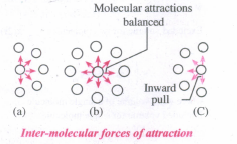
The pressure of a gas is directly proportional to the force created by the bombardment of molecules on the walls of the container. The speed of a molecule moving towards the wall of the container is reduced by the attractive forces exerted by its neighbours. Hence, the measured gas pressure is lower than the ideal pressure of the gas. Hence, van der Waals introduced a correction term to this effect.
Van der Waals found out the forces of attraction experienced by a molecule near the wall are directly proportional to the square of the density of the gas.
\(P^{\prime} \propto \rho^{2} ; \quad \rho=\frac{n}{v}\)
where n is the number of moles of gas and
V is the volume of the container
\( \Rightarrow p^{\prime} \alpha \frac{n^{2}}{V^{2}} \)
\(\Rightarrow p^{\prime}=a \frac{n^{2}}{V^{2}}\)
where a is proportionality constant and depends on the nature of gas
Therefore \(P_{\text {ideal }}=P+\frac{\operatorname{an}^{2}}{V^{2}}\)
Volume Correction
As every individual molecule of a gas occupies a certain volume, the actual volume is less than the volume of the container,
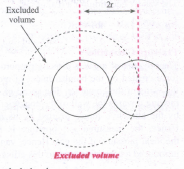
V. Van der Waals introduced a correction factor V' to this effect. Let us calculate the correction term by considering gas molecules as spheres.
V = excluded volume
Excluded volume for two molecules
\(=\frac{4}{3} \pi(2 r)^{3}=8\left(\frac{4}{3} \pi r^{3}\right)=8 V_{m}\)
Where Vm it a volume of a single molecule
Excluded volume for single molecule = \(\frac{8 \mathrm{~V}_{\mathrm{m}}}{2}=4 \mathrm{~V}_{\mathrm{m}}\)
Excluded volume for n molecule = n(4Vm) = nb
Where b is van der waals constant which is equal to 4Vm
\( \Rightarrow V^{\prime}=n b \)
\(V_{\text {ideal }}=V-n b\)
Replacing the corrected pressure and volume in the ideal gas equation PV = nRT we get the Van der Waals equation of state for real gases as below,
\(\left(p+\frac{a^{2}}{V^{2}}\right)(V-n b)=n R T\)
The constants a and b are van der Waals constants and their values vary with the nature of the gas. It is an approximate formula for the non-ideal gas.
43.
Statement : "No two electrons in an atom can have the same set of values of all four quantum numbers"
Explanation : It means that, each electron must have unique values for the four quantum numbers (n, l, m and s).
For the lone electron present in hydrogen atom, the four quantum numbers are: n = 1; l = 0; m = 0 and s = +1/2. For the two electrons present in helium, one electron has the quantum numbers same as the electron of hydrogen atom, n = 1.
l = 0, m = 0 and s = +1/2. For other electron, the fourth quantum number is different i.e., n = 1, l = 0, m = 0 and s = -1/2.
As we know that the spin quantum number can have only two values +1/2 and - 1/2, only two electrons can be accommodated in a given orbital in accordance with pauli exclusion principle.
| Atom | e- | n | l | m | s |
| Helium | First | 1 | 0 | 0 | +1/2 |
| Second | 1 | 0 | 0 | +1/2 |

11th Standard Syllabus & Materials
11th Standard
TN 11th Tamil பீடு பெற நில் - செய்யுள் - காவடிச்சிந்து Important Questions And Answers Study Material - QB365 Set A
NEW11th Standard
TN 11th Tamil பீடு பெற நில் - உரைநடை - மலை இடப்பெயர்கள் : ஓர் ஆய்வு Important Questions And Answers Study Material - QB365 Set A
NEW11th Standard
TN 11th Tamil மாமழை போற்றுதும் - துணைப்பாடம் - யானை டாக்டர் Important Questions And Answers Study Material - QB365 Set A
NEW11th Standard
TN 11th Tamil மாமழை போற்றுதும் - செய்யுள் - ஐங்குறுநூறு Important Questions And Answers Study Material - QB365 Set A



Tamilnadu Stateboard 11th Standard Subjects

Maths

Commerce

Economics

Biology

Business Maths and Statistics

Accountancy

Computer Science

Physics
Chemistry
Maths
Biology
Economics
Physics
Chemistry

History
Business Maths and Statistics

Computer Science
Accountancy

Computer Applications
History
Computer Technology
Commerce
Computer Applications
Computer Technology

Tamil

English

French
Tamilnadu Stateboard Standards


