
 100% FREE ACCESS
11th Standard Syllabus & Materials
11th Standard
TN 11th Tamil இயற்கை வேளாண்மை,சுற்றுச்சூழல் -செய்யுள் - மனோன்மணீயம் Important Questions And Answers Study Material - QB365 Set A
NEW11th Standard
TN 11th Tamil என்னுயிர் என்பேன் -துணைப்பாடம் - இசைத்தமிழர் இருவர் Important Questions And Answers Study Material - QB365 Set A
NEW11th Standard
TN 11th Tamil மொழி கலை -செய்யுள் - ஒவ்வொரு புல்லையும் Important Questions And Answers Study Material - QB365 Set A
NEW11th Standard
TN 11th Tamil பீடு பெற நில் - இலக்கணம் - பகுபத உறுப்புகள் Important Questions And Answers Study Material - QB365 Set A
NEW11th Standard
TN 11th Tamil பீடு பெற நில் - துணைப்பாடம் - வாடிவாசல் Important Questions And Answers Study Material - QB365 Set A
NEW11th Standard
TN 11th Tamil பீடு பெற நில் - செய்யுள் - குறுந்தொகை Important Questions And Answers Study Material - QB365 Set A

Published on: 24/08/2026
Download Tamil Nadu 11th Standard Chemistry question papers, model tests, one-mark questions, important questions, and public exam papers in PDF format. Free study materials and answer keys for TN State Board students.
Questions + Answers key
Take MCQ Chemistry Test
1.
On the basis of chemical reactions involved, explain how do CFC’s cause depletion of ozone layer in stratosphere ?
2.
Ethane burns completely in air to give CO2, while in a limited supply of air gives CO. The same gases are found in automobile exhaust. Both CO and CO2 are atmospheric pollutants
i) What is the danger associated with these gases
ii) How do the pollutants affect the human body ?
3.
Even though the use of pesticides increases the crop production, they adversely affect the living organisms. Explain the function and the adverse effects of the pesticides.
4.
Mention the standards prescribed by BIS for quality of drinking water.
5.
Explain how does greenhouse effect cause global warming.
6.
A person was using water supplied by corporation. Due to shortage of water he started using underground water. He felt laxative effect. What could be the cause ?
7.
What would happen, if the greenhouse gases were totally missing in the earth’s atmosphere ?
8.
Dissolved oxygen in water is responsible for aquatic life. What processes are responsible for the reduction in dissolved oxygen in water ?
9.
What are particulate pollutants ? Explain any three.
10.
How does classical smog differ from photochemical smog ?
11.
What is green chemistry ?
12.
From where does ozone come in the photo chemical smog ?
13.
What are degradable and nondegradable pollutants ?
14.
Which is considered to be earth’s protective umbrella ? Why ?
15.
16.
What are the various methods you suggest to protect our environment from pollution ?
17.
Explain how oxygen deficiency is caused by carbon monoxide in our blood ? Give its effect
18.
Differentiate the following
(i) BOD and COD
(ii) Viable and non-viable particulate pollutants
19.
How is acid rain formed ? Explain its effect
1.
The chloro fluoro derivatives of methane and ethane are referred by trade name Freons. These Chloro Fluoro Carbon compounds are stable, non-toxic, noncorrosive and noninflammable, easily liquefiable and are used in refrigerators, air- conditioners and ln the production of plastic foams. CFC's are the exhaust of supersonic air craft's and jumbo jets in the upper atmosphere. They slowly pass from troposphere to stratosphere. ,They stay for very longer period of 50 - 100 years. In the presence of uv radiation, CFC's break up into chlorine free radical
CF2Cl2 \(\xrightarrow{hv}\) CF2 CI +Cl.
CFCl3 \(\xrightarrow{hv}\)CFCI2+ Cl
Clo+O3 ⟶ C10+O2
Cloo+O ⟶ CI+O2
Chlorine radical is regenerated in the. course of reaction. Due to this continuous attack of Cl0 thinning of ozone layer takes place which leads to formation of ozone hole. It is estimated that for every reactive chlorine atom generated in the stratosphere 1,00,000 molecules of ozone are depleted.
2.
(i) (a) Carbon Monoxide:
Carbon monoxide is a poisonous gas produced as a result of incomplete combustion of coal are firewood. It is released into the air mainly by automobile exhaust. It binds with haemoglobin and form carboxy haemoglobin which impairs normal oxygen transport by blood and hence the oxygen carrying capacity of blood is reduced. This oxygen deficiency results in headache, dizziness, tension, Loss of consciousness, blurring of eye sight and cardiac arrest.
(b) Carbon dioxide:
Carbon dioxide is released into the atmosphere mainly by the process of respiration, burning of fossil fuels, forest fire, decomposition of limestone in cement industry etc.Green plants can convert CO2 gas in the atmosphere into carbohydrate and oxygen through a process called photosynthesis. The increased CO2 level in the atmosphere is responsible for global warming. It causes headache and nausea.
ii) a) Carbon Monoxide :
It binds with haemoglobin and form carbory haemoglobin which impairs normal oxygen transport by blood and hence the oxygen carrying capacity of blood is reduced. This oxygen deficiency results in headache, dizziness, tension, Loss of consciousness, blurring of eye sight and cardiac arrest.
b) Carbon dioxide :
It causes headache and nausea.
3.
Pesticides are the chemicals that are used to kill or stop the growth of unwanted organisms. But these pesticides can affect the health of human beings. These are further classified as
a. Insecticides:
Insecticides like DDT ,BHC ,aldrin etc. can stay in soil for long period of time and are absorbed by soil . Th.y contaminate root crops like carrot, raddish, etc.
b. Fungicide :
Organo mercury compeunds are used as most common fungicide. They dissociate in soil to produce mercury which is highly toxic.
c. Herbicides :
Herbicides are the chemical compounds used to control unwanted plants. They are otherwise known as weed killers. Example sodium chlorate (NaClO3) and sodium arsenite (Na3 As O3). Most of the herbicides are toxic to mammals.
4.
Standard characteristics of drinking water.
| S.No | Characteristics | Desirable limit |
|---|---|---|
| I | Physico-chemical Characteristics | |
| i) | pH | 6.5 to 8.5 |
| ii) | Total Dissolved Solids (TDS) | 500ppm |
| iii) | Total Hardness (as CaCO3) | 300 ppm |
| iv) | Nitrate | 45ppm |
| v) | Chloride | 250ppm |
| vi) | Sulphate | 200ppm |
| vii) | Fluoride | 1 ppm |
| II | Biological Characteristics | |
| i) | Escherichia Coli (E.Coil) | Not at all |
| ii) | Coliforms | Not to exceed 10 (In 100 ml water sample) |
5.
(i) Thus Greenhouse effect may be defined as the heating up of the earth surface due to trapping of infrared radiations reflected by earth's surface by CO2 layer in the atmosphere.
(ii) The heating up of earth through the greenhouse effect is called global warming.
(iii) Without the heating caused by the greenhouse effect, Earth's average surface temperature would be only about -18 oC (0 oF). Although the greenhouse effect is a naturally occurring phenomenon, it is intensified by the continuous ernission of greenhouse gases into the atmosphere.
(iv) During the past 100 years, the amount of carbon dioxide in the atmosphere increased by roughly 30 percent and the amount of methane more than doubled. If these trends continue, the average global temperature will increase which can lead to melting of polar ice caps and flooding of low lying areas. This will increase incidence of infectious diseases like dengue, malaria, etc.
6.
There may be exercise concentration ( > 500 ppm) of sulphates in the ground water. So he could have felt laxative effect.
7.
Without the heating caused by the greenhouse effect, earth's average surface temperature would be only about -18 oC (0 oF). Although the greenhouse effect is a naturally occurring phenomenon, it is intensified by the continuous emission of greenhouse gases into the atmosphere.
During the past 100 years, the amount of carbon dioxide in the atmosphere increased by roughly 30 percent and the amount of methane more than doubled.If these trends continue, the average global temperature will increase which can lead to melting of polar ice caps and flooding of low areas. This will increase incidence of infectious diseases like dengu., malaria, etc.
8.
a) The growth of algae in extreme abundance covers the water surface and reduces the oxygen concentration in water. Thus, bloom-infested water inhibits the growth of other living organisms in the water body. This process in which the nutrient rich water bodies support a dense plant population, kills animal life by depriving it of orygen and results in loss of biodiversity is known as eutrophication.
b) Chemicals from industries
c) Toxic pesticides
d) Detergents and oil floats
e) Acids from mine drianage and salts from various sources.
9.
Particulate pollutants are small solid particles and liquid droplets suspended in air. Many of particulate pollutants are hazardous.
Examples : dust, pollen, smoke, soot and liquid droplets (aerosols) etc,.
They are blown into the atmosphere by volcanic eruption, blowing of dust, incomplete combustion of fossil fuels induces soot. Combustion of high ash fossil fuels creates fly ash and finishing of metals throws metallic particles into the atmosphere.
The non- viable particulates are small solid particles and liquid droplets suspended in air. They help in the transportation of viable particles. There are four types of non-viable particulates in the atmosphere. They are classified according to their nature and size as follows.
(i) Smoke : Smoke particulate consists of solid particles (or) mixture of solid and liquid particles formed by combustion of organic matter.
For example, cigarette smoke, oil smoke, smokes from burning of fossil fuel, garbage and dry leaves.
(ii) Dust: Dust composed of fine solid particles produced during crushing and grinding of solid materials.
For example, sand from sand blasting, saw dust from wood works, cement dust from cement factories and fly ash from power generating units.
(iii) Mists : They are formed by particles of spray liquids and condensation of vapours in air.
For example, sulphuric acid mist, herbicides and insecticides sprays can form mists.
(iv) Fumes : Fumes are obtained by condensation of vapours released during sublimation, distillation, boiling and calcination and by several other chemical reactions.
For example : organic solvents, metals and metallic oxides form fume particles.
10.
| S.No | Classical somg (london smog) | Photochemical smog (Los Angels smog) |
|---|---|---|
| 1 | It was first observed in London in Dec. 1952 | It was first observed in Los Angels in 1950. |
| 2 | It occurs in cool, humid climate | It occurs in warm, dry and sunn climate |
| 3 | It consists of coal smoke and fog | It is formed by the combination of smoke dust and fog with air pollutants like N2 and hydrocarbons in presence of light. |
| 4 | It generally occurs in the morning and becomes worse when the sunshines | It forms when the sunshines and becomes worse in the afternoon. |
| 5 | This is mainly due to the induced oxidation of SO2 to SO3, which reacts with water yielding sulphuric acid aerosol. | This is mainly due to the induced oxidation of N2 to NO, NO2 and [O] + O2 to O3 NO and O3 are strong oxidising agents and can react with unburnt hydrocarbons in polluted air to form HCHO, Acrolein and PAN. |
| 6 | Chemically it is reducing in nature because of high concentration of SO2. | Chemically it is oxidising in nature because of high concentrations of oxidising agents like NO2 and O2 |
| 7 | It is called reducing smog | It is called oxidising smog |
| 8 | Responsible for acid rain, causes poor visibility, affects air and road transport and causes bronchial irritation. | Causes irritation to nose, throat, eyes, skin and lungs, increases asthma, causes chest pain, uncomfortable breathing, PAN attacks young leaves, causes corrosion of metals, stones painted surfaces, etc., |
11.
(i) Green chemistry is a chemical philosophy encouraging the design of products and Processes that reduce or eliminate the use and generation of hazardous substances.
(ii) For this, scientist are trying to develop methods to produce eco-friendly compounds. This can be best understood by considering the following example in which styrene is produced both by traditional and greener routes. To avoid carcinogenic benzene, greener route is to start with cheaper and environmentally safer xylenes.
(iii) Green chemistry means science of environmentally favourable chemical synthesis.
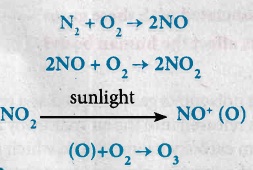
12.
Ozone is formed by a series of reactions that occur from the sun shines
13.
i. Bio-degradable pollutants :
The pollutants which can be easily decomposed by the natural biological processes are called bio-degradable pollutants.
Examples: plant wastes, animal wastes, etc.
ii. Non bio-degradable pollutants :
The pollutants which cannot be decomposed by the natural biological processes are called Non bio-degradable pollutants.
Examples : metal wastes (mainly Hg and Pb), D.D.T, plastics, nuclear wastes, etc., These pollutants are harmful to living organisms even in low concentration. As they are not degraded naturally,it is difficult to eliminate them from our environment.
14.
At high altitudes to the atmosphere consists of a layer of ozone (O3) which acts as an umbrella or shield for harmful UV radiations. It protects us from harmful effect such as skin cancer. UV radiation can convert molecular oxygen into ozone as shown in the following reaction.
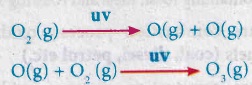
Ozone gas is thermodynamically unstable and readily decomposes to molecular oxygen.
15.
16.
1. Waste management : Environmental pollution can be controlled by proper disposal of wastes.
2. Recycling : a large amount of disposed waste material can be reused by recycling the waste, thus it reduces the land fill and converts waste into useful forms.
3. Substitution of less toxic solvents for highly toxic ones used in certain industrial processes.
4. Use of fuels with lower sulphur content (e.g., washed coal)
5. Growing more trees
6. Control measures in vehicle emissions are adequate.
7. Green chemistry philosophy can be followed.
8. Eco-friendly compounds should be developed.
g. Greener routes should be followed in our day to day life.
10. For dry cleaning liquified CO2 or H2O2 may be used.
11. Paper may be bleached by H2O2.
12. Methanol maybe used instead of petrol.
13. Neem based pesticides may be used.
14. Awareness among students and public may be created by using slogans like "Save water; Water will save You".
17.
It binds with haemoglobin and form carboxy haemoglobin which impairs normal oxygen transport by blood and hence the oxygen carrying capacity of blood is reduced. This oxygen deficiency results in headache, dizziness, tension, Loss of consciousness, blurring of eye sight and cardiac arrest.
18.
(i) BOD and COD
| No | BOD | COD |
| 1 | This is Bio chemical oxygen demand | This is chemical oxygen demand |
| 2 | The total amount of oxygen in milligrams consumed by microorganisms in decomposing the waste in one litre of water at 20o for a period of 5 days is called biochemical oxygen demand (BOD) |
Chemical oxygen demand (COD) is defined as the amount of oxygen required by the organic matter in a sample of water for its oxidation by strong oxidising agent like K2Cr2O7 in acid medium for a Period of 2 hrs. |
| 3 | It is expressed in ppm | It is expressed in mg/L |
| 4 | It is a measure of consumed oxygen | It isa measurement of requirement of dissolved oxygen. |
| 5 | In waste streams BOD levels are less than COD. | In waste streams COD levels are higher than than BOD. |
| 6 | BOD measurements takes 5 days | COD measurements takes 2 hrs only. |
(ii) Viable and non-viable particulate pollutants
| No | Viable particulates | Non - Viable Particulates |
| 1 | These are small sized living organisms which are dispersed in air. Eg : bacteria, fungi, moulds, algae, etc. |
These are small solid particles and liquid droplets suspended in air. Eg : Smoke, Dust, Mists, Fumes, etc. |
| 2 | Fungi causes allergy in humans and diseases in Plants. | Causes long cancer, asthma, affects mattuation of RBC, affects Photosynthesis, etc. |
| 3 | They do not help in the transportation of Particulates. | They help in transportation of viable particulates |
19.
Rain water normally has a pH of 5.6 due to dissolution of atmospheric CO2 into it. Oxides of sulphur and nitrogen in the atmosphere may be absorbed by droplets of frater that make up clouds and get chemically converted into sulphuric acid and nitric acid respectively as a results of pH of rain water drops below the level 5.6, hence it is called acid rain. Acid rain is a by-product of a variety of sulphur and nitrogen oxides in the atmosphere. Burning of fossil fuels (coal and oil) in power stations, furnaces and petrol, diesel in motor engines produce sulphur dioxide and nitrogen oxides The main contributors of acid rain are SO2 and NO2.They are converted into sulphuric acid and nitric acid respectively by the reaction with oxygen and water.
2SO2 + O2 + 2H2O ⟶ 2H2SO4
4NO2 + O2 + 2H2O ⟶ 4HNO3
Harmful effects of acid rain
Some harmful effects are discussed below :
(i) Acid rain causes extensive damage to buildings and structural materials of marbles. This attack on marble is termed as Stone leprosy.
CaCO3 + H2SO4 ⟶ CaSO4 + H2O +CO2 ↑
(ii) Acid rain affects plants and animal life in aquatic ecosystem.
(iii) It is harmful for agriculture, trees and plants as it dissolves and removes the nutrients needed for their growth.
(iv) It corrodes water pipes resulting in the leaching of heavy metals such as iron, lead and copper into the drinking water which have toxic effects.
(v) It causes respiratory ailment in humans and animals.

11th Standard Syllabus & Materials
11th Standard
TN 11th Tamil பீடு பெற நில் - செய்யுள் - காவடிச்சிந்து Important Questions And Answers Study Material - QB365 Set A
NEW11th Standard
TN 11th Tamil பீடு பெற நில் - உரைநடை - மலை இடப்பெயர்கள் : ஓர் ஆய்வு Important Questions And Answers Study Material - QB365 Set A
NEW11th Standard
TN 11th Tamil மாமழை போற்றுதும் - துணைப்பாடம் - யானை டாக்டர் Important Questions And Answers Study Material - QB365 Set A
NEW11th Standard
TN 11th Tamil மாமழை போற்றுதும் - செய்யுள் - ஐங்குறுநூறு Important Questions And Answers Study Material - QB365 Set A



Tamilnadu Stateboard 11th Standard Subjects

Maths

Commerce

Economics

Biology

Business Maths and Statistics

Accountancy

Computer Science

Physics
Chemistry
Maths
Biology
Economics
Physics
Chemistry

History
Business Maths and Statistics

Computer Science
Accountancy

Computer Applications
History
Computer Technology
Commerce
Computer Applications
Computer Technology

Tamil

English

French
Tamilnadu Stateboard Standards


