
 100% FREE ACCESS
11th Standard Syllabus & Materials
11th Standard
TN 11th Tamil இயற்கை வேளாண்மை,சுற்றுச்சூழல் -செய்யுள் - மனோன்மணீயம் Important Questions And Answers Study Material - QB365 Set A
NEW11th Standard
TN 11th Tamil என்னுயிர் என்பேன் -துணைப்பாடம் - இசைத்தமிழர் இருவர் Important Questions And Answers Study Material - QB365 Set A
NEW11th Standard
TN 11th Tamil மொழி கலை -செய்யுள் - ஒவ்வொரு புல்லையும் Important Questions And Answers Study Material - QB365 Set A
NEW11th Standard
TN 11th Tamil பீடு பெற நில் - இலக்கணம் - பகுபத உறுப்புகள் Important Questions And Answers Study Material - QB365 Set A
NEW11th Standard
TN 11th Tamil பீடு பெற நில் - துணைப்பாடம் - வாடிவாசல் Important Questions And Answers Study Material - QB365 Set A
NEW11th Standard
TN 11th Tamil பீடு பெற நில் - செய்யுள் - குறுந்தொகை Important Questions And Answers Study Material - QB365 Set A

Published on: 24/08/2026
Download Tamil Nadu 11th Standard Computer Science question papers, model tests, one-mark questions, important questions, and public exam papers in PDF format. Free study materials and answer keys for TN State Board students.
Questions + Answers key
Take MCQ Computer Science Test
1.
Which of the following is not an invariant of the assignment? m, n := m+2, n+3
m mod 2
n mod 3
3 x m - 2 x n
2 x m - 3 x n
2.
If m x a + n x b is an invariant for the assignment a, b: = a + 8, b + 7, the values of m and n are
m = 8, n = 7
m = 7, n = -8
m = 7, n = 8
m = 8, n = -7
3.
The symbol indicates the comment statement while specifying an algorithm is ______.
--
|| ||
~~
none of these
4.
In which control flow, the statements are repeated until the condition becomes false?
sequential
alternative control flow
iterative
all of these
5.
Which are named boxes for storing data?
Data
process
functions
variables
6.
7.
If C1 is false and C2 is true, the compound statement
1 if CI
2 SI
3 else
4 if C2
5 S2
6 else
7 S3
executes
S1
S2
S3
none
8.
Which of the following properties is true after the assignment (at line 3)?
1 --i, j = 0, 0
2 i, j := i+1, j-1
3 -- ?
i + j > 0
i+j < 0
i+j=0
i = j
9.
Stating the input property and the input-output relation a problem is known
specification
statement
algorithm
definition
10.
Omitting details inessential to the task and representing only the essential features of the task is known as
specification
abstraction
composition
decomposition
11.
How do we refine a statement?
12.
What is the difference between an algorithm and a program?
13.
What is recursive problem solving?
14.
What is an invariant?
15.
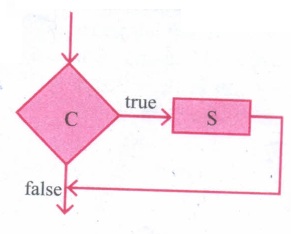
Draw a flowchart for conditional statement.
16.
Specify a function to find the minimum of two numbers.
17.
Define an algorithm.
18.
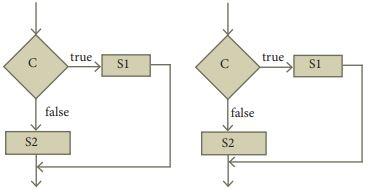
For the given two flowcharts write the pseudo code.
19.
Define a function to double a number in two different ways:
(1) n + n,
(2) 2 x n.
20.
What is case analysis?
21.
There are 7 tumblers on a table, all standing upside down. You are allowed to turn any 2 tumblers simultaneously in one move. Is it possible to reach a situation when all the tumblers are right side up? (Hint: The parity of the number of upside-down tumblers is invariant.)
22.
What is the form and meaning of assignment statement?
23.
24.
What is the format of the specification of an algorithm?
25.
Explain the types of symbols used in flowchart in detail.
26.
Trace the step-by-step execution of the algorithm for factorial(4).
factorial(n)
--inputs: n is an integer, n > 0
-- outputs: f = n!
f, i := 1 ,1
while i < nf
, i := f × i, i+1
27.
Exchange the contents: Given two glasses marked A and B. Glass A is full of apple drink and glass B is full of grape drink. Write the specification for exchanging the contents of glasses A and B, and write a sequence of assignments to satisfy the specification.
28.
Explain the types of control flow statements.
29.
Exchange the contents: Given two glasses marked A and B. Glass A is full of apple drink and glass B is full of grape drink. For exchanging the contents of glasses A and B, represent the state by suitable variables, and write the specification of the algorithm.
30.
Write the specification of an algorithm hypotenuse whose inputs are the lengths of the two shorter sides of a right angled triangle, and the output is the length of the third side.
1.
(d)
2 x m - 3 x n
2.
(b)
m = 7, n = -8
3.
(a)
--
4.
(c)
iterative
5.
(d)
variables
6.
(a)
7.
(b)
S2
8.
(c)
i+j=0
9.
(a)
specification
10.
(b)
abstraction
11.
In refinement, each statement is repeatedly expanded into more detailed statements in the subsequent levels.
12.
| Algorithm | Program |
| Algorithm is for human readers to understand. | Program is for the computers to execute directly. |
| Knowledge of English is needed. | Knowledge of programming language is required. |
| Easy to understand. | It is difficult to understand. |
13.
1. Recursion is a method of solving problems that involves breaking a problem down into smaller and smaller sub problems until user gets in to a small problem that it can be solved trivially.
2. Usually recursion involves a function calling itself. While it may not seem like much on the surface, recursion allows us to write elegant solutions to problems that may otherwise be very difficult to program.
14.
An expression involving variables, which remains unchanged by an assignment to one of these variables is called as an invariant of the assignment.
15.
16.
1. --minimum (a,b)
2. -- inputs: a, b are real numbers.
3. --output: result: minimum (a,b)
17.
An algorithm is a step by step sequence of statements intended to solve a problem. An algorithm starts execution with the input data, executes the statements and finishes execution with the output data.
18.
1. Enter A,B
2. Initialise Q-0, r-A
3. If r ≥ B, then do Q-Q+1; r-r-B else r,q
4. Exit.
19.
(1) double (n)
--inputs: n is a real number or an integer, n > 0
--outputs: y is a real number or an integer such that y= n x h.
(2) double (n)
--inputs: n is a real number or an integer, n > 0
--outputs: y is a real number or an integer such that y = 2 x n.
20.
1. Case analysis statement generalizes it to multiple cases.
2. Case analysis splits the problem into an exhaustive set of disjoint cases.
21.
Let u - No. of tumblers right side up
v - No. of tumblers up side down
Initial stage: u = 0, v=7 (All tumblers upside down)
Final stage output: u=7, v=0 (All tumblers right side up)
Possible Iterations:
(i) Turning both up side down tumblers to right side up
u=u+ 2, v=y-2 [u is even]
(ii) Turning both right side up tumblers to upside down.
u=u-2, v=v+2 [u is even]
(iii) Turning one right side up tumblers to upside down and other tumbler from upside down to right side up.
u=u+1-1=u, v=y+1-1=v [u is even]
Initially u = 0 and continuous to be even in all the three cases. Therefore u is always even.
Invariant: u is even (i. e. No. of right side up tumblers are always even)
But in the final stage (Goal), u = 7 and v=0 i. e. u is odd.
Therefore it is not possible to reach a situation where all the tumblers are right side up.
22.
Assignment statement is used to assign values to the variables.
The variable on the left side of the assignment operator and a value on the right side.
Variable := Value
23.
24.
Let P be the required property of the inputs and Q the property of the desired outputs.
Format of specification of an algorithm:
(a) Algorithm name (Inputs)
(b) Inputs - P
(c) Outputs - Q
25.
Flowchart is a diagrammatic notation for representing algorithms. They show the control flow of algorithms using diagrams in a visual manner. In flowcharts, rectangular boxes represent simple statements, diamond-shaped boxes represent conditions, and arrows describe how the control flows during the execution of the algorithm. A flowchart is a collection of boxes containing statements and conditions which are connected by arrows showing the order in which the boxes are to be executed.
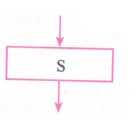
(i) A statement is contained in a rectangular box with a single outgoing arrow, which points to the box to be executed next.
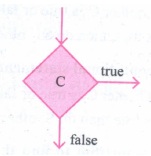
(ii) A condition is contained in a diamond-shaped box with two outgoing arrows, labelled true and false. The true arrow points to the box to be executed next if the condition is true, and the false arrow points to the box to be executed next if the condition is false.
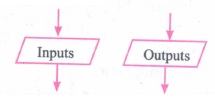
(iii) Parallelogram boxes represent inputs given and outputs produced.
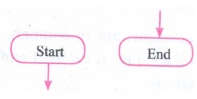
(iv) Special boxes marked Start and End are used to indicate the start and end of execution:
26.
(i) f=1 i=1 f = f * i i = i+1
f = 1 x 1 = 1 i = 2
(ii) f = 1 x 2 i = 3 = 2
(iii) f = 2 × 3 i = 4 = 6
(iv) f = 6 x 4 i = 5 (loop terminates) = 24
27.
Let the variables a, b, c represent Glass A, Glass B and Glass C and a, b, c can store values APPLE, GRAPE or EMPTY.
Specification:
1 exchange (a, b)
2-inputs: a, b: APPLE, GRAPE
3-outputs: a, b: = GRAPE, APPLE
Algorithm:
1. exchange (a, b)
2. a, b, c :- APPLE, GRAPE, EMPTY.
3. c:=b
4. -- a, b, c :- APPLE, EMPTY, GRAPE,
5. b:= a
6. --a, b, c = EMPTY, APPLE, GRAPE
7. a: = c
8. --a, b, c = GRAPE, APPLE, EMPTY
28.
There are three important control flow .statements to alter the control flow depending on the state.
(i) In sequential control flow, a sequence of statements are executed one after another in the same order as they are written.
(ii) In alternative control flow, a condition of the state is tested, and if the condition is true, one statement is executed; if the condition is false an alternative statement is executed.
(iii) In iterative control flow, a condition of the state is tested, and if the condition is true, a statement is executed. The two steps of testing the condition and executing the statement are repeated until the condition becomes false.
29.
Let the variables a, b, c represent the glass A, glass B and Glass C respectively. Variables A, B, C can store values APPLE, GRAPE or EMPTY.
Initial State:
1.-- a, b, c : = APPLE, GRAPE, EMPTY
2. C : = b
3.-- a, b, c : = APPLE, EMPTY, GRAPE
4. b : = a
5.-- a, b, c : = EMPTY, APPLE, GRAPE
6. a : = C
7.-- a, b, c : = GRAPE, APPLE, EMPTY
Final State:
Specification:
1. Exchange ()
2. -- inputs: a, b, c :- APPLE, GRAPE, EMPTY
3.--outputs: a, b, c:- GRAPE, APPLE, EMPTY
30.
1. hypotenuse (a, b)
2. -- inputs: a, b are real numbers, a > 0, b > 0
3 -- outputs: c²=a² + b² where c is real number, c > 0

11th Standard Syllabus & Materials
11th Standard
TN 11th Tamil பீடு பெற நில் - செய்யுள் - காவடிச்சிந்து Important Questions And Answers Study Material - QB365 Set A
NEW11th Standard
TN 11th Tamil பீடு பெற நில் - உரைநடை - மலை இடப்பெயர்கள் : ஓர் ஆய்வு Important Questions And Answers Study Material - QB365 Set A
NEW11th Standard
TN 11th Tamil மாமழை போற்றுதும் - துணைப்பாடம் - யானை டாக்டர் Important Questions And Answers Study Material - QB365 Set A
NEW11th Standard
TN 11th Tamil மாமழை போற்றுதும் - செய்யுள் - ஐங்குறுநூறு Important Questions And Answers Study Material - QB365 Set A



Tamilnadu Stateboard 11th Standard Subjects

Maths

Commerce

Economics

Biology

Business Maths and Statistics

Accountancy
Computer Science

Physics

Chemistry
Maths
Biology
Economics
Physics
Chemistry

History
Business Maths and Statistics

Computer Science
Accountancy

Computer Applications
History
Computer Technology
Commerce
Computer Applications
Computer Technology

Tamil

English

French
Tamilnadu Stateboard Standards


