
 100% FREE ACCESS
11th Standard Syllabus & Materials
11th Standard
TN 11th Tamil இயற்கை வேளாண்மை,சுற்றுச்சூழல் -செய்யுள் - மனோன்மணீயம் Important Questions And Answers Study Material - QB365 Set A
NEW11th Standard
TN 11th Tamil என்னுயிர் என்பேன் -துணைப்பாடம் - இசைத்தமிழர் இருவர் Important Questions And Answers Study Material - QB365 Set A
NEW11th Standard
TN 11th Tamil மொழி கலை -செய்யுள் - ஒவ்வொரு புல்லையும் Important Questions And Answers Study Material - QB365 Set A
NEW11th Standard
TN 11th Tamil பீடு பெற நில் - இலக்கணம் - பகுபத உறுப்புகள் Important Questions And Answers Study Material - QB365 Set A
NEW11th Standard
TN 11th Tamil பீடு பெற நில் - துணைப்பாடம் - வாடிவாசல் Important Questions And Answers Study Material - QB365 Set A
NEW11th Standard
TN 11th Tamil பீடு பெற நில் - செய்யுள் - குறுந்தொகை Important Questions And Answers Study Material - QB365 Set A

Published on: 24/08/2026
Download Tamil Nadu 11th Standard Maths question papers, model tests, one-mark questions, important questions, and public exam papers in PDF format. Free study materials and answer keys for TN State Board students.
Questions + Answers key
Take MCQ Maths Test
1.
If |x - 2| > 5, then x belongs to ___________
(\(\infty\), -2]∪[5, \(\infty\)]
(-\(\infty\), -3]∪[7, \(\infty\))
(-\(\infty\), -3)∪(7, \(\infty\))
(\(\infty\), -2]∪(5, \(\infty\))
2.
Let A = {-2, -1, 0, 1, 2} and f : A ⟶ Z be given by f(x) = x2- 2x - 3 then preimage of 5 is ___________
-2
-1
0
1
3.
The number of rectangles than can be formed on a chess board is _________
9C2
9C2 \(\times\) 9C2
204
224
4.
Sum of the binomial coefficients is ______________
2n
n2
2n
n+17
5.
The length of the perpendicular from origin to line is \(\sqrt{3}x-y+24=0\) is ______________
2\(\sqrt{3}\)
8
24
12
6.
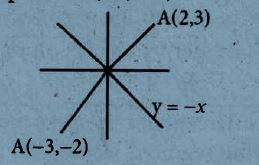
The image of the point (2, 3) in the line y = -x is
(-3, -2)
(-3, 2)
(-2, -3)
(3, 2)
7.
If nC4,nC5,nC6 are in AP the value of n can be
14
11
9
5
8.
The equation of the locus of the point whose distance from y-axis is half the distance from origin is
x2 + 3y2 = 0
x2- 3y2 = 0
3x2+ y2 = 0
3x2- y2 = 0
9.
The nth term of the sequence \(\frac { 1 }{ 2 } ,\frac { 3 }{ 4 } ,\frac { 7 }{ 8 } ,\frac { 15 }{ 6 } \),......is
2n - n - 1
1 - 2-n
2-n + n - 1
2n-1
10.
There are 10 points in a plane and 4 of them are collinear. The number of straight lines joining any two points is
45
40
39
38
11.
The number of ways in which the following prize be given to a class of 30 boys first and second in mathematics, first and second in physics, first in chemistry and first in English is
304\(\times\) 292
303\(\times\) 293
302\(\times\) 294
30\(\times\)295
12.
If a, 8, b are in AP, a, 4, b are in GP, and if a, x, b are in HP then x is
2
1
4
16
13.
The number of roots of (x + 3)4+ (x + 5)4 = 16 is
4
2
3
0
14.
The value of \({ log }_{ \sqrt { 2 } }512\) is
16
18
9
12
15.
In a ΔABC, if
(i) \(sin\frac { A }{ 2 } sin\frac { B }{ 2 } sin\frac { C }{ 2 } \) > 0
(ii) sin A sin B sin C > 0, Then
Both (i) and (ii) are true
Only (i) is true
Only (ii) is true
Neither (i) nor (ii) is true
16.
\(\frac { sin(A-B) }{ cosAcosB } +\frac { sin(B-C) }{ cosBcosC } +\frac { sin(C-A) }{ cosCcosA } \) is
sin A + sin B + sin C
1
0
cos A + cos B + cos C
17.
cos10 + cos20 + cos30 +: : : + cos1790 =
0
1
-1
89
18.
If cos 280+ sin 280 = k3, then cos 170 is equal to
\(\frac { { k }^{ 3 } }{ \sqrt { 2 } } \)
-\(\frac { { k }^{ 3 } }{ \sqrt { 2 } } \)
±\(\frac { { k }^{ 3 } }{ \sqrt { 2 } } \)
-\(\frac { { k }^{ 3 } }{ \sqrt { 3 } } \)
19.
The range of the function \(f(x) = \left| \left\lfloor x \right\rfloor - x \right| ,x \in R\) is
[0, 1]
[0, ∞)
[0, 1)
(0, 1)
20.
The function f:R➝R be defined by f(x) = sinx + cosx is
an odd function
neither an odd function nor an even function
an even function
both odd function and even function
21.
Find the distance between the parallel lines.
3x - 4y + 5 = 0 and 6x - 8y - 15 = 0.
22.
Find the angle between the lines 3x2 + 10xy + 8y2 + 14x + 22y + 15 = 0.
23.
Rationalize the denominator \(\frac{1}{\sqrt{5}+\sqrt{4}}\)
24.
If f and g are two functions from R to R defined by f (x) = 4x - 3, g(x) = x2 + 1, find fog and gof.
25.
If A = {1, 2, 3, 4} and B = {3, 4, 5, 6}, find \(n((A\cup B)\times(A\cap B)\times(A \triangle B))\)
26.
If nC12 = nC9 find 21Cn.
27.
Find \(\sqrt [ 3 ]{ 1001 } \) approximately. (two decimal places).
28.
Determine the number of permutations of the letters of the word SIMPLE if all are taken at a time?
29.
Express each of the following as a product.
cos 65o + cos 15o
30.
Solve for x \(\left| 4x-5 \right| \ge -2\)
31.
For what value of k does 12x2+7xy+ky2+13x-y+3=0 represents a pair of straight lines? Also write the separate equations
32.
Prove \(log\frac{75}{16}-2log\frac{5}{9}+log\frac{32}{243}=log2\)
33.
Find the values of sin 18°
34.
The AM of two numbers exceeds their GM by 10 and HM by 16, Find the numbers
35.
A 150 m long train is moving with constant velocity of 12.5 m/s. Find
(i) the equation of the motion of the train
(ii) time taken to cross a pole
(iii) The time taken to cross the bridge of length 850m is?
36.
A committee of 7 peoples has to be formed from 8 men and 4 women. In how many ways can this be done when the committee consists of
(i) exactly 3 women?
(ii) at least 3 women?
(iii) at most 3 women?
37.
Find the equation of the locus of the point P such that the line segment AB, joining the points A(1, -6) and B(4,-2), subtends a right angle at P.
38.
Prove that \(\sqrt [ 3 ]{ { x }^{ 3 }+6 } -\sqrt [ 3 ]{ { x }^{ 3 }+3 } \) is approximately equal to \(\frac { 1 }{ { x }^{ 2 } } \) when x is sufficiently large.
39.
Using the mathematical induction, show that for any natural number n > 2
\({1\over 1+2}+{1\over 1+2+3}+{1\over 1+2+3+4}+...+{1\over 1+2+3..+n}={n-1\over n+1}\)
40.
If f:R \(\rightarrow\) R is defined by f(x) = 3x - 5, prove that f is a bijection and find its inverse.
41.
Find the largest possible domain of the real valued function f(x) =\(\frac { \sqrt { 4-{ x }^{ 2 } } }{ \sqrt { { x }^{ 2 }-9 } } \)
42.
Resolve the following rational expressions into partial fractions.
\({{x}\over{{(x-1)}^{3}}}\)
43.
Solve : \({{x^2-4}\over{x^2-2x-15}}\le0\)
44.
If \(\theta +\phi =\alpha\) and \(tan\theta=k\ \tan\ \phi \) then prove that \(\sin { \left( \theta -\phi \right) } =\frac { k-1 }{ k+1 } \sin { \alpha } \).
45.
Let X = {a, b, c, d}, and R = {(a, a) (b, b) (a, c)}. Write down the minimum number of ordered pairs to be included to R to make it
(i) reflexive
(ii) symmetric
(iii) transitive
(iv) equivalence
46.
If A + B + C = 1800, prove that \(tan\frac { A }{ 2 } tan\frac { B }{ 2 } +tan\frac { B }{ 2 } tan\frac { C }{ 2 } +tan\frac { C }{ 2 } tan\frac { A }{ 2 } =1\)
47.
Show that \(cot(A+{ 15 }^{ 0 })-tan(A-{ 15 }^{ 0 })=\frac { 4cos2A }{ 1+2sin2A } \)
48.
\(\text { Let } \mathbf{f}: \mathbf{R} \rightarrow \mathbf{R}: \mathbf{f}(x)=\sin x \text { and }\mathbf{g}: \mathbf{R} \rightarrow \mathbf{R}: g(x)=x^{2} \text { find } \text { fog and gof. }\)
49.
Find the rank of the word "SCHOOL".
50.
Out of 18 points in a plane, no three are in the same line except five points which are collinear. Find the number of lines that can be formed joining the points.
51.
52.
How many 4 - digit even numbers can be formed using the digits 0, 1, 2, 3 and 4, if repetition of digits are not permitted?
53.
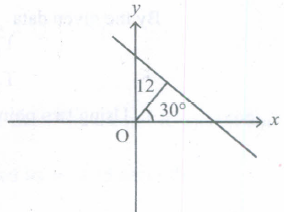
Find the equation of the line, if the perpendicular drawn from the origin makes an angle 30° with x-axis and its length is 12
54.
There are 5 teachers and 20 students. Out of them a committee of 2 teachers and 3 students is to be formed. Find the number of ways in which this can be done. Further find in how many of these committees
(i) a particular teacher is included?
(ii) a particular student is excluded?
55.
Write the first 4 terms of the logarithmic series of log (1 + 4x). Find the intervals on which the expansions are valid
56.
In the set Z of integers, define mRn if m - n is divisible by 7. Prove that R is an equivalence relation.
57.
Find the values of cos 2A, A lies in the first quadrant, when tan A = \(\frac{16}{63}\)
58.
Show that tan 75o + cot 75o = 4
59.
A quadratic polynomial has one of its zeros as \(1+\sqrt { 5 } \) and it satisfies p(1) = 2. Find the quadratic polynomial.
60.
Solve log4 28x = 2 log28
1.
(c)
(-\(\infty\), -3)∪(7, \(\infty\))
2.
(a)
-2
3.
(b)
9C2 \(\times\) 9C2
4.
(c)
2n
5.
(d)
12
6.
The required point is (-3, -2)
7.
\(\text { Given }{ }^{n} C_{4},{ }^{n} C_{5},{ }^{n} C_{6} \text { are in A.P }\)
\({ }^{2 n} \mathrm{C}_{5}={ }^{n} \mathrm{C}_{4}+{ }^{n} \mathrm{C}_{6}\)
\(\frac{2\lfloor n}{\lfloor n-5\lfloor 5}=\frac{\lfloor n}{\lfloor n -4\lfloor 4}+\frac{n}{\lfloor n -6\lfloor 6}\)
\(\frac{2}{\lfloor n-5\lfloor 5} =\frac{1}{\operatorname{\lfloor n}-4\lfloor 4}+\frac{1}{\lfloor n-6\lfloor 6}\)
\(\frac{2(n-4) 6}{(n-4)\lfloor n-5\lfloor 5.6}=\frac{5.6}{\lfloor-45.6\lfloor 4}+ \frac{(n-4)(n-5)}{\lfloor 6(n-4)(n-5) \lfloor n-6}\)
\(\Rightarrow \frac{12(n-4)}{\lfloor n-4\lfloor 6}=\frac{30}{\lfloor n-4\lfloor 6}+ \frac{(n-4)(n-5)}{\lfloor n-4 \lfloor 6}\)
\(12 n-48 =30+n^{2}-9 n+20 \)
\(n^{2}-21 n+98 =0 \)
\((n-14)(n-7) =0 \)
\(n=14(\text { or }) n =7 \)
8.
Let the point be (x, y)
Its distance from origin is \(\sqrt{x^{2}+y^{2}}\)
Given \(x =\frac{1}{2} \sqrt{x^{2}+y^{2}} \)
\(\Rightarrow 2 x =\sqrt{x^{2}+y^{2}} \)
\(4 x^{2} =x^{2}+y^{2} \)
\(3 x^{2}-y^{2}=0 \) is the required equation of the locus
9.
\(n^{\text {th }} \text { term }=1-\frac{1}{2^{n}}=1-2^{-n}\)
10.
\(\text { No. of lines }{ }^{10} \mathrm{C}_{2}-{ }^{4} \mathrm{C}_{2}+1=45-6+1=40\)
11.
First in Maths = 30 ways
Second in Maths - 29 ways
Similarly for other subjects
30 \(\times\) 29 \(\times\) 30 \(\times\) 29 \(\times\) 30 \(\times\)30 = 304 \(\times\)292
12.
\(a+b= 16, a b=16, x=\frac{2 a b}{a+b}
\)
\(x=\frac{2 \times 16}{16}\)
\(x=2\)
13.
(a)
4
14.
\(\text { Let } \log _{\sqrt{2}} 512=x\)
\(\text { Then }(\sqrt{2})^{x}=2^{9}\)
\(\Rightarrow 2^{\frac{x}{2}}=2^{9} \Rightarrow x / 2=9 \Rightarrow x=18\)
15.
\(\text { We know that in } \Delta \mathrm{ABC}\)
\(\sin \frac{A}{2} \sin \frac{B}{2} \sin \frac{C}{2}>0\)
\(\text { And also } \sin A \sin B \sin C>0\)
Both are true..
Since sine is positive in I and II quadrant.
Both (i) and (ii) are true.
16.
\(\frac{\sin (A-B)}{\cos A \cos B} =\frac{\sin A \cos B-\cos A \sin B}{\cos A \cos B} \)
\(=\tan A-\tan B \)
\(\text { L.H.S } =\tan A-\tan B+\tan B-\tan C+\tan C-\tan A=0\)
17.
\(\cos 1^{\circ}+\cos 2^{\circ}+\cos 3^{\circ}+\ldots \ldots \ldots+\cos 179^{\circ} \)
\(=\left(\cos 1^{\circ}+\cos 179^{\circ}\right)+\left(\cos 2^{\circ}+\cos 178^{\circ}\right)+ ...\)
\(=2 \cos 90^{\circ} \cos 89^{\circ}+2 \cos 90^{\circ} \cos 80^{\circ}+\ldots \ldots . \)
\(=0+0+0 \ldots \ldots=0 \)
18.
\(\cos 28^{\circ}+\sin 28^{\circ} =\mathrm{k}^{3} \)
\(\cos 28^{\circ}+\sin \left(90^{\circ}-62^{\circ}\right) =\mathrm{k}^{3} \)
\(\cos 28^{\circ}+\cos 62^{\circ} =\mathrm{k}^{3} \)
\(2 \cos 45^{\circ} \cos 17^{\circ} =\mathrm{k}^{3} \)
\(2 \frac{1}{\sqrt{2}} \cos 17^{\circ} =\mathrm{k}^{3} \)
\(\cos 17^{\circ} =\frac{\mathrm{k}^{3}}{\sqrt{2}} \)
19.
\(\mathrm{f}(x)=\left\lfloor\begin{array}{lll} x & -x \mid, \mathrm{f}(x) \end{array}=\left\lfloor\begin{array}{ll} x & -x \end{array}\right.\right.\)
\(f(0) =0-0=0 \)
\(f(6.5) =6-6.5=|-0.5|=0.5 \)
\(f(-7.2) =8-7.2=0.8 \)
\(\therefore \text { Range is }[0,1)\)
20.
\(f(x) =\sin x+\cos x \)
\(f(-x) =\sin (-x)+\cos (-x) \)
\(=-\sin x+\cos x \)
\(-f(-x) =\sin x-\cos x \)
\(f(x) \neq-f(-x) \)
f(x) is neither odd function nor even function.
21.
3x - 4y + 5 = 0 and 6x - 8y - 15 = 0.
Given parallel lines are 3x - 4y + 5 = 0
\(\Rightarrow\) 6x - 8y + 10 = 0 and 6x-8y-15 = 0 [Multiplied by 2]
Here a = 6, b = -8, c1 = 10 and c2 = -15
Distance between parallel lines = \(\left| \frac { { c }_{ 1 }-{ c }_{ 2 } }{ \sqrt { { a }^{ 2 }+{ b }^{ 2 } } } \right| \) = \(\left| \frac { 10-(-15) }{ \sqrt { { 6 }^{ 2 }+(-8)^{ 2 } } } \right| \)
= \(\left| \frac { 25 }{ \sqrt { 36+64 } } \right| =\left| \frac { 25 }{ 10 } \right| =\frac { 5 }{ 2 } \)
22.
\({\tan}^{-1}\left( {2 \over 11} \right)\)
23.
\(\sqrt{5}-\sqrt{4}\)
24.
4x2 + 7, 16x2 - 24x + 10
25.
We have \(n(A \cup B)=6,n(A\cap B)=2\) and \(n(A \triangle B)=4.\)
So, \(n((A\cup B)\times(A\cap B)\times(A \triangle B))=n(A \cup B)\times n(A\cap B)\times n(A\triangle B)= 6 \times 2 \times 4 = 48.\)
26.
We have nCx = nCy ⇒ x = y or x + y = n
⇒ 12 + 9 = n
⇒ n = 21
⇒ 21Cn = 21C21
= 1 [∵ nCn= 1]
27.
Given \(\sqrt [ 3 ]{ 1001 } ={ \left( 1000+1 \right) }^{ \frac { 1 }{ 3 } }={ \left( 1000 \right) }^{ \frac { 1 }{ 3 } }{ \left( 1+\frac { 1 }{ 1000 } \right) }^{ \frac { 1 }{ 3 } }\)
\(={ 10 }^{ 3\times \frac { 1 }{ 3 } }{ \left[ 1+\frac { 1 }{ 1000 } \right] }^{ \frac { 1 }{ 3 } }\)
\(\sqrt [ 3 ]{ 1001 } =10{ \left( 1+.001 \right) }^{ \frac { 1 }{ 3 } }\)
\(=10\left[ 1+\frac { .001 }{ 3 } +\left( \frac { 1 }{ 3 } \right) \left( -\frac { 2 }{ 3 } \right) \left( \frac { .000001 }{ 2 } \right) \right] app\)
\(=10\left[ 1+.00033-\frac { .000001 }{ 9 } \right] app\)
= 10 [1.00033 - .00000011] app
= 10 [1.000329]
= 10 [1.00033]
\(\\ \\ { \left( 1000 \right) }^{ \frac { 1 }{ 3 } }\cong 10.0033\)
28.
There are 6 letters in the word 'SIMPLE'.
So, total number of words is equal to the number of arrangements of these letters, taken all at a time. Sum order of such arrangements is 6 P6 = 6! = 720
29.
cos 65o + cos 15o = \(2\cos { \left( \frac { 65+15 }{ 2 } \right) } .\cos { \left( \frac { 65-15 }{ 2 } \right) } \)
= 2 cos 40o cos 25o
30.
.png)
Given |4x - 5| > -2.
This means -2 < 4x - 5 < 2
⇒ -2 + 5 < 4x < 2 + 5
⇒ 3 < 4x < 7
\(⇒{3\over 4}\le x\le{7\over 4}\)
\(\therefore\) The Solution set is \(\left[ \frac { 3 }{ 4 } ,\frac { 7 }{ 4 } \right] \)
31.
12x2+7xy+ky2+13x-y+3=0
a=12, h=\(\frac { 7 }{ 2 } \), b=k, g=\(\frac { 13 }{ 2 } \), f =\(\frac { 1 }{ 2 } \), c=3
af2+bg2+ch2-abc-2fgh=0
12\(\left( -\frac { 1 }{ 2 } \right) ^{ 2 }+k\left( \frac { 13 }{ 2 } \right) ^{ 2 }+3\left( \frac { 7 }{ 2 } \right) ^{ 2 }\)-12(k)(3)-2\(\left( -\frac { 1 }{ 2 } \right) \left( \frac { 13 }{ 2 } \right) \left( \frac { 7 }{ 2 } \right) \)=0
\(\frac { 12 }{ 4 } +\frac { 169k }{ 4 } +\frac { 147 }{ 4 } -36k+\frac { 91 }{ 4 } \)=0
⇒ 12 + 169k+ 147 -144k+ 91 = 0
25k = -250 ⇒ k = -10
The equation is 12x2+7xy-10y2+13x-y+3=0
To find separate equations: 12x2+7xy-10y=(3x-2y)(4x+5y)
Let 12x2+7xy-10y2+13x-y+3=0 (3x-2y+l)(4x+5y+m)
Equating the coefficient of x ⇒ 4l+ 3m = 13.....(1)
Equating the coefficient of y ⇒ 5l-2m = -1 .....(2)
(1) x 2 ⇒ 8l+6m=26
(2) x 3 ⇒ 15l-6m=-3
23l=23
l=1
4+3=13
3m=9 ⇒ m=3
The separate equations are 3x - 2y + 1 = 0 and 4x + 5y + 3 = 0
32.
Using the properties of logarithm we have \(log\frac{75}{16}-2log\frac{5}{9}+log\frac{32}{243}\)
= log 75 -log 16 - 2 log 5 + 2 log 9 + log 32 -log 243 (By quotient rule)
= log 3 + log 25 - log 16 - log 25 + log 81 + log 16 + log 2 - log 81 - log 3 = log 2
33.
Let θ = 18°, Then 5θ = 90°
3θ + 2θ = 90° ⇒2θ = 90°-3θ
sin 2θ = sin (90° - 3θ) = cos 3θ
2 sin θ cos θ = 4 cos3θ - 3 cos θ. Since cos θ = cos 18° ≠ 0, we have
2 sin θ = 4 cos2θ - 3 = 4 (1 - sin2θ) - 3
4 sin2θ + 2 sin θ - 1 = 0
\(sin\ \theta=\frac{-2\pm\sqrt{4-4(4)(-1)}}{2(4)}=\frac{-1\pm\sqrt 5}{4}\)
Thus, \(\sin\ 18^o=\frac{\sqrt 5 -1}{4}\) (positive sign is taken sin 18o is in I quadrant sinθ is positive).
34.
Let the numbers be a and b
\(∴ A={a+b\over 2}, G=\sqrt ab\ and\ H={2ab\over a+b}\)
Given A-G = 10 and A - H = 16
G = A-10 and H = A-16
We know G2 = AH
⇒ (A - 10)2 = A (A-16)
⇒ A2 + 100 - 20A = A2-16A
⇒ 100 = \(4A⇒A=25⇒{a+b\over2}=25⇒a+b=50\)
∴ G = A-10 = 25 - 10 = 15
\(∴ \sqrt{ab}=15⇒ab=225\)
\(⇒ b={225\over a}\)

Substituting (2) in (1) we get,
\(a+{225\over a}=50\)
\(⇒\ {a^2+225\over a}=50\)
⇒ a2 + 225 = 50a
⇒ a2 - 50a + 225 = 0
⇒ (a - 45) (a -5) = 0
⇒ a = 5, 45
If a = 5, b = \({225\over 5}=45\)
If a = 45, b = \({225\over 45}=45\)
Hence the numbers are 5, 45
35.
(i) Let x-axis be the time in seconds and y-axis be the distance in meters.
Let the train be at the origin
ஃ Length of train = 150m is the negative y-intercept
Slope of the motion of the train m = 12.5m/sec
Since we are given slope and y-intercept, the equation of the line is y = mx - c
Equation of the motion of the train ஃ y = 12.5x-150
(ii) To find the Time taken to cross the pole, put y = 0
⇒ ஃ 12.5x = 150
⇒ x = \(\frac{150}{12.5}\) = 12 sec
(iii) Time taken to cross the bridge of length 850m is,
850 = 12.5x - 150
⇒ 850 + 150 = 12.5x
= \(\frac{1000}{12.5}=x\)
⇒ x = 80 sec
36.
(i) The following are the choices to select at least 3 women
| Men(8) | Women(4) | Combinations | |
| (a) | 4 | 3 | 8C4 \(\times \)4C3 |
| (b) | 3 | 4 | 8C3\(\times \) 4C4 |
∴ Required number of ways of forming the committee
= 8C4\(\times \)4C3 + 8C3\(\times \)4C4
= \(\frac { 8\times 7\times 6\times 5 }{ 4\times 3\times 2\times 1 } \times 4+\frac { 8\times 7\times 6 }{ 3\times 2\times 1\times } \times 1\) [∵ 4C3 = 4C1 = 4, 4C4 = 1]
= 280 + 56
= 336
(ii) The following are the choices to select at most 3 women
| Men(8) | Women(4) | Combination | |
| a) | 4 | 3 | 8C4\(\\ \times \\ \)4C3 |
| b) | 5 | 2 | 8C5\(\\ \times \\ \)4C2 |
| c) | 6 | 1 | 8C6\(\\ \times \\ \)4C1 |
| d) | 7 | 0 | 8C7\(\\ \times \\ \)4C0 |
Hence, required number of ways of forming the 49 committee is
\({ 8C }_{ 4 }\times { 4 }C_{ 3 }+{ 8C }_{ 5 }\times 4{ C }_{ 2 }+{ 8C }_{ 6 }\times 4C_{ 1 }+8C_{ 7 }\times 4C_{ 0 }\)
= \({ 8C }_{ 4 }\times { 4C }_{ 1 }+{ 8C }_{ 3 }\times { 4C }_{ 2 }+{ 8C }_{ 2 }\times { 4C }_{ 1 }+{ 8C }_{ 1 }\times { 4C }_{ 0 }\)
=.jpg)
= 280 + 336 + 112 + 8 = 736
(iii) The following are the choices to select at most 3 women
| Men(8) | Women(4) | Combination | |
| a) | 4 | 3 | 8C4\(\\ \times \\ \)4C3 |
| b) | 5 | 2 | 8C5\(\\ \times \\ \)4C2 |
| c) | 6 | 1 | 8C6\(\\ \times \\ \)4C1 |
| d) | 7 | 0 | 8C7\(\\ \times \\ \)4C0 |
Hence, required number of ways of forming the 49 committee is
\({ 8C }_{ 4 }\times { 4 }C_{ 3 }+{ 8C }_{ 5 }\times 4{ C }_{ 2 }+{ 8C }_{ 6 }\times 4C_{ 1 }+8C_{ 7 }\times 4C_{ 0 }\)
=\({ 8C }_{ 4 }\times { 4C }_{ 1 }+{ 8C }_{ 3 }\times { 4C }_{ 2 }+{ 8C }_{ 2 }\times { 4C }_{ 1 }+{ 8C }_{ 1 }\times { 4C }_{ 0 }\)
=
= 280 + 336 + 112 + 8 = 736
37.
Let P(h, k) be the point on the locus and A(1, -6) B(4, -2) be the given points.
By the given condition, \(\angle APB=90°\)
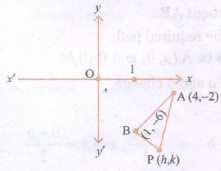
\(\therefore \) \(\Delta\) APB is a right angled triangle
\(\Rightarrow\) AB2 = PA2 + PB2
\(\Rightarrow { (1-4) }^{ 2 }+(-6+{ 2) }^{ 2 }={ (h-1) }^{ 2 }+{ (k+6) }^{ 2 }+{ (h-4) }^{ 2 }+{ (k+2) }^{ 2 }\)
\(\Rightarrow 9+16={ h }^{ 2 }-2h+1+{ k }^{ 2 }+36+12k+{ h }^{ 2 }-8h+16+{ k }^{ 2 }+4k+4\)
\(\Rightarrow { 2h }^{ 2 }+2{ k }^{ 2 }-10h+16k+57-25=0\)
\( \Rightarrow { 2h }^{ 2 }+{ 2k }^{ 2 }-10h+16k+32=0\)
Dividing by 2, we get,
\(\Rightarrow { h }^{ 2 }+{ k }^{ 2 }-5h+8k+16=0\)
\(\therefore\) Locus of (h, k) is
x2 + y2-5x+8y+16 = 0
38.
LHS = \({ \left( { x }^{ 3 }+6 \right) }^{ \frac { 1 }{ 3 } }-{ \left( { x }^{ 3 }+3 \right) }^{ \frac { 1 }{ 3 } }\)
\(={ x }^{ 3\times \frac { 1 }{ 3 } }{ \left( 1+\frac { 6 }{ { x }^{ 3 } } \right) }^{ \frac { 1 }{ 3 } }-{ x }^{ 3\times \frac { 1 }{ 3 } }{ \left( 1+\frac { 3 }{ { x }^{ 3 } } \right) }^{ \frac { 1 }{ 3 } }\)
\(=x\left[ 1+\frac { 1 }{ 3 } \left( \frac { 6 }{ { x }^{ 3 } } \right) \right] -x\left[ 1+\frac { 1 }{ 3 } \left( \frac { 3 }{ { x }^{ 3 } } \right) \right] \)
\(=x+\frac { 2 }{ { x }^{ 2 } } -x-\frac { 1 }{ { x }^{ 2 } } \)
\(=\frac { 2 }{ { x }^{ 2 } } -\frac { 1 }{ { x }^{ 2 } } =\frac { 1 }{ { x }^{ 2 } } =RHS\)
Hence proved.
39.
Adding 1 both sides to the given statement
p(n): \(1+{1\over 1+2}+{1\over 1+2+3}+..+{1\over 1+2+3+.+n}=1+{n-1\over n+1}={n+1+n-1\over n+1}={2n\over n+1}\)
Step 1:
Putting n = 2
\(1+{1\over 1+2}={2(2)\over 2+1}⇒1+{1\over 3}={4\over 3}⇒{4\over3}={4\over 3}\)
∵ p(1) is true
Step 2:
Let us assume that p(K) is true
\(∵\ 1+{1\over 1+2}+...+{1\over 1+2+3+...+K}={2K\over K+1}\)
Step 3:
To prove that p(K+1) is true
ie \(1+{1\over 2}+...+{1\over 1+2+3+K}+{1\over 1+2+...+K+1}={2(K+1)\over K+2}\)
LHS = \(1+{1\over 1+2}+...+{1\over 1+2+3+...+K}+{1\over 1+2+...+(K+1)}\)
\(={2K\over K+1}+{1\over 1+2+3+..+(K+1)}\) [using (1)]
\(={2K\over K+1}+{1\over {(K+1)(K+2)\over2}}\) \(\left[ ∵\ \sum n={n(n+1)\over2} \right]\)
\(={2K\over K+1}+{2\over (K+1)(K+2)}={2\over K+1}\left[ K+{1\over K+2}\right]={2\over K+1}\left(K^2+2K+1\over K+2\right)\)
\(={2(K+1)^2\over (K+1)(K+2)}={2(K+1)\over K+2}=RHS\)
∵ p(K+1) is true
Hence, by mathematical induction, p(n) is true for all values of n
40.
Let y = 3x -5.
\(\Rightarrow y+5=3x\Rightarrow \frac { y+5 }{ 3 } =x\)
Let g(y) = \(\frac { y+5 }{ 3 } \)
\(gof(x)=g(f(x))=g(3x-5)=\frac { 3x-5+5 }{ 3 } =\frac { 3x }{ 3 } =y\)
Also f o g(y) = f(g(y)) = \(f\left( \frac { y+5 }{ 3 } \right) =3\left( \frac { y+5 }{ 3 } \right) -5=y+5-5=y\)
Thus g o f = Ix and fog = Iy.
This implies that f and g are bijections and inverses to each other.
Hence f is a bijection and f-1(y) = \(\frac { y+5 }{ 3 } \)
Replacing y by x we get, f-1(x) = \(\frac { x+5 }{ 3 } \)
41.
Given f(x) = \(\frac { \sqrt { 4-{ x }^{ 2 } } }{ \sqrt { { x }^{ 2 }-9 } } \)
When x = 2, f(x) = 0
When x = -2, f(x) = 0
For all the other values, we get negative value in the square root which is not possible.
\(\therefore\) Domain = {2, -2}
42.
\({x\over (x-1)^3}={A\over x-1}+{B\over (x-1)^2}+{C\over (x-1)^3}\)
⇒ \({x\over (x-1)^3}={A\over x-1}+{B\over (x-1)^2}+{C\over (x-1)^3}\)
⇒ x = A(x - 1)2+ B(x - 1) + C
Putting x = 1 in (1) we get
1 = C
Putting x = 0 in (1) we get
0 = A - B + C
0 = A - B + 1
⇒ A - B = -1
Equating the Coefficient of x2 we get
0 = A
Substituting A = 0 in (2) we get
0 - B = -1 ⇒ B = 1
\(∴\ \ {x\over (x-1)^3}={0\over x -1}+{1\over (x-1)^2}+{1\over (x-1)^3 }\)
\(={{1}\over{{(x-1)}^{2}}}+{{1}\over{{(x-1)}^{3}}}\)
43.
Given inequality is \({{x^2-4}\over{x^2-2x-15}}\le0\)
\(⇒\ {(x+2)(x-2)\over (x-5)(x+3)}\le 0\)
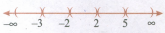
The critical numbers are -2, 2, 5, -3
∴ The possible intervals are (- ∞, -3) (- 3, -2) (-2, 2)(2, 5) and (5, ∞)
| Intervals | Sign of (x + 2) | Sign of (x - 2) | Sign of (x - 5) | Sign of (x + 3) | Sign of \((x+2)(x-2)\over (x-5)(x+5)\) |
|---|---|---|---|---|---|
| (-∞, -3) Say x = 0 | - | - | - | - | + |
| (-3, -2) Say x = -2.5 | - | - | - | + | - |
| (-2, 2) Say x = 0 | + | - | - | + | + |
| (2, 5) Say x = 3 | + | + | - | + | - |
| (5, ∞) Say x = 6 | + | + | + | + | + |
The inequality \({(x+2)(x-2)\over (x-5)(x+2)}\le 0\) is satisfied by the intervals (-3, -2) and (2, 5)
∴ Solution Set is (-3, -2) \(\cup\) (2, 5)
44.
Given θ + Φ = \(\alpha\) and tan θ = k tan Φ
an θ = k tan Φ
\(\frac { tan\theta }{ tan\phi } =k\Rightarrow \frac { sin\theta cos\phi }{ cos\theta .sin\phi } =\frac { k }{ 1 } \)
⇒ \(\frac { sin\theta cos\phi }{ cos\theta .sin\phi } =\frac { k }{ 1 } \)
(By componendo and dividends)
⇒ \(\frac { sin\theta cos\phi -cos\theta sin\phi }{ cos\theta .sin\phi +cos\theta sin\phi } =\frac { k-1 }{ k+1 } \)
⇒ \(\frac { sin\left( \theta -\phi \right) }{ sin\left( \theta +\phi \right) } =\frac { k-1 }{ k+1 } \)
⇒ \(\frac { sin\left( \theta -\phi \right) }{ sin\alpha } =\frac { k-1 }{ k+1 } \)
⇒ \(sin\left( \theta -\phi \right) =\frac { k-1 }{ k+1 } sin\alpha \)
45.
X = {a, b, c, d}
R = {(a, a), (b, b), (a, c)}
(i) To make R reflexive we need to include (c, c) and (d, d)
(ii) To make R symmetric we need to include (c, a)
(iii) R is transitive
(iv) To make R reflexive we need to include (c, c)
To make R symmetric we need to include (c, c) and (c, a) for transitive
∴ The relation now becomes
R = {(a, a), (b, b), (a, c), (c, c), (c, a)}
∴ R is equivalence relation.
46.
Given\(A+B+C={ 180 }^{ 0 }\)
\(A+B={ 180 }-C\Rightarrow \frac { A }{ 2 } +\frac { B }{ 2 } =90-\frac { C }{ 2 } \)
\(tan\left( \frac { A }{ 2 } +\frac { B }{ 2 } \right) =tan\left( 90-\frac { C }{ 2 } \right) =cot\frac { C }{ 2 } \)
\(\Rightarrow \frac { tan\frac { A }{ 2 } +tan\frac { B }{ 2 } }{ 1-tan\frac { A }{ 2 } .tan\frac { B }{ 2 } } =\frac { 1 }{ tan\frac { C }{ 2 } } \)
\(tan\frac { A }{ 2 } tan\frac { C }{ 2 } +tan\frac { B }{ 2 } tan\frac { C }{ 2 } =1-tan\frac { A }{ 2 } tan\frac { B }{ 2 } \)
\(tan\frac { A }{ 2 } tan\frac { C }{ 2 } +tan\frac { B }{ 2 } tan\frac { C }{ 2 } +tan\frac { A }{ 2 } tan\frac { B }{ 2 } =1\)
47.
\(LHS=cot(A+{ 15 }^{ 0 })-tan(A-{ 15 }^{ 0 })\)
\(=\frac { cos(A+15) }{ sin(A+15) } -\frac { sin(A-15) }{ cos(A-15) } \)
\(=\frac { cos(A+15)cos(A-15)-sin(A-15)sin(A+15) }{ sin(A+15).cos(A-15) } \)
\(=\frac { { cos }^{ 2 }A-{ sin }^{ 2 }15\left[ { sin }^{ 2 }A-{ sin }^{ 2 }{ 15 }^{ 0 } \right] }{ \frac { 1 }{ 2 } \left[ sin(A+15+A-15)+sin(A+15-A+15) \right] } \)
\(\left[ \because cos(A+B)cos(A-B)={ cos }^{ 2 }A-{ sin }^{ 2 }Bsin(A+B)sin(A-B)={ sin }^{ 2 }A-{ sin }^{ 2 }B\quad and sinAcosB=\frac { 1 }{ 2 } (sin(A+B)+sin(A-B)) \right] \)
\(=\frac { 2\left[ { cos }^{ 2 }A-{ sin }^{ 2 }15-{ sin }^{ 2 }A+{ sin }^{ 2 }{ 15 }^{ 0 } \right] }{ sin(2A)+sin({ 30 }^{ 0 }) } \quad \left[ \because cos2A={ cos }^{ 2 }A-{ sin }^{ 2 }B \right] \)
\(=\frac { 2\left( { cos }^{ 2 }A-{ sin }^{ 2 }A \right) }{ sin2A+\frac { 1 }{ 2 } } =\frac { 2,cos2A\times 2 }{ 2sin2A+1 } \)
\(=\frac { 4cos2A }{ 1+2sin2A } =RHS\)
48.
\(\text { Given } \quad f(x)=\sin x \text { and } g(x)=x^{2}\)
\(\text { Clearly fog and gof both exist. }\)
\(\text { Now, (gof) }(x)=g[\mathrm{f}(x)]\)
\(=g(\sin x) \)
\(=(\sin x)^{2} \)
\((\text { gof })(x) =\sin ^{2} x \)
\(\text { And, }(\text { fog })(x) =f(g(x)) \)
\(=f\left(x^{2}\right) \)
\((f o g)(x) =\sin \left(x^{2}\right)\)
49.
Rank \(=\frac { 5 }{ 2! } \times 5!+\frac { 0 }{ 2! } \times 3!+\frac { 1 }{ 0! } \times 2!+\frac { 1 }{ 0 } \times 1!+\frac { 0 }{ 0! } \times 1!+1\)
= 303
50.
Total number of points = 18
Out of 18 numbers, 5 are collinear and we get a straight line by joining any two points.
\(\therefore\) Total number of straight line formed by joining 2 points out of 18 points = 18C2
Number of straight lines formed by joining 2 points out of 5 points = 5C2
But 5 points are collinear and we get only one line when they are joined pairwise.
So, the required number of straight lines are
=18C2 -5C2 +1 = \({18 ·17\over2.1}-{5·4\over2.1}+1= 153 -10 + 1-144\)
Hence, the total number of straight lines = 144
51.
52.
There are three conditions as follows:
1. It is 4-digit number and hence its 1000th place cannot be 0.
2. It is an even number and hence its unit place can be either 0, 2 or 4.
Two cases arise in this situation. Either 0 in the unit place or not.
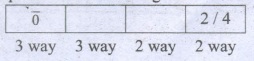
Case 1: When the unit place is filled by 0, then the 1000th place can be filled in 4 ways, 100th place can be filled in 3 ways and 10th place in 2 ways. Therefore, number of 4-digit numbers having 0 at unit place is \(4 \times 3 \times 2 \times 1=24\)
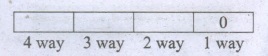
Case 2: When the unit place is filled with non-zero numbers, that is 2 or 4, the number of ways is 2, the number of ways of filling the 1000th place is in 3 ways (excluding '0'), 100th place in 3 ways and 10th place in 2 ways. Therefore, number of 4-digit numbers without 0 at unit place is \(3 \times 3 \times 2 \times 2=36\)
Hence, by the rule of sum, the required number of 4 digit even numbers is 24 + 36 = 60.
53.
Given \(\alpha\) = 30° and p = 12
Equation of the straight line in normal form is x cos\(\alpha\)+y sin \(\alpha\) = p
⇒ x cos 30°+ y sin 30° = 12
⇒ \(x(\frac{\sqrt{3}}{2})+y(\frac{1}{2})=12\)
\(\frac{\sqrt{3}x+y}{2}=12\)
√3x + y = 24
54.
(i) a particular teacher is included?
There are 5 teachers and 20 students 2 teachers out of 5 teachers can be selected in 5C2 ways.
3 students out of 20 students can be selected in 20C3 ways
Hence, total number of committees = 20C3 \(\times \) 5C2
= \(\frac { 20\times 19\times 18 }{ 3\times 2\times 1 } \times \frac { 5\times 4 }{ 2\times 1 } \)
= \(10\times 19\times 6\times 5\times 2\)
= 11400
Since a particular teacher is included, the committee will have 1 teacher and 3 students.
∴ 1 teacher can be selected from 4'teachers in 4C1 = 4 ways.
3 students out of 20 students can be selected in 20C3 ways.
Hence, required number of committees
= 4C1 \(\times \) 20C3
= \(4\times \frac { 20\times 19\times 18 }{ 3\times 2\times 1 } \)
= 4560
(ii) 2 teachers can be selected from 5 teachers in 5C2 ways
Since a particular student is excluded, 3 students can be selected from 19 students in 19C3 ways
Hence required number of committees = 19C3 \(\times \) 5C2
=\(\frac { 19\times 18\times 17 }{ 3\times 2\times 1 } \times \frac { 5\times 4 }{ 2\times 1 } \)
= 19 \(\times \)6\(\times \)17\(\times \)5
= 9690
55.
We have log (1 + x) = \(x-\frac { { x }^{ 2 } }{ 2 } +\frac { { x }^{ 2 } }{ 3 } -\frac { { x }^{ 4 } }{ 4 } +...\)
\(\therefore \log { \left( 1+4x \right) } =4x-\frac { { \left( 4x \right) }^{ 2 } }{ 2 } +\frac { { \left( 4x \right) }^{ 3 } }{ 3 } -\frac { { \left( 4x \right) }^{ 4 } }{ 4 } +\frac { { \left( 4x \right) }^{ 5 } }{ 5 } -\frac { { \left( 4x \right) }^{ 6 } }{ 6 } +...\)
\(=4x-\frac { { 16x }^{ 2 } }{ 2 } +\frac { { 64x }^{ 3 } }{ 3 } -\frac { 256x^{ 4 } }{ 4 } +\frac { { 1024x }^{ 5 } }{ 5 } -\frac { { 4096x }^{ 6 } }{ 6 } +...\)
\(=4x-{ 8x }^{ 2 }+\frac { { 64x }^{ 3 } }{ 3 } -{ 64x }^{ 4 }+\frac { { 1024x }^{ 5 } }{ 5 } -\frac { { 2048x }^{ 6 } }{ 3 } +...\)
The series is valid only when \(\left| 4x \right| <1\)
\(\Rightarrow \left| x \right| <\frac { 1 }{ 4 } \)
Hence, This series is valid only in the interval \(-\frac { 1 }{ 4 }
56.
As m - m = 0,
m - m is divisible by 7 \(\Rightarrow\) mRm
\(\therefore\) R is reflexive.
Let mRn. Then m - n = 7k for some integer k
Thus n-m = 7 (-k) and hence nRm
\(\therefore\) R is symmetric.
Let mRn and nRp
\(\Rightarrow\) m-n = 7k and n - p = 7l for some
\(\Rightarrow\) m = 7k + n and - p = 7l- n integers k and l
so m-p = 7k+n+7l-n
\(\Rightarrow\) m = p = 7(k+l) \(\Rightarrow\) mRp
\(\therefore\) R is transitive.
Thus, R is an equivalence relation.
57.
Given tan A = \(\frac{16}{63}\)
cos 2A = \(\frac { 1-\tan ^{ 2 }{ A } }{ 1+\tan ^{ 2 }{ A } } =\frac { 1-{ \left( \frac { 16 }{ 36 } \right) }^{ 2 } }{ 1+{ \left( \frac { 16 }{ 36 } \right) }^{ 2 } } =\frac { 1-\frac { 256 }{ 3969 } }{ 1+\frac { 256 }{ 3969 } }\)
\( =\frac { 3969-256 }{ 3969+256 } =\frac { 3713 }{ 4225 } \)
58.
consider tan 75° = tan(45° + 30°)
= \(\frac{tan45°+tan30°}{1-tan45°.tan30°}\)
tan 75° = \(\frac { 1+\frac { 1 }{ \sqrt { 3 } } }{ 1-(1)\left( \frac { 1 }{ \sqrt { 3 } } \right) } =\frac { \sqrt { 3 } +1 }{ \sqrt { 3 } -1 } \)
cot 75° = \(\frac { 1 }{ tan75° } =\frac { \sqrt { 3 } -1 }{ \sqrt { 3 } +1 } \)
Now, LHS = tan75° + cot 75°
= \(\frac { \sqrt { 3 } +1 }{ \sqrt { 3 } -1 } +\frac { \sqrt { 3 } -1 }{ \sqrt { 3 } +1 } \)
= \(\frac { { \left( \sqrt { 3 } +1 \right) }^{ 2 }+{ \left( \sqrt { 3 } -1 \right) }^{ 2 } }{ \left( \sqrt { 3 } -1 \right) \left( \sqrt { 3 } +1 \right) } =\frac { 3+1+2\sqrt { 3 } +3+1-2\sqrt { 3 } }{ { \left( \sqrt { 3 } \right) }^{ 2 }-{ 1 }^{ 2 } } =\frac { 8 }{ 3-1 } =\frac { 8 }{ 2 } \) = 4 = RHS
Hence proved
59.
Required polynomial equation is
\(\mathrm{p}(x)=a x^{2}+b x+c\)
Given one root is \(1+\sqrt{5}\)
another root is \(1-\sqrt{5}\)
Required equation is s (x- a)(x- b)
\( =(x-(1+\sqrt{5}))(x-(1-\sqrt{5})) \)
\( =(x-1-\sqrt{5})(x-1+\sqrt{5}) \)
\( =(x-1)^{2}-(\sqrt{5})^{2} \)
\( =x^{2}-2 x+1-5 \)
\( =x^{2}-2 x-4\)
60.
Given log428x = 2log28
⇒ 8x \({ log }_{ 4 }^{ 2 }=2\times 3\quad { log }_{ 2 }^{ 2 }\)
⇒ 8x \({ log }_{ 4 }^{ 2 }\) = 6 (1) [∵ \({ log }_{ 2 }^{ 2 }=1\)]
⇒ \(\frac { 8x }{ { log }^{ 4 } } \) = 6
⇒ \(\frac { 8x }{ { log }_{ 2 }^{ 2^{ 2 } } } =6\)
⇒ \(\frac { 8x }{ { 2log }_{ 2 }^{ 2^{ 2 } } } =6\) ⇒\(\frac { 8x }{ 2(1) } \) = 6
⇒\(\frac { 4x }{ 1 } \) = 6
⇒ x = \(\frac { 6 }{ 4 } \)
⇒ x = \(\frac { 3 }{ 2 } \)

11th Standard Syllabus & Materials
11th Standard
TN 11th Tamil பீடு பெற நில் - செய்யுள் - காவடிச்சிந்து Important Questions And Answers Study Material - QB365 Set A
NEW11th Standard
TN 11th Tamil பீடு பெற நில் - உரைநடை - மலை இடப்பெயர்கள் : ஓர் ஆய்வு Important Questions And Answers Study Material - QB365 Set A
NEW11th Standard
TN 11th Tamil மாமழை போற்றுதும் - துணைப்பாடம் - யானை டாக்டர் Important Questions And Answers Study Material - QB365 Set A
NEW11th Standard
TN 11th Tamil மாமழை போற்றுதும் - செய்யுள் - ஐங்குறுநூறு Important Questions And Answers Study Material - QB365 Set A



Tamilnadu Stateboard 11th Standard Subjects
Maths

Commerce

Economics

Biology

Business Maths and Statistics

Accountancy

Computer Science

Physics

Chemistry
Maths
Biology
Economics
Physics
Chemistry

History
Business Maths and Statistics

Computer Science
Accountancy

Computer Applications
History
Computer Technology
Commerce
Computer Applications
Computer Technology

Tamil

English

French
Tamilnadu Stateboard Standards


