
 100% FREE ACCESS
11th Standard Syllabus & Materials
11th Standard
TN 11th Tamil இயற்கை வேளாண்மை,சுற்றுச்சூழல் -செய்யுள் - மனோன்மணீயம் Important Questions And Answers Study Material - QB365 Set A
NEW11th Standard
TN 11th Tamil என்னுயிர் என்பேன் -துணைப்பாடம் - இசைத்தமிழர் இருவர் Important Questions And Answers Study Material - QB365 Set A
NEW11th Standard
TN 11th Tamil மொழி கலை -செய்யுள் - ஒவ்வொரு புல்லையும் Important Questions And Answers Study Material - QB365 Set A
NEW11th Standard
TN 11th Tamil பீடு பெற நில் - இலக்கணம் - பகுபத உறுப்புகள் Important Questions And Answers Study Material - QB365 Set A
NEW11th Standard
TN 11th Tamil பீடு பெற நில் - துணைப்பாடம் - வாடிவாசல் Important Questions And Answers Study Material - QB365 Set A
NEW11th Standard
TN 11th Tamil பீடு பெற நில் - செய்யுள் - குறுந்தொகை Important Questions And Answers Study Material - QB365 Set A

Published on: 24/08/2026
Download Tamil Nadu 11th Standard Physics question papers, model tests, one-mark questions, important questions, and public exam papers in PDF format. Free study materials and answer keys for TN State Board students.
Questions + Answers key
Take MCQ Physics Test
1.
The work done by Sun on Earth in one year will be
zero
non-zero
positive
negative
2.
The work done by the Sun’s gravitational force on the Earth is
always zero
always positive
can be positive or negative
always negative
3.
The kinetic energies of a planet in an elliptical orbit about the Sun, at positions A, B and C are KA, KB and KC respectively. AC is the major axis and SB is perpendicular to AC at the position of the Sun S as shown in the figure. Then
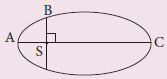
KA > KB >KC
KB < KA < KC
KA < KB < KC
KB > KA > KC
4.
The time period of a satellite orbiting Earth in a cirular orbit is independent of
Radius of the orbit
The mass of the satellite
Both the mass and radius of the orbit
Neither the mass nor the radius of its orbit
5.
If the masses of the Earth and Sun suddenly double, the gravitational force between them will
remain the same
increase 2 times
increase 4 times
decrease 2 times
6.
When a mass is rotating in a plane about a fixed point, its angular momentum is directed along
a line perpendicular to the plane of rotation
the line making an angle of 45o to the plane of rotation
the radius
tangent to the path
7.
The speed of a solid sphere after rolling down from rest without sliding on an inclined plane of vertical height h is,
\( \sqrt \frac{4}{3}gh\)
\( \sqrt \frac{10}{7}gh\)
\(\sqrt{2gh}\)
\( \sqrt \frac{1}{2}gh\)
8.
The ratio of the acceleration for a solid sphere (mass m and radius R) rolling down an incline of angle \(\theta\) without slipping and slipping down the incline without rolling is,
5: 7
2: 3
2: 5
7: 5
9.
From a disc of radius R a mass M, a circular hole of diameter R, whose rim passes through the center is cut. What is the moment of inertia of the remaining part of the disc about a perpendicular axis passing through it
15MR2/32
13MR2/32
11MR2/32
9MR2/32
10.
A wind-powered generator converts wind energy into electric energy. Assume that the generator converts a fixed fraction of the wind energy intercepted by its blades into electrical energy. For wind speed v, the electrical power output will be proportional to
v
v2
v3
v4
11.
If the linear momentum of the object is increased by 0.1% then the kinetic energy is Increased by
0.1 %
0.2 %
0.4 %
0.01 %
12.
The potential energy of a system increases, if work is done
by the system against a conservative force
by the system against a non-conservative force
upon the system by a conservative force
upon the system by a non- conservative force
13.
A closed cylindrical container is partially filled with water. As the container rotates in a horizontal plane about a perpendicular bisector, its moment of inertia
increases
decreases
remains constant
depends on direction of rotation
14.
A body of mass 1 kg is thrown upwards with a velocity 20 ms-1. It momentarily comes to rest after attaining a height of 18 m. How much energy is lost due to air friction?(Take g = 10 ms-2)
20 J
30 J
40 J
10 J
15.
A uniform force of (2\(\hat { i }\)+\(\hat { j }\)) N acts on a particle of mass 1 kg. The particle displaces from position (3\(\hat { j }\)+\(\hat { k }\)) m to (5\(\hat { i }\)+3\(\hat { j }\)) m. The work done by the force on the particle is
9 J
6 J
10 J
12 J
16.
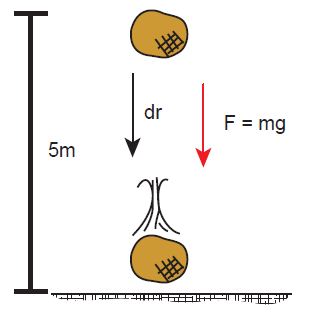
An object of mass 2 kg falls from a height of 5 m to the ground. What is the work done by the gravitational force on the object? (Neglect air resistance; Take g = 10 m s-2)
17.
1. Calculate the value of g in the following two cases:
(a) If a mango of mass ½ kg falls from a tree from a height of 15 meters, what is the acceleration due to gravity when it begins to fall?
(b) Consider a satellite orbiting the Earth in a circular orbit of radius 1600 km above the surface of the Earth. What is the acceleration experienced by the satellite due to Earth’s gravitational force?
18.
If the angular momentum of a planet is given by \(\vec{L}=5t^2\hat i-6t\hat j+3\hat k\) . What is the torque experienced by the planet? Will the torque be in the same direction as that of the angular momentum?
19.
Explain the variation of g with depth from the Earth’s surface.
20.
Two objects of masses 2 kg and 4 kg are moving with the same momentum of 20 kg m s-1.
(a) Will they have same kinetic energy?
(b) Will they have same speed?
21.
A cyclist while negotiating a circular path with speed 20 m s-1 is found to bend an angle by 30° with vertical. What is the radius of the circular path? (given, g = 10 m s-2)
22.
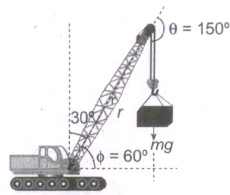
A crane has an arm length of 20 m inclined at 30° with the vertical. It carries a container of the mass of 2 ton suspended from the top end of the arm. Find the torque produced by the gravitational force on the container about the point where the arm is fixed to the crane. [Given: 1 ton = 1000 kg; neglect the weight of the arm. g= 10 ms-2]
23.
A man of mass 50 kg is standing at one end of a boat of mass 300 kg floating on still water. He walks towards the other end of the boat with a constant velocity of 2 ms-1 with respect to a stationary observer on land. What will be the velocity of the boat,
(a) with respect to the stationary observer on land?
(b) with respect to the man walking in the boat?
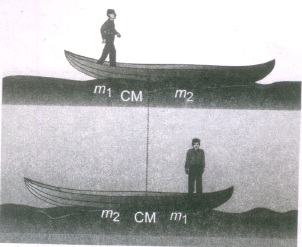
[Given: There is friction between the man and the boat and no friction between the boat and water].
24.
From a uniform disc of radius R, a small disc of radius \(\frac{R}{2}\) is cut and removed as shown in the diagram. Find the center of mass of the remaining portion of the disc.
25.
Define the following
a) Coefficient of restitution
26.
Explain in detail the geostationary and polar satellites.
27.
Derive the time period of satellite orbiting the Earth.
28.
State and prove perpendicular axis theorem.
29.
Derive the expression for moment of inertia of a rod about its center and perpendicular to the rod?
30.
Arrive at an expression for elastic collision in one Dimension and discuss various cases.
31.
Find the moment of inertia of a hydrogen molecule about an axis passing through its center of mass and perpendicular to the inter-atomic axis. Given: mass of hydrogen atom 1.7 x 10⁻²⁷ kg and inter atomic distance is equal to 4 x 10⁻¹⁰m.
32.
A particle of mass 5 units is moving with a uniform speed of v = 3\(\sqrt{2}\) units in the XOY plane along the line y = x + 4. Find the magnitude of angular momentum.
33.
Calculate the change in g value in your district of Tamilnadu. (Hint: Get the latitude of your district of Tamilnadu from the Google). What is the difference in g values at Chennai and Kanyakumari?
34.
What is meant by escape speed in the case of the Earth?
35.
Will the angular momentum of a planet be conserved? Justify your answer.
36.
State Kepler’s three laws.
37.
Consider an object of mass 2 kg moved by an external force 20 N in a surface having coefficient of kinetic friction 0.9 to a distance 10 m. What is the work done by the external force and kinetic friction? Comment on the result. (Assume g = 10 ms-2)
38.
A rolling wheel has velocity of its center of mass as 5 ms-1. If its radius is 1.5 m and angular velocity is 3 rad s-1 then check whether it is in pure rolling or not.
39.
A variable force F = kx2 acts on a particle which is initially at rest. Calculate the work done by the force during the displacement of the particle from x = 0 m to x = 4 m. (Assume the constant k = 1 N m-2)
40.
A box is pulled with a force of 25 N to produce a displacement of 15 m. If the angle between the force and displacement is 30°, find the work done by the force.
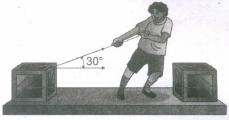
1.
(d)
negative
2.
(c)
can be positive or negative
3.
(a)
KA > KB >KC
4.
Time period T = \(\frac{2\pi}{\sqrt GM_E} (R_E+ h)^\frac{3}{2}\)
\(\therefore\) It is independemt of mass
5.
\(\text { Gravitational force } F \propto m_{1} m_{2}\)
\(\text { If } m_{1}=2 m_{1} \text { and } m_{2}=2 m_{2} \text { then }\)
\(\text { Force } F \propto\left(2 m_{1}\right)\left(2 m_{2}\right)\)
\(\propto 4 m_{1} m_{2}\)
6.
(a)
a line perpendicular to the plane of rotation
7.
Potential energy = Translational kinetic energy + Rotational kinetic energy
\(m g h=\frac{1}{2} m v^{2}+\frac{1}{2} I \omega^{2} \)
\(=\frac{1}{2} m v^{2}+\frac{1}{2} \times \frac{2}{5} M R^{2} \times \frac{v^{2}}{R^{2}}\left[\omega=\frac{v}{R}\right] \)
\(=\frac{1}{2} m v^{2}+\frac{1}{5} m v^{2} \)
\(=\frac{5 m v^{2}+2 m v^{2}}{10}=\frac{7 m v^{2}}{10} \)
\(m g h=\frac{7 m v^{2}}{10} \)
\(g h=\frac{7 v^{2}}{10} \)
\(\therefore v^{2}=\frac{10 g h}{7} \)
\(\therefore v=\frac{\sqrt{10 g h}}{7} \)
8.
Acceleration of the solid sphere while rolling down without slipping
\(a_{1}=\frac{g \sin \theta}{1+\frac{k^{2}}{r^{2}}}\)
Acceleration developed while slipping down \(a_{2}=g \sin \theta\)
\(\text { Required ratio } \frac{a_{1}}{a_{2}}=\frac{g \sin \theta}{1+\frac{k^{2}}{r^{2}}} / g \sin \theta\)
\(\frac{a_{1}}{a_{2}}=\frac{1}{1+\frac{k^{2}}{r^{2}}}\)
\(\text { For a solid sphere } \frac{k^{2}}{r^{2}}=\frac{2}{5}\)
\(\therefore \text { Ratio of accelerations } \frac{a_{1}}{a_{2}}=\frac{1}{1+\frac{2}{5}}\)
\(=\frac{1}{5+\frac{2}{5}}=\frac{1}{\frac{7}{5}}=\frac{5}{7}\)
\(\therefore a_{1}: a_{2}=5: 7 \)
9.
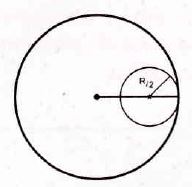
Moment of inertia of a disc
\(\mathrm{I}_{1}=\frac{M R^{2}}{2}\)
\(\text { Mass of small disc }=\frac{M}{\pi R^{2}} \times \pi \times\left(\frac{R}{2}\right)^{2}\)
\(=\frac{M}{\pi R^{2}} \times \frac{\pi R^{2}}{4}=\frac{M}{4}\)
By the theorem of parallel axis, the moment of inertia of the small disc. About an axis passing through 0 is
\(I_{2} =\frac{1}{2} \times \frac{M}{4}\left(\frac{R}{2}\right)^{2}+\frac{M}{4}\left(\frac{R}{2}\right)^{2} \)
\(=\frac{M}{8} \times \frac{R^{2}}{4}+\frac{M}{4} \times \frac{R^{2}}{4} \)
\(=\frac{M R^{2}}{32}+\frac{M R^{2}}{16}=\frac{M R^{2}+2 M R^{2}}{32} \)
\(I_{2} =\frac{3 M R^{2}}{32} \)
Moment of inertia of the remaining part is I= I1 - I2
\(=\frac{M R^{2}}{2}-\frac{3 M R^{2}}{32} \)
\(=\frac{16 M R^{2}-3 M R^{2}}{32}=\frac{13 M R^{2}}{32}\)
\(I =\frac{13 M R^{2}}{32} \)
10.
\(\text { Force }=v \frac{d m}{d t}\)
\(=v \frac{d}{d t} \text { (volume } \times \text { density) }\)
\(=v \frac{d}{d t}(A x p) \)
\(=v A p \frac{d x}{d t} \)
\(=v \times A p \times v \)
\(=A p v^{2} \)
Power = Force x Velocity
\(=A p v^{2} \times v=A p v^{3}\)
\(\therefore \text { Power } \alpha v^{3}\)
11.
\(\text { Kinetic energy } E_{k}=\frac{p^{2}}{2 m}\)
\(\frac{\Delta E_{k}}{E_{k}}=\frac{2 \Delta p}{p}\)
\(\text {Given that } \frac{\Delta p}{p}=0.1\)
∴ Increase in kinetic energy
\(\frac{\Delta E_{k}}{E_{k}}=2 \frac{\Delta p}{p} \)
\(\frac{\Delta E_{k}}{E_{k}}=2 \times 0.1=0.2 \% \)
12.
(a)
by the system against a conservative force
13.
(a)
increases
14.
Mass = 1kg
Velocity v = 20m/s
Height h = 18 m
\(g=10 \mathrm{~m} / \mathrm{s}^{2}\)
\(\text { Potential energy } P . E=m g h\)
\(=1 \times 10 \times 18 =180 \mathrm{~J} \)
\(\text { Kinetic energy } K . E=\frac{1}{2} m v^{2}\)
\(K . E=\frac{1}{2} \times 1(20)^{2}\)
\(=\frac{1}{2} \times 20 \times 20=200 J\)
\(\text { Loss of energy due to air friction }= K.E - P.E\)
\(=200-180=20 \mathrm{~J}\)
15.
\(\text { Force } \overrightarrow{\mathbf{F}}=(2 i+\vec{j}) N\)
\(\text { Displacement } d=(5 \vec{i}+3 \vec{j})-(3 \vec{j}+\vec{k})\)
\(=(5 i-k) m\)
\(\text { Work done } W=F . d\)
\(=(2 \vec{i}+\vec{j})(5 i-k)\)
\(=10-0-0=10 J \)
16.
In this case the force acting on the object is downward gravitational force \(m\vec{g}\). This is a constant force.
Work done by gravitational force is
\(W=\int^{r_f}_{r_i}\vec{F}.d\vec{r}\)
\(W = (F \ cos\theta)\int^{r_f}_{r_i}dr=(mg\ cos \theta)(r_f-r_i)\)
The object also moves downward which is in the direction of gravitational force (\(\vec F\) = \(m\vec{g}\)) as shown in figure. Hence, the angle between them is θ = 0°; cos 0° = 1 and the displacement, (rf - ri) = 5m
W = mg (rf - ri)
W = 2 × 10 × 5 = 100 J
The work done by the gravitational force on the object is positive.
17.
a) \(g'=g\left( 1-2\frac { h }{ { R }_{ e } } \right) \)
\(g'=9.8\left( 1-\frac { 2\times 15 }{ 6400\times { 10 }^{ 3 } } \right) \)
\(g'=9.8\left( 1-0.468\times { 10 }^{ -5 } \right) \)
But 1 - 0.00000468 \(\cong \)1
Therefore g' = g
\(g'=g\left( 1-2\frac { h }{ { R }_{ e } } \right) \)
\(g'=g\left( 1-\frac { 2\times 1600\times { 10 }^{ 3 } }{ 6400\times { 10 }^{ 3 } } \right) \)
\(g'=g\left( 1-\frac { 2 }{ 4 } \right) \)
\(g'=g\left( 1-\frac { 1 }{ 2 } \right) =g/2\)
18.
Angular momentum \(\mathrm{L} =5 t^{2} \hat{i}-6 t \hat{j}+3 \hat{k} \)
\(\text {Torque } \propto \frac{d L}{d t}
\)
\(=\frac{d}{d t}\left[5 t^{2} \hat{i}-6 t \hat{j}+3 \hat{k}\right]=10 t \hat{i}-6 \hat{j}\)
19.
Variation of g with depth:
Consider a particle of mass m which is in a deep mine on the Earth. (Example: coal mines -in Neyveli). Assume the depth of the mine as d. To calculate g' at a depth d, consider the following points.
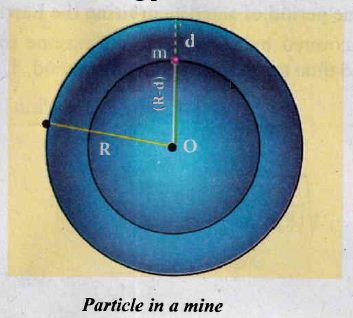
The part of the Earth which is above the radius (Re - d) do not contribute to the acceleration. The e· result is proved earlier and is given as
g' = \(\frac { GM' }{ ({ R }_{ e }-d)^{ 2 } } \)
Here M' is the mass of the Earth of radius (Re - d)
Assuming the density of Earth p to be constant
\(\rho =\frac { M' }{ V' } \)
where M is the mass of the Earth and V its volume, Thus
\(\rho =\frac { M' }{ V' } \)
\(\frac { M' }{ V' } =\frac { M }{ V } \) and M' = \(\frac { M }{ V } V'\)
M' = \(\left( \frac { M }{ \frac { 4 }{ 3 } \pi { R }_{ e }^{ 3 } } \right) \left( \frac { 4 }{ 3 } \pi ({ R }_{ e }-d)^{ 3 } \right) \)
M'=\(\frac { M }{ { R }_{ e }^{ 3 } } \)(Re - d)3
g' = G\(\frac { M }{ { R }_{ e }^{ 3 } } \)(Re - d)3.\(\frac { 1 }{ ({ R }_{ e }-d)^{ 2 } } \)
g' = GM \(\frac { R_{ e }\left( 1-\frac { d }{ { R }_{ e } } \right) }{ { R }_{ e }^{ 3 } } \)
g' = GM \(\frac { \left( 1-\frac { d }{ { R }_{ e } } \right) }{ { R }_{ e }^{ 2 } } \)
Thus
g' = g \(\left( 1-\frac { d }{ { R }_{ e } } \right) \)
Here also g' < g. As depth increases, g' decreases. It is very interesting to know that acceleration due to gravity is maximum on the surface of the Earth but decreases when we go either upward or downward.
20.
(a) The kinetic energy of the mass is given by \(KE=\frac { { p }^{ 2 } }{ 2m } \)
For the object of mass 2 kg, kinetic energy is KE1 = \(\frac { ({ 20 })^{ 2 } }{ 2\times 2 } =\frac { 400 }{ 4 } =100 \ J\)
For the object of mass 4 kg, kinetic energy is KE2 = \(\frac { { (20) }^{ 2 } }{ 2\times 4 } =\frac { 400 }{ 8 } =50 \ J\)
Note that KE1 \(\neq \) KE2 i.e., even though both are having the same momentum, the kinetic energy of both masses is not the same. The kinetic energy of the heavier object has lesser kinetic energy than smaller mass. It is because the kinetic energy is inversely proportional to the mass (KE \(\infty \frac { 1 }{ m } \) ) for a given momentum.
(b) As the momentum, p = mv, the two objects will not have same speed.
21.
Speed of the cyclist, v = 20 m s-1
Angle of bending with vertical, θ = 30°
Equation for angle of bending, \(tan \theta=\frac{v^{2}}{rg}\)
Rewriting the above equation for radius r = \(\frac{v^{2}}{tan \theta g}\)
Substituting, \(r=\frac{(20)^{2}}{(tan 30^{\theta}\times 10)}=\frac{20\times 20}{(tan 30^{\theta})\times 10}=\frac{400}{(\frac{1}{\sqrt{3}}\times10)}\)
\(r=(\sqrt{3})\times 40=1.732 \times 40\)
r = 69.28 m
22.
The force F at the point of suspension is due to the weight of the hanging mass.
F = mg = 2\(\times\) 1000 \(\times\) 10 = 20000 N;
The arm length, r = 20 m
We can solve this problem by three different methods.
Method-I:
The angle (\(\theta\)) between the arm length (r) and the force (F) is, \(\theta\) = 150°
The torque (\(\tau\)) about the fixed point of the arm is,
\(\tau=rF sin\theta\)
\(\tau=20\times 20000\times sin(150^o)\)
= 400000\(\times sin(90^o+60^o)\) [here, sin\((90^{0}+\theta)=cos \theta\)]
= 400000 x cos (60o)
= \(400000\times \frac{1}{2}[cos 60^o=\frac{1}{2}]=200000\) Nm
\(\tau=2\times 10^{5}\)Nm
Method-II:
Let us take the force and perpendicular distance - from the point where the arm is fixed to the crane.
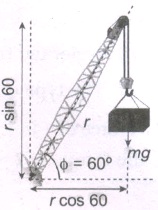
\(\tau=(r\bot )F\)
\(\tau=r \cos \phi\ mg\)
\(\tau=20\times cos 60^o \times 20000\)
= \(20 \times \frac{1}{2}\times 20000=200000\) Nm
\(\tau=2\times 10^{5}Nm\)
Method-III:
Let us take the distance from the fixed point and perpendicular force.
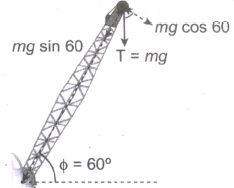
\(\tau=(r \bot)F\)
\(\tau= r\ mg \cos\phi\)
\(\tau=20\times 20000 \times cos 60^{0}\)
= \(20\times 20000\times \frac{1}{2}=200000 Nm\)
\(\tau=2\times 10^{5} Nm\)
All the three methods, give the same answer.
23.
Mass of the man (m1) is, m1= 50 kg
Mass of the boat (m2) is, m2 = 300 kg
With respect to a stationary observer:
The man moves with a velocity, v1 = 2 m s-1 and the boat moves with a velocity v2 (which is to be found)
(i) To determine the velocity of the boat with respect to a stationary observer on land. As there is no external force acting on the system, the man and boat move due to the friction, which is an internal force in the boat-man system. Hence, the velocity of the center of mass is zero (VCM= 0). Using equation,
\(\overrightarrow{{v}}_{CM}=\frac{\sum { m_1v_1} }{\sum{m_1}}=\frac{m_1v_1+m_2v_2}{m_1+m_2}\)
0 = \(\frac{\sum{m_1v_1}}{\sum{m_1}}=\frac{m_1v_1+m_2v_2}{m_1+v_2}\)
0 = m1v1 + m2v2 - m2v2 = m1v1
-m2v2 = m1v1
\(v_2=-\frac{m_1}{m_2}v_1\)
\(v_2= -\frac{50}{300}\times 2= -\frac{100}{300}\)
v2 = -0.33 ms-1
The negative sign in the answer implies that the boat moves in a direction opposite to that of the walking man on the boat to a stationary observer on land.
(ii) To determine the velocity of the boat with respect to the walking man: We can find the relative velocity as
v21 = v2 - v1
where, v21 is the relative velocity of the boat with respect to the walking man.
v21 = (-0.33)-(2)
v21 = -2.33 ms-1
The negative sign in the answer implies that the boat appears to move in the opposite direction to the man walking in the boat.
24.
Let us consider the mass of the uncut full disc be M. Its center of mass would be at the geometric center of the disc on which the origin coincides.
Let the mass of the small disc cut and removed be m and its center of mass is at a position \(\frac{R}{2}\) to the right of the origin as shown in the figure.
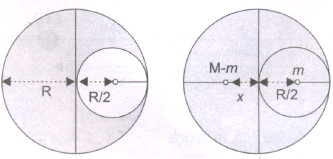
Hence, the remaining portion of the disc should have its center of mass to the left of the origin say at a distance x. We can write from the principle of moments,
\((M-m)x=(m)\frac{R}{2}\)
\(x=(\frac{m}{M-m})\frac{R}{2}\)
If \(\sigma\) is the surface mass density (i.e. mass per unit surface area.), \(\sigma=\frac{M}{\pi R^{2}}\); then, the mass m of small disc is
m = surface mass density\(\times\) surface area
\(m=\sigma \times \pi (\frac{R}{2})^{2}\)
\(m=(\frac{M}{\pi R^{2}})\pi (\frac{R}{2})^{2}=\frac{M}{\pi R^{2}}\pi \frac{R^{2}}{4}=\frac{M}{4}\)
substituting m in the expression for x
\(x=\frac{\frac{M}{4}}{(M-\frac{M}{4})}\times \frac{R}{2}=\frac{\frac{M}{4}}{(\frac{3M}{4})}\times \frac{R}{2}\)
\(x=\frac{R}{6}\)
The center of mass of the remaining portion is at a distance \(\frac{R}{6}\) to the left from the center of the disc.
25.
(a) Coefficient of restitution
It is defined as the ratio of velocity of separation (relative velocity) after collision to the velocity of approach (relative velocity) before collision.
\(e=\frac{v_2-v_1}{u_1-u_2}\)
26.
(i) The satellites orbiting the Earth have different time periods corresponding to different orbital radii. Orbital radius of a satellite if its time period is 24 hours is calculated below:
Kepler's third law is used to find the radius of the orbit.
T2 = \(\frac { 4\pi ^{ 2 } }{ { GM }_{ E } } \) (RE + h)3
(RE + h)3 = \(\frac { { GM }_{ E }{ T }^{ 2 } }{ 4\pi ^{ 2 } } \)
RE + h = \(\left( \frac { { GM }_{ E }{ T }^{ 2 } }{ 4\pi ^{ 2 } } \right) ^{ 1/3 }\)
(ii) Substituting for the time period (24 hrs = 86400 seconds), mass, and radius of the Earth, h turns out to be 36,000 km. Such Satellites are called "geo-stationary satellites", They appear to be stationary when seen from Earth.
India uses the INSAT group of satellites that are basically geo-stationary satellites for the purpose of telecommunication.
Another group of satellite which is placed at a distance of 500 to 800 km from the surface of the Earth orbits the Earth from north to south direction. This type of satellite that orbits Earth from North Pole to South Pole is called a polar satellite. The time period of a polar satellite is nearly 100 minutes and the satellite completes many revolutions in a day. A polar satetrlite covers a small strip of area from pole to pole during one revolution it covers a different strip of area since the Earth would have moved by a small angle. In this way polar satellites cover the entire surface area of the Earth.
27.
The distance covered by the satellite during one rotation in its orbit is equal to 2\(\pi\)(RE + h) and time taken for it, is the time period, T. Then
\(\text{speed v} =\frac { Distance \ travelled }{ Time \ taken } =\frac { 2\pi ({ R }_{ E }+h) }{ T } \)
From equation
\(\sqrt { \frac { { GM }_{ E } }{ ({ R }_{ E }+h) } } =\frac { 2\pi ({ R }_{ E }+h) }{ T } \) ...(1)
T = \(\frac { 2\pi }{ \sqrt { G{ M }_{ E } } } \)(RE + h)3/2 ....(2)
Squaring both sides of the equation (2), we get
T2 = \(\frac { 4\pi ^{ 2 } }{ { GM }_{ E } } \) = (RE + h)3
\(\frac { 4\pi ^{ 2 } }{ { GM }_{ E } } \) = constant say c
T2 = T2 = c(RE + h)3 ...(3)
Equation (3) implies that a satellite orbiting the Earth has the same relation between time and distance as that of Kepler's law of planetary motion. For a satellite orbiting near the surface of the Earth, h is negligible compared to the radius of the Earth RE Then,
T2 = \(\frac { 4\pi ^{ 2 } }{ { GM }_{ E } } \) = RE2
T2 = \(\frac { 4\pi ^{ 2 } }{ { { GM }_{ E } }/{ { R }_{ E }^{ 2 } } } R_E\)
T2 = \(\frac { { 4\pi }^{ 2 } }{ g } \)RE
Since\(\frac { { GM }_{ E } }{ { R }_{ E }^{ 2 } } \) = g
T = \(2\pi \sqrt { \frac { { R }_{ E } }{ g } } \) ......(4)
By substituting the values of RE = 6.4 x 10⁶ m and g = 9.8 ms-2, the orbital time period is obtained as T ≅ 85 minutes.
28.
Perpendicular axis theorem:
(i) The theorem states that the moment of inertia of a plane laminar body about an axis perpendicular to its plane is equal to the sum of moments of inertia about two perpendicular axes lying in the plane of the body such that all the three axes are mutually perpendicular and have a common point.
(ii) Let the X and Y-axes lie in the plane and Z-axis perpendicular to the plane of the laminar object. If the moments of inertia of the body about X and Y-axes are Ix and Iy respectively and It is the moment of inertia about Z-axis, then the perpendicular axis theorem could be expressed as,
Iz = Ix + Iy
(iii) To prove this theorem, let us consider a plane laminar object of negligible thickness on which lies the origin (0). The X and Y-axes lie on the plane and Z-axis is perpendicular to it as shown in Figure. The lamina is considered to be made up of a large number of particles of mass m. Let us choose one such particle at a point P which has coordinates (x, y) at a distance r from O.
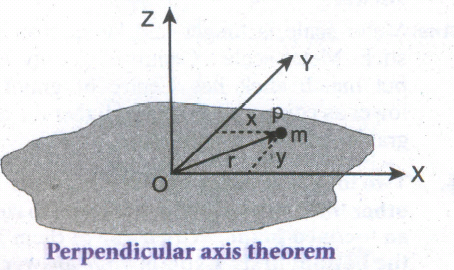
(iv) The moment of inertia of the particle about Z axis is mr2. The summation of the above expression gives the moment of inertia of the entire lamina about Z-axis as, Iz = \(\Sigma \)mr2
Here r2 = x2 + y2
Then, Iz = \(\Sigma \)(x2 +y2)
Iz = \(\Sigma \)mx2 + \(\Sigma \)my2
(v) In the above expression, the term \(\Sigma \)mx2 is the moment of inertia of the body about the Y-axis and similarly the term \(\Sigma \)my2 is the moment of inertia about X-axis. Thus,
Ix= \(\Sigma \)my2and Iy= \(\Sigma \)mx2
Substituting in the equation for Iz gives,
Iz = Ix + Iy
Y-axis and similarly the term \(\Sigma \)my2 is the moment of inertia about X-axis. Thus,
IX = \(\Sigma \)my2and Iy= \(\Sigma \)mx2
Substituting in the equation for Iz gives,
Iz = Ix + Iy
Thus, the perpendicular axis theorem is proved.
29.
Let us consider a uniform rod of mass (M) and length (1) as shown in Figure. Let us find an expression for moment of inertia of this rod about an axis that passes through the center of mass and perpendicular to the rod. First an origin is to be fixed for the coordinate system so that it coincides with the center of mass, which is also the geometric center of the rod. The rod is now along the x axis. We take an infinitesimally small mass (dm) at a distance (x) from the origin. The moment of inertia (dI) of this mass (dm) about the axis is,
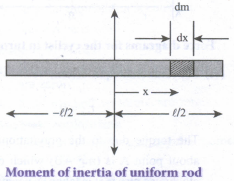
dI = (dm) x2
As the mass is uniformly distributed, the mass per unit length (λ) of the rod is, \(\lambda =\frac { M }{ l } \)
The (dm) mass of the infinitesimally small length as, dm = λ dx = \(\frac { M }{ l } dx\)
The moment of inertia (I) of the entire rod can be found by integrating dI,
\(I=\int { dI } =\int { \left( dm \right) { x }^{ 2 } } =\int { \left( \frac { M }{ l } dx \right) { x }^{ 2 } } \)
\(I=\frac { M }{ l } \int { { x }^{ 2 }dx } \)
As the mass is distributed on either side of the origin, the limits for integration are taken from -1/2 to 1/2.
\(I=\frac { M }{ l } \int _{ -t/2 }^{ t/2 }{ { x }^{ 2 }dx=\frac { M }{ l } } \left[ \frac { { x }^{ 3 } }{ 3 } \right] ^{ t/2 }_{ -t/2 }\)
\(I=\frac { M }{ l } \left[ \frac { { l }^{ 3 } }{ 24 } -\left( -\frac { { l }^{ 3 } }{ 24 } \right) \right] =\frac { M }{ l } \left[ \frac { { l }^{ 3 } }{ 24 } +\frac { { l }^{ 3 } }{ 24 } \right] \)
\(I=\frac { M }{ l } \left[ 2\left( \frac { { l }^{ 3 } }{ 24 } \right) \right] \)
I = \(\frac { 1 }{ 12 } \) ml2
30.
Consider two elastic bodies of masses m1 and m2 moving in a straight line (along positive x-direction) on a frictionless horizontal.
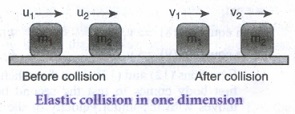
| Mass | Initial Velocity | Final Velocity |
| Mass m1 | u1 | v1 |
| Mass m2 | u2 | v2 |
(i) In order to have collision, we assume that the mass m1 moves faster than mass m2 i.e., u1 > u2 For elastic collision, the total linear momentum and kinetic energies of the two bodies before and after collision must remain the same.
| Momentum of mass m1 | Momentum of mass m2 | Total linear momentum | |
| Before collision | Pi1 = m1u1 | Pi2 = m2u2 | Pi = pi1 + Pi2 Pi = m1u1 + m2u2 |
| After collision | Pf1 = m1v1 | Pf2 = m2v2 | Pf = Pf1 + Pf2 Pf = m1v1 + m2v2 |
From the law of conservation of linear momentum,
Total momentum before collision (pi) = Totai momentum after collision (Pf)
Further,
m1u1 + m2u2 = m1v1 + m2vs ...........(1)
or
m1 (u1 - v1) = m2 (v2 - u2) ...............(2)
| Kinetic energy of mass m1 | Kinetic energy of mass m2 | Total kinetic energy | |
| KEi = KEi1 + KEi2 | |||
| Before collision |
KEi1 = \(\frac { 1 }{ 2 } { m }_{ 1 }{ u }_{ 1 }^{ 2 }\) | KEi2 = \(\frac { 1 }{ 2 } { m }_{ 1 }{ u }_{ 2 }^{ 2 }\) | KEi = \(\frac { 1 }{ 2 } { m }_{ 1 }{ u }_{ 1 }^{ 2 }\) + \(\frac { 1 }{ 2 } { m }_{ 1 }{ u }_{ 2 }^{ 2 }\) KEi = KEi1 + KEi2 |
| After collision | KEf1 = \(\frac { 1 }{ 2 } { m }_{ 1 }{ v }_{ 1 }^{ 2 }\) | KEf2 = \(\frac { 1 }{ 2 } { m }_{ 1 }{ v }_{ 2 }^{ 2 }\) | KEf1 = \(\frac { 1 }{ 2 } { m }_{ 1 }{ v }_{ 1 }^{ 2 }\) + \(\frac { 1 }{ 2 } { m }_{ 1 }{ v }_{ 2 }^{ 2 }\) |
For elastic collision,
Total kinetic energy before collision KEi = Total kinetic energy after collision KEf.
\(\frac { 1 }{ 2 } { m }_{ 1 }{ u }_{ 1 }^{ 2 }+\frac { 1 }{ 2 } { m }_{ 2 }{ u }_{ 2 }^{ 2 }=\frac { 1 }{ 2 } { m }_{ 1 }{ v }_{ 1 }^{ 2 }+\frac { 1 }{ 2 } { m }_{ 2 }{ v }_{ 2 }^{ 2 }\) ................(3)
After simplifying and rearranging the terms,
\({ m }_{ 1 }\left( { u }_{ 1 }^{ 2 }-{ v }_{ 1 }^{ 2 } \right) ={ m }_{ 2 }\left( { v }_{ 2 }^{ 2 }-{ u }_{ 2 }^{ 2 } \right) \)
Using the formula a2 - b2 = (a + b) (a - b), we can rewrite the above equation as
m1 (u1 + v1) (u1 - v1) = m2 (v2 + u2) (v2 - u2) .................(4)
Dividing equation (4) by (2) gives,
\(\frac { { m }_{ 1 }\left( { u }_{ 1 }+{ v }_{ 1 } \right) \left( { u }_{ 1 }-{ v }_{ 1 } \right) }{ { m }_{ 1 }\left( { u }_{ 1 }-{ v }_{ 1 } \right) } =\frac { { m }_{ 2 }\left( { u }_{ 2 }+{ v }_{ 2 } \right) \left( { u }_{ 2 }-{ v }_{ 2 } \right) }{ { m }_{ 2 }\left( { u }_{ 2 }-{ v }_{ 2 } \right) } \)
u1 + v1 = v2 + u2
u1 - u2 = v2 - v1 .............(5)
Equation (5) can be rewritten as
(u1 - u2) = -(v1 - v2)
This means that for any elastic head on collision, the relative speed of the two elastic bodies after the collision has the same magnitude as before collision but in opposite direction. Further note that this result is independent of mass.
Rewriting the above equation for v1 and v2,
v1 = v2+ u2 - u1 .........(6)
or
v2 = u1 + v1 - u2 ............(7)
To find the final velocities v1 and v2:
Substituting equation (7) in equation (2) gives the velocity of ml as
m1 (u1 - vI) = m2 (u1 + v1 - u2 - u2)
m1 (u1 - v1) = m2 (u1 + v1 - 2u2)
m1u1 - m1v1 = m2u1 + m2v1 - 2m2u2
m1u1 - m2u1 + 2m2u2 = m1v1 + m2v1
(m1 - m2)u1 + 2m2u2 = (m1 + m2) v1
or \({ v }_{ 1 }=\left( \frac { { m }_{ 1 }-{ m }_{ 2 } }{ { m }_{ 1 }+{ m }_{ 2 } } \right) { u }_{ 1 }+\left( \frac { { 2m }_{ 2 } }{ { m }_{ 1 }+{ m }_{ 2 } } \right) { u }_{ 2 }\) ............(8)
Similarly, by substituting (6) in equation (2) or substituting equation (8) in equation (7), we get the final velocity of m2 as
\({ v }_{ 2 }=\left( \frac { { 2m }_{ 1 } }{ { m }_{ 1 }+{ m }_{ 2 } } \right) { u }_{ 1 }+\left( \frac { { m }_{ 2 }-{ m }_{ 1 } }{ { m }_{ 1 }+{ m }_{ 2 } } \right) { u }_{ 2 }\) ............... (9)
Case 1:
When bodies has the same mass i.e., m1 = m2,
equation (8) \(\Rightarrow { v }_{ 1 }=\left( 0 \right) { u }_{ 1 }+\left( \frac { { 2m }_{ 2 } }{ { 2m }_{ 2 } } \right) { u }_{ 2 }\)
v1 = u2 ...........................(10)
equation (9) \(\Rightarrow { v }_{ 2 }=\left( \frac { { 2m }_{ 1 } }{ { 2m }_{ 1 } } \right) { u }_{ 1 }+\left( 0 \right) { u }_{ 2 }\)
v2 = u1 ..........................(11)
The equations (10) and (11) show that in one dimensional elastic collision when two bodies of equal mass collide after the collision their velocities are exchanged.
Case 2:
When bodies have the same mass i.e., m1 = m2 and second body (usually called target) is at rest (u2 = 0),
By substituting m1 = m2 = and u2 = 0 in equations (8) and (9).
we get,
from equation (8) => v1 = 0 (..................... 12)
from equation (9) => v2 = u1 ( .................. 13)
Equations (12) and (13) show that when the first body comes to rest the second body moves with the initial velocity of the first body.
Case 3:
The first body is very much lighter than the second body
\(\left( { m }_{ 1 }<{ m }_{ 2 },\frac { { m }_{ 1 } }{ { m }_{ 2 } } <1 \right) \) then the ratio \(\frac { { m }_{ 1 } }{ { m }_{ 2 } } = 0\) and also if the target is at rest (u2 = 0)
Dividing numerator and denominator of equation (8) by m2, we get
\({ v }_{ 1 }=\left( \frac { \frac { { m }_{ 1 } }{ { m }_{ 2 } } -1 }{ \frac { { m }_{ 1 } }{ { m }_{ 2 } } +1 } \right) { u }_{ 1 }+\left( \frac { 2 }{ \frac { { m }_{ 1 } }{ { m }_{ 2 } } +1 } \right) \left( 0 \right) \)
\({ v }_{ 1 }=\left( \frac { 0-1 }{ 0+1 } \right) { u }_{ 1 }\)
v1 = - u1 ............................(14)
Similarly,
Dividing numerator and denominator of equation (9) by m2, we get
\({ v }_{ 2 }=\left( \frac { 2\frac { { m }_{ 1 } }{ { m }_{ 2 } } }{ \frac { { m }_{ 1 } }{ { m }_{ 2 } } +1 } \right) { u }_{ 1 }+\left( \frac { 1-\frac { { m }_{ 1 } }{ { m }_{ 2 } } }{ \frac { { m }_{ 1 } }{ { m }_{ 2 } } +1 } \right) \left( 0 \right) \)
\({ v }_{ 2 }=\left( 0 \right) { u }_{ 1 }+\left( \frac { 1-\frac { { m }_{ 1 } }{ { m }_{ 2 } } }{ \frac { { m }_{ 1 } }{ { m }_{ 2 } } +1 } \right) \left( 0 \right) \)
v2 = 0 ..............................(15)
The equation (14) implies that the first body which is lighter returns back (rebounds) in the opposite direction with the same initial velocity as it has a negative sign. The equation (15) implies that the second body which is heavier in mass continues to remain at rest even after collision. For example, if a ball is thrown at a fixed wall, the ball will bounce back from the wall with the same velocity with which it was thrown but in opposite direction.
Case 4:
The second body is very much lighter than the first body
\(\left( { m }_{ 2 }<<{ m }_{ 1 },\frac { { m }_{ 2 } }{ { m }_{ 1 } } <<1 \right) \) then the ratio \(\frac { { m }_{ 2 } }{ { m }_{ 1 } } = 0\) and also if the target is at rest (u2 = 0).
Dividing numerator and denominator of equation 8 by m1 we get
\({ v }_{ 1 }=\left( \frac { 1-\frac { { m }_{ 2 } }{ { m }_{ 1 } } }{ 1+\frac { { m }_{ 2 } }{ { m }_{ 1 } } } \right) { u }_{ 1 }+\left( \frac { 2\frac { { m }_{ 2 } }{ { m }_{ 1 } } }{ 1+\frac { { m }_{ 2 } }{ { m }_{ 1 } } } \right) \left( 0 \right) \)
\({ v }_{ 1 }=\left( \frac { 0-1 }{ 0+1 } \right) { u }_{ 1 }+\left( \frac { 0 }{ 1+0 } \right) \left( 0 \right) \)
v1 = u1 .....................(16)
Dividing numerator and denominator of equation (14) by m1 we get
\({ v }_{ 2 }=\left( \frac { 2 }{ 1+\frac { { m }_{ 2 } }{ { m }_{ 1 } } } \right) { u }_{ 1 }+\left( \frac { \frac { { m }_{ 2 } }{ { m }_{ 1 } } -1 }{ 1+\frac { { m }_{ 2 } }{ { m }_{ 1 } } } \right) \left( 0 \right) \)
\({ v }_{ 2 }=\left( \frac { 2 }{ 1+0 } \right) { u }_{ 1 }\)
v2 = 2u1 ....................(17)
The equation (16) implies that the first body which is heavier continues to move with the same initial velocity. The equation (17) suggests that the second body which is lighter will move with twice the initial velocity of the first body. It means that the lighter body is thrown away from the point of collision.
31.
\(\text {Mass of each H-atom }=1.7 \times 10^{-27} \mathrm{~kg}\)
Distance of each H-atom from the axis of rotation = 2 x 10⁻¹⁰ m.
Moment of inertia of a hydrogen molecule
\(\text {I } =m r^{2}+m r^{2}
\)
\(\text {I } =2 m r^{2}
\)
\(=2 \times 1.7 \times 10^{-27} \times\left(2 \times 10^{-10}\right)^{2}
\)
\(=2 \times 1.7 \times 4 \times 10^{-27-20}=13.6 \times 10^{-47}
\)
\(\text {I } =1.36 \times 10^{-46} \mathrm{kgm}^{2}\)
32.
Mass of a particular = 5 units
Uniform speed v = 3\(\sqrt{2}\) units
y = x + 4
Angular momentum, L = I\(\omega\)
L = mr2\(\omega\)
\(\omega=\frac{v}{r}\)
\(\therefore L=m\frac{r^2av}{r}\)
L = mvr 5 x 3\(\sqrt{2}\) x 2\(\sqrt{2}\)
= 60 units
33.
\(\mathrm{g}_{\text {latitude'}} \ g^{\prime}=g-\omega^{2} R \cos ^{2} \lambda\)
Value of latitude of g at Chennai \(\simeq 13^{\circ}\)
\(\operatorname{Cos} 13^{\circ} =0.2268 \mathrm{rad}
\)
\(\omega =\frac{2 \pi}{T}=\frac{2 \pi}{24 \times 3600}
\)
\(=\frac{2 \pi}{86400}=\frac{2 \times 3.14}{86400}
\)
\(\therefore \omega^{2} R =\left(\frac{2 \times 3.14}{86400}\right)^{2} \times\left(6400 \times 10^{3}\right)
\)
\(=3.4 \times 10^{-2} \mathrm{~m} / \mathrm{s}^{2}
\)
\(\mathrm{g}_{\text {Cbeanai }} =\mathrm{g}-\omega^{2} R \cos ^{2} \lambda
\)
\(=9.8-\left(3.4 \times 10^{-2}\right)^{2} \cos (0.2268)^{2}
\)
\(\mathrm{~g}_{\text {Chennai }} =9.7677 \mathrm{~m} / \mathrm{s}^{2}\)
Value of latitude at Kanyakumari
\(=8.088^{\circ} \mathrm{N}=8.08=8.1^{\circ} \mathrm{N}
\)
\(\omega =\frac{2 \pi}{T}=\frac{2 \times 3.14}{86400}
\)
\(\omega^{2} R =\left(\frac{2 \times 3.14}{86400}\right)^{2} \times\left(6400 \times 10^{3}\right)
\)
\(=3.4 \times 10^{2} \mathrm{~m} / \mathrm{s}^{2}\)
\(\mathrm{g}_{\text {Kanyakumari }} =g-\omega^{2} R \cos ^{2} \lambda
\)
\(=9.8-\left(3.4 \times 10^{2}\right)^{2}\left[\cos \left(8.1^{\circ}\right)\right]^{2}
\)
\(g_{\text {Kanyakumari }} =9.798 \mathrm{~ms}^{-2}
\)
\(\Delta g =9.798-9.767=0.031 \mathrm{~ms}^{-2}\)
34.
Escape speed is the minimum speed of an object thrown vertically up such that it escapes the Earth's gravity and would never come back.
35.
Yes, the angular momentum of a planet is conserved.
During the orbitary motion of the planets around the Sun, the line of action of gravitational force passes through the axis, the external torque is zero. Hence the angular momentum is conserved.
Torque, \( { \tau } =\frac { dL }{ dt }\)
If torque is zero then angular momentum (L) is constant i.e., it is conserved.
36.
1. Law of orbits
Each planet moves around the Sun in an elliptical orbit with the Sun at one of the foci.
2. Law of area
The radial vector (line joining the Sun to a planet) sweeps equal areas in equal intervals of time.
3. Law of period
The square of the time period of revolution of a planet around the Sun in its elliptical orbit is directly proportional to the cube of the semi major axis of the ellipse. It can be written as :
\(T^{2} \propto a^{3} \)
\(\frac{T^{2}}{a^{3}}=\text { constant. }\)
37.
m = 2 kg, d = 10 m, Fext = 20 N, \(\mu\)k = 0.9.
when an object is in motion on he horizontal surface, it experiences two forces.
(a) External force, Fext = 20 N
(b) Kinetic friction,
fk = \(\mu\)k mg = 0.9 \(\times\) (2) \(\times\) 10 = 18N
The work done by the external force Wext = Fd = 20 x 10 = 200J
The work done by the force of kinetic friction Wk = fkd = (-18) \(\times\) 10 = -180 J. Here the negative sign implies that the force of kinetic friction is opposite to the direction of displacement.
The total work done on the object Wtotal = Wext + Wk = 200 J - 180 J = 20 J.
Since the friction is a non-conservative force, out of 200 J given by the external force, the 180 J is lost and it can not be recovered.
38.
Translational velocity (VTRANS) or velocity of center of mass, VCM = 5 m s-1
The radius is, R = 1.5 m and the angular velocity is, \(\omega\) = 3 rad s-1
Rotational velocity, VROT = R\(\omega\)
VROT = 1.5 x 3
VROT = 4.5 ms-1
As vCM > R\(\omega\) (or) VTRANS> R\(\omega\), It is not in pure rolling but sliding.
39.
Work done, \(W-\int^{x_f}_{x_i}F(x)dx=k\int_0^4x^2 dx={64\over 3}Nm\)
40.
Force, F = 25 N
Displacement, dr = 15 m
Angle between F and dr, θ = 30°
Work done, W = F dr cos θ
W = 25 x 15 x cos 30° = 25\(\times\)15\(\times\) \(\sqrt3\over 2\)
W = 324.76 J

11th Standard Syllabus & Materials
11th Standard
TN 11th Tamil பீடு பெற நில் - செய்யுள் - காவடிச்சிந்து Important Questions And Answers Study Material - QB365 Set A
NEW11th Standard
TN 11th Tamil பீடு பெற நில் - உரைநடை - மலை இடப்பெயர்கள் : ஓர் ஆய்வு Important Questions And Answers Study Material - QB365 Set A
NEW11th Standard
TN 11th Tamil மாமழை போற்றுதும் - துணைப்பாடம் - யானை டாக்டர் Important Questions And Answers Study Material - QB365 Set A
NEW11th Standard
TN 11th Tamil மாமழை போற்றுதும் - செய்யுள் - ஐங்குறுநூறு Important Questions And Answers Study Material - QB365 Set A



Tamilnadu Stateboard 11th Standard Subjects

Maths

Commerce

Economics

Biology

Business Maths and Statistics

Accountancy

Computer Science
Physics

Chemistry
Maths
Biology
Economics
Physics
Chemistry

History
Business Maths and Statistics

Computer Science
Accountancy

Computer Applications
History
Computer Technology
Commerce
Computer Applications
Computer Technology

Tamil

English

French
Tamilnadu Stateboard Standards


