
 100% FREE ACCESS
11th Standard Syllabus & Materials
11th Standard
TN 11th Tamil இயற்கை வேளாண்மை,சுற்றுச்சூழல் -செய்யுள் - மனோன்மணீயம் Important Questions And Answers Study Material - QB365 Set A
NEW11th Standard
TN 11th Tamil என்னுயிர் என்பேன் -துணைப்பாடம் - இசைத்தமிழர் இருவர் Important Questions And Answers Study Material - QB365 Set A
NEW11th Standard
TN 11th Tamil மொழி கலை -செய்யுள் - ஒவ்வொரு புல்லையும் Important Questions And Answers Study Material - QB365 Set A
NEW11th Standard
TN 11th Tamil பீடு பெற நில் - இலக்கணம் - பகுபத உறுப்புகள் Important Questions And Answers Study Material - QB365 Set A
NEW11th Standard
TN 11th Tamil பீடு பெற நில் - துணைப்பாடம் - வாடிவாசல் Important Questions And Answers Study Material - QB365 Set A
NEW11th Standard
TN 11th Tamil பீடு பெற நில் - செய்யுள் - குறுந்தொகை Important Questions And Answers Study Material - QB365 Set A

Published on: 24/08/2026
Download Tamil Nadu 11th Standard Physics question papers, model tests, one-mark questions, important questions, and public exam papers in PDF format. Free study materials and answer keys for TN State Board students.
Questions + Answers key
Take MCQ Physics Test
1.
A student tunes his guitar by striking a 120 Hertz with a tuning fork, and simultaneously plays the 4th string on his guitar. By keen observation, he hears the amplitude of the combined sound oscillating thrice per second. Which of the following frequencies is the most likely the frequency of the 4th string on his guitar?
130
117
110
120
2.
A mass of 3 kg is attached at the end of a spring moves with simple harmonic motion on a horizontal frictionless table with time period 2π and with amplitude of 2m, then the maximum fore exerted on the spring is
1.5 N
3 N
6 N
12 N
3.
Which of the following gases will have least rms speed at a given temperature?
Hydrogen
Nitrogen
Oxygen
Carbon dioxide
4.
A distant star emits radiation with maximum intensity at 350 nm. The temperature of the star is
8280 K
5000 K
7260 K
9044 K
5.
When food is cooked in a vessel by keeping the lid closed, after some time the steam pushes the lid outward. By considering the steam as a thermodynamic system, then in the cooking process
Q > 0, W > 0,
Q < 0, W > 0,
Q > 0, W < 0,
Q < 0, W < 0,
6.
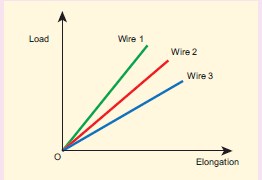
The load – elongation graph of three wires of the same material are shown in figure. Which of the following wire is the thickest?
wire 1
wire 2
wire 3
all of them have same thickness
7.
If a person moves from Chennai to Trichy, his weight
increases
decreases
remains same
increases and then decreases
8.
Round of the following number 19.95 into three significant figures.
19.9
20.0
20.1
19.5
9.
The work done by the conservative force for a closed path is
always negative
zero
always positive
not defined
10.
What is the minimum velocity with which a body of mass m must enter a vertical loop of radius R so that it can complete the loop?
\(\sqrt{2gR}\)
\(\sqrt{3gR}\)
\(\sqrt{5gR}\)
\(\sqrt{gR}\)
11.
A couple produces,
pure rotation
pure translation
rotation and translation
no motion
12.
Choose the correct statement from the following
Centrifugal and centripetal forces are action reaction pairs
Centripetal forces is a natural force
Centrifugal force arises from gravitational force
Centripetal force acts towards the center and centrifugal force appears to act away from the center in a circular motion.
13.
If a particle executes uniform circular motion in the xy plane in clockwise direction, then the angular velocity is in
+y direction
+z direction
-z direction
-x direction
14.
If one object is dropped vertically downward and another object is thrown horizontally from the same height, then the ratio of vertical distance covered by both objects at any instant t is
1
2
4
0.5
15.
The density of a material in CGS system of units is 4 g cm-3. In a system of units in which unit of length is 10 cm and unit of mass is 100 g, then the value of density of material will be
0.04
0.4
40
400
16.
What are concurrent forces?
17.
A uniform disk of radius r = 0.6 m and mass M = 2.5 kg is freely suspended from a horizontal pivot located a radial distance d = 0.30 m from its centre. Find the angular frequency of small amplitude oscillations of the disk.
18.
Define latent heat capacity. Give its unit.
19.
Write down the expression for the Stoke’s force and explain the symbols involved in it.
20.
21.
22.
Define velocity and speed
23.
Define displacement and distance.
24.
Briefly explain the types of physical quantities.
25.
What do you mean by capillarity or capillary action?
26.
Give an example of a quasi-static process.
27.
What is meant by escape speed in the case of the Earth?
28.
Consider an object of mass 2 kg moved by an external force 20 N in a surface having coefficient of kinetic friction 0.9 to a distance 10 m. What is the work done by the external force and kinetic friction? Comment on the result. (Assume g = 10 ms-2)
29.
Find the radius of gyration of a disc of mass M and radius R rotating about an axis passing through the center of mass and perpendicular to the plane of the disc.
30.
The position vector of a particle is given by \(\vec { r } =3t\hat { i } +5t^{ 2 }\hat { j } +7\hat { k } \). Find the direction in which the particle experiences net force?
31.
State the number of significant figures in the following 0.007
32.
Check the correctness of the equation\(\frac { 1 }{ 2 } \)mv2 = mgh using dimensional analysis method.
33.
Define a scalar. Give examples
34.
Explain how overtones are produced in a
(a) Closed organ pipe
(b) Open organ pipe
35.
Write down the difference between simple harmonic motion and angular simple harmonic motion.
36.
37.
Explain in detail Newton’s law of cooling.
38.
State Hooke’s law and verify it with the help of an experiment?
39.
Derive an expression for escape speed.
40.
State and explain work energy principle. Mention any three examples for it.
41.
Explain the motion of blocks connected by a string in
i) Vertical motion
ii) Horizontal motion.
42.
Discuss the properties of scalar and vector products.
43.
1.
f = 120Hz
Frequency of the 4th string is obtained from harmonic series
120,119, 118 and 117 Hz
(1) (2) (3) (4)
\(\therefore\) f4 = 117 Hz
2.
(c)
6 N
3.
Carbon dioxide
\(v_{r m s}=1.73 \sqrt{\frac{k T}{m}}\)
4.
\(\lambda_{m} T =\mathrm{b} \)
\(\therefore T =\frac{2.898 \times 10^{-3}}{350 \times 10^{-9}}\)
\(\mathrm{~T} =0.00828 \times 10^{6} \)
\(=8280 \mathrm{~K} \)
5.
\(-Q>0 \quad W>0\)
\(\Delta Q=\Delta U+\Delta W\)
\(\therefore \Delta Q \propto \Delta W\)
\(\text { If } \Delta Q>0 \text { then } \Delta W>0\)
6.
For the wire 1
Young's modulus is less
\(\text { Young's modulus } Y \propto \frac{F}{A}\)
\(\therefore \text { Area is more }\)
\(\therefore \text { Wire } 1 \text { is thickest }\)
7.
(b)
decreases
8.
(b)
20.0
9.
(b)
zero
10.
Radius =R
\(v_{1}^{2}-v_{2}^{2}=4 g R\)
\(\text { Tension } T_{2}=\frac{m v_{2}^{2}}{R_{2}}-m g\)
\(\text {To find minimum speed, let } T_{2}=0\)
\(0 =\frac{m v_{2}^{2}}{R}-m g \)
\(\frac{m v^{2}}{R} =m g \)
\(v_{2}^{2}=R g \ v_{2} =\sqrt{g R} \)
\(\text { sub (2) in the eqn (1) we get }\)
\(v_{1}^{2}-(\sqrt{g R})^{2} =4 g R \)
\(v_{1}^{2}-g R =4 g R \)
\(v_{1}^{2} =4 g R+g R \)
\(=5 g R \)
\(v_{1} =\sqrt{5 g R} \)
11.
(a)
pure rotation
12.
(d)
Centripetal force acts towards the center and centrifugal force appears to act away from the center in a circular motion.
13.
Use thumb rule
14.
For a free falling body, initial vertical downward velocity = 0
For a body thrown horizontally with a velocity, initial vertical downward velocity = 0
Since both having same initial vertical downward velocity they cover equal vertical distance at any instant
15.
(c)
40
16.
A collection of forces is said to be concurrent, if the lines of forces act at a common point.
17.
The moment of inertia of the disk about a perpendicular axis passing through its centre is
I= \(\frac{1}{2}\)mr2
From the parallel axis theorem, the moment of inertia of the disk about the pivot point is
I'=I+Md2=\(\frac{2.5\times0.6\times0.6}{2}\)+ 2.5 x 0.30 x 0.30
=\(\frac{0.9}{2}\)+0.225
= 0.45 + 0.225
=0.675kgm2
The angular frequency of small amplitude oscillations of a compound pendulum is given by
w=\(\sqrt { \frac { Mgd }{ I' } } =\sqrt { \frac { 2.5\times 9.8\times 0.30 }{ 0.675 } } \)
=\(\sqrt { \frac { 7.53 }{ 0.675 } } =\sqrt { \frac { 0.675 }{ 10.9 } } \)=3.3 rad/s
18.
Latent heat capacity of a substance is defined as the amount of heat energy required to change the state of a unit mass of the material
Unit is J kg-1.
19.
Stoke's force F = 6πη αv
where a - radius of the sphere
v - velocity of the sphere and
η - coefficient of viscosity of the liquid
20.
21.
22.
Velocity:
Velocity is equal to the rate of change of position vector with respect to time.
It is a vector quantity \(\overrightarrow{v}=\frac{d\overrightarrow{r}}{dt}\)
Speed:
The magnitude of velocity is called speed and is given by \(v= \sqrt{v^2_x+v^2_y+v^2_z}\). It is a positive scalar.
23.
(i) Displacement is the difference between the final and initial positions of the object in a given interval of time. It can also be defined as the shortest distance between these two positions of the object and its direction is from the initial to final position of the object, during the given interval of time. It is a vector quantity.
(ii) Distance is the actual path length travelled by an object in the given interval of time during the motion. It is a positive scalar quantity.
24.
(i) Physical quantities are classified into two types. There are fundamental and derived quantities.
(ii) Fundamental or base quantities are quantities which cannot be expressed in terms of any other physical quantities.
(iii) These are length, mass, time, electric current, temperature, luminous intensity and amount of substance.
(iv) Quantities that can be expressed in terms of fundamental quantities are called derived quantities.
(v) For example, area, volume, velocity, acceleration, force.
25.
The rise or fall of a liquid in a narrow tube is called capillarity or capillary action.
26.
Consider a container of gas with volume V, pressure P and temperature T. If we add sand particles one by one slowly on the top of the piston, the piston will move inward very slowly. This can be taken as almost a quasi-static process. It is shown in the figure
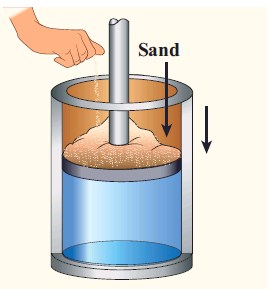
Sand particles added slowly- quasi-static process
27.
Escape speed is the minimum speed of an object thrown vertically up such that it escapes the Earth's gravity and would never come back.
28.
m = 2 kg, d = 10 m, Fext = 20 N, \(\mu\)k = 0.9.
when an object is in motion on he horizontal surface, it experiences two forces.
(a) External force, Fext = 20 N
(b) Kinetic friction,
fk = \(\mu\)k mg = 0.9 \(\times\) (2) \(\times\) 10 = 18N
The work done by the external force Wext = Fd = 20 x 10 = 200J
The work done by the force of kinetic friction Wk = fkd = (-18) \(\times\) 10 = -180 J. Here the negative sign implies that the force of kinetic friction is opposite to the direction of displacement.
The total work done on the object Wtotal = Wext + Wk = 200 J - 180 J = 20 J.
Since the friction is a non-conservative force, out of 200 J given by the external force, the 180 J is lost and it can not be recovered.
29.
The moment of inertia of a disc about an axis passing through the center of mass and perpendicular to the disc is, \(I=\frac{1}{2}MR^{2}\)
In terms of radius of gyration, I = MK2
Hence, \(Mk^{2}=\frac{1}{2}MR^{2} ; K^{2}=\frac{1}{2}R^{2}\)
\(K=\frac{1}{\sqrt{2}}R\ or\ K=\frac{1}{1.414}R\ or\ K=(0.707)R\)
From the case of a rod and also a disc, we can conclude that the radius of gyration of the rigid body is always a geometrical feature like length, breadth, radius or their combinations with a positive numerical value multiplied to it.
30.
Velocity of the particle,
\(\vec { v } =\frac { d\vec { r } }{ dt } =\frac { d }{ dt } (3t)\hat { i } +\frac { d }{ dt } (5{ t }^{ 2 })\hat { j } +\frac { d }{ dt } (7)\hat { k } \)
\(\frac { d\vec { r } }{ dt } =3\hat { i } +10t\hat { j } \)
Acceleration of the particle
\(\frac { d\vec { r } }{ dt } =\frac { { d }\vec { v } }{ dt } =\frac { { d }^{ 2 }\vec { r } }{ dt^{ 2 } } =10\hat { j } \)
Here, the particle has acceleration only along positive y direction. According to Newton's second law, net force must also act along positive y direction. In addition, the particle has constant velocity in positive x direction and no velocity in z direction. Hence, there are no net force along x or z direction.
31.
one
32.
Dimension formula for
\(\frac { 1 }{ 2 } \)mv2 = [M][LT-1]2 = [ML2T-2]
Dimension formula for
mgh = [M][LT-2][L] = [ML2T-2]
[ML2T-2] = [ML2T-2]
Both sides are dimensionally the same, hence the equations \(\frac { 1 }{ 2 } \)mv2 = mgh is dimensionally correct
33.
Scalar is a property which can be described only by magnitude.
Examples:
Distance, mass, temperature, speed and energy.
34.
(a) Closed organ pipes:
Closed organ is a pipe with one end closed and the other end open. If one of a pipe is closed, the wave reflected at this closed end is 180o out of phase with the incoming wave. Thus there is no displacement of the
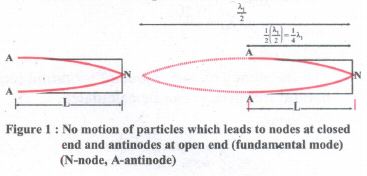
particles at the closed end. Therefore, nodes are formed at the closed end and anti-nodes are formed at open end.
Let us consider the simplest mode of vibration of the air column called the fundamental mode. Anti-node is formed at the open end and node at closed end. From the figure let L be the length of the tube and λ be the wavelength of the wave produced. For the fundamental mode of vibration, we have,
\(L={\lambda_1\over4}(or)\lambda_1=4L\)
The frequency of the note emitted is
\(f_1={v\over \lambda_1}={v\over 4L}\)
which is called the fundamental note.
The frequencies higher than fundamental frequency can be produced by blowing air strongly at open end. Such frequencies are called overtones.
The figure (2) shows the second mode of vibration having two nodes and two anti-nodes
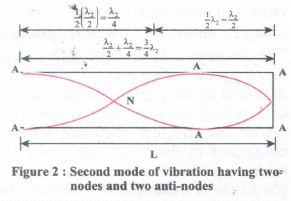
4L = 3λ2
\(L={3⋋_2\over 2}or\ ⋋_2={4L\over 3}\)
The frequency for this
\(f_1={v\over \lambda_2}={3v\over 4L}=3f_1\)
is called first over tone, since here, the frequency is three times the fundamental frequency it is called third harmonic.
The Figure (3) shows third mode of vibration having three nodes and three anti-nodes.
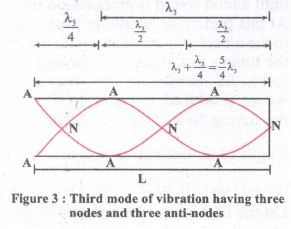
We have 4L= 5⋋3
\(L={5\lambda_3\over4}\ or\ \lambda_3={4L\over 5}\)
The frequency
\(f_3={v\over \lambda _3}={5v\over 4L}=5f_1\)
is called second over tone, and since n = 5 here, this is called fifth harmonic. Hence, the closed organ pipe has only odd harmonics and frequency of the nth harmonic is f n = (2n + 1)f1. Therefore, the frequencies of harmonics are in the ratio
f1:f2:f3:f4:.... = 1:3:5:7:....
(b) Open organ pipe:
Consider the picture of a flute, shown in Figure. It is a pipe with both the ends open. At both open ends, anti-nodes are formed. Let us consider the simplest mode of vibration of the air column called fundamental mode. Since anti-nodes are formed at the open end, a node is formed at the mid-point of the pipe
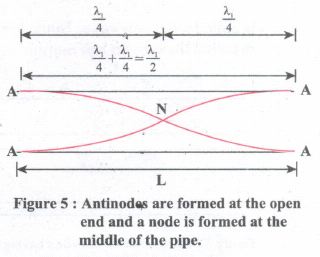
From Figure (5), if L be the length of the tube, the wavelength of the wave produced is given by
\(L={\lambda_1\over 2}or\ {\lambda_1=2L}\)
The frequency of the note emitted is
\(f_1={v\over \lambda_1}={v\over 2L}\)
which is called the fundamental note.
The frequencies higher than fundamental frequency can be produced by blowing air strongly at one of the open ends. Such frequencies are called overtones.
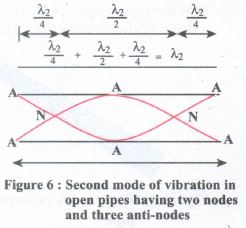
The Figure (6) shows the second mode of vibration in open pipes. It has two mode of vibration in open pipes. It has two nodes and three anti-nodes, and therefore,
L= ⋋2 or ⋋2= L
The frequency
\(f_2={v\over \lambda_2}={v\over L}=2\times{v\over 2L}=2f_1\)
is called first over tone. Since n = 2 here, it is called the second harmonic.
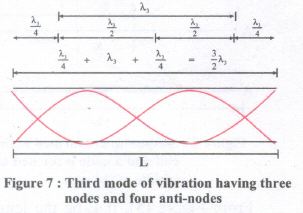
The Figure (7) above shows the third mode of vibration having three nodes and four anti-nodes
\(L={3\over2}\lambda,\ or\ \lambda_3={2L\over 3}\)
The frequency
\(f_3={v\over \lambda_3}={3v\over 2L}=3f_1\)
is called second over tone. Since n = 3 here, it is called the third harmonic.
Hence, the open organ pipe has all the harmonics and frequency of nth harmonic is f n = nf1, Therefore, the frequencies of harmonics are in the ratio
f1 : f2 : f3 : f4 :... = 1 : 2 : 3 : 4 : ....
35.
| S.No | Simple Harmonic Motion | Angular Harmonic Motion |
| 1. | The displacement of the particle is measured in terms of linear displacement \(\vec { r } \). | The displacement of the particle is measured in terms of angular displacement \(\vec { \theta } \)(also known as angle of twist). |
| 2. | Acceleration of the particle is \(\vec { a } =-{ \omega }^{ 2 }\vec { r } \) | Angular acceleration of the particle is \(\vec { \alpha } =-{ \omega }^{ 2 }\vec { \theta } \) |
| 3. | Force, \(\vec { F } =m\vec { a } \) where m is called mass of the particle. | Torque, \(\vec { \tau } =I\vec { \propto } \) where I is called moment of inertia of a body. |
| 4. | The restoring force \(\vec { F } =-k\vec { r } \), where k is restoring force constant. | The restoring torque \(\vec { \tau } =-k\vec { \theta } \), where the symbol k (kappa) is called restoring torsion constant It depends on the property of a particular torsion fiber. |
| 5. | Angular frequency \(\omega =\sqrt { \frac { k }{ m } } \)rads-1 | Angular frequency, \(\omega =\sqrt { \frac { k }{ I } } \) rad s-1 |
36.
37.
Newton's law of cooling states that the rate of loss of heat of a body is directly proportional to the difference in the temperature between that body and its surroundings.
\(\frac{d Q}{d t} \propto-\left(\mathrm{T}-\mathrm{T}_{s}\right)\) ...(1)
The negative sign indicates that the quantity of heat lost by liquid goes on decreasing with time. Where,
T = Temperature of the object
Ts = Temperature of the surrounding
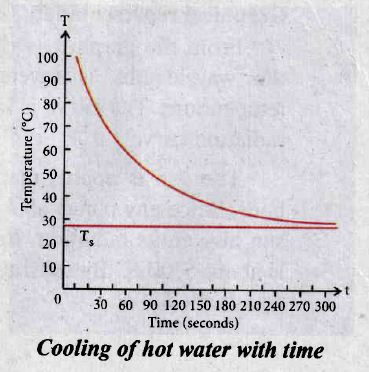
From the graph in figure it is clear that the rate of cooling is high initially and decreases with falling temperature.
Let us consider an object of mass m and specific heat capacity s at temperature T. Let Ts be the temperature of the surroundings. If the temperature falls by a small amount dT in time dt, then the amount of heat lost is,
dQ = msdT ........(2)
(iv) Dividing both sides of equation (2) by dt
\(\frac { dQ }{ dt } =\frac { msdT }{ dt } \)..........(3)
From Newton's law of cooling
\(\frac { dQ }{ dt } \propto -(T-{ T }_{ s })\)
\(\frac { dQ }{ dt } =-\alpha (T-{ T }_{ s })\) ...(4)
Where a is some positive constant.
From equation (2) and (4)
-\(\alpha\) (T - Ts) = \(md\frac { dt }{ dt } \)
\(\frac { dt }{ T-{ T }_{ s } } =\frac { a }{ ms } dt\) ....(5)
Integrating equation (5) on both sides,
\(\int _{ 0 }^{ \infty }{ \frac { dt }{ T-{ T }_{ a } } =-\int _{ 0 }^{ 1 }{ \frac { a }{ ms } dt } } \)
ln (T - Ts) = \(-\frac { a }{ ms } t+{ b }_{ 1 }\)
Where b1 is the constant of integration taking exponential both sides, we get
\(\mathrm{T} =T_{s}+b_{2} e^{-\frac{a}{m s} t} \)
here \(\mathrm{~b}_{2} =e^{b_{1}}=\text { constant }\)
38.
Hooke's law states that within the elastic limit, the strain produced in a body is directly proportional to the stress applied.
It can be verified in a simple way by stretching a thin straight wire (stretches like spring) of length L and uniform cross-sectional area A suspended from a fixed point O. A pan and a pointer are attached at the free end of the wire as shown in Figure. The extension produced on the wire is measured using a vernier scale arrangement. The experiment shows that for a given load, the corresponding stretching force is F and the elongation produced on the wire is ΔL. It is directly proportional to the original length L and inversely proportional to the area of cross section A. A graph is plotted using F on the X-axis and ΔL on the Y-axis. This graph is a straight line passing through the origin as shown in Figure.
.JPG)
.JPG)
Therefore,
ΔL = (slope)F
Multiplying and dividing by volume,
V = AL,
F (slope) = \(\frac{AL}{AL} \Delta L\)
Rearranging, we get
\(\frac{F}{A}=[\frac{L}{A(Slope)}]\frac{\Delta L}{L}\)
Therefore, \(\frac{F}{A} \alpha [\frac{\Delta L}{L}]\)
Comparing with equations stress and strain \(\sigma=\frac{\text { Force }}{\text { Area }}=\frac{F}{A}, \varepsilon=\frac{\text { Change in size }}{\text { Original size }}=\frac{\Delta l}{l}\),
we get volume strain, \(\varepsilon_{v}=\frac{\Delta V}{V}\) equation as
\(\sigma \propto \varepsilon\)
i.e., the stress is proportional to the strain in the elastic limit.
39.
Consider an object of mass M on the surface of the Earth. When it is thrown up with an initial speed Vi' the initial total energy of the object is
Ei = \(\frac { 1 }{ 2 } { Mv }_{ i }^{ 2 }-\frac { GMM_{ E } }{ R_{ E } } \) ............(1)
where, ME is the mass of the Earth and RE- the radius of the Earth. The term \(\frac { GMM_{ E } }{ R_{ E } } \) is the potential energy of the mass M.
When the object reaches a height far away from Earth and hence treated as approaching infinity, the gravitational potential energy becomes zero [U(∝) = 0] and the kinetic energy becomes zero as well. Therefore the final total energy of the object becomes zero. This is for minimum energy and for minimum speed to escape. Otherwise Kinetic energy can be non-zero.
Ef = 0
According to the law of energy conservation,
Ei = Ef .............(2)
Substituting (1) in (2) we get,
\(\frac { 1 }{ 2 } { Mv }_{ i }^{ 2 }-\frac { GMM_{ E } }{ R_{ E } } \) =0
\(\frac { 1 }{ 2 } { Mv }_{ e }^{ 2 }-\frac { GMM_{ E } }{ R_{ E } } \) = 0 .............(3)
Consider the escape speed, the minimum speed required by an object to escape Earth's gravitational field, hence replace vi with ve. i.e.,
\(\frac { 1 }{ 2 } { Mv }_{ e }^{ 2 }-\frac { GMM_{ E } }{ R_{ E } } \)
\(v_{ e }^{ 2 }-\frac { GMM_{ E } }{ R_{ E } } .\frac { 2 }{ M } \)
\(v_{ e }^{ 2 }=\frac { 2G{ M }_{ E } }{ { R }_{ E } } \) ..............(4)
Using g = \(\frac { G{ M }_{ E } }{ { R }_{ e } } \) ..............(5)
\(v_{ e }^{ 2 }=2g{ R }_{ E }\)
\({ v }_{ e }=\sqrt { 2g{ R }_{ E } } \) .................(6)
40.
Work-Kinetic Energy Theorem
Work and energy are equivalents. This is true in the case of kinetic energy also. To prove this, let us consider a body of mass m at rest on a frictionless horizontal surface.
The work (W) done by the constant force (F) for a displacement (s) in the same direction is,
W = Fs
The constant force is given by the equation,
F = ma
The third equation of motion can be written as,
\(v^{2} =u^{2}+2 a s \)
\(a =\frac{v^{2}-u^{2}}{2 s}\)
Substituting for a in equation (2),
\(F=m\left(\frac{v^{2}-u^{2}}{2 s}\right)\)
Substituting equation (2), (1)
\(w=m\left(\frac{v^{2}}{2 s} s\right)-m\left(\frac{u^{2}}{2 s} s\right) \)
\(w=\frac{1}{2} m v^{2}-\frac{1}{2} m u^{2}\)
The expression for kinetic energy:
The term \(\left(\frac{1}{2} m v^{2}\right)\) in the above equation is the kinetic energy of the body of mass (m) moving with velocity(v).
\(K E=\frac{1}{2} m v^{2}\)
Kinetic energy of the body is always positive. From equations (4) and (5)
\(\Delta K E =\frac{1}{2} m v^{2}-\frac{1}{2} m u^{2} \)
\(\text {Thus, } W =\Delta K E\)
The expression on the right hand side (RHS) of equation (6) is the change in kinetic energy (\(\Delta\)KE) of the body.
This implies that the work done by the force on the body changes the kinetic energy of the body, This is called work-kinetic energy theorem.
The work-kinetic energy theorem implies the following.
1. If the work done by the force on the body is positive then its kinetic energy increases.
2. If the work done by the force on the body is negative then its kinetic energy decreases.
3. If there is no work done by the force on the body then there is no change in its kinetic energy, which means that the body has moved at constant speed provided its mass remains constant.
41.
i) Vertical motion
Consider two blocks of masses m1 and m2 (m1 > m2) connected by a light and inextensible string that passes over a pulley as shown in fig. A little consideration will show, that the greater mass m1 will move downwards, whereas the smaller one will move upwards. Since the string is inextensible, the upward acceleration of the mass m2 will be equal to the downward acceleration of the mass m1
| Condition | Acceleration | Tension |
.JPG) |
T - m2g = m2a .......(1) T - m1g = m1a m1g - T = m1a .......(2) Adding equations (1) and (2), we get m1g - m2g = m1a + m2a (m1 - m2)g = (m1 + m2)a .......(3) (vi) From equation (3), the acceleration of both the masses is \(a=\left( {{m_1-m_2}\over{m_1+m_2}} \right)g\) .......(4) If both the masses are equal (m1 = m2), from equation then a = 0 |
T - m2g = m2a .......(1)\(a=\left({m_1-m_2 \over m_1+m_2 } \right)g\) .......(4) Substituting the equation (4) into(1) \(T-m_2g=m_2\left({m_1-m_2 \over m_1+m_2 } \right)g\) \(T=m_2 g\left(1+{m_1-m_2 \over m_1+m_2 } \right)\) \(T=g\left({2m_1m_2\over m_1+m_2} \right)\) |
ii) Horizontal Motion: Mass m, is kept on a horizontal table and mass m, is hanging through a small pulley as shown in the figure. Assume that there is no friction on the surface. As both blocks are connected to the unstretchable string, if m, moves with an accelerating 'a' downward them m2 move with the same acceleration 'a' horizontally.
| Condition | Acceleration | Tension |
.JPG) (i) The forces acting on mass m2 are 1. Downward gravitational force (m2g) 2. Upward normal force (N) exerted by the surface 3. Horizontal tension (T) exerted by the string. (ii) The forces acting on mass m1 are 1. Downward gravitational force (m1g). 2. Tension (T) acting upwards |
T-m1g= -m1a ...........(1) T = m2 a .......(2) There is no acceleration along y-direction for m2 N - m2g = 0 ⇒ N= m2g .... (3) m2a-m1g= -m1a m2a+m1a= m1g \(a={m_1 \over m_1+m_2}g\) ......(4) |
Tension in the string can be obtained by substituting equation (4) in equation (2). \(T=m_2({m_1 \over m_1+m_2})g\) \(T=g({m_1m_2 \over m_1+m_2})\) This result has an important application in industries. The ropes used in conveyor belts (horizontal motion) work for longer duration than those of cranes and lifts (vertical motion). |
42.
Scalar product:
Scalar product or dot product of two vectors in defined as the product of the magnitudes of both the vectors and the cosine of the angle between them.
If \(\vec{A}\) and \(\vec{B}\) are two vector having an angle \(\theta\) between them, then \(\vec{A} \vec{B}=A B \cos \theta\) where A and B are magnitudes of \(\vec{A}\) and \(\vec{B}\) .
Example: work, energy and electric flux.
Properties:
1. \(\vec{A}\).\(\vec{B}\) is always a scalar. It is positive if \(\theta\)<90 and it is negative if \(90^{\circ}<\theta<180^{\circ}\)
2. When the vectors are parallel, \(\theta=0^{\circ} \ and \ \cos 0^{\circ}=1 \therefore(\vec{A} \cdot \vec{B})_{\text {mat }}=A B\).
3. When the vectors are anti-parallel, \(\theta=180^{\circ}\ and \ \cos 180^{\circ}=-1 \therefore(\vec{A} \cdot \vec{B})_{\min }=-A B\)
4. When the vectors are perpendicular to each other, \(\theta=90^{\circ}\ and \ \cos 90^{\circ}=0\therefore \vec{A} \vec{B}=0\).
5. Scalar product is commutative i.e, \(\vec{A} \cdot \vec{B}=\vec{B} \cdot \vec{A}\)
6. It obeys distributive law i.e., \(\vec{A} \cdot(\vec{B}+\vec{C})=\vec{A} \cdot \vec{B}+\vec{A} \cdot \vec{C}\)
7. Self dot product is given by \(\vec{A} \cdot \vec{A}=A A \cos \theta=A^{2}, \ here\ \theta=0^{\circ}\). The magnitude of the vector \(\vec{A}\ is \ (\vec{A})=A=\sqrt{\vec{A} \cdot \vec{A}}\)
8. In the case of orthogonal unit vectors \(\vec{i}, \vec{j} \ and \ \vec{k}\)
\(\hat{i} \hat{j}=\hat{j} \hat{j}=\hat{k} \cdot \hat{k}=1 \text { and } \)
\(\vec{i} \cdot \vec{j}=\hat{j} \hat{k}=\hat{k} \hat{i}=0\)
9. The angle between the vectors \(\theta=\cos ^{-1}\left[\frac{\vec{A} \cdot \vec{B}}{A B}\right]\)
10. In terms of components,
\(\vec{A} \cdot \vec{B} =\left(A_{x} \hat{i}+\mathrm{A}_{y} \hat{j}+A_{z} \hat{k}\right)\left(B_{x} \hat{i}+\mathrm{B}_{y} \hat{j}+B_{z} \hat{k}\right) \)
\(=A_{x} B_{x}+A_{y} B_{y}+A_{i} B_{z} \text {, with all other terms zero. }\)
The magnitude of A is given by \(|\vec{A}|=A=\sqrt{A_{x}^{2}+A_{y}^{2}+A_{2}^{2}}\) and \(|\vec{B}|=B=\sqrt{B_{x}^{2}+B_{y}^{2}+B_{2}^{2}}\) Vector product:
The vector product or cross product of two vectors is defined as another vector having a magnitude equal to the product of the magnitudes of two vectors and the sine of the angle between them.
If \(\vec{A}\) and \(\vec{B}\) are two vectors, then \(\vec{A} \times \vec{B}=\vec{C}=(A B \sin \theta) \hat{n}\).
The direction \(\hat{n}\ of \ \vec{A} \times \vec{B}\) is perpendicular to the plane containing the vectors \(\vec{A}\) and \(\vec{B}\) and is determined by the right hand screw rule or right hand thumb rule.
Example: Torque \(\tau=\vec{r} \times \vec{F}\) and Angular momentum \(\vec{L}=\vec{r} \times \vec{p}\)
Properties:
1. The resultant of the vector product is always another vector whose direction is perpendicular to the plane containing these two vectors \(\vec{A}\) and \(\vec{B}\) even though the vectors \(\vec{A}\) and \(\vec{B}\) may or may not be mutually orthogonal.
2. It is not commutative. \(\vec{A} \times \vec{B} \neq \vec{B} \times \vec{A}\). But \(\vec{A} \times \vec{B}=-[\vec{B} \times \vec{A}]\)
3. When the vectors \(\vec{A}\) and \(\vec{B}\) are orthogonal to each other the vector product will have maximum magnitude as \(\theta=90^{\circ}\ and \ \sin \theta=1\).
\((\vec{A} \times \vec{B})_{\max }=A B \hat{n}\)
4. The vector product of two non-zero vectors will be minimum when (sin \(\theta\))=0, i.e., \(\theta=0^{\circ} \ or \ 180^{\circ}(\vec{A} \times \vec{B})_{\min }=0\).
It means that the vector product of two non-zero vectors vanishes if the vectors are parallel or anti parallel.
5. The self-cross product is a null vector. \(\vec{A} \times \vec{A}=A A \sin 0^{\circ} \hat{n}=\overrightarrow{0}\)
6. The self-vector products of unit vectors are then zero \(\hat{i} \times \hat{i}=\hat{j} \times \hat{j}=\hat{k} \times \hat{k}=0\).
7. In the case of orthogonal unit vectors, \(\vec{i}, \vec{j} \ and \ \hat{k}\)
\(\hat{i} \times \hat{j}=\hat{k}, \hat{j} \times \hat{k}=\hat{i} \ and \ \hat{k} \times \hat{i}=\hat{j}\) and
\(\hat{j} \times \hat{i}=-\hat{k}, \hat{k} \times \hat{j}=-\hat{i} \ and \ \hat{i} \times \hat{k}=-\hat{j}\)
8. In terms of components,
\(\vec{A} \times \vec{B}=\left|\begin{array}{ccc}
\hat{i} & \hat{j} & \hat{k} \\
A_{x} & A_{y} & A_{z} \\
B_{x} & B_{y} & B_{z}
\end{array}\right|=\begin{array}{r}
+\hat{i}\left(A_{y} B_{z}-A_{z} B_{y}\right) \\
+\hat{j}\left(A_{z} B_{x}-A_{x} B_{z}\right) \\
+\hat{k}\left(A_{0} B_{y}-A_{z} B_{x}\right)
\end{array}\)
9. If two vectors \(\vec{A}\) and \(\vec{B}\) form adjacent sides of a parallelogram, then magnitude \((\vec{A} \times \vec{B})\) is equal to the area of the parallelogram.
10. If two vectors \(\vec{A}\) and \(\vec{B}\) are represented by the two sides of a triangle taken in order, then the area of the triangle is equal to \(\frac{1}{2}|\vec{A} \times \vec{B}|\)
43.

11th Standard Syllabus & Materials
11th Standard
TN 11th Tamil பீடு பெற நில் - செய்யுள் - காவடிச்சிந்து Important Questions And Answers Study Material - QB365 Set A
NEW11th Standard
TN 11th Tamil பீடு பெற நில் - உரைநடை - மலை இடப்பெயர்கள் : ஓர் ஆய்வு Important Questions And Answers Study Material - QB365 Set A
NEW11th Standard
TN 11th Tamil மாமழை போற்றுதும் - துணைப்பாடம் - யானை டாக்டர் Important Questions And Answers Study Material - QB365 Set A
NEW11th Standard
TN 11th Tamil மாமழை போற்றுதும் - செய்யுள் - ஐங்குறுநூறு Important Questions And Answers Study Material - QB365 Set A



Tamilnadu Stateboard 11th Standard Subjects

Maths

Commerce

Economics

Biology

Business Maths and Statistics

Accountancy

Computer Science
Physics

Chemistry
Maths
Biology
Economics
Physics
Chemistry

History
Business Maths and Statistics

Computer Science
Accountancy

Computer Applications
History
Computer Technology
Commerce
Computer Applications
Computer Technology

Tamil

English

French
Tamilnadu Stateboard Standards


