
 100% FREE ACCESS
11th Standard Syllabus & Materials
11th Standard
TN 11th Tamil இயற்கை வேளாண்மை,சுற்றுச்சூழல் -செய்யுள் - மனோன்மணீயம் Important Questions And Answers Study Material - QB365 Set A
NEW11th Standard
TN 11th Tamil என்னுயிர் என்பேன் -துணைப்பாடம் - இசைத்தமிழர் இருவர் Important Questions And Answers Study Material - QB365 Set A
NEW11th Standard
TN 11th Tamil மொழி கலை -செய்யுள் - ஒவ்வொரு புல்லையும் Important Questions And Answers Study Material - QB365 Set A
NEW11th Standard
TN 11th Tamil பீடு பெற நில் - இலக்கணம் - பகுபத உறுப்புகள் Important Questions And Answers Study Material - QB365 Set A
NEW11th Standard
TN 11th Tamil பீடு பெற நில் - துணைப்பாடம் - வாடிவாசல் Important Questions And Answers Study Material - QB365 Set A
NEW11th Standard
TN 11th Tamil பீடு பெற நில் - செய்யுள் - குறுந்தொகை Important Questions And Answers Study Material - QB365 Set A

Published on: 24/08/2026
Download Tamil Nadu 11th Standard Physics question papers, model tests, one-mark questions, important questions, and public exam papers in PDF format. Free study materials and answer keys for TN State Board students.
Questions + Answers key
Take MCQ Physics Test
1.
A gas made of a mixture of 2 moles of oxygen and 4 moles of argon at temperature T. Calculate the energy of the gas in terms of RT. Neglect the vibrational modes.
2.
If the rms speed of methane gas in the Jupiter’s atmosphere is 471.8 m s-1, show that the surface temperature of Jupiter is sub-zero.
3.
Define mean free path and write down its expression.
4.
State the law of equipartition of energy.
5.
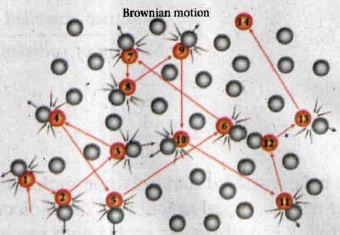
Define the term degrees of freedom.
6.
Why moon has no atmosphere?
7.
What is the microscopic origin of temperature?
8.
What is the microscopic origin of pressure?
9.
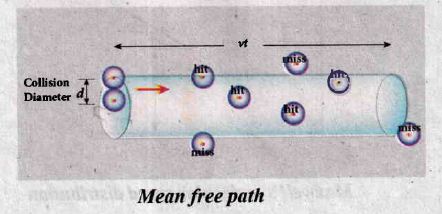
Ten particles are moving at the speed of 2, 3, 4, 5, 5, 5, 6, 6, 7 and 9 m s-1. Calculate rms speed, average speed and most probable speed.
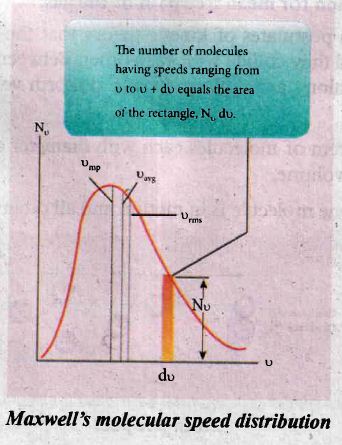
10.
A football at 27°C has 0.5 mole of air molecules. Calculate the internal energy of air in the ball.
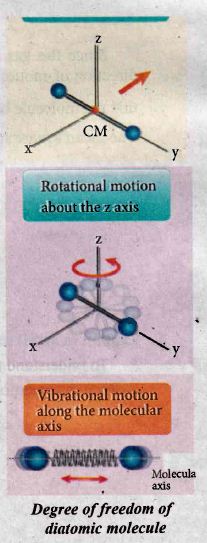
11.
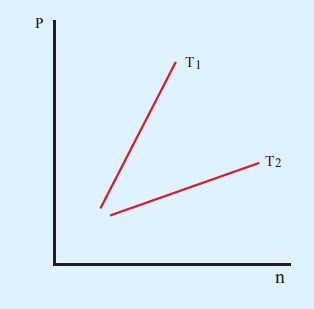
The following graph represents the pressure versus number density for ideal gas at two different temperatures T1 and T2. The graph implies
T1 = T2
T1 > T2
T1 < T2
Cannot be determined
12.
For a given gas molecule at a fixed temperature, the area under the Maxwell-Boltzmann distribution curve is equal to
\(\frac{PV}{KT}\)
\(\frac{KT}{PV}\)
\(\frac{P}{NKT}\)
PV
13.
Which of the following gases will have least rms speed at a given temperature?
Hydrogen
Nitrogen
Oxygen
Carbon dioxide
14.
If sP and sV denote the specific heats of nitrogen gas per unit mass at constant pressure and constant volume respectively, then
sP - sV = 28R
sP - sV = R/28
sP - sV = R/14
sP - sV = R
15.
A sample of gas consists of \(\mu\)1 moles of monoatomic molecules, \(\mu\)2 moles of diatomic molecules and \(\mu\)3 moles of linear triatomic molecules. The gas is kept at high temperature. What is the total number of degrees of freedom?
[3\(\mu\)1 + 7( \(\mu\)2 + \(\mu\)3)] NA
[3\(\mu\)1 + 7\(\mu\)2 + 6\(\mu\)3] NA
[7\(\mu\)1 + 3( \(\mu\)2 + \(\mu\)3)] NA
[3\(\mu\)1 + 6( \(\mu\)2 + \(\mu\)3)] NA
16.
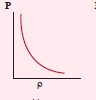
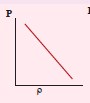
Which of the following shows the correct relationship between the pressure and density of an ideal gas at constant temperature?

17.
If the temperature and pressure of a gas is doubled the mean free path of the gas molecules
remains same
doubled
tripled
quadrapoled
18.
A container has one mole of monoatomic ideal gas. Each molecule has f degrees of freedom. What is the ratio of \(\gamma =\frac { { C }_{ p } }{ { C }_{ V } } \)
f
\(\frac{f}{2}\)
\(\frac{f}{f+2}\)
\(\frac{f+2}{f}\)
19.
The ratio \(\gamma =\frac { { C }_{ p } }{ { C }_{ V } } \) for a gas mixture consisting of 8 g of helium and 16 g of oxygen is
23/15
15/23
27/11
17/27
20.
If the internal energy of an ideal gas U and volume V are doubled then the pressure
doubles
remains same
halves
quadruples
21.
The average translational kinetic energy of gas molecules depends on
number of moles and T
only on T
P and T
P only
22.
Two identically sized rooms A and B are connected by an open door. If the room A is air conditioned such that its temperature is 4°C lesser than room B, which room has more air in it?
Room A
Room B
Both room has same air
Cannot be determined
23.
An ideal gas is maintained at constant pressure. If the temperature of an ideal gas increases from 100K to 1000K then the rms speed of the gas molecules
increases by 5 times
increases by 10 times
remains same
increases by 7 times
24.
25.
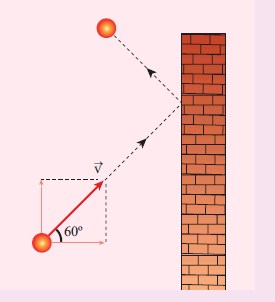
A particle of mass m is moving with speed u in a direction which makes 60° with respect to x axis. It undergoes elastic collision with the wall. What is the change in momentum in x and y direction?
Δpx = −mu, Δpy = 0
Δpx = −2mu, Δpy = 0
Δpx = 0, Δpy = mu
Δpx = mu, Δpy = 0
26.
State the postulates of Kinetic theory of gases. ( Any 6 points )
27.
Describe the Brownian motion.
28.
What is the reason for Brownian motion?
29.
List the factors affecting the mean free path.
30.
Deduce Avogadro’s law based on kinetic theory.
31.
Deduce Boyle’s law based on kinetic theory.
32.
Deduce Charles’ law based on kinetic theory.
33.
What is the relation between the average kinetic energy and pressure?
34.
Write the expression for rms speed, average speed and most probable speed of a gas molecule.
35.
Derive the expression for mean free path of the gas.
36.
Explain in detail the Maxwell Boltzmann distribution function.
37.
Derive the ratio of two specific heat capacities of monoatomic, diatomic and triatomic molecules.
38.
Describe the total degrees of freedom for monoatomic molecule, diatomic molecule and triatomic molecule.
39.
Explain in detail the kinetic interpretation of temperature.
40.
Derive the expression of pressure exerted by the gas on the walls of the container.
41.
1.
Since oxygen is a diatomic molecule with 5 degrees of freedom. Degrees of freedom of molecules in 2 moles of oxygen = f1
\(=2 \mathrm{~N} \times 5=10 \mathrm{~N}\)
Since argon is a mono atomic molecule with 3 degrees of freedom. Degrees of freedom of molecules in 4 moles of argon = f2
\(=4 \mathrm{~N} \times 3=12 \mathrm{~N}\)
∴ Total degrees of freedom of the mixture = f
\(=\mathrm{f}_{1}+\mathrm{f}_{2}=22 \mathrm{~N}\)
According to the principle of law of equipartition energy, energy associated with each degree of freedom of a molecule
\(=\frac{1}{2} k T\)
∴ Total energy of the system \(=\frac{1}{2} k T \times 22\)
But k = R
∴ Total energy of the system \(=\frac{1}{2} R T \times 22=11 \mathrm{RT}\)
2.
Molar mass of methane gas \(=16.04 \times 10^{-3} \mathrm{~kg} / \mathrm{mole}\)
RMS speed of methane gas \(v_{m s}=471.8 \mathrm{~ms}^{-1}\)
Universal gas constant \(\mathrm{R}=8.31 \mathrm{~J} / \mathrm{mol} / \mathrm{k}\)
\(v_{m s}=\sqrt{\frac{3 R T}{m}}\)
\(\therefore\) Surface temperture of Jupiter
\(\mathrm{T} =\frac{v_{r m s}^{2} m}{3 R}
\)
\(=\frac{(471.8)^{2} \times 16.04 \times 10^{-3}}{3 \times 8.31}
\)
\(=\frac{3.549456 \times 10^{-3}}{24.93}
\)
\(\therefore \mathrm{T} =143 \mathrm{~K}=143-273=-130^{\circ} \mathrm{C}\)
3.
The average distance travelled by the molecule between two successive collisions is called mean free path
Mean free path \(\lambda=\frac{k T}{\sqrt{2} \pi d^{2} P}\)
Where K - Boltzmann's constant
T - Temperature
d - diameter of the molecule
P - Pressure
4.
Law of equipartition energy states that the average kinetic energy of system of molecules in thermal equilibrium at temperature T is uniformly distributed to all degrees of freedom (x or y or z) directions of motion so that each degree of freedom will get \(\frac{1}{2}\)kT of energy.
5.
The minimum number of independent coordinates needed to specify the position and configuration of a thermodynamic system in space is called degree of freedom of the system.
6.
The escape speed of gases on the surface of Moon is much less than the root mean square speeds of gases due to low gravity. Due to this all the gases escape from the surface of the Moon.
7.
The average kinetic energy of the molecule is directly proportional to the absolute temperature of the gas.
8.
Pressure arises due to momentum transfer to the wall of the container.
9.
The average speed
\(\overset { - }{ v } =\frac { 2+3+4+5+5+5+6+6+7+9 }{ 10 } =5.2{ ms }^{ -1 }\)
To find the rms speed, first calculate the mean square speed \(\overset { - }{ { v }^{ 2 } } \)
\(\overset { - }{ { v }^{ 2 } } =\frac { { 2 }^{ 2 }+{ 3 }^{ 2 }+{ 4 }^{ 2 }+{ 5 }^{ 2 }+{ 5 }^{ 2 }+{ 5 }^{ 2 }+6^{ 2 }+{ 6 }^{ 2 }+{ 7 }^{ 2 }+{ 9 }^{ 2 } }{ 10 } \)
= 30.6ms2s-2
The rms speed
\({ v }_{ rms }\sqrt { \overset { - }{ { v }^{ 2 } } } =\sqrt { 30.6 } =5.53{ ms }^{ -1 }\)
The most probable speed is 5 m s-1 because three of the particles have that speed.
10.
The internal energy of ideal gas = \(\frac{3}{2}\)NKT
The number of air molecules is given in terms of number of moles so, rewrite the expression as follows
U = \(\frac{3}{2}\)\(\mu\)RT
Since Nk = μR. Here μ is number of moles.
Gas constant R = 8.31\(\frac{J}{molK}\)
Temperature T = 273 + 27 =300K
U =\(\frac{3}{2}\)\(\times\)0.5\(\times\)8.31\(\times\)300 = 1869.75J
This is approximately equivalent to the kinetic energy of a man of 57 kg running with a speed of 8 m s-1.
11.
From the graph we get T1 > T2
12.
The area under the graph will give total member of gas molecules in the system
\(\mathrm{n} =\frac{P V}{R T} \quad \mathrm{R}=k \)
\(\therefore \quad \mathrm{n} =\frac{P V}{k T} \)
13.
Carbon dioxide
\(v_{r m s}=1.73 \sqrt{\frac{k T}{m}}\)
14.
\(C_{p}-C_{v}=R\)
For diatomic gas (N2) No of degrees of freedom = 5
\(\therefore S_{p}-S_{v}=R / 28\)
15.
For mono atomic molecule No of degrees of freedom = 3
For diatomic molecule of degrees of freedom = 5
For triatomic molecule No of degree of freedom = 7
\(\text { Total }=\left[3 x_{1}+7\left(\mu_{2}+\mu_{3}\right)\right] N_{A}\)
16.
Pressure is directly proportional to density.
17.
Mean free path is independent of temperature and pressure
18.
\(\mathrm{V}=\frac{f}{2} R T \quad \mathrm{C}_{\mathrm{V}}=\frac{f}{2} R \)
\(\mathrm{C}_{\mathrm{P}}=\left(1+\frac{f}{2}\right) R \)
\(\gamma=\frac{C_{p}}{C_{v}}=1+\frac{2}{f} \)
\(=\frac{f+2}{f} \)
19.
\(\gamma=\frac{27}{17}\)
Number of moles of helium
\(\mathrm{n}=\frac{8}{4}=2\)
Number of moles of oxygen
\(n^{\prime}=\frac{16}{32}=\frac{1}{2}\)
For mono atomic Helium gas
\(\mathrm{f} =3 \)
\(\mathrm{C}_{\mathrm{V}} =\frac{f}{2} R \)
\(=\frac{3}{2} R \)
For diatomic oxygen gas
f = 5
\(\mathrm{C}_{\mathrm{V}} =\frac{f}{2} R \)
\(=\frac{5}{2} R \)
\(\mathrm{C}_{\mathrm{V}} \text { mixture } =\frac{n c_{v}+n^{\prime} C_{v}^{\prime}}{n+n^{\prime}} \)
\(=\frac{2 \times \frac{3}{2} R+\frac{1}{2} \times \frac{5}{2} R}{2+\frac{1}{2}} \)
\(C_{V} =\frac{3 R+\frac{5}{4} R}{\frac{5}{2}} \)
\(=\frac{17 R}{10} \)
\(\gamma =\frac{C_{p}}{C_{v}} \)
\(=1+\frac{R}{C_{V}} \)
\(=1+\frac{R}{\frac{17 R} {10}}\)
\(=1+\frac{10}{17} \)
\(=\frac{27}{17} \)
20.
Pressure is independent of internal energy.
21.
Average K.E of each degree of freedom
\(=\frac{1}{2} k T=\frac{1}{2} N T[k=N]\)
N - no. of moles
T - temperature
22.
As Temperature of room A is less than that of room B evidently Room A has more air in it.
23.
\(v_{m s}=1.73 \sqrt{\frac{k T}{m}}\)
\(\text { AT Increased by } 10 \text { times }\)
\(v_{\mathrm{ms}} \propto \Delta T\)
\(\text { RMS speed increases by } 10 \text { times. }\)
24.
(c)
25.
As it moves with respect to x axis
\(\Delta p_{x}=-m u, \Delta p_{y}=0\)
26.
27.
In 1827, Robert Brown, a botanist reported that grains of pollen suspended in a liquid moves randomly from one place to other. The random (Zig - Zag path) motion of pollen suspended in a liquid is called Brownian motion. In fact we can observe the dust particle in water moving in random directions. This discovery puzzled scientists for long time. There were a lot of explanations for pollen or dust to move in random directions were found adequate. After a systematic study, Wiener and Gouy proposed that Brownian motion is to the bombardment of suspended particles by bombardment of suspended particles by molecules of the surrounding fluid. But during 19+++ century people did not accept that every matter is made up of small atoms or molecules. In the year 1905, Einstein gave systematic theory of Brownian motion based on kinetic theory and he deduced the average size of molecules.
According to kinetic theory any particle suspended in a liquid or gas is continuously bombarded from all the directions so that the mean free path is almost negligible. This leads to the motion of the particles in a random and zig-zag manner as shown in Figure. But when we put our hand in water it causes no random motion because the mass of our hand is so large that the momentum transferred. by the molecular collision is not enough to move our hand.
Factors affecting Brownian Motion:
(i) Brownian motion increases with increasing temperature.
(ii) Brownian motion decreases with bigger particle size, high viscosity and density of the liquid (or) gas.
28.
According to kinetic theory any particle suspended in a liquid or gas is continuously bombarded from all the directions so that the mean free path is almost negligible. This leads to the motion of the particles in a random and zig-zag manner which is called Brownian motion.
29.
(i) Temperature of the gas
(ii) Pressure of the gas
(iii) Diameter of the gas molecules
30.
This law states that at constant temperature and pressure, equal volumes of all gases contain same number of molecules. For two different gases at the same temperature and pressure, according to kinetic theory of gases. We get
\(\mathrm{P}=\frac{1}{3} n m \overline{v^{2}} \ or \ \mathrm{P}=\frac{1}{3} \frac{N}{V} m \overline{v^{2}}\)
\(\mathrm{P}=\frac{1}{3} \frac{N_{1}}{V} m_{1} v_{1}^{2}
\)
\(=\frac{1}{3} \frac{N_{2}}{V} m_{2} v_{2}^{2}\) ......(1)
where \(\overline{v_{1}^{2}} \ and \ \overline{v_{2}^{2}}\) are the mean square speed for two gases and \(\mathrm{N}_{1} \ and \ \mathrm{N}_{2}\) are the number of gas molecules in two different gases.
At the same temperature, average kinetic energy per molecule is the same for two gases.
\(\frac{1}{2} m_{1} \overline{v_{1}^{2}}=\frac{1}{2} m_{2} \overline{v_{2}^{2}}\) ........(2)
Dividing the equation (1) by (2) we get
N1 = N2
31.
We get \(P V=\frac{2}{3} U\) But the internal energy of an ideal gas is equal to N times the average kinetic energy \((\epsilon)\) of each molecule.
\(\mathrm{U}=\mathrm{N} \in\)
For a fixed temperature, the average translational kinetic energy \(\in\) will remain constant It implies that
\(\mathrm{PV} =\frac{2}{3} \mathrm{~N} \in
\)
\(\text {Thus } \mathrm{PV} =\text { constant }\)
Therefore, pressure of a given gas is inversely proportional to its volume provided the temperature remains constant. This is Boyle's law.
32.
We get \(P V=\frac{2}{3} U\) For a fixed pressure, the volume of the gas is proportional to internal energy of the gas or average kinetic energy of the gas and the average kinetic energy is directly proportional to absolute temperature. It implies that.
\(\mathrm{V} \propto \mathrm{T} \text { or }
\)
\(\frac{V}{T}=\text { constant }\)
This is Charles' law
33.
Relation between the average kinetic energy and pressure is
\(\mathrm{P}=P=\frac{2}{3} K . E\)
P - Pressure
K.E - kinetic energy
34.
The rms speed of gas molecules
\(v_{r m}=\sqrt{\frac{3 k T}{m}}=1.73 \sqrt{\frac{k T}{m}}\)
The average speed of gas molecule
\(\bar{v}=\sqrt{\frac{8 k T}{\pi m}}=1.6 \sqrt{\frac{k T}{m}}\)
The most probable speed of gas molecular
\(v_{m p}=\sqrt{\frac{2 k T}{m}}=1.4 .1 \sqrt{\frac{k T}{m}}\)
35.
(i) We know from postulates of kinetic theory that the molecules of a gas are in random motion and they collide with each other.
(ii) Between two successive collisions, a molecule moves along a straight path with uniform velocity.
(iii) This path is called mean free path. Consider a system of molecules each with diameter d. Let n be the number of molecules per unit volume.
(iv) Assume that only one molecule is in motion,and all others are at rest.
(v) If a molecule moves with average speed v in a time t, the distance travelled is vt.
(vi) In this time t, consider the molecule to move in an imaginary cylinder of volume nd2vr.
(vii) It collides with any molecule. whose center is within this cylinder. Therefore, the number of collisions is equal to the number of molecules in the volume of the imaginary cylinder.
(viii) It is equal to \(\pi\)d2vtn. The total path length divided by the number of collisions in time t is the mean free path.
Mean free pat, \(\lambda =\frac{distance \ travelled}{Number \ of \ collisions}\)
\(\lambda =\frac { vt }{ n{ \pi d }^{ 2 }vt } =\frac { 1 }{ n{ \pi d }^{ 2 } } \) ...(1)
(ix) Though we have assumed that only one molecule is moving at a time and other molecules are at rest, in actual practice all the molecules are in random motion.
(x) So the average relative speed of one molecule with respect to other molecules has to be taken into account. After some detailed calculations (you will learn in higher classes) the correct expression for mean free path .
\(\therefore \ \lambda =\frac { 1 }{ \sqrt { 2 } n{ \pi d }^{ 2 } } \) ...(2)
(xi) The equation (1) implies that the mean free path is inversely proportional to number density.
(xii) When the number density increases the molecular collisions increases and it decreases the distance travelled by the molecule before collisions:
Case1: Rearranging the equation (2) using 'm' (mass of the molecule)
\(\therefore \ \lambda =\frac { 1 }{ \sqrt { 2 } n{ \pi d }^{ 2} mm } \)
But mn = mass per unit volume = p (density of the gas)
\(\therefore \ \lambda =\frac { 1 }{ \sqrt { 2 } n{ \pi d }^{ 2 } p} \)
Also we know that PV = NkT
P =\(\frac{N}{V}\)KT= nKT
\(\therefore n =\frac{P}{KT}\)
Substituting n = \(\frac{P}{KT}\) in equation, we get
\(\lambda =\frac { 1 }{ \sqrt { 2 } n{ \pi d }^{ 2 }P } \)
36.
In general our interest our interest is to find how many gas molecules have the range of speed from v to v + dv. This is given by Maxwell's speed distribution function.
\({ N }_{ v }=4\pi N{ \left( \frac { m }{ 2\pi KT } \right) }^{ \frac { 3 }{ 2 } }{ v }^{ 2 }{ e }^{ \frac { { mv }^{ 2 } }{ 2KT } }\) ....(1)
The above expression is graphically shown as follows
From the figure it is clear that, for a given temperature the number of molecules having lower speed increases parabolically but decreases exponentially after reaching most probable speed. The rms speed, average speed and most probable speed are indicated in the figure. It can be seen that the rms speed is greatest among the three. To Know the number of molecules in the range of speed between \(50 \mathrm{~m} \mathrm{~s}^{-1} \ and \ 60 \mathrm{~m}\mathrm{s}^{-1}\), we need to integrate \(\int_{50}^{60} 4 \pi N\left(\frac{m}{2 \pi k T}\right)^{\frac{3}{2}} v^{2} e^{\frac{m v^{2}}{2 k T}} d v=\mathrm{N}\left(50\right.\ to \ \left.60 \mathrm{~ms}^{-1}\right)\). In general the number of molecules within the range of speed v and v + dv is given by
\(\int_{v}^{v+d v} 4 \pi N\left(\frac{m}{2 \pi k T}\right)^{\frac{3}{2}} v^{2} e^{\frac{m v^{2}}{2 k T}} d v=N(v \text { to } v+d v)
\)
The exact integration is beyond the scope of the book. But we can infer the behaviour of gas molecules from the graph.
(i) The area under the graph will give the total number of gas molecules in the system.
(ii) Figure shows the speed distribution graph for two different temperatures. As temperature increases, the peak of the curve is shifted to the right. It implies that the average speed of each molecule will increase. But the area under each graph is same since it represents the total number of gas molecules.
.JPG)
37.
Monoatomic molecule
Average kinetic energy of a molecule
\(=\left[\frac{3}{2} k T\right]\)
Total energy of a mole of gas \(=\frac{3}{2} k T \times N_{A}=\frac{3}{2} R T\)
For one mole, the molar specific heat at constant volume
\(\mathrm{C}_{\mathrm{V}} =\frac{d U}{d t}=\frac{d}{d t}\left[\frac{3}{2} R T\right]
\)
\(\mathrm{C}_{\mathrm{V}} =\left[\frac{3}{2} R\right]
\)
\(\mathrm{C}_{\mathrm{P}} =\mathrm{C}_{\mathrm{V}}+\mathrm{R}
\)
\(=\frac{3}{2} R+R=\frac{5}{2} R\)
The ratio of specific heats,
\(=\frac{C_{p}}{C_{v}}=\frac{\frac{5}{2} R}{\frac{3}{2} R}=\frac{5}{3}=1.67\)
Diatomic molecule
Average kinetic energy of a diatomic molecule at low temperature \(=\frac{5}{2} k T\). Total energy of one mole of gas
\(=\frac{5}{2} k T \times N_{A}=\frac{5}{2} R T\)
(Here, the total energy is purely kinetic)
For one mole specific heat at constant volume
\(\mathrm{C}_{\mathrm{V}}=\frac{d U}{d T}=\left[\frac{5}{2} R T\right]=\frac{5}{2} R\)
But \(C_{P}=C_{v}+R\)
\(=\frac{5}{2} R+R=\frac{7}{2} R\)
\(\therefore \gamma=\frac{C_{p}}{C_{v}}=\frac{\frac{7}{2} R}{\frac{5}{2} R}=\frac{7}{5}=1.40\)
Energy of a diatomic molecule at high temperature is equal to \(\frac{7}{2} \mathrm{RT}\)
\(C_{v} =\frac{d U}{d t}=\left[\frac{7}{2} R T\right]=\frac{7}{2} R
\)
\(\therefore C_{p} =C_{v}+R=\frac{7}{2} R+R
\)
\(C_{P} =\frac{9}{2} R\)
Note that the CV and CP are higher for diatomic molecules than the mono atomic molecules. It implies that to increase the temperature of diatomic gas molecules by \(1^{\circ} \mathrm{C}\) it require more heat energy than mono atomic molecules.
\(\therefore \gamma=\frac{C_{P}}{C_{V}}=\frac{\frac{9}{2} R}{\frac{7}{2} R}=\frac{9}{7}=1.28\)
Triatomic molecule
a) Linear molecule
\(\text {Energy of one mole } =\frac{7}{2} k T \times N_{A}=\frac{7}{2} R T
\)
\(C_{v} =\frac{d U}{d T}
\)
\(=\frac{d}{d t}\left[\frac{7}{2} R T\right]
\)
\(C_{v} =\frac{7}{2} R
\)
\(C_{P} =C_{v}+R=\frac{7}{2} R+R=\frac{9 R}{2}\)
\(\therefore \gamma=\frac{C_{P}}{C_{V}}=\frac{\frac{9}{2} R}{\frac{7}{2} R}=\frac{9}{7}\)
= 1.28
b) Non-linear molecule
\(\text {Energy of a mole } =\frac{6}{2} k T \times N_{A}=\frac{6}{2} R T=3 R T
\)
\(C_{V} =\frac{d U}{d T}=3 R
\)
\(C_{V} =C_{V}+\mathrm{R}
\)
\(=3 R+R=4 R \)
\(\therefore \gamma =\frac{C_{p}}{C_{v}}=\frac{4 R}{3 R}=\frac{4}{3}=1.33\)
Note that according to kinetic theory model of gases the specific heat capacity at constant volume and constant pressure are independent of temperature. But in reality it is not sure. The specific heat capacity varies with the temperature.
38.
Monoatomic molecule
A monoatomic molecule by virtue of its nature has only three translational degrees of freedom. Therefore f = 3
Example: Helium, Neon, Argon
Diatomic temperature
At Normal temperature.
A molecule of a diatomic gas consists of two atoms bound to each other by a force of attraction. Physically the molecule can be regarded as a system of two point masses fixed at the ends of a massless elastic spring.
The center of mass lies in the center of the diatomic molecule. so, the motion of the center of mass requires three translational degrees of freedom. In addition, the diatomic can rotate about three mutually perpendicular axes. But the moment of inertia about its own axis of rotation is negligible. Therefore, it has only two rotational degrees of freedom (one rotation is about Z axis and another rotation is about Y axis). Therefore totally there are five degrees of freedom. f = 5
At High Temperature
At a very high temperature such as 5000 K, the diatomic molecules possess additional two degrees of freedom due to vibrational motion [one due to kinetic energy of vibration and the other is due to potential energy]. So, totally are seven degrees of freedom. f = 7.
Examples: Hydrogen, Nitrogen, Oxygen
Triatomic molecules
There are two cases.
Linear triatomic molecule
In this type, two atoms lie on either side of the central atom.
.JPG)
Linear triatomic molecule has three translational degrees of freedom. It has two rotational degrees of freedom because it is similar to diatomic molecule except there is an addtional atom at the center. At normal temperature, linear triatomic molecule will have five degrees of freedom. At high temperature it has two additional vibrational degrees of freedom. So a linear triatomic molecule has seven degrees of freedom.
Example: Carbon dioxide
Non-Linear triatomic molecule
In this case, the three atoms lie at the vertices of a triangle.
In has three translational degrees of freedom and three rotational degrees of freedom about three mutually orthogonal axes. The total degrees of freedom f = 6
.JPG)
Example: Water, Sulphur dioxide
39.
To understand the microscopic origin of temperature in the same way.
Rewrite the equations
\(\mathrm{P} =\frac{1}{3} n m \overline{v^{2}} \text { or } P \frac{1}{3} \frac{N}{V} m \overline{v^{2}} \quad \text { as }\left[n=\frac{N}{V}\right] \\
\)
\(\mathrm{P} =\frac{1}{3} n m \overline{v^{2}} \text { or } P \frac{1}{3} \frac{N}{V} m \overline{v^{2}} \\
\)
\(\mathrm{PV} =\frac{1}{3} N m \overline{v^{2}}\) ....(1)
Comparing the equation (1) with ideal gas equation PV = Nkt
\(\mathrm{NkT} =\frac{1}{3} N m \overline {v^{2} }
\)
\(\mathrm{kT} =\frac{1}{3} m v\overline v^{2}\) ....(2)
Multiply the above equation by 3 / 2 on both sides,
\(\frac{3}{2} k T=\frac{1}{2} m \overline v^{2}\)
R.H.S of the equation is called average kinetic energy of a single molecule \((\overline{KE})\)
The average kinetic energy per molecule
\(\overline{K E}=\frac{3}{2} k T
\)
\(\frac{3}{2} k T =\frac{1}{2} \overline{m v^{2}}\)
Implies that the temperature of a gas is a measure of the average translational kinetic energy per molecule of the gas.
40.
A molecule of mass m moving with a velocity \(\vec{v}\) having components \(\left(v_{x}, v_{y}, v_{z}\right)\) hits the right side wall. Since we have assumed that the collision is elastic, the particle rebounds with same speed and its x-component is reversed. The components of velocity of the molecule after collision are \(\left(-v_{x}, v_{y}, v_{z}\right)\)
The x-component of momentum of the molecule before collision = mvx
The x-component of momentum of the molecule after collision = mvx
The change in momentum of the molecule in x direction
= Final momentum - initial momentum
= \(-\mathrm{mv}_{\mathrm{x}}-\mathrm{mv}_{\mathrm{x}} \)
= \(-2 \mathrm{mv}_{\mathrm{x}}\)
According to law of conservation of linear momentum, the change in momentum of the wall \(=2 \mathrm{mv}_{\mathrm{x}}\)
The number of molecules hitting the right side wall in a small interval of time ∆t is calculated as follows.
The molecules within the distance of vx∆t from the right side wall and moving towards the right will hit the wall in the time interval ∆t. The number of
molecules that will hit the right side wall in a time interval ∆t is equal to the product of volume \(\left(\mathrm{Av}_{x} \Delta t\right)\)and number density of the molecules (n). Here A is area of the wall and n is number of molecules per unit volume \(\left(\frac{N}{V}\right)\). We have assumed that the number density is the same throughout the cube.
Not all the n molecules will move to the right, therefore on an average only half of the n molecules move to the right and the other half moves towards left side. The number of molecules that hit the right side wall in a time interval
\(\Delta t=\frac{n}{2} A v_{x} \Delta t\) .....(1)
In the same interval of time ∆t, the total momentum transferred by the molecules.
\(\Delta \dot{p} =\frac{n}{2} A v_{x} \Delta t \times 2 m v_{x} \)
\(=A v_{x}^{2} m n \Delta t\) ....(2)
From Newton's second law, the change in momentum in a small interval of time gives rise to force.
The force exerted by the molecules on the wall (in magnitude)
.JPG)
\(\mathrm{F} =\frac{\Delta p}{\Delta t} \)
\(=n m A v_{x}^{2} \) ...(3)
Pressure, P = force divided by the area of the wall.
.JPG)
\(\mathrm{P} =\frac{F}{A} \)
\(=n m v_{x}{ }^{2}\)
Since all the molecules are moving completely in random manner, they do not have same speed. So we can replace the term vx2 by the average \(\overline{v_{x}^{2}}\)
\(\mathrm{P}=\frac{F}{A}=n m v_{x}^{2} \)
\(\mathrm{P}=n m \overline{v_{x}^{2}}\)
Since the gas is assumed to move in random direction, it has no preferred direction of motion. (the effect of gravity on the molecules is neglected). It implies that the molecule has same average speed in all the three direction. So.\( \overline{v_{x}^{2}}=\overline{v_{y}^{2}}=\overline{v_{x}^{2}}\).
The mean square speed is written as
\(\overline{v^{2}}=\overline{v_{\dot{x}}^{2}}+\overline{v_{y}^{2}}+\overline{v_{z}^{2}}=\overline{3 v_{x}^{2}} \)
\(\overline{v_{x}^{2}}=\frac{1}{3} \overline{v^{2}} \)
\(\mathrm{P}=n m \overline{v_{x}^{2}} \)
\(\mathrm{P}=\frac{1}{3} n m \overline{v^{2}} \text { or } P \frac{1}{3} \frac{N}{V} m \overline{v^{2}} \quad \text { as }\left[n=\frac{N}{V}\right]\)
41.

11th Standard Syllabus & Materials
11th Standard
TN 11th Tamil பீடு பெற நில் - செய்யுள் - காவடிச்சிந்து Important Questions And Answers Study Material - QB365 Set A
NEW11th Standard
TN 11th Tamil பீடு பெற நில் - உரைநடை - மலை இடப்பெயர்கள் : ஓர் ஆய்வு Important Questions And Answers Study Material - QB365 Set A
NEW11th Standard
TN 11th Tamil மாமழை போற்றுதும் - துணைப்பாடம் - யானை டாக்டர் Important Questions And Answers Study Material - QB365 Set A
NEW11th Standard
TN 11th Tamil மாமழை போற்றுதும் - செய்யுள் - ஐங்குறுநூறு Important Questions And Answers Study Material - QB365 Set A



Tamilnadu Stateboard 11th Standard Subjects

Maths

Commerce

Economics

Biology

Business Maths and Statistics

Accountancy

Computer Science
Physics

Chemistry
Maths
Biology
Economics
Physics
Chemistry

History
Business Maths and Statistics

Computer Science
Accountancy

Computer Applications
History
Computer Technology
Commerce
Computer Applications
Computer Technology

Tamil

English

French
Tamilnadu Stateboard Standards


