
 100% FREE ACCESS
11th Standard Syllabus & Materials
11th Standard
TN 11th Tamil இயற்கை வேளாண்மை,சுற்றுச்சூழல் -செய்யுள் - மனோன்மணீயம் Important Questions And Answers Study Material - QB365 Set A
NEW11th Standard
TN 11th Tamil என்னுயிர் என்பேன் -துணைப்பாடம் - இசைத்தமிழர் இருவர் Important Questions And Answers Study Material - QB365 Set A
NEW11th Standard
TN 11th Tamil மொழி கலை -செய்யுள் - ஒவ்வொரு புல்லையும் Important Questions And Answers Study Material - QB365 Set A
NEW11th Standard
TN 11th Tamil பீடு பெற நில் - இலக்கணம் - பகுபத உறுப்புகள் Important Questions And Answers Study Material - QB365 Set A
NEW11th Standard
TN 11th Tamil பீடு பெற நில் - துணைப்பாடம் - வாடிவாசல் Important Questions And Answers Study Material - QB365 Set A
NEW11th Standard
TN 11th Tamil பீடு பெற நில் - செய்யுள் - குறுந்தொகை Important Questions And Answers Study Material - QB365 Set A

Published on: 03/09/2018
UNIT TEST 6
Download Tamil Nadu 11th Standard Chemistry question papers, model tests, one-mark questions, important questions, and public exam papers in PDF format. Free study materials and answer keys for TN State Board students.
Questions + Answers key
Take MCQ Chemistry Test
1.
At identical temperature and pressure, the rate of diffusion of hydrogen gas is 3\(\sqrt { 3 } \) times that of a hydrocarbon having molecular formula CnH2n-2. What is the value of n ?
8
4
3
1
2.
If temperature and volume of an ideal gas is increased to twice its values, the initial pressure P becomes _________
4P
2P
P
3P
3.
Consider the following statements
i) Atmospheric pressure is less at the top of a mountain than at sea level
ii) Gases are much more compressible than solids or liquids
iii) When the atmospheric pressure increases the height of the mercury column rises.
Select the correct statement
I and II
II and III
I and III
I, II and III
4.
The table indicates the value of van der Waals constant 'a' in (dm3)2 atm. mol-2.
| Gas | O2 | N2 | NH3 | CH4 |
| a | 1.360 | 1.390 | 4.170 | 2.253 |
The gas which can be most easily liquefied is ______________
O2
N2
NH3
CH4
5.
Use of hot air balloon in sports at meteorological observation is an application of __________________
Boyle's law
Newton's law
Kelvin's law
Brown's law
6.
The value of the gas constant R is ____________
0.082 dm3 atm.
0.987 cal mol-1K-1
8.3 J mol-1 K-1
8 erg mol-1 K-1
7.
The value of universal gas constant depends upon __________
Temperature of the gas
Volume of the gas
Number of moles of the gas
units of Pressure and volume.
8.
A bottle of ammonia and a bottle of HCI connected through a long tube are opened simultaneously at both ends. The white ammonium chloride ring first formed will be ___________
At the center of the tube
Near the hydrogen chloride bottle
Near the ammonia bottle
Throughout the length of the tube
9.
The temperatures at which real gases obey the ideal gas laws over a wide range of pressure is called ____________-
Critical temperature
Boyle temperature
Inversion temperature
Reduced temperature
10.
Equal weights of methane and oxygen are mixed in an empty container at 298 K. The fraction of total pressure exerted by oxygen is ___________
\(\frac { 1 }{ 3 } \)
\(\frac { 1 }{ 2 } \)
\(\frac { 2 }{ 3 } \)
\(\frac { 1 }{ 3 } \times 273\times 298\)
11.
When an ideal gas undergoes unrestrained expansion, no cooling occurs because the molecules _____________
are above inversion temperature
exert no attractive forces on each other
do work equal to the loss in kinetic energy
collide without loss of energy
12.
Which of the following is the correct expression for the equation of state of van der Waals gas?
\(\left( P+\frac { a }{ { n }^{ 2 }{ V }^{ 2 } } \right) (V-nb)=nRT\)
\(\left( P+\frac { na }{ { n }^{ 2 }{ V }^{ 2 } } \right) (V-nb)=nRT\)
\(\left( P+\frac { { an }^{ 2 } }{ { V }^{ 2 } } \right) (V-nb)=nRT\)
\(\left( \frac { P+{ n }^{ 2 }{ a }^{ 2 } }{ { V }^{ 2 } } \right) (V-ab)=nRT\)
13.
Rate of diffusion of a gas is ________
directly proportional to its density
directly proportional to its molecular weight
directly proportional to its square root of its molecular weight
inversely proportional to the square root of its molecular weight
14.
Gases deviate from ideal behavior at high pressure. Which of the following statement(s) is correct for non-ideality?
at high pressure the collision between the gas molecule become enormous
at high pressure the gas molecules move only in one direction
at high pressure, the volume of gas become insignificant
at high pressure the intermolecular interactions become significant
15.
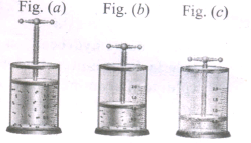
In the below figure, let us find the missing parameters [volume in (b) and pressure in (c)]
P1 = 1 atm, P2 = 2 atm, P3 = ? atm
V1 = 1dm3, V2 =? dm3, V3 = 0.25 dm3
T1 = 298 K, T2 = 298 K, T3 = 298 K.
16.
Write a short note on the consequence of Boyle's law. (or) Give the relationship between pressure and density
17.
A sample of gas at 15°C at 1 atm. has a volume of 2.58 dm3. When the temperature is raised to 38°C at 1 atm does the volume of the gas increase? If so, calculate the final volume.
18.
When ammonia combines with HCL, NH4CI is formed as white dense fumes. Why do more fumes appear near HCL ?
19.
When the driver of an automobile applies brake, the passengers are pushed toward the front of the car but a helium balloon is pushed toward back of the car. Upon forward acceleration the passengers are pushed toward the front of the car. Why?
20.
Aerosol cans carry clear warning of heating of the can. Why?
21.
Which of the following gases would you expect to deviate from ideal behaviour under conditions of low temperature F2, Cl2 or Br2? Explain.
22.
Suggest why there is no hydrogen (H2) in our atmosphere. Why does the moon have no atmosphere?
23.
Suppose there is a tiny sticky area on the wall of a container of gas. Molecules hitting this area stick there permanently. Is the pressure greater or less than on the ordinary area of walls?
24.
What are ideal gases? In what way real gases differ from ideal gases.
25.
Name two items that can serve as a model for Gay Lussac's law and explain.
26.
A balloon filled with air at room temperature and cooled to a much lower temperature can be used as a model for Charle's law.
27.
State Boyle's law.
28.
Calculate the pressure exerted by 2 moles of sulphur hexafluoride in a steel vessel of volume 6 dm3 at 70°C assuming it is an ideal gas.
29.
When a real gas is converted from its initial to final state by adiabatic expansion, it is not possible to calculate its volume using Boyle's law. Why?
30.
Give suitable explanation for the following facts about gases.
Gases don't settle at the bottom of a container.
31.
Give the mathematical expression that relates gas volume and moles.
32.
A neon-di-oxygen mixture contains 70.6 g of di-oxygen and 167.5 g of neon. If the pressure of the mixture of gases in the cylinder is 25 bar, what is the partial pressure of di-oxygen and neon in the mixture? (Atomic mass of Ne = 20u)
33.
In an experiment of verification of Charle's law, the following are the set of readings taken by a student.
| Experiment | Volume (L) | Temperature (0C) |
|---|---|---|
| 1 | 1.54 | 20 |
| 2 | 1.65 | 40 |
| 3 | 1.95 | 100 |
| 4 | 2.07 | 120 |
What is the average value of the constant of proportionality ?
34.
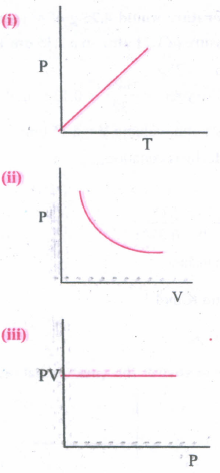
Use the graphs to answer the question below.
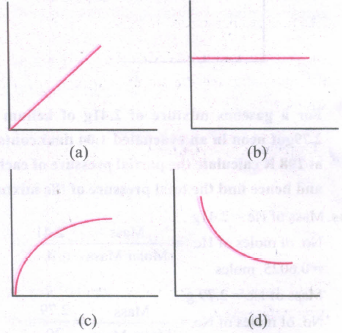
i) Which of the graphs is the best representation of pressure and temperature (measured in kelvin) for one mole of ideal gas
ii) Which of the graphs is the best representation of pressure and volume of one mole of an ideal gas.
iii) Which of the above graph represents PV vs P of one mole of an ideal gas?
35.
Which of following flasks has higher pressure
(a) 5.00 L containing 4.15 g of Helium at 298 K
(b) 10.0 L containing 56.2 g Argon at 303 K
36.
In an experiment of verification of Charle's law, the following are the set of readings taken by a student
| Experiment | Volume (L) | Temperature (°C) |
| 1 | 1.54 | 20 |
| 2 | 1.65 | 40 |
| 3 | 1.95 | 100 |
| 4 | 2.07 | 120 |
What is the average value of the constant of proportionality?
37.
Solve
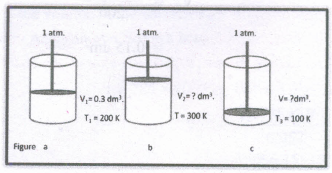
Effect of temperature on volume of the gas to verify Charles' law All the container a, b and c have same pressure of 1 atm. If T1, T2, and T3 are, respectively, at 200, 300 and 100 K, and V1 = 0.3 dm3, calculate V2 and V3.
38.
Derive the ideal gas equation by combining the empirical gas laws.
39.
Why do astronauts have to wear protective suits when they are on the surface of moon?
40.
Derive the values of critical constants in terms of van der Waals constants.
41.
Write the Van der Waals equation for a real gas. Explain the correction term for pressure and volume.
42.
Distinguish between diffusion and effusion.
1.
(b)
4
2.
(c)
P
3.
(d)
I, II and III
4.
(c)
NH3
5.
(a)
Boyle's law
6.
(c)
8.3 J mol-1 K-1
7.
(d)
units of Pressure and volume.
8.
(b)
Near the hydrogen chloride bottle
9.
(b)
Boyle temperature
10.
(a)
\(\frac { 1 }{ 3 } \)
11.
(b)
exert no attractive forces on each other
12.
(c)
\(\left( P+\frac { { an }^{ 2 } }{ { V }^{ 2 } } \right) (V-nb)=nRT\)
13.
(d)
inversely proportional to the square root of its molecular weight
14.
(d)
at high pressure the intermolecular interactions become significant
15.
According to Boyle's law, at constant temperature for a given mass of gas at constant temperature,
P1VI = P2V2 = P3V3
1 atm x 1 dm3 = 2 atm x V2 = P3 x 0.25 dm3
\(\therefore\) 2 atm x V2 = 1 atm x 1 dm3
.png)
\(\boxed{V_2=0.5\ dm^3}\)
and P3 x 0.25 dm3 = 1 atm x 1 dm3
.png)
\(\boxed{P_3=4\ atm}\)
16.
The pressure-density relationship can be derived from the Boyle's law as shown below.
P1V1 = P2V2 (Boyle's law)
\({ P }_{ 1 }\frac { m }{ { d }_{ 1 } } ={ P }_{ 2 }\frac { m }{ { d }_{ 2 } } \)
where "m" is the mass, d 1 and d2 are the densities of gases at pressure P1 and P2 .
\(\frac { { P }_{ 1 } }{ { d }_{ 1 } } =\frac { { P }_{ 2 } }{ { d }_{ 2 } } \)
In other words, the density of a gas is directly proportional to pressure.
17.
T1 = 15oC + 273 T2= 38 + 273
T1 = 288 K T2 = 311 K
V1 = 2.58 dm3 V2 = ?
(P = 1 atm constant)
\(\frac { { V }_{ 1 } }{ { T }_{ 1 } } =\frac { { V }_{ 2 } }{ { T }_{ 2 } } \)
\({ V }_{ 2 }=\left( \frac { { V }_{ 1 } }{ { T }_{ 1 } } \right) \times { T }_{ 2 }\)
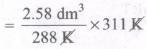
V2 = 2.78 dm3 i.e. volume increased from 2.58 dm3 to 2.78 dm3.
18.
Rate of diffusion \(\text { (r) } \alpha \frac{1}{\sqrt{M}}\)
\(\mathrm{M}_{\mathrm{NH}_{3}}=17 ; \mathrm{M}_{\mathrm{HCl}}=36.5
\)
\(\therefore \mathrm{r}_{\mathrm{NH}_{3}}>\mathrm{r}_{\mathrm{HCl}}
\)
Hence white fumes are first formed near HCL.
19.
The passenger in a moving bus falls in the forward direction, when brakes are applied suddenly is in accordance with Newton's first law of motion.
When breaks are applied, the automobile comes to rest but the passenger due to inertia of motion tend to continue to move in forward direction hence fall forward.
The movement of helium balloon in the opposite direction is due to the difference in the density of surrounding air. When the car stops suddenly, the air moves forward due to inertia of motion.
As a result the air in the front of the car is more dense that at the rear of the car creating more pressure on the front side of the balloon. This causes the balloon move towards the rear of the car where air is less dense.
The body is at rest but the car is forward motion, due to inertia the passengers are pushed toward the front of the car on forward acceleration.
20.
On heating incineration might take place due to the increase of pressure
21.
The larger the size of the molecule, the greater will be Van der Waals' attraction. Therefore greater the deviation from ideal behaviour. So bromine will deviate more from ideal behaviour because it has bigger atoms.
22.
a) Hydrogen is the lightest gas in the atmosphere. So it rises up and other gases which are heavier like O2 & N2 come down towards the surface of the earth according to Graham's law of diffusions \(\mathrm{r} \alpha \sqrt{\frac{1}{M}}\). Hydrogen diffuses very fast. Its mean speed in greater than the escape velocity from the earth. As a consequence, H2 would have escaped from the atmosphere long time ago.
b) The acceleration due to gravity 'g' on moon surface is small. The value of escape velocity is also small. The molecules of the atmospheric gases on the moon's surface have thermal velocities greater than the escape velocity.
All the molecules have escaped. So the atmosphere is so thin.
23.
If there is a tiny sticky area on the walls of the container of a gas, then the collision of the molecules will not be elastic. So the gas will behave as a real gas. So the pressure will be less than the calculated value.
24.
Gases which obey Boyle's Law and Charle's law or ideal gas equation PV = nRT are called ideal gases.
All gases whose behaviour is consistent with the assumption of kinetic theory of gases under all condition are called ideal gases.
| Ideal Gas | Real gas | |
|---|---|---|
| (i) | Ideal gases obey all gas laws under all conditions of temperature and pressure | Real obey gas law only at low pressures and high temperature. |
| (ii) | The volume occupied by a gas molecule is negligible when compared to the total volume of the gas. | The volume occupied by a gas molecule is not negligible when compared to the total volume of the gas. |
| (iii) | The attractive forces between the molecules are negligible | The force of attraction are not negligible at all temperatures and pressures. |
| (iv) | They obey the ideal gas equation: PV = nRT | They obey the Vander waal's equation: \(\left(P+\frac{n^{2} a}{V^{2}}\right)(V-n b)=n R T\) |
| (v) | The collision between the molecules are elastic | The collision between the molecules are not elastic |
| (vi) | No energy is involved during, the collision of the molecules of ideal gas | Collision of molecules in real gas have attractive energy |
25.
The following table gives the pressure of a gas with increasing temperature at constant volume for two cylinders.
| ToC | 32oC | 69oC | 94oC | 130oC |
| P (atm) 50 L container |
0.51 | 0.56 | 0.6 | 0.66 |
| P (atm) 75 L container |
0.34 | 0.37 | 0.40 | 0.44 |
Both the models explain Gay - Lussac's Law. P \(\propto\) T are constant V & n
For 50 L container:
The pressure increases with rise in temperature (at constant volume)
For 75 L container:
The pressure increases with rise in temperature (at constant volume)
26.
Charles law states that "At constant pressure, the volume of a given mass of an ideal gas is directly proportional to its temperature." According to Charles Law, if we were to take a balloon filled with air and increase the temperature of the air inside, the volume of air would increase causing the balloon to expand. This is caused by the heating of the molecules of air inside the balloon causing them to move rapidly. In the same manner if we cooled the balloon in a freezer, the volume of air decreases, making the balloon look partially deflated.
27.
At a given temperature the volume occupied by a fixed mass of a gas is inversely proportional to its pressure.
\(V\alpha \frac { 1 }{ P }\) at constant T& n.
Mathematical form: P1V1 = P2 V2 = K
28.
We will use the ideal gas equation for this calculation as below:
\({P=nRT\over V}={{2mol\times 0.0821Latm.K^{-1}.mo^l{-1}\times (70+273K)}\over{6dm^3}}\)
= 9.39 atm.
29.
Boyle's law is applicable only at the condition of constant temperature. Since in adiabatic expansion, temperature is lowered Boyle's law cannot be applied.
30.
Gases are very less denser. They have negligible intermolecular forces of attraction between the molecules. They are in continuous kinetic motion. So they won't settle at the bottom due to gravitational forces. The material that is most dense will sink to the bottom; the less denser will go up.
31.
According to Avogadro's hypothesis: V \(\alpha\) n
\(\therefore \frac{V_{1}}{n_{1}}=\frac{V_{2}}{n_{2}}=\text { constant }\)
V1 & n2 are the volume and number of moles of a gas and V2 & n2 are a different set of values of volume and number of moles of the same gas at same temperature and pressure.
32.
No. of mol of dioxygen \((n_{O_2})=\frac{ mass of O_2}{molar mass of O_2}\)
=\(\frac{70.6 g }{32.0 g mol^{-1}}=2.21 mol\)
No. of mol of neon \((n_{Ne})=\frac{mass of Ne}{molar mass of Ne}=\frac{167.5 g}{20 g mol^{-1}}\)
= 8.375 mol.
mole fraction of di-hydrogen = \(\frac{n_{O_2}}{n_{O_2}+n_{N_e}}=\frac{2.21}{2.21+8.375}=0.21\)
mole fraction of neon = 1 - 0.21 = 0.79
partial pressure of O2 = mole fraction of O2 x Total pressure
= 0.21 x 25 bar = 5.25 bar
partial pressure of Ne = mole fraction of Ne x Total pressure
= 0.79 x 25 bar = 19.75 bar
33.
| Experiment | \(\frac{v_1}{T_1}\)=constant |
|---|---|
| 1 | \(\frac{1.54}{293}\) = 0.0053 |
| 2 | \(\frac{1.65}{313}\) = 0.0053 |
| 3 | \(\frac{1.95}{373}\) = 0.0053 |
| 4 | \(\frac{2.07}{393}\) = 0.0053 |
The average value of the constant is 0.0053.
34.
35.
(a) 5.076 atm
(b) 3.495 atm
36.
According to charles law
\(\frac { { V }_{ 1 } }{ { T }_{ 1 } } =\frac { 1.54 }{ 293 } \)
= 0.0052
T1 = 20 C + 273 = 293 K
T2 = 40°C
\(\frac { { V }_{ 2 } }{ { T }_{ 2 } } =\frac { 1.65 }{ 40+273 } =\frac { 1.65 }{ 313 } =0.0052\)
T3 = 100°C + 273 = 373 K
\(\frac { { V }_{ 3 } }{ { T }_{ 3 } } =\frac { 1.95 }{ 373K } =0.0052\)
T4 = 120°C+273 = 393 K
\(\frac { { V }_{ 4 } }{ { T }_{ 4 } } =\frac { 2.07 }{ 393 } =0.0052\)
The average value of constant of proportionality is 0.0052.
37.
0.15 dm2
38.
The gaseous state is described completely using the following four variables T,P, V and n and their relationships were governed by the gas laws studied so far.
Boyle's law \(\mathrm{V} \propto \frac{1}{\mathrm{P}}\)
Charles law \(\mathrm{V} \propto T\)
Avogadro's law \(\mathrm{V} \propto n\)
We can combine these equations into the following general equation that describes the physical behaviour of all gases.
\(
\mathrm{V} \propto \frac{\mathrm{nT}}{\mathrm{P}}
\)
\(\mathrm{V}=\frac{\mathrm{nRT}}{\mathrm{P}}\)
Where, R is the proportionality constant called universal gas constant. The above equation can be rearranged to give the ideal gas equation
PV = nRT
39.
Astronauts must wear space suits filled with air, whenever they leave a space craft and are exposed to the environment of space.
Dangers experienced on moon's space :
1. In space there is no air to breathe and no air pressure.
2. Space is extremely cold and filled with dangerous radiations.
3. If they do not wear space suits, there may be bleeding due to high body pressure.
4. The space suits prevent astronauts from impacts of small bits of space dust.
5. There is no atmosphere on the moon and there are dangers from micro-meteorite impacts.
6. The astronauts are protected from these dangers on wearing space suits.
40.
The van der Waals equation for n moles is
\(\left( P+\frac { { an }^{ 2 } }{ { v }^{ 2 } } \right) \left( v-nb \right) =nRT\) ....(1)
For 1 mole
\(\left( P+\frac { { a }^{ 2 } }{ { v }^{ 2 } } \right) \left( v-b \right) =RT\) ...(2)
From the equation we can derive the values of critical constants Pc, Vc and Tc, in terms of a and b, the van der Waals constants, On expanding the above equation
\(pv+\frac { a }{ v } -pb-\frac { ab }{ { v }^{ 2 } } -RT=0\) ...(3)
Multiply equation (3) by V2 / P
\(\frac { { v }^{ 2 } }{ p } \left( Pv+\frac { a }{ v } -pb-\frac { ab }{ { v }^{ 2 } } -RT \right) =0\)
\({ v }^{ 3 }+\frac { av }{ p } +-{ bv }^{ 2 }-\frac { ab }{ { v }^{ 2 } } -\frac { { RTV }^{ 2 } }{ p } \) ...(4)
When the above equation is rearranged in powers of Y.
\({ v }^{ 3 }-\left[ \frac { RT }{ P } +b \right] { v }^{ 2 }+\left[ \frac { a }{ p } \right] v-\left[ \frac { ab }{ p } \right] =0\) ...(5)
The equation (5) is a cubic equation in V. On solving this equation,
we will get three solutions. At the critical point all these three solutions of V are equal to the critical volume VC. The pressure and temperature becomes Pc and Tc respectively
i.e., V = Vc
V - Vc = 0
(V - VC)3 = 0
V3 - 3VCV2 + 3Vc2V - Vc3 = 0 .....(6)
As equation (5) is identical with equation (6), we can equate the coefficients of V2, V and constant terms in (5) and (6).
\(-3{ v }_{ c }{ v }^{ 2 }=-\left[ \frac { { RT }_{ c } }{ { p }_{ c } } +b \right] { v }^{ 2 }\)
\(3{ v }_{ c }=\frac { { RT }_{ c } }{ { p }_{ c } } +b\) .....(7)
\(3{ v }_{ c }^{ 2 }=\frac { a }{ { p }_{ c } } \) ......(8)
\(3{ v }_{ c }^{ 2 }=\frac { ab }{ { p }_{ c } } \) ...(9)
Divide equation (9) by equation (8)
\(\frac { { v }_{ c }^{ 3 } }{ 3{ v }_{ c }^{ 2 } } =\frac { ab/{ p }_{ c } }{ a/{ p }_{ c } } \)
\(\frac { { V }_{ c } }{ 3 } =b\)
i.e. Vc = 3b .....(10)
when equation (10) is substituted in (8)
\(3{ v }_{ c }^{ 2 }=\frac { a }{ { p }_{ c } } \)
\({ p }_{ c }=\frac { a }{ 3{ v }_{ c }^{ 2 } } =\frac { a }{ 3\left( { 3b }^{ 2 } \right) } =\frac { a }{ { 3\times 9b }^{ 2 } } =\frac { a }{ { 27 }b^{ 2 } } \)
\({ p }_{ c }=\frac { a }{ { 27 }b^{ 2 } } \) ...(11)
substituting the values of Vc and Pc in equation (7),
\(3vc=b+\frac { { RT }_{ c } }{ p } \)
\(3\left( 3b \right) =b+\frac { { RT }_{ c } }{ \left( \frac { a }{ { 27b }^{ 2 } } \right) } \)
\(9b-b=\left( \frac { { RT }_{ c } }{ a } \right) 27{ b }^{ 2 }\)
\(8b=\frac { { t }_{ c }R{ 27b }^{ 2 } }{ a } \)
\(\therefore { T }_{ c }=\frac { 8ab }{ 27R{ b }^{ 2 } } =\frac { 8a }{ 27Rb } \)
\({ T }_{ c }=\frac { { 8 }_{ a } }{ 27Rb } \) ......(12)
The critical constants can be calculated using the values of van der Waals constant of a gas and vice versa.
\(a=3{ V }_{ C }^{ 2 }{ P }_{ C }\quad and\quad b=\frac { { V }_{ C } }{ 3 } \)
41.
The van der equation for a real gas is
\(\left( P+{{{am}^{2}}\over{{V}^{2}}} \right)(V-nb)=nRT\)
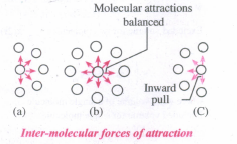
Pressure, Correction:
The pressure of a gas is directly proportional to the force created by the bombardment of molecules on the walls of the container. The speed of a molecule moving towards the wall of the container is reduced by the attractive forces exerted by its neighbours. Hence, the measured gas pressure is lower than the ideal pressure of the gas. Hence, van der Waals introduced a correction term to this effect.
Van der Waals found out the forces of attraction experienced by a molecule near the wall are directly proportional to the square of the density of the gas.
\(P^{\prime} \propto \rho^{2} ; \quad \rho=\frac{n}{v}\)
where n is the number of moles of gas and
V is the volume of the container
\( \Rightarrow p^{\prime} \alpha \frac{n^{2}}{V^{2}} \)
\(\Rightarrow p^{\prime}=a \frac{n^{2}}{V^{2}}\)
where a is proportionality constant and depends on the nature of gas
Therefore \(P_{\text {ideal }}=P+\frac{\operatorname{an}^{2}}{V^{2}}\)
Volume Correction
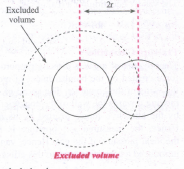
As every individual molecule of a gas occupies a certain volume, the actual volume is less than the volume of the container,
V. Van der Waals introduced a correction factor V' to this effect. Let us calculate the correction term by considering gas molecules as spheres.
V = excluded volume
Excluded volume for two molecules
\(=\frac{4}{3} \pi(2 r)^{3}=8\left(\frac{4}{3} \pi r^{3}\right)=8 V_{m}\)
Where Vm it a volume of a single molecule
Excluded volume for single molecule = \(\frac{8 \mathrm{~V}_{\mathrm{m}}}{2}=4 \mathrm{~V}_{\mathrm{m}}\)
Excluded volume for n molecule = n(4Vm) = nb
Where b is van der waals constant which is equal to 4Vm
\( \Rightarrow V^{\prime}=n b \)
\(V_{\text {ideal }}=V-n b\)
Replacing the corrected pressure and volume in the ideal gas equation PV = nRT we get the Van der Waals equation of state for real gases as below,
\(\left(p+\frac{a^{2}}{V^{2}}\right)(V-n b)=n R T\)
The constants a and b are van der Waals constants and their values vary with the nature of the gas. It is an approximate formula for the non-ideal gas.
42.
| S.NO | diffusion | effusion |
| 1 | It is the spreading of molecules of a substance throughout a space or second substance | It is the escape of the gas molecules through a very small hole (orifice) in a membrane into an evacuated area. |
| 2 | It is typically used to describe statistical properties of a gas at length scales that are much larger than mean free path. | The diameter of the hole should be smaller than mean free path of the molecules. |
| 3 | It is the spreading of gases. | It is the pouring out of gases. |

11th Standard Syllabus & Materials
11th Standard
TN 11th Tamil பீடு பெற நில் - செய்யுள் - காவடிச்சிந்து Important Questions And Answers Study Material - QB365 Set A
NEW11th Standard
TN 11th Tamil பீடு பெற நில் - உரைநடை - மலை இடப்பெயர்கள் : ஓர் ஆய்வு Important Questions And Answers Study Material - QB365 Set A
NEW11th Standard
TN 11th Tamil மாமழை போற்றுதும் - துணைப்பாடம் - யானை டாக்டர் Important Questions And Answers Study Material - QB365 Set A
NEW11th Standard
TN 11th Tamil மாமழை போற்றுதும் - செய்யுள் - ஐங்குறுநூறு Important Questions And Answers Study Material - QB365 Set A



Tamilnadu Stateboard 11th Standard Subjects

Maths

Commerce

Economics

Biology

Business Maths and Statistics

Accountancy

Computer Science

Physics
Chemistry
Maths
Biology
Economics
Physics
Chemistry

History
Business Maths and Statistics

Computer Science
Accountancy

Computer Applications
History
Computer Technology
Commerce
Computer Applications
Computer Technology

Tamil

English

French
Tamilnadu Stateboard Standards
