
 100% FREE ACCESS
11th Standard Syllabus & Materials
11th Standard
TN 11th Tamil இயற்கை வேளாண்மை,சுற்றுச்சூழல் -செய்யுள் - மனோன்மணீயம் Important Questions And Answers Study Material - QB365 Set A
NEW11th Standard
TN 11th Tamil என்னுயிர் என்பேன் -துணைப்பாடம் - இசைத்தமிழர் இருவர் Important Questions And Answers Study Material - QB365 Set A
NEW11th Standard
TN 11th Tamil மொழி கலை -செய்யுள் - ஒவ்வொரு புல்லையும் Important Questions And Answers Study Material - QB365 Set A
NEW11th Standard
TN 11th Tamil பீடு பெற நில் - இலக்கணம் - பகுபத உறுப்புகள் Important Questions And Answers Study Material - QB365 Set A
NEW11th Standard
TN 11th Tamil பீடு பெற நில் - துணைப்பாடம் - வாடிவாசல் Important Questions And Answers Study Material - QB365 Set A
NEW11th Standard
TN 11th Tamil பீடு பெற நில் - செய்யுள் - குறுந்தொகை Important Questions And Answers Study Material - QB365 Set A

Published on: 28/07/2018
Some of the important questions are prepared from this chapter Biology: Vegetative Morphology .it covers one, two, three marks and five marks questions from the book back and previous year questions.
For parents, Please subscribe and get the plenty of question with answer for your children practice. For Subscription please click here.
Download Tamil Nadu 11th Standard Biology question papers, model tests, one-mark questions, important questions, and public exam papers in PDF format. Free study materials and answer keys for TN State Board students.
Questions + Answers key
Take MCQ Biology Test1.
One of the following is a leaf ____.
phyllode
phylloclade
cotyledons
ligule
2.
The terminal leaflets are modified into __________ in Bignonia
tendril
hooks
spines
foliar roots
3.
The leaf of Coriandrum is described as _____
bipinnate
unipinnate
decompound
tripinnate
4.
Ternate phyllotaxy is seen in _____
Nerium
Ocimum
Allamanda
Guava
5.
Stilt roots are also called _____
Pillar roots
Buttress root
Clasping root
Brace roots
6.
Bryophyllum and Dioscorea are example for ______.
Foliar bud, apical bud
Foliar bud, cauline bud
Cauline bud, apical bud
Cauline bud, foliar bud
7.
Curcuma amada, Curcuma domestica, Asparagus, Maranta are example of __________
Tuberous root
Beaded root
Moniliform root
Nodulose root
8.
Example for negatively geotropic roots __________
Ipomoea, Dahlia
Asparagus, Ruellia
Vitis, Portulaca
Avicennia, Rhizophora
9.
When the root is thick and fleshy, but does not taken a definite shape, it said to be _________
Nodulose root
Tuberous root
Monilliform root
Fasiculated root
10.
Roots are ______.
Descending, negatively geotrophic, positively phototropic
Descending, positively geotrophic, negatively phototrophic
Ascending, positively geotrophic, negatively phototrophic
Ascending, negatively geotrophic, positively phototrophic
11.
What are hypsophylls or bract leaves?
12.
What is Phyllome?
13.
How are Bulbs classified? Give examples of Bulbs.
14.
Name the types of Subaerial stems.
15.
Name the types of Adventitious roots modified for storage.
16.
What are assimilatory roots?
17.
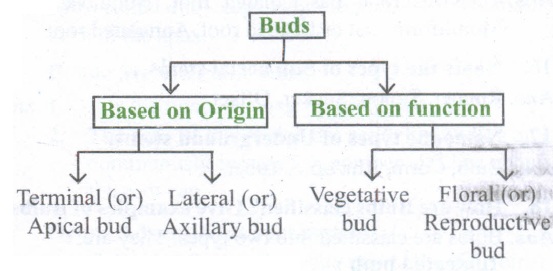
How are buds classified?
18.
What are hook climbers?
19.
Mention any four secondary functions of the stem.
20.
What are Stilt / Brace roots?
21.
What are breathing roots?
22.
How are Tap roots modified for storage?
23.
Explain the subaerial stem modifications.
24.
Write a note on Adventitious roots modified for storage.
1.
(c)
cotyledons
2.
(b)
hooks
3.
(c)
decompound
4.
(a)
Nerium
5.
(d)
Brace roots
6.
(b)
Foliar bud, cauline bud
7.
(d)
Nodulose root
8.
(d)
Avicennia, Rhizophora
9.
(b)
Tuberous root
10.
(b)
Descending, positively geotrophic, negatively phototrophic
11.
These leaves cover the flower or an inflorescence in their axil. The main function of these leaves is to protect the flower buds.
12.
All the leaves of a plant together are referred to as Phyllome.
13.
Bulbs are classified into two types. They are,
Tunicated bulb:
a) Simple Tunicated bulb, Eg: Allium cepa
b) Compound Tunicated bulb, Eg: Allium sativum
Scaly Bulb: Eg: Tulipa spp
14.
Runner, Stolon, Sucker, Offset.
15.
Tuberous root, Fasciculated root, Nodulose root, Moniliform root or Beaded root, Annulated root.
16.
These are roots of some climbing or epiphytic plants which develop chlorophyll and turn green to help in photosynthesis. Eg: Tinospora, Trapa natans.
17.
18.
These plants produce specialized hook-like structures which are the modification of various organs of the plant. In Artabotrys inflorescence axis is modified into hook .
19.
1. Food storage- Eg: Solanum tuberosum, Colocasia and Zingiber officinale.
2. Perennation/reproduction - Eg: Zingiber officinale, Curcuma longa.
3. Water storage - Eg: Opuntia.
4. Buoyancy - Eg: Neptunia.
20.
These are thick roots growing obliquely from the basal nodes of the main stem. These provide mechanical support. Eg: Saccharum officinarum, Zea mays.
21.
Some mangrove plants like Avicennia, Rhizophora, develop special kinds of roots (Negatively geotropic) for respiration because the soil becomes saturated with water and aeration is very poor. They have a large number of breathing pores or pneumatopores for exchange of gases.
22.
1. Conical Root: These are cone like , broad at the base and gradually tapering towards the apex. Eg: Daucus carota.
2. Fusiform root: These roots are swollen in the middle and tapering towards both ends. Eg: Raphanus sativus
3. Napiform root: It is very broad and suddenly tapers like a tail at the apex. Eg: Beta vulgaris.
23.
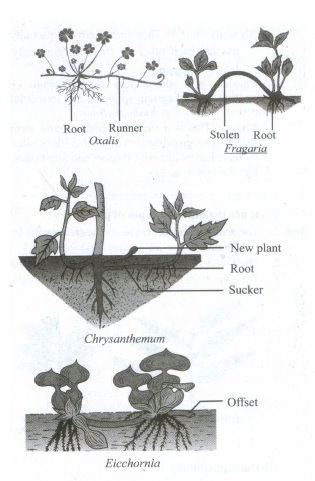
Sub aerial stem found in plants with weak stem in which branches lie horizontally on the ground. These are meant for vegetative propagation. They are classified as:
1. Runner
2. Stolon
3. Sucker
4. Offset
1. Runner: This is a slender, prostrate branch creeping on the ground and rooting at the nodes. Eg: Centella, Oxalis
2. Stolon: This is also a slender, lateral branch originating from the base of the stem. But it first grows obliquely above the ground, produces a loop and bends down towards the ground. When touches the ground it produces roots and becomes an independent plantlet. Eg: Mentha piperita, Fragaria
3. Sucker: Sucker develops from an underground stem and grows obliquely upwards and gives rise to a separate plantlet or new plant. Eg: Chrysanthemum.
4. Offset: Offset is similar to the runner but found in aquatic plants especially in rosette leaved forms. A short thick lateral branch arises from the lower axil and grows horizontally leafless for a short distance, then it produces a bunch of rosette leaves and root at nodes. Eg: Eichhornia
24.
Tuberous root: These are swollen without any definite shape. They are produced singly and not in clusters. Eg. Ipomoea batatas.
Fasciculated root: These are in a cluster from the base of the stem. Eg: Dahlia, Asparagus.
Nodulose root: Swelling occurs only near the tips. Eg: Maranta (arrowroot) Curcuma Amada (mango ginger).
Moniliform or Beaded root: These roots swell at frequent intervals giving them a beaded appearance. Eg. Vitis, Portulaca.
Annulated root: These roots have a series of ring-like swelling on their surface at regular intervals. Eg: Ipecac (Psychotria).

11th Standard Syllabus & Materials
11th Standard
TN 11th Tamil பீடு பெற நில் - செய்யுள் - காவடிச்சிந்து Important Questions And Answers Study Material - QB365 Set A
NEW11th Standard
TN 11th Tamil பீடு பெற நில் - உரைநடை - மலை இடப்பெயர்கள் : ஓர் ஆய்வு Important Questions And Answers Study Material - QB365 Set A
NEW11th Standard
TN 11th Tamil மாமழை போற்றுதும் - துணைப்பாடம் - யானை டாக்டர் Important Questions And Answers Study Material - QB365 Set A
NEW11th Standard
TN 11th Tamil மாமழை போற்றுதும் - செய்யுள் - ஐங்குறுநூறு Important Questions And Answers Study Material - QB365 Set A



Tamilnadu Stateboard 11th Standard Subjects

Maths

Commerce

Economics
Biology

Business Maths and Statistics

Accountancy

Computer Science

Physics

Chemistry
Maths
Biology
Economics
Physics
Chemistry

History
Business Maths and Statistics

Computer Science
Accountancy

Computer Applications
History
Computer Technology
Commerce
Computer Applications
Computer Technology

Tamil

English

French
Tamilnadu Stateboard Standards

