
 100% FREE ACCESS
11th Standard Syllabus & Materials
11th Standard
TN 11th Tamil இயற்கை வேளாண்மை,சுற்றுச்சூழல் -செய்யுள் - மனோன்மணீயம் Important Questions And Answers Study Material - QB365 Set A
NEW11th Standard
TN 11th Tamil என்னுயிர் என்பேன் -துணைப்பாடம் - இசைத்தமிழர் இருவர் Important Questions And Answers Study Material - QB365 Set A
NEW11th Standard
TN 11th Tamil மொழி கலை -செய்யுள் - ஒவ்வொரு புல்லையும் Important Questions And Answers Study Material - QB365 Set A
NEW11th Standard
TN 11th Tamil பீடு பெற நில் - இலக்கணம் - பகுபத உறுப்புகள் Important Questions And Answers Study Material - QB365 Set A
NEW11th Standard
TN 11th Tamil பீடு பெற நில் - துணைப்பாடம் - வாடிவாசல் Important Questions And Answers Study Material - QB365 Set A
NEW11th Standard
TN 11th Tamil பீடு பெற நில் - செய்யுள் - குறுந்தொகை Important Questions And Answers Study Material - QB365 Set A

Published on: 07/11/2019
Download Tamil Nadu 11th Standard Chemistry question papers, model tests, one-mark questions, important questions, and public exam papers in PDF format. Free study materials and answer keys for TN State Board students.
Questions + Answers key
Take MCQ Chemistry Test1.
Which one of the following compound does not give Prussian blue colour in Lassaigne's test _________
C6H5NH2
\({ NH }_{ 2 }-\underset { \overset { || }{ O } }{ C } -{ NH }_{ 2 }\)
C6H5CONH2
C6H5COCI
2.
Which of the following is not an ideal solution?
Benzene & toluene
n-Hexane & n-Heptane
Ethyliodide & ethyl bromide
Ethanol and water
3.
Which of the following is an example of heterogeneous equilibrium?
Synthesis of HI
Dissociation of PCl5
Acid hydrolysis of ester
Decomposition of limestone
4.
In which of the following equilibrium, change in pressure will not affect the equilibrium?
\({ N }_{ 2\left( g \right) }+3{ H }_{ 2\left( g \right) }\rightleftharpoons 2NH_{ 3\left( g \right) }\)
\({ H }_{ 2\left( g \right) }+I_{ 2\left( g \right) }\rightleftharpoons 2HI_{ \left( g \right) }\)
\({ PCI }_{ 5\left( g \right) }\rightleftharpoons { PCI }_{ 3\left( g \right) }+CI_{ 2\left( g \right) }\)
\({ N }_{ 2 }{ O }_{ 4\left( g \right) }\rightleftharpoons 2NO_{ 2\left( g \right) }\)
5.
\(\underset { \underset { OH }{ | } }{ { CH }_{ 3 }-{ CH }_{ 2 }-{ CH }-CH_{ 2 }-{ CH }_{ 2 }-{ CH }_{ 3 } } \) and \(\underset { \underset { OH }{ | } }{ { CH }_{ 3 }-{ CH }_{ 2 }-{ CH_{ 2 } }-CH-{ CH }_{ 3 } } \) are ___________
Functional isomers
Position isomers
Chain isomers
These are not isomers
6.
In a binary solution __________
solvent may be liquid
solvent may be solid
solute may be gas
any of these
7.
The purity of an organic compound is determined by __________
Chromatography
Crystallisation
melting or boiling point
both (a) and (c)
8.
Which of the following is optically active?
3 – Chloropentane
2 Chloro propane
Meso – tartaric acid
Glucose
9.
The IUPAC name of the Compound is _____________
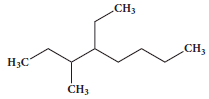
2,3 - Diemethylheptane
3- Methyl -4- ethyloctane
5-ethyl -6-methyloctane
4-Ethyl -3 - methyloctane
10.
11.
According to Raoults law, the relative lowering of vapour pressure for a solution is equal to __________
mole fraction of solvent
mole fraction of solute
number of moles of solute
number of moles of solvent
12.
Osometic pressure (p) of a solution is given by the relation ____________
= nRT
V = nRT
\(\pi\)RT = n
none of these
13.
Consider the following reversible reaction at equilibrium, A + B ⇌ C, If the concentration of the reactants A and B are doubled, then the equilibrium constant will ___________
be doubled
become one fourth
be halved
remain the same
14.
Match the equilibria with the corresponding conditions,
| i) Liquid ⇌ Vapour | 1) melting point |
| ii) Solid ⇌ Liquid | 2) Saturated solution |
| iii) Solid ⇌ Vapour | 3) Boiling point |
| iv) Solute (s) ⇌ Solute (Solution) | 4) Sublimation point |
| 5) Unsaturated solution |
| (i) | (ii) | (iii) | (iv) |
| 1 | 2 | 3 | 4 |
| (i) | (ii) | (iii) | (iv) |
| 3 | 1 | 4 | 2 |
| (i) | (ii) | (iii) | (iv) |
| 2 | 1 | 3 | 4 |
| (i) | (ii) | (iii) | (iv) |
| 3 | 2 | 4 | 5 |
15.
\({K_c\over K_p}\) for the reaction,
N2(g) + 3H2(g) ⇌ 2NH3(g) is ___________
\({1\over RT}\)
\(\sqrt{RT}\)
RT
(RT)2
16.
Explain the effect of concentration of reactants on an equilibrium with example
17.
Write the value of KP, and KC equation for CaCO3(s) ⇌CaO(s) + CO2(g)
18.
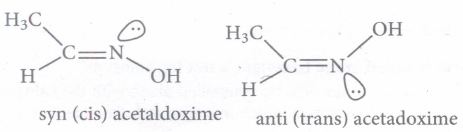
Explain about the geometrical isomerism possible in oximes.
19.
Draw the structures of
(I) 3-methylpentanal
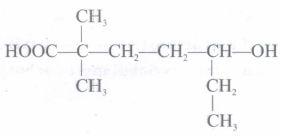
(ii) 5-hydroxy 2, 2-dimethyl heptanoic acid
(iii) 2-ethyl-4-propylpentane-dioic acid
20.
Explain reverse osmosis.
21.
What are the advantages of standard solution.
22.
Describe optical isomerism with suitable example.
23.
Write all the possible isomers of molecular formula C4H10O and identify the isomerisms found in them.
24.
An aqueous solution of 2% nonvolatile solute exerts a pressure of 1.004 bar at the boiling point of the solvent. What is the molar mass of the solute when PA is 1.013 bar ?
25.
State Le-Chatelier principle.
26.
What is the relation between KP and KC. Give one example for which KP is equal to KC.
27.
What are the condition for optical isomerism (or) enantiomerism.
28.
Define Van't Hoff factor.
29.
The following concentration were obtained for the formation of NH3 from N2 and H2 at equilibrium for the reaction \({ N }_{ 2g }+3{ H }_{ 2\left( g \right) }\rightleftharpoons { { 2NH }_{ 3\left( g \right) } }\)
[N2] = 1.5 x 10⁻²M; [H2]= 3.0 x 10⁻²M;
[NH3] = 1.2 x 10⁻²M
Calculate the equilibrium constant.
30.
What is KH in Psolute= KH Xsolute?On what does the value of KH depend ?
31.
What is osmosis ?
32.
Derive the values of Kp and Kc for dissociation of PCl5.
33.
Derive the expressions for KC and KP, for the synthesis of Hl.
34.
Explain Dumas method of estimation of nitrogen.
35.
Explain about lassaigne's test for detection of nitrogen in an organic compound.
36.
What are ideal and non-ideal solutions ? Explain with suitable diagram the behaviour of ideal solutions.
37.
How will you obtain the molecular mass of a solute from relative lowering of vapour pressure ?
38.
Explain the effect of concentration, pressure, temperature, catalyst and inert gas on equilibrium.
39.
Explain the following with example.
(i) Fisher projection formula
(ii) Saw horse projection formula
(iii) Newman projection formula
40.
List down the characteristics possessed by the organic compounds.
41.
Give the expression and illustration for the following concentration terms
(i) Molarity
{ii) Formality
(iii) Mass Percentage
(iv) Volume Percentage
(v) Mass by volume
42.
Write a note on homologous series.
1.
(a)
C6H5NH2
2.
(d)
Ethanol and water
3.
(d)
Decomposition of limestone
4.
(b)
\({ H }_{ 2\left( g \right) }+I_{ 2\left( g \right) }\rightleftharpoons 2HI_{ \left( g \right) }\)
5.
(d)
These are not isomers
6.
(d)
any of these
7.
(d)
both (a) and (c)
8.
(d)
Glucose
9.
(d)
4-Ethyl -3 - methyloctane
10.
(d)
11.
(b)
mole fraction of solute
12.
(b)
V = nRT
13.
(d)
remain the same
14.
(b)
| (i) | (ii) | (iii) | (iv) |
| 3 | 1 | 4 | 2 |
15.
(d)
(RT)2
16.
At equilibrium, the concentration of the reactants and products does not change. The addition of more reactants or products to the reacting system at equilibrium causes an increase in their respective concentration.
According to Le-Chatelier's principle, the effect of increase in concentration of a substance is to shift the equilibrium in a direction that consumes the added substance. For example,
H2(g) + I2(g) ≓ 2HI(g)
The addition of H2 or I2 to the equilibrium mixture, disturbs the equilibrium. In order to minimize the stress, the system shifts the reaction in a direction where H2 and I2 are consumed i.e., formation of additional HI would balance the effect of added reactant. Hence the equilibrium shifts to the right (forward direction). i.e., the equilibrium is re-established. Similarly, removal of HI (Product) also favours forward reaction.
If HI is added to the equilibrium mixture, the concentration of HI is increased and system proceeds in the reverse direction to nullify the effect of increase in concentration of HI.
17.
A pure solid always has the same concentration at a given temperature, as it does not expand to fill its container i.e., it has the same no. of moles of its volume. Therefore the concentration of pure solid is a constant. So the expression if KC and KP, is KC = [CO2], K, = PCO2
18.
(i) Restricted rotation around C = N (oximes) gives rise to geometrical isomerism in oximes. Here syn and anti are used instead of cis and trans respectively.
(ii) In the syn isomer the H atom of a doubly bonded carbon and -OH group of doubly bonded nitrogen lie on the same side of the double bond, while in the anti isomer, they lie on the opposite side of the double bond.
(iii) for e.g.,
19.
(i) \({ CH }_{ 3 }-{ CH }_{ 2 }-\underset { \overset { | }{ { CH }_{ 3 } } }{ CH } -{ CH }_{ 2 }-CHO\)
(ii)
(iii) \({ H }_{ 3 }C-{ CH }_{ 2 }-\overset { \underset { | }{ COOH } }{ CH } -{ CH }_{ 2 }-\overset { \underset { | }{ COOH } }{ CH } -{ CH }_{ 2 }-{ { CH }_{ 2 } }-{ CH }_{ 3 }\)
20.
(i) The pure water moves through the semipermeable membrane to the NaCI solution due to osmosis.
(ii) This process can be reversed by applying pressure greater than the osmotic pressure to the solution side. Now the pure water moves from the solution side to the solvent side and this process is called reverse osmosis.
(iii) Reverse osmosis can be defined as a process in which a solvent passes through a semipermeable membrane in the opposite direction of osmosis, when subjected to a hydrostatic pressure greater than the osmotic pressure.
21.
1. The error due to weighing the solute can be minimised by using concentrated stock solution that requires large quantities of solute.
2. We can prepare working standards of different concentrations by diluting the stock solution which is more efficient since consistency is maintained.
3. Some of the concentrated solutions are more stable and are less likely to support microbial growth than working standards used in the experiments.
22.
Optical isomerism:
Compounds having same physical and chemical property but differ only in the rotation of plane of the polarized light are known as optical isomers and the phenomenon is known as optical isomerism.
Some organic compounds such as glucose have the ability to rotate the plane of the plane polarized light and they are said to be optically active compounds and this property of a compound is called optical activity. The optical isomer, which rotates the plane of
the plane polarised light to the right or in cloclauisl direction is said to be dextrorotary (dexter means right) denoted by the sign (+), whereas the compound which rotates to the left or anticloclanrise is said to be leavo rotatory (leanues mean left) denoted by sign(-).
Dextrorotatory compounds are represented as 'd' or by sign (+) and lavorotatory compounds are ( - ) represented as 'l' or by sign (-).
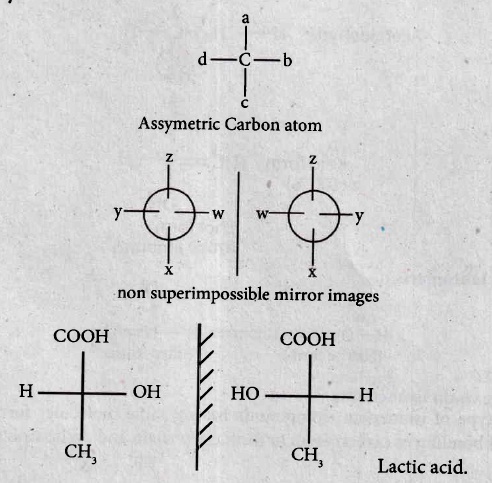
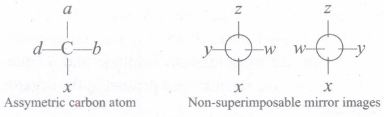
Enantiomerism and optical activity: An optically active substance may exist in two or more isomeric forms which have same physical and chemical properties but differ in terms of direction of rotation of plane polarized light, such optical isomers which rotate the plane of polarized light with equal angle but in opposite direction are known as enantiomers and the phenomenon is knovrrn as enantiomerism. Isomers which are non-super impossible mirror images of each other are called enantiomers.
conditions for enantiomerism or optical isomerism:
A carbon atom whose tetra vaiency is satisfied by four different substituents (atoms or groups) is called a symmetric carbon or chiral carbon. It is indicated by an asterisk as C*. A molecule Possessing chiral carbon atom and non-super impossible to its own mirror image is said to be a chiral molecule or asymmetric, and the pioperty is called chirality or dissymmetry.
23.
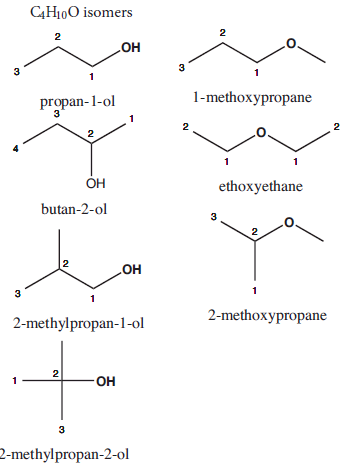
i) Butan.- I - ol & Butan - 2 -ol are position isomers. - Position isomerism
ii) Butan -I -ol & 2-methyl propan - I - ol are chain isomers - Chainisomerism
iii) Butan -I - ol and I - methoxy propane are functional isomers - Functional isomerism
iv) 1 - methoxy Propane and ethoxy ethane and 2 - methoxy Propane are metamers - Metamerism
24.
\({\Delta P\over P_A^o}={W_B\times M_A\over M_B\times W_A}\)
In a 2 % solution weight of the solute is 2g and solvent is 98g
ΔP = PA - Psolution = 1.013 - 1.004 bar = 0.009 bar
\(M_B={P_A^o\times W_B\times M_A\over \Delta P\times W_A}\)
MB = 2 x 18 x 1.013/(98 x 0.009)
= 41.3 g mol-1.
25.
If a system at equilibrium is disturbed, then the system shifts itself in a direction that nullifies the effect of that disturbance.
26.
i) \(K_{p}=K_{c}(R T)^{\Delta n_{g}}\)
Kp = Equilibrium constant in term of partial Pressures.
Kc = Equilibrium constant in term of concentration.
R = Gas constant; T = Temperature
\(\Delta \mathrm{n}_{\mathrm{g}}\) = Difference between the sum of number of moles of products and the sum of number of moles of reactants in gas phases.
ii) Synthesis of HI:
\( \mathrm{H}_{2(\mathrm{~g})}+\mathrm{I}_{2(\mathrm{~g})} \rightleftharpoons 2 \mathrm{HI}_{(\mathrm{g})} \)
\(\Delta n_{g}=0 \therefore K_{p}=K_{c}(R T) \Delta n_{g}\)
\(K_{p}=K_{c}(R T)^{\circ} \)
\(K_{p}=K_{c} \text {. }\)
27.
(i) A carbon atom whose tetravalency in satisfied by four different substituents (atoms (or) groups) is called asymmetric carbon (or) chiral carbon. The optical isomer should have one or more chiral carbon to show optical activity.
(ii) The molecule possessing chiral carbon atom and is non-superimposable its own mirror image is said to be chiral molecule and the property is called chirality or dissymmetry.
28.
van't Hoff factor (i) is defined as the ratio of the actual molar mass to the abnormal molar mass of the solute.
\(i=\cfrac { Normal\ (actual)\ molar\ mass }{ Abnormal\ (observed)\ molar\ mass } \)
\(i=\cfrac { observed\ colligative\ property }{ Calculated\ colligative\ property } \)
29.
\({ K }_{ c }=\cfrac { \left[ { NH }_{ 3 } \right] ^{ 2 } }{ \left[ { N }_{ 2 } \right] \left[ { H }_{ 2 } \right] ^{ 3 } } =\cfrac { 1.2\times { 10 }^{ -2 } }{ 1.5\times { 10 }^{ -2 }\times \left( 3\times { 10 }^{ -2 } \right) ^{ 3 } } \)
30.
KH is a empirical constant with the dimensions of pressure. The value of 'KH' depends on the nature of the gaseous solute and solvent.
31.
Osmosis, which is a spontaneous process by which the solvent molecules pass through a semi permeable membrane from a solution of lower concentration to a solution of higher concentration.
32.
Consider that 'a' moles of PCl , is taken in container of volume 'V'
Let x moles of PCl5 be dissociated into x moles of PCl3 and x moles of Cl2
| PCl5 | PCl3 | Cl2 | |
| Initial number of moles | a | 0 | 0 |
| Number of moles dissociated | x | 0 | 0 |
| Number of moles at equilibrium | a - x | x | x |
| Active mass | \(\cfrac { (a-x) }{ V } \) | \(\cfrac { x }{ V } \) | \(\cfrac { x }{ V } \) |
Applying law of mass action
\(\\ \\ { K }_{ C }=\cfrac { \left[ { PCl }_{ 3 } \right] \left[ { Cl }_{ 2 } \right] }{ \left[ { PCl }_{ 5 } \right] } =\cfrac { \left( \frac { x }{ V } \right) \left( \frac { x }{ V } \right) }{ \frac { a-x }{ V } } =\cfrac { { x }^{ 2 } }{ \left( a-x \right) V } \)
Kp, calculation: KP= KC . RTΔng
Δng = 2-1 = 1
We know that = PV = nRT
\(RT=\cfrac { PV }{ n } \)
Where 'n' is the total number of moles at equilibrium
n = a - x + x + x = a + x
\({ LK }_{ P }=\cfrac { { x }^{ 2 } }{ \left( a-x \right) V } .\cfrac { PV }{ n } \)
\({ K }_{ P }=\cfrac { { x }^{ 2 }\times PV }{ \left( a-x \right) V(a+x) } \)
\({ K }_{ P }=\cfrac { { x }^{ 2 }P }{ \left( a-x \right) \left( a+x \right) } \)
33.
Let us consider the formation of HI in which, 'a' moles of hydrogen and 'b' moles of iodine gas are allowed to react in a container of volume V. Let 'x' moles of each of H2 and I2 react together to form 2x moles of HI.
H2(g) + I2(g) ⇌ 2HI(g)
| H2 | I2 | HI | |
| Initial number of moles | a | b | 0 |
| Number of moles reacted | x | x | 0 |
| Number of moles at equilibrium | a - x | b - x | 2x |
| Active mass | \(\frac{a-x}{V}\) | \(\frac{b-x}{V}\) | \(\frac{2 x}{V}\) |
Applying law of mass action
\({ K }_{ C }=\cfrac { \left[ HI \right] ^{ 2 } }{ \left[ { H }_{ 2 } \right] \left[ I_{ 2 } \right] } \)
\({ K }_{ C }=\cfrac { \left( \cfrac { 2x }{ V } \right) ^{ 2 } }{ \cfrac { \left( a-x \right) }{ V } \cfrac { \left( b-x \right) }{ V } } =\cfrac { { 4x }^{ 2 } }{ \left( a-x \right) \left( b-x \right) } \)
The equilibrium constant Kp can also be calculated as follows:
We know the relationship between the Kc and Kp
KP, = KC . RTΔng
Here the
Δng = np - nr = 2 - 2 = 0
Hence, KP = KC
\(\\ \\ \\ { K }_{ P }=\cfrac { { 4x }^{ 2 } }{ \left( a-x \right) \left( b-x \right) } \)
34.
Dumas method:
Principle: This method is based on the fact that nitrogeneous compound when heated with cupric oxide in an atmosphere of CO2 yields free nitrogen.
\({ C }_{ x }{ H }_{ y }N_{ 2 }+\left( 2x+\cfrac { 1 }{ 2 } \right) CuO\longrightarrow x{ CO }_{ 2 }+\cfrac { y }{ 2 } { H }_{ 2 }O+\cfrac { z }{ 2 } { N }_{ 2 }+\left( 2x+\cfrac { y }{ 2 } \right) cu\)
Traces of nitrogen are reduced to elemental nitrogen by passing over heated copper spiral.
Description of the apparatus:
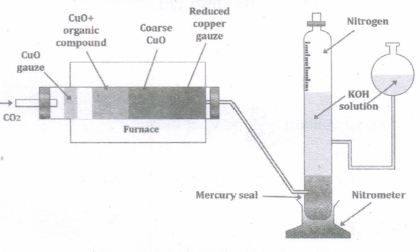
CO2 Generator: CO2 needed in this process is prepared by heating magnetite or sodium bicarbonate contained in a hard glass tube (or) by the action of dil. HCl on marble in a kipps apparatus. The gas is passed through the combustion tube after dried by bubbling through cone. H2SO4.
Combustion tube: The combustion tube is heated in a furnace is charged with
(a) A roll of oxidised copper gauze to prevent the back diffusion of products of combustion and to heat the organic substance mixed with CuO by radiation
(b) a weighed amount of organic substance mixed with excess of CuO
(c) a layer of CuO packed in about 2/3 length of the tube and kept in position by loose asbestos plug on either side and
(d) a reduced copper spiral which reduces any oxides of nitrogen formed during combustion of nitrogen.
Schiff's nitromete: The nitrogen gas obtained by the decomposition of the substance in the combustion tube is mixed with considerable excess of CO2. It is estimated by passing
nitro meter when CO2 is absorbed by KOH and the nitrogen gas gets collected in the upper part of the graduated tube.
Calculation:
Weight of the substance taken = Wg
Volume of nitrogen = V 1L
Room temperature = T 1K
Atmospheric pressure = P mm Hg
Aqueous tension at room temperature = P mm of Hg
\(\therefore\) Pressure of dry nitrogen = P-P' = P1mm Hg
Po'Vo and Tobe the pressure, volume and temperature respectively of dry nitrogen at S.T.P.
Then,\(\cfrac { { P }_{ o }{ V }_{ o } }{ { T }_{ o } } =\cfrac { P_{ 1 }{ V }_{ 1 } }{ { T }_{ 1 } } \)
\(\therefore { V }_{ o }=\cfrac { { P }_{ 1 }{ V }_{ 1 } }{ { T }_{ 1 } } \times \cfrac { { T }_{ o } }{ { P }_{ o } } \)
\({ V }_{ o }=\cfrac { { P }_{ 1 }{ V }_{ 1 } }{ { T }_{ 1 } } \times \cfrac { 273K }{ 760mm\quad Hg } \)
22.4 L of N2 at STP weigh 28 g of N2
\(\therefore\) VoL of N2 at STP weigh \(\cfrac { 28 }{ 22.4 } \times { V }_{ O }\)
W g of organic compound contain \(\cfrac { 28 }{ 22.4 } \times { V }_{ O }\ g\ of\ { N }_{ 2 }\)
\(\therefore\) 100 g of organic contain \(\cfrac { 28 }{ 22.4 } \times \cfrac { { V }_{ o } }{ w } \times 100=\%of\quad nitrogen\)
35.
I step: Preparation of sodium fusion extract: A small piece of Na dried by pressing between the folds of filter paper is taken in"a fusion tube and it is heated. When it melts to a shining globule, a pinch of organic compound is added to it. The tube is then heated till the reaction ceases and becomes red hot. Then the test tube is plunged in about 50 ml of distilled water taken in a china dish and break the bottom of the tube by striking against the dish. The contents of the dish is boiled for about 10 minutes and then filtered. This filtrate is known as lassaigne's extract (or) sodium fusion extract.
II step: Test for Nitrogen: If Nitrogen is present, it gets converted to sodium cyanide which reacts with freshly prepared ferrous sulphate and ferric ion followed by cone. HCI and gives a Prussian blue colour (or) green coloured precipitate. It confirms the presence of nitrogen. HCI is added to dissolve the greenish precipitate of ferrous hydroxide produced by the action of NaOH on FeSO4 which would otherwise mark the Prussian blue precipitate. Reactions involved.
\(Na+C+N\longrightarrow NaCN\)
\({ FeSO }_{ 4 }+2NaOH\longrightarrow Fe\left( OH \right) _{ 2 }+{ Na }_{ 2 }{ SO }_{ 4 }\)
\(\underset { Sodiumferrocyanide }{ 6NaCN+Fe\left( OH \right) _{ 2 }\longrightarrow { Na }_{ 4 }\left[ Fe\left( CN \right) _{ 6 } \right] +2NaOH } \)
\(\underset { Ferric\quad ferro\quad cyanide\\ (Prussianblue) }{ 3{ Na }_{ 4 }\left[ Fe\left( CN \right) _{ 6 } \right] \longrightarrow { Fe }_{ 4 }\left[ Fe\left( CN \right) _{ 6 } \right] +12Nacl } \)
If both N & S are present, a blood red colour is obtained due to the following reactions.
\(Na+C+N+S\overset { \Delta }{ \longrightarrow } \underset { Sodium\quad sulphocyanide }{ NACNS } \)
\(3NaCNS+FeCl_{ 3 }\longrightarrow Fe\left( CNS \right) _{ 3 }+3Nacl\)
\(3NaCNS+FeCl_{ 3 }\longrightarrow \underset { Ferric\quad sulphocyanide\\ (Blood\quad red\quad colour)\qquad }{ Fe\left( CNS \right) _{ 3 }+3Nacl } \)
36.
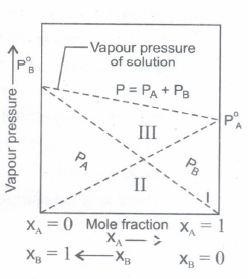
Ideal solutions: The solutions which obey Raoult's law over the entire range of concentration are known as ideal solutions. Ideal solutions are formed by mixing the two components which are identical in molecular size, in structure and have almost identical intermolecular forces.
Examples:
(i) Benzene and toluene
(ii) n-Hexane and n-Heptane
(iii) Chlorobenzene and bromobenzene.
Characteristics:
(i) They must obey Raoult's law.
(ii) ΔH mixing should be zero.
(iii)ΔV mixing should be zero, i.e. volume change on mixing is zero.
Non-ideal solutions : The solutions which do not obey Raoult's law are called non-ideal solutions. In case of non-ideal solutions there is change in volume and heat energy when the two componnts are mixed.
Characterstics :
(i) They does not Rault's law.
(ii)△V = mix ≠ 0
(iii) △H mix ≠ 0
Behaviour of Ideal Solutions: A plot of PI or P2 versus the mole fraction x1 and x2 for an ideal solution gives a linear plot. These Lines (I and II) pass through the points and respectively when x I and x2 is equal to unity. Similarly the plot (Line III) of Ptotal versus x2 is also linear. The minimum value of Ptotal is Ptotal and the maximum value is P20, assuming that component I is less volatile than component 2, i.e. P1 O < P2 O
37.
(i) The measurement of relative lowering of vapour pressure can be used to determine the molar mass of a non-volatile solute.
(ii) A known mass of the solute is dissolved in a known quantity of solvent. The relative lowering of vapour pressure is measured experimentally.
(iii) According to Raoult's law, the relative lowering of vapour pressure is
\(\cfrac { { P }_{ solvent }^{ o }-{ P }_{ solution } }{ { P }_{ solvent }^{ o } } =xB\)
WA = weight of solvent, WB = weight of solute
MA= Molar mass of solvent, MB = molar mass of solute
\(\therefore { x }_{ B }=\cfrac { { n }_{ B } }{ { n }_{ A }+{ n }_{ B } } \)
where nA= number of moles of solvent, nB = number of moles of solute.
For dilute solution, nA>> nB, nA + nB≈nA.
Then ,\({ x }_{ B }=\cfrac { { n }_{ B } }{ { n }_{ A } } \)
Number of moles of solvent and solute are
\({ n }_{ A }=\cfrac { { W }_{ A } }{ { M }_{ A } } .{ n }_{ B }=\cfrac { { W }_{ B } }{ { M }_{ B } } \)
\(\therefore { x }_{ B }=\cfrac { \frac { { W }_{ b } }{ { M }_{ B } } }{ \frac { { W }_{ A } }{ { M }_{ A } } } \)
Thus, relative lowering of vapour pressure = \(\cfrac { \frac { { W }_{ B } }{ { M }_{ B } } }{ \frac { { W }_{ A } }{ { M }_{ A } } } \)
Relative lowering of vapour pressure = \(\cfrac { { P }^{ o }-P }{ { P }^{ o } } \)
\(\cfrac { { P }^{ o }-P }{ { P }^{ o } } =\cfrac { { W }_{ B }-{ M }_{ A } }{ { W }_{ A }\times { M }_{ B } } \)
From the above equation, molar mass of the solute MB can be calculated using the known values of WA'WB' MAand the measured relative lowering of vapour pressure.
38.
| Condition | Stress | Direction in which equilibrium shifts |
| Concentration | Addition of reactants (increase in reactant concentration) | Forward reaction |
| Removal of products (decreas~ jn productconcentration) | Reverse reaction | |
| Addition of products (increase in product concentration) | ||
| Removal of reactants (decrease in reactant concentration) | ||
| Pressure | Increase of pressure (Decrease in volume) | Reaction that favours fewer moles of the gaseous molecules |
| Decrease of pressure (Increase in volume) | Reaction that favours more moles of the gaseous molecules |
|
| Temperature (Alters equilibrium constants | Increase (High T) | Towards endothermic reaction |
| Decrease (Low T) | Towards exothermic reaction | |
| Catalyst (Speeds up the attainment of equilibrium |
Addition of catalyst | No effect |
| Inert gas | Addition of inert gas at constant volume | No effect |
39.
(i) Fisher projection formula:
This is a method of representing three dimensional structures in two dimension. In this method, the chiral atom(s) lies in the plane of paper. The horizontal substituents are pointing towards the observer and the vertical substituents are away from the observer. Fisher projection formula for tartaric acid is given below.
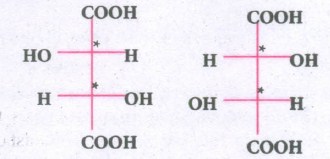
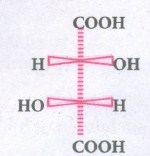
(ii) Sawhorse projection formula :
Here the bond between two carbon atoms is drawn diagonally and slightly elongated. The lower left hand carbon is considered lying towards the front and the upper right hand carbon towards the back. The Fischer projection inadequately portrays the spatial relationship between ligands attached to adjacent atoms. The sawhorse projection attempts to clarify the relative location of the groups.
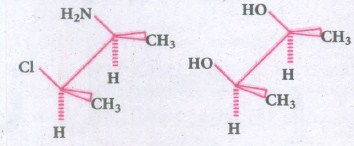
(iii) Newman projection- formula:
In this method the molecules are viewed from the front along the carbon-carbon bond axis. The two carbon atom forming the bond is represented by two circles. One behind the other so that only the front carbon is seen. The front carbon atom is shown by a point where as the carbon lying further from the eye is represented by the origin of the circle. Therefore, the C-H bonds of the front carbon are depicted from the circle while C-H bonds of the back carbon are drawn from the circumference of the circle with an angle of 1200 to each other.
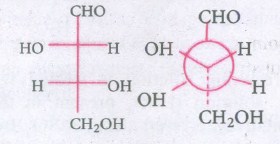
40.
(i) They are covalent compounds of carbon and generally insoluble in water and readily soluble in organic solvent such as benzene, toluene, ether, chloroform, etc ...
(ii) Many of the organic compounds are inflammable (except CCI4).They possess low boiling and melting points due to their covalent nature.
(iii) Organic compounds are characterised by functional groups. A functional group is an atom or a specific combination of bonded atoms that react in a characteristic way, irrespective of the organic molecule in which it is present. In
almost all the cases, the reaction of an organic compound takes place at the functional group. They exhibit isomerism which is a unique phenomenon.
(iv) Homologous series: A series of organic compounds each containing a characteristic functional group and the successive members differ from each other in molecular formula by a CH2 group is called homologous series.
Alkanes: Methane (CH4) Ethane (C2H6) Propane (C3H8) etc.
41.
| S.No | Concentration Term | Expression | Illustration |
|---|---|---|---|
| (i) | Molarity (m) | \(\frac { Number\quad of\quad moles\quad of\quad solute }{ Volume\quad of\quad solution(in\quad L) } \) | 5.845 g of sodium chloride is dissolved in water and the solution was made up to 500mL using a standard flask. The strength of the solution in molarity is \(\frac { Number\quad of\quad moles\quad of\quad solute }{ Volume\quad of\quad solution(in\quad L) } \) = \(\frac { \left( \frac { 5.845 }{ 58.45 } \right) }{ 0.5 } \) \(\frac { 0.1 }{ 0.5 } \) = 0.2 M |
| (ii) | Formality (F) | \(\frac { Number\quad of\quad formula\quad weight\quad of\quad solute }{ Volume\quad of\quad solution\quad (in\quad L) } \) | 5.85g of sodium chloride is dissolved in water and the solution was made up to 500 mL using a standard flask. The strength of the solution in formality is \(\frac { Number\quad of\quad formula\quad weight\quad of\quad solute }{ Volume\quad of\quad solution\quad (in\quad L) } \) = \(\frac { 5.85 }{ 58.5\times 0.5L } \) = 0.2F |
| (iii) | Mass Percentage (%W/W) | \(\frac { Mass\quad of\quad the\quad solute }{ Mass\quad of\quad solution } \times 100\) | Neomycin, aminoglycoside antibiotic cream contains 300 mg of neomycin sulphate the active ingredient, in 30g of ointment base. The mass percentage of neomycin is = \(\frac { Mass\quad of\quad the\quad solute }{ Mass\quad of\quad solution } \times 100\) = \(\frac { 0.3g }{ 30g } \times 100\) = 1%W/W |
| (iv) | Volume Percentage (%v/v) | \(\frac { Volume\quad of\quad the\quad benzoin(in\quad mL) }{ Volume\quad of\quad solution(in\quad mL) } \times 100\quad \) | 50 mL of tincture of benzoin, an antiseptic solution contains 10 mL of benzoin, The volume percentage of benzoin \(\frac { Volume\quad of\quad the\quad benzoin(in\quad mL) }{ Volume\quad of\quad solution(in\quad mL) } \times 100\quad \)= \(\frac { 10 }{ 50 } \times 100\) = 20% V/v |
| (v) | Mass by volume Percentage (% w/v) | \(\frac { Mass\quad of\quad the\quad solute(in\quad g) }{ Volume\quad of\quad solution\quad (in\quad mL) } \times 100\) | A 60 mL of paracetamol pediatric oral suspension contains 3g of par aceta mol. The mass percentage of paracetamol is = \(\frac { Mass\quad of\quad the\quad solute(in\quad g) }{ Volume\quad of\quad solution\quad (in\quad mL) } \times 100\) = \(\frac { 3 }{ 60 } \times 100\) =5%w/v |
42.
Homologous series: A series of organic compounds each containing a characteric functional group and the successive' members differ from each other in molecular formula by a CH2 group is called homologous series. Eg.
Alkanes : Methane (CH4), Ethane (C2H6), Propane (C3Hg) etc .
Alcohols: Methanol (CH3OH), Ethanol (C2H5OH) Propanol (C3H7OH) etc ..)
Compounds of the homologous series are represented by a general formula Alkanes CnH2n+2' Alkenes CnH2n, Alkynes CnH2n-2 and can be prepared by general methods. They show regular gradation in physical properties but have almost similar chemical property.

11th Standard Syllabus & Materials
11th Standard
TN 11th Tamil பீடு பெற நில் - செய்யுள் - காவடிச்சிந்து Important Questions And Answers Study Material - QB365 Set A
NEW11th Standard
TN 11th Tamil பீடு பெற நில் - உரைநடை - மலை இடப்பெயர்கள் : ஓர் ஆய்வு Important Questions And Answers Study Material - QB365 Set A
NEW11th Standard
TN 11th Tamil மாமழை போற்றுதும் - துணைப்பாடம் - யானை டாக்டர் Important Questions And Answers Study Material - QB365 Set A
NEW11th Standard
TN 11th Tamil மாமழை போற்றுதும் - செய்யுள் - ஐங்குறுநூறு Important Questions And Answers Study Material - QB365 Set A



Tamilnadu Stateboard 11th Standard Subjects

Maths

Commerce

Economics

Biology

Business Maths and Statistics

Accountancy

Computer Science

Physics
Chemistry
Maths
Biology
Economics
Physics
Chemistry

History
Business Maths and Statistics

Computer Science
Accountancy

Computer Applications
History
Computer Technology
Commerce
Computer Applications
Computer Technology

Tamil

English

French
Tamilnadu Stateboard Standards

