
 100% FREE ACCESS
11th Standard Syllabus & Materials
11th Standard
TN 11th Tamil இயற்கை வேளாண்மை,சுற்றுச்சூழல் -செய்யுள் - மனோன்மணீயம் Important Questions And Answers Study Material - QB365 Set A
NEW11th Standard
TN 11th Tamil என்னுயிர் என்பேன் -துணைப்பாடம் - இசைத்தமிழர் இருவர் Important Questions And Answers Study Material - QB365 Set A
NEW11th Standard
TN 11th Tamil மொழி கலை -செய்யுள் - ஒவ்வொரு புல்லையும் Important Questions And Answers Study Material - QB365 Set A
NEW11th Standard
TN 11th Tamil பீடு பெற நில் - இலக்கணம் - பகுபத உறுப்புகள் Important Questions And Answers Study Material - QB365 Set A
NEW11th Standard
TN 11th Tamil பீடு பெற நில் - துணைப்பாடம் - வாடிவாசல் Important Questions And Answers Study Material - QB365 Set A
NEW11th Standard
TN 11th Tamil பீடு பெற நில் - செய்யுள் - குறுந்தொகை Important Questions And Answers Study Material - QB365 Set A

Published on: 06/12/2018
HSC Board Exams are fast approaching and students are getting anxious about how to prepare for their HSC Board Exams. This question paper exclusively designed for the chapter Waves from plus one Physics. The latest sample papers have been designed as per the latest syllabus and examination trends.
Now you can use this model question paper for 11th Physics to practice on your own and score more on your board exams. By practicing with this important model question paper from the chapter Waves from plus one Physics, students can gain more knowledge and confidence to crack the exams. Our aim is to bring out the best scores on board exams. Creative questions were added in this question paper in order to enhance the student's knowledge and get the idea that how to answer strategic questions asked in the board exams.
By practicing repeatedly you will get the idea of answering the questions and this improves the speed of answering. This will save the time and you can complete all the questions without any last our tension. Get more model question papers and practice for the board examination.
It's the right time to grab the model question papers on chapter wise and practice for the board exams. This question paper is designed based on the academic syllabus. It will be more helpful for the Matriculation and state board students to prepare for their exams. The best way to prepare exams is to simply do one thing at a time. Using the model question papers, every student can get an idea about the exam questions in a subject wise and collect more information to score high marks on the board.
Download Tamil Nadu 11th Standard Physics question papers, model tests, one-mark questions, important questions, and public exam papers in PDF format. Free study materials and answer keys for TN State Board students.
Questions + Answers key
Take MCQ Physics Test1.
What is the effect of pressure on velocity of sound in gas?
2.
Consider two organ pipes of same length in which one organ pipe is closed and another organ pipe is open. If the fundamental frequency of closed pipe is 250 Hz. Calculate the fundamental frequency of the open pipe.
3.
Define wavelength.
4.
If a flute sounds a note with 450Hz, what are the frequencies of the second, third, and fourth harmonics of this pitch? If the clarinet sounds with a same note as 450Hz, then what are the frequencies of the lowest three harmonics produced?
5.
An increase in pressure of 100 kPa causes a certain volume of water to decrease by 0.005% of its original volume.
(a) Calculate the bulk modulus of water?
(b) Compute the speed of sound (compressional waves) in water?
6.
Consider a string whose one end is attached to a wall. Then compute the following in both situations given in figure (assume waves crosses the distance in one second)
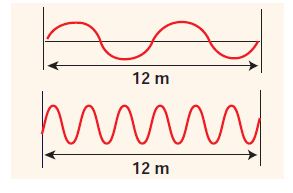
(a) Wavelength
(b) Frequency and
(c) Velocity
7.
Which of the following has longer wavelength?
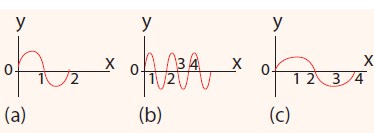
8.
Derive the Equation of a plane progressive wave.
9.
Write the characteristics of wave motion.
10.
Consider the following function
(a) y = x2 + 2 \(\alpha\) t x
(b) y = (x + vt)2
which among the above function can be characterized as a wave?
11.
The ratio of the densities of oxygen and nitrogen is 16:14. Calculate the temperature when the speed of sound in nitrogen gas at 17°C is equal to the speed of sound in oxygen gas.
12.
A particle on the tough of a wave art any instant will come to the mean position after a time (7= time period) ______________.
\(\frac{T}{2}\)
\(\frac{T}{4}\)
T
2T
13.
An observer moves towards a stationary source of sound with a velocity on fifth of the velocity of sound, what is the percentage increase in the apparent frequency?
Zero
0.5%
5%
20%
14.
A wave travelling along the x-axis described by the equation y (x, t) = 0.005 cos (\(\alpha x-\beta t\)) of the wavelength and time period of the wave are 0.08 and 2.0s then and in appropriate units are ____________.
\(\alpha=12.50 \pi;\ \beta=\frac{\pi}{2.0}\)
\(\alpha=25.00\pi;\ \beta=\overline \pi\)
\(\alpha=\frac{0.08}{\pi}\pi;\ \beta=\frac{2.0}{\pi}\)
\(\alpha=\frac{0.04}{\pi}\pi;\ \beta=\frac{4.0}{\pi}\)
15.
During propagation of a plane progressive mechanical wave _____________.
amplitude of all particules is equal
particles of the medium execute S.H.M.
wave velocity depends upon the nature of the medium
all the above
16.
Speed of sound wave in air _____________.
Independent of temp
Increase with pressure
Increase with increase in humidity
Decreases with increase in humidity
17.
An organ pipe A closed at one end is allowed to vibrate in its first harmonic and another pipe B open at both ends is allowed to vibrate in its third harmonic. Both A and B are in resonance with a given tuning fork. The ratio of the length of A and B is
\(\frac{8}{3}\)
\(\frac{3}{8}\)
\(\frac{1}{6}\)
\(\frac{1}{3}\)
18.
Let y = \(\frac{1}{1+x^2}\) at t = 0 s be the amplitude of the wave propagating in the positive x-direction. At t = 2 s, the amplitude of the wave propagating becomes \(y=\frac{1}{1+(x-2)^{2}}. \) Assume that the shape of the wave does not change during propagation. The velocity of the wave is
0.5m s-1
1.0m s-1
1.5m s-1
2.0m s-1
19.
Consider two uniform wires vibrating simultaneously in their fundamental notes. The tensions, densities, lengths and diameter of the two wires are in the ratio 8 : 1, 1 : 2, x : y and 4 : 1 respectively. If the note of the higher pitch has a frequency of 360 Hz and the number of beats produced per second is 10, then the value of x : y is
36 : 35
35 : 36
1 : 1
1 : 2
20.
A sound wave whose frequency is 5000 Hz travels in air and then hits the water surface. The ratio of its wavelengths in water and air is
4.30
0.23
5.30
1.23
21.
Which of the following options is correct?.
| A | B |
| (1) Quality | (A) Intensity |
| (2) Pitch | (B) Waveform |
| (3) Loudness | (C) Frequency |
Options for (1), (2) and (3), respectively are
(B), (C) and (A)
(C), (A) and (B)
(A), (B) and (C)
(B), (A) and (C)
22.
For the travelling : harmonic wave y(x, t) = 2.0 cos 2π [St - 0.0060x + 0.27], where x and yare in cm and t in s.
Calculate the phase difference between oscillatory motion of two points separated by a distance of,
(a) 300 cm
(b) 0.75 m (c)\(\lambda\over 4\)
23.
1.
For a fixed temperature, when the pressure varies, correspondingly density also varies such that the ratio \((\frac{p}{\rho})\) becomes constant. This means that the speed of sound is independent of pressure for a fixed temperature.
2.
For a closed organ Pipe
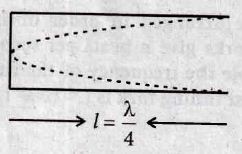
\(\ell=\frac{\lambda}{4}
\)
\(\therefore \lambda=4 \ell\)
For a open organ pipe \(L=\frac{\lambda}{2} \quad \therefore \lambda=2 L\)
Fundamental frequency of a closed pipe
\(f_{c} =250 \mathrm{~Hz}
\)
\(f_{0} =\frac{V}{\lambda}
\)
\(=\frac{V}{2 L}\)
Fundamental frequency of open organ pipe
\(f_{o} =2\left(\frac{V}{4 L}\right)
\)
\(=2 \times f_{c}
\)
\(=2 \times 250=500 \mathrm{~Hz}\)
∴ Frequency of open organ pipe =500 Hz.
3.
For transverse waves, the distance between two neighbouring crests or troughs is known as the wavelength. For longitudinal waves, the distance between two neighbouring compressions or rarefactions is known as the wavelength. The SI unit of wavelength is meter.
4.
For a flute which is an open pipe, we have
Second harmonics f2 = 2 f1 = 900 Hz
Third harmonics f3 = 3 f1 = 1350 Hz
Fourth harmonics f4 = 4 f1 = 1800 Hz
For a clarinet which is a closed pipe, we have
Second harmonics f2 = 3f1 = 1350 Hz
Third harmonics f3 = 5 f1 = 2250 Hz
Fourth harmonics f4 = 7f1 = 3150 Hz
5.
(a) Bulk modulus
\(B =V\left|\frac{\Delta P}{\Delta V}\right|=\frac{100 \times 10^{3}}{0.005 \times 10^{-2}}=
\)
\(=\frac{100 \times 10^{3}}{5 \times 10^{-5}}=2000 \mathrm{MPa}, \text { where }\)
MPa is mega pascal
(b) Speed of sound in water is
\(v=\sqrt { \frac { B }{ \rho } } =\sqrt { \frac { { 200\times 10 }^{ 6 } }{ 1000 } } =1414 \ ms^{-1}\)
6.
| First case | Second case | |
| (a) Wavelength | λ = 6 m | λ = 2 m |
| (b) Frequency | f = 2 Hz | f = 6 Hz |
| (c) Velocity | v = 6 × 2 = 12 m s-1 | v = 2 × 6 = 12 m s-1 |
This means that the speed of the wave along a string is a constant. Higher the frequency, shorter the wavelength and vice versa, and their product is velocity which remains the same.
7.
Answer is (c)
8.
A jerk is given on a stretched string at time t = 0 s. Assume that the wave pulse created during this disturbance moves along positive x direction with constant speed v as shown in Figure (a).
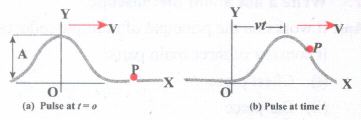
Represent the shape of the wave pulse, mathematically as y = y(x, 0) = j(x) at time t = 0s. Assume that the shape of the wave pulse remains the same during the propagation. After some time t, the pulse moving towards the right and any point on it can be represented by x' (read it as x prime) as shown in Figure (b). Then
y(x, t) =j(x') =j(x - vt)
Similarly, if the wave pulse moves towards left with constant speed v, then y =j(x + vt). Both waves y =j(x + v!) and y =j(x - vt) will satisfy the following one dimensional differential equation known as the wave equation
\({∂^2y\over ∂x^2}={1\over4 v^2}{∂^2y\over ∂t^2}\)
where the symbol p represent partial derivative (read \({∂y\over ∂x}\) as partial y by partial x). Not all the solutions satisfying this differential equation can represent waves, because any physical acceptable wave must take finite values for all values of x and t. But if the function represents a wave then it must satisfy the differential equation. Since, in one dimension (one independent variable), the partial derivative with respect to x is the same as total derivative in coordinate x, we write So it can be written as
\({d^2y\over dx^2}={1\over v^2}{d^2y\over dt^2}\)
9.
(i) For the propagation of the waves, the medium must possess both inertia and elasticity, which decide the velocity of the wave in that medium.
(ii) In a given medium, the velocity of a wave is a constant whereas the constituent particles in that medium move with different velocities at different positions. Velocity is maximum at their mean position and zero at extreme positions.
(iii) Waves undergo reflections, refraction, interference, diffraction and polarization.
10.
Given
Function \(a \rightarrow y=x^{2}+2 \alpha t x\)
Function \(b \rightarrow y=(x+\mathrm{vt})^{2}\)
Formula
For the function to be a wave function
\(\frac{d y / d x}{d y / d t}\) must be a constant.
For function (a)
\(y =x^{2}+2 \alpha t x
\)
\(\frac{d y}{d x} =2 x+2 \alpha t
\) .....(1)
\(\frac{d y}{d t} =0+2 \alpha x=2 \alpha x\) .......(2)
Dividing equation (1) by (2) we get
\(\frac{d y / d x}{d y / d t}=\frac{2 x+2 \alpha t}{2 d x} \text { is not a constant }\)
∴ Function (a) is not describing wave
For function b :
\(\mathrm{y} =(x+\mathrm{vt})^{2}
\)
\(\therefore \frac{d y}{d x} =2(x+\mathrm{vt}) \times 1=2(x+\mathrm{vt})
\) .....(3)
\(\frac{d y}{d t} =2(x+\mathrm{vt}) \times \mathrm{v}
\)
\(=2 \mathrm{v}(x+\mathrm{vt})\) ......(4)
Dividing equation (3) by equation (4) we get
\(\frac{d y / \mathrm{dx}}{d y / \mathrm{dt}}=\frac{2(x+v t)}{2 v(x+v t)}=\frac{1}{v}=\text { constant }\)
Hence function b satisfies the wave equation.
11.
From equation (11.25), we have
\(v=\sqrt { \frac { \gamma P }{ \rho } } \)
But \(\rho =\frac { M }{ V } \)
Therefore,\(v=\sqrt { \frac { \gamma PV }{ M } } \)
Using equation (11.26)
\(v=\sqrt { \frac { \gamma RT }{ M } } \)
Where, R is the universal gas constant and M is the molecular mass of the gas. The speed of sound in nitrogen gas at 17°C is
\({ v }_{ N }=\sqrt { \frac { \gamma R\left( 273K+17K \right) }{ { M }_{ N } } } \)
\(=\sqrt { \frac { \gamma R(290K) }{ { M }_{ N } } } \\ \)............(1)
Similarly, the speed of sound in oxygen gas at temperature t
\({ v }_{ 0 }=\sqrt { \frac { \gamma R\left( 273K+t \right) }{ { M }_{ 0 } } } \) ............ (2)
Given that the value of γ is same for both the gases, the two speeds must be equal. Hence, equating equation (1) and (2), we get
\({ v }_{ 0 }={ v }_{ n }\)
\(\sqrt { \frac { \gamma R\left( 273+t \right) }{ { M }_{ 0 } } } =\sqrt { \frac { \gamma R(290K) }{ { M }_{ N } } } \)
Squaring on both sides and cancelling γ R term and rearranging, we get
\(\frac { { M }_{ 0 } }{ { M }_{ N } } =\frac { 273+t }{ 290 } \) ...............(3)
Since the densities of oxygen and nitrogen is 16:14,
\(\frac { { \rho }_{ 0 } }{ { \rho }_{ N } } =\frac { 16 }{ 14 } \) ...(4)
\(\frac { { \rho }_{ 0 } }{ { \rho }_{ N } } =\frac { \frac { { M }_{ 0 } }{ V } }{ \frac { { M }_{ N } }{ V } } =\frac { { M }_{ 0 } }{ { M }_{ N } } \Rightarrow \frac { { M }_{ 0 } }{ { M }_{ N } } =\frac { 16 }{ 15 } \) ....(5)
Substituting equation (5) in equation (3), we get
\(\frac { 273+t }{ 290 } =\frac { 16 }{ 14 } \Rightarrow 3822+14t=4640\)
\(\Rightarrow \) t = 58.4 °C
12.
(b)
\(\frac{T}{4}\)
13.
(d)
20%
14.
(b)
\(\alpha=25.00\pi;\ \beta=\overline \pi\)
15.
(a)
amplitude of all particules is equal
16.
(c)
Increase with increase in humidity
17.
First harmonic of a closed organ pipe
\(\mathrm{L}_{\mathrm{c}}=\frac{\lambda}{4}\)
Third harmonic of an open organ pipe
\(\mathrm{L}_{\mathrm{o}} =\frac{3 \lambda}{2} \)
\(\frac{L_{c}}{L_{o}} =\frac{\lambda}{4} \times \frac{2}{3 \lambda} \)
\(\frac{L_{c}}{L_{o}} =, \frac{1}{6} \)
18.
Factual information
\(\text { At } \mathrm{t}=0 \text { amplitude } \mathrm{y}=\frac{1}{1+x^{2}}\)
\(\text { At } \mathrm{t}=2 \text { amplitude } \mathrm{y}=\frac{1}{1+(x-2)^{2}}\)
\(\therefore v=\frac{\Delta y}{\Delta t} =\frac{2}{2} =1.0 \mathrm{~ms}^{-1} \)
19.
No. of beats = 10
Frequency of pitch in the first wire
\(f_{1}=360 \mathrm{~Hz}\)
\(\therefore \text { Frequency of pitch in the second wire}\)
\(f_{2} =360-10=350 \mathrm{~Hz} \)
\(\text { Ratio of length }=x: y\)
\(l \propto f\)
\(\therefore \mathrm{x}: \mathrm{y} =\mathrm{f}_{1}: \mathrm{f}_{2} \)
\(=360: 350 =36: 35 \)
20.
Frequency = 5000 Hz
Speed of sound in air = 332 m/s
Speed of sound in water = 1450 m/s
Wavelength of sound in air \(=\frac{332}{5000}\)
\(=66.4 \times 10^{-3}\)
\(\text { Wavelength of sound water } \lambda_{\text {water }}\)
\(=\frac{1450}{5000} =290 \times 10^{-3} \mathrm{~m} \)
\(\therefore \frac{\lambda_{\text {water }}}{\lambda_{\text {air }}} =\frac{290 \times 10^{3}}{66.4 \times 10^{-3}} =4.367 \)
21.
(a)
(B), (C) and (A)
22.
Here,
y = 2.0 cos 2π(8t - 0.0060x + 0.27)
= 2.0 cos [2π (8t - 0.0060x) + 2π(0.27)]
Standard equation for a travelling wave is,
\(y=r\ cos\left[ {2\pi\over \lambda}(vt-x)+\phi\right]\)
Here
\(\phi={2\pi\over \lambda}x=2\pi\times0.006x\)
\({2\pi\over \lambda}=0.006\)
(a) When x = 300 em,
ψ= 2π\(\times\) 0.006\(\times\)300
=3.6π rad.
(b) When x = 0.75 m = 75 em,
ψ = 2π\(\times\)0.006\(\times\)75
= 0.9π rad
(c) When \(x={{\lambda}\over 4}\)
\(\phi={2\pi\over \lambda}\times{\lambda\over4}={\lambda \over 2}rad\)
23.

11th Standard Syllabus & Materials
11th Standard
TN 11th Tamil பீடு பெற நில் - செய்யுள் - காவடிச்சிந்து Important Questions And Answers Study Material - QB365 Set A
NEW11th Standard
TN 11th Tamil பீடு பெற நில் - உரைநடை - மலை இடப்பெயர்கள் : ஓர் ஆய்வு Important Questions And Answers Study Material - QB365 Set A
NEW11th Standard
TN 11th Tamil மாமழை போற்றுதும் - துணைப்பாடம் - யானை டாக்டர் Important Questions And Answers Study Material - QB365 Set A
NEW11th Standard
TN 11th Tamil மாமழை போற்றுதும் - செய்யுள் - ஐங்குறுநூறு Important Questions And Answers Study Material - QB365 Set A



Tamilnadu Stateboard 11th Standard Subjects

Maths

Commerce

Economics

Biology

Business Maths and Statistics

Accountancy

Computer Science
Physics

Chemistry
Maths
Biology
Economics
Physics
Chemistry

History
Business Maths and Statistics

Computer Science
Accountancy

Computer Applications
History
Computer Technology
Commerce
Computer Applications
Computer Technology

Tamil

English

French
Tamilnadu Stateboard Standards

