
11th Standard Syllabus & Materials
11th Standard
Tamilnadu 11th Standard Tamil மொழி கலை -செய்யுள் - ஒவ்வொரு புல்லையும் Important Questions And Answers Study Material - QB365
NEW11th Standard
Tamilnadu 11th Standard Tamil கேடில் விழுச்செல்வம் - உரைநடை - தமிழகக் கல்வி வரலாறு Important Questions And Answers Study Material - QB365
NEW11th Standard
Tamilnadu 11th Standard Tamil பீடு பெற நில் - இலக்கணம் - பகுபத உறுப்புகள் Important Questions And Answers Study Material - QB365
NEW11th Standard
Tamilnadu 11th Standard Tamil பீடு பெற நில் - செய்யுள் - குறுந்தொகை Important Questions And Answers Study Material - QB365 Set B
NEW11th Standard
Tamilnadu 11th Standard Tamil பீடு பெற நில் - செய்யுள் - குறுந்தொகை Important Questions And Answers Study Material - QB365 Set A
NEW11th Standard
Tamilnadu 11th Standard Tamil பீடு பெற நில் - செய்யுள் - காவடிச்சிந்து Important Questions And Answers Study Material - QB365 Set B

Published on: 02/08/2018
From the chapter Composition and Decomposition, some of the important questions are covered in this question paper.The questions are prepared from the book back and the creative questions.
Download Tamil Nadu 11th Standard Computer Science question papers, model tests, one-mark questions, important questions, and public exam papers in PDF format. Free study materials and answer keys for TN State Board students.
Questions + Answers key
Take MCQ Computer Science Test
Part A
Multiple Choice Question
1.
Which of the following is the most widely used notation to represent algorithms?
Flowchart
Pseudo code
English language
all of these
2.
Which notation shows the algorithm in a visual manner?
Flowchart
Pseudo code
Programming language
Natural language
3.
In the flowchart, the control flow of the algorithm represented by ________.
rectangular
diamond shaped boxes
arrows
parallelogram boxes
4.
How many outgoing arrows are labeled in flowchart diamond shaped box?
2
4
1
0
5.
Suppose u, v = 10, 5 before the assignment. What are the values of u and v after the sequence of assignments?
1 u :=v
2 v := u
u, v = 5,5
u, v = 5,10
u, v = 10,5
u, v = 10,10
6.
Which of the following properties is true after the assignment (at line 3)?
1 --i, j = 0, 0
2 i, j := i+1, j-1
3 -- ?
i + j > 0
i+j < 0
i+j=0
i = j
7.
If C1 is false and C2 is true, the compound statement
1 if CI
2 SI
3 else
4 if C2
5 S2
6 else
7 S3
executes
S1
S2
S3
none
8.
9.
If C is true, S1 is executed in both the flowcharts, but S2 is executed in
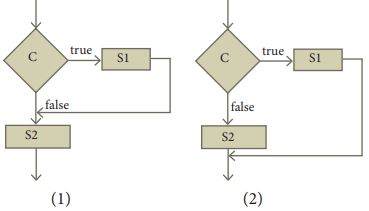
(1) only
(2) only
both (1) and (2)
neither (1) nor (2)
10.
How many times the loop is iterated?
i:= 0
while i \(\neq \)5
i := i+ 1
4
5
6
0
Part B
Answer all the Two Mark Questions
11.
Both conditional statement and iterative statement have a condition and a statement. How do they differ?
12.
What is the difference between an algorithm and a program?
13.
What is a Pseudocode?
14.
What is a Flow-chart?
15.
16.
What is meant by Decomposition?
Part C
Answer all the Three Mark Questions
17.
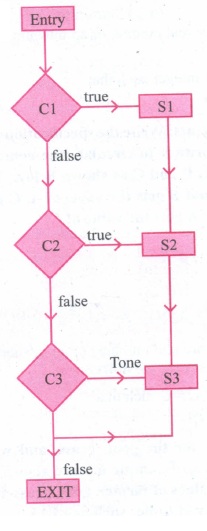
Draw a flowchart for -3 case analysis using alternative statements.
18.
Define a function to double a number in two different ways:
(1) n + n,
(2) 2 x n.
19.
What are the notations used for expressing algorithms?
20.
Define Decomposition in defining algorithm.
21.
Write a note on Pseudo code.
22.
What are the disadvantage of using flowchart?
Part D
Answer all the Five Mark Questions
23.
Explain case analysis in detail with an example.
24.
Write the disadvantages of flowcharts.
Part A
Multiple Choice Question
1.
(b)
Pseudo code
2.
(a)
Flowchart
3.
(c)
arrows
4.
(a)
2
5.
(a)
u, v = 5,5
6.
(c)
i+j=0
7.
(b)
S2
8.
(a)
9.
(a)
(1) only
10.
(b)
5
Part B
Answer all the Two Mark Questions
11.
| Conditional Statement | Iterative Statement |
| Statements are executed only once when the condition is true. | Iterative statement repeatedly evaluates a condition and executes a statement until it becomes false. |
| If condition statement. | While condition statement. |
12.
| Algorithm | Program |
| Algorithm is for human readers to understand. | Program is for the computers to execute directly. |
| Knowledge of English is needed. | Knowledge of programming language is required. |
| Easy to understand. | It is difficult to understand. |
13.
Pseudo code is a notation similar to programming languages.
14.
It is a diagrammatic representation of algorithms.
15.
16.
It is nothing but breaking down problem into smaller and more manageable problems.
Part C
Answer all the Three Mark Questions
17.
18.
(1) double (n)
--inputs: n is a real number or an integer, n > 0
--outputs: y is a real number or an integer such that y= n x h.
(2) double (n)
--inputs: n is a real number or an integer, n > 0
--outputs: y is a real number or an integer such that y = 2 x n.
19.
Programming language, pseudo code, flowchart are notations for expressing algorithms.
20.
Decomposition breaks down a problem into smaller subproblems and combines their solutions to solve the original problem.
21.
(i) Pseudo code is a mix of programming-language like constructs and plain English. This notation is not formal nor exact. It uses the same building blocks as programs, such as variables and control flow.
(ii) But it allows the use of natural English for statements and conditions. An algorithm expressed as pseudo code is not for computers to execute directly, but for 'human readers to understand.
(iii) Therefore, there is no need to follow the rules of the grammar of a programming language. However, even pseudo-code must be rigorous and correct. Pseudo code is the most widely used notation to represent algorithms
22.
Flowcharts have disadvantages:
(i) Flowcharts are less compact than a representation of algorithms in 132 programming language or pseudo code.
(ii) They obscure the basic hierarchical structure of the algorithms.
(iii) Alternative statements and loops are disciplined control flow structures. Flowcharts do not restrict us to disciplined control flow structures
Part D
Answer all the Five Mark Questions
23.
Alternative statement analyses the problem into two cases. Case analysis statement generalizes it to multiple cases. Case analysis splits the problem into an exhaustive set of disjoint cases. For each case, the problem is solved independently. If C1, C2, and C3 are conditions, and S1, S2, S3 and S4 are statements, a 4-case analysis statement has the form,
1. case C1
2. S1
3. case C2
4. S2
5. case C3
6. S3
7. else
8. S4
The conditions C1, C2, and C3 are evaluated in turn. For the first condition that evaluates to true, the corresponding statement is executed, and the case analysis statement ends. If none of the conditions evaluates to true, then the default case S4 is executed.
(i) The cases are exhaustive: at least one of the cases is true. If all conditions are false, the default case is true.
(ii) The cases are disjoint: only one of the cases is true. Though it is possible for more than one condition to be true, the case analysis always executes only one case, the first one that is true. If the three conditions are disjoint, then the four cases are (1) C1, (2) C2, (3) C3, (4) (not C1) and (not C2) and (not C3).
24.
Disadvantages of flowcharts:
1. Flowcharts are less compact than representation of algorithms in programming language or pseudo code.
2. They obscure the basic hierarchical structure of the algorithms.
3: Alternative statements and loops are disciplined control flow structures.

11th Standard Syllabus & Materials
11th Standard
Tamilnadu 11th Standard Tamil பீடு பெற நில் - செய்யுள் - காவடிச்சிந்து Important Questions And Answers Study Material - QB365 Set A
NEW11th Standard
Tamilnadu 11th Standard Tamil பீடு பெற நில் - உரைநடை - மலை இடப்பெயர்கள் : ஓர் ஆய்வு Important Questions And Answers Study Material - QB365 Set B
NEW11th Standard
Tamilnadu 11th Standard Tamil பீடு பெற நில் - உரைநடை - மலை இடப்பெயர்கள் : ஓர் ஆய்வு Important Questions And Answers Study Material - QB365 Set A
NEW11th Standard
Tamilnadu 11th Standard Tamil மாமழை போற்றுதும் - செய்யுள் - ஐங்குறுநூறு Important Questions And Answers Study Material - QB365 Set B



Tamilnadu Stateboard 11th Standard Subjects

Maths

Commerce

Economics

Biology

Business Maths and Statistics

Accountancy
Computer Science

Physics

Chemistry
Maths
Biology
Economics
Physics
Chemistry

History
Business Maths and Statistics

Computer Science
Accountancy

Computer Applications
History
Computer Technology
Commerce
Computer Applications
Computer Technology

Tamil

English

French
Tamilnadu Stateboard Standards
