
 100% FREE ACCESS
9th Standard Syllabus & Materials
9th Standard
TN 9th Tamil உள்ளத்தின் சீர் -கற்கண்டு (இலக்கணம்) - தொடர் இலக்கணம், ஆகுபெயர் Important Questions And Answers Study Material - QB365 Set A
NEW9th Standard
TN 9th Tamil உள்ளத்தின் சீர் -விரிவானம் (துணைப்பாடம்) - தாய்மைக்கு வறட்சி இல்லை! Important Questions And Answers Study Material - QB365 Set A
NEW9th Standard
TN 9th Tamil உள்ளத்தின் சீர் -கவிதை பேழை (செய்யுள்) - மார்கழி பெருவிழா Important Questions And Answers Study Material - QB365 Set A
NEW9th Standard
TN 9th Tamil உயிருக்கு வேர்-இலக்கணம் - பகுபத உறுப்பிலக்கணம் Important Questions And Answers Study Material - QB365 Set A
NEW9th Standard
TN 9th Tamil அமுதென்று பேர் - இலக்கணம்-எழுத்து -அளபெடை Important Questions And Answers Study Material - QB365 Set A
NEW9th Standard
TN 9th Tamil அமுதென்று பேர்-துணைப்பாடம் - ஆறாம்திணை Important Questions And Answers Study Material - QB365 Set A

Published on: 30/07/2018
In this question paper, some of the important one mark, two and five marks questions from the chapter Light are covered. The questions are prepared from the book back and previous year questions.
Download Tamil Nadu 9th Standard Science question papers, model tests, one-mark questions, important questions, and public exam papers in PDF format. Free study materials and answer keys for TN State Board students.
Questions + Answers key
Take MCQ Science Test1.
Write the spherical mirror formula and explain the meaning of each symbol used in it.
2.
What is meant by magnification? Write its expression. What is its sign for the image and virtual image?
3.
State the direction of incident ray which after reflection from a spherical mirror retraces its path. Give reason for your answer.
4.
Pick out the concave and convex mirrors from the following and tabulate them Rear-view mirror, Dentist’s mirror, Torch-light mirror, Mirrors in shopping malls, Make-up mirror.
5.
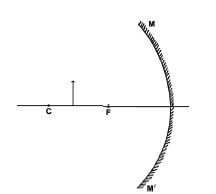
a) Complete the diagram to show how a concave mirror forms the image of the object.
b) What is the nature of the image?
6.
An object 2 cm high is placed at a distance of 16 cm from a concave mirror which produces a real image 3 cm high. Find the position of the image.
7.
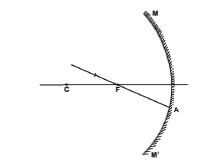
Copy this figure in your answer book and show the direction of the light ray after reflection
8.
If an object is placed at the focus of a concave mirror, where is the image formed?
9.
Name the mirror(s) that can give (i) an erect and enlarged image, (ii) same sized, inverted image
10.
A coin in a glass beaker appears to rise as the beaker is slowly filled with water, why?
11.
Give two examples of transparent medium that are denser than air
12.
The speed of light in air is 3 \(\times\) 108ms-1 and in glass it is 2 \(\times\) 108ms-1 what is the refractive index of glass
13.
The speed of light is maximum in
vacuum
glass
diamond
graphite
14.
The focal length of a concave mirror is 5cm. Its radius of curvature is
5 cm
10 cm
2.5 cm
15.
When the reflecting surface is curved outwards the mirror formed will be
concave mirror
convex mirror
plane mirror
spherical mirror
16.
A ray of light passes from one medium to another medium. Refraction takes place when angle of incidence is
0o
45o
90o
120o
17.
The field of view is maximum for ________
plane mirror
concave mirror
convex mirror
18.
All distances parallel to the principal axis are measured from the ____________ of the mirror
19.
Large _________ mirrors are used to concentrate sunlight to produce heat in solar furnaces
20.
A spherical mirror whose reflecting surface is curved outwards is called ___________ mirror
21.
The angle of deviation of light ray in a prism depends on the angle of _________
22.
The mirror used in search light is ________ .
23.
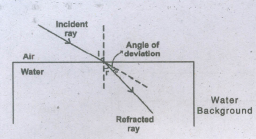
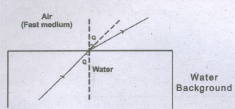
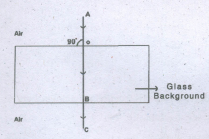
Explain with diagrams how refraction of incident light takes place from
a) rarer to denser medium
b) denser to rarer medium
c) normal to the surface separating the two media.
24.
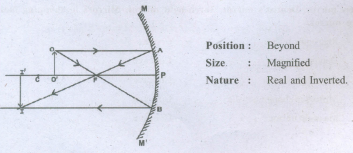
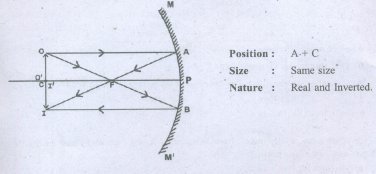
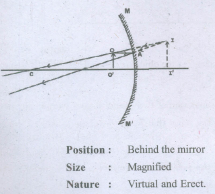
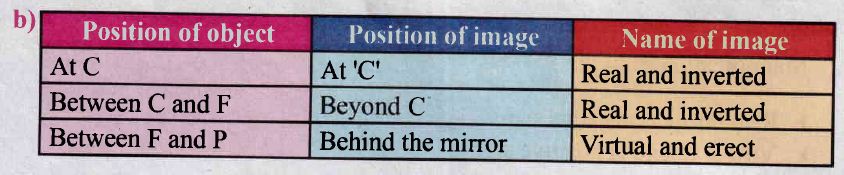
a) Draw ray diagrams to show how the image is formed using a concave mirror, when the position of object is i) at C ii) between C and F iii) between F and P of the mirror.
b) Mention in the diagram the position and nature of image in each case.
1.
The spherical mirror equation is \(\frac { 1 }{ f } =\frac { 1 }{ { u } } +\frac { 1 }{ v } \)
u = distance of object.
v = distance of image.
f = focal length of spherical mirror.
2.
Magnification is defined as the ratio of the height of the image \(\left( { h }_{ i } \right) \) to the height of object \(\left( { h }_{ 0 } \right) \)
Magnification \(=\frac { { h }_{ i } }{ { h }_{ 0 } }\)
1. Real image is negative sign.
2. Virtual image is positive sign
3.
A ray of light going towards the centre of curvature is reflected back along the same path. It is a rule for construction of image formed by spherical mirrors.
4.
| Concave mirror | Convex mirror |
| 1. Dentist's mirror | Rear view mirror |
| 2. Torch light mirror, Make up mirror | Mirrors in shopping malls |
5.
(a)
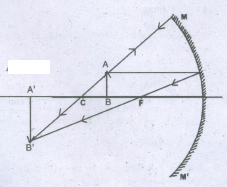
b) Nature of the image is Real, inverted, magnified.
6.
Height of object h1 = 2 cm
Height of real image h2 = -3 cm
Magnification m =\(\frac { { h }_{ 2 } }{ { h }_{ 1 } } \)
= \(\frac { -3 }{ 2 } \)
= -1.5
We know that, m = \(\frac { -v }{ u } \)
here, object distance u = - 16 cm
Substituting the value, we get
-1.5 = - \(\frac { v }{ (-16) } \)
-1.5 = \(\frac { v }{ (-16) } \)
v = 16 \(\times\) -1.5
v = -24 cm
The position of image is 24 cm in front of the mirror (negative sign indicates that the image is on the left side of the mirror).
7.
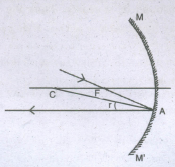
A ray passing through the principal focus of a concave mirror after reflection will emerge parallel to the principal axis.
8.
At infinity.
9.
1. Concave mirror
2. Concave mirror.
10.
Due to refraction.
11.
Water, glass.
12.
\(_{ a }{ { \mu }_{ g } }=\frac { 3\times { 10 }^{ 8 } }{ 2\times { 10 }^{ 8 } } =\frac { 3 }{ 2 } \) = 1.5
13.
(a)
vacuum
14.
(b)
10 cm
15.
(a)
concave mirror
16.
(b)
45o
17.
(c)
convex mirror
18.
()
pole
19.
()
concave
20.
()
convex
21.
()
incidence
22.
()
concave mirror
23.
a) Rarer to denser medium:
When a ray of light travels from optically rarer medium to optically denser medium, it bends towards the normal.
b) Denser medium to rarer medium:
When a ray of light travels from an optically denser medium to an optically rarer medium it bends away from the normal.
c) Normal to the surface separating the two media:
A ray of light incident normally on a denser medium goes without any deviation.
24.
(a) (i) At the centre of Curvature C
(ii) Between C and F
(iii) Between the focus F and the pole P of the mirror.

9th Standard Syllabus & Materials
9th Standard
TN 9th Tamil உள்ளத்தின் சீர் - திருக்குறள் Important Questions And Answers Study Material - QB365 Set A
NEW9th Standard
TN 9th Tamil உள்ளத்தின் சீர் - மணிமேகலை Important Questions And Answers Study Material - QB365 Set A
NEW9th Standard
TN 9th Tamil உள்ளத்தின் சீர் - ஏறு தழுவுதல் Important Questions And Answers Study Material - QB365 Set A
NEW9th Standard
TN 9th Tamil உயிருக்கு வேர் - தண்ணீர் Important Questions And Answers Study Material - QB365 Set A



Tamilnadu Stateboard 9th Standard Subjects
Tamilnadu Stateboard Standards





