
11th Standard Syllabus & Materials
11th Standard
Tamilnadu 11th Standard Tamil மொழி கலை -செய்யுள் - ஒவ்வொரு புல்லையும் Important Questions And Answers Study Material - QB365
NEW11th Standard
Tamilnadu 11th Standard Tamil கேடில் விழுச்செல்வம் - உரைநடை - தமிழகக் கல்வி வரலாறு Important Questions And Answers Study Material - QB365
NEW11th Standard
Tamilnadu 11th Standard Tamil பீடு பெற நில் - இலக்கணம் - பகுபத உறுப்புகள் Important Questions And Answers Study Material - QB365
NEW11th Standard
Tamilnadu 11th Standard Tamil பீடு பெற நில் - செய்யுள் - குறுந்தொகை Important Questions And Answers Study Material - QB365 Set B
NEW11th Standard
Tamilnadu 11th Standard Tamil பீடு பெற நில் - செய்யுள் - குறுந்தொகை Important Questions And Answers Study Material - QB365 Set A
NEW11th Standard
Tamilnadu 11th Standard Tamil பீடு பெற நில் - செய்யுள் - காவடிச்சிந்து Important Questions And Answers Study Material - QB365 Set B

Published on: 01/08/2018
In this question paper, some of the important one mark, two and five marks questions from the chapter Work, Energy and Power are covered. The questions are prepared from the book back and previous year questions.
Download Tamil Nadu 11th Standard Physics question papers, model tests, one-mark questions, important questions, and public exam papers in PDF format. Free study materials and answer keys for TN State Board students.
Questions + Answers key
Take MCQ Physics TestPart A
1.
A body of mass 4 m is lying in xy-plane at rest. It suddenly explodes into three pieces. Two pieces each of mass m move perpendicular to each other with equal speed v. The total kinetic energy generated due to explosion is
mv2
\(\frac{3}{2}\)mv2
2mv2
4mv2
2.
What is the minimum velocity with which a body of mass m must enter a vertical loop of radius R so that it can complete the loop?
\(\sqrt{2gR}\)
\(\sqrt{3gR}\)
\(\sqrt{5gR}\)
\(\sqrt{gR}\)
3.
The work done by the conservative force for a closed path is
always negative
zero
always positive
not defined
4.
A wind-powered generator converts wind energy into electric energy. Assume that the generator converts a fixed fraction of the wind energy intercepted by its blades into electrical energy. For wind speed v, the electrical power output will be proportional to
v
v2
v3
v4
5.
Part D
6.
What is meant by elastic potential energy? Derive an expression for the elastic potential energy of the spring.
7.
Derive an expression for the velocity of the body moving in a vertical circle. And also find a tension at the bottom and the top of the circle.
Part B
8.
Which is conserved in inelastic collision? Total energy (or) Kinetic energy?
9.
The potential energy of a spring when stretched through a distance x is 10J. What is the amount of work done on the same spring to stretch it through on additional distance x?
10.
A man weighing 60 kg climbs up a staircase carrying a load of 20 kg on his head. The stair case has 20 steps each of height 0.2 m. lf he takes 10s to climb, find his power.
11.
When is the exchange of energy maximum during an elastic collision?
12.
Is whole of the kinetic energy lost in any perfectly inelastic collision?
13.
A spark is produced, when two stones are struck against each other. Why?
14.
If energy is neither created nor destroyed, what happens to the so much energy spent against friction?
15.
A man run a distance on the level road. The same man ascends up a hill with the same velocity through the same distance. When does he do more work?
16.
Express a unit of electrical energy in terms of joule.
17.
Two bodies of identical masses with 2nd body at rest collides with 1st body, prove that the velocities of the bodies are reversed.
Part C
18.
Suppose that the earth revolves around the sun in a perfectly circular orbit. Does the sun do any work on the earth?
19.
A body is displaced 10 \(\hat{j}\) under the force of \(-2\hat{j}+15\hat{j}+6\hat{i}\ N.\) Calculate the work done.
20.
In some demonstration, a police officer fires a bullet of mass 50.0g with speed 200 ms-1 on soft plywood of thickness 2.00 cm. The bullet emerges with only 10% of its initial kinetic energy. What is the emergent speed of the bullet?
Part A
1.
Using law of conservation of momentum,
\(2 m v =\sqrt{m^{2} v^{2}+m^{2} v^{2}} \)
\(=\sqrt{2 m^{2} v^{2}} \)
\(v =\frac{\sqrt{2} m v}{2 m}=\frac{v}{\sqrt{2}} \)
Energy released in explosion = \(2 \times \frac{1}{2} m v^{2} +\frac{1}{2} \times 2 m \times\left(\frac{v^{2}}{\sqrt{2}}\right)^{2} \)
\(=m v^{2}+m \times \frac{v^{2}}{2} \)
\(=\frac{3}{2} m v^{2} \)
2.
Radius =R
\(v_{1}^{2}-v_{2}^{2}=4 g R\)
\(\text { Tension } T_{2}=\frac{m v_{2}^{2}}{R_{2}}-m g\)
\(\text {To find minimum speed, let } T_{2}=0\)
\(0 =\frac{m v_{2}^{2}}{R}-m g \)
\(\frac{m v^{2}}{R} =m g \)
\(v_{2}^{2}=R g \ v_{2} =\sqrt{g R} \)
\(\text { sub (2) in the eqn (1) we get }\)
\(v_{1}^{2}-(\sqrt{g R})^{2} =4 g R \)
\(v_{1}^{2}-g R =4 g R \)
\(v_{1}^{2} =4 g R+g R \)
\(=5 g R \)
\(v_{1} =\sqrt{5 g R} \)
3.
(b)
zero
4.
\(\text { Force }=v \frac{d m}{d t}\)
\(=v \frac{d}{d t} \text { (volume } \times \text { density) }\)
\(=v \frac{d}{d t}(A x p) \)
\(=v A p \frac{d x}{d t} \)
\(=v \times A p \times v \)
\(=A p v^{2} \)
Power = Force x Velocity
\(=A p v^{2} \times v=A p v^{3}\)
\(\therefore \text { Power } \alpha v^{3}\)
5.
(c)
Part D
6.
(i) The potential energy possessed by a spring due to a deforming force which stretches or compresses the spring is termed as elastic potential energy. The work done by the applied force against the restoring force of the spring is stored as the elastic potential energy in the spring.
(ii) Consider a spring-mass system. Let us assume a mass, m lying on a smooth horizontal table as shown in Figure. Here, x = 0 is the equilibrium position. One end of the spring is attached to a rigid wall and the other end to the mass.
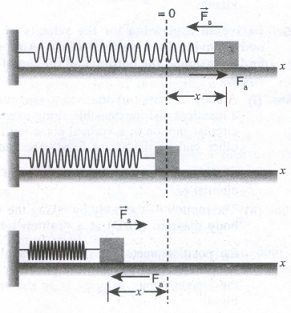
(iii) As long as the spring remains in equilibrium position, its potential energy is zero. Now an external force \(\overrightarrow { { F }_{ a } } \) is applied so that it is stretched by a distance (x) in the direction of the force.
(iv) There is a restoring force called spring force \(\overrightarrow { { F }_{ s } } \) developed in the spring which tries. to bring the mass back to its original position. This applied force and the spring force are equal in magnitude but opposite in direction i.e \(\overrightarrow { { F }_{ a } } \) = - \(\overrightarrow { { F }_{ s } } \) According Hooke's law, the restoring force developed in the spring is
\(\overrightarrow { { F }_{ s } } \) = -k\(\overrightarrow { x } \)
(v) The negative sign in the above expression implies that the spring force is always opposite to that of displacement \(\overrightarrow { x } \) and k is the force constant. There, fore applied force is \(\overrightarrow { { F }_{ a } } \) = +k\(\overrightarrow { x } \) The positive sign implies. that the applied force is in the direction of displacement \(\overrightarrow { x } \). The spring force is an example of variable force as it depends on the displacement \(\overrightarrow { x } \). Let the spring be stretched to a small distance d\(\overrightarrow { x } \). The work done by the applied force on the spring to stretch it by a displacement \(\overrightarrow { x } \) is stored as elastic potential energy.
\(U=\int \overrightarrow { { F }_{ a } } .d\overrightarrow { r } =\overset { x }{ \underset { 0 }{ \int } } \left| \overrightarrow { { F }_{ a } } \right| \left| d\overrightarrow { r } \right| \cos { \theta } \)
\(=\overset { x }{ \underset { 0 }{ \int } } { F }_{ a }dx\cos { \theta } \)
(vi) The applied force \(\overrightarrow { { F }_{ a } } \) and the displacement d\(\overrightarrow { { r } } \) (i.e., here dx ) are in the same direction. As, the initial position is taken as the equilibrium position or mean position, x = 0 is the lower limit of integration.
\(U=\overset { x }{ \underset { 0 }{ \int } } Kxdx\)
\(U={ \left[ \frac { { x }^{ 2 } }{ 2 } \right] }_{ 0 }^{ x }\)
\(U=\frac { 1 }{ 2 } { kx }^{ 2 }\)
(vii) If the initial position is not zero, and if the mass is changed from position xi to xf then the elastic potential energy is
\(U=\frac { 1 }{ 2 } k\left( { x }_{ f }^{ 2 }-{ x }_{ i }^{ 2 } \right) \)
From equations (1) and (2), we observe that the' potential energy of the stretched spring depends on the force constant k and elongation or compression x.
7.
(i) A body of mass (m) attached to one end of a massless and inextensible string executes circular motion in a vertical plane with the other end of the string fixed. The length of the string becomes the radius \(\vec{r}\) of the circular path.
(ii) The motion of the body by taking the free body diagram (FBD) at a position where the position vector \(\vec{r}\) makes an angle e with the vertically downward direction and the instantaneous velocity is as shown in Figure.
There are two forces acting on the mass.
1. Gravitational force which acts downward
2. Tension along the string.
Applying Newton's second law on the mass, In the tangential direction,
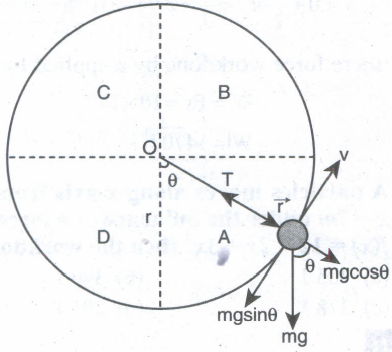
mg sinθ = mat
mg sinθ = -m \((\frac{dv}{dt})\)
where, at = -\((\frac{dv}{dt})\) is tangential retardation
In the radial direction,
T - mg cosθ = m ar
T - mg cosθ = \(\frac{mv^{2}}{r}\)
where, ar = \(\frac{v^{2}}{r}\) is the centripetal acceleration.
Part B
8.
Total energy is always conserved.
But K.E. is not conserved
9.
P.E of the spring when stretched through a distance x,
\(U={1\over2}{kx}^{2}=10J\)
When x becomes lx, the potential energy will be
\(u'={1\over2}k(2x)^2=4\times{1\over2}{kx}^{2}=4\times10=40J\)
\(\therefore\) Workdone = u' - u = 40 - 10 = 30 J
10.
m = 60 + 20 = 80 kg
h = 20\(\times\)0.2 = 4m
g = 9.8 ms-2, t = 10s
\(P={W\over t}={mgh \over t}={80\times 9.8 \times 4 \over 10}={3136 \over 10}=313.6W\)
11.
Energy exchange will be maximum if the two colliding bodies are of equal masses.
12.
No, only that much amount of kinetic energy is lost as is necessary for the conservation of momentum.
13.
The work done in striking the two stones against each other gets converted into heat. This appears as a spark.
14.
The energy is dissipated in the form of heat. The heat energy so produced is not available for work.
15.
Work done is more, while moving up a hill.
16.
1 electrical unit = 1 kWh = 1\(\times\)(103 W)\(\times\)(3600 s)
1 electrical unit = 3600\(\times\)103 W s
1 electrical unit = 3.6\(\times\)106 J
1 kWh = 3.6\(\times\)106 J
17.
When bodies have the same mass i.e., m1 = m2 and second body (usually called target) is at rest (u2 = 0), By substituting m1 = m2 and u2 = 0 in equations
\({ v }_{ 1 }=\left( \frac { { m }_{ 1 }-{ m }_{ 2 } }{ { m }_{ 1 }+{ m }_{ 2 } } \right) { u }_{ 1 }+\left( \frac { { 2m }_{ 2 } }{ { m }_{ 1 }+{ m }_{ 2 } } \right) { u }_{ 2 }\)...(1)
and equations \({ v }_{ 2 }=\left( \frac { { 2m }_{ 1 } }{ { m }_{ 1 }+{ m }_{ 2 } } \right) { u }_{ 1 }+\left( \frac { { m }_{ 2 }-{ m }_{ 1 } }{ { m }_{ 1 }+{ m }_{ 2 } } \right) { u }_{ 2 }\) , we get...(2)
from equations (1) => v1 = 0
from equations (2) => v2 = u1
Part C
18.
When the earth revolves around the sun in a perfectly circular orbit the force of the sun on the earth is along the radius while displacement of the earth is along the tangent to the orbit. Now in a circle, radius and tangent are always orthogonal i.e., angle between them at any point on the orbit is 90° and so, work done by the sun on the earth is zero.
19.
\(w=\bar{F}.\bar{a}\)
\(=(-2\hat{i}+15\hat{j}+6\hat{k})-10\hat{j}\)
= 0 + 15\(\times\)10 + 0
= 150 Joule
20.
Initial kinetic energy,
\(k_1={1\over2}\times{50\over 1000}\times200\times 300\ J\)
= 1000 J
Final kinetic energy, \({k}_{f}={10\over100}\times1000\ J=100\ J\)
If vf is emergent speed of the bullet, then
\({1\over2}\times{50\over1000}\times{v}_{f}^{2}=100\)
or \({v}_{f}^{2}=4000\) (or) vf = 63.2 ms-1

11th Standard Syllabus & Materials
11th Standard
Tamilnadu 11th Standard Tamil பீடு பெற நில் - செய்யுள் - காவடிச்சிந்து Important Questions And Answers Study Material - QB365 Set A
NEW11th Standard
Tamilnadu 11th Standard Tamil பீடு பெற நில் - உரைநடை - மலை இடப்பெயர்கள் : ஓர் ஆய்வு Important Questions And Answers Study Material - QB365 Set B
NEW11th Standard
Tamilnadu 11th Standard Tamil பீடு பெற நில் - உரைநடை - மலை இடப்பெயர்கள் : ஓர் ஆய்வு Important Questions And Answers Study Material - QB365 Set A
NEW11th Standard
Tamilnadu 11th Standard Tamil மாமழை போற்றுதும் - செய்யுள் - ஐங்குறுநூறு Important Questions And Answers Study Material - QB365 Set B



Tamilnadu Stateboard 11th Standard Subjects

Maths

Commerce

Economics

Biology

Business Maths and Statistics

Accountancy

Computer Science
Physics

Chemistry
Maths
Biology
Economics
Physics
Chemistry

History
Business Maths and Statistics

Computer Science
Accountancy

Computer Applications
History
Computer Technology
Commerce
Computer Applications
Computer Technology

Tamil

English

French
Tamilnadu Stateboard Standards

